 by Tom Gurney
Tom Gurney BSc (Hons) is an art history expert with over 20 years experience
Published on June 19, 2020 / Updated on August 21, 2026
Email: tomgurney1@gmail.com / Phone: +44 7429 011000
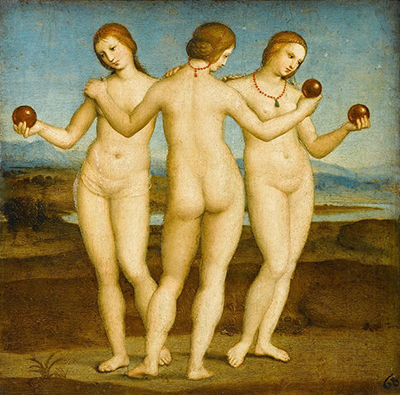
Raphael's Three Graces is a painting of balance achieved through revision. Three nude women stand close together in a shallow landscape. The central figure turns her back to the viewer while the others face outward. Arms pass behind shoulders, bodies alternate front and back, and each woman holds a golden sphere or fruit.[1][2]
Technical examination has revealed that Raphael did not begin with this equal distribution. At first only the woman on the left held a golden fruit. The centre figure rested her hands differently, and the woman on the right concealed her body in a gesture associated with the modest Venus. Raphael changed all three relationships before completing the image.[1][3]
Those discoveries complicate the familiar title. The first state may have evoked the three goddesses awaiting the Judgment of Paris; the finished state can suggest the Hesperides and their immortality-giving fruit. The traditional Three Graces—often associated with beauty, love and chastity—remain another compelling level. This tiny panel contains not one fixed myth but a carefully harmonised field of ancient meanings.
At a Glance
- ArtistRaphael
- TitleThe Three Graces
- Dateabout 1504–05
- Medium/supportoil on poplar panel
- Dimensions17 × 17 cm
- Compositionthree linked nude women, centre seen from behind
- Attributesthree golden spheres or fruits in the finished state
- Technical discoveryonly the left woman originally held a fruit
- Likely visual stimulusan ancient marble group of the Three Graces
- Proposed companionThe Dream of a Knight, National Gallery, London
- Present collectionMusée Condé, Château de Chantilly
- InventoryPE 38
- Location within Chantillythe Santuario
Contents
- Three bodies, one group
- The central figure
- Annotated Details
- The two outer women
- Three golden fruits
- The first conception
- From one fruit to three
- Why call them the Three Graces?
- Giving, receiving and returning
- An ancient marble stimulus
- Painting around sculpture
Three bodies, one group
The figures form a compact chain. The outer women turn toward the viewer, while the centre woman faces the landscape with her back exposed.
That alternation derives from an ancient formula for representing the Graces as an inseparable trio. One body seen from behind allows the group to display different aspects without sending the figures in separate directions.[1]
Raphael gives each woman an individual head, hairstyle and relation to the others. Their similarities produce unity; their slight differences prevent mechanical repetition.
The grouping is intimate but not crowded. Arms and hands pass across narrow intervals, creating a rhythm of connection around the bodies.
At only seventeen centimetres square, the panel asks the viewer to approach closely. Monumentality comes from compositional completeness rather than physical size.
The central figure
The centre woman is the pivot. Her back establishes the composition's vertical axis, while her head turns enough to remain part of the shared exchange.
By facing away, she joins the two outer women more securely. Her arms extend to either side, and their bodies answer her at the edges.
The pose also makes viewing mobile. The spectator mentally circles a group that painting presents on a flat surface.
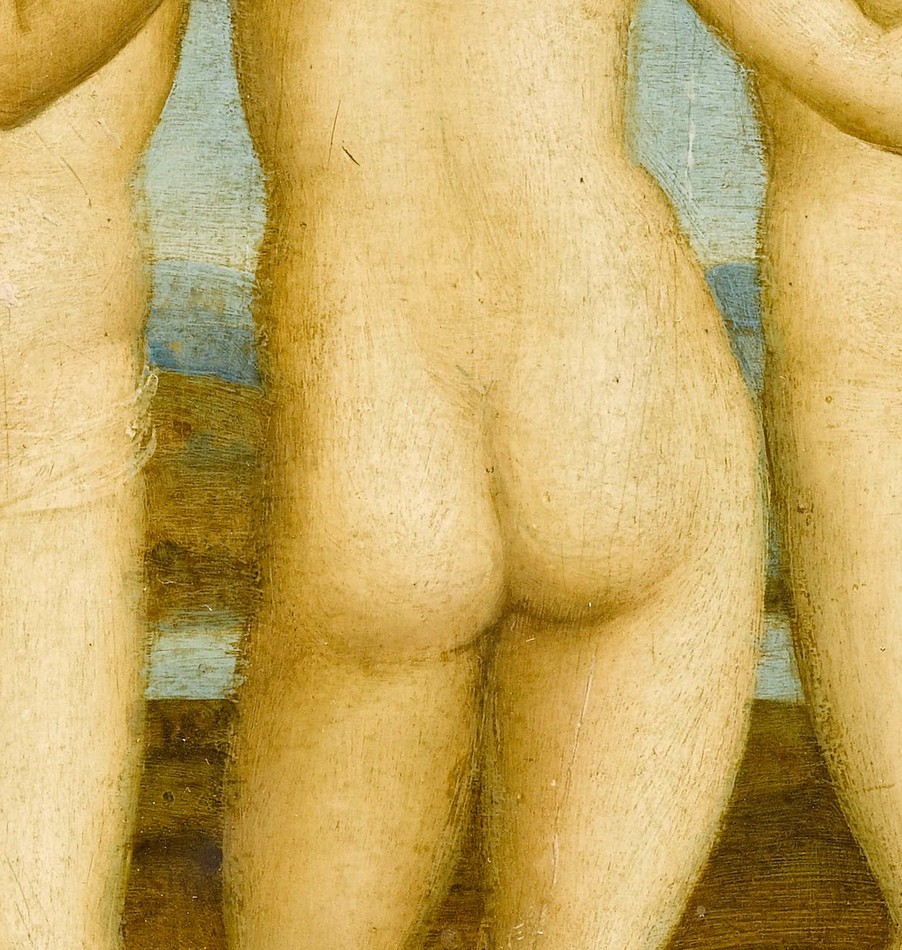
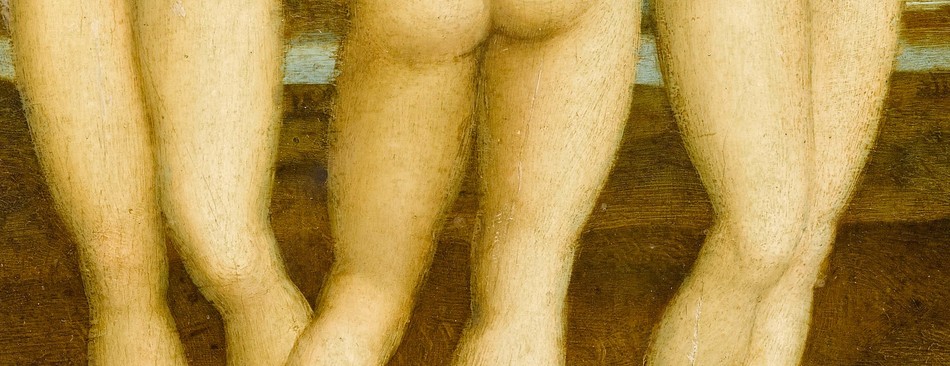
Her exposed back carries much of the panel's tonal modelling. Light moves across shoulders, spine and hips, allowing Raphael to turn a small nude into a study of continuous form.
The figure's revised arms are especially important. Technical images show that her hands originally rested more directly on her companions' shoulders.[3] The final arrangement regularises the exchange of gesture and fruit.
Annotated Details from Three Graces
The annotated view keeps the whole work in sight while isolating visible details that reward close looking. The source image is a public-domain Wikimedia Commons reproduction used only for this local close-reading feature.
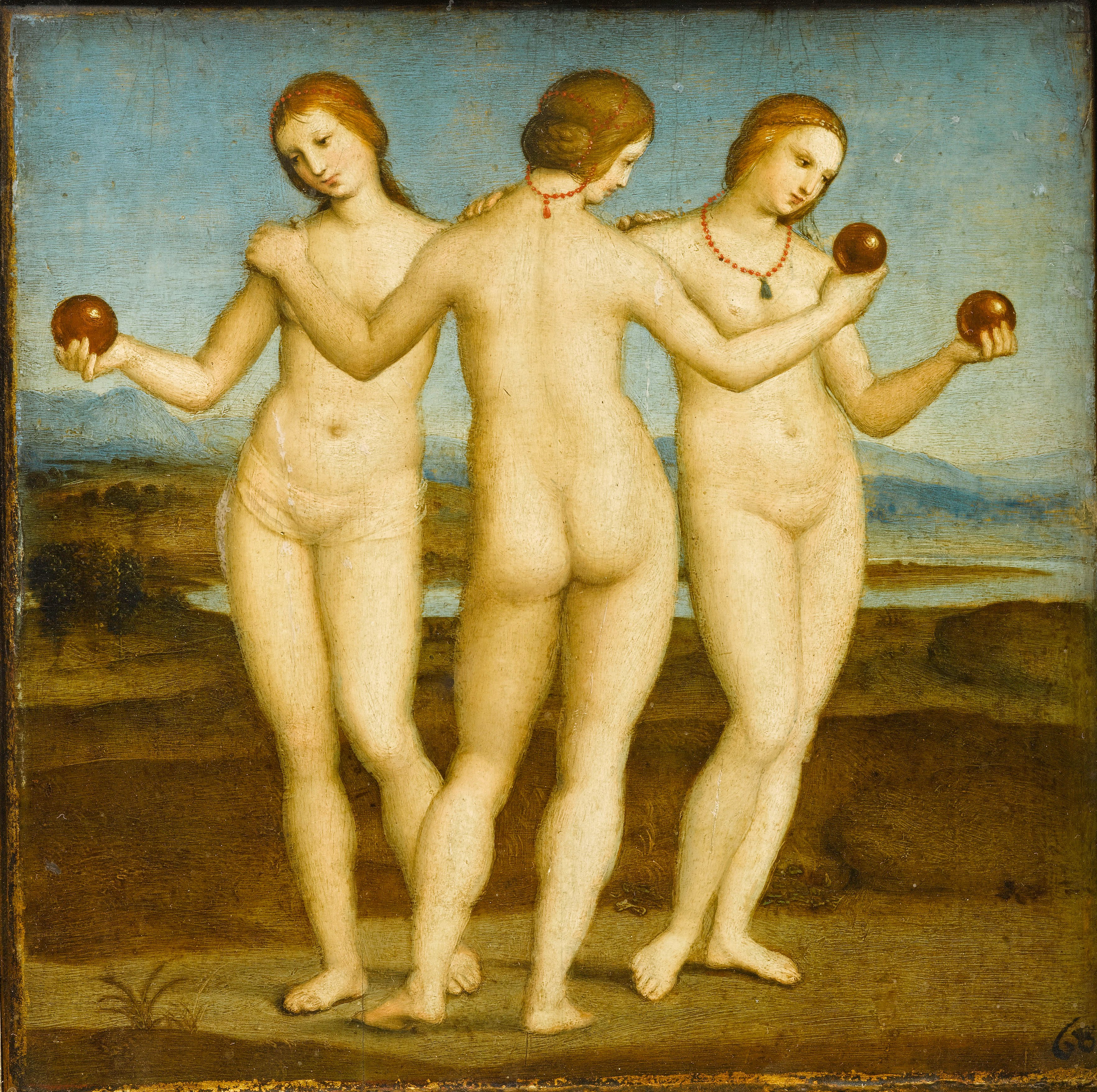
Details from THREE GRACES
Close looking highlights visible details in the work while keeping source and image posture controlled.
Linked shoulders
The joined shoulders make the three figures read as one turning chain.
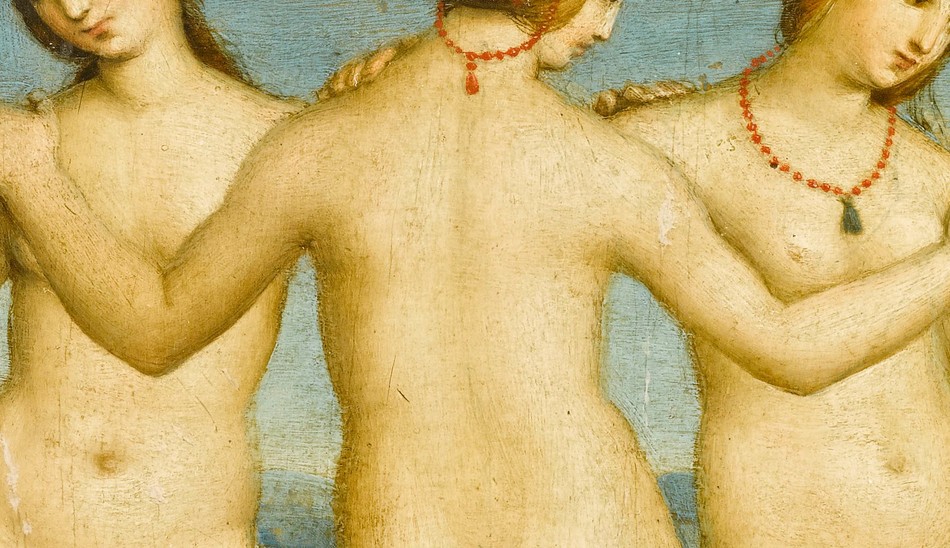
Central back
The central figure's back supplies the small panel's strongest sculptural passage.
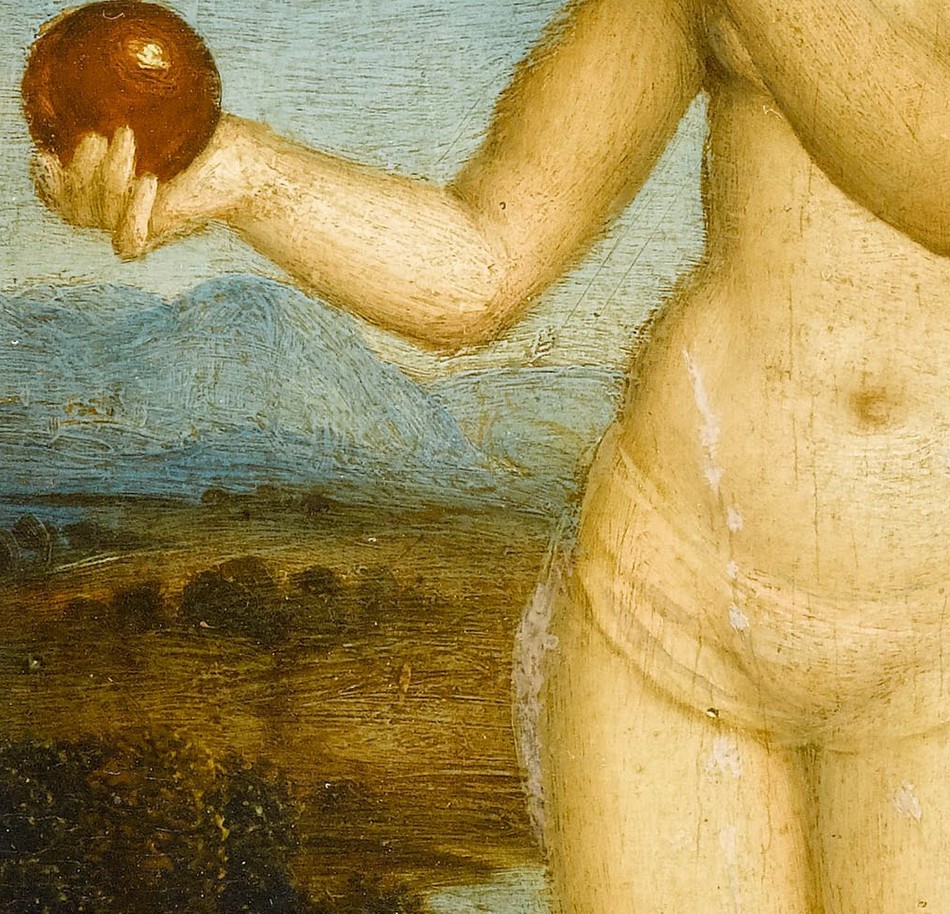
Left apple
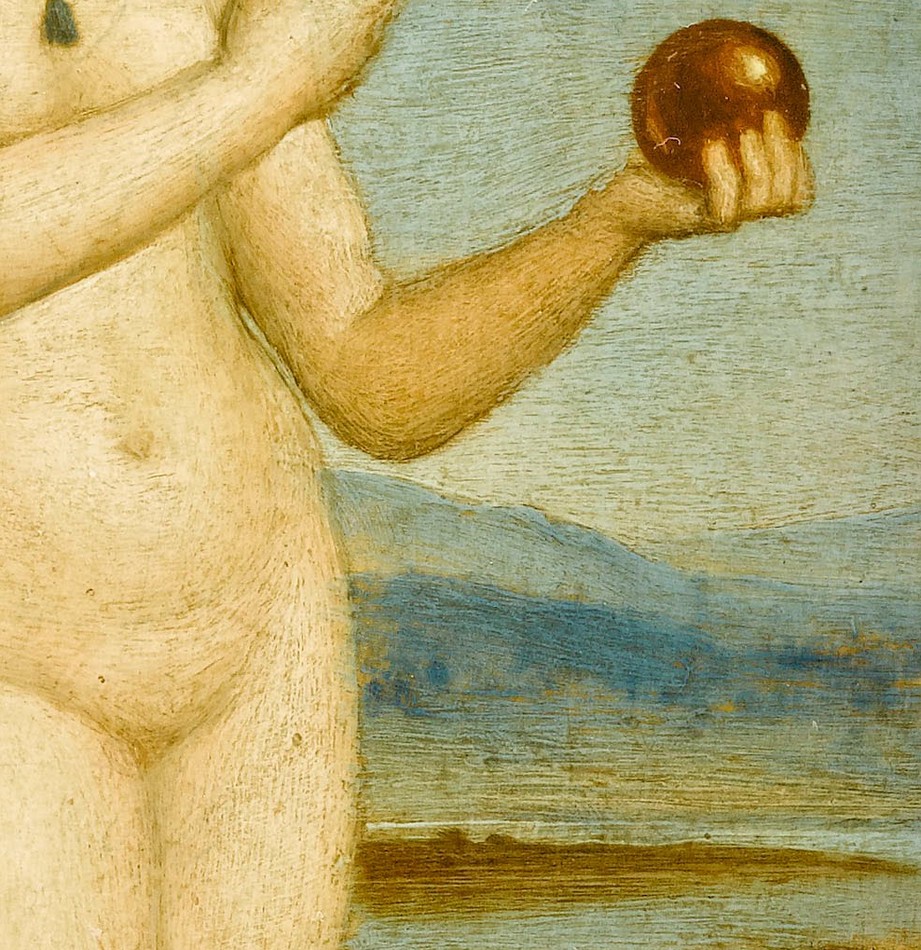
The left-hand apple is tiny but crucial, linking the bodies to mythic choice and reward.
Right apple
The matching apple on the right completes the balanced exchange of gesture and attribute.
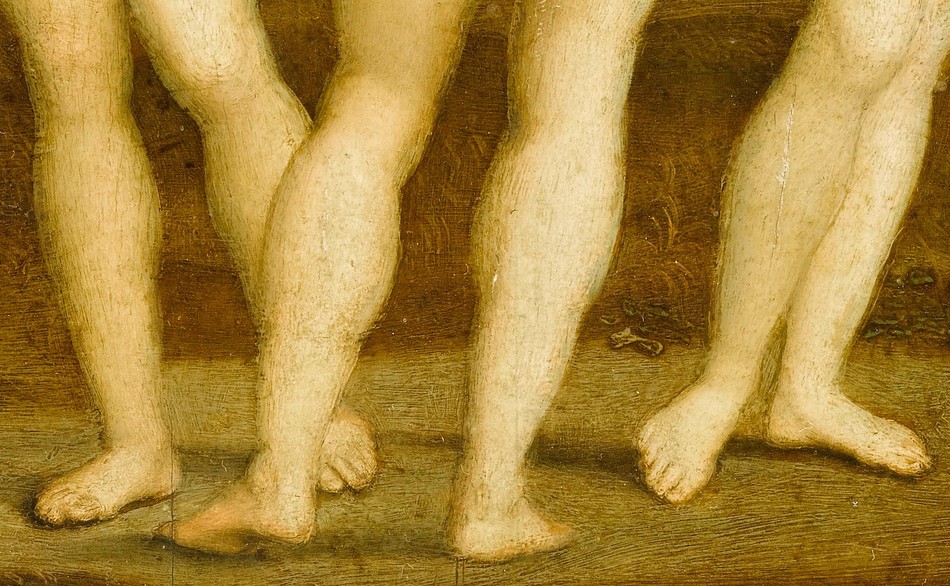
Feet and stance
The feet reveal the delicate adjustments needed to make three bodies stand as one group.
Open landscape
The low landscape gives air to the compact figures without distracting from their linked movement.
The two outer women
The left and right figures face the viewer more directly, but they are not mirror images.
Their weight falls differently, their heads incline in separate directions and their free arms respond to the golden objects.
Jewellery and hair ornaments give them courtly refinement. The French national record notes coral among the visible details, adding colour and material specificity to the nude group.[2]
The left woman belonged most clearly to the first conception because she alone initially held a fruit.[1][3]
The right woman underwent the most revealing change. Beneath the finished paint, she once concealed herself with a modest gesture associated with ancient images of Venus.[3]
Three golden fruits
Each finished figure holds a rounded golden object. Their repetition creates a simple visual beat across the panel.
They are often called apples, but “golden fruit” or “sphere” preserves the range of possible meanings. The objects could recall the apple that Paris awarded to the most beautiful goddess, or the golden apples guarded in the garden of the Hesperides.[1]
Their colour also supplies a concentrated luxury against skin and subdued landscape. Tiny points of gold-like brightness organise the hands.
Because only one fruit existed at first, the final equality was a deliberate decision rather than a given part of the subject.[1][3]
Raphael moved from an asymmetrical narrative attribute toward a triad in which each woman receives the same emblem.
The first conception
Radiography and infrared reflectography allow researchers to see parts of the design hidden beneath the final surface.[1][3]
In the earlier arrangement, the left figure held the sole golden fruit. The middle figure placed both hands on the shoulders of her companions. The right adopted a more modest, self-concealing pose.[3]
That configuration distinguishes one woman from the others and makes the group easier to read as three goddesses before the Judgment of Paris.
Hera, Athena and Aphrodite competed for a single golden apple inscribed for the fairest. Paris's decision in favour of Aphrodite set in motion the chain leading to the Trojan War.
Raphael may not have illustrated the judgement itself. The absent Paris and solitary fruit could still summon the moment before choice.
From one fruit to three
The revisions changed narrative emphasis. Three equivalent fruits no longer point naturally toward one prize contested by three goddesses.
Chantilly proposes that the women can consequently be understood as Hesperides, whose golden apples confer immortality.[1]
The multiplication also makes the image more balanced. Each hand now participates in a repeated relation, and no figure possesses the sole centre of meaning.
Raphael's changes may have responded to a companion image, a patron's wishes or his own pursuit of harmony. No document selects among these explanations.
What can be said securely is that technical evidence reveals thought in motion. The finished simplicity emerged from substantial reconsideration.
Why call them the Three Graces?
The ancient Charites, or Graces, personified qualities such as charm, beauty, generosity and social delight. Renaissance authors and artists adapted their meanings freely.
The linked nude trio had become the most recognisable visual formula for them. Raphael's front-back-front arrangement invites that identification even when the fruits introduce other mythological associations.
The National Gallery connects the women with chastity, beauty and love when discussing their relationship to the Dream of a Knight.[4]
These names need not function as labels attached rigidly from left to right. The group can embody a circulating harmony rather than three isolated definitions.
The title Three Graces therefore describes visual type and moral resonance, while the hidden first state keeps Judgment and Hesperides readings active.
Giving, receiving and returning
Ancient and Renaissance interpretations of the Graces often emphasised reciprocal generosity: giving, receiving and returning a benefit.
Raphael's linked bodies suit that idea. No woman stands alone, and each golden object is held within a chain of touch.
The centre figure's reversed orientation can suggest circulation. What begins at one edge passes through the middle and returns at the other.
Whether or not a patron requested that exact philosophical meaning, the composition makes mutuality visible.
The panel's harmony thus depends on relation, not sameness. Each body has a distinct view, but all participate in a single graceful exchange.
An ancient marble stimulus
Chantilly states that the painting was inspired by an antique marble group.[1]
A celebrated ancient Three Graces was displayed in Siena and later incorporated into the Piccolomini Library of the cathedral. Its front-back-front arrangement offered a close sculptural precedent for painters.[5]
Raphael had ties to Siena during Pinturicchio's work on that library, making knowledge of the object plausible.
The panel should not be described as a flat copy of one statue. Raphael translates bodies from marble into colour, landscape and intimate oil technique.
He also adds the repeated fruit and adjusts gestures during painting. Antique authority becomes the beginning of invention, not its limit.
Painting around sculpture
Sculpture can be walked around; a painted panel cannot. Raphael answers the problem by showing three orientations at once.
The outer women reveal frontal anatomy, while the middle supplies the back view that a spectator might encounter by circling a statue.
Light separates the bodies gently. Contours meet and divide without hard outlining, creating the sense of rounded form on a flat support.
Colour provides what ancient marble had lost or never possessed for Renaissance viewers: warm flesh, ornaments, gold fruit, vegetation and atmospheric distance.
The result honours antique form while claiming painting's own resources.
The shallow landscape
The women stand outdoors before low vegetation, water and distant ground.[2]
Landscape prevents the group from becoming an archaeological specimen. The figures inhabit an ideal natural world appropriate to fertility, beauty and immortal fruit.
The horizon is low enough to keep their bodies dominant. Small transitions in blue and green supply depth without distracting incident.
The central woman's outward orientation also connects the group to the distance. She looks into the world that the outer figures partly shield from view.
At this scale, every opening between arms and torsos becomes a window into landscape. Figure and setting are interlaced as carefully as the bodies themselves.
Jewellery, hair and coral
The women are nude but not stripped of culture. Arranged hair, small ornaments and coral-like details give them refinement.[2]
Such touches distinguish ideal nudity from ordinary undress. These are mythological beings presented through the visual language of a courtly object.
Coral carried associations with rarity, protection and the sea. Its warm red also sharpens the restrained colour scheme.
The jewellery asks for close attention, reinforcing the panel's status as a precious possession.
Raphael balances sensual visibility with formal composure. The bodies are exposed, yet their gestures and adornment make the group ceremonial rather than casual.
A probable relationship with the Dream of a Knight
The Three Graces and the National Gallery's Dream of a Knight are almost exactly the same size and share early style and Borghese provenance.[2][4]
Those facts make an original relationship highly probable. The sleeper's sword, book and flowers can represent courage, learning and love; the women can embody chastity, beauty and love.[4]
The combined programme may have addressed ideal qualities expected within courtship or marriage.
No commission document identifies a wedding couple, and the paintings were not necessarily hung beside one another.
The best account therefore keeps both conviction and restraint: they were probably conceived as companions, while occasion and physical arrangement remain unresolved.
A possible marriage gift
Small mythological panels could serve as learned private objects within elite exchanges.
A marriage setting would explain the pairing of traditionally masculine knightly qualities with feminine virtues and the repeated importance of love.[4]
Golden fruit could also suggest fertility, beauty and continuity. The Graces' mutual touch would suit ideals of concord.
But the proposal depends on iconographic fit rather than surviving household papers. No bride, groom or date can be named securely.
Treating marriage as a possibility preserves the painting's social intelligence without turning an attractive interpretation into biography.
How the pair might have been kept
The National Gallery cautions that the two panels may not have been designed for side-by-side display.[4]
Different figure scales make a conventional open diptych less straightforward, despite the identical outer measurements.
One could have formed a cover for the other. They might have been framed back to back or stored together in a bag or drawer.[4]
Any of these arrangements would make viewing an intimate act of handling, turning and comparison.
The missing original frame prevents certainty. The panels' later separation makes their precise early use still harder to reconstruct.
Raphael before Florence and Rome
The date about 1504–05 places the work near Raphael's transition from Umbrian beginnings toward Florence.[1][2]
Its fine scale and controlled contours retain the elegance of the culture in which he trained. The nude bodies and antique source point toward a widening classical ambition.
Raphael is already doing more than imitating a master. Hidden revisions show him testing how narrative, emblem and symmetry should relate.
The panel is one of his rare early secular works and one of the smallest pictures at Chantilly.[1]
Its importance lies precisely in that concentration: an artist at the start of his career converts ancient sculpture and courtly ideas into a perfectly portable image.
Borghese provenance
The French national collection record places the panel in the Borghese collection before 1633 and until 1798.[2]
There it was associated with the Dream of a Knight, now in London. This shared seventeenth-century record is the earliest secure basis for treating them together.
After leaving the Borghese collection, the Three Graces passed through Henry Reboul and the dealer Samuel Woodburn.[2]
It also belonged to Sir Thomas Lawrence and later to collectors including Lord Ward and Lord Dudley.
Unlike the Dream, which entered the National Gallery in 1847, the panel continued through the nineteenth-century market before reaching the duc d'Aumale.
The duc d'Aumale and Chantilly
Henri d'Orléans, duc d'Aumale, assembled the Musée Condé collection at Chantilly. He acquired the Three Graces as part of a concentrated group of Raphael paintings and drawings.[1][2]
The Joconde record notes an acquisition date of 1886 and material entry in 1897.[2]
The painting now hangs in the Santuario, a compact room reserved for exceptional treasures.[1]
Aumale's gift imposed conditions preventing the collection's dispersal and ordinary lending. The panel's permanent relation to Chantilly is consequently part of its modern identity.
The small painting has moved far from its unknown first owner, yet it is again experienced at close range among objects selected for intimate attention.
Why the painting matters
The Three Graces demonstrates that equilibrium can be the result of change rather than an effortless starting point.
Infrared and radiographic evidence recover Raphael's earlier asymmetry, different gestures and single fruit. The visible picture is therefore one solution among alternatives he considered.
Its classical source connects the young artist to antique sculpture. Its probable partner links mythological women to a dreaming knight and a wider courtly education.
The unresolved iconography is a strength. Judgment of Paris, Hesperides and Graces do not cancel one another; they reveal how a patron could enjoy recognition, ambiguity and layered thought.
Three figures, three fruits and one square become a compact exercise in reciprocity, beauty and transformation.
Artist Up Close
First count the golden objects, then remember that Raphael began with only one. The finished repetition is a choice visible because technical study recovered what lies below.
Look at the centre figure's shoulders and arms. Her present relation to the outer women replaces a more direct earlier embrace.
Compare the right-hand body with the idea of the modest Venus. Its former self-concealing gesture would have changed both the myth and the group's emotional tone.
Notice how jewellery, coral and styled hair make antique nudity into a courtly Renaissance image.
Finally, imagine the panel beside, behind or covering the Dream of a Knight. Its physical use remains unknown, but every proposal emphasises private, close viewing.
Frequently Asked Questions
Discussion
What detail most changes how you read Three Graces?
Reader Insights
Which source detail gives the page its strongest anchor?
Which visual or historical distinction should readers keep in mind?
How does this page change the wider picture of Raphael's career?
Join the Conversation
Share your reading below.
References
- Château de Chantilly, “Les Trois Grâces,” Musée Condé collection record View source.
- Ministère de la Culture, France, POP/Joconde, “Les Trois Grâces,” notice 00000077325 View source.
- Château de Chantilly, Lumières sur Chantilly, technical interpretation based on C2RMF examination View source.
- National Gallery, London, “The Dream of a Knight,” NG213, collection record and catalogue text View source.
- Musée du Louvre, “Les Trois Grâces antique de la Libreria de la cathédrale de Sienne,” collection record View source.