 by Tom Gurney
Tom Gurney BSc (Hons) is an art history expert with over 20 years experience
Published on June 19, 2020 / Updated on August 21, 2026
Email: tomgurney1@gmail.com / Phone: +44 7429 011000
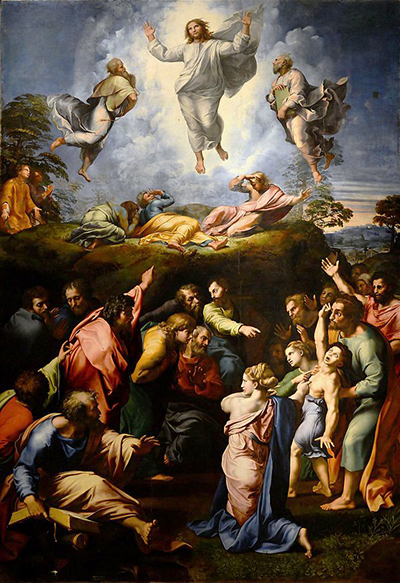
Raphael's Transfiguration joins revelation above to human failure below. Christ rises in radiant glory between Moses and Elijah while Peter, James and John collapse on the mountaintop. Beneath them, the remaining apostles confront a boy they cannot heal, his terrified body held within a crowd of pleading, pointing and disputing figures. Light opens heaven at the top; the lower world strains toward a power it does not yet possess.[1][5][6]
The two episodes follow one another in the Gospels. Christ descends from the mountain into the crisis below and cures the boy after his disciples have failed. Raphael makes the sequence simultaneous, so the healing is not yet shown but its source is visible. The altarpiece became his final painting, left incomplete or at least still in the workshop when he died in April 1520, and its precise division of hands remains one of the central questions in Raphael scholarship.[1][8][11]
At a Glance
- ArtistRaphael, with a debated completion history involving his workshop
- Dateabout 1516–20
- Mediumtempera grassa on wood, later transferred to canvas
- Dimensionsapproximately 405 × 278 cm
- Original patronCardinal Giulio de' Medici, future Pope Clement VII
- Intended destinationCathedral of Saint-Just and Saint-Pasteur, Narbonne
- Paired commissionSebastiano del Piombo's Raising of Lazarus, incorporating designs by Michelangelo
- Subjectsthe Transfiguration and the afflicted boy whom the apostles cannot heal
- Later Roman locationhigh altar of San Pietro in Montorio
- Present locationPinacoteca Vaticana, Vatican Museums
- StatusRaphael's last altarpiece and one of the defining works of his late career
Contents
- A commission for Narbonne
- Raphael and Sebastiano in parallel
- Annotated Details
- The altarpiece from below
- Two successive Gospel episodes
- Christ between Moses and Elijah
- Peter, James and John on the mountain
- The afflicted boy
- The woman who points
- The apostles who cannot heal
- The lower crowd as three communities
A commission for Narbonne
Giulio de' Medici became bishop of Narbonne in 1515 and commissioned two monumental altarpieces for the city's cathedral. Raphael received the Transfiguration. Sebastiano del Piombo received the Raising of Lazarus, with compositional assistance from Michelangelo. The two works were thus conceived within a competitive Roman situation involving the circles of the age's most prominent artists.[1][3]
Competition should not reduce the paintings to a sporting contest. Each altarpiece had to meet a different biblical subject, complex patronal expectation and a distant French destination. Sebastiano's work unfolds Lazarus's return to life across a broad horizontal panel; Raphael's rises vertically from afflicted body to transfigured Christ.[3][4]
Michelangelo's designs for Sebastiano matter because Raphael would have understood the rival commission's ambition. The Transfiguration answers through its own language: bodily extremity, saturated colour, multiplied gestures and a daring union of two moments. It does not simply imitate Michelangelo's anatomy.
Neither painting finally occupied its intended Narbonne setting as first planned. Sebastiano's panel travelled; Raphael's was retained after his death by Giulio de' Medici, who donated it to San Pietro in Montorio in Rome.[1][3]
Raphael and Sebastiano in parallel
The two Narbonne commissions reward comparison because they solve related demands through different structures. Sebastiano's Raising of Lazarus spreads around the newly revived man, whose body is unbound while Christ commands from across the field. Raphael's altarpiece stacks revelation over failed healing, withholding the boy's cure while displaying the Christ who will accomplish it.[1][3]
Both concern transformation of bodies and the authority of Christ. Lazarus moves from death toward life; the mountain Christ reveals divine glory; the afflicted boy waits for restoration. The patron did not simply order two large religious pictures but two statements about power over mortality and suffering.
The National Gallery's technical history of Sebastiano's panel reveals its own support changes and material complexity.[4] Placing that evidence beside the Transfiguration discourages a false opposition between one perfectly preserved Raphael and one secondary rival. Each altarpiece became a mobile object shaped by intervention.
Michelangelo's role in designs for Sebastiano sharpened the Roman context. Raphael could answer an invention associated with two celebrated contemporaries through an unprecedented vertical synthesis. Yet the surviving works do not record a direct vote on who “won.” Their later fame, location and condition altered the terms of comparison.
Giulio de' Medici's retention of Raphael's painting after the artist died also changed the pair's history. What began as a matched commission separated into London and Vatican objects. Reuniting them conceptually restores a patronal relationship no modern gallery can show through ordinary adjacency.
Annotated Details from Transfiguration
The annotated view keeps the whole work in sight while isolating visible details that reward close looking. The source image is a public-domain Wikimedia Commons reproduction used only for this local close-reading feature.
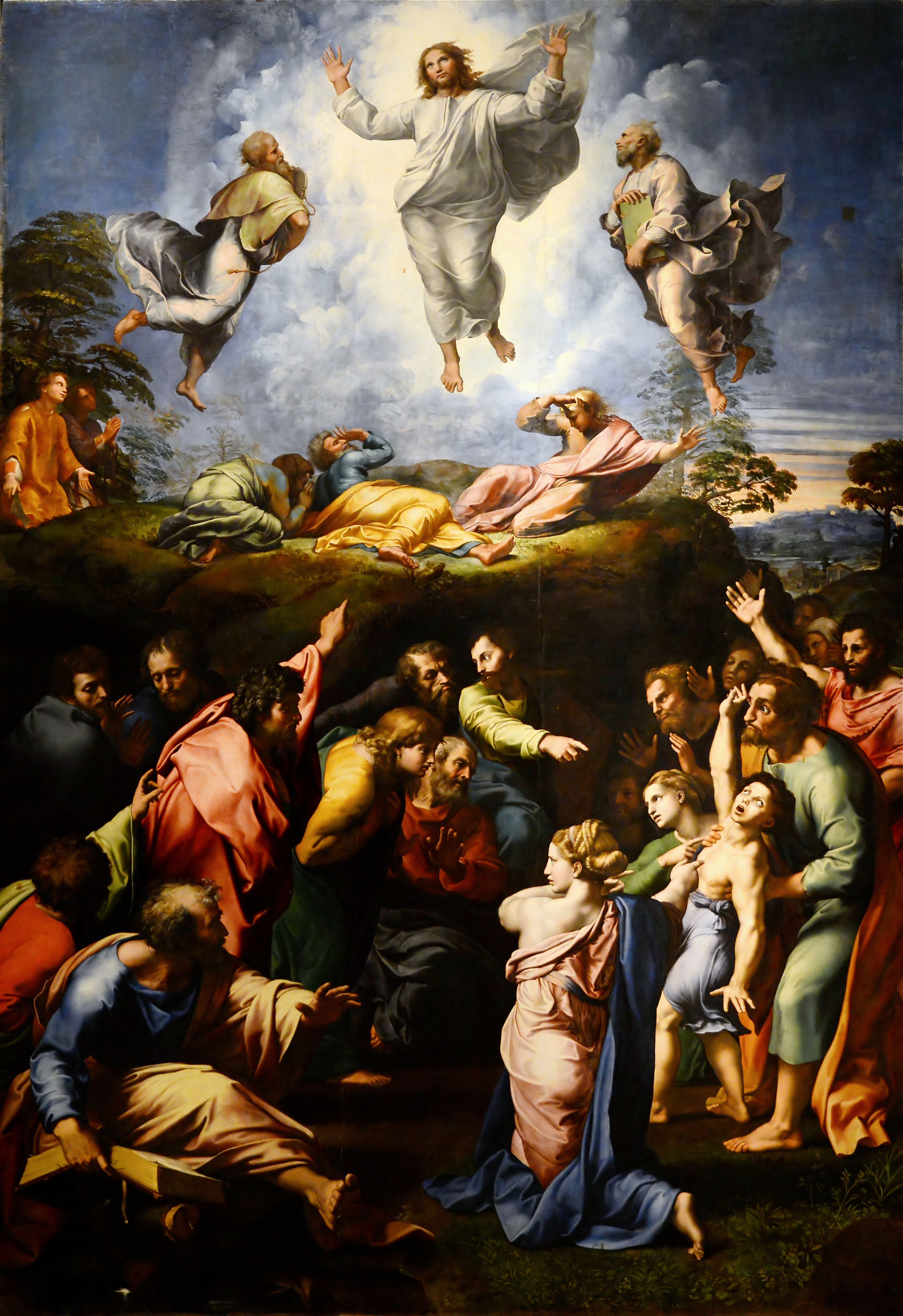
Details from TRANSFIGURATION
Close looking highlights visible details in the work while keeping source and image posture controlled.
Christ in light
Christ's suspended body crowns the panel and sets the upper register apart from the anxious crowd below.
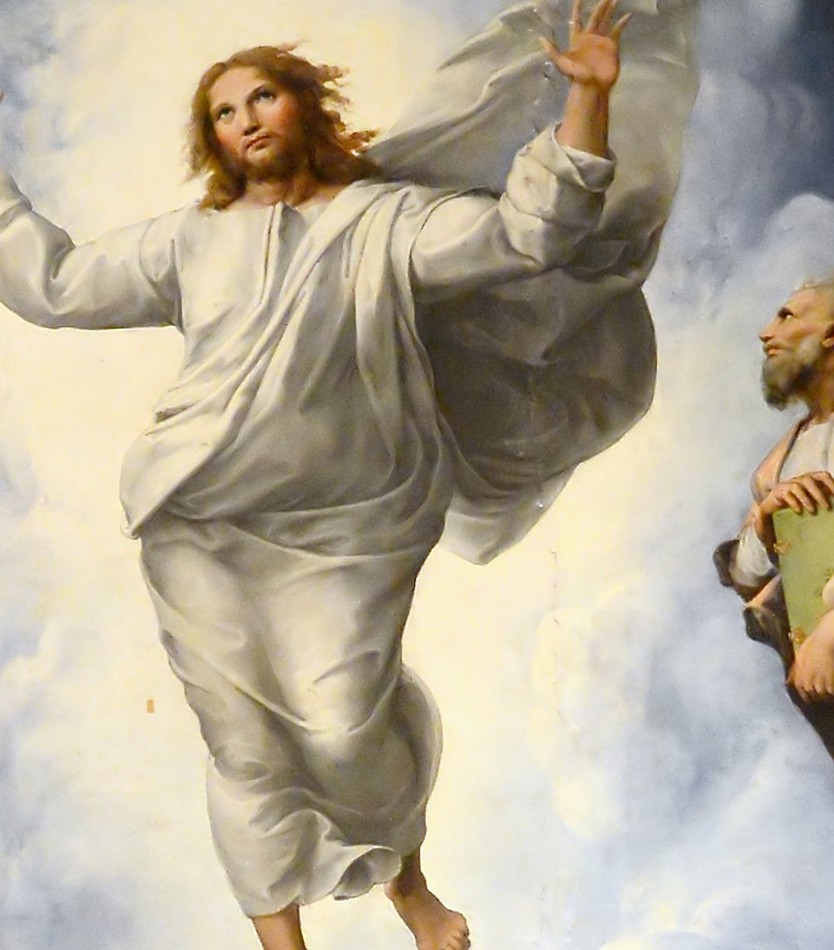
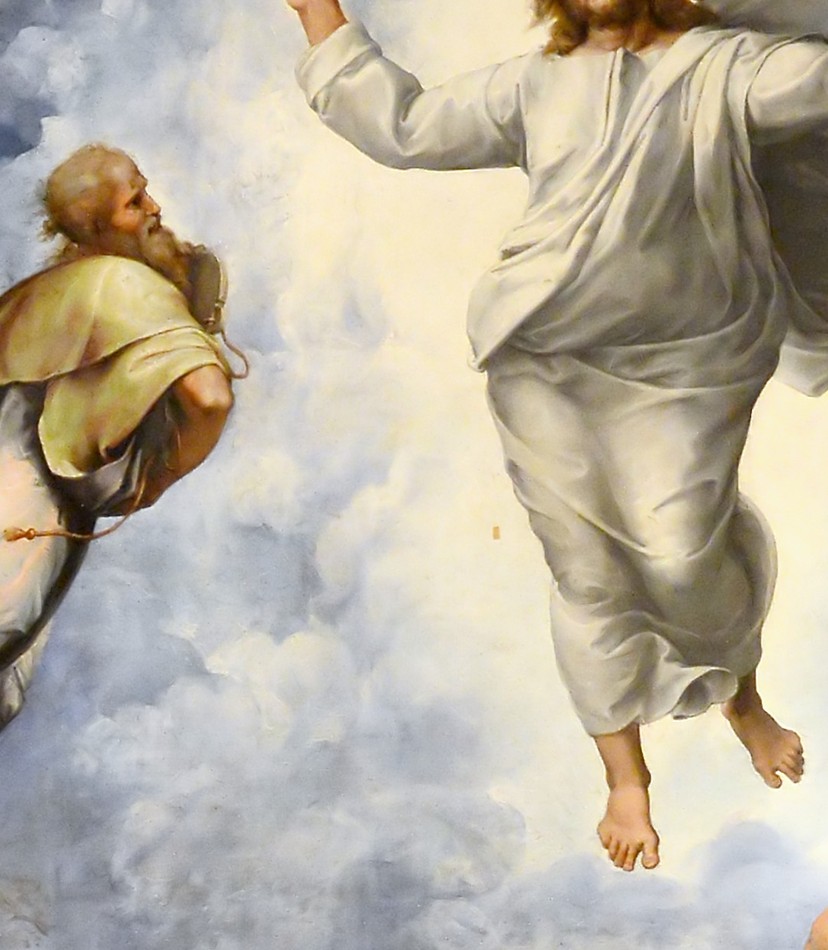
Moses and Elijah
The flanking prophets turn the radiance into a recognisable biblical vision rather than a generic apparition.
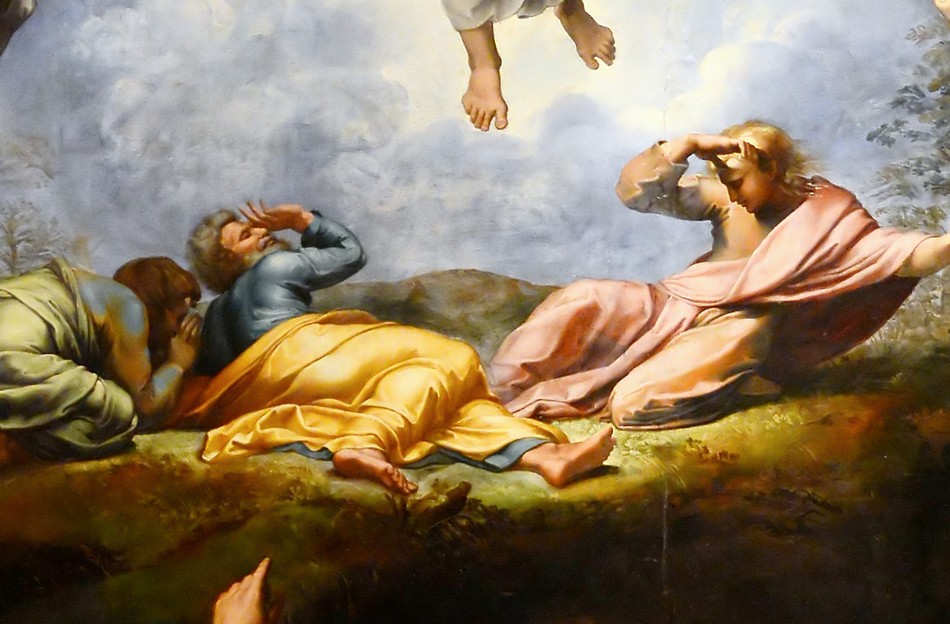
Dazzled apostles
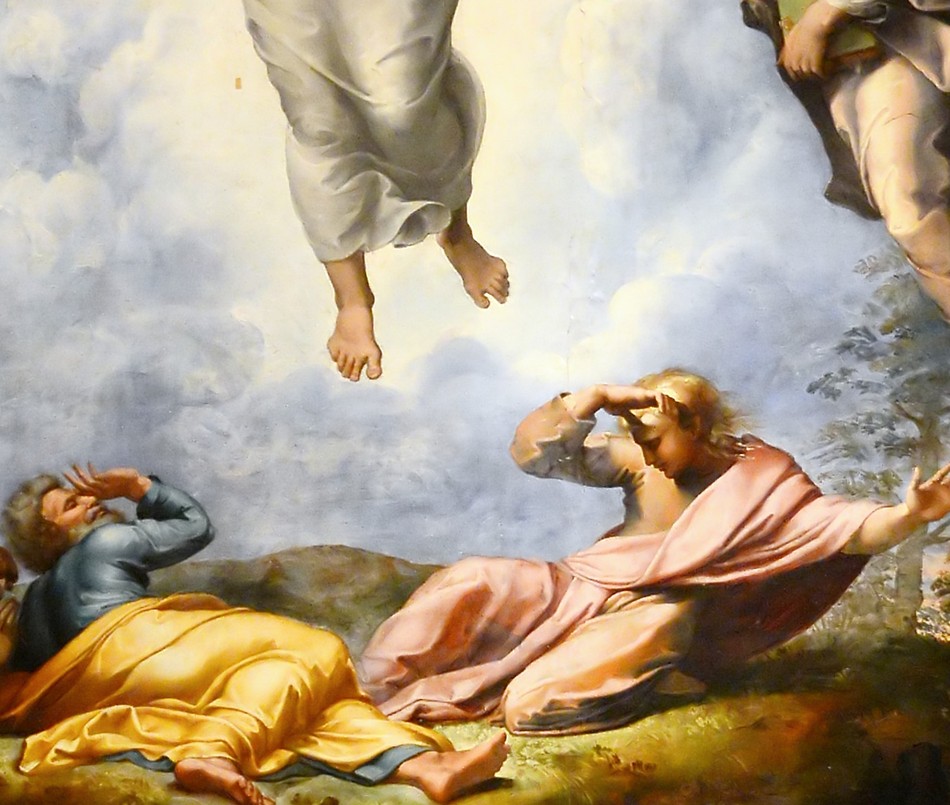
The apostles on the mountain shield, twist and fall back under the force of what they see.
Pointing apostle
The upward-pointing arm becomes the hinge between the earthly crisis and the vision above.
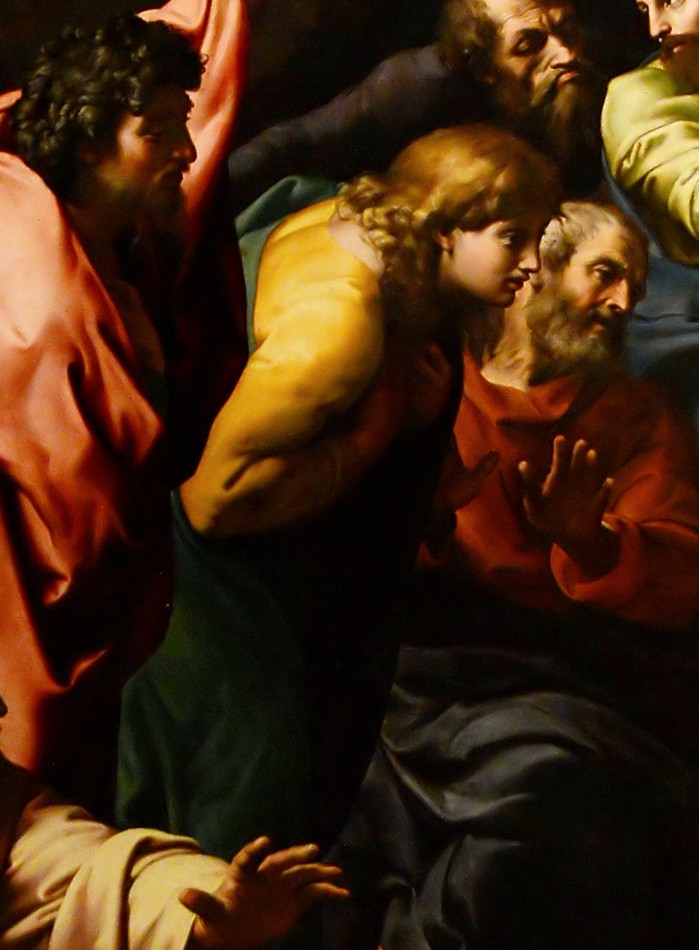
Possessed boy
The boy's exposed body and lifted arm concentrate the lower scene's urgent need for healing.
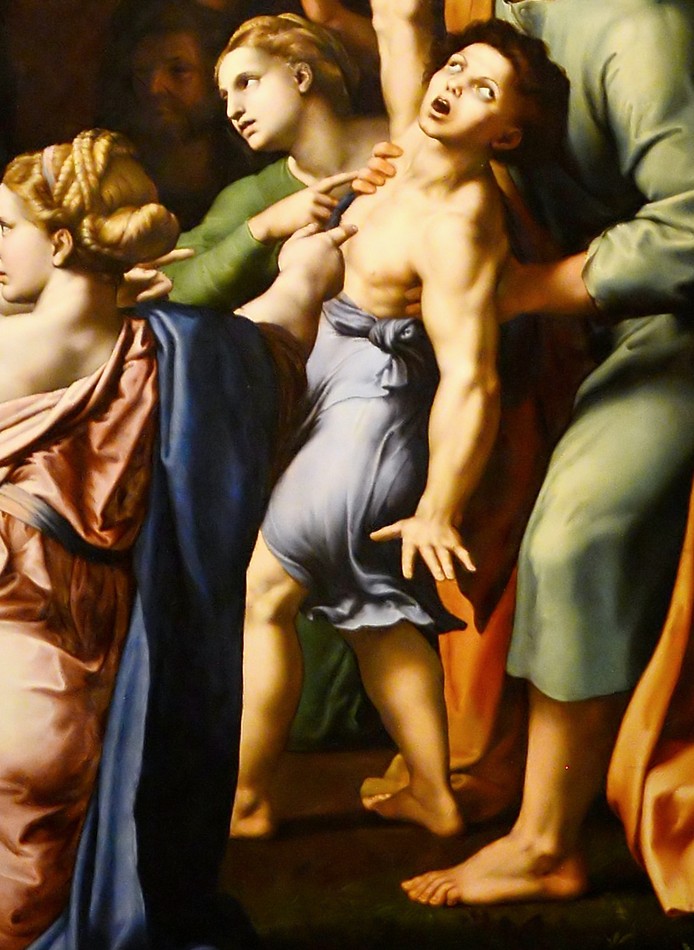
Kneeling woman
The kneeling woman turns sharply across the lower register, directing attention toward the boy.
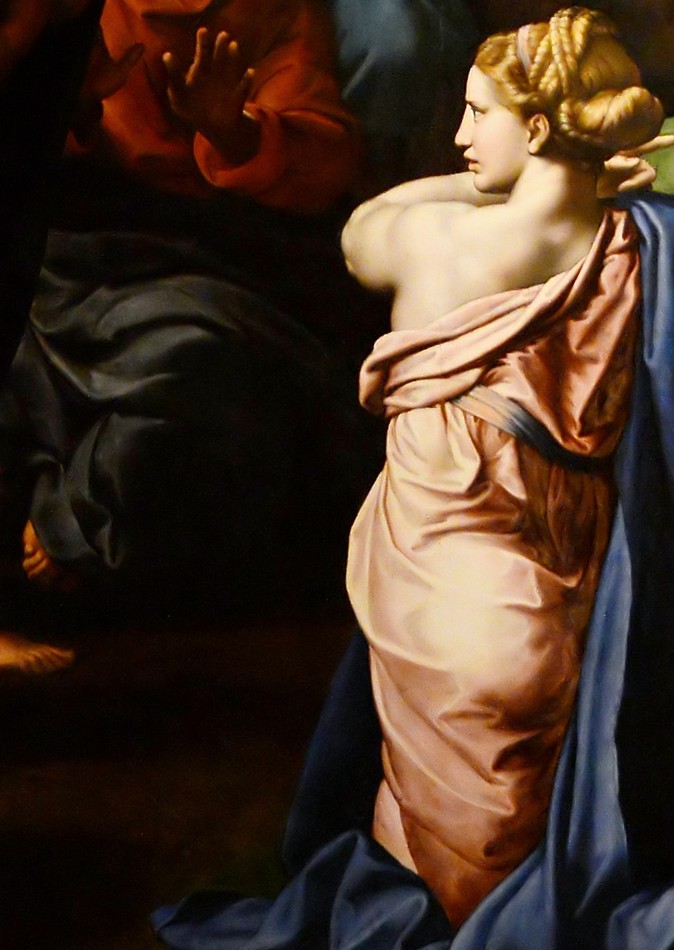
Foreground apostles
The lower-left figures create a dense counterweight to the open light above.
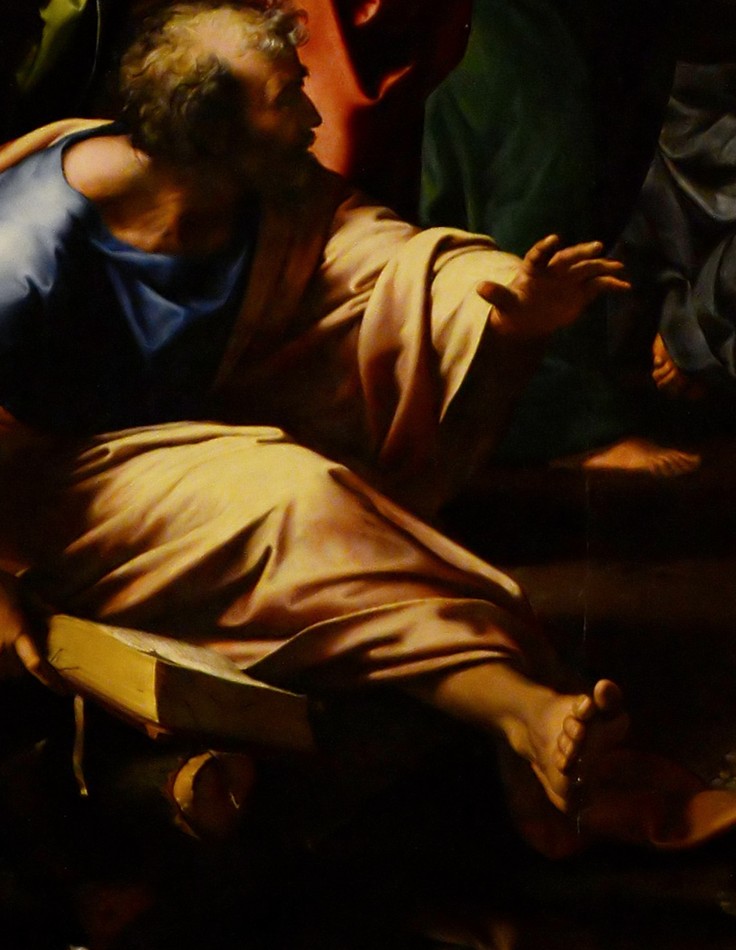
Sky and cloud break
The clouded sky separates but also connects the two registers of revelation and human distress.
The altarpiece from below
The painting was designed for an altar, not a museum wall at arbitrary height. Its more than four-metre vertical scale would place the upper Christ far above worshippers while the afflicted boy and crowd approached their visual world.[1][2]
This physical arrangement reinforces the narrative division. Human suffering belongs near ordinary space; revelation appears beyond immediate reach. The viewer's upward gaze repeats the lower apostles' dependence, but with the advantage of seeing the answer.
An altar also gives the image a liturgical centre outside the painted field. Eucharistic celebration below would stand beneath a work in which Christ's transfigured body and the prospect of Passion are joined. The extended arms, white garment and Gospel sequence could acquire meanings through repeated worship rather than one isolated viewing.
The lower figures' large scale prevents them from becoming a distant predella beneath a celestial icon. Their need is monumental. Raphael makes suffering impossible to treat as a minor prelude to spiritual beauty.
Museum display allows close comparison and conservation but changes the axis between painting, altar and congregation. Remembering San Pietro in Montorio—and the intended Narbonne cathedral—restores the work's demand that viewers look upward through crisis rather than encounter two equally accessible rectangles.
Two successive Gospel episodes
Matthew, Mark and Luke describe Christ taking Peter, James and John onto a mountain, where his appearance changes and Moses and Elijah appear. A cloud and divine voice identify him as the beloved Son. The disciples fall in fear or are overwhelmed by sleep and glory.[5][6][7]
After descending, Christ encounters a crowd and an afflicted boy. The father explains that the disciples could not cure him. Christ rebukes the possessing spirit or illness, restores the child and later addresses the disciples' failure.[5][6][7]
Raphael's combination therefore has strong textual foundations. The lower episode is not an unrelated scene added to fill space. It follows the revelation and tests what the disciples can do in Christ's absence.
The simultaneity changes narrative into theology. The cure has not happened below, but Christ's radiant presence already answers the desperation. The lower crowd points upward without necessarily seeing the transfiguration; the viewer sees both and understands the connection that the figures cannot yet complete.
Christ between Moses and Elijah
Christ occupies the upper centre, suspended above the mountain with arms extended. White garments catch and emit the surrounding radiance, while the body seems freed from ordinary weight. Raphael makes glory visible through light, levitation and calm symmetry.[1][8]
Moses and Elijah appear at either side. Christian interpretation traditionally understands them as representing Law and Prophets, brought into relation with Christ's identity and mission.[6] Their airborne bodies turn toward him, forming a celestial triad distinct from the disciples below.
Christ's extended arms can recall the future Crucifixion without converting the Transfiguration into a Passion scene. The Gospel episode itself points toward suffering: in Luke, Moses and Elijah speak of Christ's departure or exodus to be accomplished in Jerusalem.[7]
The brightness is not atmospheric daylight. It marks revelation. Raphael layers white, yellow and cool surrounding tones so the upper field appears to transform the material world rather than merely illuminate it from one external source.
Peter, James and John on the mountain
The three disciples occupy the ridge beneath Christ. Their bodies twist, shield and fall, making human perception look inadequate to revelation. They do not stand as composed witnesses taking notes; glory overwhelms ordinary sight.[5][6]
One raises an arm defensively, another turns into the ground, and another struggles between looking and retreating. Raphael differentiates fear from sleep or astonishment through full bodily poses.
Their dark, solid forms establish the mountain as a threshold. They belong to the upper event but remain earthly, physically anchored beneath the floating figures. The gap between ridge and Christ becomes charged space.
Two small kneeling figures traditionally associated with saints connected to Narbonne appear at the left of the celestial zone in many accounts, though exact identification should follow secure source evidence.[8] Their inclusion would connect universal revelation to the altarpiece's intended destination without altering the Gospel's principal cast.
The afflicted boy
At lower right, the boy's body is the most violent human form in the painting. His limbs pull in competing directions, eyes turn upward and mouth opens as family or supporters struggle to hold him. Raphael renders affliction as loss of bodily unity.[5][6]
The Gospels describe seizures, falling, rigidity, foaming or a destructive spirit according to each account.[5][6][7] Modern diagnosis cannot be imposed confidently on an ancient narrative and a Renaissance image. The safest language recognises a boy represented as grievously afflicted and, within the text, subject to a spirit Christ expels.
His body mirrors Christ's only through contrast. Both occupy elevated, open poses, but Christ is weightless and ordered while the boy is strained and involuntary. The viewer's eye moves between them, finding the promise of restored unity above.
The father brings the boy after the disciples fail. His appeal gives the lower scene emotional urgency: desperation is not spectacle for its own sake but the demand that someone act when recognised authorities cannot.[5]
The woman who points
A kneeling woman in the lower centre turns toward the apostles while pointing or directing attention toward the boy. Her bright back, twisting torso and extended arms make her a visual hinge between groups.
She is not securely named in the Gospel narrative. Attempts to identify her as a particular biblical person should remain cautious. Her compositional function is clearer: she makes the child's need impossible to ignore.
The figure's pose belongs to Raphael's most sophisticated late inventions. She faces one direction, gestures toward another and occupies the threshold between viewer and scene. Drapery and exposed shoulders concentrate light within the crowded lower register.
A Royal Collection record preserves a head study associated with this kneeling woman within the Raphael drawing tradition.[13] Such evidence demonstrates the care devoted to figures who organise attention even without a named textual identity.
The apostles who cannot heal
The apostles at lower left answer the family's appeal with a mixture of debate, gesture, thought and helplessness. Some consult one another or books; others point upward or toward the absent Christ. No single hand resolves the crisis.
Their failure is explicit in the Gospel sequence.[5][6] Raphael does not mock them. The group represents limited authority confronting suffering without its source. Their varied responses make inadequacy communal and psychologically credible.
One pointing apostle creates the painting's most important directional bridge. His gesture can lead from the lower crisis toward the transfigured Christ, though the figures within the scene do not necessarily share the spectator's full vision.
Books in the group suggest knowledge, but textual consultation alone does not heal the boy. The contrast is not anti-intellectual; it distinguishes learning from the divine power on which apostolic action depends.
The lower crowd as three communities
The lower register becomes clearer when read as intersecting communities. At left, apostles search for an answer. At right, family and companions hold and present the boy. In the centre, the kneeling woman and crossing gestures negotiate between demand and failed authority.
The apostles are not one emotional block. Some turn inward toward discussion, some consult, and others point away from themselves. Their inability generates thought, argument and appeal rather than indifference. Raphael makes failure active.
The boy's group likewise contains several relations. The father speaks or presents; supporters bear the child's weight; witnesses recoil or look toward the apostles. Affliction spreads through a family and public body without becoming a generic crowd scene.[5][6]
The kneeling woman converts these separate groups into one visible claim. Her shoulders catch light, her head turns toward the apostles and her arms drive attention back to the child. She behaves almost like the altarpiece's syntax: orientation, subject and demand joined in one figure.
Space between hands is as important as contact. Pointing fingers nearly meet sightlines; open palms ask for response; supporting arms prevent collapse. Raphael choreographs a community around an absence—the effective healer who remains above and away.
The groups also differ in what they know. The family knows the boy's suffering and the failure of previous attempts. The apostles know their calling but confront its limits. The spectator alone can see the revelation above and the need below simultaneously. Privileged vision creates responsibility: the viewer must perform the connection the painted crowd cannot yet see.
Gesture as connection
The altarpiece contains many hands, yet their abundance does not dissolve into noise. Gestures perform specific narrative work. The father presents, the woman insists, apostles argue and point, disciples shield themselves, prophets orient toward Christ and Christ opens his arms.
These directions create a circulation between registers. The eye does not simply rise along a central ladder. It crosses the lower crowd, encounters the boy's diagonal, returns through pointing arms and finally reaches the light.
Raphael's late style depends on this social intelligence. Bodies communicate knowledge unevenly. One figure sees, another asks, another refuses, another redirects. The painting's unity grows from relations among partial understandings.
The result is more dynamic than the stable assemblies of the Stanza della Segnatura but equally organised. Crisis requires a different clarity from philosophy or theology at rest.
Light and divided worlds
The upper register is open, cool and radiant. The lower is densely occupied and marked by deep shadows, strong local colours and abrupt highlights. This division has encouraged the idea of two separate pictures, but light connects them through contrast.[1][8]
The transfiguration supplies a source beyond ordinary daylight. Below, selected flesh, white cloth and coloured drapery catch illumination as if revelation were approaching a world that cannot yet see its cause.
Darkness around the boy intensifies suffering without making the lower half morally evil. The crowd includes loving family, anxious witnesses and disciples who have tried and failed. Shadow is a condition of incomplete power, not a simple sign of wickedness.
The mountain ridge forms a strong boundary but not an absolute wall. Heads, arms and sightlines press toward it. The narrative future—Christ's descent—will cross what the composition holds apart.
One painting, not two solutions
The strong horizontal boundary has long made the altarpiece seem vulnerable to division. The upper scene possesses centred symmetry and open sky; the lower is asymmetric, dark and crowded. Yet nearly every formal difference expresses the narrative relation.[1]
Stillness above is meaningful because disorder exists below. The boy's diagonal makes Christ's vertical ascent feel restorative; the apostles' dispersed gestures make the celestial triad's orientation appear complete. The registers define one another.
Colour also crosses the divide. Reds, blues, whites and ochres recur in altered intensities, preventing upper and lower palettes from becoming unrelated. Flesh moves from the cool radiance of Christ to the strained highlights of the child.
The middle ridge functions like a delay. It holds Christ apart at the instant before descent and lets the spectator understand why descent is necessary. If the two episodes merged into one continuous landscape, the theological distinction between revelation and its human application would weaken.
Raphael's unity is therefore temporal rather than purely spatial. The painting shows what has just happened above, what is happening below and what will happen when Christ returns. A sequence can be one altarpiece without pretending to be one second.
Preparatory drawings
Numerous drawings connected with the Transfiguration preserve Raphael's process and the workshop's participation. The Royal Collection, Ashmolean, British Museum, Albertina-related records and other institutions catalogue studies of apostle heads, hands and groups.[9][10][11][12][14]
The celebrated study of heads and hands of two apostles reveals how expression and gesture were developed together. A head does not convey thought alone; the hands complete the apostle's reaction. Restoration and technical study have also changed attribution assessments for such sheets.[9]
The Ashmolean's studies of two apostles demonstrate Raphael's searching black-chalk method for the lower group.[10] Auxiliary cartoons or highly finished head studies could help transfer exact forms while allowing assistants to realise sections under supervision.[11][15]
Drawing evidence does not automatically identify who painted every corresponding passage. A Raphael study proves his invention and planning; the final surface still requires technical and stylistic examination.
Who completed the painting?
Raphael died on 6 April 1520 while the altarpiece remained central to his workshop. Sources and scholars disagree about the degree to which pupils completed passages. Giulio Romano is frequently named, and some accounts argue for other assistants, but the precise division remains open.[8][11][12]
The question is complicated by Raphael's workshop method. He could design figures through drawings, establish cartoons and paint key passages while assistants prepared or completed others. “Finished by the workshop” does not mean the composition ceased to be Raphael's.
The British Museum's record for an apostle head discusses an alternative account involving Giulio Romano, while the Met catalogues an associated group under both Giulio and Raphael.[11][12] Institutional disagreement is evidence of a live attribution problem, not a defect to conceal.
The public conclusion should therefore be proportional: this is Raphael's last great design and substantially his painting, with probable workshop participation and debated completion after or near the time of his death.
Invention, execution and evidence
Authorship becomes clearer when divided into questions. Who selected and organised the two episodes? Who designed particular figures? Who transferred cartoons? Who laid in colour or completed paint after Raphael's final intervention? One name need not answer every stage.
Preparatory sheets strongly establish Raphael's intellectual and graphic control over the lower apostles and associated heads.[9][10][13][14] Their quality and specificity contradict any suggestion that pupils invented the lower half independently after his death.
At the same time, a drawing cannot certify every brushstroke on the altarpiece. Assistants could follow Raphael's studied forms closely, and later transfer from wood to canvas complicates direct reading of the original surface.[2][11]
Older biographies, connoisseurial judgements, conservation observations and modern technical imaging may therefore produce different distributions of responsibility. Where institutions catalogue associated designs under both Raphael and Giulio Romano, the double name preserves uncertainty rather than evading it.[12]
The most historically faithful view recognises the workshop as the mechanism through which Raphael's late ambition could be completed. Collaboration is not an alternative to authorship. The disputed question is its extent in this particular object.
Raphael's death and the funeral image
Early biography associated the Transfiguration closely with Raphael's death and funeral, famously describing the painting displayed near his body. Whether every later retelling preserves exact circumstances, the tradition shaped the work's reception as a final testament.[1]
The vertical passage from suffering to glory made that association powerful. Viewers could understand the painting not only as Gospel narrative but as an image of mortal crisis answered by transformation.
Calling it a spiritual testament should not make every detail prophetic autobiography. The commission began years before Raphael's death and served a public altar. Its final status emerged from circumstance, completion history and reception.
Vasari's extravagant praise helped establish its canonical position. The Vatican cites his description of it as exceptionally famous, beautiful and divine.[1] Later reproduction turned that judgement into wide visual familiarity.
The funeral association inevitably encouraged biographical reading of the light above and anguish below. Such response is historically important even when it is not the commission's original iconographic key. A painting can acquire meanings through the conditions of its first public fame.
Displayed beside the dead artist, the unfinished or newly completed altarpiece would have demonstrated the scale of work Rome had lost. Workshop collaboration became poignant: pupils capable of extending Raphael's designs could preserve his enterprise, but not replace the directing intelligence around which it had formed.
The work's later title as a “last painting” therefore names more than chronology. It marks the point where creative process became posthumous reception, and where questions about completion became inseparable from grief, praise and institutional custody.
From Rome to Paris and back
After retaining the painting, Giulio de' Medici donated it to San Pietro in Montorio, where it stood over the high altar.[1] This Roman setting replaced the unrealised Narbonne destination and connected the work to a prominent sacred site.
In 1797, following the Treaty of Tolentino, French forces took the altarpiece to Paris. It returned after Napoleon's fall in 1816 and entered the Pinacoteca of Pius VII.[1]
The painting's support was transferred from wood to canvas during its French period, a major intervention affecting the material object even while preserving the visible composition.[2] Such transfers can alter texture, dimensions or paint behaviour and belong to conservation history, not merely provenance.
Its current Vatican display makes it a museum masterpiece, but the scale and upward movement remain those of an altarpiece intended to address worshippers across architectural space.
Paint, support and transfer
The Vatican catalogue identifies the present support as canvas and records the work's original altarpiece identity.[2] The transfer carried the paint layer away from its wooden support during the period of French custody, a drastic treatment once applied to major panels thought endangered or difficult to manage.
Transfer is not the same as relining an original canvas. Conservators removed or separated the painted preparation from the wood and attached it to a textile support. Even when the visible composition survives, surface texture and mechanical behaviour change.
Raphael's late painting practice involved layered oil-rich or mixed techniques, carefully chosen pigments, grounds and passages built for optical effect.[17] Technical conclusions drawn from other examined works provide context, but the Transfiguration's altered support demands object-specific evidence before every material observation is generalised.
The radiant upper whites and saturated lower draperies depend on paint structure as well as iconography. Glazes, opaque highlights and contrasting grounds can make light appear internal to a colour. Ageing, cleaning and transfer affect that balance.
Condition therefore belongs to interpretation. Viewers encounter Raphael's invention through a surface shaped by workshop completion, centuries over an altar, removal to Paris, support transfer, return and Vatican care. The object is continuous without being materially untouched.
Colour as narrative argument
The upper Christ's white garment creates a value no lower costume can equal. Around him, cooler air and luminous cloud reduce material weight. Moses and Elijah receive the same transformed atmosphere without matching his central brilliance.
Below, red, blue, yellow and green cluster in bodies under pressure. Colour separates overlapping limbs and helps the eye navigate argument, fear and care. The kneeling woman's light clothing makes her a bridge not because she belongs to heaven but because she carries the lower demand most clearly.
The boy's pallor and abrupt highlights make bodily disorder visible against supporters' warmer flesh. Colour registers condition before a viewer identifies every face.
Raphael also uses saturation to keep the lower world valuable. Darkness does not drain it into monochrome inferiority. Human need is painted with splendour, ensuring that revelation above cannot become an excuse to ignore suffering below.
This richness would have interacted with altar light differently across a church day. The museum's controlled illumination improves visibility, but the original work expected colour to emerge unevenly as worshippers moved and conditions changed.[17]
Prints and reception
Cornelis Cort engraved the Transfiguration in 1573, helping the composition circulate beyond Rome.[16] Engraving translated radiance, colour and two crowded registers into black line.
Reproduction encouraged artists to study individual groups and gestures, while the complete design became a standard of monumental religious composition. It could be known even by viewers who never saw San Pietro in Montorio.
Print also flattens the material distinction between registers. Line can intensify the compositional skeleton but cannot reproduce the altarpiece's changing colour or painted light. Reception through engraving is therefore interpretation.
The work's fame generated copies, details and academic study, sometimes making the lower boy or upper Christ appear like independent inventions. Returning fragments to the full vertical argument restores their narrative necessity.
How to look at the Transfiguration
Begin below. Find the boy, then the kneeling woman and the apostles who cannot help. Let their gestures lead upward rather than starting with Christ as an isolated icon.
Compare bodies: the boy's involuntary extension, the disciples' collapse and Christ's weightless opening. Raphael uses three kinds of physical loss of ordinary control for suffering, fear and glory.
Trace light across the boundary. Notice where lower figures catch illumination and where shadow interrupts communication.
Finally, remember the sequence. Christ will descend and heal the boy. The altarpiece holds revelation and need apart only so the viewer can understand what must connect them.
Why the painting matters
The Transfiguration brings Raphael's gifts for social composition, bodily clarity and theological structure to their most dramatic limit. It is crowded without becoming formless and divided without becoming two paintings.
Its completion history makes authorship visible as a workshop problem. Raphael's drawings and governing invention remain decisive; assistants and later material interventions belong to the object that survived.
As a final work, it acquired meanings Raphael could not fully control. Funeral memory, Vasari's praise, Napoleonic displacement and museum canonisation turned an unfulfilled Narbonne commission into an image of the artist's own passage from life into the history attached to his name.
The altarpiece also expands the meaning of harmony in Raphael. Harmony here is not the absence of conflict. It is the capacity to give failed authority, bodily terror, family grief, apostolic argument and divine glory one intelligible order without pretending that they occupy the same state. Unity preserves difference.
That achievement explains why the lower scene cannot be dismissed as a late addition or sensational counterweight. It supplies the human stakes of the revelation above. A transfigured Christ separated from suffering might remain a vision; placed over the afflicted boy, he becomes the promised agent of return, descent and cure.
The painting's own material and collaborative history repeats that movement imperfectly. Raphael's death breaks the process, assistants and conservators sustain it, removal displaces the object, and return gives it a new institutional home. The work survived through transformations that did not leave it unchanged.
To see the Transfiguration whole is therefore to resist several easy separations: heaven from earth, revelation from healing, Raphael from workshop, design from material object and original commission from later reception. Its greatness lies in making every boundary visible while directing the eye across it.
No other Raphael altarpiece combines so many kinds of transition at this scale. That density, rather than its position at the end of his life alone, gives the work the character of culmination.
Artist Up Close
Look at pointing hands before faces. They map who knows the problem, who proposes an answer and who can only indicate the absent source of power.
Compare Christ and the boy. Their open limbs create a formal echo whose difference—ordered radiance against afflicted strain—holds the entire altarpiece together.
Then find the quietest figures. The apostles who think or consult a book show that Raphael's drama includes uncertainty, not only spectacular emotion.
Frequently Asked Questions
Discussion
What detail most changes how you read The Transfiguration?
Reader Insights
Which source detail gives the page its strongest anchor?
Which visual or historical distinction should readers keep in mind?
How does this page change the wider picture of Raphael's career?
Join the Conversation
Share your reading below.
References
- Vatican Museums, “Raffaello Sanzio, The Transfiguration,” official object record. View source.
- Vatican Museums Online Catalogue, “Pala d'altare: Trasfigurazione,” inventory MV.40333.0.0. View source.
- National Gallery, London, “Sebastiano del Piombo, incorporating designs by Michelangelo: The Raising of Lazarus,” object record. View source.
- Jill Dunkerton and Helen Howard, “Sebastiano del Piombo's Raising of Lazarus: A History of Change,” National Gallery Technical Bulletin 30. View source.
- United States Conference of Catholic Bishops, “Matthew, Chapter 17,” biblical text and notes. View source.
- United States Conference of Catholic Bishops, “Mark, Chapter 9,” biblical text and notes. View source.
- United States Conference of Catholic Bishops, “Luke, Chapter 9,” biblical text and notes. View source.
- Vatican News, “A Transfiguração, o último Rafael,” figure, light and authorship discussion. View source.
- Royal Collection Trust, “Studies of the Heads and Hands of Two Apostles for The Transfiguration,” Raphael Collection record. View source.
- Ashmolean Museum, “Studies of Two Apostles,” collection and curatorial record. View source.
- British Museum, “Head of an Apostle,” auxiliary-cartoon record and completion discussion. View source.
- The Metropolitan Museum of Art, “Studies for Apostles in the Transfiguration,” Albertina sheet record. View source.
- Royal Collection Trust, “The Head of a Kneeling Woman for The Transfiguration,” collection record. View source.
- Royal Collection Trust, “Three Apostles from The Transfiguration,” drawing and attribution record. View source.
- National Gallery, London, “Studying Raphael: Drawings and Cartoons.” View source.
- British Museum, Cornelis Cort, “The Transfiguration at Mount Tabor,” engraving after Raphael, 1573. View source.
- National Gallery, London, “Studying Raphael: Pigments and Medium.” View source.