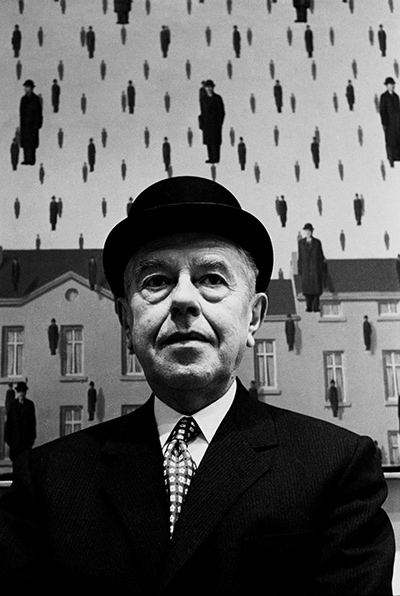
 by Tom Gurney
Tom Gurney BSc (Hons) is an art history expert with over 20 years experience
Published on June 19, 2020 / Updated on July 5, 2026
Email: tomgurney1@gmail.com / Phone: +44 7429 011000
René Magritte: Belgian Surrealist Painter of The Son of Man
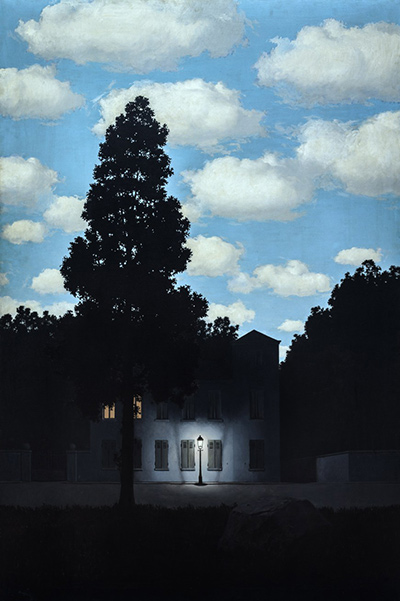
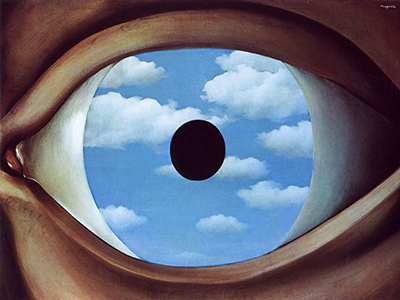
René Magritte was the Belgian Surrealist who made ordinary things behave with quiet impossibility. His paintings are full of pipes, apples, bowler hats, mirrors, windows, curtains, cloudy skies and formally dressed figures, yet their power lies in how calmly these familiar objects stop making sense. A pipe is declared not to be a pipe. A green apple blocks a face. A daylight sky hangs above a night-time street. A mirror shows the wrong reflection. [1]
Born in Lessines, Belgium, in 1898 and active mainly in Brussels, Magritte became one of the most influential artists of the twentieth century. His work belongs to Surrealism, but it is not the wild, melting, theatrical Surrealism many viewers associate with Salvador Dalí. Magritte's art is cooler, flatter and more exact. It often looks rational at first glance, then quietly exposes how unstable seeing and naming can be. [1]
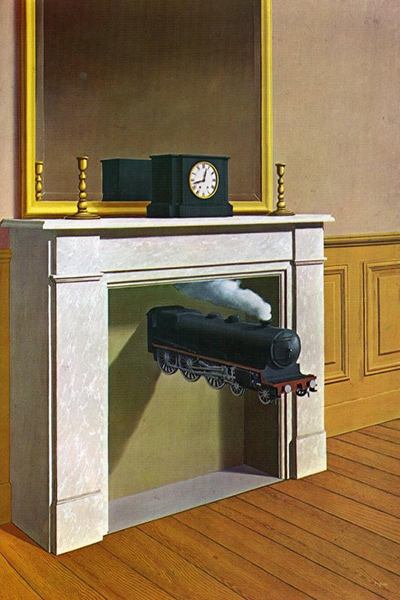
Today he is best known for The Son of Man, The Treachery of Images, The Human Condition, The False Mirror, The Empire of Light, Golconde, Les Amants and Time Transfixed. These paintings have become icons of modern art not because they explain mystery, but because they preserve it. [1]
At a Glance
- Full name: René François Ghislain Magritte
- Born: 21 November 1898, Lessines, Belgium
- Died: 15 August 1967, Brussels, Belgium
- Nationality: Belgian
- Movement: Surrealism
- Known for: Ordinary objects placed in impossible relationships
Contents
- Why Magritte Matters
- Early Life and Training
- From Brussels to Surrealism
- Magritte's Style
- Key Periods
- Major Paintings
- Motifs and Ideas
- Technique and Working Method
- Later Career and Recognition
- Legacy and Influence
Why Magritte Matters
Magritte matters because he changed the way modern viewers think about images. He did not simply paint strange scenes. He made paintings that ask what an image is, what a word does, why a thing can be recognised without being understood, and why the visible world always seems to hide something else. [4]
His art is unusually accessible at first sight. A viewer does not need specialist training to recognise an apple, pipe, eye, hat, window or room. But Magritte's accessibility is a trap of the best kind. The object is easy to name, then difficult to explain. [4]
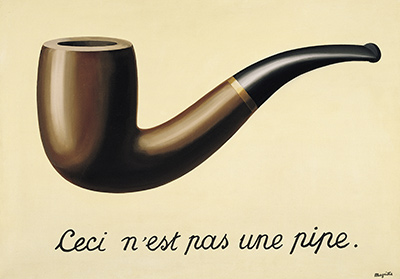
This is why The Treachery of Images remains so central to modern art. The painted pipe is clear and ordinary, but the inscription below it denies the viewer's first response. The picture is not a pipe; it is an image of one. That distinction may sound simple, yet it opens a whole field of thought about representation, language and reality. [4]
Magritte also matters because his imagery escaped the museum without losing its force. His apples, clouds, bowler hats and masked faces influenced Pop art, conceptual art, graphic design, advertising, film, music and popular culture. Few modern artists have produced images so easy to recognise and so resistant to being used up. [4]
Early Life and Training
René François Ghislain Magritte was born on 21 November 1898 in Lessines, Belgium. His early life is often discussed through the tragedy of his mother's suicide in 1912, when Magritte was still a teenager. Later writers have sometimes connected that event with his repeated use of covered or hidden faces, although the relationship should be treated carefully. Magritte's paintings are not simply biographical codes. [1]
He studied in Brussels and passed through several early artistic influences before arriving at the language now associated with his name. His early work included Impressionist, Futurist and Cubist elements, and his training did not immediately point toward the cool Surrealist images of his mature career. [1]
The practical world of design also mattered. Magritte worked as a draughtsman in a wallpaper factory and later as an advertising and poster designer. That experience helped shape the clarity of his mature paintings. His images often have the instant legibility of commercial graphics, but they use that clarity to create doubt rather than sell certainty. [1] [5]
From Brussels to Surrealism
Magritte's decisive move toward Surrealism came in the 1920s. The Lost Jockey, painted in 1926, is often treated as an early Surrealist breakthrough. In 1927 he held his first solo exhibition in Brussels, but the response was poor. Soon after, he moved near Paris and entered the orbit of André Breton and the Surrealist group. [1]
Paris was important, but Magritte remained distinct from the Parisian centre of Surrealism. His mature work belongs strongly to Belgian Surrealism, a cooler and more linguistic strand associated with figures such as Paul Nougé, E. L. T. Mesens and Louis Scutenaire. Where some Surrealists pursued automatic writing, dream imagery or theatrical fantasy, Magritte often worked through contradiction, deadpan humour and ordinary things placed under impossible conditions. [1]
He returned to Brussels in 1930 after the closure of Galerie Le Centaure disrupted his financial support. For much of his life he lived and worked in Belgium, building a visual language that could seem bourgeois in setting and revolutionary in effect. His rooms, suits, hats, windows and tidy skies are ordinary only until the viewer notices what they are doing. [1]
Magritte's Style
Magritte's style is precise, calm and conceptually disruptive. He usually paints familiar objects clearly, then changes one relation between them. A face is hidden. A scale is wrong. A word contradicts an image. A view through a window is replaced by a painting. A sky appears where an eye should be. [1]
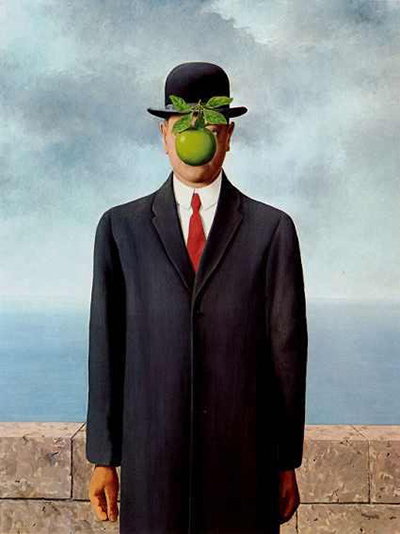
That restraint is crucial. Magritte rarely needs to distort the entire world. He keeps most of the image stable so the disruption becomes sharper. In The Son of Man, the man, coat, sea wall and sky are all easy to understand. The apple alone is enough to make the portrait impossible. [1]
His style is also unusually memorable because it works almost like a visual language. Apples, pipes, bowler hats, clouds, curtains, mirrors, stones and windows return across different paintings, but they do not carry fixed meanings. Their force depends on their situation. [1]
Key Periods
Magritte's career is easiest to understand as a series of experiments that eventually produced a remarkably stable visual language. He did not begin as the painter of apples and bowler hats. The early years include academic study, encounters with modernist painting and work that absorbed aspects of Impressionism, Futurism and Cubism. These stages matter because they show that his later clarity was achieved rather than automatic. [1]
The first decisive Surrealist period came in the second half of the 1920s. Paintings such as The Lost Jockey, The Menaced Assassin, Les Amants, The False Mirror and The Treachery of Images established many of the problems that would remain central: theatrical stillness, covered faces, unstable identity, word-image contradiction and the strange authority of ordinary objects. [1]
The 1930s deepened this language. Works such as The Human Condition, Not to Be Reproduced, The Red Model and Time Transfixed show Magritte becoming more exact about interiors, frames, mirrors, substitution and visual paradox. The image often appears more orderly, but the ideas become more severe. [1]
The 1940s are more complicated. During and after the German occupation of Belgium, Magritte moved through brighter and deliberately rougher modes, usually discussed as the Renoir and Vache periods. These works can surprise readers who know only the polished icons, but they reveal an artist willing to test the limits of his own public identity. [1]
The later decades brought the most widely recognisable Magritte. In works such as Golconde, The Listening Room, The Empire of Light and The Son of Man, his motifs become bolder, clearer and more iconic. The paintings are easy to remember, but they are not simplified in thought. They are late statements of a method he had refined for decades. [1]
Major Paintings
| Painting | Date | Why It Matters |
|---|---|---|
| The Treachery of Images | 1929 | Defines Magritte's word-image problem through the famous pipe that is not a pipe. |
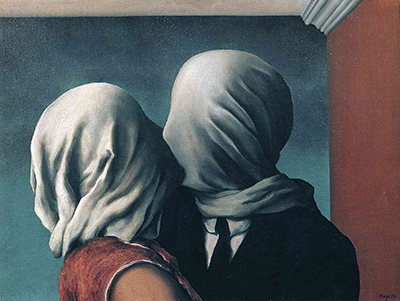
| Les Amants | 1928 | Turns intimacy into obstruction through the cloth-covered faces of two lovers. |
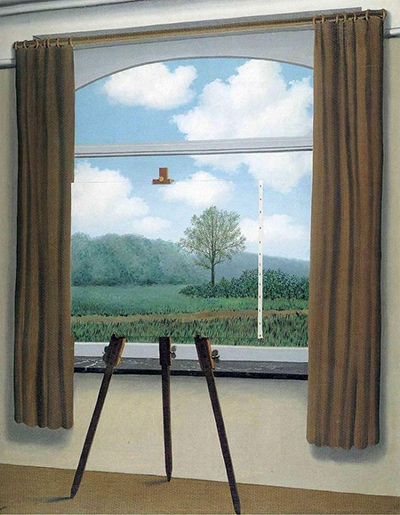
| The Human Condition | 1933 | Confuses painting, window and landscape to question representation itself. |
| Time Transfixed | 1938 | Places a locomotive inside a domestic interior with unnerving composure. |
| The Empire of Light | 1940s-1960s | Combines night and day in one of Magritte's most poetic recurring images. |
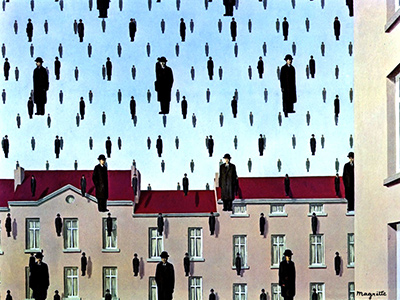
| Golconde | 1953 | Turns the bowler-hatted man into a repeated pattern across the sky. |
| The Son of Man | 1964 | Transforms the self-portrait into an image of concealment and frustrated recognition. |
Other important works include The False Mirror, The Listening Room, Not to Be Reproduced, The Menaced Assassin, The Red Model, Personal Values, The Blank Signature, The Castle of the Pyrenees and The Mysteries of the Horizon. [7]
Motifs and Ideas
Magritte's motifs are famous, but they are often misunderstood as simple symbols. The apple does not always mean one thing. The bowler hat does not always mean one thing. The curtain, mirror, pipe, eye or sky changes function from painting to painting. [1] [9]
A better way to read Magritte is to ask what ordinary expectation has been interrupted. Does the object appear in the wrong place? Has it changed scale? Is it blocking something the viewer wants to see? Does a word deny what the eye recognises? Is inside confused with outside? [1]
-
Apples
Used in works such as The Son of Man, The Listening Room and This is Not an Apple, apples shift between obstruction, scale and naming. -
Bowler hats
The bowler-hatted man can suggest Magritte himself, a middle-class type, a mask or a repeated unit of modern anonymity. -
Windows and frames
Windows, easels and framed views let Magritte confuse the boundary between seeing the world and seeing a picture. -
Words and images
Painted inscriptions and titles expose the difference between a thing, an image of a thing and the word used to name it.
Technique and Working Method
Magritte's technique serves clarity. Many major works are oil on canvas, with smooth surfaces, clear outlines and restrained modelling. He usually avoids painterly bravura because expressive brushwork would distract from the image's conceptual pressure. [1]
The paintings often look almost factual. This is why their impossibilities feel so sharp. The viewer is not looking at a storm of dream imagery. The viewer is looking at a calm report of something that cannot happen. [1] [6]
Composition is one of his strongest tools. He places objects with exactness, uses scale carefully and lets a single contradiction carry the painting. The method is economical: the apple blocks the face; the sky fills the eye; the train enters the fireplace; the painting covers the view. [1]
Later Career and Recognition
- 1898 — René Magritte is born in Lessines, Belgium. [1]
- 1926 — The Lost Jockey marks a decisive move toward Surrealism. [1]
- 1927-1930 — Magritte lives near Paris and comes into contact with the Surrealist circle around André Breton. [1]
- 1929 — The Treachery of Images establishes one of his central image-word problems. [1]
- 1940s — Magritte experiments with brighter and rougher manners during the Renoir and Vache periods. [1]
- 1950s-1960s — His motifs become increasingly iconic in works such as Golconde, The Empire of Light and The Son of Man. [1]
- 1967 — Magritte dies in Brussels. [1]
Magritte's experiments during and after the Second World War are important because they show that his familiar clear style was a choice rather than an inability to paint otherwise. By the 1950s and 1960s, his reputation had grown significantly, and the late works include some of the images by which he is now best known. [1]
Legacy and Influence
Magritte's influence is wide because his images are both intellectually serious and visually direct. Pop artists could respond to his clarity. Conceptual artists could respond to his word-image problems. Designers and filmmakers could respond to his memorable silhouettes and uncanny juxtapositions. [1]
His influence can be seen in later art concerned with signs, language, repetition, commercial imagery and the instability of representation. But his legacy also survives in ordinary visual culture. The apple in front of the face, the cloudy sky inside the eye, the pipe that is not a pipe and the bowler-hatted man have become part of the shared vocabulary of modern images. [1]
That popularity can make Magritte seem familiar too quickly. The best way back into his art is to slow down and notice how little the paintings actually explain. They are famous not because their mysteries have been solved, but because they keep producing new thought from simple things. [1]
Where to Start
For readers new to Magritte, the best starting point is not to search for a hidden code. Begin with the ordinary object. Name what is visible: a pipe, apple, eye, curtain, room, hat, mirror or sky. Then ask what has changed. Is the object too large? Is it in the wrong place? Is it blocking something? Does a word deny what the eye recognises? [8]
Start with The Treachery of Images if you want to understand Magritte's interest in language and representation. Start with The Son of Man if you want to understand concealment and the hidden face. Start with The Human Condition if you want to understand windows, pictures and the uncertain boundary between image and world. Start with The Empire of Light if you want to see how calmly he could make two incompatible realities coexist. [8]
The wider Magritte cluster should work in the same way. The biography explains the life, the paintings overview gives the broad map, and the individual painting pages allow each major image to be studied closely. Magritte rewards this slower route because his paintings are designed to look simple before they become difficult. [8]
Where to See Magritte
The Magritte Museum in Brussels, part of the Royal Museums of Fine Arts of Belgium, is the central institution for Magritte's work and legacy. It presents a major collection of paintings, drawings, sculptures and archival material connected to the artist. [1] [2]
The René Magritte Museum in Jette is different: it is located in the Brussels house where Magritte and his wife Georgette lived for many years. It is especially valuable for understanding the domestic and artistic environment from which much of his work emerged. [1] [3]
Major international museums also hold important Magritte works, including MoMA in New York. Because many famous paintings are in different collections, the best route for readers is often to begin with the paintings overview, then follow individual works. [1]
FAQs
René Magritte was a Belgian Surrealist artist born in 1898 and active mainly in Brussels. He is famous for paintings that place ordinary objects in strange, impossible or conceptually disruptive relationships. [1]
He is most famous for The Son of Man, showing a bowler-hatted man with a green apple hiding his face, and The Treachery of Images, the pipe painting inscribed with the phrase Ceci n'est pas une pipe. [1]
Magritte belonged to Surrealism, especially the Belgian Surrealist circle. His version of Surrealism is often cooler, more precise and more linguistic than the more theatrical Surrealism associated with some other artists. [1]
Magritte used apples, bowler hats and other ordinary motifs because they were instantly recognisable. By placing them in unexpected relationships, he could make familiar things strange. [1]
The Son of Man is often described as a self-portrait, but it complicates the category by hiding the face. It presents a figure associated with Magritte while refusing the normal promise of portraiture. [1]
Important places include the Magritte Museum in Brussels, the René Magritte Museum in Jette and major international museums such as MoMA. Individual works are spread across public and private collections. [1]
References
- MoMA, "René Magritte", View source.
- Royal Museums of Fine Arts of Belgium, "Magritte Museum", View source.
- René Magritte Museum, "Welcome to the René Magritte Museum", View source.
- Anne Umland, ed., Magritte: The Mystery of the Ordinary, 1926-1938, Museum of Modern Art, 2013.
- Harry Torczyner, Magritte: Ideas and Images, New York: Harry N. Abrams, 1977.
- David Sylvester, Magritte: The Silence of the World, Houston: Menil Foundation, 1992.
- David Sylvester, Sarah Whitfield and Michael Raeburn, René Magritte: Catalogue Raisonné, London: Menil Foundation / Philip Wilson, 1992-1997.
- Suzi Gablik, Magritte, London: Thames & Hudson, 1970.
- Patricia Allmer, René Magritte: Beyond Painting, Manchester: Manchester University Press, 2009.