by Tom Gurney
Tom Gurney BSc (Hons) is an art history expert with over 20 years experience
Published on June 19, 2020 / Updated on October 27, 2026
Email: tomgurney1@gmail.com / Phone: +44 7429 011000
Home in the Woods by Thomas Cole: Introduction
A log cabin stands beside a lake, caught between the deep shade of the forest and the openness of water and sky. Near its doorway, family life gives the enormous landscape a human centre. In Home in the Woods, painted in 1847, Thomas Cole brings the idea of wilderness close to the ordinary needs of a household: shelter, food, work and companionship. The painting belongs to Reynolda House Museum of American Art in Winston-Salem, North Carolina. [1]
Its peace deserves careful attention. The cabin is made from trees, and the clearing around it bears the marks of human intervention. Cole has not imagined a household living without altering its surroundings. He asks us to look at a small settlement within a much larger natural world. The home appears secure, but it does not command the mountains or exhaust the forest. That balance makes the painting both welcoming and difficult to reduce to a simple celebration of expansion.
At a Glance
- ArtistThomas Cole, 1801–1848.
- TitleHome in the Woods.
- Date1847.
- MediumOil on canvas.
- CollectionReynolda House Museum of American Art, Winston-Salem, North Carolina; gift of Barbara B. Millhouse, accession 1978.2.2.
- SubjectAn idealised settler family beside a lakeside cabin in a northeastern American landscape.
- Early historyThe American Art-Union paid Cole $500; the painting was listed as number 7 for its autumn 1847 sale. [1]
This work in Cole’s career
First European journey
1829–1832The Course of Empire
1834–1836The Oxbow
1836The Voyage of Life
1840 and 1842Church’s training
1844–1846Notes and sources
American recognition. Three New York sales brought Cole to the attention of artists and patrons. [2]
First European journey. Looking in Britain and Italy enlarged the repertoire of his American landscapes. [2]
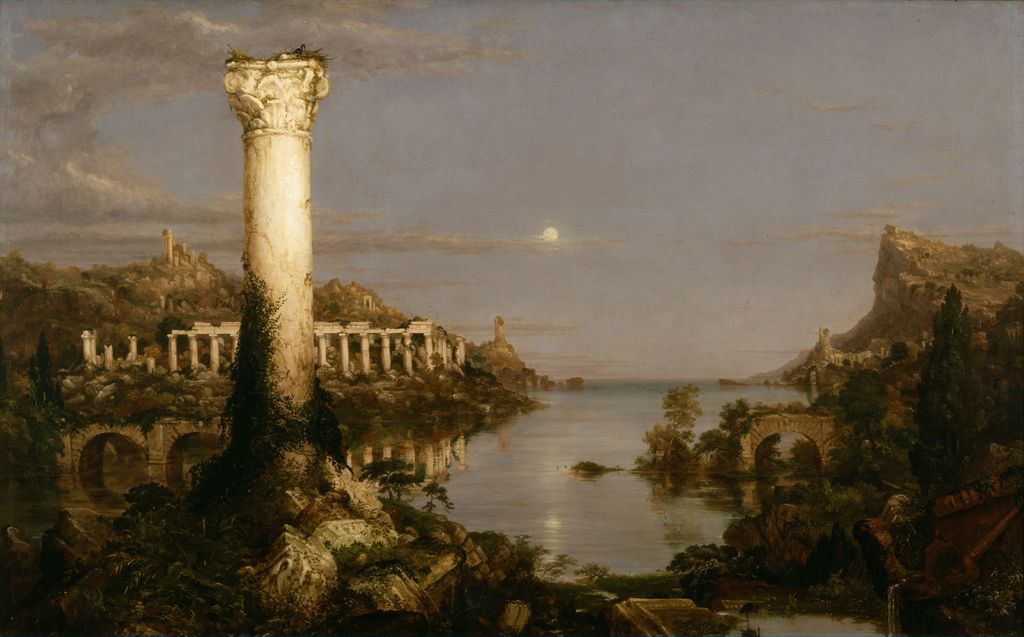
The Course of Empire. Five invented landscapes turn the rise and fall of civilisation into a visual argument. [2]
The Oxbow. An American prospect joined direct observation to a carefully staged view. [2]
The Voyage of Life. The original cycle and Roman replicas give human life the course of a river. [2]
Church’s training. Cole taught Frederic Edwin Church in Catskill. [2]
Home in the Woods. A late cabin landscape brings settlement and surrounding woodland into one scene. [2]
Contents
- Introduction
- The cabin and the clearing
- Family life depends on labour
- Light makes the home visible
- How Cole changed the design
- Settlement, memory and environmental cost
- A late painting made under practical pressures
- From the American Art-Union to Reynolda
The cabin and the clearing
The cabin occupies the right side of the composition. Its broad roof and horizontal logs give it a readable shape against the surrounding trees. Across the lake, low wooded ground leads towards a mountain whose pale summit rises above the darker landscape. Water opens the left half of the picture, allowing the eye to travel beyond the small dwelling. The house draws attention without becoming the largest or most imposing thing we see.
This is an important choice. Had Cole placed the cabin at the centre and made it dominate the view, the landscape might have appeared to exist chiefly as its property or setting. Here, the building remains part of a larger environment. The forest rises behind it, while the distant mountain holds its own position across the water. The household is visually accommodated within the scene rather than allowed to replace it.
Nevertheless, the clearing is a made space. Cut wood and disturbed ground distinguish the immediate surroundings of the cabin from the standing forest. The logs of the house make the relationship especially direct: shelter has been built out of the material of the woods. The contrast between intact trees and felled timber allows the viewer to recognise the practical cost of establishing a home, even within an inviting scene.
The rough foreground also keeps the painting from becoming an entirely smooth pastoral prospect. We look across uneven earth and timber towards the lake and cabin. There is a difference between the comfortable idea of home and the work needed to secure it. Cole gives us enough of that work to make the settlement feel inhabited, while arranging its visible consequences within a composed and reassuring whole.
The word home in the title therefore matters as much as woods. It directs attention to belonging, return and shared daily life. The woods provide the scale and setting; the home supplies the emotional focus. Neither term can be understood independently of the other. A cabin isolated from this landscape would be a different subject, and a landscape without the family would offer a different kind of solitude.
Family life depends on labour
Cole's family figures are small, but they give the landscape a sequence of human actions. Elizabeth Mankin Kornhauser, writing in the 2018 catalogue Thomas Cole's Journey: Atlantic Crossings, connects the picture with a fisherman returning to his wife and young children. She places it alongside The Hunter's Return, where the arrival of hunters similarly organises a domestic scene. In each, obtaining food and coming home are joined within a single landscape. [1]
The figures invite us to imagine relationships rather than merely count inhabitants. Someone approaches; someone waits or welcomes; children belong to the household. Such actions make time felt. The painting holds a moment within a recurring pattern of departure, provision and return. The surrounding water and woods are places through which people move and from which they draw sustenance, as well as objects of contemplation.
Domestic work is part of that relationship. The clothesline in Cole’s study and the activities around the cabin connect the grandeur of landscape with familiar needs. Reynolda's educational interpretation develops precisely this aspect of the picture, using fishing, washing laundry, gathering materials and preparing food to help children consider how the family uses natural resources. These activities offer a useful way of looking, although an educational exercise is not proof that every imagined action is literally depicted. [3]
The painting's harmony consequently rests on labour. A roof must be built, food obtained and household tasks repeated. The scenery may seem abundant, but its abundance does not remove the need to work. Cole makes domestic survival intelligible without turning the picture into a technical account of cabin construction or subsistence farming. Its narrative depends on recognisable tasks, not on an inventory of everything a real household would require.
Nor does the scene supply a named family biography. The figures can be understood as members of an imagined settler household without identifying them as portraits of Cole, his wife or particular children. Kornhauser proposes an autobiographical resonance in these homecoming subjects, connecting them with Cole's family responsibilities and repeated returns from travel. That is a reading of the emotional structure, not evidence that the painted people reproduce his family members' appearances. [1]
This distinction leaves the human feeling intact. The value of return does not depend on knowing the figures' names. Their small size also helps the painting avoid becoming a formal family portrait with scenery behind it. Household life remains inseparable from the physical space that supports and surrounds it.
Light makes the home visible
Light creates a passage between the dense woods and the open lake. The cabin and its immediate surroundings receive enough illumination to become distinct from the trees behind them. The water, distant slopes and broad sky extend the view outwards, while darker vegetation gives the domestic scene a sheltered edge. The effect depends on contrast: the home is welcoming partly because the forest retains depth and shadow.
The colour relationships reinforce this movement. Warm tones in the roof, logs and foreground stand against cooler water and distant mountains. Greens vary from the deep forest near the house to the softer slopes across the lake. These shifts allow distance to become perceptible without making the remote landscape disappear. The mountain remains a firm presence, but its paler colour keeps it from competing with the closer household details.
Cole gives the eye more than one reason to move across the canvas. The low band of water carries it horizontally; trees lift it; the mountain draws it into the distance. The roof of the cabin provides a compact, stable form amid the irregular growth of vegetation. Human architecture and natural forms have different rhythms, and the composition lets them remain different while bringing them into balance.
The sky is especially valuable because it prevents the forest from closing around the figures. Its openness offers visual relief above the lake and mountain. We can see the home as protected without feeling that its inhabitants are confined. That distinction is achieved through the distribution of space, not through an explanatory inscription or a sequence of separate episodes.
The tranquillity is therefore carefully constructed. Small domestic actions occur within a landscape whose broad forms remain still. The picture offers an interval in which the household and its surroundings seem to fit together. Yet shadows, cut timber and the great scale of the mountain keep this tranquillity from becoming weightless. The scene retains enough material resistance to make its comfort something established through effort.
How Cole changed the design
A surviving oil study makes the finished composition more revealing. Study for Home in the Woods, dated about 1847, is painted on board. In that preliminary version, the cabin stands on the left, with a clothesline nearby. A mother and infant emerge from its doorway towards the father returning in a canoe. The sky is filled with clouds. Kornhauser describes the finished painting as a substantial rearrangement: Cole shifted the cabin to the right and opened the view above the lake and mountain. [1]
These changes show that the final arrangement was chosen. The picture cannot be understood simply as a view Cole happened to encounter and transferred intact to a large canvas. Moving the dwelling changes how the human narrative and the distant landscape meet. In the finished work, the cabin gathers the domestic activity to one side, leaving the water and the mountain room to unfold across the rest of the composition.
The study also helps distinguish continuity from revision. A homecoming beside a cabin was already central to the idea. Cole did not need to abandon that narrative in order to improve its setting. He could retain the family relationship while altering the spatial conditions through which the viewer experiences it. The difference between study and finished painting concerns both the distribution of forms and the feeling of the whole.
It would be excessive to claim that every alteration has a single symbolic meaning. A cabin moved from left to right does not, by itself, encode a political position. The secure point is that Cole developed the design, making the landscape more open and giving the mountain and lake a clearer role. Interpretation starts with that visible and documented change rather than replacing it with a hidden message.
The related study for The Hunter's Return follows a comparable method: a swiftly established family narrative becomes a more detailed finished landscape. The two works demonstrate how Cole could use studies to organise an idea before enriching and rebalancing it. They also make the ordinary life of settlers a deliberate late subject within his wider practice. [1]
Watch: Thomas Cole
Choose a film to explore the artist’s work, its interpretation and its wider setting.
Thomas Cole: Painting the American Landscape (remastered audio)
An introduction to Cole’s landscapes and artistic ambitions.
Watch on YouTubeSettlement, memory and environmental cost
It is easy to describe Home in the Woods as a frontier painting, but the term needs care. Kornhauser distinguishes this work and The Hunter's Return from representations of the American West. She reads them as idealised images of early white settlement in northeastern America, drawing on kinds of scenes Cole may have encountered during his earlier travels in New York and New Hampshire. The possible connection to remembered experience is not an identification of a particular cabin or lake. [1]
This distinction changes the historical question. The painting need not be a report of settlers advancing westwards in 1847. It can offer an imagined earlier relationship between family life and nature from the standpoint of a region already experiencing major change. Kornhauser interprets the two pictures as a native American Arcadia, set before the arrival of steamboats and trains. Their peacefulness belongs to a selective construction of the past. [1]
A comparison with River in the Catskills, painted in 1843, helps make the selectivity visible. There, a locomotive crosses the valley and an axeman occupies a landscape marked by felled trees. Kornhauser reads that painting as an anxious response to transformation in Cole's own surroundings. Home in the Woods gives us a different scale of human intervention: the requirements of a household remain within a largely wooded setting. This difference does not erase the cutting of trees; it changes the relation between the clearing and the landscape beyond it. [4]
Cole's own writing complicates any claim that he opposed every alteration of nature. In his journal entry of 1 August 1836, he lamented damage to a favourite walk caused by railroad construction. But he also allowed that works necessary for commerce could be undertaken without destroying scenery, and could sometimes improve access to it. His condemnation centred on insensitivity and unnecessary destruction. That distinction supports a more careful reading of a picture in which human shelter itself requires timber. [5]
The depicted family's apparent harmony is also a limited perspective. The title and composition make their dwelling the focus of belonging. They do not explain the history of land ownership or represent everyone with a relationship to the territory. Recognising an idealised white settler household should prompt attention to what the picture leaves outside its account, including Indigenous histories. The absence of those histories from this domestic narrative cannot establish that the country was previously unoccupied.
This is where admiration and questioning can coexist. Cole's sympathy for home and his concern about environmental destruction do not automatically amount to a full critique of settlement. Equally, the depiction of a cabin is not sufficient evidence that he endorsed every form of expansion. The work's distinctive achievement lies in imagining a modest dwelling within a continuing natural world. Its historical limits lie in how narrowly that image defines the people whose home we are asked to contemplate.
A late painting made under practical pressures
Home in the Woods belongs to the final full year of Cole's life. Its domestic feeling sits alongside his continuing ambition to paint large religious and moral subjects. Kornhauser connects the naturalistic landscapes of the 1840s with difficulty finding patrons for his more ambitious projects, and suggests that the popularity of everyday narrative painting at the American Art-Union may have encouraged the family details in these two cabin scenes. The suggestion concerns an artistic and commercial context, not a proved instruction from a buyer. [1]
Cole's journal offers a more personal account of the pressure. On 9 July 1844, he described a winter spent in New York away from his wife and children, business difficulties and the desire to make works that would edify as well as amuse. On 1 January 1846, he again contrasted the pictures demanded by financial necessity with subjects his imagination urged him to undertake. These entries establish a recurring tension between earning a living and pursuing large ambitions. They do not describe Home in the Woods as a work he disliked. [5]
By Christmas 1846, he was sitting in his nearly completed New Studio, whose walls were still drying. He recorded an intention to enlarge his project The Cross and the World. In early April 1847, he also recorded the birth and death of an infant daughter. The same year therefore held artistic plans and profound domestic grief. This context makes it unwise to treat the painting's contentment as an uncomplicated record of his household's circumstances, or to claim without evidence that it commemorates a particular loss. [5]
The family scene can be appreciated as an imaginative achievement in its own right. Peace is something Cole gives form to through composition, light and human action. Its presence in the picture does not require an absence of difficulty in his life. The very ordinariness of its subject makes it a substantial alternative to the vast historical cycles for which he is famous: moral and emotional meaning can reside in a small homecoming as well as the rise and fall of an empire.
Cole died on 11 February 1848, aged forty-seven. A memorial exhibition at the American Art-Union followed in March. Seen within that short remaining span, Home in the Woods is a late completed painting, but there is no need to turn it into a conscious farewell. Its forms and narrative deserve to be understood before hindsight supplies them with a last message. [6]
From the American Art-Union to Reynolda
The documented early transaction places the painting within the American Art-Union's promotion of American art. The organisation paid Cole $500 for Home in the Woods. He completed it in time to send it down the river for the autumn 1847 sale, where it appeared as number 7. The same sum had been paid for The Hunter's Return by its individual patron, George W. Austin. These records show that both domestic landscapes had a place in Cole's professional market. [1]
The Art-Union also explains how an image of modest household life could address an audience beyond a single private patron. Its five-dollar annual subscription provided an engraving and entry into a lottery for an original painting. Receiving the print was part of membership; receiving an oil painting depended on the drawing. The arrangement brought original works and reproductions into a shared system of public interest and collecting. [1]
The 2018 catalogue identifies the finished canvas at Reynolda House Museum of American Art, with the credit line recording Barbara B. Millhouse's gift and accession number 1978.2.2. That establishes a secure modern collection identity without requiring a reconstructed chain of every intervening owner. Reynolda's educational treatment continues to draw attention to the painting's combination of family activity, landscape and resource use. [1] [3]
These subjects remain closely connected. The picture invites us to recognise the comfort of a home while noticing the clearing that makes it possible. Its lake and mountain resist reduction to background decoration, and its small people resist reduction to symbols of an impersonal national process. To spend time with Home in the Woods is to attend to the scale at which living becomes possible, and to the larger world that such living alters but cannot wholly possess.
Artworks directory
Explore paintings, drawings and studies across Cole’s career. The two Voyage of Life sets appear separately. Dates and study identifications draw on the exhibition and collection catalogues, supplemented by the National Gallery’s drawing records. [2] [7] [8] [9]
| Name | Date | Medium |
|---|---|---|
| The Oxbow | 1836 | Painting |
| The Titan’s Goblet | 1833 | Painting |
| The Architect’s Dream | 1840 | Painting |
| The Course of Empire: The Savage State | ca. 1834 | Painting |
| The Course of Empire: The Arcadian or Pastoral State | ca. 1834 | Painting |
| The Course of Empire: The Consummation of Empire | 1835–1836 | Painting |
| The Course of Empire: Destruction | 1836 | Painting |
| The Course of Empire: Desolation | 1836 | Painting |
| The Voyage of Life: Childhood | 1842 | Painting |
| The Voyage of Life: Youth | 1842 | Painting |
| The Voyage of Life: Manhood | 1842 | Painting |
| The Voyage of Life: Old Age | 1842 | Painting |
| Home in the Woods | 1847 | Painting |
| Distant View of Niagara Falls | 1830 | Painting |
| View on the Catskill—Early Autumn | 1836–37 | Painting |
| Lake with Dead Trees (Catskill) | 1825 | Painting |
| River in the Catskills | 1843 | Painting |
| A View of the Mountain Pass Called the Notch of the White Mountains (Crawford Notch) | 1839 | Painting |
| Expulsion from the Garden of Eden | 1828 | Painting |
| The Subsiding of the Waters of the Deluge | 1829 | Painting |
| The Mountain Ford | 1846 | Painting |
| American Lake Scene | 1844 | Painting |
| A View near Tivoli (Morning) | 1832 | Painting |
| Aqueduct near Rome | 1832 | Painting |
| The Hunter’s Return | 1845 | Painting |
| The Voyage of Life: Childhood (first version) | 1840 | Painting |
| The Voyage of Life: Youth (first version) | 1840 | Painting |
| The Voyage of Life: Manhood (first version) | 1840 | Painting |
| The Voyage of Life: Old Age (first version) | 1840 | Painting |
| Panorama of the Oxbow on the Connecticut River as seen from Mount Holyoke | ca. 1832 (museum); 1833 (2018 catalogue) | Drawing |
| Sketch for The Oxbow | 1836 | Painting |
| From Nature | 1823 | Drawing |
| View of the Round-Top in the Catskill Mountains (Sunny Morning on the Hudson) | 1827 | Painting |
| Scene from The Last of the Mohicans: Cora Kneeling at the Feet of Tamenund | 1827 | Painting |
| View of Monte Video, the Seat of Daniel Wadsworth | 1828 | Painting |
| The Garden of Eden | 1828 | Painting |
| Tomb of General Brock, Queenston Heights, Ontario | 1830 | Painting |
| Effect for Newstead Abbey, Nottinghamshire, England | 1830 | Drawing |
| The Ilissos, from the Parthenon West Pediment | 1829 or 1830 | Drawing |
| Life Study for the Prostrate Shepherd in The Angel Appearing to the Shepherds | 1831–1832 | Painting |
| Interior of the Colosseum, Rome | ca. 1832 | Painting |
| Campagna di Roma (Study for Aqueduct near Rome) | 1832 | Painting |
| Landscape with a Round Temple | ca. 1830s | Painting |
| Stormy Landscape | 1832 | Painting |
| View of Florence from San Miniato | 1837 | Painting |
| Mount Holyoke, Massachusetts (after Basil Hall) | ca. 1829–1831 | Drawing |
| Layout for The Course of Empire | 1833 | Drawing |
| Study for The Course of Empire: The Savage State | ca. 1834 | Painting |
| Study for The Course of Empire: The Arcadian or Pastoral State | ca. 1834 | Painting |
| Study for The Course of Empire: Desolation | 1836 | Painting |
| Study for Dream of Arcadia | 1838 | Painting |
| Clouds | ca. 1830s | Painting |
| Study for The Hunter’s Return | 1845 | Painting |
| Study for Home in the Woods | ca. 1847 | Painting |
| Sunrise in the Catskills | 1826 | Painting |
| Study for The Mountain Ford | 1846 | Drawing |
| Tree Trunks | 1825–1840 | Drawing |
Frequently Asked Questions
It belongs to Reynolda House Museum of American Art in Winston-Salem, North Carolina. The recorded credit is the gift of Barbara B. Millhouse, accession 1978.2.2. [1]
The 2018 catalogue interprets it as an idealised scene of early white settlement in northeastern America. It should not be treated as documentary evidence of Western frontier life or as a view of a securely identified location. [1]
Their identities are not established. Kornhauser suggests that the homecoming narrative may echo Cole's own family commitments and travels, but that interpretation does not identify individual figures as portraits. [1]
The study places the cabin on the left under a cloud-filled sky. Cole moved the cabin to the right in the finished canvas and opened the view towards the lake, sky and mountain. [1]
The work presents a sympathetic domestic scene, but that does not establish an endorsement of all settlement or expansion. Its small clearing can be read alongside Cole's criticism of unnecessary destruction and his distinction between such destruction and useful alterations of scenery. [5]
Discussion
Look again at Home in the Woods and compare your reading with the questions below.
Reader Insights
Does the cut timber around the cabin strengthen the picture's sense of a hard-earned home, or disturb its apparent harmony with the forest?
How would your understanding of the family's place in the landscape change if Cole had kept the cabin on the left, as in the oil study?
Which detail or comparison would you add to this account, and what evidence supports your reading?
Join the Conversation
Share the details that shaped your response, or suggest a comparison for other readers.
References
- Elizabeth Mankin Kornhauser, entries 65–66, “Study for The Hunter's Return” and “Study for Home in the Woods”, in Thomas Cole's Journey: Atlantic Crossings, by Elizabeth Mankin Kornhauser and Tim Barringer, with Dorothy Mahon, Christopher Riopelle and Shannon Vittoria, 2018, printed pp. 227–228, figs. 134–135 (PDF pp. 231–233). https://cdn.sanity.io/files/cctd4ker/production/be901737ad5f92e33d91db53c6dd8ce6ed47ff27.pdf
- Elizabeth Mankin Kornhauser and Tim Barringer, Thomas Cole’s Journey: Atlantic Crossings (2018). Career context and artwork/study metadata: catalogue entries 10–66 and chronology, PDF pp. 137–231 and 249–262; related Barringer essay passages, PDF pp. 23–66.
- Reynolda House Museum of American Art, “Home in the Woods — Combined Gardens and House Tour”, undated, educational description and learning objectives, unpaginated. https://reynolda.org/home-in-the-woods-combined-gardens-and-house-tour/
- Elizabeth Mankin Kornhauser, entry 63, “River in the Catskills”, in Thomas Cole's Journey: Atlantic Crossings, 2018, printed pp. 223–224 (PDF pp. 227–228). https://cdn.sanity.io/files/cctd4ker/production/be901737ad5f92e33d91db53c6dd8ce6ed47ff27.pdf
- Thomas Cole, journal, transcribed by Peter Fedoryk and published by the Thomas Cole National Historic Site, 2022; entries 1 August 1836, 9 July 1844, 1 January 1846, Christmas Day 1846 and 3–6 April 1847, PDF pp. 23–24, 61–62 and 67–68. Original: New York State Library, Thomas Cole Papers, SC10635, Box 4a, Folder 1. https://thomascole.org/wp-content/uploads/FINAL-PDF-for-Website-2022.pdf
- Shannon Vittoria, “Chronology”, in Thomas Cole's Journey: Atlantic Crossings, 2018, printed p. 257 (PDF p. 261), entries 11 February and 27 March 1848. https://cdn.sanity.io/files/cctd4ker/production/be901737ad5f92e33d91db53c6dd8ce6ed47ff27.pdf
- Franklin Kelly et al., American Paintings of the Nineteenth Century, Part I (National Gallery of Art, 1996). Cole catalogue and both Voyage of Life sets, PDF pp. 91–124.
- National Gallery of Art, Study for The Mountain Ford (1846), accession 2015.19.772. Collection record and open-access image.
- National Gallery of Art, Tree Trunks (1825–1840), accession 2015.19.607. Collection metadata and open-access image.
- Splash image source.
Thomas Cole, Home in the Woods, 1847. Oil on canvas. Reynolda House Museum of American Art, Winston-Salem, North Carolina, Gift of Barbara B. Millhouse (1978.2.2).