by Tom Gurney
Tom Gurney BSc (Hons) is an art history expert with over 20 years experience
Published on June 19, 2020 / Updated on October 27, 2026
Email: tomgurney1@gmail.com / Phone: +44 7429 011000
The Hunter’s Return by Thomas Cole: Introduction
In The Hunter’s Return, two men carry a deer out of the forest towards a cabin, where a family waits to greet them. Beyond this small homecoming, autumn trees, a lake and a mountain fill a landscape far larger than the human figures. Thomas Cole completed the painting in 1845; it belongs to the Amon Carter Museum of American Art in Fort Worth, Texas. The scene promises shelter and abundance, yet the felled trees at its edge complicate that promise. Making a home here has already changed the woods. [1]
The warmth of the reunion is essential to the picture, but so is its setting within a landscape under cultivation. Cole joins the pleasures of family life to questions about what people take from nature, what they preserve and how much alteration a beautiful place can bear. The result is a welcoming image with an unsettled margin: the household seems secure, while the foreground records the cutting and killing on which that security partly depends.
At a Glance
- ArtistThomas Cole (1801–1848)
- TitleThe Hunter’s Return
- Completed1845; commissioned in 1844
- MediumOil on canvas
- Dimensions101.9 × 153.7 cm (40⅛ × 60½ inches)
- CollectionAmon Carter Museum of American Art, Fort Worth, Texas
- Accession number1983.156
- Commissioning patronGeorge W. Austin; price $500
The museum records the canvas as signed and dated 1845. Elizabeth Mankin Kornhauser’s catalogue account establishes the earlier commission and its payment. [1] [2]
This work in Cole’s career
First European journey
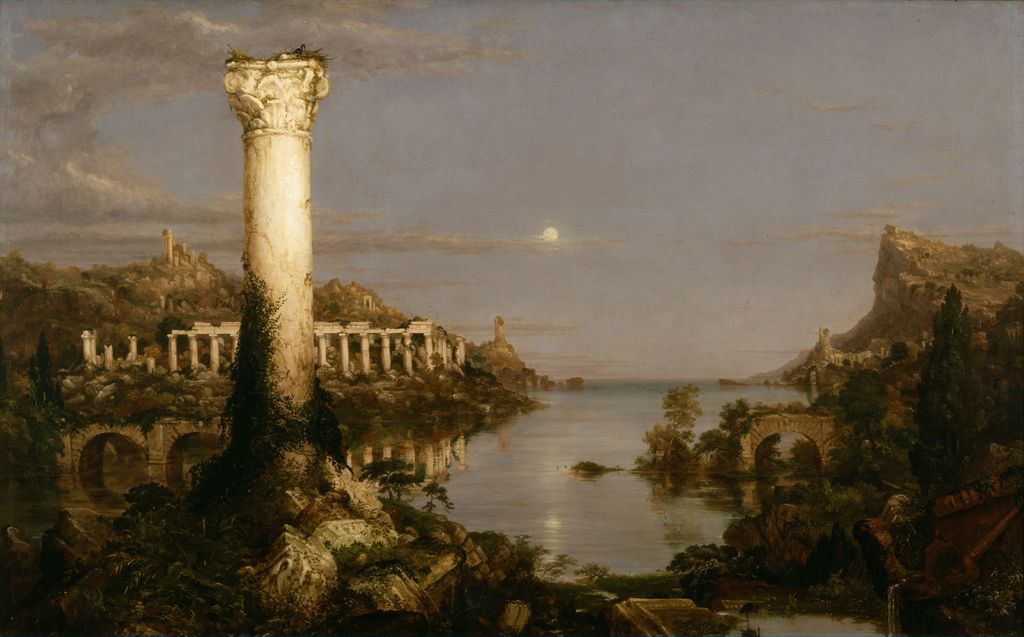
1829–1832The Course of Empire
1834–1836The Oxbow
1836The Voyage of Life
1840 and 1842Church’s training
1844–1846Notes and sources
American recognition. Three New York sales brought Cole to the attention of artists and patrons. [3]
First European journey. Looking in Britain and Italy enlarged the repertoire of his American landscapes. [3]
The Course of Empire. Five invented landscapes turn the rise and fall of civilisation into a visual argument. [3]
The Oxbow. An American prospect joined direct observation to a carefully staged view. [3]
The Voyage of Life. The original cycle and Roman replicas give human life the course of a river. [3]
Church’s training. Cole taught Frederic Edwin Church in Catskill. [3]
The Hunter’s Return. George W. Austin’s 1844 commission led to the completed 1845 canvas, joining a family reunion to a landscape changed by settlement. [2]
Home in the Woods. A late cabin landscape brings settlement and surrounding woodland into one scene. [3]
Contents
- Introduction
- A homecoming within a mountain landscape
- Austin’s commission and Cole’s oil study
- Family, hunting and the cultivated garden
- An American Arcadia, with limits
- The woods and the changing Northeast
- A related home, a different route to an audience
- The painting in the Carter collection
A homecoming within a mountain landscape
Cole gives the returning hunters a clear destination. They approach from the wooded left towards the cabin on the right, crossing the space between forest and cultivated ground. Their burden hangs between them from a pole, while the greeting of the man nearest the house turns the labour of carrying it into a moment of recognition. The landscape remains expansive, but this gesture makes its lower part feel intimate. We can follow a human action without losing sight of the distant mountain. [1]
The cabin occupies a modest clearing rather than dominating the scene. Its low roof and timber walls belong among the surrounding trees; the pale garden and patches of warm foliage draw attention to it without making it the largest form. Trees rise high on either side, establishing the scale of the mountain beyond. The lake opens a quiet interval between the foreground activity and the rocky distance. It gives the eye somewhere to pause before moving upwards towards the sky.
That arrangement makes two kinds of looking possible at once. From a distance, the painting reads as an autumn landscape with a small habitation tucked into it. Looking more closely, the figures become a story about arrival, welcome and provisions. Neither experience cancels the other. The family gives the valley emotional meaning, while the valley places that family within a world whose extent exceeds its immediate needs.
Light helps hold the two scales together. The distant mountain and parts of the clearing catch illumination, while much of the wooded foreground remains darker. Across this change in brightness, the cabin is neither isolated in a theatrical spotlight nor swallowed by the forest. The illuminated garden offers a bridge between its sheltered entrance and the open view. The sense of belonging comes partly from these connections between adjoining spaces, rather than from any single emblem.
There is also a difference between the time of the landscape and the time of the action. The mountain appears enduring; the coloured leaves suggest a season approaching its close. The hunters’ return is a fleeting event within those larger durations. Cole makes a brief gesture of welcome matter without pretending that it can command the whole scene. This balance between human incident and an extensive view is one of the painting’s most persuasive effects.
Austin’s commission and Cole’s oil study
George W. Austin, a New York auctioneer and art collector, commissioned The Hunter’s Return in 1844 and paid Cole five hundred dollars. The finished picture is dated 1845. Those dates describe different stages in the work’s history: the patron’s request preceded the completed canvas. The museum’s record of the inscription confirms 1845, so the commission year should not replace the painting’s date. [2] [1]
The surviving Study for The Hunter’s Return, also dated 1845 in the 2018 catalogue, shows how much of the conception was established before the large canvas. It is a small oil painting on paper mounted on canvas, measuring 19.1 × 25.4 cm. Kornhauser describes its tall framing trees, a boy leading two hunters with a deer, and a cabin whose waiting figures complete the homecoming. A lake and a distant mountain already provide the larger setting. This is a study for the composition, rather than another full-sized version of the finished work. [2]
The relationship between sketch and canvas is especially revealing because the additions are small in scale but substantial in meaning. Kornhauser identifies a cabbage patch near the house and a large trunk in the lower right foreground as details added in the finished painting. One makes cultivation more explicit; the other makes the removal of trees more conspicuous. The finished picture therefore develops both the household’s provision and the alteration of its surroundings. Its greater detail does more than make the scene picturesque. [2]
The study also prevents us from treating the scene as an unmediated glimpse of life in the woods. Cole organised the figures and landscape as a coherent pictorial idea. The repeated structure across study and canvas shows the importance of their relationships: return towards a home, a small clearing enclosed by taller growth, and human movement under a distant mountain. It does not establish that every cabin, person or ridge was copied from one identifiable location.
Kornhauser places the work among the landscapes Cole continued to make while struggling to obtain support for ambitious historical and religious projects. Austin’s payment belongs to that practical history of patronage. A landscape could provide income while still carrying demanding ideas about American life. The painting’s accessible family story and its larger concerns about settlement need not be understood as opposing ambitions. Both depend on Cole’s ability to make a natural setting carry a narrative. [2]
Family, hunting and the cultivated garden
The title directs attention to the hunter, but the painting distributes the homecoming among several people. The museum’s visual description identifies a younger and an older man carrying the deer, with a boy ahead of them carrying a long rifle. Near the cabin, a woman holds up a baby; another girl appears in the doorway, and a younger child embraces a dog. The action belongs to the household as a group, rather than solely to the man who raises his hat. [1]
These separate responses keep the greeting from becoming a rigid tableau. Some figures advance, some wait, and some remain close to the house. The shared event connects them across the clearing. The boy’s position ahead of the men helps lead the movement towards the cabin, while the waiting figures draw it to a close. Even at their small scale, the differences between bodies in motion and bodies receiving them make the reunion legible.
Domestic life includes a touch of mischief. According to the museum’s description, a black dog beside the doorway attempts to take meat from a bench, while the other dog is held by a child. The contrast adds an ordinary, comic distraction to the ceremonial welcome. Animals are not merely distant inhabitants of the wilderness here: they enter the family’s affections and its food supply. This minor episode gives the household a liveliness that a purely solemn treatment would lack. [1]
The garden broadens the account of provision. The museum describes rows of vegetables and a patch of coloured flowers, and its handbook text specifically identifies cabbages. The hunt brings food from the surrounding woods; cultivation brings food from a managed plot beside the house. Flowers contribute a further kind of attention to the place, suggesting that the clearing can accommodate pleasure as well as immediate necessity. These are complementary uses of the land within the picture. [1]
The arrangement also gives the scene a recognisable division of activity. The men and boy approach with weapons and game, while the women and younger children gather near the cabin. That is the household order represented by Cole, not a complete account of all the work that such a family would have performed. The vegetables, house and prepared food imply a life extending beyond the particular task named in the title. We encounter that life at a moment of reunion, with much of its labour already accomplished.
Kornhauser suggests that the returns depicted here and in Home in the Woods can be read alongside Cole’s own repeated journeys back to his family. She also notes his financial responsibilities to relatives. This supplies a possible autobiographical resonance, but it does not turn the painted settlers into identified portraits of the Coles. A familiar experience can inform a subject without determining the identity of each figure. The painting’s emotional force does not require a family likeness to be proved. [2]
An American Arcadia, with limits
Kornhauser describes The Hunter’s Return and Home in the Woods as Cole’s versions of an American Arcadia: an ideal rural world expressed through native scenery and modest households. She locates their subjects in the early white settlement of northeastern America, rather than in the contemporary frontier of the American West. She proposes that they may draw on scenes encountered during Cole’s earlier travels in New York State and New Hampshire. The possibility is significant, but it does not identify this valley as a securely documented site. [2]
This distinction changes how the painting’s apparent immediacy should be understood. A log cabin, rifles and a forest clearing can easily encourage a generalised idea of westward pioneering. Here, the scholarly account instead places the scene within an older northeastern rural world. Cole offers a composed image of settlement, viewed through nostalgia, rather than a report from a newly advancing western frontier. The autumn setting contributes to that sense of a beautiful condition already vulnerable to passing away.
The family’s apparent harmony is also a particular settler interpretation of the land. Within the image, the clearing functions as a welcome home, and the surrounding woods furnish both beauty and resources. That makes the household seem at ease in its setting. It does not establish that settlement was harmless, or that the land had no history before these inhabitants. No Indigenous people are represented in the domestic narrative; their absence cannot serve as evidence that the territory had been empty.
The foreground gives the strongest visible reason to resist an entirely innocent reading. Stumps and cut trunks mark the reduction of the forest. They are both useful material and signs of loss. Similarly, the deer supplies the returning men with food and a reason for celebration, but it remains a dead animal carried out of the woods. The picture does not conceal these costs beneath its foliage. They sit close to the viewer, beside the pleasures of reunion. [1]
There is no need to reduce this coexistence to a single verdict. The cabin can embody shelter while depending on cleared land; the garden can look abundant while occupying a place formerly covered by trees. What distinguishes the scene is the scale and setting of the alteration. The house remains enclosed by woods, lake and mountain. Its occupants have made an opening within the landscape, and the composition lets us see both that opening and the greater world around it.
Watch: Thomas Cole
Choose a film to explore the artist’s work, its interpretation and its wider setting.
Thomas Cole: Painting the American Landscape (remastered audio)
An introduction to Cole’s landscapes and artistic ambitions.
Watch on YouTubeThe woods and the changing Northeast
The Carter’s handbook interpretation connects the painting with environmental changes Cole witnessed near Catskill. It identifies railroad building and leather tanning as activities that diminished northeastern forests, and proposes that the cabin scene may answer those changes with an agrarian ideal. The museum treats the foreground stumps as signs of both Euro-American development and nature’s vulnerability. That is a modern interpretation of the work’s tensions, rather than a documented explanation supplied by Cole for this particular canvas. [1]
A dated entry in Cole’s journal helps clarify the broader concern. On 1 August 1836, he recorded a walk near Catskill where railroad construction had disturbed a favourite place. He criticised the unnecessary destruction of trees, while allowing that works needed for commerce could be undertaken with greater regard for scenery and might even make it more accessible. His position was more discriminating than a rejection of every human intervention. The journal passage predates The Hunter’s Return and gives context, not a commission instruction. [4]
That distinction is useful when looking at the cabin and its clearing. Cole’s concern with destructive development does not require the house to represent an untouched natural world. It visibly cannot: its garden, timber and food all depend on intervention. What the scene makes imaginable is a limited habitation within a still extensive landscape. Whether such a balance could last is another question. The peaceful welcome establishes an appealing condition without showing its future.
A comparison with River in the Catskills sharpens this point. In that 1843 painting, a locomotive and cleared land bring modern transport into the rural prospect. Kornhauser contrasts it with the earlier View on the Catskill — Early Autumn, whose tranquil scene preserves an idealised rural past. The Hunter’s Return belongs to the same larger conversation about human habitation, but makes its argument through a family’s scale of life and the enclosing forest. [5]
The absence of a train here matters because it leaves the relationship between household and surroundings as the principal subject. Smoke from a cabin chimney, described by the museum, belongs to the small domestic setting. Against that, the distant mountain remains a large, open form. The scene invites us to experience the attraction of a life whose needs appear to fit within the valley, while the chopped timber makes the attraction less simple than it first seems. [1]
A related home, a different route to an audience
Home in the Woods, completed in 1847, offers a close comparison, but the two paintings should retain their separate histories. Both bring a returning provider towards a cabin beside water, and both surround a family with a much larger landscape. In Kornhauser’s account, the later painting substitutes a fisherman’s return for the hunters’ arrival. The relationship between livelihood and reunion persists, while the immediate action changes. [2]
Their studies show different degrees of revision. The study for The Hunter’s Return already establishes the cabin and the returning party in the essential arrangement of the finished picture. In the study for Home in the Woods, however, the cabin stands on the left and the father returns in a canoe. Cole moves the cabin to the right in the completed painting and opens the prospect towards the lake and mountain. This comparison shows that a recurring subject did not require an unchanging design. [2]
The routes to ownership also differed. Austin’s private commission produced The Hunter’s Return. The American Art-Union paid Cole five hundred dollars for Home in the Woods, which he completed for its autumn 1847 distribution. The same price connected the two works economically, but the Art-Union created a broader public setting: subscribers received an engraving and entered a lottery for an original painting. Its purchase of the later work does not make it the commissioner of the earlier one. [2]
Kornhauser suggests that the expanding popularity of genre painting, promoted by the Art-Union, may help explain the developed domestic narratives in these landscapes. Genre painting focused on scenes of everyday life, and the welcoming family gives Cole’s great landscape an immediately intelligible human interest. The connection is a proposed influence, rather than proof that Austin demanded a fashionable formula. It helps explain how this picture can operate at once as scenery, story and reflection on rural life. [2]
The painting in the Carter collection
The completed canvas is identified in the Amon Carter Museum of American Art’s collection by accession number 1983.156. Its recorded size is approximately a metre high and a metre and a half wide, giving generous space to a family scene whose figures occupy only a small portion of the surface. The preparatory oil study is a separate object, and its history should not be folded into that of the museum’s painting. [1] [2]
The museum records its inclusion in Wild Spaces, Open Seasons: Hunting and Fishing in American Art, shown at the Carter from 7 October 2017 to 7 January 2018. That exhibition placed it in a longer history of outdoor subjects and changing relationships with nature. The work also appeared in the museum’s 2018–19 collection exhibition From Remington to O’Keeffe: The Carter’s Greatest Hits. These exhibitions brought its family scene into changing contexts of American landscape and outdoor life. [1]
The museum’s environmental interpretation allows the painting’s appeal to remain intact while examining its costs. The greeting, garden and sheltered doorway still make a persuasive image of home. The severed trunks, weapons and deer remain equally present. Cole gives the viewer a place to enter emotionally, then enough surrounding space to reconsider the terms of that welcome. The family’s happiness and the landscape’s vulnerability are visible together, held within the same autumn light.
Artworks directory
Explore paintings, drawings and studies across Cole’s career. The two Voyage of Life sets appear separately. Dates and study identifications draw on the exhibition and collection catalogues, supplemented by the National Gallery’s drawing records. [3] [6] [7] [8]
| Name | Date | Medium |
|---|---|---|
| The Oxbow | 1836 | Painting |
| The Titan’s Goblet | 1833 | Painting |
| The Architect’s Dream | 1840 | Painting |
| The Course of Empire: The Savage State | ca. 1834 | Painting |
| The Course of Empire: The Arcadian or Pastoral State | ca. 1834 | Painting |
| The Course of Empire: The Consummation of Empire | 1835–1836 | Painting |
| The Course of Empire: Destruction | 1836 | Painting |
| The Course of Empire: Desolation | 1836 | Painting |
| The Voyage of Life: Childhood | 1842 | Painting |
| The Voyage of Life: Youth | 1842 | Painting |
| The Voyage of Life: Manhood | 1842 | Painting |
| The Voyage of Life: Old Age | 1842 | Painting |
| Home in the Woods | 1847 | Painting |
| Distant View of Niagara Falls | 1830 | Painting |
| View on the Catskill—Early Autumn | 1836–37 | Painting |
| Lake with Dead Trees (Catskill) | 1825 | Painting |
| River in the Catskills | 1843 | Painting |
| A View of the Mountain Pass Called the Notch of the White Mountains (Crawford Notch) | 1839 | Painting |
| Expulsion from the Garden of Eden | 1828 | Painting |
| The Subsiding of the Waters of the Deluge | 1829 | Painting |
| The Mountain Ford | 1846 | Painting |
| American Lake Scene | 1844 | Painting |
| A View near Tivoli (Morning) | 1832 | Painting |
| Aqueduct near Rome | 1832 | Painting |
| The Hunter’s Return | 1845 | Painting |
| The Voyage of Life: Childhood (first version) | 1840 | Painting |
| The Voyage of Life: Youth (first version) | 1840 | Painting |
| The Voyage of Life: Manhood (first version) | 1840 | Painting |
| The Voyage of Life: Old Age (first version) | 1840 | Painting |
| Panorama of the Oxbow on the Connecticut River as seen from Mount Holyoke | ca. 1832 (museum); 1833 (2018 catalogue) | Drawing |
| Sketch for The Oxbow | 1836 | Painting |
| From Nature | 1823 | Drawing |
| View of the Round-Top in the Catskill Mountains (Sunny Morning on the Hudson) | 1827 | Painting |
| Scene from The Last of the Mohicans: Cora Kneeling at the Feet of Tamenund | 1827 | Painting |
| View of Monte Video, the Seat of Daniel Wadsworth | 1828 | Painting |
| The Garden of Eden | 1828 | Painting |
| Tomb of General Brock, Queenston Heights, Ontario | 1830 | Painting |
| Effect for Newstead Abbey, Nottinghamshire, England | 1830 | Drawing |
| The Ilissos, from the Parthenon West Pediment | 1829 or 1830 | Drawing |
| Life Study for the Prostrate Shepherd in The Angel Appearing to the Shepherds | 1831–1832 | Painting |
| Interior of the Colosseum, Rome | ca. 1832 | Painting |
| Campagna di Roma (Study for Aqueduct near Rome) | 1832 | Painting |
| Landscape with a Round Temple | ca. 1830s | Painting |
| Stormy Landscape | 1832 | Painting |
| View of Florence from San Miniato | 1837 | Painting |
| Mount Holyoke, Massachusetts (after Basil Hall) | ca. 1829–1831 | Drawing |
| Layout for The Course of Empire | 1833 | Drawing |
| Study for The Course of Empire: The Savage State | ca. 1834 | Painting |
| Study for The Course of Empire: The Arcadian or Pastoral State | ca. 1834 | Painting |
| Study for The Course of Empire: Desolation | 1836 | Painting |
| Study for Dream of Arcadia | 1838 | Painting |
| Clouds | ca. 1830s | Painting |
| Study for The Hunter’s Return | 1845 | Painting |
| Study for Home in the Woods | ca. 1847 | Painting |
| Sunrise in the Catskills | 1826 | Painting |
| Study for The Mountain Ford | 1846 | Drawing |
| Tree Trunks | 1825–1840 | Drawing |
Frequently Asked Questions
George W. Austin, a New York auctioneer and art collector, commissioned it and paid Cole $500. The American Art-Union’s purchase of Home in the Woods was a separate transaction. [2]
It belongs to the Amon Carter Museum of American Art in Fort Worth, Texas, accession number 1983.156. Its medium is oil on canvas. [1]
Kornhauser interprets the subject as early white settlement in northeastern America, with possible connections to Cole’s travels in New York and New Hampshire. It should not be treated as a documentary view of western frontier life. [2]
The return to a waiting household has been given a possible autobiographical reading, but that does not establish the figures as identified portraits of Cole and his relatives. [2]
They show that creating the home and garden has changed the forest. The Carter interprets the stumps as holding together the idea of settler development and the fragility of nature, complicating the scene’s apparent harmony. [1]
Discussion
Look again at The Hunter’s Return and compare your reading with the questions below.
Reader Insights
How do the garden, deer and cut trunks change your response to the family’s welcome? Which details make the scene feel secure, and which make it feel vulnerable?
Does the great expanse of forest, lake and mountain make the household seem to belong within nature, or remind you of the limits of its control?
Which detail or comparison would you add to this account, and what evidence supports your reading?
Join the Conversation
Share the details that shaped your response, or suggest a comparison for other readers.
References
- Amon Carter Museum of American Art, “The Hunter’s Return”, collection record, visual description, Carter Handbook (2023) object text and recorded exhibition history. Current object metadata: 1845, oil on canvas, 40⅛ × 60½ inches, accession 1983.156.
- Elizabeth Mankin Kornhauser, catalogue entries 65–66, “Study for The Hunter’s Return” and “Study for Home in the Woods”, in Elizabeth Mankin Kornhauser and Tim Barringer, Thomas Cole’s Journey: Atlantic Crossings, Metropolitan Museum of Art, 2018, pp. 227–228 (PDF pp. 231–232), figs. 134–135; associated notes, p. 273 (PDF p. 277).
- Elizabeth Mankin Kornhauser and Tim Barringer, Thomas Cole’s Journey: Atlantic Crossings (2018). Career context and artwork/study metadata: catalogue entries 10–66 and chronology, PDF pp. 137–231 and 249–262; related Barringer essay passages, PDF pp. 23–66.
- Thomas Cole, Thomas Cole’s Journal, transcribed by Peter Fedoryk, Thomas Cole National Historic Site, 2022, entry for 1 August 1836, PDF pp. 23–24.
- Elizabeth Mankin Kornhauser, catalogue entries 62–63, “View on the Catskill — Early Autumn” and “River in the Catskills”, in Thomas Cole’s Journey: Atlantic Crossings, Metropolitan Museum of Art, 2018, pp. 222–224 (PDF pp. 226–228).
- Franklin Kelly et al., American Paintings of the Nineteenth Century, Part I (National Gallery of Art, 1996). Cole catalogue and both Voyage of Life sets, PDF pp. 91–124.
- National Gallery of Art, Study for The Mountain Ford (1846), accession 2015.19.772. Collection record and open-access image.
- National Gallery of Art, Tree Trunks (1825–1840), accession 2015.19.607. Collection metadata and open-access image.
- Splash image source.
Thomas Cole, The Hunter’s Return, 1845. Oil on canvas, 101.9 × 153.7 cm. Amon Carter Museum of American Art, Fort Worth, Texas (1983.156).