by Tom Gurney
Tom Gurney BSc (Hons) is an art history expert with over 20 years experience
Published on June 19, 2020 / Updated on October 27, 2026
Email: tomgurney1@gmail.com / Phone: +44 7429 011000
The Mountain Ford by Thomas Cole: Introduction
A white horse steps into dark water beneath a mountain that fills much of the sky. Its rider is a small presence in an immense, closely wooded landscape, yet the bright animal and the rider's warm red clothing make them difficult to overlook. In The Mountain Ford, Thomas Cole gives a river crossing the weight of a human encounter with a world whose scale exceeds our own. Painted in 1846, the oil on canvas belongs to the Metropolitan Museum of Art in New York. [1]
The scene feels particular: rocks interrupt the stream, roots grip the bank, and light catches the summit. The Met interprets its setting as imagined and associates the rider with an allegorical tradition. Those readings remain distinct from an identification of a particular place or person. [1]
At a Glance
- ArtistThomas Cole
- TitleThe Mountain Ford
- Date1846
- MediumOil on canvas
- Dimensions71.8 × 101.8 cm
- CollectionMetropolitan Museum of Art, New York
- Accession number15.30.63
- Related studyStudy for The Mountain Ford, 1846, National Gallery of Art, Washington
The painting details follow the Met's object record; the related drawing is catalogued by the National Gallery of Art. [1] [2]
This work in Cole’s career
First European journey
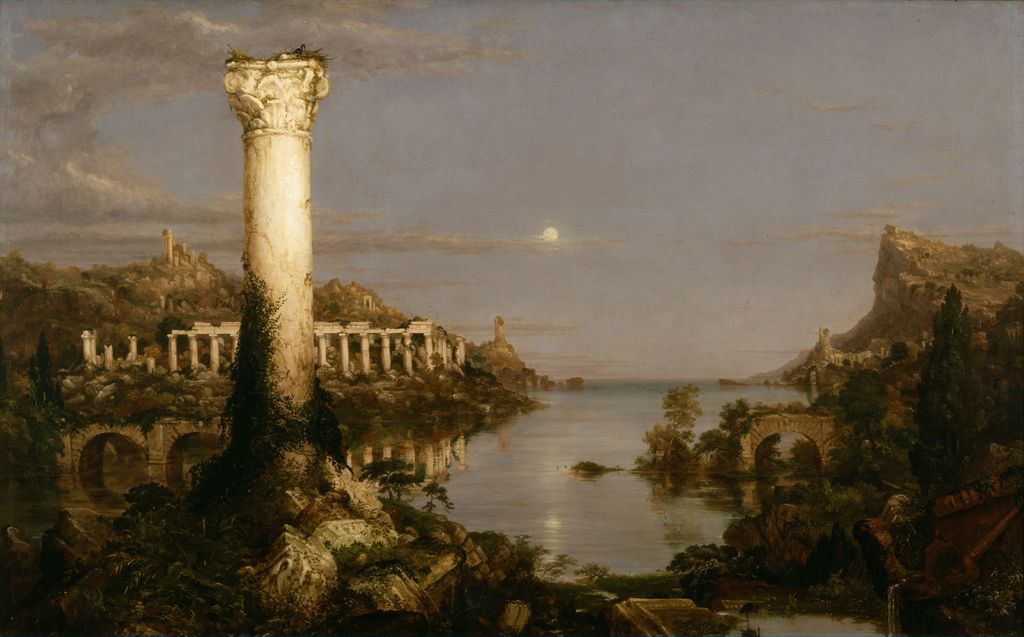
1829–1832The Course of Empire
1834–1836The Oxbow
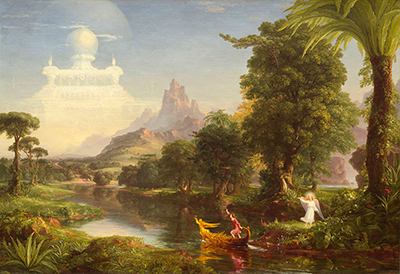
1836The Voyage of Life
1840 and 1842Church’s training
1844–1846Notes and sources
American recognition. Three New York sales brought Cole to the attention of artists and patrons. [3]
First European journey. Looking in Britain and Italy enlarged the repertoire of his American landscapes. [3]
The Course of Empire. Five invented landscapes turn the rise and fall of civilisation into a visual argument. [3]
The Oxbow. An American prospect joined direct observation to a carefully staged view. [3]
The Voyage of Life. The original cycle and Roman replicas give human life the course of a river. [3]
Church’s training. Cole taught Frederic Edwin Church in Catskill. [3]
The Mountain Ford. A surviving 1846 drawing for this late landscape records the rider, crossing and mountain as a separate stage of Cole’s working process. [2]
Home in the Woods. A late cabin landscape brings settlement and surrounding woodland into one scene. [3]
Contents
- Introduction
- A crossing held in suspense
- How the mountain governs the view
- An imagined place made persuasive
- The drawing and the finished canvas
- Painting detail without losing the whole
- A solitary journey, rather than a fixed key
A crossing held in suspense
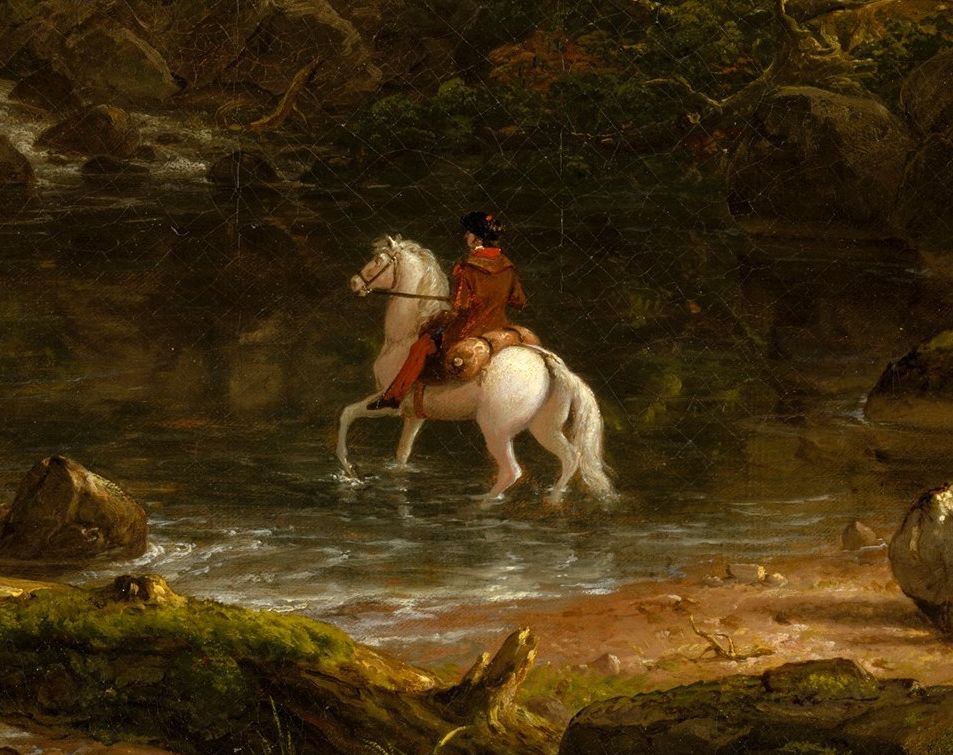
The horse and rider occupy the lower centre of the canvas, close enough for us to register their action but far too small to command the landscape. The horse faces left, one foreleg lifted above the water. The rider sits upright, looking in the direction of travel. Neither the figure's identity nor a destination is established by the picture. What Cole makes immediately legible is the need to cross.
The title helps us understand this stretch of water as a ford, a place where a river can be crossed without a bridge. Yet the painting gives no easy diagram of a safe passage. Scattered boulders, dark reflections and narrow streaks of moving water complicate the surface. The far side is visible, but the precise course through the stream remains uncertain. We can follow the horse's direction more readily than we can predict its next few steps.
The white coat does much of the compositional work. Against the surrounding browns and greens, the animal becomes the brightest compact shape near the bottom of the painting. The rider's reddish garment provides a second, smaller emphasis. Our attention settles on this pair before travelling up the dark slope and towards the illuminated rock. Cole establishes human scale through a contrast of colour as well as size.
There is a productive difference between the stillness of the image and the motion it suggests. The lifted leg promises another step, while the long lines of water continue past the horse. The rider's poised posture, however, gives the moment a suspended quality. We are invited to contemplate a decision or a difficulty rather than witness a dramatic accident. The Met's account emphasises hesitation; close looking also reveals a body already engaged with the crossing. [1]
Nothing requires us to supply a detailed story about this traveller. An invented occupation, a personal crisis or a particular errand would narrow an image whose force comes partly from withholding such information. The figure is recognisably human, dependent on an animal and exposed to the terrain. That is enough to create a connection between a distant painted rider and a viewer standing outside the scene.
Annotated Details from The Mountain Ford
Compare four details with the full composition, then open the photographs for a closer view.
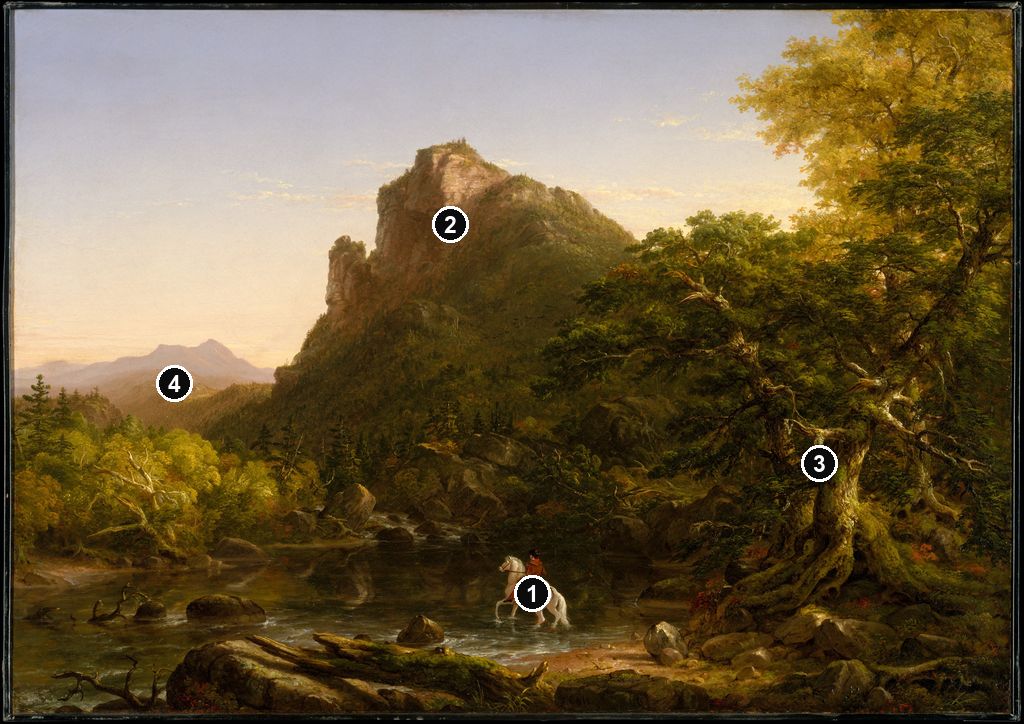
Details from THE MOUNTAIN FORD
Each crop comes from the same painting shown above.
The horse and rider
The white horse and red-clad rider stand out against dark water and wooded slopes. The Met connects this small traveller with an allegorical tradition of solitary journeys, without naming a specific person. [1]
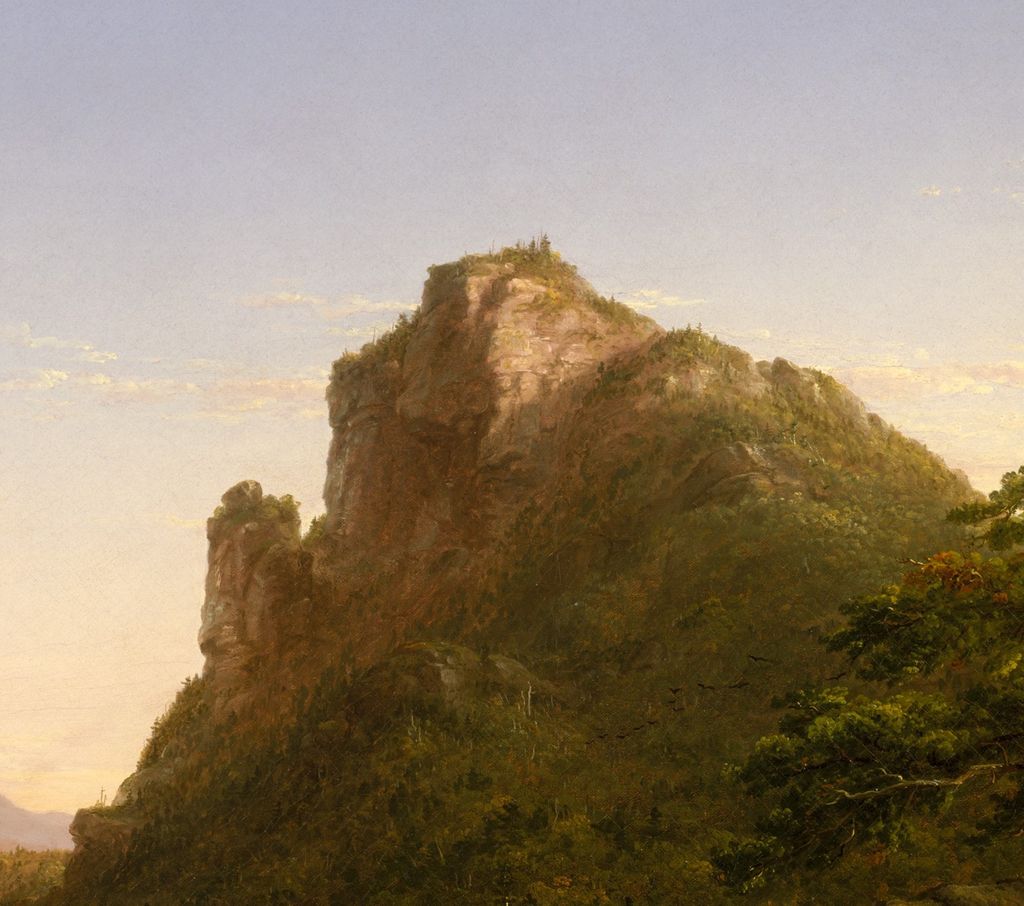
The illuminated mountain
Light strikes the rocky summit while the wooded base merges into shadow. The mountain governs the composition through its size and the contrast between its upper and lower slopes. [1]
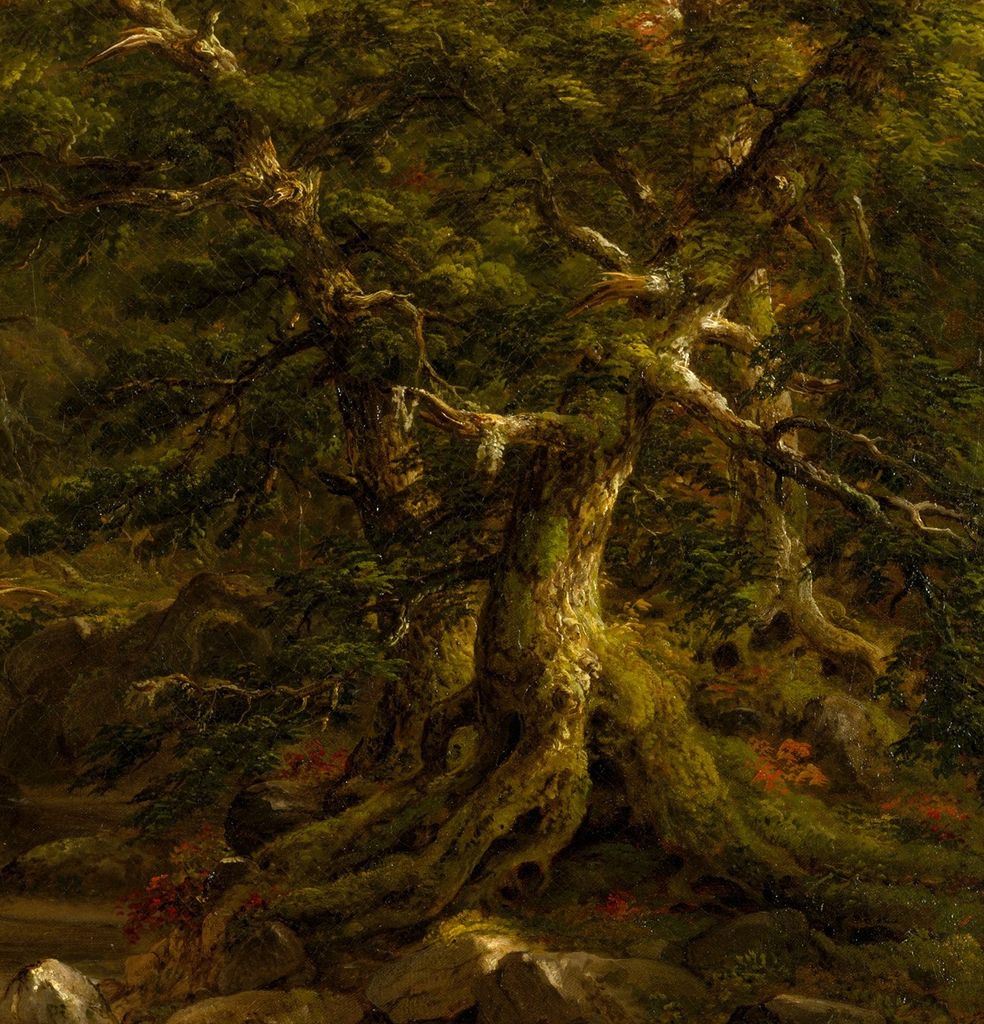
The great tree and its roots
The heavy tree grips the bank with exposed roots and reaches across the view. Comparing it with the surviving study shows how Cole developed the foreground structure in the painted composition. [2]
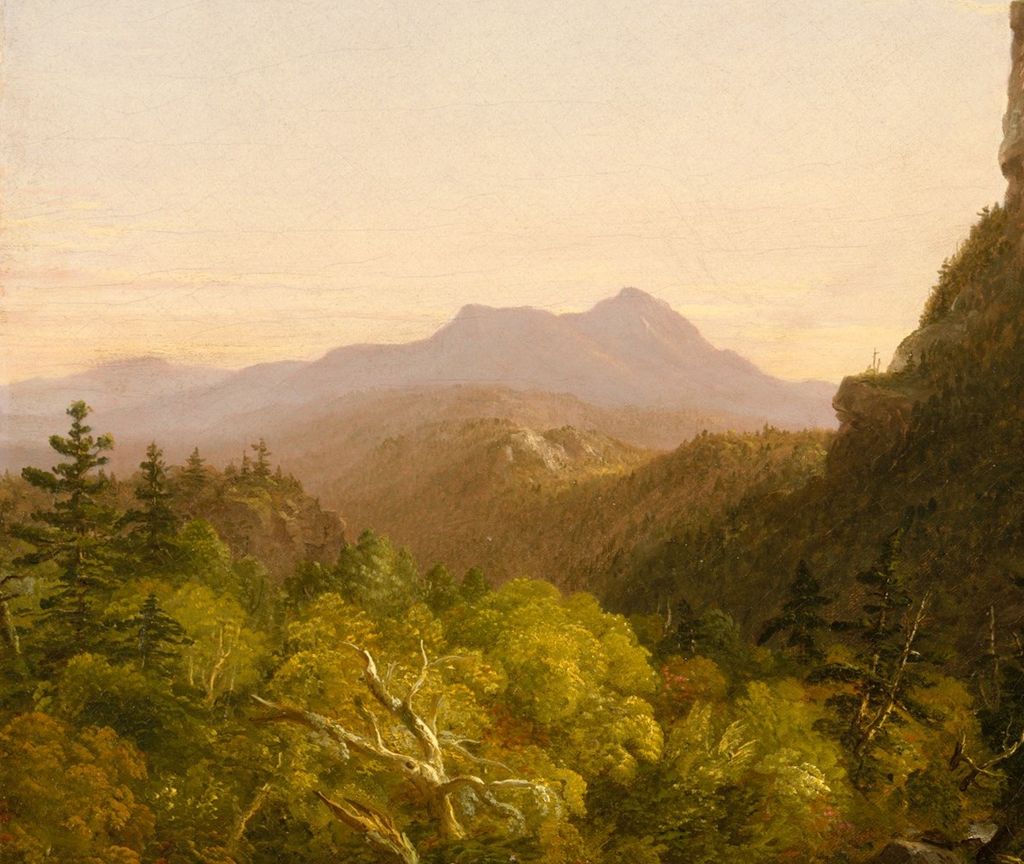
The opening towards distant ridges
Pale sky and softened ridges open the left side of the landscape. Roque discusses how Cole’s increasingly constructed later landscapes could also appear increasingly convincing. [4]
How the mountain governs the view
The central mountain rises abruptly from the woods. Its upper rock face receives light, while its lower slopes merge into the darker forest. Cole makes the summit easy to locate but gives the base fewer clear boundaries. Trees, exposed stones and shadows overlap, so that the mountain seems to emerge from the entire wooded mass rather than sit behind it as a separate backdrop.
The strongest vertical accent is slightly left of centre. A lower, narrower outcrop rises beside the main summit, and the ridge descends towards the right. This uneven silhouette matters. A symmetrical peak might have given the painting a more static arrangement; here, the skyline leads the eye across the canvas and towards the branches that enter from the right. Mountain and tree participate in the same broad structure.
The right-hand tree offers a nearer equivalent to the distant rock. Its heavy trunk, exposed roots and twisting limbs give us forms that can be followed individually. Some branches are bare, while others support thick foliage. The tree occupies so much of the side of the composition that it acts as a screen: we look past and through it, rather than survey the landscape from an entirely unobstructed position.
On the left, the view opens. Smaller trees descend towards the water, and distant ridges appear beneath a broad area of pale sky. The contrast between an open distance and an enclosed foreground creates two different experiences of space. We can imagine travelling far into the left-hand vista, but the ford itself keeps us among nearby stones and roots. The picture offers expansive vision while insisting on the immediate demands of movement.
Cole also gives the foreground a rough, material edge. A fallen trunk runs across the bottom, with broken wood and vegetation around it. These forms do not make an impassable barrier, but they interrupt any effortless visual entry. We first encounter a landscape with texture and resistance, then discover the larger spaces beyond. The rider's passage is therefore echoed by our own effort to find a way through the composition.
An imagined place made persuasive
The absence of a securely identified site is central to understanding The Mountain Ford. A convincing rock formation or a carefully differentiated tree does not make a painting a topographical record. Here, the relationships between river, mountain and forest form a coherent landscape, but they need not reproduce one view that Cole encountered on a journey.
Art historian Oswaldo Rodriguez Roque placed the painting among Cole's important later interpretations of American scenery. In his essay for American Paradise, he also used it to discuss the paradox that Cole's increasingly constructed compositions could look increasingly convincing. For Roque, imaginative arrangement and the appearance of natural truth could develop together. His account is a historical interpretation of Cole's achievement, rather than proof of a specific geographical source for this canvas. [4]
That distinction helps explain the painting's richness. The distant mountains are softened and simplified; the nearer rocks have more distinct edges; the foreground tree carries a wealth of small variations. These differences tell us how far away things are. Cole does not apply the same degree of definition to every part of the scene. He makes an imagined space readable by organising what we can see clearly and what recedes beyond our reach.
The sky is especially important to that organisation. It occupies a generous part of the upper left, with delicate clouds and a gentle change of colour near the horizon. Its openness gives the central mountain room to rise. Without that quieter area, the forest and rock would press more uniformly against the picture's limits. The apparent immensity of the mountain depends partly on the space left beside it.
An imagined landscape can also concentrate an experience more tightly than a literal view. Here, the river crossing, abrupt summit and enclosing tree all bear upon the small traveller. They remain recognisable natural forms, but their arrangement gathers attention around a human act. This is where the painting's emotional effect begins: in the relationship between things, before any explicit allegorical explanation is supplied.
Watch: Thomas Cole
Choose a film to explore the artist’s work, its interpretation and its wider setting.
Thomas Cole: Painting the American Landscape (remastered audio)
An introduction to Cole’s landscapes and artistic ambitions.
Watch on YouTubeThe drawing and the finished canvas
A related sheet in the National Gallery of Art provides a valuable glimpse of Cole's compositional thinking. The museum dates Study for The Mountain Ford to 1846 and identifies its materials as graphite and white chalk on grey wove paper. The drawn image measures 13.02 × 19.69 cm, within a larger sheet measuring 17.46 × 24.92 cm. Those measurements distinguish the composition from the surrounding paper. [2]
The comparison reveals substantial continuity. Both images contain the central rocky height, a more distant view towards the left and an imposing tree on the right. The horseman occupies the lower portion in each. These shared elements make the relationship more informative than a general resemblance between two wooded landscapes. The drawing records the principal ingredients of this particular composition.
There are also conspicuous differences. In the sheet, the rider is left of centre, closer to the opening towards the distant landscape. In the painting, horse and rider move towards the centre and somewhat to the right. Their new position gives the white animal a darker background and places the crossing more directly beneath the mountain. The finished arrangement strengthens the visual relation between the small moving body and the massive stationary rock.
The great tree changes, too. In the drawing, its thick trunk stands high on the right and its branches spread through the upper part of the outlined rectangle. In the canvas, the trunk and exposed roots occupy a broader part of the lower right, while the foliage forms a dense canopy. The painted tree feels more deeply embedded in the bank, and its lateral limbs extend the enclosing effect across the scene.
Graphite allows Cole to seek contours and indicate clusters of leaves with repeated strokes. White chalk supplies selected light accents against the grey paper. Oil paint introduces a different range of relationships: the horse's brightness, the rider's warm colour, the golden foliage and the dark reflective stream can be balanced against one another. The study establishes an arrangement; the canvas makes colour and atmosphere integral to its meaning.
The drawing does not, by itself, establish the exact sequence of every decision or a particular method of transferring the design to canvas. It does show that the finished picture was not a simple enlargement of an unchanged small image. Readers interested in this distinction can compare it with other drawings by Cole, where observation, composition and revision serve different purposes.
Painting detail without losing the whole
One of the pleasures of The Mountain Ford is the movement between broad masses and small incidents. From a distance, the composition reads through a few large relationships: pale sky, dark mountain, enclosed forest and the light horse below. Looking more closely, we encounter roots, broken branches, rocky ledges and changes in the water. The details enrich the structure without replacing it.
The large tree demonstrates this particularly well. Its individual forms are varied, but they remain part of a single dark and golden mass. A bright patch on bark or stone pulls our attention briefly towards the surface; a shaded interval then leads it back into depth. The mountain works differently. Its summit is relatively simple and emphatic, while the wooded slope contains more complicated transitions. Each area has a different task.
This visible handling should be distinguished from findings about the painting's hidden layers. Dorothy Mahon's technical study of The Oxbow and The Consummation of Empire demonstrated how Cole adapted preparation, drawing and paint application to different subjects. Her investigation is useful evidence of the deliberateness of his practice, but its discoveries concern those two canvases. They do not establish the ground colour, pigments or underdrawing of The Mountain Ford. [5]
For this painting, the drawing offers the firmer evidence of planning. The visible canvas then shows how a relatively compact landscape can accommodate both minute forms and a large spatial conception. Cole's style and technique are best understood through that interaction: selection and arrangement matter as much as the accumulation of recognisable details.
A solitary journey, rather than a fixed key
The Met relates the horseman to an allegorical tradition of solitary travel through imposing nature. That reading suits the disparity of scale and the uncertain crossing. Yet the painting supplies no caption naming a virtue, a stage of life or a particular spiritual condition. Its suggestiveness remains broader than a single decoded message. [1]
Cole's The Voyage of Life offers a useful comparison because it makes a journey the basis of an extended allegorical sequence. The Mountain Ford concentrates on one moment instead. The traveller has no visible companion; the landscape offers both an obstacle and an opening. A viewer may find anxiety, courage, vulnerability or patient attention in the scene, but those responses need not be converted into claims about the rider's identity.
The mountain's lit summit can suggest a goal beyond the shadowed water. Equally, it can be experienced as a striking natural feature that dwarfs the immediate action. These readings can coexist. Cole's arrangement encourages us to think beyond the practical crossing while preserving enough ordinary physical detail to keep the act credible. The horse still has to negotiate water and stones.
The work's material history is more definite than its symbolic meaning. The Met records it as a bequest of Maria DeWitt Jesup, from the collection of her husband, Morris K. Jesup, with a credit-line date of 1914. The related drawing followed a separate history: the National Gallery records descent to Cole's granddaughter Florence H. Cole Vincent, followed by the Macbeth Galleries, the Corcoran Gallery of Art and acquisition by the National Gallery in 2015. The painting and drawing are now preserved in different collections, allowing two stages of Cole's conception to be considered together. [1] [2]
Artworks directory
Explore paintings, drawings and studies across Cole’s career. The two Voyage of Life sets appear separately. Dates and study identifications draw on the exhibition and collection catalogues, supplemented by the National Gallery’s drawing records. [3] [6] [7] [8]
| Name | Date | Medium |
|---|---|---|
| The Oxbow | 1836 | Painting |
| The Titan’s Goblet | 1833 | Painting |
| The Architect’s Dream | 1840 | Painting |
| The Course of Empire: The Savage State | ca. 1834 | Painting |
| The Course of Empire: The Arcadian or Pastoral State | ca. 1834 | Painting |
| The Course of Empire: The Consummation of Empire | 1835–1836 | Painting |
| The Course of Empire: Destruction | 1836 | Painting |
| The Course of Empire: Desolation | 1836 | Painting |
| The Voyage of Life: Childhood | 1842 | Painting |
| The Voyage of Life: Youth | 1842 | Painting |
| The Voyage of Life: Manhood | 1842 | Painting |
| The Voyage of Life: Old Age | 1842 | Painting |
| Home in the Woods | 1847 | Painting |
| Distant View of Niagara Falls | 1830 | Painting |
| View on the Catskill—Early Autumn | 1836–37 | Painting |
| Lake with Dead Trees (Catskill) | 1825 | Painting |
| River in the Catskills | 1843 | Painting |
| A View of the Mountain Pass Called the Notch of the White Mountains (Crawford Notch) | 1839 | Painting |
| Expulsion from the Garden of Eden | 1828 | Painting |
| The Subsiding of the Waters of the Deluge | 1829 | Painting |
| The Mountain Ford | 1846 | Painting |
| American Lake Scene | 1844 | Painting |
| A View near Tivoli (Morning) | 1832 | Painting |
| Aqueduct near Rome | 1832 | Painting |
| The Hunter’s Return | 1845 | Painting |
| The Voyage of Life: Childhood (first version) | 1840 | Painting |
| The Voyage of Life: Youth (first version) | 1840 | Painting |
| The Voyage of Life: Manhood (first version) | 1840 | Painting |
| The Voyage of Life: Old Age (first version) | 1840 | Painting |
| Panorama of the Oxbow on the Connecticut River as seen from Mount Holyoke | ca. 1832 (museum); 1833 (2018 catalogue) | Drawing |
| Sketch for The Oxbow | 1836 | Painting |
| From Nature | 1823 | Drawing |
| View of the Round-Top in the Catskill Mountains (Sunny Morning on the Hudson) | 1827 | Painting |
| Scene from The Last of the Mohicans: Cora Kneeling at the Feet of Tamenund | 1827 | Painting |
| View of Monte Video, the Seat of Daniel Wadsworth | 1828 | Painting |
| The Garden of Eden | 1828 | Painting |
| Tomb of General Brock, Queenston Heights, Ontario | 1830 | Painting |
| Effect for Newstead Abbey, Nottinghamshire, England | 1830 | Drawing |
| The Ilissos, from the Parthenon West Pediment | 1829 or 1830 | Drawing |
| Life Study for the Prostrate Shepherd in The Angel Appearing to the Shepherds | 1831–1832 | Painting |
| Interior of the Colosseum, Rome | ca. 1832 | Painting |
| Campagna di Roma (Study for Aqueduct near Rome) | 1832 | Painting |
| Landscape with a Round Temple | ca. 1830s | Painting |
| Stormy Landscape | 1832 | Painting |
| View of Florence from San Miniato | 1837 | Painting |
| Mount Holyoke, Massachusetts (after Basil Hall) | ca. 1829–1831 | Drawing |
| Layout for The Course of Empire | 1833 | Drawing |
| Study for The Course of Empire: The Savage State | ca. 1834 | Painting |
| Study for The Course of Empire: The Arcadian or Pastoral State | ca. 1834 | Painting |
| Study for The Course of Empire: Desolation | 1836 | Painting |
| Study for Dream of Arcadia | 1838 | Painting |
| Clouds | ca. 1830s | Painting |
| Study for The Hunter’s Return | 1845 | Painting |
| Study for Home in the Woods | ca. 1847 | Painting |
| Sunrise in the Catskills | 1826 | Painting |
| Study for The Mountain Ford | 1846 | Drawing |
| Tree Trunks | 1825–1840 | Drawing |
Frequently Asked Questions
Cole painted it in 1846. The Metropolitan Museum of Art catalogues the work as oil on canvas. [1]
The painting belongs to the Metropolitan Museum of Art in New York, accession number 15.30.63. [1]
No specific mountain is securely identified here. The Met interprets the scene as an imagined landscape. Its detailed natural forms should not be mistaken for proof of a particular location. [1]
The rider is not securely identified. The figure's small scale and the horse's bright coat make the crossing a focus within the much larger landscape. The Met connects the solitary traveller with an allegorical tradition. [1]
Yes. The National Gallery of Art owns Study for The Mountain Ford, dated 1846, in graphite and white chalk on grey wove paper. Its rider placement and tree forms differ from the finished canvas. [2]
Discussion
Look again at The Mountain Ford and compare your reading with the questions below.
Reader Insights
Does the open, luminous distance make the crossing feel hopeful, or does the mountain's scale make it seem more uncertain?
How does moving the rider towards the centre change your experience when you compare the drawing with the painting?
Which detail or comparison would you add to this account, and what evidence supports your reading?
Join the Conversation
Share the details that shaped your response, or suggest a comparison for other readers.
References
- Metropolitan Museum of Art, The Mountain Ford, current collection record, accessed 6 October 2026; object 10496, accession 15.30.63, description and artwork details. https://www.metmuseum.org/art/collection/search/10496
- National Gallery of Art, Study for “The Mountain Ford”, current collection record, accessed 6 October 2026; accession 2015.19.772, artwork overview and provenance. https://www.nga.gov/artworks/194402-study-mountain-ford
- Elizabeth Mankin Kornhauser and Tim Barringer, Thomas Cole’s Journey: Atlantic Crossings (2018). Career context and artwork/study metadata: catalogue entries 10–66 and chronology, PDF pp. 137–231 and 249–262; related Barringer essay passages, PDF pp. 23–66.
- Oswaldo Rodriguez Roque, “The Exaltation of American Landscape Painting”, in American Paradise: The World of the Hudson River School, Metropolitan Museum of Art, 1987, pp. 31–35 (PDF pp. 50–54; selected passages). https://cdn.sanity.io/files/cctd4ker/production/dce378a2ad2f7a6d05cbdc4b9c29b9b9733b3cd1.pdf
- Dorothy Mahon, “Thomas Cole's The Oxbow and The Consummation of Empire: A Technical Comparison”, in Elizabeth Mankin Kornhauser and Tim Barringer, Thomas Cole's Journey: Atlantic Crossings, Metropolitan Museum of Art, 2018, pp. 106–115 (PDF pp. 110–119). https://cdn.sanity.io/files/cctd4ker/production/be901737ad5f92e33d91db53c6dd8ce6ed47ff27.pdf
- Franklin Kelly et al., American Paintings of the Nineteenth Century, Part I (National Gallery of Art, 1996). Cole catalogue and both Voyage of Life sets, PDF pp. 91–124.
- National Gallery of Art, Study for The Mountain Ford (1846), accession 2015.19.772. Collection record and open-access image.
- National Gallery of Art, Tree Trunks (1825–1840), accession 2015.19.607. Collection metadata and open-access image.
- Splash image source.
Thomas Cole, The Mountain Ford, 1846. Oil on canvas, 71.8 × 101.8 cm. Metropolitan Museum of Art, New York, 15.30.63. Bequest of Maria DeWitt Jesup, from the collection of her husband, Morris K. Jesup, 1914.