by Tom Gurney
Tom Gurney BSc (Hons) is an art history expert with over 20 years experience
Published on June 19, 2020 / Updated on October 27, 2026
Email: tomgurney1@gmail.com / Phone: +44 7429 011000
The Subsiding of the Waters of the Deluge by Thomas Cole: Introduction
The storm has passed, but the world has not yet recovered. In Thomas Cole’s The Subsiding of the Waters of the Deluge, a dark enclosure of fractured rock opens onto a pale, flooded distance. A waterfall still pours down the left-hand cliffs. Far beyond it, Noah’s ark rests on quiet water beneath an expansive, luminous sky. Cole painted this biblical landscape in 1829; it now belongs to the Smithsonian American Art Museum in Washington, D.C. [1]
The small ark is easy to overlook. So is the skull near the lower edge, almost absorbed by the shadows. Together they bring the immense landscape into focus: this is a world marked by death, yet containing the possibility of continued life. Instead of showing the Flood at its most violent, Cole gives us its aftermath. The picture’s drama comes from the distance between those two conditions, and from the slow movement of the eye out of darkness towards light.
At a Glance
- ArtistThomas Cole
- TitleThe Subsiding of the Waters of the Deluge
- Date1829
- MediumOil on canvas
- Dimensions90.8 × 121.4 cm
- CollectionSmithsonian American Art Museum, Washington, D.C.
- Accession number1983.40
- SubjectThe receding waters of the biblical Flood and Noah’s ark. [1]
This work in Cole’s career
First European journey
1829–1832The Course of Empire
1834–1836The Oxbow
1836The Voyage of Life
1840 and 1842Church’s training
1844–1846Notes and sources
American recognition. Three New York sales brought Cole to the attention of artists and patrons. [2]
The Subsiding of the Waters of the Deluge. In 1829 Cole used the receding Flood to consider destruction and renewal through a landscape almost emptied of human life. [1]
First European journey. Looking in Britain and Italy enlarged the repertoire of his American landscapes. [2]
The Course of Empire. Five invented landscapes turn the rise and fall of civilisation into a visual argument. [2]
The Oxbow. An American prospect joined direct observation to a carefully staged view. [2]
The Voyage of Life. The original cycle and Roman replicas give human life the course of a river. [2]
Church’s training. Cole taught Frederic Edwin Church in Catskill. [2]
Home in the Woods. A late cabin landscape brings settlement and surrounding woodland into one scene. [2]
Contents
- Introduction
- A world emerging from the water
- Noah’s story, held at a distance
- The skull and the limits of consolation
- John Martin and the choice of an aftermath
- From Eden to a new beginning
- Exhibition and collection
- A related structure in a biblical drawing
A world emerging from the water
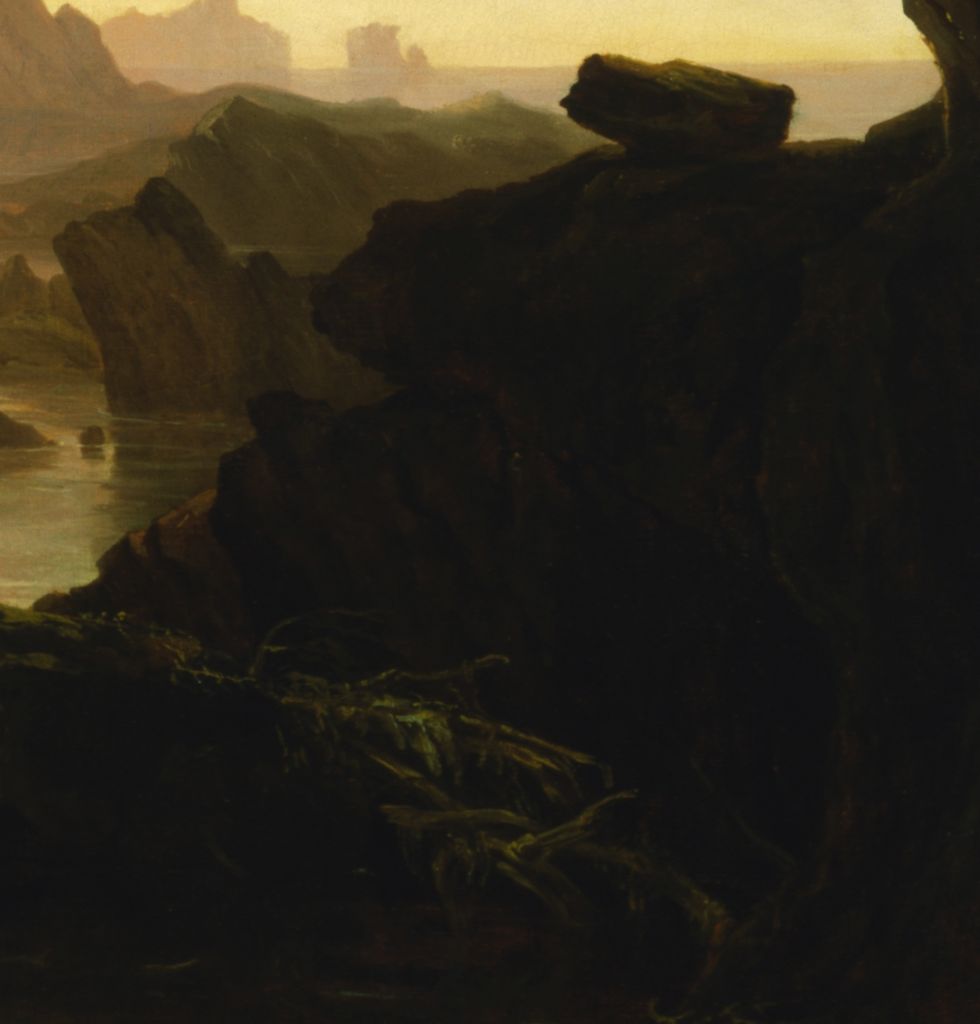
Cole places us low among the rocks, beneath an overhang that stretches across much of the upper edge. The foreground feels enclosed even though the scene beyond it is enormous. At the left, stacked cliffs descend in broken stages; at the right, shadowed masses crowd into the opening. Between them lies a narrow passage of water and wet ground. The view does not begin with a comfortable, open prospect. We must look through the remains of a damaged world.
The shapes of the rocks help establish the scale of the disaster. Large blocks lie at competing angles, and the ledges offer little continuous level ground. Fallen wood and bare branches interrupt the surfaces nearest us. These elements make the shore appear difficult to cross or inhabit. Their sharp contours also differ from the distant pinnacles, which soften into the warm haze. Nearness brings weight and obstruction; distance brings air and room.
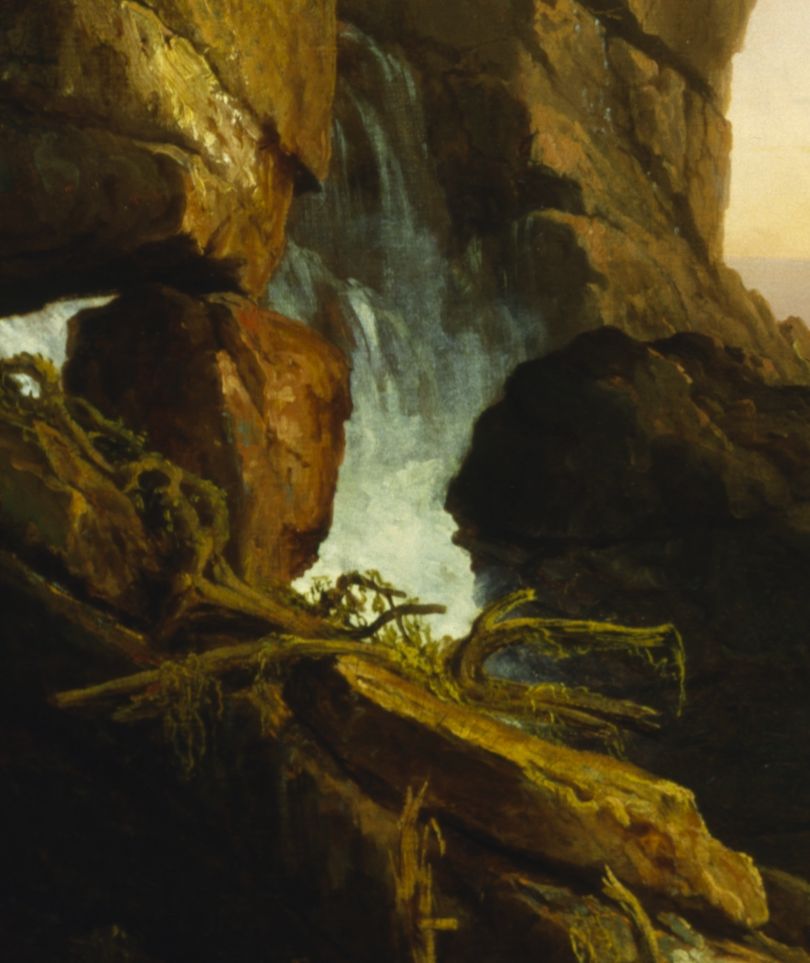
Water connects these zones. The waterfall at the left is the most visibly active part of the landscape, its white stream cutting through the darker cliff. Smaller falls appear farther into the opening. By contrast, the central expanse has become smooth enough to reflect the distant rock formations and the ark. The same water can be forceful where it drops over ledges and almost still where it spreads into the basin. Cole makes recession legible through these differences rather than through a single dramatic wave.
The light is similarly uneven. It touches the ochre surfaces on the left and picks out a strip of the nearer shore, but much of the foreground remains dark. The brightest region lies beyond the enclosing rocks, where a cream and yellow sky meets the distant water. That distribution matters: relief is visible, but it is not evenly available across the picture. The place from which we look still carries the heaviness of what has happened.
Annotated Details from The Subsiding of the Waters of the Deluge
Compare four details with the full composition, then open the photographs for a closer view.
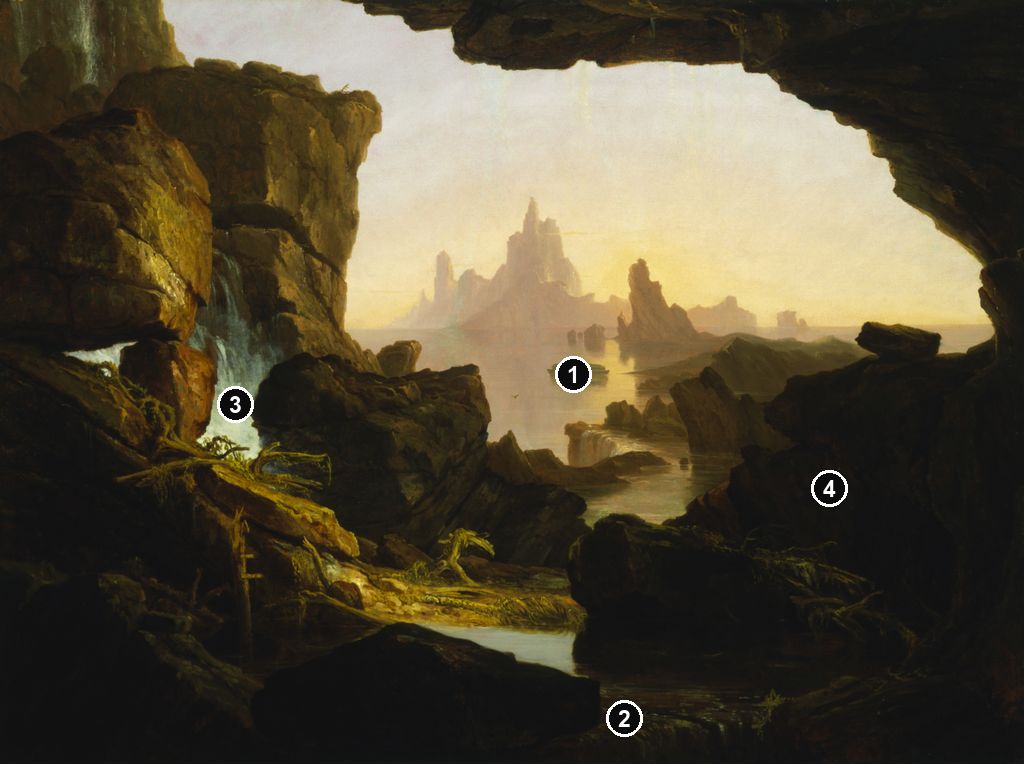
Details from THE SUBSIDING OF THE WATERS OF THE DELUGE
Each crop comes from the same painting shown above.
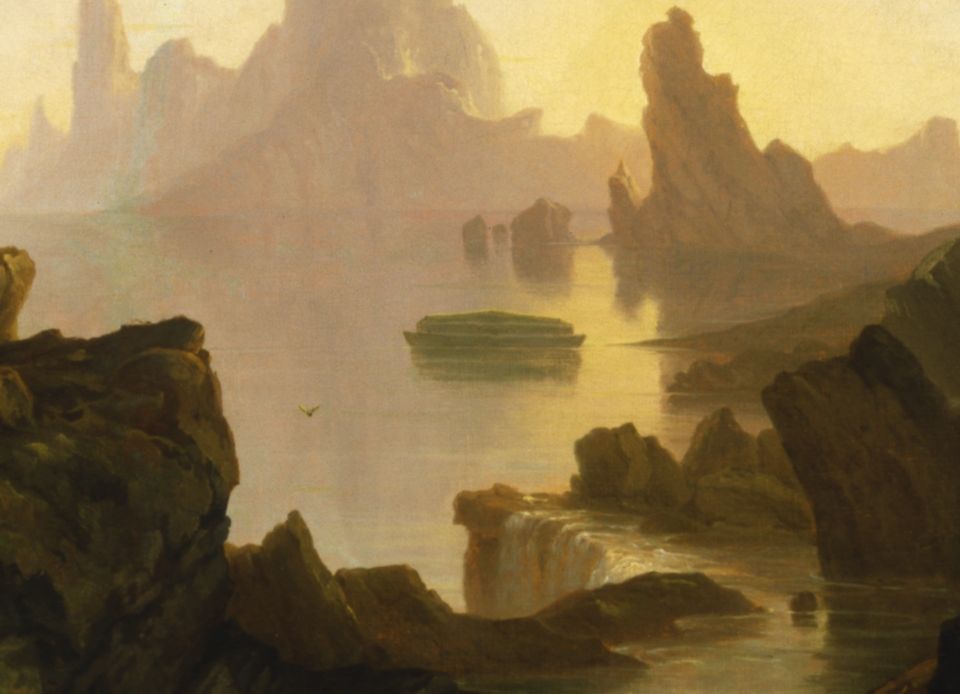
The ark on calm water
The small ark floats beyond the enclosing rocks. Calm water and pale light distinguish Cole’s aftermath from the violent moment represented in John Martin’s Deluge. [4]
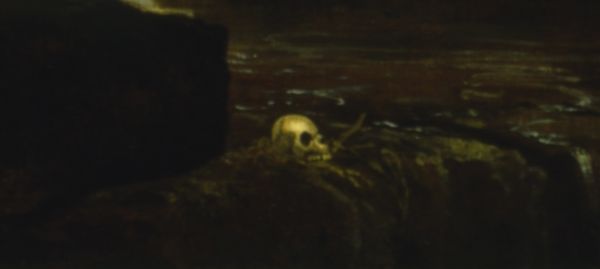
The skull near the viewer
A small skull remains among the dark foreground debris. The Smithsonian interprets it as a sign that the Flood has swept away human folly; its proximity keeps death present beside the prospect of renewal. [1]
Water still falling
A bright waterfall descends through the fractured left-hand cliffs. Moving water close to the viewer contrasts with the broad, quiet surface around the ark. [4]
Rocks enclosing the view
Shadowed rock masses frame the illuminated distance and make the foreground feel difficult to traverse. The open water offers relief beyond an environment still marked by devastation. [1]
Noah’s story, held at a distance
The subject comes from the account of the Flood in Genesis. Chapter 8 describes the rain stopping, the water retreating and mountain tops becoming visible. Noah sends out a raven and then a dove to discover whether the earth is habitable again. The dove eventually returns with an olive leaf; later, Noah and the living creatures leave the ark. The chapter thus describes recovery as a sequence of waiting and testing, rather than an instantaneous return to ordinary life. [3]
Cole’s picture concentrates on that interval. Land has emerged, yet broad areas remain submerged. The ark is still in the water, and its occupants are not presented as a group of figures on the shore. A single bird flies low in the opening. At this scale, the survival of people and animals is conveyed chiefly by the vessel and the bird, while the landscape carries almost all the emotional weight.
There is a genuine difference between published identifications of the bird. The Smithsonian describes it as a dove travelling towards land. Art historian Tim Barringer, writing in Thomas Cole’s Journey: Atlantic Crossings, suggests that it may instead be the raven of Genesis 8:7. The biblical account includes both birds, so either identification would connect it to Noah’s search for dry ground. Its species need not be settled to recognise its importance as the picture’s small, mobile sign of life. [1] [4]
The ark itself has a low, horizontal silhouette. It provides a modest counterweight to the jagged vertical rocks rising behind it. Cole does not make it large enough to dominate the view, but the quiet water around it leaves it relatively easy to distinguish once noticed. Its very smallness is expressive: human survival occupies a tiny place within a world whose scale exceeds it.
Reading the scene beside Genesis also clarifies the difference between a biblical subject and a literal illustration of every detail. Cole gathers rocks, falls, open water, a distant vessel and a bird into a coherent landscape. The picture offers an imagined experience of the story’s aftermath. It does not require us to assign each visible ledge to a named mountain or each pool to a particular verse.
The skull and the limits of consolation
Near the bottom of the composition, slightly right of centre, a skull lies among dark debris. The Smithsonian identifies it explicitly and interprets it as evidence that the Flood has swept away human folly. [1] Its position gives this moral sign a different force from the ark: the vessel belongs to the open distance, while death remains close to the viewer.
The skull is not a theatrical centrepiece. Its light colour makes it detectable, but the enclosing shadows and neighbouring fragments prevent it from immediately commanding attention. Recognising it changes the foreground. What may first seem simply a wilderness of broken matter becomes a place where human life has been lost. Cole makes that recognition a small act of discovery within the larger act of looking.
Its relationship to the bird is especially telling. One lies still near the lower edge; the other moves in the space beyond the rocks. One is a remnant, the other a sign that life continues. Neither needs to occupy much canvas to alter our understanding of everything around it. They establish two different kinds of time: the catastrophe that has already occurred and the future that remains possible.
This is why the luminous distance does not make the entire painting cheerful. The cliffs remain harsh, the exposed ground is sparse, and the near shore contains reminders of loss. Barringer reads Cole’s scene as a vision of redemption and hope. [4] That reading is persuasive in the calm water and spreading light, but hope here exists alongside devastation. Cole gives the viewer reasons to look forward without removing the evidence of what recovery follows.
Watch: Thomas Cole
Choose a film to explore the artist’s work, its interpretation and its wider setting.
Thomas Cole: Painting the American Landscape (remastered audio)
An introduction to Cole’s landscapes and artistic ambitions.
Watch on YouTubeJohn Martin and the choice of an aftermath
The painting belongs to a transatlantic exchange in which British prints reached American audiences quickly. John Martin published a mezzotint of The Deluge in London in September 1828. By January 1829 an impression was exhibited at William A. Colman’s Literary Emporium in New York. Barringer records Cole’s visit and associates two rapidly made drawings inscribed “Deluge” with his response to Martin’s print. He describes them as recollections of elements such as water and craggy rocks, rather than direct copies of the entire composition. [4]
Martin’s subject was the catastrophe at its height. As Barringer describes the print, people face drowning, animals are swept into the tumult, lightning cuts through darkness and boulders fall. Mezzotint allowed Martin particularly strong contrasts between velvety black shadows and brilliant light. The distant ark is present, but the surrounding action emphasises the terrifying destruction of the world. [4]
Cole chose another moment. His large rock masses and dramatic contrast retain a sense of overwhelming natural power, yet the central water is tranquil and the immediate struggle of drowning figures is absent. The subject changes from the experience of impending death to the uncertain prospect of beginning again. Barringer makes this distinction central to his comparison, opposing Martin’s apocalyptic vision to Cole’s quieter hope. [4]
This relationship is more useful than describing Cole as merely borrowing a biblical theme. It reveals a consequential artistic decision about where a story should begin and end. Showing the height of a disaster directs attention towards fear and action. Showing its aftermath asks us to study what remains, how the landscape has changed and whether survival can lead to renewal. Cole’s picture gives these questions time to unfold.
From Eden to a new beginning
The Flood followed closely upon Cole’s two paintings of Eden. He completed The Garden of Eden in 1828 and developed Expulsion from the Garden of Eden as its darker companion. Barringer describes the pair as visions of nature’s abundance and its threatened loss. These paintings already used landscape to give physical form to a biblical change in the human condition. [5]
The Subsiding of the Waters of the Deluge continues that interest, but its subject turns towards the possibility of renewal after judgement. The landscape has not returned to Eden’s richness. There is no abundant garden in the foreground and no visible community established on the shore. Beginning again is presented as a prospect, carried by light, water and a surviving vessel, rather than as an accomplished new society.
The Smithsonian extends this theme into American history. Its interpretation links the Flood with the American Revolution: the destruction of British despotism would make a fresh start possible for the young republic. In this reading, the distant ark and clearing light suggest the emergence of a more enlightened national future. [1] This is the museum’s interpretation of the painting, rather than a quoted explanation by Cole. It adds a political dimension to the biblical renewal while leaving the story’s religious meaning intact.
A later comparison offers a different kind of aftermath. In The Course of Empire: Desolation, completed in 1836, a ruined city gives way to vegetation and animal life. Barringer connects that final panel with the earlier Flood landscape through their shared attention to the consequences of human wrongdoing. [6] The comparison shows how persistently Cole returned to the relationship between damaged human worlds and enduring nature. It does not make the two pictures interchangeable: Noah’s ark preserves a human future, whereas the empire has disappeared.
Exhibition and collection
The painting was made before Cole’s first European journey. The researched chronology in Atlantic Crossings records its appearance among seven Cole landscapes at the opening of the National Academy of Design’s Fourth Annual Exhibition on 9 May 1829. Cole departed New York for England on 1 June. [7] Its response to Martin therefore developed through a print seen in America, before Cole encountered London’s collections in person.
The Smithsonian’s record identifies the painting as oil on canvas, measuring 90.8 × 121.4 cm. It entered the museum through a gift from Mrs. Katie Dean in memory of Minnibel S. and James Wallace Dean, combined with a purchase through the Smithsonian Institution Collections Acquisition Program. The accession number is 1983.40. [1]
These details establish the object without diminishing the experience of its scale. Almost a metre high, the canvas gives substantial physical presence to its enclosing rocks, yet the meaningful human vessel remains minute. Cole’s landscape draws us towards that distant survival through a foreground in which recovery is still incomplete. The light offers an opening; the skull ensures that the opening has a cost.
A related structure in a biblical drawing
Gaudio also notes the structural resemblance between this painting and Cole’s drawing Elijah at the Mouth of the Cave, about 1829. The drawing places a small biblical figure at an opening before a distant wilderness. In both compositions, near darkness frames a far-reaching landscape, making the threshold important to the spectator’s position. [8]
The comparison concerns pictorial structure. It does not identify the figures in The Subsiding of the Waters of the Deluge as Elijah or substitute his biblical story for Noah’s. It shows how Cole could adapt a relationship between enclosure, small figures and distance across distinct religious subjects.
Artworks directory
Explore paintings, drawings and studies across Cole’s career. The two Voyage of Life sets appear separately. Dates and study identifications draw on the exhibition and collection catalogues, supplemented by the National Gallery’s drawing records. [2] [9] [10] [11]
| Name | Date | Medium |
|---|---|---|
| The Oxbow | 1836 | Painting |
| The Titan’s Goblet | 1833 | Painting |
| The Architect’s Dream | 1840 | Painting |
| The Course of Empire: The Savage State | ca. 1834 | Painting |
| The Course of Empire: The Arcadian or Pastoral State | ca. 1834 | Painting |
| The Course of Empire: The Consummation of Empire | 1835–1836 | Painting |
| The Course of Empire: Destruction | 1836 | Painting |
| The Course of Empire: Desolation | 1836 | Painting |
| The Voyage of Life: Childhood | 1842 | Painting |
| The Voyage of Life: Youth | 1842 | Painting |
| The Voyage of Life: Manhood | 1842 | Painting |
| The Voyage of Life: Old Age | 1842 | Painting |
| Home in the Woods | 1847 | Painting |
| Distant View of Niagara Falls | 1830 | Painting |
| View on the Catskill—Early Autumn | 1836–37 | Painting |
| Lake with Dead Trees (Catskill) | 1825 | Painting |
| River in the Catskills | 1843 | Painting |
| A View of the Mountain Pass Called the Notch of the White Mountains (Crawford Notch) | 1839 | Painting |
| Expulsion from the Garden of Eden | 1828 | Painting |
| The Subsiding of the Waters of the Deluge | 1829 | Painting |
| The Mountain Ford | 1846 | Painting |
| American Lake Scene | 1844 | Painting |
| A View near Tivoli (Morning) | 1832 | Painting |
| Aqueduct near Rome | 1832 | Painting |
| The Hunter’s Return | 1845 | Painting |
| The Voyage of Life: Childhood (first version) | 1840 | Painting |
| The Voyage of Life: Youth (first version) | 1840 | Painting |
| The Voyage of Life: Manhood (first version) | 1840 | Painting |
| The Voyage of Life: Old Age (first version) | 1840 | Painting |
| Panorama of the Oxbow on the Connecticut River as seen from Mount Holyoke | ca. 1832 (museum); 1833 (2018 catalogue) | Drawing |
| Sketch for The Oxbow | 1836 | Painting |
| From Nature | 1823 | Drawing |
| View of the Round-Top in the Catskill Mountains (Sunny Morning on the Hudson) | 1827 | Painting |
| Scene from The Last of the Mohicans: Cora Kneeling at the Feet of Tamenund | 1827 | Painting |
| View of Monte Video, the Seat of Daniel Wadsworth | 1828 | Painting |
| The Garden of Eden | 1828 | Painting |
| Tomb of General Brock, Queenston Heights, Ontario | 1830 | Painting |
| Effect for Newstead Abbey, Nottinghamshire, England | 1830 | Drawing |
| The Ilissos, from the Parthenon West Pediment | 1829 or 1830 | Drawing |
| Life Study for the Prostrate Shepherd in The Angel Appearing to the Shepherds | 1831–1832 | Painting |
| Interior of the Colosseum, Rome | ca. 1832 | Painting |
| Campagna di Roma (Study for Aqueduct near Rome) | 1832 | Painting |
| Landscape with a Round Temple | ca. 1830s | Painting |
| Stormy Landscape | 1832 | Painting |
| View of Florence from San Miniato | 1837 | Painting |
| Mount Holyoke, Massachusetts (after Basil Hall) | ca. 1829–1831 | Drawing |
| Layout for The Course of Empire | 1833 | Drawing |
| Study for The Course of Empire: The Savage State | ca. 1834 | Painting |
| Study for The Course of Empire: The Arcadian or Pastoral State | ca. 1834 | Painting |
| Study for The Course of Empire: Desolation | 1836 | Painting |
| Study for Dream of Arcadia | 1838 | Painting |
| Clouds | ca. 1830s | Painting |
| Study for The Hunter’s Return | 1845 | Painting |
| Study for Home in the Woods | ca. 1847 | Painting |
| Sunrise in the Catskills | 1826 | Painting |
| Study for The Mountain Ford | 1846 | Drawing |
| Tree Trunks | 1825–1840 | Drawing |
Frequently Asked Questions
It depicts the aftermath of the biblical Flood, with receding water, exposed rocks, Noah’s ark and a bird in flight. Cole chose the quieter prospect of survival rather than the disaster at its height. [4]
It reminds the viewer of death during the Flood. The Smithsonian interprets it more specifically as a sign that the world has been cleared of human folly. Its proximity to the viewer qualifies the hopeful light in the distance. [1]
It belongs to the Smithsonian American Art Museum in Washington, D.C., under accession number 1983.40. [1]
Discussion
Look again at The Subsiding of the Waters of the Deluge and compare your reading with the questions below.
Reader Insights
Does the calm, illuminated distance overcome the darkness and debris nearest the viewer, or do they remain equally powerful?
How does discovering the small ark and skull change your first impression of this landscape?
Which detail or comparison would you add to this account, and what evidence supports your reading?
Join the Conversation
Share the details that shaped your response, or suggest a comparison for other readers.
References
- Smithsonian American Art Museum, The Subsiding of the Waters of the Deluge, collection record, undated; object dated 1829. https://americanart.si.edu/artwork/subsiding-waters-deluge-5080
- Elizabeth Mankin Kornhauser and Tim Barringer, Thomas Cole’s Journey: Atlantic Crossings (2018). Career context and artwork/study metadata: catalogue entries 10–66 and chronology, PDF pp. 137–231 and 249–262; related Barringer essay passages, PDF pp. 23–66.
- The Holy Bible, King James Version (1611), Genesis 8:1–22, digital text at Bible Gateway. https://www.biblegateway.com/passage/?search=Genesis%208&version=KJV
- Tim Barringer, catalogue entry 15, “John Martin: The Deluge,” in Elizabeth Mankin Kornhauser and Tim Barringer, Thomas Cole’s Journey: Atlantic Crossings (2018), pp. 142–143 (PDF pp. 146–147). https://cdn.sanity.io/files/cctd4ker/production/be901737ad5f92e33d91db53c6dd8ce6ed47ff27.pdf
- Tim Barringer, catalogue entry 14, “The Garden of Eden,” in Thomas Cole’s Journey: Atlantic Crossings (2018), pp. 140–142 (PDF pp. 144–146). https://cdn.sanity.io/files/cctd4ker/production/be901737ad5f92e33d91db53c6dd8ce6ed47ff27.pdf
- Tim Barringer, catalogue entries 59–60, “The Course of Empire: Desolation” and “Study for Desolation,” in Thomas Cole’s Journey: Atlantic Crossings (2018), pp. 216–217 (PDF pp. 220–221). https://cdn.sanity.io/files/cctd4ker/production/be901737ad5f92e33d91db53c6dd8ce6ed47ff27.pdf
- Shannon Vittoria, “Chronology,” in Thomas Cole’s Journey: Atlantic Crossings (2018), p. 249 (PDF p. 253), January–June 1829 entries. https://cdn.sanity.io/files/cctd4ker/production/be901737ad5f92e33d91db53c6dd8ce6ed47ff27.pdf
- Michael Gaudio, “At the Mouth of the Cave: Listening to Thomas Cole’s Kaaterskill Falls”, Art History 33, no. 3 (June 2010), pp. 448–465, especially pp. 454–455, 458 and note 23 on p. 465. Source.
- Franklin Kelly et al., American Paintings of the Nineteenth Century, Part I (National Gallery of Art, 1996). Cole catalogue and both Voyage of Life sets, PDF pp. 91–124.
- National Gallery of Art, Study for The Mountain Ford (1846), accession 2015.19.772. Collection record and open-access image.
- National Gallery of Art, Tree Trunks (1825–1840), accession 2015.19.607. Collection metadata and open-access image.
- Splash image source.
Thomas Cole, The Subsiding of the Waters of the Deluge, 1829. Oil on canvas, 90.8 × 121.4 cm. Smithsonian American Art Museum, 1983.40.