Thomas Cole.jpg)
 by Tom Gurney
Tom Gurney BSc (Hons) is an art history expert with over 20 years experience
Published on June 19, 2020 / Updated on October 27, 2026
Email: tomgurney1@gmail.com / Phone: +44 7429 011000
A View near Tivoli (Morning): Introduction
In Thomas Cole’s A View near Tivoli (Morning), a broken arch rises against a luminous sky while people and animals continue their journeys below. The foreground is dense with stone and vegetation; beyond it, mist softens a broad sweep of mountains. Painted in 1832, this small oil on canvas belongs to the Metropolitan Museum of Art in New York. Its quiet subject brings together two of Cole’s lasting interests: the appearance of a particular landscape and the history carried by its ruins. [1]
The architecture is more specific than a general impression of ancient Italy might suggest. Roman aqueducts intersect on the right, a medieval tower stands above them, and a later bridge crosses the middle of the scene. Cole developed the painting from several studies made during his visit to Tivoli, then completed it in Florence. Looking closely reveals how he made those different structures, viewpoints and moments of observation into one landscape. [2]
At a Glance
- ArtistThomas Cole.
- TitleA View near Tivoli (Morning).
- Date1832.
- MediumOil on canvas.
- Dimensions37.5 × 58.7 cm.
- CollectionMetropolitan Museum of Art, New York.
- Accession03.27; Rogers Fund, 1903. [1]
- SubjectIntersecting Roman aqueducts, a medieval tower and a later bridge near Tivoli. [2]
This work in Cole’s career
First European journey
1829–1832The Course of Empire
1834–1836The Oxbow
1836The Voyage of Life
1840 and 1842Church’s training
1844–1846Notes and sources
American recognition. Three New York sales brought Cole to the attention of artists and patrons. [3]
First European journey. Looking in Britain and Italy enlarged the repertoire of his American landscapes. [3]
A View near Tivoli (Morning). Made during the first Italian journey, this 1832 view turns studies near Tivoli into a finished composition painted in Florence. [2]
The Course of Empire. Five invented landscapes turn the rise and fall of civilisation into a visual argument. [3]
The Oxbow. An American prospect joined direct observation to a carefully staged view. [3]
The Voyage of Life. The original cycle and Roman replicas give human life the course of a river. [3]
Church’s training. Cole taught Frederic Edwin Church in Catskill. [3]
Home in the Woods. A late cabin landscape brings settlement and surrounding woodland into one scene. [3]
Contents
- Introduction
- A landscape held open by light
- Tivoli in the spring of 1832
- Roman arches, a medieval tower and a later bridge
- From several viewpoints to one composition
- Morning atmosphere and European study
- Exhibition, gift and a later return to the subject
A landscape held open by light
The painting’s first striking quality is the difference between its two sides. On the right, the aqueduct pier and tower form a heavy upright mass, close enough for their uneven masonry to be legible. To the left, the landscape opens out into fields, hills and a sky filled with pale light. The ruin gives the scene a firm edge without closing it. Its large arch offers another view of the distance, framed within the main prospect.
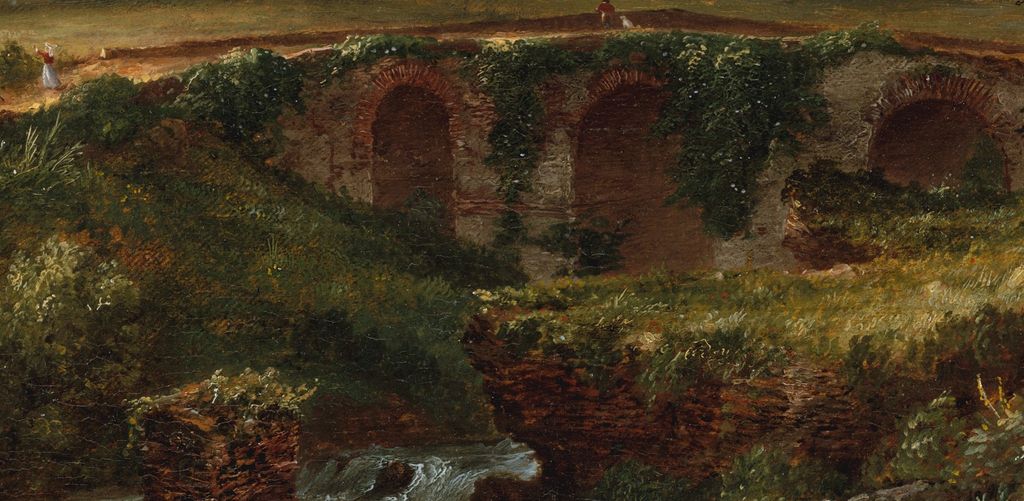
A lower bridge connects the two sides. Its sequence of dark openings establishes a measured rhythm across the foreground, while foliage interrupts the regularity of the stonework. Below, water appears between broken piers and rocks. These crossings and openings make the scene unusually permeable: the eye can follow the bridge across, look through the great arch, or descend into the shaded ground beneath it.
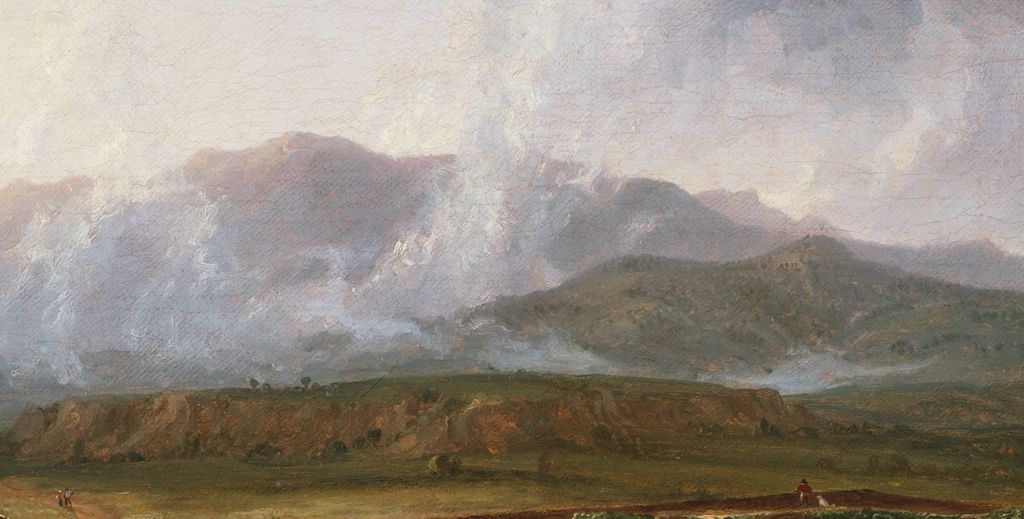
Cole reserves his sharpest contrasts for the nearer landscape. Brick-red and brown masonry, dark leaves and small touches of yellow vegetation stand against the lighter valley. Further away, the hills lose that crispness. Their contours overlap gently, and pale vapour drifts in front of them. The viewer moves from things that seem almost within reach towards a landscape whose forms are partly dissolved by atmosphere.
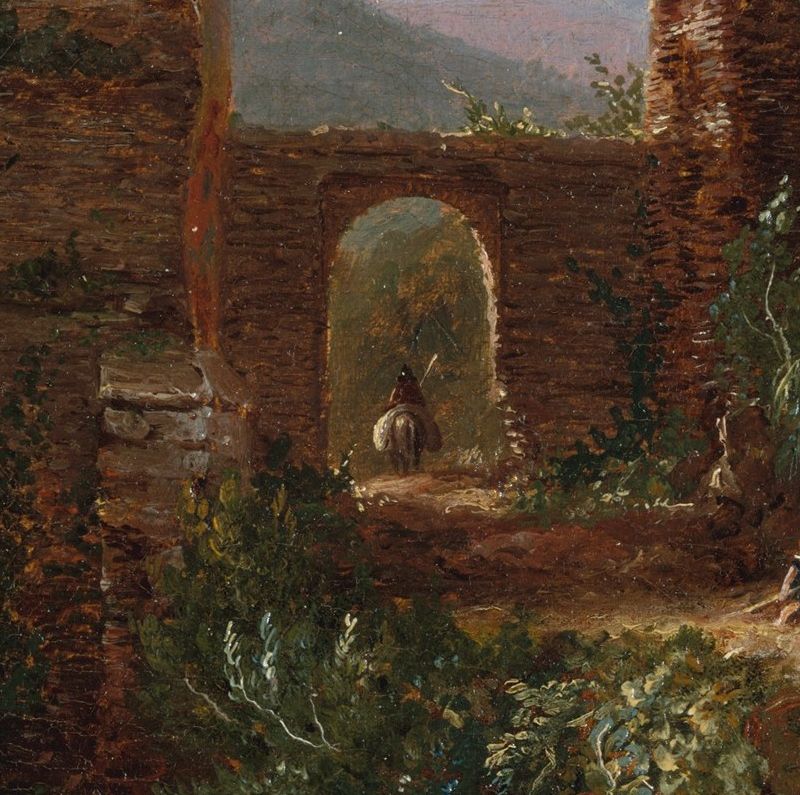
The figures are small, but they prevent the ruins from seeming wholly abandoned. A mounted traveller passes beneath the smaller opening on the right; another figure stands near the path. Further left, a flock and its attendant occupy a sunlit stretch of ground. Other people appear as little marks within the breadth of the landscape. Their dispersed positions make the setting feel inhabited without turning it into a single, dominant human story.
The small scale of the canvas matters to this balance. At less than sixty centimetres wide, it offers a substantial view through closely fitted relationships rather than overwhelming size. The tower, bridge, animals and distant mountains each have room to register. The broad horizontal format lets a relatively modest object contain both an intimate encounter with masonry and the feeling of a much larger world beyond. [1]
Annotated Details from A View near Tivoli (Morning)
Compare four details with the full composition, then open the photographs for a closer view.
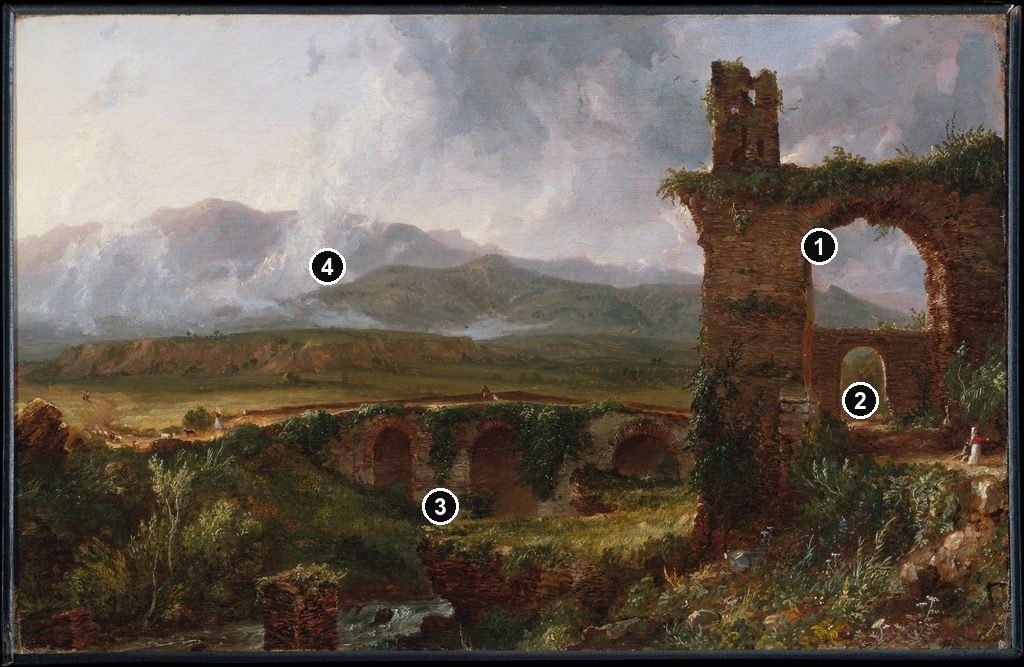
Details from A VIEW NEAR TIVOLI (MORNING)
Each crop comes from the same painting shown above.
The tower above the ancient arch
The large arch of the Anio Novus aqueduct supports a fourteenth-century tower. Their layered masonry brings ancient and medieval construction into the same landscape. [2]
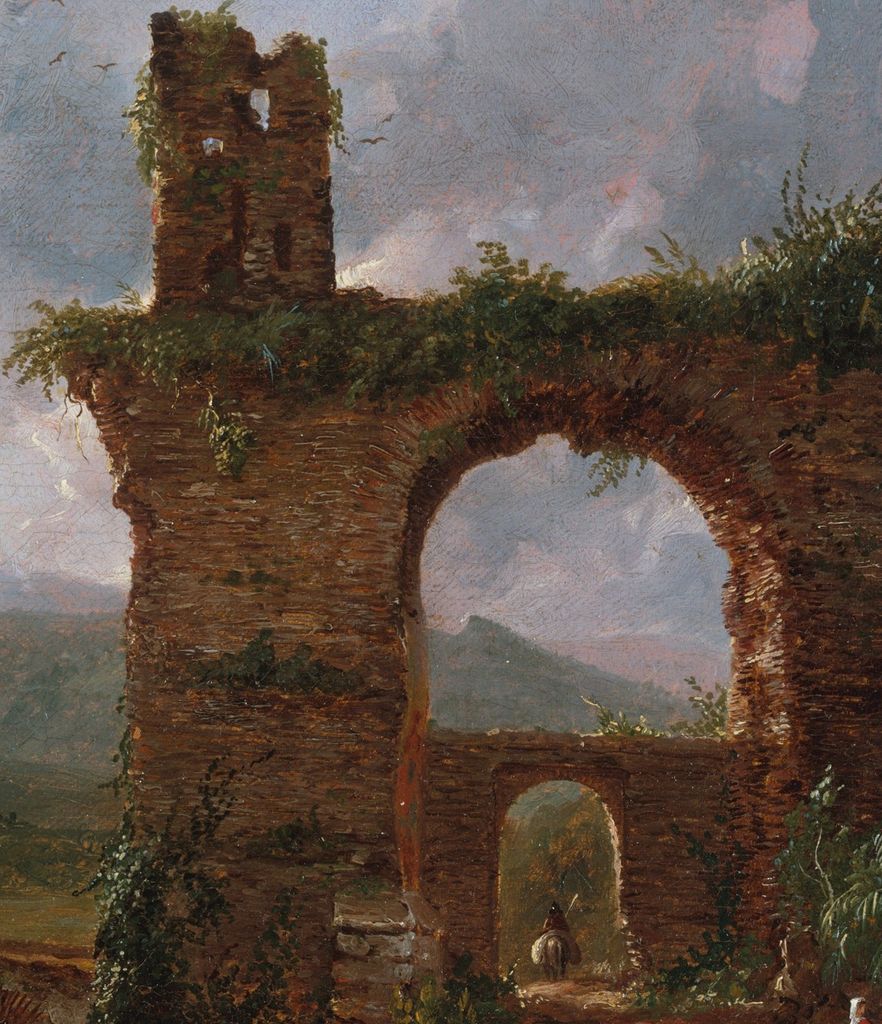
A rider within the smaller arch
The Aqua Marcia opening sits within the larger arch. A mounted traveller passes through it, giving the masonry a human scale and showing the site still in use. [2]
The bridge across the foreground
The later bridge was built over ancient aqueduct remains. Its repeated openings join the sides of the composition, while plants soften the surviving walls. [2]
Morning mist over the mountains
Pale mist drifts across the distant mountains beyond the emphatic foreground ruins. Vittoria interprets this fleeting atmosphere as a subtle counterpart to the long passage of time embodied in the architecture. [2]
Tivoli in the spring of 1832
Cole travelled from Rome to Tivoli on 12 April 1832 with the American artists Amasa Hewins and John H. W. Lane. They left at six in the morning in a four-wheeled carriage. The day began with threatening weather but improved, and Cole remained in Tivoli for ten days. His studies included the cascades, ancient ruins, and trees in the gardens of the Villa d’Este. This painting arose from a sustained period of exploration, rather than a brief stop beside one monument. [4]
Tivoli was already familiar territory for visiting painters. Situated in the hills northeast of Rome, where the Aniene River meets the Roman Campagna, it offered waterfalls, varied vegetation and architecture from different periods. Claude Lorrain and Gaspard Dughet had painted its scenery in the seventeenth century; later visitors included Turner, Corot and several American artists. Cole encountered a place that was at once physically present and densely represented in earlier art. [2]
That distinction helps explain the painting’s particular appeal. Cole did not simply produce a panoramic catalogue of Tivoli’s most recognisable sights. The Temple of Vesta, which he also drew during the visit, is not the structure dominating this canvas. Here, an intersecting group of aqueducts and later additions becomes the centre of attention. A place associated with celebrated monuments yielded a scene whose interest lay in a less obvious combination of forms. [2]
In a letter to W. A. Adams dated 15 September 1834, Cole described the subject as a picturesque discovery during his wanderings, rather than one of the sites particularly celebrated by travellers or history. Shannon Vittoria’s catalogue account draws attention to the tension in that description: the scene nevertheless contains substantial Roman remains. His modest presentation of the subject does not make the architecture anonymous, and its interest need not depend on the fame of an individual monument. [2]
The journey belongs to Cole’s first European tour. He had arrived in Italy in June 1831 and spent much of his early Italian stay in Florence before travelling to Rome in February 1832. Tivoli came during the Roman part of that visit. After further travel in southern Italy, he returned to Florence and completed a group of Italian landscapes during the summer. These included A View near Tivoli (Morning) and Aqueduct near Rome. [4]
Roman arches, a medieval tower and a later bridge
The great opening on the right supports the Anio Novus aqueduct and was popularly known as the Arch of Nero. The smaller opening within it belongs to the Aqua Marcia. Above the larger arch stands a fourteenth-century tower. The bridge crossing the centre is a later construction built over the remains of another ancient aqueduct. Vittoria identifies this meeting of structures as a way in which Cole brings different historical periods into the same view. [2]
These distinctions change how the painting can be read. The most imposing vertical feature is not one building created at one moment. It combines ancient engineering with a medieval addition. Similarly, the horizontal crossing is not simply another stretch of untouched Roman work. The landscape preserves adaptation as well as damage: later people built with, upon and around earlier structures.
Visually, those layers do not appear as separate historical illustrations. Plants grow along the top of the arch and trail down its face. The tower’s irregular summit repeats, in stone, some of the broken outlines found in the surrounding vegetation. On the lower bridge, foliage obscures portions of the walls and openings. Architecture remains forceful, but its surfaces have become part of the landscape’s texture.
The arches also retain a relationship to movement. A rider can still pass through the smaller opening, and a path leads beside the masonry. The low bridge stretches towards the open ground. Whatever their original engineering purposes, the structures organise the painted space around routes and thresholds. Human activity makes the distance between ancient construction and present use visible without requiring a dramatic event.
It would be too simple to treat every surviving wall here as a symbol of complete collapse. Some portions are broken, others stand prominently, and the scene contains ordinary life. The painting asks the viewer to look at what has endured in altered form. The history of the place is not reduced to a single moment of destruction; different periods remain entangled in a setting that continues to support movement, grazing and growth.
From several viewpoints to one composition
Cole’s preparatory work shows how actively he examined the site. Vittoria traces a sequence beginning with a simple landscape outline and written notes about colour and composition. He also made a more detailed panoramic drawing and a vertical study of the tower and arches. These sheets preserve different kinds of information: the broad arrangement of the scene, the character of particular buildings, and reminders of effects that graphite alone could not record. [2]
Cole then passed beneath the aqueducts and studied the prospect from the east. He made another pencil sketch and an oil study on the reverse of Stormy Landscape, a separate oil-on-paper work from the same Tivoli visit. One further drawing simplified the scene to a single arch and substituted a goat pursued by a shepherd for the medieval tower. That alternative is a useful reminder that looking and inventing could occur within the same group of studies. [2]
The finished painting therefore cannot be understood as a straightforward enlargement of one field sketch. Its preparation involved walking, changing direction, isolating details and testing another arrangement. The panoramic and vertical drawings were complementary rather than interchangeable. One helped encompass the country around the aqueducts; another concentrated on the architectural mass that would anchor the right-hand side.
The final balance can be appreciated even without seeing every preparatory sheet. The tower rises in a place where it does not conceal the distant mountains, and the low bridge links the foreground to the bright fields. The rider supplies a small measure of scale inside the nested arches. These relationships make the architecture comprehensible while leaving the view open. The painting’s apparent ease rests on a carefully organised distribution of solid forms and empty spaces.
Back in Florence in June 1832, Cole used his sketches to develop the finished canvas. The inscription on the reverse names Florence and dates the painting to 1832. The work thus combines observation made near Tivoli with completion in another city. That distinction is central to Cole’s working methods: material gathered outdoors could remain a basis for a considered studio composition. [2]
Watch: Thomas Cole
Choose a film to explore the artist’s work, its interpretation and its wider setting.
Thomas Cole: Painting the American Landscape (remastered audio)
An introduction to Cole’s landscapes and artistic ambitions.
Watch on YouTubeMorning atmosphere and European study
Morning is visible here through a relationship of light, colour and distance. The left side of the sky glows, while grey clouds gather above and behind the tower. Thin vapour softens the mountains. The upper masonry catches warmth, but the foreground below the bridge remains darker. Cole does not distribute illumination evenly; the scene is made legible through successive areas of brightness and shade.
Vittoria interprets the morning mist as a subtle counterpart to the passage of time embodied in the architecture. The two forms of change operate on very different scales. Buildings preserve evidence of centuries, whereas the mist describes an effect that may alter within minutes. That reading connects the painting’s historical subject to its immediate atmosphere without requiring the light to carry a precise moral message. [2]
Cole’s European study gave him opportunities to develop this attention to weather. Elizabeth Mankin Kornhauser describes his interest in the oil studies and cloud paintings of John Constable, whose work he examined in England. In Italy, he increasingly used outdoor oil studies to capture changing conditions. The Tivoli Stormy Landscape and the daylight and evening studies for Aqueduct near Rome belong to that practice. This is a documented context for his observation, rather than proof that the finished morning view copies a particular Constable painting. [5]
A second inheritance was Claude’s treatment of the Roman countryside. Tim Barringer describes Cole encountering the terrain that had supplied Claude’s landscapes after studying his paintings in London. The relation between rich foregrounds and distant, paler land offered more than a formula to repeat: it provided a compositional tradition that could be tested against new observations. In the Tivoli canvas, the emphatic ruin and the spacious prospect belong to that meeting of inherited art and direct experience. [5]
Aqueduct near Rome, also painted in 1832, offers a useful comparison. There, a longer line of ancient arches extends across the Campagna, accompanied by evening light and pastoral figures. Here, the principal architecture gathers much nearer to the viewer, while morning vapour opens the distance. The shared subject of aqueducts produces distinct experiences of space and time of day. Both works were completed in Florence from material collected around Rome. [6]
Exhibition, gift and a later return to the subject
Cole exhibited A View near Tivoli (Morning) at the National Academy of Design’s eighth annual exhibition in spring 1833. Vittoria cites a New-York Mirror review that welcomed his European pictures. The critic had feared that study abroad might draw Cole away from nature, but concluded that the paintings demonstrated the value of his Italian experience. This was a response to the exhibited group, rather than a surviving detailed review devoted solely to the Tivoli canvas. [2]
That reception places the painting within a larger question facing an American landscape artist returning from Europe: how could foreign study strengthen his work? The small Tivoli view offered a tangible answer through its combination of a studied place, older pictorial traditions and carefully rendered atmosphere. Its subject was Italian, but the debate about what Cole had gained from travelling took place before his American audience.
The verso inscription records that Cole presented the painting to W. A. Adams in September 1834. This later date belongs to the gift, not to the making of the canvas. The Metropolitan Museum acquired it through the Rogers Fund in 1903. The canvas was thus completed in Italy, presented by the artist two years later and acquired by the museum in the early twentieth century. [2] [1]
The Tivoli studies also had a life beyond this painting. In 1846 Cole returned to them for The Arch of Nero, a separate, larger canvas with a vertical format, identified in the 2018 catalogue as part of the Newark Museum’s collection. He did not repaint the 1832 museum object into that later work. The reuse of the drawings shows how an encounter on his first Italian journey could supply material fourteen years afterwards. [2]
In A View near Tivoli (Morning), the wide format preserves a particular balance between the standing arch and the open country. Architecture occupies the foreground, but light keeps drawing attention beyond it. The ruin is neither an isolated specimen nor the sole destination of the eye. It belongs to a landscape in which people pass, plants spread and the distant atmosphere changes around the things that remain.
Artworks directory
Explore paintings, drawings and studies across Cole’s career. The two Voyage of Life sets appear separately. Dates and study identifications draw on the exhibition and collection catalogues, supplemented by the National Gallery’s drawing records. [3] [7] [8] [9]
| Name | Date | Medium |
|---|---|---|
| The Oxbow | 1836 | Painting |
| The Titan’s Goblet | 1833 | Painting |
| The Architect’s Dream | 1840 | Painting |
| The Course of Empire: The Savage State | ca. 1834 | Painting |
| The Course of Empire: The Arcadian or Pastoral State | ca. 1834 | Painting |
| The Course of Empire: The Consummation of Empire | 1835–1836 | Painting |
| The Course of Empire: Destruction | 1836 | Painting |
| The Course of Empire: Desolation | 1836 | Painting |
| The Voyage of Life: Childhood | 1842 | Painting |
| The Voyage of Life: Youth | 1842 | Painting |
| The Voyage of Life: Manhood | 1842 | Painting |
| The Voyage of Life: Old Age | 1842 | Painting |
| Home in the Woods | 1847 | Painting |
| Distant View of Niagara Falls | 1830 | Painting |
| View on the Catskill—Early Autumn | 1836–37 | Painting |
| Lake with Dead Trees (Catskill) | 1825 | Painting |
| River in the Catskills | 1843 | Painting |
| A View of the Mountain Pass Called the Notch of the White Mountains (Crawford Notch) | 1839 | Painting |
| Expulsion from the Garden of Eden | 1828 | Painting |
| The Subsiding of the Waters of the Deluge | 1829 | Painting |
| The Mountain Ford | 1846 | Painting |
| American Lake Scene | 1844 | Painting |
| A View near Tivoli (Morning) | 1832 | Painting |
| Aqueduct near Rome | 1832 | Painting |
| The Hunter’s Return | 1845 | Painting |
| The Voyage of Life: Childhood (first version) | 1840 | Painting |
| The Voyage of Life: Youth (first version) | 1840 | Painting |
| The Voyage of Life: Manhood (first version) | 1840 | Painting |
| The Voyage of Life: Old Age (first version) | 1840 | Painting |
| Panorama of the Oxbow on the Connecticut River as seen from Mount Holyoke | ca. 1832 (museum); 1833 (2018 catalogue) | Drawing |
| Sketch for The Oxbow | 1836 | Painting |
| From Nature | 1823 | Drawing |
| View of the Round-Top in the Catskill Mountains (Sunny Morning on the Hudson) | 1827 | Painting |
| Scene from The Last of the Mohicans: Cora Kneeling at the Feet of Tamenund | 1827 | Painting |
| View of Monte Video, the Seat of Daniel Wadsworth | 1828 | Painting |
| The Garden of Eden | 1828 | Painting |
| Tomb of General Brock, Queenston Heights, Ontario | 1830 | Painting |
| Effect for Newstead Abbey, Nottinghamshire, England | 1830 | Drawing |
| The Ilissos, from the Parthenon West Pediment | 1829 or 1830 | Drawing |
| Life Study for the Prostrate Shepherd in The Angel Appearing to the Shepherds | 1831–1832 | Painting |
| Interior of the Colosseum, Rome | ca. 1832 | Painting |
| Campagna di Roma (Study for Aqueduct near Rome) | 1832 | Painting |
| Landscape with a Round Temple | ca. 1830s | Painting |
| Stormy Landscape | 1832 | Painting |
| View of Florence from San Miniato | 1837 | Painting |
| Mount Holyoke, Massachusetts (after Basil Hall) | ca. 1829–1831 | Drawing |
| Layout for The Course of Empire | 1833 | Drawing |
| Study for The Course of Empire: The Savage State | ca. 1834 | Painting |
| Study for The Course of Empire: The Arcadian or Pastoral State | ca. 1834 | Painting |
| Study for The Course of Empire: Desolation | 1836 | Painting |
| Study for Dream of Arcadia | 1838 | Painting |
| Clouds | ca. 1830s | Painting |
| Study for The Hunter’s Return | 1845 | Painting |
| Study for Home in the Woods | ca. 1847 | Painting |
| Sunrise in the Catskills | 1826 | Painting |
| Study for The Mountain Ford | 1846 | Drawing |
| Tree Trunks | 1825–1840 | Drawing |
Frequently Asked Questions
Cole painted it in 1832, after visiting Tivoli that April. He completed the canvas in Florence, which is named in the inscription on the reverse. The September 1834 inscription records its later presentation to W. A. Adams. [2]
The large and small arches on the right belong to the Anio Novus and Aqua Marcia aqueducts. A fourteenth-century tower stands above the larger arch, popularly called the Arch of Nero. The central bridge is a later construction over ancient aqueduct remains. The dominant structure is not the Temple of Vesta. [2]
Cole made several drawings and an oil study near Tivoli, examining the subject from different viewpoints. He developed the finished oil-on-canvas painting in his Florentine studio. The outdoor studies and the completed canvas are distinct works. [2]
It belongs to the Metropolitan Museum of Art in New York, accession 03.27. The museum records its acquisition through the Rogers Fund in 1903. It measures 37.5 × 58.7 cm. [1]
No. The Arch of Nero is a separate painting from 1846, made in a larger, vertical format using studies associated with the earlier Tivoli subject. A View near Tivoli (Morning) is the smaller horizontal canvas of 1832. [2]
Discussion
Look again at A View near Tivoli (Morning) and compare your reading with the questions below.
Reader Insights
Does your attention settle first on the tower and arches, or on the light and distant mountains? How does that starting point change your experience of the scene?
Do the paths, figures and vegetation make these ruins feel like remnants of a lost world, or part of a place still being used?
Which detail or comparison would you add to this account, and what evidence supports your reading?
Join the Conversation
Share the details that shaped your response, or suggest a comparison for other readers.
References
- Metropolitan Museum of Art, A View near Tivoli (Morning), object 10500, accession 03.27, collection metadata and Open Access image. Collection record; complete object metadata.
- Shannon Vittoria, catalogue entries 42–43, especially A View near Tivoli (Morning), in Elizabeth Mankin Kornhauser and Tim Barringer, Thomas Cole’s Journey: Atlantic Crossings (Metropolitan Museum of Art, 2018), pp. 187–189; entry 43 notes, p. 271. The letter to W. A. Adams, 15 September 1834, and the 1833 review are discussed through this scholarly edition. Catalogue PDF.
- Elizabeth Mankin Kornhauser and Tim Barringer, Thomas Cole’s Journey: Atlantic Crossings (2018). Career context and artwork/study metadata: catalogue entries 10–66 and chronology, PDF pp. 137–231 and 249–262; related Barringer essay passages, PDF pp. 23–66.
- Italy: The Grand Tour, p. 179, and Shannon Vittoria, Chronology, p. 254, in Thomas Cole’s Journey: Atlantic Crossings (2018). Catalogue PDF.
- Elizabeth Mankin Kornhauser, Manifesto for an American Sublime, pp. 72–73, and Tim Barringer, p. 47, in Thomas Cole’s Journey: Atlantic Crossings (2018). Catalogue PDF.
- Elizabeth Mankin Kornhauser, catalogue entries 39–40, Aqueduct near Rome and Campagna di Roma, pp. 183–185, in Thomas Cole’s Journey: Atlantic Crossings (2018). Catalogue PDF.
- Franklin Kelly et al., American Paintings of the Nineteenth Century, Part I (National Gallery of Art, 1996). Cole catalogue and both Voyage of Life sets, PDF pp. 91–124.
- National Gallery of Art, Study for The Mountain Ford (1846), accession 2015.19.772. Collection record and open-access image.
- National Gallery of Art, Tree Trunks (1825–1840), accession 2015.19.607. Collection metadata and open-access image.
- Splash image source.
Thomas Cole, A View near Tivoli (Morning), 1832. Oil on canvas, 37.5 × 58.7 cm. Metropolitan Museum of Art, New York, Rogers Fund, 1903 (03.27).