by Tom Gurney
Tom Gurney BSc (Hons) is an art history expert with over 20 years experience
Published on June 19, 2020 / Updated on October 14, 2023
Email: tomgurney1@gmail.com / Phone: +44 7429 011000
Mountain Landscape with Church by Wassily Kandinsky: Introduction
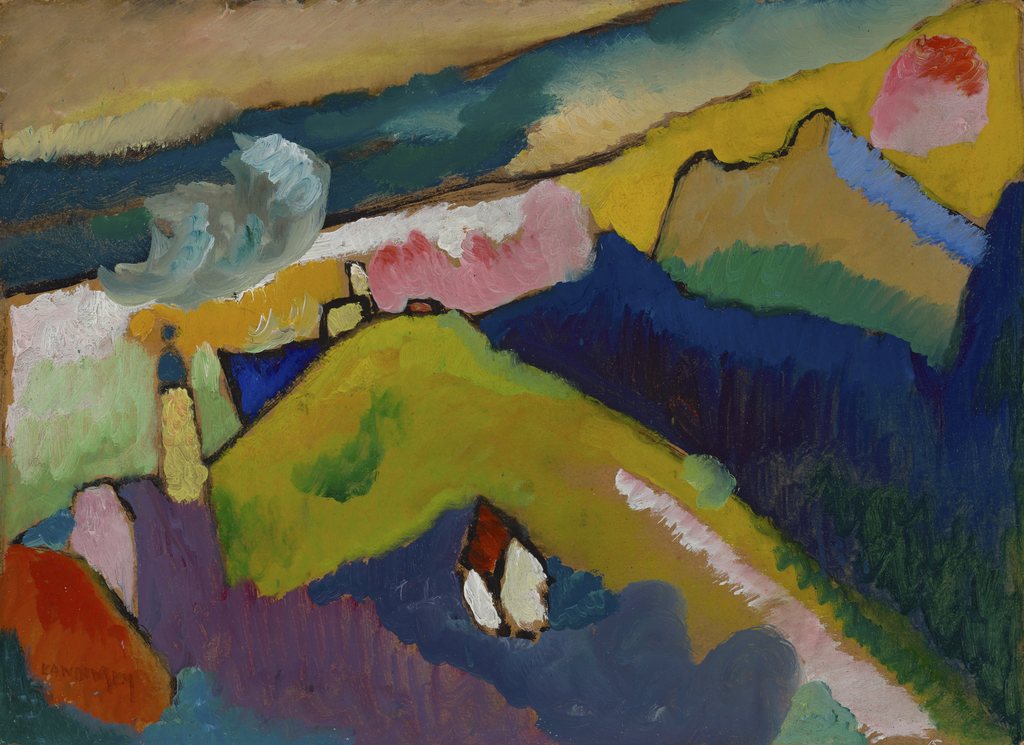
In Wassily Kandinsky's Mountain Landscape with Church, a vivid yellow-green hill rises across the centre of the picture. A very small upright near its upper edge suggests the church named in the title, while deeper blue mountains and a dark hollow lie behind. Pink touches and an ochre-yellow height at the right brighten the scene. The forms are broad and simplified, yet the landscape still has a path for the eye from near ground to far ridge. The Lenbachhaus in Munich identifies the exact work as Murnau – Berglandschaft mit Kirche, made in summer 1910, oil on cardboard, 32.7 × 44.8 cm. [1].
The object is signed KANDINSKY in grey at the lower left. The museum also records inscriptions on the reverse: “Kirche”, probably written by Kandinsky, and a fuller artist-title-date notation by Johannes Eichner. Such evidence gives the painting a much firmer identity than a translated title alone. It is a small horizontal cardboard picture, inventory GMS 46, and should not be confused with Kandinsky's separate, more upright Murnau with Church I, also in the Lenbachhaus. [1]; [2].
Annotated details in Mountain Landscape with Church
Select a numbered point to examine three close views of the work.
 123
Select a number to reach its detail.
Details from MOUNTAIN LANDSCAPE WITH CHURCH
Three close views of the work.
Foreground form
A strong upright shape anchors the left foreground.
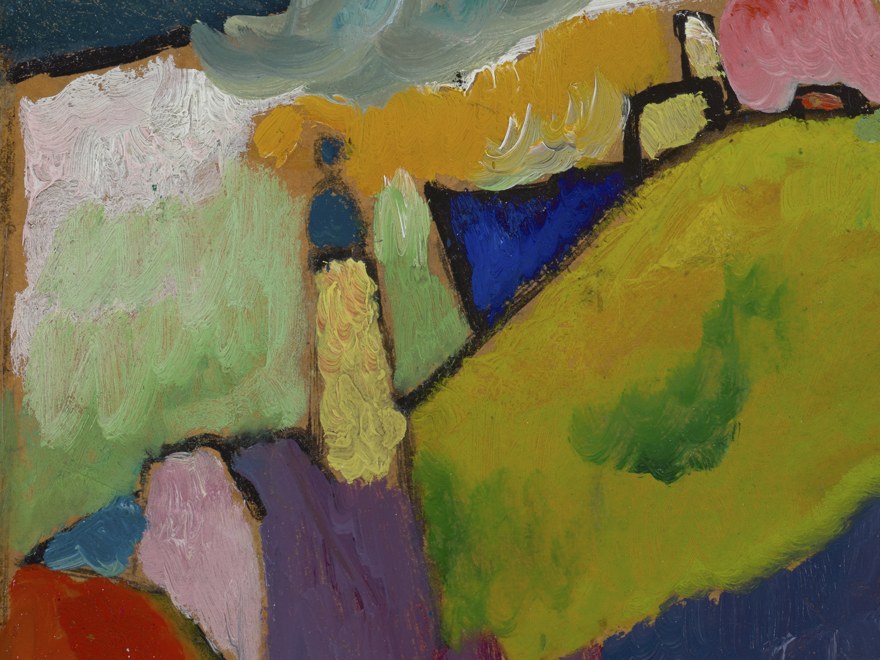
Blue ridge
Blue and green bands carry the landscape across the upper half.
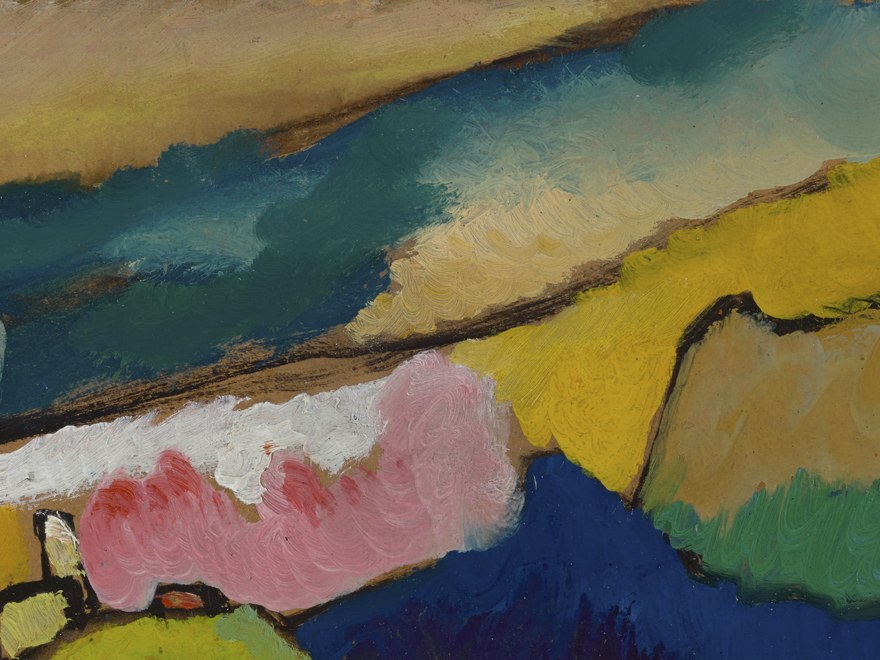
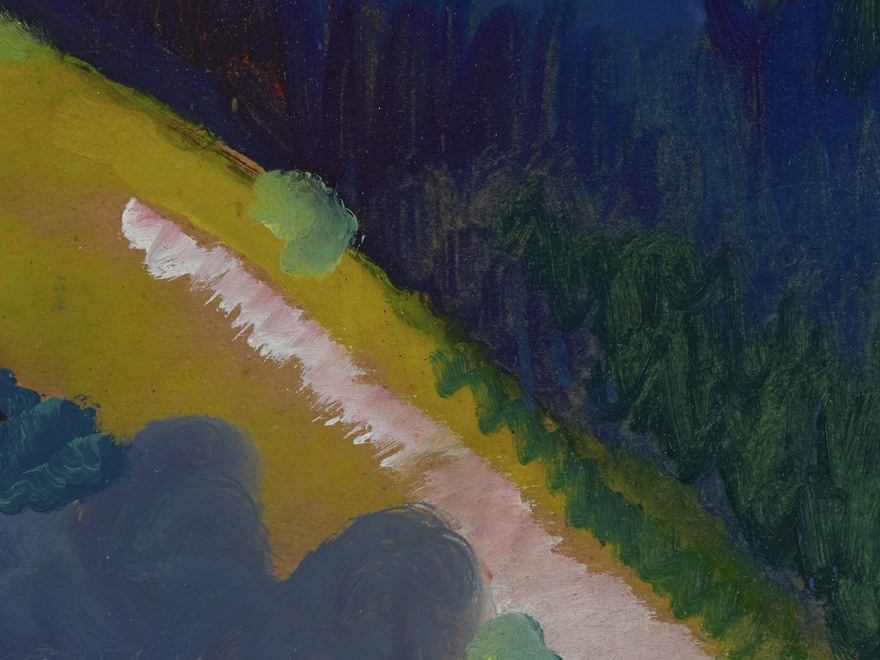
Lower colour blocks
Violet and blue areas break the foreground into broad shapes.
Reproduction from the linked collection record, CC0 1.0. View image source and terms.
Watch: Wassily Kandinsky
Five museum videos about Kandinsky’s art, sources of inspiration and the relationship between colour and music.
Vasily Kandinsky: Around the Circle
Curator Megan Fontanella introduces Kandinsky and the Guggenheim collection.
Watch on YouTubeAt a Glance
- Artist and museum title:Wassily Kandinsky, Murnau – Berglandschaft mit Kirche (Murnau – Mountain Landscape with Church).
- Date:Summer 1910, according to the Lenbachhaus.
- Medium and size:Oil on cardboard, 32.7 × 44.8 × 0.4 cm.
- Collection identity:Lenbachhaus, Munich, inventory GMS 46; entered by gift in 1957.
- Documented marks:Grey KANDINSKY signature at lower left; reverse “Kirche” probably by the artist; fuller reverse notation by Johannes Eichner.
- Visible arrangement:Bright foreground hill, small skyline church form, dark blue mountain passage, yellow ridge and pink accents.
- Separate painting:Murnau with Church I, Lenbachhaus GMS 59, is larger and has a different format and composition.
Where this work sits in Kandinsky’s career
The Blue Rider
1903Composition VII
1913Composition VIII
1923Several Circles
1926Sky Blue
1940Contents
- Annotated details
- A small church in a large colour field
- Object details and the reverse inscriptions
- Not the same as Murnau with Church I
- Colour, place and what remains open
- Frequently asked questions
- References
A small church in a large colour field
The church is not a grand central monument. It appears as a little dark-edged upright near the crest of the green-yellow hill, easy to overlook among the stronger colour masses. The title encourages the eye to find it, but then the wider landscape takes over. A broad yellow-green form runs diagonally from the middle toward the lower right; dark blue presses against it at the right and behind; pink patches punctuate the skyline. Kandinsky makes a place legible through a few signals while letting colour dominate the experience. [1].
The central slope is not painted as a smoothly shaded hill. Its greens, yellows and ochres sit in distinct strokes and patches, with a darker green mark within it. Across its lower edge, a pale diagonal and blue-grey area complicate the sense of depth. The hill can read as a rising landform, but it can also be enjoyed as a large, tilted colour plane. That double reading is characteristic of how the small painting holds on to a landscape subject while exploring a freer arrangement of marks. [1].
At the upper right, a yellow-brown mountain shape is bounded by a sharply bending black line. A blue diagonal cuts into it and a pink-red patch sits near the top. In a literal view, these might be mountain, shadow and cloud or tree; the museum's title and tags support a mountain setting, but they do not identify each brush mark. The important visual fact is the energetic contrast between the warm crest and the deep blue passage below. The colour boundaries are as decisive as the distant topography. [1].
The left side is more broken. Pale blue-grey, pink, cream and yellow patches cluster around a few dark marks that may suggest buildings or hillside forms. A small white and dark-roofed shape near the bottom sits below the great green hill. The eye can move from that near form to the tiny skyline church and then to the higher right-hand mountain. The painting offers a route into depth, but its overlapping bands never turn into a carefully mapped panorama. [1].
Object details and the reverse inscriptions
The owner museum catalogues the painting as oil on cardboard, a portable support often used by Kandinsky in these years. Its dimensions, 32.7 × 44.8 cm, make it a compact horizontal work. A Wikimedia description for a related digital file has at times called it oil on canvas, but the Lenbachhaus's object record governs the material here. The owner also records a 0.4 cm depth. Material matters: this is a small painted board, not a large church canvas cut down in reproduction. [1].
The signature at the lower left reads KANDINSKY in grey. On the reverse, the word “Kirche” is probably by Kandinsky, according to the museum. That qualifier is part of the evidence and should remain. The other reverse notation is attributed to Johannes Eichner and records Kandinsky, the landscape-with-church title and 1910. These marks help explain the work's identification while also showing that not every inscription is autographic. [1].
The Lenbachhaus lists the painting as a 1957 gift, credited to the Gabriele Münter Foundation. The public object page does not set out a full chronological provenance, and none needs to be invented to account for the painting's present museum holding. The museum also indicates it is not currently on display in its online record. Displays can change, so that status is a practical detail to check afresh before a visit rather than a permanent property of the work. [1].
Not the same as Murnau with Church I
Kandinsky painted more than one church landscape around Murnau. Another Lenbachhaus work, Murnau mit Kirche I, is also dated 1910 but measures 64.7 × 50.2 cm and bears inventory GMS 59. Its white church tower is a much stronger vertical feature in a taller composition. The present mountain landscape is GMS 46, a broad 32.7 × 44.8 cm painting with a small church signal almost absorbed by the hills. The shared word “church” in translated titles is not an identity test. [1]; [2].
The museum's essay for Murnau with Church I explains how that separate painting pushes recognisable houses and tower toward nearly independent colour signs. It can provide a useful comparison with GMS 46, but its precise discussion of the other composition should not be transferred wholesale. In Mountain Landscape with Church, the hill itself is the largest visual event. The tiny architecture is held in a landscape of coloured ridges, not placed as the main vertical anchor. [2]; [1].
The different sizes also affect how one might encounter the pictures. A viewer approaching the larger Murnau with Church I may see a striking tower first. The smaller landscape asks for a closer search. The church can be found only after the green slope and dark blue mountain have already claimed attention. That makes the title a guide to close looking rather than a complete summary of the scene. [1]; [2].
Colour, place and what remains open
The painting's title names Murnau, and the Lenbachhaus identifies it as a mountain landscape. It does not provide a surveyed viewpoint or identify the church by parish name in the cited record. A viewer may recognise the broad terrain of the Bavarian foothills, but the picture should not be turned into a precise map without a source. Kandinsky's colour choices also make exact topographic decoding difficult: yellow and pink can describe light while acting as independent shapes. [1].
Across the painting, the warm hill, cool hollow, tiny church and pink accents hold together through strong boundaries and diagonals. Its small scale does not make it a minor sketch of a larger church picture. The signed and inscribed summer 1910 board is its own object. Its church is modest in size but important to how the eye navigates Kandinsky's unusually bright mountain landscape. [1].
Kandinsky artworks directory
Frequently Asked Questions
The Lenbachhaus dates Murnau – Berglandschaft mit Kirche to summer 1910. [1].
It is oil on cardboard, 32.7 × 44.8 × 0.4 cm, according to the owner museum. [1].
A very small upright near the crest of the central yellow-green hill appears to mark the church. Much of the composition is given to the surrounding slopes and colour. [1].
No. The present work is Lenbachhaus GMS 46, 32.7 × 44.8 cm. Murnau with Church I is the separate Lenbachhaus GMS 59, 64.7 × 50.2 cm. [1]; [2].
The museum says “Kirche” on the reverse is probably by Kandinsky. It attributes the fuller artist-title-1910 notation to Johannes Eichner. [1].
It belongs to the Lenbachhaus in Munich, inventory GMS 46, and entered the museum as a 1957 gift. [1].
Discussion
What do you notice first in Mountain Landscape with Church? Share a close observation or a question about the evidence for this work.
Comments are for comparing what we see and what the cited sources establish.
Reader Insights
Where do you first find the little church among the colour fields?
How does the yellow-green slope balance the dark blue mountain hollow?
Which object details keep this painting distinct from Murnau with Church I?
Join the Conversation
Add your observation below and tell us which part of the artwork led you to it.
References
- Lenbachhaus, Kandinsky, Murnau – Berglandschaft mit Kirche, GMS 46. View source.
- Lenbachhaus, distinct Murnau mit Kirche I, GMS 59. View source.