by Tom Gurney
Tom Gurney BSc (Hons) is an art history expert with over 20 years experience
Published on June 19, 2020 / Updated on October 14, 2023
Email: tomgurney1@gmail.com / Phone: +44 7429 011000
Murnau with Church I by Wassily Kandinsky: Introduction
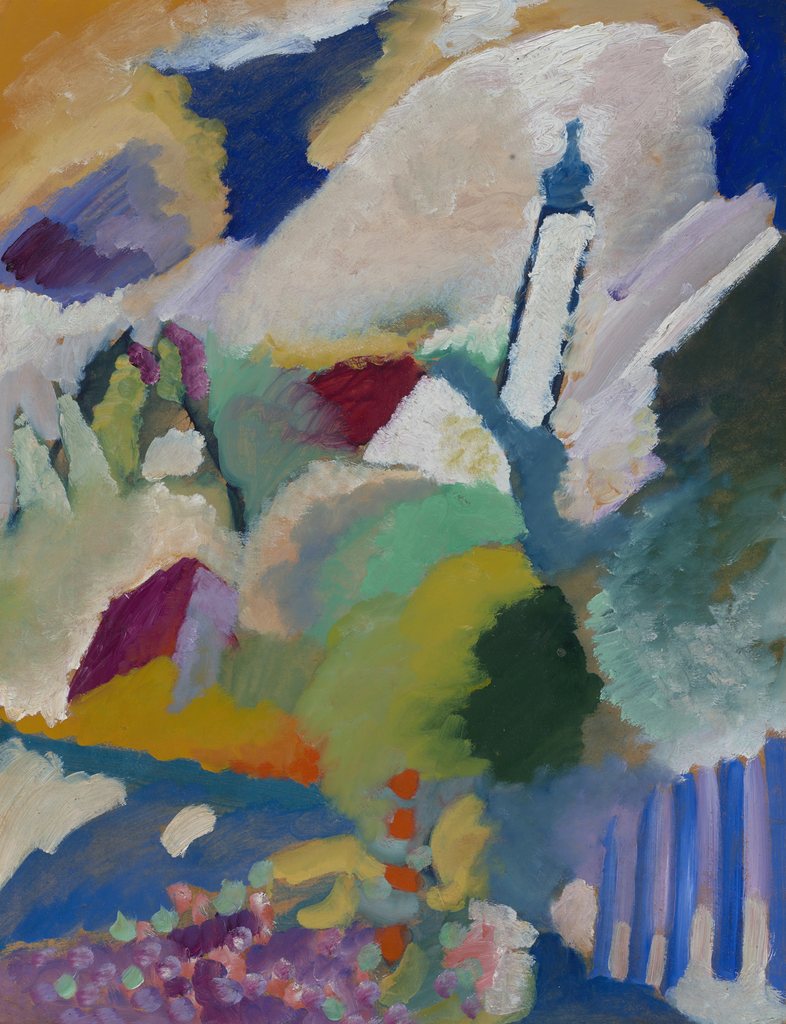
A tall white church tower rises through the shifting colour of Wassily Kandinsky's Murnau with Church I. Its blue tip and dark edges make it one of the few forms that remain immediately recognisable. Around it, pale pink, yellow, turquoise, deep blue and green passages suggest buildings, foliage, ground and sky without fixing them into a conventional town view. The painting is a vertical 1910 work, oil on cardboard, 64.7 × 50.2 cm, held by the Lenbachhaus in Munich as inventory GMS 59. [1].
The museum's English exhibition material calls it Murnau with Church I. That final I matters. Kandinsky made other church views of Murnau, including a separate Murnau – Mountain Landscape with Church also in the Lenbachhaus and a Murnau with Church II held in Eindhoven. The owner record and image identify this page's subject as the tall, white-towered GMS 59. Similar translated titles should never be taken as proof that the objects are interchangeable. [2]; [1].
Annotated details in Murnau with Church I
Select a numbered point to examine three close views of the work.
 123
Select a number to reach its detail.
Details from MURNAU WITH CHURCH I
Three close views of the work.
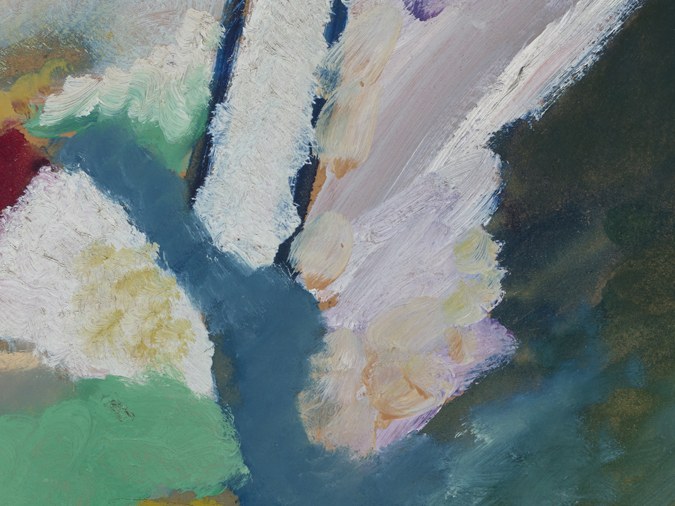
Church tower
A slim tower stands among broad, differently coloured areas.
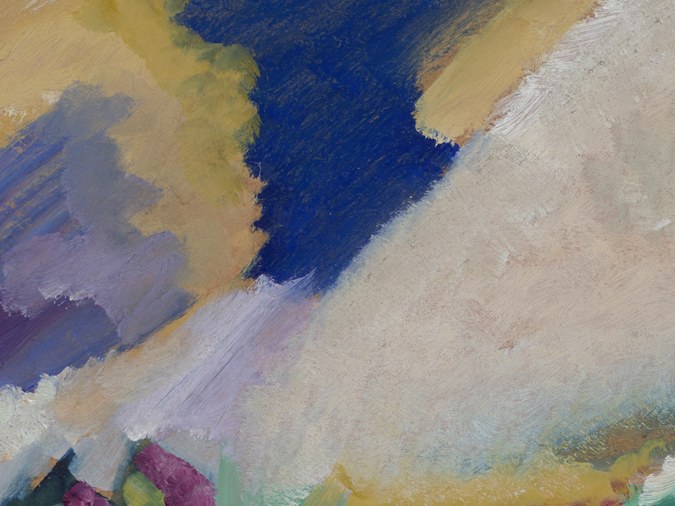
Blue band
Deep blue opens the sky above the village.
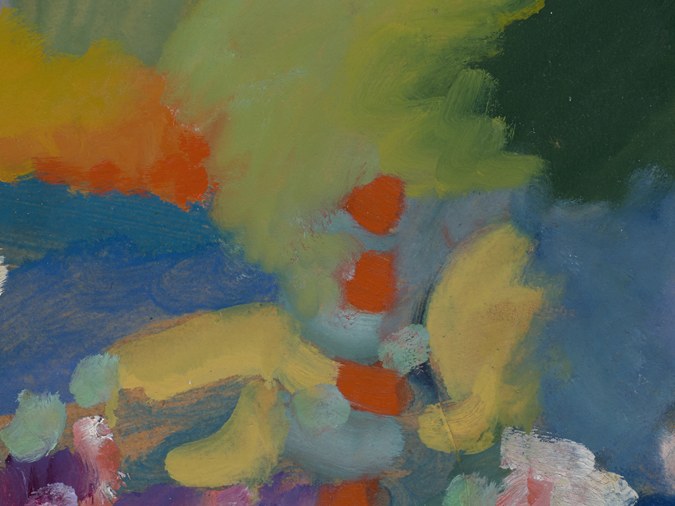
Foreground village
Small colour patches gather below the church.
Reproduction from the linked collection record, CC0 1.0. View image source and terms.
Watch: Wassily Kandinsky
Five museum videos about Kandinsky’s art, sources of inspiration and the relationship between colour and music.
Vasily Kandinsky: Around the Circle
Curator Megan Fontanella introduces Kandinsky and the Guggenheim collection.
Watch on YouTubeAt a Glance
- Artist and museum title:Wassily Kandinsky, Murnau mit Kirche I (Murnau with Church I).
- Date:1910, according to the Lenbachhaus.
- Medium and size:Oil on cardboard, 64.7 × 50.2 cm.
- Collection:Städtische Galerie im Lenbachhaus und Kunstbau München, inventory GMS 59.
- Provenance:Gabriele Münter held it from 1926 to 1957 after transfer from Kandinsky; she gave it to the Lenbachhaus in 1957.
- Visible subject:High white church tower, loosely indicated houses, hills and trees within broad moving colour.
- Distinct works:The horizontal Mountain Landscape with Church is Lenbachhaus GMS 46; Murnau with Church II is another painting in Eindhoven.
Where this work sits in Kandinsky’s career
The Blue Rider
1903Composition VII
1913Composition VIII
1923Several Circles
1926Sky Blue
1940Contents
- Annotated details
- The tower holding the picture together
- A Murnau view at the edge of abstraction
- Similar titles, different objects
- Collection history and a cautious anecdote
- Frequently asked questions
- References
The tower holding the picture together
The church tower sits slightly right of centre, its white body edged by dark blue-green. It is tall enough to connect several otherwise separate zones of paint. A blue pointed top rises against a pale field; lower down, its sides meet turquoise, lavender and darker green forms. The tower anchors the eye, but it does not make everything around it easy to name. The Lenbachhaus curatorial text draws attention to this tension: identifiable signs of the town remain, yet colour and brushwork loosen their outlines. [1].
To the left, white and green marks suggest a cluster of buildings or trees. A red roof-like wedge emerges near the centre, while a violet-red angular passage stands farther down. These signs are enough to imply houses without describing each one. The eye can move from pale facades to saturated colour, then back to the tower. As the museum observes, a viewer may recognise the church and faint houses while much of the town seems to dissolve into colour. [1].
The top of the picture is especially unsettled. Dark blue pushes through warm orange and pale cream, with a wide white-pink mass behind the steeple. Rather than opening a smooth sky above the town, Kandinsky lets large areas press against one another. Some strokes turn and overlap; others leave traces of the underlying cardboard. The sky can feel close to the buildings because the colour planes are so emphatic. [1].
At the bottom, orange, blue, violet and mottled pink passages gather more densely. They do not form a neatly graded foreground. A set of upright blue stripes at the lower right hints at a fence or repeated architectural feature, while an orange-red sequence nearer the centre punctuates greener forms. Such details invite recognition but remain part of a surface that is more vigorous than literal. The museum reads the picture as a landscape whose objects are close to breaking apart into colour. [1].
A Murnau view at the edge of abstraction
The Lenbachhaus presents Murnau with Church I as one of Kandinsky's notable views of the Bavarian town. The curators argue that among his Murnau landscapes up to 1910, it pushes the loosening of recognizable objects especially far. The scene still belongs to landscape painting: there is a church and a grouping of houses. Yet the colour is handled with freedom similar to his more invented pictures of that period. This is the museum's interpretation of this particular canvas, not a universal description of every Murnau picture. [1].
The tall format helps create that effect. Forms appear to tip and compress within the narrow field. Blue and white recur in different areas, balancing the picture even while individual things remain uncertain. The museum also notes that light brown cardboard is visible beneath the loose paint in places. Those glimpses of support matter because the picture's openness is not simply a failure to finish. The surface offers both energetic colour and spaces where the ground participates in the design. [1].
The church can be read as a stable sign in this changeable field. At one scale it is a familiar tower, but at another it becomes a tall white shape set against blue and pink. Kandinsky lets the same form work as architecture and as a colour relation. That dual role is more precise than saying the picture is already wholly abstract. The identifiable motif remains crucial: without the white tower, a viewer might have much less reason to call the painting a townscape. [1].
Similar titles, different objects
The Lenbachhaus's Murnau – Mountain Landscape with Church, GMS 46, is a horizontal work of summer 1910, 32.7 × 44.8 cm, with a small church near a bright hillside. Murnau with Church I is vertical and nearly twice as tall, 64.7 × 50.2 cm, with the white church tower prominent. Both are oil on cardboard and belong to the same owner, but their proportions and inventories make them distinct. Translated page titles can blur this if the images and object numbers are not checked. [1]; [3].
The Lenbachhaus essay also compares Murnau with Church II in the Van Abbemuseum in Eindhoven. It says that related work describes the topography more exactly and gives the hills behind the church clearer dark contours. That comparison helps define what is unusual here: Kandinsky did not remove the scene, but he reduced many of its locating features to broad colour and a few remaining signs. The museum's comparison is about two separate paintings, not a sequence of identical versions of one board. [1].
Another related scene, Murnau – Castle and Church of 1909, offers a different view with clearer roofs and a castle gable. Its museum record describes repeated views of Murnau from the house Kandinsky shared with Münter. That wider history makes the town a meaningful subject, but the exact viewpoint of Murnau with Church I should be drawn from its own source rather than borrowed from every related picture. [4]; [1].
Collection history and a cautious anecdote
The Lenbachhaus traces this painting to Gabriele Münter, who held it from 1926 to 1957 after receiving it from Kandinsky. She donated it to the museum in 1957. These dates describe this specific object, GMS 59, and should not automatically be transferred to other church paintings. The museum's credit line identifies the Gabriele Münter Foundation 1957. [1].
The museum's essay raises a well-known Kandinsky anecdote: one evening he unexpectedly saw one of his own paintings turned sideways in dim light and could not at first identify its subject. The curators say this or a similar work may have been the picture involved. That wording is deliberately tentative. There is no object-level proof in the public record that GMS 59 was the exact painting in the episode. The story is useful for understanding how recognition can falter in these colour-driven scenes, so long as its uncertain link to this object remains clear. [1].
The canvas-like drama of Murnau with Church I is therefore carried by a relatively modest cardboard support. Its visual force comes from colour fields that tilt and collide, balanced by the pale tower. The museum record holds the work firmly in 1910 and in its documented Münter-to-Lenbachhaus history. Within that secure identity, Kandinsky leaves viewers free to move between the familiar church and the painting's less settled forms. [1].
Kandinsky artworks directory
Frequently Asked Questions
The Lenbachhaus dates it to 1910. [1].
It is oil on cardboard, 64.7 × 50.2 cm. [1].
It belongs to the Lenbachhaus in Munich, inventory GMS 59, following Gabriele Münter's 1957 gift. [1].
No. Murnau with Church I is the tall GMS 59. The separate Murnau – Mountain Landscape with Church is horizontal GMS 46, with different dimensions and composition. [1]; [3].
The tower remains visible, but the museum's essay notes how freely applied colour reduces many other objects to fleeting signs. The blue and white areas balance the tall picture without outlining every building. [1].
The Lenbachhaus says this or a similar picture may have been involved in that episode. It does not identify GMS 59 as the anecdote's painting with certainty. [1].
Discussion
What do you notice first in Murnau with Church I? Share a close observation or a question about the evidence for this work.
Comments are for comparing what we see and what the cited sources establish.
Reader Insights
How does the white church tower organise the surrounding colour?
Which areas still suggest houses, and which become freer forms?
Why does the museum leave the sideways-painting anecdote as a possibility?
Join the Conversation
Add your observation below and tell us which part of the artwork led you to it.
References
- Lenbachhaus, Kandinsky, Murnau mit Kirche I, GMS 59: object, provenance and essay. View source.
- Lenbachhaus English Blue Rider exhibition caption for Murnau with Church I. View source.
- Lenbachhaus, separate Murnau – Berglandschaft mit Kirche, GMS 46. View source.
- Lenbachhaus, earlier Murnau – Schloss und Kirche. View source.