 by Tom Gurney
Tom Gurney BSc (Hons) is an art history expert with over 20 years experience
Published on June 19, 2020 / Updated on October 16, 2026
Email: tomgurney1@gmail.com / Phone: +44 7429 011000
Art and Literature as an allegory
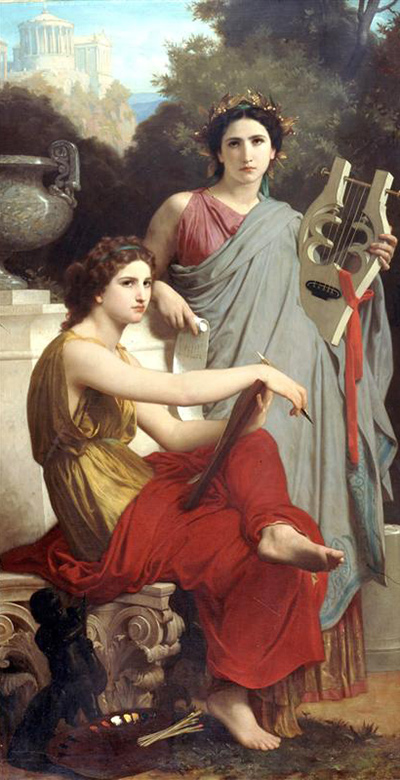
William-Adolphe Bouguereau's Art and Literature presents two idealized women as personifications of cultural life. The title is direct, but the painting is not a simple illustration of two professions. Bouguereau turns abstract fields of human activity into poised figures, giving art and literature bodies, gestures and a shared pictorial space. The result belongs to a long academic tradition in which virtues, disciplines and ideals could be made visible through the human form.
The painting is source-identified as an oil on canvas from 1867. Exhibition documentation for Bouguereau & America gives its dimensions as 78 3/4 x 42 1/2 inches, or about 200 x 108 cm, and places it in the collection of the Arnot Art Museum in Elmira, New York. The French title variant, L'art et la litterature, appears in secondary image and catalogue routes, but the English title Art and Literature is well supported by the exhibition sources that anchor this page.
At a Glance
- ArtistWilliam-Adolphe Bouguereau
- TitleArt and Literature [1]
- French Title VariantL'art et la litterature [3]
- Date1867 [1]
- MediumOil on canvas [1]
- Dimensions78 3/4 x 42 1/2 in. / about 200 x 108 cm [1]
- Collection LineArnot Art Museum, Elmira, New York [1]
- Source NoteExhibition-label-led object facts; no current display claim
Contents
- Introduction
- A Painting Made for an American Library
- Bouguereau in 1867
- Two Disciplines in One Composition
- Arnot, Exhibitions and Later Circulation
- Reading Art and Literature Today
A Painting Made for an American Library
One reason Art and Literature matters within Bouguereau's career is that it was not only a studio allegory. The San Diego Museum of Art's exhibition label records the work in an American commission context. Colonel John Stricker Jenkins arranged the commission through George A. Lucas and Samuel Putnam Avery, and the painting was planned for Jenkins's library in Baltimore. That setting helps explain the subject. A library was a place where literature was physically present, but it could also become a room of cultured aspiration, shaped by paintings, books and the owner's desired public identity.
For an American collector in the 1860s, Bouguereau offered something powerful: a living French academic painter whose pictures could carry the authority of classical training. The subject was not mythological in the narrative sense, but it used the same vocabulary of ideal figures, calm order and polished finish. Art and Literature gave Jenkins a painting that honored the arts while also marking his library as a cultivated space.
The commission also points to the practical networks behind Bouguereau's reputation. George A. Lucas and Samuel Putnam Avery were important intermediaries between American patrons and European art markets. Through such figures, French academic painting traveled into American homes, libraries and later museum collections. Bouguereau's American success was not only a matter of taste; it was also built through dealers, agents, exhibitions and collectors who knew how to turn Parisian prestige into transatlantic possession.
Bouguereau in 1867
The date, 1867, places Art and Literature early in Bouguereau's mature public career. By this point he had already absorbed the lessons of academic drawing, Italian study and Salon ambition, but many of his later best-known mythological and religious works were still ahead. The painting therefore belongs to a period when he was consolidating a language of ideal figure painting that could serve different kinds of subjects: classical, devotional, domestic and allegorical.
In Art and Literature, the bodies are not dramatic actors. They are signs of cultivated restraint. Bouguereau's finish smooths the surface of the painting, and his compositional discipline keeps the figures legible as symbolic presences. The viewer is invited to read posture, attribute and relationship rather than a specific moment in a story. This is one of the key differences between allegory and narrative painting: the figures are less concerned with what has just happened than with what they permanently stand for.
Two Disciplines in One Composition
The pairing of art and literature also lets Bouguereau stage a gentle rivalry and alliance. The two figures belong together because both are forms of culture, but they are not identical. Literature suggests language, memory, study and imagination carried through words. Art suggests making, looking and the transformation of the visible world. Bouguereau joins them through the shared grammar of the idealized female figure, suggesting that both disciplines can be elevated into beauty.
That choice also reveals the limits and strengths of Bouguereau's academic method. Modern viewers may find the allegory conventional, but convention was not accidental here. The painting was meant to be readable. Its refinement depends on forms that educated nineteenth-century viewers could recognize quickly: ideal bodies, balanced arrangement, classical calm and the elevation of abstract ideas into graceful personifications. Bouguereau's task was not to make the subject obscure, but to make it dignified.
The legacy page once leaned heavily on broad interpretation. A stronger reading begins with what the source trail can actually support: title, date, medium, dimensions, Arnot collection line and the Jenkins commission context. From there, the painting can be understood as a carefully tailored work of cultural self-presentation. It was made for a library, commissioned through transatlantic art-world intermediaries, and designed by a painter whose academic training made allegory feel authoritative.
Arnot, Exhibitions and Later Circulation
The Arnot Art Museum collection line is important, but the current documentation available here is exhibition-label led rather than a direct Arnot object entry. That distinction matters. Readers should not be led to assume a current display status or complete provenance that the available sources do not provide. What can be said is strong enough: Art and Literature was exhibited in the Bouguereau & America context and is identified there as belonging to the Arnot Art Museum.
Secondary routes help fill out the surrounding picture without taking over the object facts. Wikimedia Commons and ARC preserve the French title route and catalogue breadcrumbs. The Metropolitan Museum of Art holds an 1882 lithograph after Bouguereau's Art and Literature, published in La Vie Artistique, which is useful evidence that the composition circulated beyond the painted canvas. A market-led study route also points toward preparatory or related work, but it should be handled as context rather than as proof of the finished painting's full process.
Together, these routes show how Art and Literature moved through several kinds of visibility: private commission, museum collection, exhibition history, reproduction and digital image circulation. Each layer is useful, but each has to be kept in its own place.
How to Read Art and Literature Today
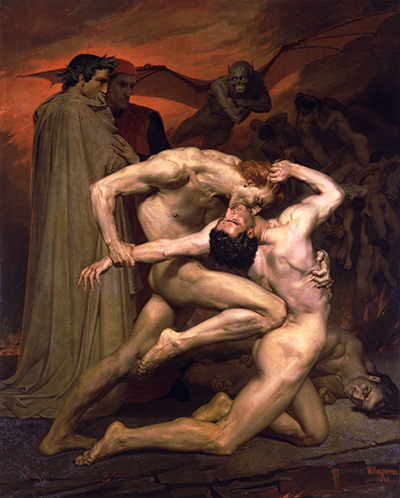
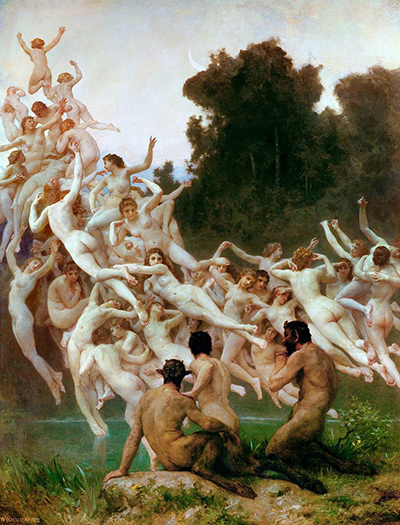
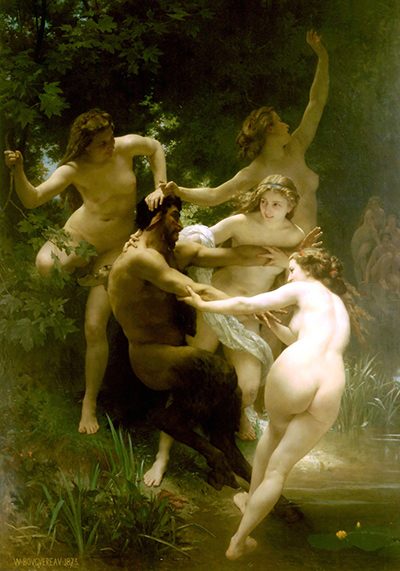
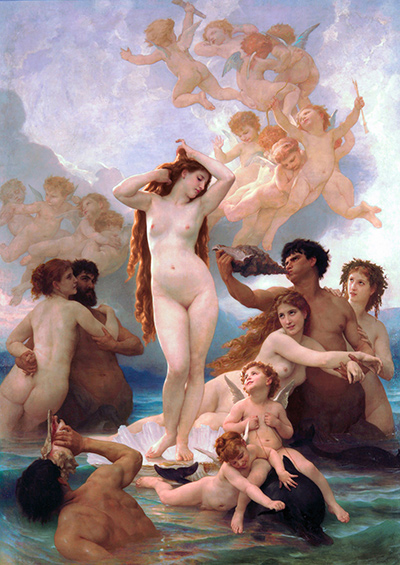
Today, Art and Literature is most useful as a bridge between Bouguereau's academic allegory and his American reception. It is not as famous as The Birth of Venus, The Oreads or Nymphs and Satyr, but it shows the same confidence in polished surfaces and idealized bodies. It also explains why American patrons valued him. Bouguereau could make culture itself look stable, refined and socially meaningful.
The painting asks to be read less as a spontaneous scene than as a public statement. Its figures embody disciplines that nineteenth-century collectors wanted to honor. Its scale suited an ambitious interior. Its French academic finish gave an American library the aura of European training. Within the Bouguereau cluster, that makes Art and Literature a useful page for understanding not just what the artist painted, but how his work entered the cultural rooms and collecting networks that helped define his international reputation.
Related Allegory and American Collecting Pages
Frequently Asked Questions
Discussion
Art and Literature is a compact route into Bouguereau's allegorical painting and American reception.
Use the prompts below to compare academic allegory, commission context and later reproduction routes.
Reader Insights
How does Bouguereau make abstract disciplines readable through idealized figures?
How does the library commission change the way you read the subject?
What does the later lithograph route suggest about the painting's visibility beyond the original canvas?
Join the Conversation
Share your reading of Bouguereau's allegory and American collecting context below.
References
- San Diego Museum of Art, Bouguereau & America, accessed 28 July 2026.
- Milwaukee Art Museum, Bouguereau & America, accessed 28 July 2026.
- Wikimedia Commons, Bouguereau, L'art et la litterature, 1867, accessed 28 July 2026.
- Art Renewal Center, L'art et la Litterature, accessed 28 July 2026.
- The Metropolitan Museum of Art, Art and Literature, after William Bouguereau, accessed 28 July 2026.
- Interencheres / Artcurial, Etude pour L'Art et la Litterature, accessed 28 July 2026.