 by Tom Gurney
Tom Gurney BSc (Hons) is an art history expert with over 20 years experience
Published on June 19, 2020 / Updated on October 16, 2026
Email: tomgurney1@gmail.com / Phone: +44 7429 011000
Berceuse and the Source Title Le coucher
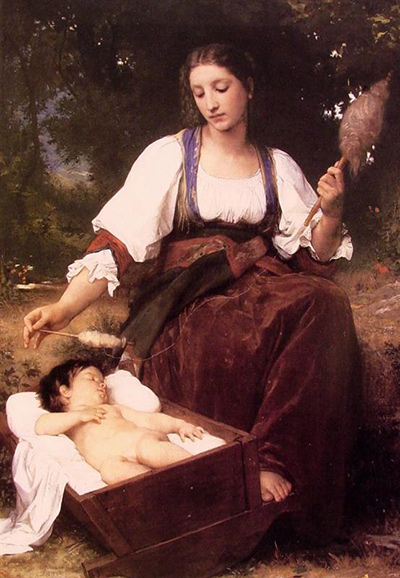
William-Adolphe Bouguereau's Berceuse, also recorded as Berceuse (Le coucher), presents a young mother bending over a sleeping infant in a cradle. The French title points toward a lullaby, while the parenthetical Le coucher suggests the moment of putting a child to bed. Bouguereau turns that domestic action into a carefully polished figure composition: the mother's body curves around the cradle, the child's pale form rests against white bedding, and the surrounding setting keeps the viewer's attention on the exchange between care and sleep.
The strongest captured source for this page is Christie's 2017 lot record for Berceuse (Le coucher). It identifies the painting as an oil on canvas, signed and dated W-BOVGVEREAV-1873, with dimensions of 44 1/8 x 34 inches, or 112 x 86.5 cm. That source corrects the older local page's 1875 date. This page therefore treats 1873 as the governing date unless a later source route supersedes it.
At a Glance
- ArtistWilliam-Adolphe Bouguereau
- TitleBerceuse / Berceuse (Le coucher) [1]
- Date1873 [1]
- MediumOil on canvas [1]
- Dimensions44 1/8 x 34 in. / 112 x 86.5 cm [1]
- Source RouteChristie's 2017 lot record [1]
- Secondary MetadataWikimedia Commons title and image route [2]
- Source NoteMarket-led object facts; no museum-object status or image-clearance claim
Contents
- Introduction
- A Mother and Child in Bouguereau's Italianate Mode
- Provenance and Circulation
- A Secular Echo of the Virgin and Child
- How to Read Berceuse Today
A Mother and Child in Bouguereau's Italianate Mode
Christie's places the painting within Bouguereau's sustained interest in mothers and children, a theme that became important to him from the mid-1860s onward. The lot essay connects this group of works to Italy, where the artist had studied earlier in his career and where religious imagery, including Raphael's Madonnas, left a lasting impression on him. Berceuse (Le coucher) is not a church painting, but it borrows some of the visual gravity of the Virgin-and-Child tradition and translates it into a secular scene of maternal care.
The mother is described by the source as a young Roman mother, and the painting's costume and setting support that Italianate character. She is not shown as a portrait sitter or named individual. Instead, Bouguereau presents her as an idealized figure of care. Her body leans toward the cradle, and the infant's sleep gives the scene its emotional center. The action is slight, but the composition is highly managed: every line directs attention toward the child.
That controlled tenderness is typical of Bouguereau's domestic subjects. He often painted children and caregivers without turning them into documentary scenes. The figures feel human and approachable, yet the finish remains refined. The hands, fabric, cradle and face are arranged so the viewer reads the scene as affection shaped by discipline. Bouguereau's sentiment is not improvised; it is built through drawing, balance and surface.
Provenance and Circulation
The source trail for Berceuse (Le coucher) is useful, but it should be handled carefully because it is market-led rather than museum-object-led. Christie's records the painting beginning with the artist, then Goupil & Cie. in Paris, which acquired it in October 1873 under the title Le coucher. The painting then passed to Wallis & Co. in London in November 1873, and later appears through several twentieth-century sale and dealer records.
That early Goupil route matters. Bouguereau's international reputation was shaped not only by Salon success, but also by dealers who moved his work through European and American markets. A mother-and-child picture such as Berceuse could appeal to collectors because it joined technical finish, emotional legibility and a subject that felt intimate without becoming untidy. The painting's later literature and exhibition references, including the Bartoli and Ross catalogue raisonne number 1873/12, give the work a stronger documentary frame than the older local text provided.
At the same time, the available source trail should not be stretched into claims it does not support. This page does not state a present owner, present location or present display. It can say that the Christie's record preserves a provenance and literature trail, but it avoids treating the auction route as a stable museum catalogue entry.
A Secular Echo of the Virgin and Child
One of the most useful ways to read Berceuse is as a secularized mother-and-child image. The subject is ordinary in one sense: a mother putting an infant to bed. Yet Bouguereau gives it a visual order that recalls devotional compositions. The cradle substitutes for the traditional setting around the Christ Child, while the mother's lowered gaze and protective posture give the picture a quiet solemnity.
That does not mean the painting should be described as a Madonna. It is better understood as Bouguereau using a familiar visual language of tenderness and reverence for a domestic subject. The young mother is not a saint, and the infant is not identified through religious narrative. Their importance comes from gesture: the lean of the body, the quiet of the sleeping child and the way the cradle anchors the composition.
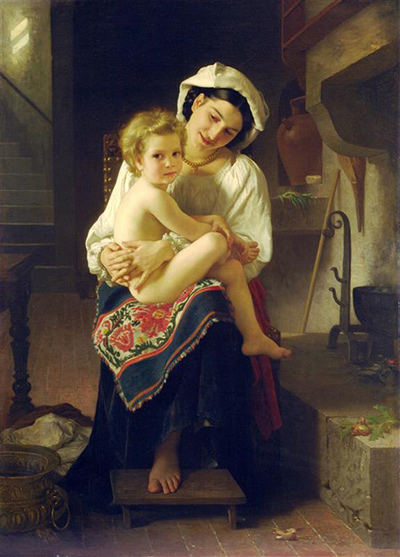
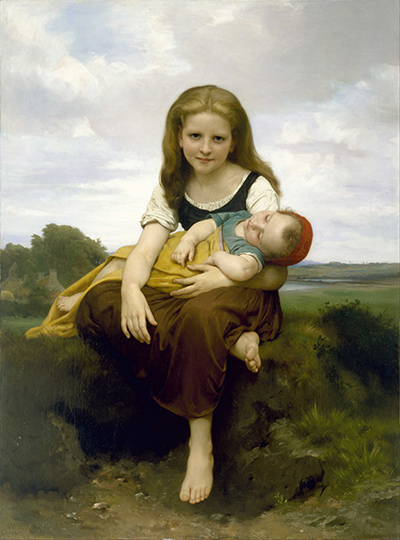
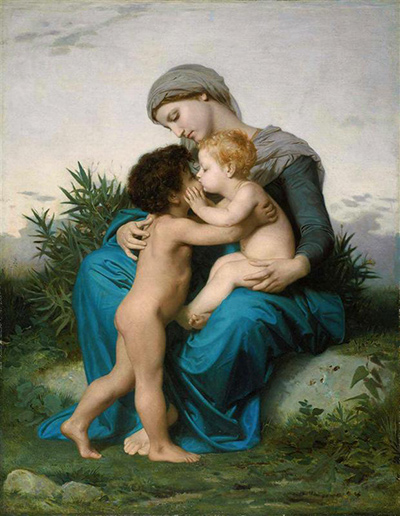
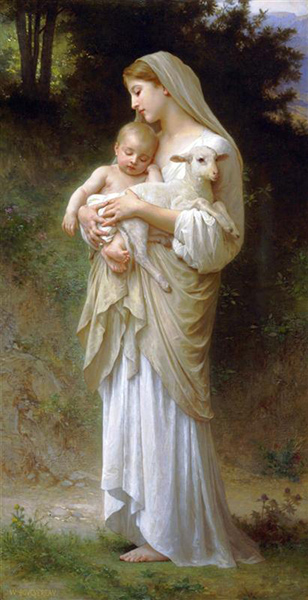
This makes Berceuse a useful comparison for other Bouguereau pages in the cluster. It belongs near Young Mother Gazing at Her Child, The Elder Sister, Fraternal Love and Innocence, all of which show how the artist turned family feeling into a polished Academic image. It also helps explain why Bouguereau's paintings could seem both intimate and formal. He made tenderness readable through idealized bodies and carefully ordered space.
How to Read Berceuse Today
Modern viewers may find the painting's sweetness direct, but its source trail and construction deserve attention. Berceuse is not only a sentimental image of motherhood. It is a carefully documented 1873 work that connects Bouguereau's Italian memories, mother-and-child subjects, dealer networks and academic technique. Its emotional appeal depends on the very control that some viewers now find old-fashioned.
The safest reading begins with the source-locked facts: Bouguereau, Berceuse (Le coucher), 1873, oil on canvas, a mother moving an infant into a cradle, and a documented early route through Goupil and Wallis. From there, the painting can be understood as a domestic scene shaped by the visual inheritance of Renaissance and Catholic imagery, but redirected toward private affection. It is quiet, polished and deliberate; a small action turned into an image of care.
That careful frame also protects the page from the kind of drift common on older artwork pages. The title can remain familiar to readers as Berceuse, but the object facts should follow the stronger source title, date and sale record. The painting's intimacy is strongest when its evidence is kept just as clear as its sentiment.
Related Mother and Child Pages
Frequently Asked Questions
Discussion
Berceuse is a quiet route into Bouguereau's mother-and-child imagery, Italianate memory and market-led source history.
Use the prompts below to compare domestic tenderness, source evidence and Bouguereau's Academic construction of feeling.
Reader Insights
How does the mother's bending posture focus attention on the sleeping infant?
Where do you see Bouguereau turning a small domestic action into a polished composition?
How does the Christie's 1873 record change the way the older page title and date should be read?
Join the Conversation
Share your reading of Bouguereau's family imagery, title history and source trail below.
References
- Christie's, William Adolphe Bouguereau, Berceuse (Le coucher), 2017 lot record, accessed 29 July 2026.
- Wikimedia Commons, Berceuse (Le coucher), by William Adolphe Bouguereau.jpg, accessed 29 July 2026.