 by Tom Gurney
Tom Gurney BSc (Hons) is an art history expert with over 20 years experience
Published on June 19, 2020 / Updated on October 16, 2026
Email: tomgurney1@gmail.com / Phone: +44 7429 011000
The Charity and UMMA's 1859 La Charité
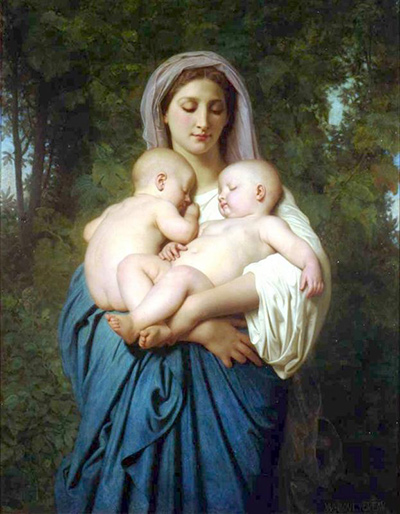
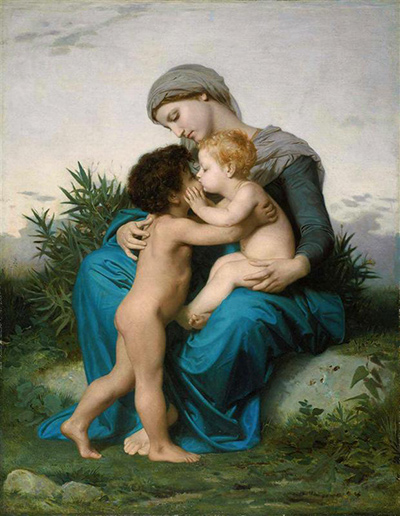
William-Adolphe Bouguereau's The Charity is best understood through the University of Michigan Museum of Art's record for Charity (La Charité), an 1859 oil on canvas. The painting shows a veiled woman holding two infants close to her body, with the group set against a dark, wooded background. The composition is quiet, frontal and highly controlled. Rather than building a dramatic story around action, Bouguereau makes the allegory readable through posture, touch and the calm pressure of the figures gathered together.
The subject is Charity, one of the theological virtues, but Bouguereau does not present it as an abstract emblem alone. He translates the virtue into a maternal image. The woman protects and supports the children, while the infants' sleeping bodies give the scene a sense of trust and dependence. The image therefore sits between religious allegory and mother-and-child painting, two areas that remained important throughout Bouguereau's career.
UMMA identifies the work as Charity (La Charité), dated 1859, by William-Adolphe Bouguereau, with the medium oil on canvas. The museum records its dimensions as 4 ft. 6 13/16 in. by 44 3/8 in. by 2 3/4 in., or 139.22 by 112.71 by 6.99 cm, and gives the credit line as the bequest of Henry C. Lewis with accession number 1895.96. Those details govern this page's object facts.
At a Glance
- ArtistWilliam-Adolphe Bouguereau
- Route TitleThe Charity
- Museum TitleCharity (La Charité) [1]
- Date1859 [1]
- MediumOil on canvas [1]
- Dimensions139.22 x 112.71 x 6.99 cm [1]
- Credit / AccessionBequest of Henry C. Lewis, 1895.96 [1]
- Governing SourceUniversity of Michigan Museum of Art [1]
Contents
- Introduction
- An Allegory of Care in Academic Form
- Why Charity Needs Version Discipline
- Reading The Charity Today
An Allegory of Care in Academic Form
Bouguereau's handling of Charity depends on a familiar nineteenth-century strategy: he makes an ideal value visible through an idealized body. The woman is not introduced as a named sitter or a portrait subject. She functions as a personification, but her tenderness is made human through the weight of the children in her arms. The infants press into her body, one turned inward and the other resting across her lap, while her face remains lowered and composed.
The painting's emotional force depends on restraint. Bouguereau avoids overt anguish or theatrical gesture. The woman's arms form a protective enclosure; her veil softens the transition between figure and background; the pale bodies of the infants emerge against the darker forest setting. Everything is arranged to make care appear stable and deliberate. This is not documentary motherhood, but an Academic construction of nurture, where feeling is clarified through drawing, finish and balance.
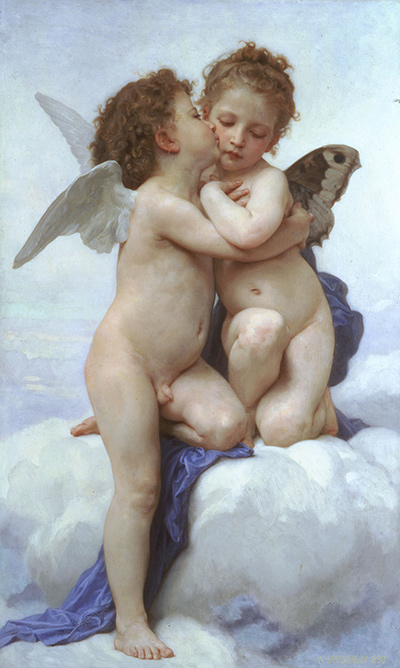
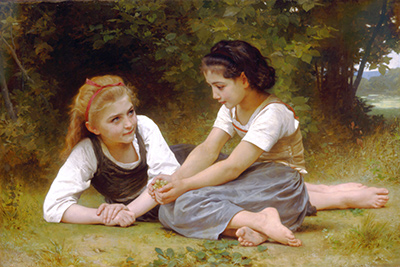
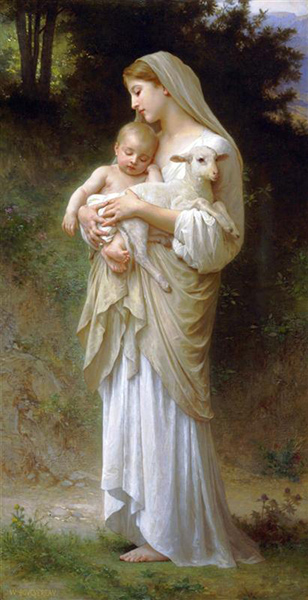
That balance places The Charity close to Bouguereau's later family and childhood subjects. Pages such as Innocence, Fraternal Love, Elder Sister and Young Mother Gazing at Her Child show how often he returned to the language of protection, childhood and idealized affection. The Charity belongs to that wider pattern while remaining more explicitly allegorical. Its theme is not simply a family scene; it is the virtue of charity expressed through maternal care.
The painting also shows how early Bouguereau was able to adapt large moral themes to a language of intimate physical presence. The figures are monumental enough for allegory, but the scene is built from bodily details: the curve of an infant's back, the weight of a sleeping head, the downward line of the woman's gaze and the sheltering movement of her arms. UMMA's record describes the work through both its title and physical presence, which is useful for this page because the painting's meaning depends on scale as well as subject. The woman is not merely holding attributes; she is holding children whose vulnerability makes the virtue visible.
Why Charity Needs Version Discipline
The title Charity can be confusing because Bouguereau returned to the theme more than once. This page should not treat every work called La Charité as the same object. The UMMA painting is the 1859 two-child composition. A separate Christie's record concerns a larger 1878 La Charité, signed and dated 1878, showing a different five-child arrangement and carrying its own provenance and exhibition history. Those later facts are useful for disambiguation, but they should not be transferred to the UMMA painting.
The Dahesh Museum's Study for Charity also helps explain the title family. That study is connected to Bouguereau's later Charity imagery and shows that the subject remained active in his practice after the 1859 painting. It is best used as process and version context, not as a replacement for UMMA's object record. Together, these sources show a recurring theme: Bouguereau used Charity to explore maternal allegory, but he did so through distinct works with distinct dates, formats and histories.
This distinction matters because the older local page mixed the Charity routes together. A later public page should correct that confusion by making the governing object clear at the start. The route title The Charity can remain useful for readers, but the object facts should follow UMMA's Charity (La Charité) rather than the 1878 auction record or secondary image pages.
Reading The Charity Today
Viewed today, The Charity is a compact example of Bouguereau's ability to fuse allegory with polished naturalism. The theme is inherited from Christian virtue imagery, but the appeal of the painting lies in its closeness: a woman, two sleeping infants and the visual language of protection. Bouguereau makes the virtue intimate without making it casual. The figures are tender, but the arrangement is formal; the children feel vulnerable, but the composition is carefully held.
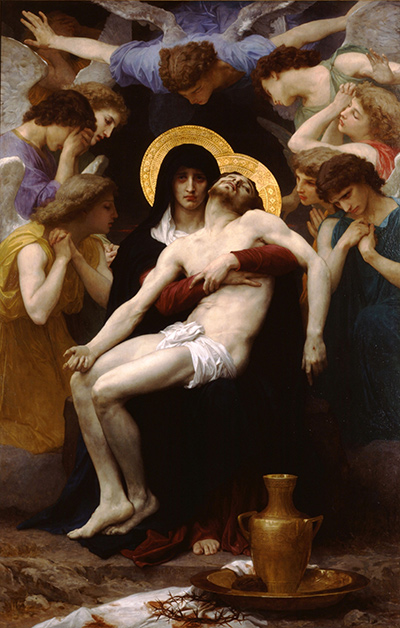
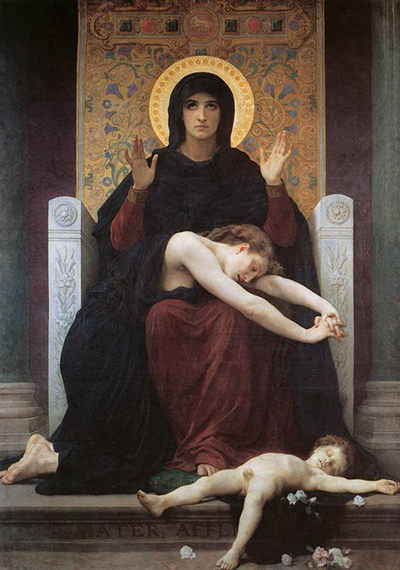
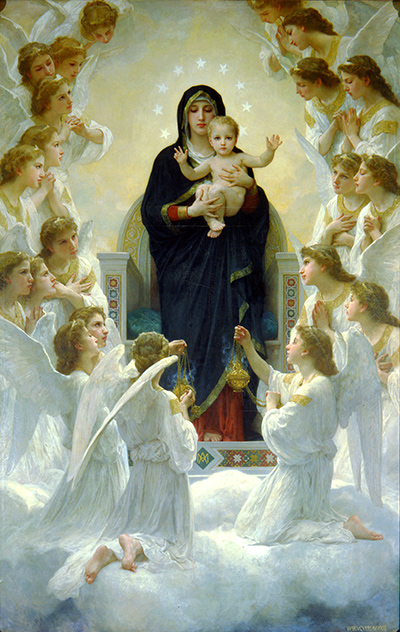
The painting also helps explain why Bouguereau's religious and domestic subjects often overlap. In works such as Virgin Comforter and The Virgin with Angels, he used Marian and devotional imagery to organize compassion, grief and idealized motherhood. In family-centered works such as Fraternal Love and Elder Sister, he used secular childhood subjects to similar emotional effect. The Charity sits between those two fields. It has the moral clarity of an allegory and the bodily immediacy of a mother-and-child image.
That overlap can make the work feel deceptively simple. Its appeal is tender, but its structure is deliberate. Bouguereau asks the viewer to understand charity not as a transaction, nor as a public act of giving, but as a sustained form of protection. The infants do not perform gratitude; they sleep. The woman does not display wealth or dramatic sacrifice; she holds them. This gives the painting its calm authority. The virtue is expressed through care that appears continuous, patient and embodied.
The safest reading begins with the UMMA object: Charity (La Charité), 1859, oil on canvas, a two-child allegory by William-Adolphe Bouguereau. From there, the broader Charity theme can be introduced carefully, as a title family rather than a single interchangeable object. That approach lets the page preserve the familiar English title while giving readers a clearer account of what they are actually seeing.
Related Religious, Allegory and Mother-Child Pages
Frequently Asked Questions
Discussion
The Charity is a concise route into Bouguereau's religious allegory, maternal imagery and title-version discipline.
Use the prompts below to compare allegory, care and Bouguereau's Academic construction of tenderness.
Reader Insights
How does Bouguereau turn the virtue of Charity into a mother-and-child image?
Where does the painting make care feel formal, balanced and carefully staged?
Why is it important to distinguish the 1859 UMMA painting from later Charity versions?
Join the Conversation
Share your reading of Bouguereau's Charity imagery, religious allegory and mother-and-child compositions below.
References
- University of Michigan Museum of Art, Charity (La Charité), accessed 29 July 2026.
- Christie's, La Charité, lot 1772365, accessed 29 July 2026.
- Dahesh Museum of Art, Study for Charity, accessed 29 July 2026.
- Wikimedia Commons, Charity (1878), accessed 29 July 2026.
- WikiArt, The Charity, 1859, accessed 29 July 2026.