 by Tom Gurney
Tom Gurney BSc (Hons) is an art history expert with over 20 years experience
Published on June 19, 2020 / Updated on October 16, 2026
Email: tomgurney1@gmail.com / Phone: +44 7429 011000
Cupid and Psyche, after L'Amour Vainqueur
William-Adolphe Bouguereau returned often to the story of Cupid and Psyche, but this page needs a careful starting point. The image associated with the protected Cupid and Psyche route is best understood through the York Art Gallery record published in the National Inventory of Continental European Paintings. That record identifies a small oil-on-panel work titled Cupid and Psyche, catalogued as after Bouguereau, and describes it as a copy after Bouguereau's L'amour Vainqueur.
That distinction matters. The composition belongs to Bouguereau's Cupid-and-Psyche world, but the safest object description for this page is not "Bouguereau's 1889 Cupid and Psyche." The York record gives the work as oil on panel, 36.8 by 30.5 cm, accession YORAG : 113, acquired in 1948, and dated between 1886 and about 1900. It also links the design to Bouguereau's original L'amour Vainqueur, painted in 1886 and later recorded in private collection. The familiar English title can remain useful for readers, but the source trail asks for version discipline.
At a Glance
- ArtistWilliam-Adolphe Bouguereau
- Route TitleCupid and Psyche
- Source FamilyL'Amour Vainqueur / Cupid Victorious [1]
- Active Image RouteAfter Bouguereau; York Art Gallery copy-after record [1]
- Date Range1886 to about 1900 for the York copy-after object [1]
- MediumOil on panel for the York copy-after object [1]
- Dimensions36.8 x 30.5 cm [1]
- Version NoteSeparate from the 1889 and 1899 Cupid/Psyche paintings [4][5]
Contents
- Introduction
- The Myth in a Tondo-like Composition
- Original, Copy and Circulation
- Distinguishing Bouguereau's Cupid and Psyche Works
- Reading Cupid and Psyche Today
The Myth in a Tondo-like Composition
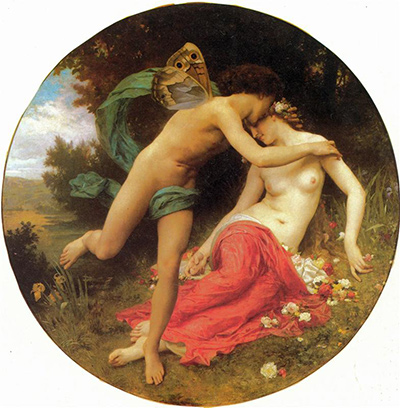
The picture shows Cupid leaning toward Psyche in a close, circular composition. The bodies are arranged with Bouguereau's characteristic polish: soft flesh, carefully placed limbs, an idealized landscape and a mood of suspended intimacy. Cupid's forward movement supplies the action, while Psyche's seated or reclining pose gives the scene its stillness. The subject is mythological, but the emotional temperature is gentle rather than heroic.
In the classical story, Psyche is the mortal beloved of Cupid, drawn through secrecy, loss, trials and reunion. Bouguereau rarely approached myth as archaeological reconstruction. He preferred to translate it into lucid bodies and refined feeling. In this source family, the myth is narrowed to one charged encounter: Cupid's approach, Psyche's receptive stillness and the visual promise of love made visible through touch.
The title L'Amour Vainqueur, or Love Victorious, helps explain the mood. The composition is less about narrative sequence than about the triumph of affection. Cupid is not shown as a distant emblem; he enters Psyche's space. Psyche is not surrounded by complicated attributes; she is made legible through pose, face and surface. Bouguereau's Academic method turns the myth into a polished image of closeness.
The smaller scale recorded for the York work also changes the way the composition reads. Instead of the grand vertical ascent found in some of Bouguereau's other Cupid-and-Psyche pictures, this version concentrates the figures into a more decorative and intimate format. The landscape becomes a soft setting for the embrace rather than a stage for dramatic flight. That compressed design suits the idea of love already victorious: the viewer is brought close to a finished moment rather than asked to follow a complicated episode.
Original, Copy and Circulation
The York record is valuable because it does not force the page into a false certainty. It names the object as after Bouguereau and describes it as a copy after L'amour Vainqueur. Sotheby's later discussion of Adolphe Itasse's sculpture L'Amour Vainqueur supports the wider circulation of the same composition, noting Bouguereau's original 1886 painting and its later sale history. The British Museum's listing of a Goupil miniature print after L'Amour Vainqueur, dated 1886-1887, adds another circulation route.
Together, these sources show how Bouguereau's image moved beyond a single original canvas. A painting could be copied, engraved, miniaturized or translated into sculpture, especially when its subject had broad appeal. Cupid and Psyche were already familiar figures; Bouguereau's refined treatment made them especially suited to reproduction and collecting.
That circulation should not be treated as a problem to hide. It is part of the work's history. The page can explain that the visible source route is copy-after, while still discussing the Bouguereau composition that shaped it. This is more accurate than pretending that every public image labelled Cupid and Psyche refers to the same original object.
Distinguishing Bouguereau's Cupid and Psyche Works
Bouguereau's Cupid and Psyche titles are easy to confuse because several related works circulate under similar English and French names. One 1889 painting, often titled Psyche et L'Amour, is a vertical young-adult composition associated with the Tasmanian Museum and Art Gallery in public metadata. Another 1889 work, L'Amour et Psyche, enfants, shows the figures as children and belongs to a different protected page. A later 1899 version, sold by Sotheby's as L'amour et psyche, presents an adult flying composition.
Those works matter as context, but they should not govern this route. The image and source trail here point toward the L'Amour Vainqueur composition and the York copy-after record. The 1889 and 1899 routes can help readers understand Bouguereau's repeated interest in the myth, but they should be treated as separate works or versions, not as interchangeable facts.
This distinction also protects the accepted child-version page. L'Amour et Psyche, enfants has its own composition, scale, visual logic and source path. It should not be folded into this page simply because the names overlap. Bouguereau's title families often require this kind of careful sorting.
Reading Cupid and Psyche Today
Read with that source discipline, Cupid and Psyche becomes a useful example of how Bouguereau's imagery circulated through nineteenth-century taste. The scene offers the expected pleasures of his mythological painting: ideal bodies, smooth finish, tender contact and a story distilled into a single visual moment. But the page also shows how an image could live through copies and reproductions, not only through an original museum object.
The safest public account begins with the York source: Cupid and Psyche, after Bouguereau, oil on panel, connected to L'Amour Vainqueur. From there, Bouguereau's 1886 original composition can be discussed as the source image behind the copy, while the better-known 1889 and 1899 Cupid/Psyche works can be separated as related but distinct. This approach keeps the protected route useful for readers without overstating what the current evidence proves.
The painting's appeal remains straightforward. Cupid leans in, Psyche receives him, and Bouguereau's language of ideal form turns myth into intimate ornament. What changes is the page's precision. Instead of treating Cupid and Psyche as a single fixed label, the work can be presented as part of a source family: a mythological composition by Bouguereau, known through an after-Bouguereau York object and through related routes of copying, printmaking and later adaptation.
Related Mythology, Cupid-Psyche and Reproduction Pages
Frequently Asked Questions
Discussion
Cupid and Psyche is a source-sensitive route into Bouguereau's mythological imagery and the circulation of L'Amour Vainqueur.
Use the prompts below to compare title families, copies and related Cupid-Psyche versions without flattening separate works into one object.
Reader Insights
How does the York copy-after route change the way this page should describe the image?
Where does Bouguereau turn the Cupid and Psyche story into a moment of intimate contact?
What does the reproduction history of L'Amour Vainqueur reveal about Bouguereau's popular imagery?
Join the Conversation
Share your reading of Bouguereau's Cupid and Psyche imagery, source families and nineteenth-century reproduction routes below.
References
- VADS / National Inventory of Continental European Paintings, York Art Gallery, Cupid and Psyche, accessed 29 July 2026.
- Sotheby's, Adolphe Itasse, L'Amour Vainqueur (Love Victorious), accessed 29 July 2026.
- British Museum, Bouguereau term route including L'Amour Vainqueur Estampe Miniature, accessed 29 July 2026.
- Sotheby's, William Bouguereau, L'amour et psyche, 1899, accessed 29 July 2026.
- Wikimedia Commons, Psyche et L'Amour, 1889, accessed 29 July 2026.
- Wikimedia Commons / Art UK image-lineage route for York L'Amour Vainqueur (Cupid Victorious), accessed 29 July 2026.