



 by Tom Gurney
Tom Gurney BSc (Hons) is an art history expert with over 20 years experience
Published on June 19, 2020 / Updated on October 16, 2026
Email: tomgurney1@gmail.com / Phone: +44 7429 011000
Far from Home and the Image of Displacement
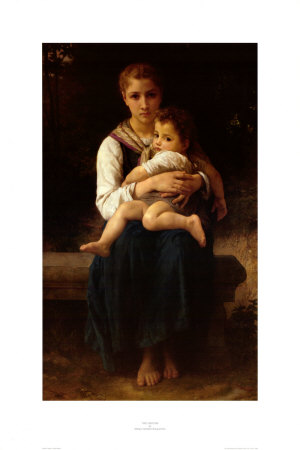
William-Adolphe Bouguereau's Far from Home presents childhood as a scene of beauty, performance and unease. The painting shows two girls on a street in Rome, one older and one younger, posed before a classical architectural setting. The older girl carries the authority of the performer, while the younger child's face turns outward with an appeal that makes the viewer part of the scene. The title gives that encounter its emotional charge: these children are not simply picturesque figures. They are away from home, exposed to public attention and dependent on strangers.
The Museo de Arte de Ponce records the painting as an 1867 oil on canvas, with the object number 57.0011. That date places it in the period when Bouguereau was consolidating the polished Academic language that would later make him one of the most successful French painters of the nineteenth century. The work belongs to the Museo de Arte de Ponce, The Luis A. Ferre Foundation, Inc., in the museum's French Painting collection. Its scale, 64 by 42 1/2 inches, gives the scene more presence than a small genre vignette. Bouguereau makes the girls large enough to meet the viewer directly. [1]
At a Glance
- ArtistWilliam-Adolphe Bouguereau
- Title VariantLoin du pays [3]
- Date1867 [1]
- MediumOil on canvas [1]
- Dimensions64 x 42 1/2 in. / 162.6 x 108 cm [1]
- Object Number57.0011 [1]
- Collection RecordMuseo de Arte de Ponce [1]
- SubjectTwo sisters performing and begging in Rome [1]
Contents
- Introduction
- Two Sisters in Rome
- Idealization and Restraint
- Source Discipline and the Ponce Record
- Reading Far from Home Today
Two Sisters in Rome
The Ponce object record identifies the figures as two sisters who perform and beg on the streets of Rome. That setting matters. Bouguereau had spent formative time in Italy after winning the Prix de Rome, and Italian subjects remained useful to him as a way to combine observed contemporary life with classical form. In Far from Home, the street does not become a documentary record of poverty. Instead, it becomes a staged encounter in which costume, gesture, architecture and expression are carefully arranged. [1]
The younger girl is the emotional center of the painting. Her upturned face does not describe misery in a blunt way; it asks for attention. Bouguereau gives her vulnerability without dissolving her into spectacle. The older sister's role is different. She stands as guardian and performer, connecting the child's appeal to the practical fact of music, work and survival. Together they form a compact family unit, one that is both intimate and public.
That balance helps explain the painting's particular force. Bouguereau was not a realist in the manner of Courbet or the social painters who deliberately emphasized roughness and material hardship. He worked through idealization, control and finish. Yet Far from Home is not empty sweetness. Its subject is a difficult one: children whose charm is also their means of endurance. The painting asks the viewer to recognize need through a language of grace.
Idealization and Restraint
The Ponce record notes that the classically inspired architectural background and the arranged poses idealize and ennoble the subject rather than showing the direness of actual poverty directly. That is one of the keys to reading the work. Bouguereau softens the scene, but he does not erase its tension. The girls' bodies, clothing and expressions are organized with the clarity of Academic figure painting, while the title keeps reminding us that their beauty exists inside displacement.
This approach was central to Bouguereau's broader art. He often turned children, mothers, peasants and mythological figures into images of composure. In later works such as The Nut Gatherers, At the Edge of the Brook, Berceuse and Fraternal Love, he returned to childhood and family feeling with extraordinary technical polish. Far from Home belongs to that larger family of images, but it is more unsettled than many of them. The children are together, yet their world is unstable. Their performance invites generosity, but it also reveals dependence.
The painting's French title, often given as Loin du pays, sharpens this reading. It suggests distance from one's country or homeland, not just the private sadness of being away from a house. The English title Far from Home captures the same idea in a more intimate register. Both titles point toward travel and vulnerability. The girls appear physically near to the viewer, but socially and emotionally removed from safety.
Source Discipline and the Ponce Record
The object facts for this page are led by the Museo de Arte de Ponce record. Some secondary routes give different dates or measurements, and older reproduction pages may repeat inherited details. Those routes can help trace the painting's image history, but they should not override the museum record. For this page, the reliable public anchor is the Ponce object record: Far from Home, William-Adolphe Bouguereau, 1867, oil on canvas, object number 57.0011. [1]
Wikimedia Commons and Wikidata are useful because they preserve the French-title lineage and connect the image to the Ponce painting. Google Arts & Culture provides museum-partner context, though its date and dimensions differ from the eMuseum route. A Sotheby's catalogue note for another work, Mignon, is useful only as period context, because it links a child's face and expression to Bouguereau's Loin du Pays in Puerto Rico's Museo de Arte de Ponce. None of those secondary routes should turn the page into a discussion of a different object. [2][3][4]
Reading Far from Home Today
Far from Home remains compelling because it sits between tenderness and discomfort. The painting is beautiful, but the beauty is not neutral. Bouguereau asks the viewer to look at children whose public charm is tied to necessity. He also asks the viewer to accept a visual language that ennobles them, setting their small drama against the weight of classical architecture.
That may be why the painting still feels more complicated than a simple sentimental scene. The girls are not reduced to poverty, but neither are they entirely protected by art. The younger child's appeal, the older sister's presence and the title's sense of distance all keep the picture emotionally active. Bouguereau's finish gives the image polish; the subject keeps it from becoming merely decorative.
In the context of Bouguereau's career, Far from Home shows how early and confidently he could join figure painting, childhood imagery and moral feeling. It belongs beside his later family and girlhood subjects, but it also has its own sharper note. The work is a painting about performance, need and separation, made with the discipline of an artist who understood that ideal beauty could carry a difficult human subject.
Related Childhood, Genre and Sibling Pages


Frequently Asked Questions
Discussion
Far from Home brings childhood, performance and displacement into a carefully idealized street scene.
Use the prompts below to compare Bouguereau's polished finish with the painting's uneasy subject.
Reader Insights
How does the younger girl's gaze shape the viewer's role in the scene?
What does the classical background add to a street subject?
How does the older sister change the painting from a single portrait into a family encounter?
Join the Conversation
Share your reading of Bouguereau's childhood, genre and sibling imagery below.
References
- Museo de Arte de Ponce eMuseum, Far from Home, accessed 29 July 2026.
- Google Arts & Culture, Far from Home, accessed 29 July 2026.
- Wikimedia Commons, Loin du pays image route, accessed 29 July 2026.
- Wikidata, Far from Home / Loin du pays, accessed 29 July 2026.
- Sotheby's, Mignon catalogue note, accessed 29 July 2026.


