 by Tom Gurney
Tom Gurney BSc (Hons) is an art history expert with over 20 years experience
Published on June 19, 2020 / Updated on October 16, 2026
Email: tomgurney1@gmail.com / Phone: +44 7429 011000
Fraternal Love by William-Adolphe Bouguereau: Introduction
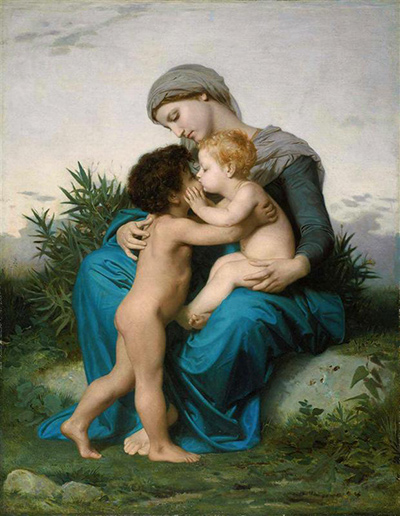
Fraternal Love is an early painting by William-Adolphe Bouguereau that shows how quickly his academic language was forming. The Museum of Fine Arts, Boston identifies the work as an oil on canvas from 1851, measuring 147 x 113.7 cm, or 57 7/8 x 44 3/4 inches, and records it under accession number `08.186`. Those details are important because this painting can easily drift into vague online reproduction culture. The MFA Boston object route gives it a stable title, date, medium, scale, collection history, and interpretive frame.
The painting belongs to Bouguereau's early career, shortly after the period in which Italian art became central to his formation. MFA Boston describes the work as painted in Rome and modeled after Raphael's groupings of the Virgin and Child with Saint John. That point changes how the picture should be read. Fraternal Love is not simply a sweet scene of children. It is a young French academic painter testing how Renaissance composition could be adapted to a tender, accessible subject.
At a Glance
- ArtistWilliam-Adolphe Bouguereau
- TitleFraternal Love
- Date1851 [1]
- MediumOil on canvas [1]
- Dimensions147 x 113.7 cm (57 7/8 x 44 3/4 in.) [1]
- Collection RouteMuseum of Fine Arts, Boston [1]
- Accession Number08.186 [1]
- Credit LineGift of the Estate of Thomas Wigglesworth [1]
- ContextPainted in Rome and modeled after Raphael groupings, per MFA Boston [1]
Contents
- Introduction
- Rome, Raphael and Object Facts
- Composition and Family Feeling
- Collecting and Reproduction
- Why the Painting Matters
Rome, Raphael and Object Facts
The title directs attention to affection between children, but the composition does more than illustrate sentiment. Bouguereau arranges the figures as a stable group, building the scene from touch, curved limbs, turned heads, and calm bodily balance. The children are idealized rather than observed casually. Their faces, skin, hair, and gestures are polished into a controlled image of harmony. The emotional subject is direct, but the construction behind it is learned and deliberate.
Raphael matters here because Bouguereau is not borrowing a single formula so much as absorbing a pictorial habit. Renaissance images of the Virgin, Christ Child, and young Saint John often turn tenderness into order. Bodies lean toward one another; glances and gestures bind the group; affection becomes a clear compositional pattern. In Fraternal Love, Bouguereau adapts that kind of balanced intimacy to a secular childhood subject. The result is gentle, but not loose. The feeling is organized.
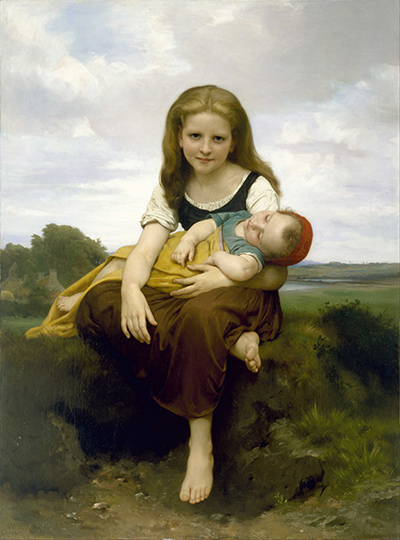
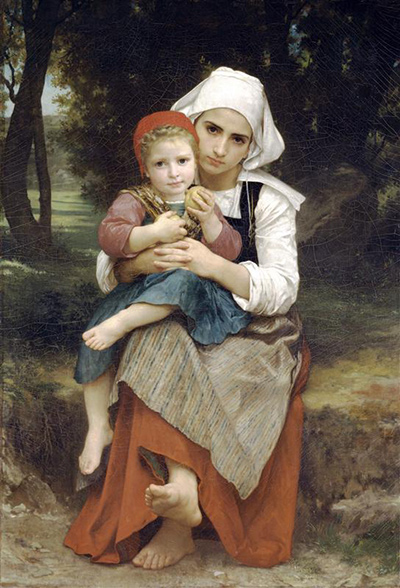
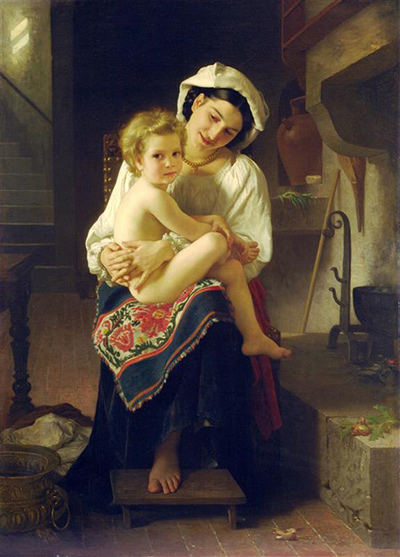
This early discipline helps explain the later Bouguereau. In mature works such as The Elder Sister, Breton Brother and Sister, and Young Mother Gazing at Her Child, he would repeatedly use family or childhood feeling as a way to display academic finish without depending on grand mythological or historical drama. Fraternal Love points toward that later success. It shows him finding a language in which softness, idealization, and drawing could support one another.
Composition and Family Feeling
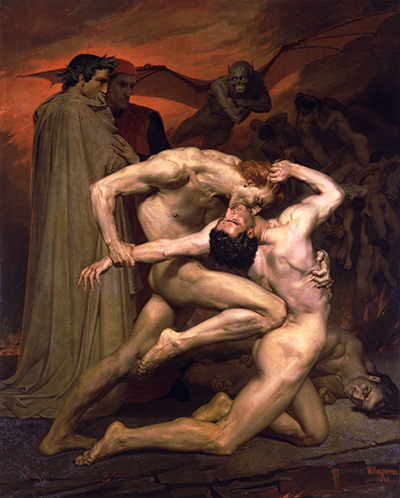
The painting's date also matters. In 1851 Bouguereau was still close to the training system that had shaped him: drawing from the figure, studying earlier masters, and learning to translate classical and Renaissance examples into modern Salon-ready painting. Fraternal Love does not have the dramatic ambition of Dante and Virgil in Hell or the public monumentality of later religious works. Its ambition is quieter. It asks whether a small family subject can carry the same seriousness of arrangement and finish.
The answer is yes, but the picture should not be mistaken for documentary realism. Bouguereau gives the figures a polished serenity that belongs to art as much as life. The children are not presented as social case studies, and the painting does not invite unsupported stories about poverty, absence, or domestic circumstance. Its power lies in selection. Bouguereau removes disorder and emphasizes affection, bodily grace, and compositional clarity. The family feeling is real as an artistic effect, but it is carefully made.
That careful making can be seen in the way the group holds together. The figures occupy a compact visual world. Their bodies turn toward one another rather than scattering across the canvas. Bouguereau uses touch to make relation visible: an arm, a leaning head, a protective placement of one figure beside another. The subject of fraternal love becomes physical structure. This is one reason the painting remains useful within the Bouguereau cluster. It lets a viewer see feeling being built through design.
Collecting and Reproduction
MFA Boston's record also keeps the object anchored in later collecting history. The museum records the painting as a gift of the Estate of Thomas Wigglesworth and preserves a provenance trail that includes nineteenth-century dealers and collectors. That history is not just administrative detail. It reminds us that Bouguereau's early images of idealized feeling circulated within a market that valued finish, clarity, and emotional legibility. Fraternal Love was not only painted; it was collected, titled, reproduced, and remembered.
The reproduction history helps explain that wider appeal. A Smithsonian record for the print L'Amour Fraternel shows the composition moving into reproductive print culture in the 1850s, with Gustave Bertinot recorded as graphic artist and Bouguereau as original artist. That print route should not replace the MFA Boston painting as the governing object, but it shows how quickly this kind of image could travel. Bouguereau's art was well suited to circulation because its sentiment was readable and its finish translated into formats beyond the original canvas.
The title history also helps keep the work historically specific. MFA Boston records earlier exhibition-title contexts such as Fraternal Affection and Holy Family, which show how viewers and owners could approach the picture through both family feeling and sacred association. Those titles should not override the museum's governing title, but they help explain why the painting's Raphael-like grouping mattered. Bouguereau made a composition that could be read as childhood affection, as ideal family harmony, and as a secular echo of devotional art.
Why the Painting Matters
The painting also sits well beside the completed family and childhood pages in this cluster. The Elder Sister turns care into the responsibility of an older child. Breton Brother and Sister uses paired children to create a rural sibling image. Young Mother Gazing at Her Child places maternal attention at the center of the scene. Fraternal Love reaches earlier in Bouguereau's career and shows the roots of that language: Renaissance order, idealized childhood, and an emotional subject made stable through composition.
Modern viewers may find the painting almost too harmonious at first. Bouguereau gives affection a polished certainty that avoids awkwardness, noise, and conflict. Yet that is precisely what makes the work revealing. The painting shows a nineteenth-century academic ideal of childhood feeling: serene, graceful, ordered, and visually complete. It does not pretend to be the whole truth of family life. It offers an image of relation refined into beauty.
Seen this way, Fraternal Love is more than a charming early canvas. It is a small but important bridge between Bouguereau's training and his later popularity. The picture shows him absorbing Raphael, studying in Rome, and shaping a subject that ordinary viewers could understand immediately. Its tenderness is not accidental. It is the result of academic control applied to a human theme. That combination would become one of Bouguereau's most durable strengths.
Related Childhood and Family Pages
Frequently Asked Questions
Discussion
Fraternal Love is a useful page for tracing Bouguereau's early Rome-period training into his later family and childhood imagery.
Use the prompts below to compare the MFA Boston painting, Raphael's compositional legacy and Bouguereau's later sibling subjects.
Reader Insights
How does Bouguereau make affection visible through touch, pose and the compact grouping of bodies?
How does the MFA Boston record change the page compared with a reproduction-led reading of the image?
How does this early painting anticipate The Elder Sister, Breton Brother and Sister or Young Mother Gazing at Her Child?
Join the Conversation
Share your reading of Bouguereau's early family imagery below.
References
- Museum of Fine Arts, Boston, Fraternal Love, object 31336, accessed 28 July 2026.
- Smithsonian National Museum of American History, L'Amour Fraternel, accessed 28 July 2026.
- Wikimedia Commons, Fraternal Love (1851), accessed 28 July 2026.
- David Rumsey / AMICA, William Adolphe Bouguereau / Fraternal Love / 1851, accessed 28 July 2026.
- Bouguereau.org, Fraternal Love 1851, accessed 28 July 2026.
- TheHistoryOfArt.org, The Elder Sister, accessed 28 July 2026.
- TheHistoryOfArt.org, Breton Brother and Sister, accessed 28 July 2026.
- TheHistoryOfArt.org, Young Mother Gazing at Her Child, accessed 28 July 2026.