 by Tom Gurney
Tom Gurney BSc (Hons) is an art history expert with over 20 years experience
Published on June 19, 2020 / Updated on October 16, 2026
Email: tomgurney1@gmail.com / Phone: +44 7429 011000
Italian Girl Drawing Water and the French Title Route
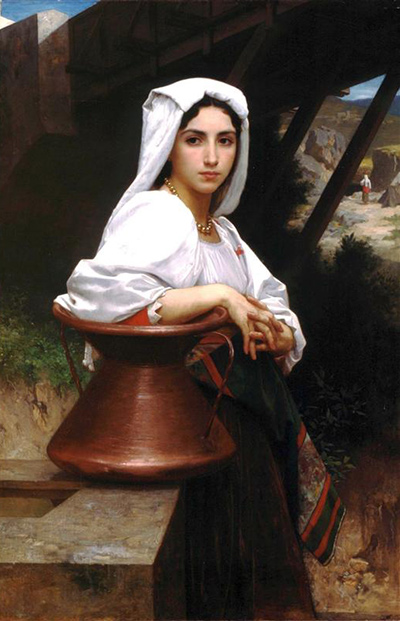
William-Adolphe Bouguereau's Italian Girl Drawing Water shows a young woman paused beside a water vessel, looking outward with a directness that gives the picture its force. The scene is simple: a figure, a jug, outdoor stonework and a suggestion of landscape beyond. Bouguereau turns that modest subject into a polished figure painting, using costume, posture and gaze to make an everyday task feel formally composed.
The protected English page title is well supported by public image and artwork routes. Wikimedia Commons identifies the work as Italian girl drawing water, gives Bouguereau as artist, dates it to 1871, describes the medium as oil on canvas and records dimensions of 119.5 by 79 cm. WikiArt and DailyArt repeat the 1871 date, oil-on-canvas medium and dimensions, while Bouguereau.org preserves the French title-family form Jeune Italienne puisant de l'eau (Italian Girl Drawing Water). [1][2][3][4]
Those sources are useful, but they are not a museum object record. Commons is the strongest captured metadata route, yet it also reports an unknown source/photographer and an unidentified location. That means the page should be honest about its source posture. It can discuss the object, title family and visual subject, but it should avoid sounding as if a settled collection record or complete ownership history has been captured.
At a Glance
- ArtistWilliam-Adolphe Bouguereau
- English TitleItalian Girl Drawing Water [1]
- French Title FamilyJeune Italienne puisant de l'eau [4]
- Date1871 [1][2]
- MediumOil on canvas [1][3]
- Reported Dimensions119.5 x 79 cm [1]
- Source TypeSecondary/public-domain metadata route
Contents
- Introduction
- A Young Figure and a Water Vessel
- Costume, Setting and Academic Finish
- What the Sources Can Support
- Reading Italian Girl Drawing Water Today
A Young Figure and a Water Vessel
The painting's subject belongs to Bouguereau's broader world of young female figures, rural costume and carefully staged genre imagery. The woman leans near a large vessel, with her hands placed in a way that lets the jug become almost architectural. It anchors the lower part of the image and gives the figure a practical setting without turning the painting into a detailed narrative.
The work is not a documentary account of a named sitter or a specific community. Its value lies in Bouguereau's idealizing studio language. He builds the scene from recognisable signs of outdoor labor, Italian dress and direct eye contact, then refines them through smooth surface, controlled anatomy and a clear vertical composition. The result is legible at once, yet carefully arranged.
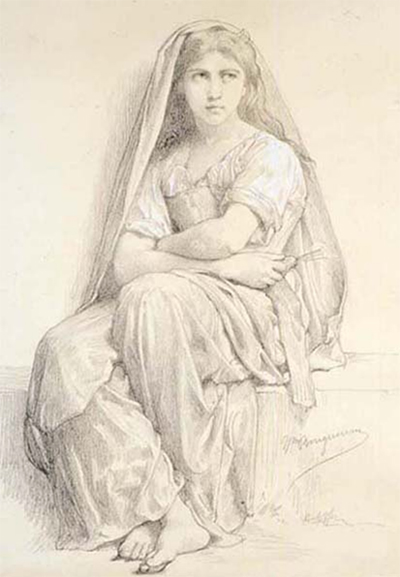
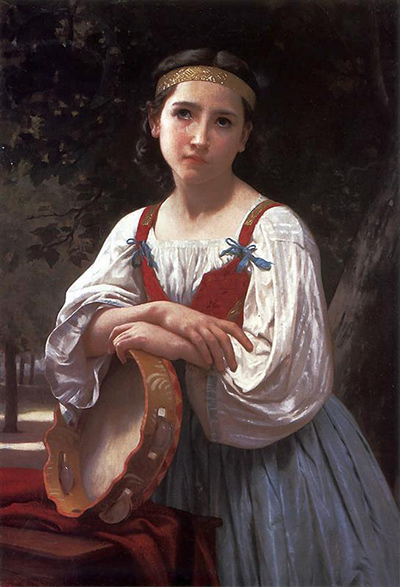
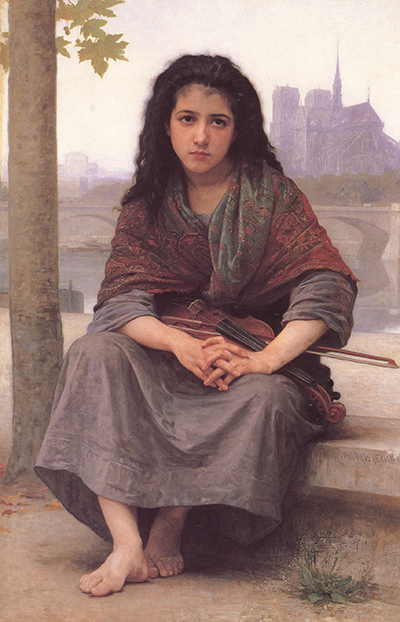
That balance connects Italian Girl Drawing Water with related Bouguereau pages such as A Girl in Peasant Costume, Gypsy Girl with a Basque Drum and The Bohemian. Each uses costume and pose to create a figure image that feels both particular and idealized. None should be treated as a straightforward social document without stronger evidence.
Costume, Setting and Academic Finish
The image's costume language is important because it helps explain why the work is often grouped with Italian or Ciociaro costume imagery. Commons categories and WikiArt tags support that general reading, but they do not identify the sitter. A safer public description is that Bouguereau used Italian costume and a water-drawing motif to shape a genre figure, not that he recorded the biography of a specific person. [1][2]
Bouguereau's finish gives the painting its authority. The figure is clearly modeled, the clothing is carefully controlled, and the large vessel supplies a contrast of texture and weight. Even the apparent informality of the pose is arranged. The young woman seems to rest for a moment, but the painting is not casual. It is built around stillness, frontal attention and the controlled display of form.
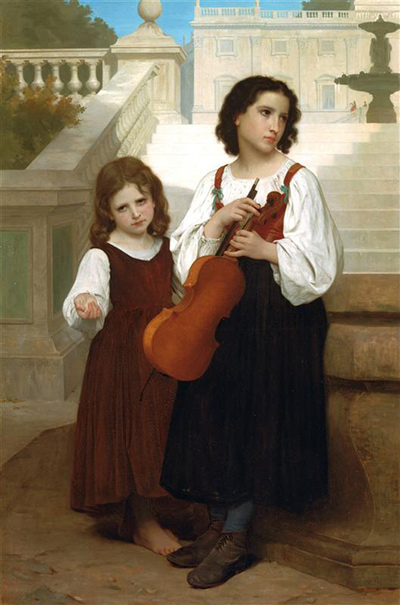
This is the same technical culture that supports Bouguereau's more widely known works, from mythological canvases to child and peasant subjects. In a painting like At the Edge of the Brook, a single outdoor figure becomes an image of quiet concentration. In Far from Home, a young figure carries emotional weight through pose and setting. Italian Girl Drawing Water belongs in that same family of carefully finished, human-scale pictures.
What the Sources Can Support
The safest object facts are modest. The page can describe the work as Bouguereau's Italian Girl Drawing Water, connect it with the French title route Jeune Italienne puisant de l'eau, and cite the repeated 1871, oil-on-canvas and 119.5 by 79 cm metadata. It can also note that secondary routes associate the image with private-collection language, while Commons leaves location unidentified. That distinction is important because it keeps the page from presenting a source convention as settled collection evidence. [1][2]
DailyArt is useful for broad context, especially in placing the painting early in Bouguereau's career and describing it as an example of his Academic polish. WikiArt is useful for title, date, medium, dimensions and genre/tag breadcrumbs. Bouguereau.org is useful for the French title family. Together they provide enough support for a controlled Standard P3 lift, but not enough for a museum-style dossier. [2][3][4]
That limitation is not a weakness if the page is framed honestly. Many Bouguereau images circulate through public-domain image routes, reproduction pages and secondary databases rather than through a single stable collection page. The task is to separate what can be said from what cannot. In this case, the artwork can be discussed as an 1871 oil-on-canvas genre figure with an Italian water-drawing subject, while ownership, provenance and image-source certainty remain outside the public claim.
Reading Italian Girl Drawing Water Today
Read today, Italian Girl Drawing Water is most compelling as a study in controlled immediacy. The young woman seems present and self-possessed, but the painting's effect depends on Bouguereau's discipline: the careful placement of the body, the polished finish of the face and clothing, and the heavy vessel that turns a daily task into a compositional anchor.
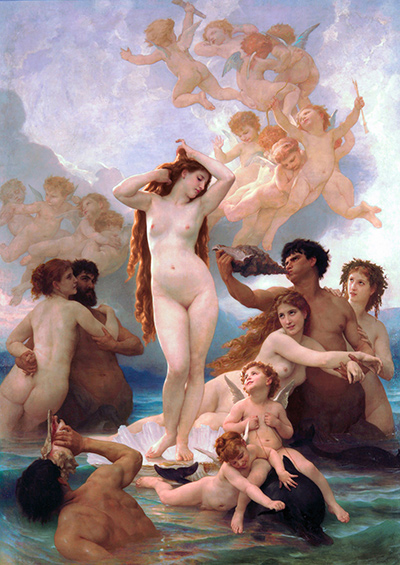
The picture also helps round out the Bouguereau cluster. It is less famous than The Birth of Venus and less source-secure than some museum-led pages, but it shows a familiar side of the artist: the transformation of genre material into idealized form. Bouguereau does not need a dramatic myth here. He uses a young figure, a practical object and a direct gaze to create an image of poise.
Handled with the right caution, Italian Girl Drawing Water can become a useful page rather than a generic image entry. Its public value lies in title clarity, visual description and honest source discipline. The painting should be allowed to remain modest: a polished 1871 figure subject, supported by secondary metadata, worth reading closely without pretending that every object fact has been fully settled.
Related Costume and Genre Pages
Frequently Asked Questions
Discussion
Italian Girl Drawing Water rewards close looking at costume, stillness and Bouguereau's polished genre language.
Use the prompts below to compare the painting's water-vessel motif, figure pose and source caution with Bouguereau's other young-figure pages.
Reader Insights
How does the vessel organize the figure's pose and the painting's sense of weight?
What does the costume suggest without becoming a documented biography?
Where do you see Bouguereau turning a modest genre subject into an idealized figure image?
Join the Conversation
Share your reading of Bouguereau's Italian figure subject, title route and careful visual construction below.
References
- Wikimedia Commons, William-Adolphe Bouguereau (1825-1905) - Italian Girl Drawing Water (1871), accessed 29 July 2026.
- WikiArt, Italian Girl Drawing Water, 1871, accessed 29 July 2026.
- DailyArt, Italian Girl Drawing Water, accessed 29 July 2026.
- Bouguereau.org, Jeune Italienne Puisant De L'Eau (Italian Girl Drawing Water), accessed 29 July 2026.