 by Tom Gurney
Tom Gurney BSc (Hons) is an art history expert with over 20 years experience
Published on June 19, 2020 / Updated on October 16, 2026
Email: tomgurney1@gmail.com / Phone: +44 7429 011000
Maternal Admiration and Admiration Maternelle
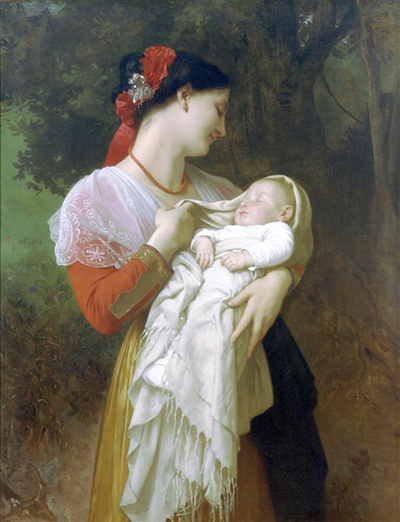
William-Adolphe Bouguereau's Maternal Admiration is a quiet mother-and-child image from 1869. The painting shows a young woman holding a sleeping infant outdoors, her face turned down toward the child with calm concentration. The subject is intimate, but Bouguereau treats it with the finish and composure of academic painting. The fabric, skin, profile, greenery and sleeping child are all carefully arranged so that a private exchange becomes a polished figure composition. [1]
The French title Admiration Maternelle is also attached to this work in catalogue-style public records. Those records identify the painting as oil on canvas and commonly give the dimensions as about 116 by 89 cm. They also describe the work as being in a private collection. Because the captured evidence is secondary and catalogue-led rather than a stable museum object page, the safest approach is to present those facts clearly but cautiously. [2][3]
That caution matters because Bouguereau also made a separate 1869 work known as Admiration maternelle - le bain, or Maternal Admiration - The Bath. Christie's records that bath composition as a distinct object with its own catalogue route. It should not be merged with the local page image. This page is about the outdoor mother-and-infant composition associated with Maternal Admiration, not the indoor bath scene. [5]
At a Glance
- ArtistWilliam-Adolphe Bouguereau
- Protected Route TitleMaternal Admiration
- French Title VariantAdmiration Maternelle
- Source PostureSecondary catalogue records
- Date1869
- MediumOil on canvas
- DimensionsAbout 116 x 89 cm
- Catalogue DistinctionSeparate from Admiration maternelle - le bain
Contents
- Introduction
- A Mother-and-Child Image
- How the Page Should Read
- Reading the Painting Today
- Related Maternal and Family Pages
- Frequently Asked Questions
- References
A Mother-and-Child Image
Bouguereau returned often to images of children, care and idealized family feeling. Maternal Admiration belongs to that larger pattern, but it is more direct than many of his allegorical or religious works. There is no elaborate narrative. The woman holds the child close, the infant sleeps, and the painting asks the viewer to notice the concentration of attention between them.
The mother's profile gives the scene much of its structure. Her head inclines toward the child, while the infant's pale clothing forms the brightest mass in the lower half of the painting. The red and yellow notes in the woman's dress add warmth, but they do not distract from the main exchange. Bouguereau uses colour and finish to make the moment feel composed rather than casual.
The setting also matters. The trees and shaded ground place the figures in a natural space, but the background remains secondary. It gives depth and atmosphere without becoming a landscape subject. The painting is built around touch, gaze and protection. The mother supports the child physically, while her expression gives the image its emotional center.
The composition also shows how Bouguereau could make a familiar subject look formal without making it cold. The infant's white clothing creates a soft, luminous shape against the darker trees and the stronger colours of the woman's dress. The woman's lowered head and the child's relaxed body form a compact diagonal, so the viewer's attention moves naturally from face to face and then to the supporting hands. Nothing in the scene feels hurried. The picture depends on pause, balance and a carefully controlled kind of tenderness.
How the Page Should Read
The inherited page treated Maternal Admiration as one of Bouguereau's greatest and most famous works and added broad claims about neoclassicism, romanticism, industrial change and the artist's supposed fascination with women. The available sources do not support that kind of language. A stronger public page should stay closer to what can be seen and what the catalogue trail can support.
That does not make the painting minor. It simply changes the kind of claim the page can make. Maternal Admiration is useful because it shows Bouguereau turning a domestic subject into a carefully finished image. The mother and child are not presented as a named family group. They function as an idealized scene of care, tenderness and visual order.
The page can therefore place the work beside Young Mother Gazing at Her Child, Charity and Innocence. Those pages show related forms of childhood, protection and maternal feeling, though each has its own source limits and object history. Maternal Admiration is less symbolic than Charity and less overtly devotional than Innocence, but it shares their interest in childhood as a subject worthy of serious finish.
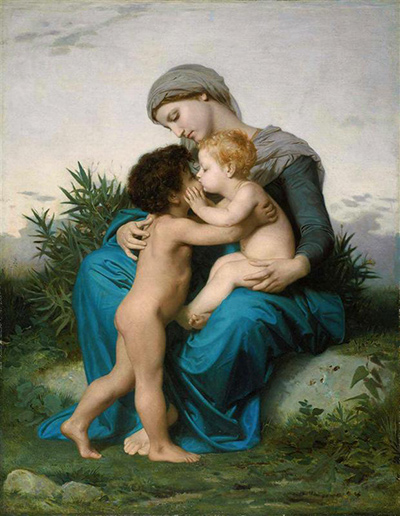
It also connects to Bouguereau's broader genre pages. In Fraternal Love, affection is shown between children. In Little Sulky, feeling is concentrated in a single child. Here, emotional weight comes from the relationship between mother and infant. The subject is simple, but the handling is deliberate.
Reading the Painting Today
Read today, Maternal Admiration works best as a compact example of Bouguereau's family imagery. It does not need a dramatic story. The sleeping infant, the supporting arms, the lowered gaze and the soft outdoor setting create a scene of stillness. Bouguereau's academic technique gives that stillness a controlled surface, turning tenderness into a formal composition.
The painting should also be kept separate from unsupported biography. The sources reviewed for this page do not identify the sitter, establish the child, or provide a full provenance for the local route object. They support a title, date, medium, dimensions and broad private-collection status, but they do not settle every question a museum record might answer.
That limitation is part of the value of a careful page. It lets readers understand the painting without pretending that every factual question has been closed. The public record can support a clear account of the image and its title family, but it cannot support a confident story about who posed, where the painting is now, or how the present image file should be reused. A good page should keep those boundaries quiet but firm.
Handled with that restraint, Maternal Admiration can become a useful page in the Bouguereau paintings cluster. It gives readers a clear account of the image, connects it to the artist's mother-and-child subjects, and avoids turning a limited source trail into false certainty. Its appeal lies in the same balance the painting itself depends on: tenderness, polish and careful control.
Related Maternal and Family Pages



Frequently Asked Questions
Discussion
Maternal Admiration rewards close looking at Bouguereau's mother-and-child imagery, title variants and source limits.
Use the prompts below to compare this quiet family image with related Bouguereau pages.
Reader Insights
How does the page change when Maternal Admiration and Admiration Maternelle are kept together?
What role do the lowered gaze, sleeping infant and supporting arms play in the painting's emotional structure?
How does this image compare with Bouguereau's other childhood and family subjects?
Join the Conversation
Share your reading of Bouguereau's mother-and-child imagery and source-cautious title handling below.
References
- Wikimedia Commons, Maternal Admiration (1869) file page, accessed 29 July 2026.
- Wikidata, Maternal Admiration Q106763455, accessed 29 July 2026.
- Wikidata catalogue list for William Bouguereau: His Life and Works, accessed 29 July 2026.
- WikiArt, Maternal Admiration, 1869, accessed 29 July 2026.
- Christie's, Admiration maternelle - le bain, accessed 29 July 2026.
- Art Renewal Center, Admiration Maternelle, accessed 29 July 2026.