 by Tom Gurney
Tom Gurney BSc (Hons) is an art history expert with over 20 years experience
Published on June 19, 2020 / Updated on October 16, 2026
Email: tomgurney1@gmail.com / Phone: +44 7429 011000
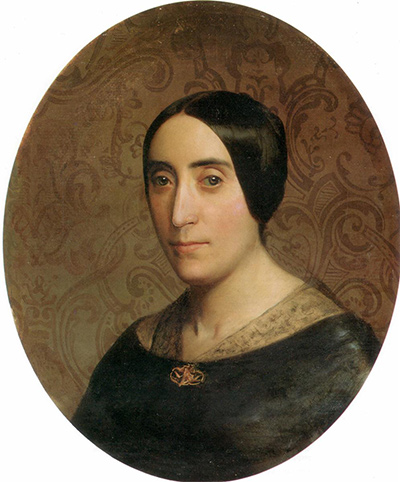
A Portrait of Amelina Dufaud
William-Adolphe Bouguereau painted A Portrait of Amelina Dufaud in 1850, at the beginning of the decade in which his public career began to open. The work is a small, direct portrait rather than one of the large mythological, religious or allegorical canvases for which he later became famous. It shows a woman in bust length, turned slightly toward the viewer, with her face framed by dark hair and a patterned background. The composition is restrained, but it already shows the careful drawing and smooth surface that would become central to Bouguereau's reputation. [1][2]
The source trail for the painting is useful but limited. Christie's records the work as A Portrait of Amelina Dufaud, oil on canvas, with dimensions of 22 by 18 inches, or 55.9 by 45.7 cm. Catalogue-style public records also identify the work as Portrait of Amelina Dufaud Bouguereau, dated 1850, and connect it with the catalogue number 1850/14 in the Bartoli and Ross Bouguereau catalogue. Those records place the painting in a private-collection context rather than in a stable museum object page. [1][2][3]
That distinction shapes how the page should be read. The painting can be described clearly as an early portrait by Bouguereau, but it should not be treated as if every museum-level detail is settled. The public records support the title, artist, date, medium and general portrait identity. They do not provide a full modern provenance, a current display location, or a complete account of the sitter beyond the name attached to the portrait.
At a Glance
- ArtistWilliam-Adolphe Bouguereau
- Protected Route TitleA Portrait of Amelina Dufaud
- Catalogue Title VariantPortrait of Amelina Dufaud Bouguereau
- Source PostureAuction and catalogue records
- Date1850
- MediumOil on canvas
- Dimensions22 x 18 in. / 55.9 x 45.7 cm
- Catalogue Number1850/14
Contents
- Introduction
- An Early Family Portrait
- What the Portrait Can Support
- Reading the Page with Care
- Related Early Portrait Pages
- Frequently Asked Questions
- References
An Early Family Portrait
A Portrait of Amelina Dufaud belongs to a cluster of early portraits associated with Bouguereau's family circle. The French title variant recorded in public metadata identifies the sitter as Amelina Dufaud Bouguereau, the wife of Bouguereau's uncle. That family context gives the portrait a different tone from many of the artist's later figure paintings. It is not an idealized peasant girl, a mythological nude, or a polished Salon subject made for an international market. It is a compact likeness connected to the artist's private world. [2][3]
The date is important. In 1850 Bouguereau won the Prix de Rome, the prestigious award that sent him to Italy for advanced study. Around this moment, portraits of relatives and nearby sitters offered him a different kind of artistic problem from the history paintings expected of ambitious young academic painters. They required likeness, character and economy. In Amelina's portrait, the challenge is not dramatic storytelling. It is the controlled presentation of a face, a pose and a relationship between sitter and viewer.
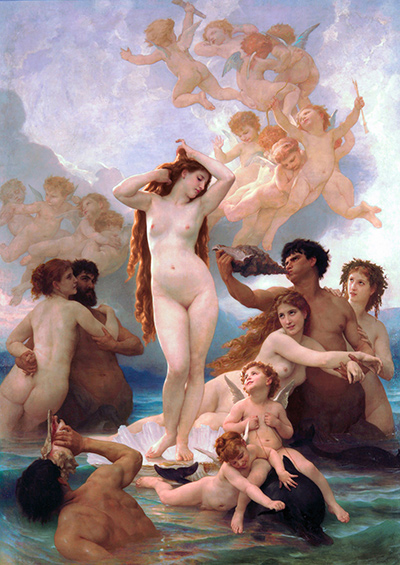
The painting is modest in format, but not casual in handling. Bouguereau's attention falls on the oval of the face, the dark contour of the hair, the soft transition of light across the cheeks, and the crisp arrangement of clothing against the background. The sitter meets the viewer with a composed expression. The effect is quieter than the theatrical intensity of Equality before Death or the large mythological staging of The Birth of Venus, but it belongs to the same academic discipline of drawing, finish and balance.
What the Portrait Can Support
The inherited page leaned heavily on broad claims about Bouguereau's supposed fascination with women, neoclassical taste, religious feeling and the sitter's purity or mystery. The reviewed sources do not support that language. A stronger account stays closer to the painting itself and to the surviving source trail. The portrait does not need to be made into a religious image or a statement about the female body. Its value lies in its position as an early likeness, probably connected to Bouguereau's relatives, painted before the full machinery of his Salon career had taken shape.
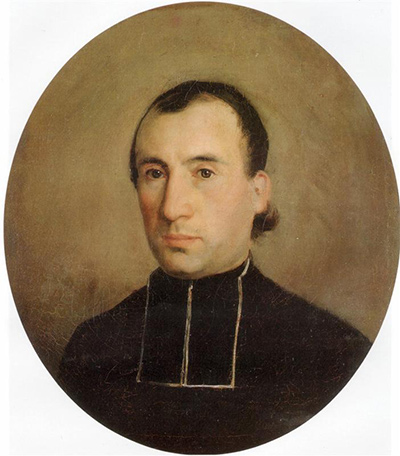
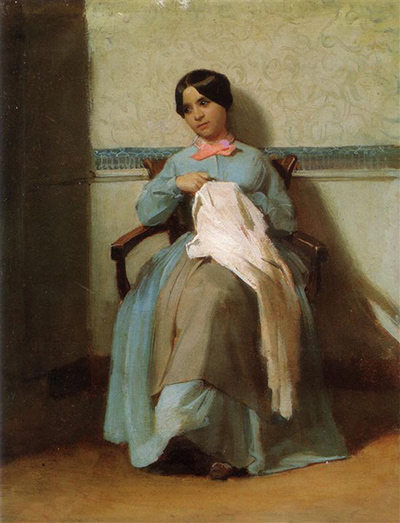
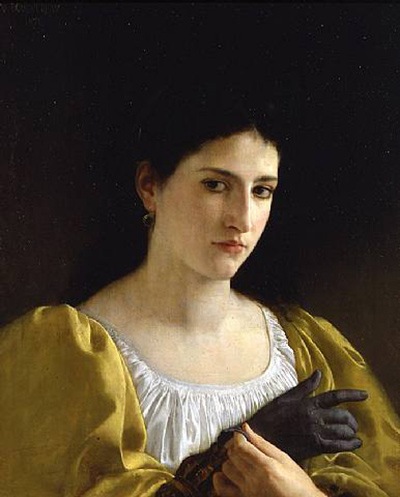
The work can also be read beside other early and portrait pages in the Bouguereau cluster. A Portrait of Eugene Bouguereau offers a close family comparison, while Portrait of Leonie Bouguereau extends the early portrait group. Later pages such as Lady with Glove show how Bouguereau's figure and portrait work could become more decorative and costume-focused. Set among those works, Amelina's portrait is useful because it is plain, direct and early.
The painting is also a reminder that Bouguereau's reputation was built from more than grand themes. Before the widely reproduced images of children, bathers, angels and mythological figures, he was a young painter proving his command of form in smaller assignments. A family portrait could test the same skills that later served him in larger works: the modelling of skin, the clarity of contour, the arrangement of costume, and the ability to make a figure appear stable within a carefully controlled surface.
Reading the Page with Care
Because no stable museum object page has been captured for this route, the public page should keep its factual claims modest. It can say that the work is recorded as an 1850 oil-on-canvas portrait and that auction and catalogue-style records preserve the title and dimensions. It should not say where the painting is now, whether it is on view, or how its ownership has moved across time.
The image should be handled with the same restraint. Public-domain records for the artwork and its reproduction are useful, but this page does not need to make a reader-facing claim that the local file has been separately cleared. The safer approach is to describe the portrait and cite the sources, while leaving image-file and reuse questions to the site's internal media checks.
Handled in that way, A Portrait of Amelina Dufaud can become a much stronger page than the inherited text. It does not need speculative symbolism or inflated praise. It needs a clear title, a careful date, a restrained object summary and a connection to Bouguereau's early portrait practice. The result should help readers place the work inside the Bouguereau paintings cluster without pretending that the surviving source trail is more complete than it is.
Related Early Portrait Pages
Frequently Asked Questions
Discussion
A Portrait of Amelina Dufaud rewards close looking at Bouguereau's early portrait practice and source-cautious family context.
Use the prompts below to compare this small portrait with related Bouguereau pages.
Reader Insights
How does the modest bust-length format change your reading of Bouguereau's early work?
What does the family-portrait context add without turning the page into unsupported biography?
How should auction and catalogue records shape a careful public artwork page?
Join the Conversation
Share your reading of Bouguereau's early portraits and careful source handling below.
References
- Christie's, lot 920633, A Portrait of Amelina Dufaud, accessed 29 July 2026.
- Wikimedia Commons, A Portrait of Amelina Dufaud Bouguereau (1850) file page, accessed 29 July 2026.
- Wikidata catalogue list for William Bouguereau: His Life and Works, accessed 29 July 2026.
- WikiArt, A Portrait of Amelina Dufaud, 1850, accessed 29 July 2026.