 by Tom Gurney
Tom Gurney BSc (Hons) is an art history expert with over 20 years experience
Published on June 19, 2020 / Updated on October 16, 2026
Email: tomgurney1@gmail.com / Phone: +44 7429 011000
Portrait of Mlle Brissac
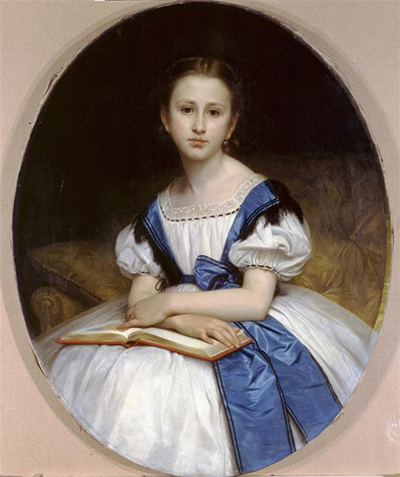
William-Adolphe Bouguereau's Portrait of Mlle Brissac belongs to the quieter side of an artist often remembered for large mythological, religious and ideal figure paintings. The work is a portrait rather than a narrative scene. It presents a young sitter in a white dress with blue accents, seated with an open book, her figure set against a dark interior. The inherited English title is useful for the local route, but the source record also circulates in French as Portrait de Mlle. Brissac and Portrait de Mademoiselle Pauline Brissac. [1][2]
The source title is often given with the accent as Portrait de Mlle. Brissac. Wikimedia Commons also records the French form Portrait de Mademoiselle Pauline Brissac, while Wikidata connects the painting with the catalogue number 1863/08 in the Bartoli and Ross Bouguereau catalogue. Those public records support the artist, title family, 1863 date, oil-on-canvas medium, portrait genre and dimensions of about 91 by 71 cm. They do not provide a stable museum object page, a full provenance or a current display location. [1][2][3]
That limited source posture is important. The painting can be presented as a portrait by Bouguereau, and it can be placed near other portrait pages in the artist cluster. It should not be made to carry a biography that the captured sources do not support. The sitter is identified in the title and metadata, but the public page should not turn that into a fuller life story or a complete account of her social position.
At a Glance
- ArtistWilliam-Adolphe Bouguereau
- Protected Route TitlePortrait of Mlle Brissac
- Accented Source TitlePortrait de Mlle. Brissac
- Source PostureCatalogue and public-domain records
- Date1863
- MediumOil on canvas
- Dimensions91 x 71 cm
- Catalogue Number1863/08
Contents
- Introduction
- A Sitter, a Book and a Controlled Surface
- Title and Source Caution
- Reading the Surviving Record
- Related Portrait Pages
- Frequently Asked Questions
- References
A Sitter, a Book and a Controlled Surface
Bouguereau organizes the portrait around restraint. The sitter faces the viewer with her body turned slightly, her dress forming the brightest passage in the composition. Blue ribbons and accents break the white fabric, while the open book supplies a quiet prop rather than an unfolding story. The painting does not ask the viewer to solve a myth or moral lesson. It asks for attention to pose, finish, fabric and expression.
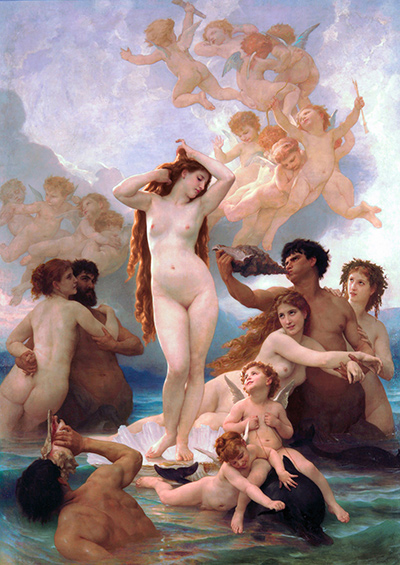
That makes Portrait of Mlle Brissac useful within the broader Bouguereau paintings group. Bouguereau's reputation can seem dominated by famous display works such as The Birth of Venus, or by religious and symbolic subjects such as Equality before Death. A portrait like this shows the same academic habits working on a smaller assignment: precise drawing, softened transitions, controlled lighting and an orderly arrangement of figure and setting.
The book is tempting to overread, but the captured sources do not support a full interpretation of the sitter's education, temperament or social position. A careful public page can say what is visible: the book is present, the sitter is posed with it, and Bouguereau uses it to give the hands and lap a point of focus. It should not turn that object into a claim about personality, rank or biography.
Title and Source Caution
The title itself needs careful handling. Portrait of Mlle Brissac is the protected local title and should remain the H1 for the route. The French variants are useful because they explain how the image appears in public metadata and reproduction records. Portrait de Mademoiselle Pauline Brissac may be mentioned as a source-title variant, but it should not be expanded into a life story for Pauline Brissac unless stronger evidence is captured later.
Dimensions should also stay cautious. Several secondary routes place the painting around 91 by 71 cm, which suits the upright image format, while at least one captured route presents the order differently. The At a Glance summary keeps the standard portrait-format order while the source note preserves that conflict. The same restraint applies to medium. Oil on canvas is supported by secondary routes, but the strongest Commons file table is not a museum record and should not be treated as complete object documentation.
Broad claims about symbolism, psychology and Bouguereau's general reputation can make a portrait like this sound more certain than the evidence allows. A stronger account stays closer to the work. It describes the sitter, the dress, the book and the dark setting; it places the painting in Bouguereau's portrait practice; and it acknowledges that the public record is catalogue-led rather than collection-led.
Reading the Surviving Record
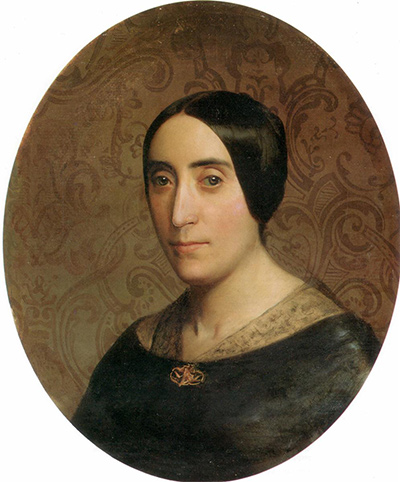
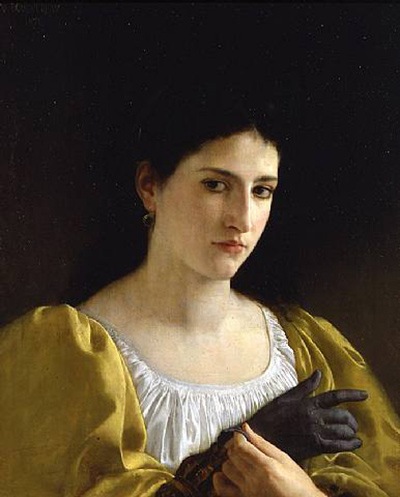
Even with a limited source trail, Portrait of Mlle Brissac has a useful role in the Bouguereau cluster. It sits naturally near A Portrait of Amelina Dufaud, Portrait of Leonie Bouguereau and Lady with Glove. Together, these pages show how Bouguereau's practice included portraiture and intimate figure studies as well as large public compositions. [4][5]
The portrait also helps readers see how academic finish works at a modest scale. Bouguereau's handling of costume and flesh is controlled, but the painting is not theatrical. Its drama is reduced to the relation between face, fabric, hands and book. The dark background keeps the focus on the sitter's pale dress and exposed skin, while the blue accents give the design a small rhythm of color.
That quietness is exactly why the page should remain source-led. The painting does not need invented provenance, a museum attribution that has not been captured, or a speculative sitter biography to justify its place. Its value is in the disciplined presentation of a young sitter and in the way it extends the viewer's picture of Bouguereau beyond his best-known subjects.
Handled carefully, the page can do three things at once. It can give readers a clear introduction to Portrait of Mlle Brissac; it can explain the title, date and catalogue evidence without overstating them; and it can leave unresolved image and ownership questions clearly outside the public claim. That is the right balance for a source-cautious page: useful, readable and honest about what the sources do and do not prove.
Related Portrait Pages
Frequently Asked Questions
Discussion
Portrait of Mlle Brissac rewards close looking at Bouguereau's portrait practice and cautious public record.
Use the prompts below to compare this small portrait with related Bouguereau pages.
Reader Insights
How does the modest format change your reading of Bouguereau's portrait work?
How should a page handle a protected English route title beside French source variants?
How should catalogue and public-domain records shape a careful artwork page?
Join the Conversation
Share your reading of Bouguereau's early portraits and careful source handling below.
References
- Wikimedia Commons, Portrait de Mlle. Brissac file page, accessed 29 July 2026.
- Wikidata creator list for William-Adolphe Bouguereau, Portrait de Mlle. Brissac entry, accessed 29 July 2026.
- Wikidata catalogue list for William Bouguereau: His Life and Works, accessed 29 July 2026.
- WikiArt, Portrait of Mlle Brissac, 1863, accessed 29 July 2026.
- Bouguereau.org, Portrait de Mlle Brissac (Portrait of Miss Brissac), accessed 29 July 2026.