



 by Tom Gurney
Tom Gurney BSc (Hons) is an art history expert with over 20 years experience
Published on June 19, 2020 / Updated on October 16, 2026
Email: tomgurney1@gmail.com / Phone: +44 7429 011000
Return from the Harvest and Bouguereau's Large Rural Scene
William-Adolphe Bouguereau's Return from the Harvest is one of his major rural figure paintings of the 1870s. The Cummer Museum of Art and Gardens records the work as an 1878 oil on canvas, acquired with funds from membership contributions and catalogued under accession number AP.1964.2.1. Its scale is central to its effect. This is not a small peasant vignette or a modest study. It is a large, carefully finished Academic painting in which harvest labor, family grouping and theatrical procession are brought together. [1][2]
The public English title is secure for this route, while source routes also preserve French title variants such as Retour de la Moisson and Retour des moissons. Those variants are useful because they make the subject more precise: the figures are not simply walking through the countryside, but returning after harvest work. The painting presents rural life as a staged passage from the fields back toward community, rest and recognition. [3][4]
Bouguereau turns that ordinary movement into a formal composition. The figures do not appear as anonymous laborers glimpsed at random. They are arranged with the clarity and polish of a Salon painter who wanted rural subject matter to carry pictorial grandeur. The harvest theme gives the work its social and seasonal setting; Bouguereau's finish gives it monumentality.
At a Glance
- ArtistWilliam-Adolphe Bouguereau
- TitleReturn from the Harvest
- French Title VariantsRetour de la Moisson; Retour des moissons
- Date1878
- MediumOil on canvas
- Collection SourceCummer Museum of Art and Gardens
- AccessionAP.1964.2.1
- Source NoteCummer governs; secondary routes support only
Contents
- Introduction
- Cummer Museum Object Facts
- Harvest Labor, Family and Procession
- Academic Finish and Nineteenth-Century Taste
- Reading the Painting Today
- Related Genre Pages
- Frequently Asked Questions
- References
Cummer Museum Object Facts
The Cummer source trail should lead the page. The museum's 19th-century European paintings overview identifies Return from the Harvest (1878) among three major Bouguereau works in its collection. A Cummer credit-line route gives the more detailed object record: artist, title, 1878 date, oil-on-canvas medium, large dimensions, accession AP.1964.2.1, and purchase through membership contributions. It also notes the reproduced frame and later frame gift, a reminder that the painting's public presentation has its own institutional history. [1][2]
That Cummer-led record keeps the page stable. Wikimedia Commons, A&AePortal and Sotheby's museum profile all support the same basic object family, including the 1878 date, oil-on-canvas medium and Cummer connection. WikiArt and reproduction pages can help readers recognize the title in wider online circulation, but they are secondary. The page should not turn those routes into governing authorities when the museum evidence is available. [3][4][5][6]
The same caution applies to display language. Cummer's pages prove collection association and object facts, but an event page is not the same as a permanent on-view statement. A public article can say that the painting belongs to the Cummer Museum of Art and Gardens collection; it should not claim evergreen display status unless a current object or gallery page is captured.
Harvest Labor, Family and Procession
Return from the Harvest belongs to Bouguereau's long interest in figures whose gestures are legible before they are dramatic. The scene has the emotional warmth often associated with his rural and family subjects, yet it also depends on discipline. The figures are posed and coordinated so that the harvest return becomes more than anecdote. It becomes an image of order after labor.
Bouguereau's rural people are idealized, but that idealization is not accidental. He smooths surfaces, clarifies bodies and simplifies emotion. The painting does not ask viewers to inspect the harsh material conditions of agricultural labor in a documentary way. Instead, it turns harvest into a subject of rhythm, dignity and communal movement. The result is closer to Academic genre painting than to social realism.
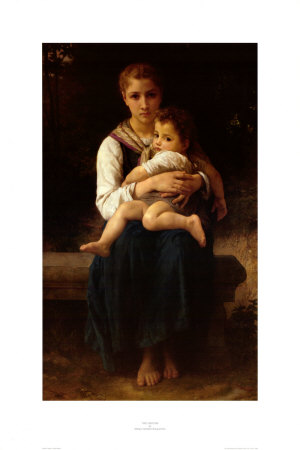
This approach connects the work to pages such as Far from Home, where Bouguereau also organizes vulnerability and public performance into a polished figure scene. It also belongs beside girlhood and family subjects such as Fraternal Love and Two Sisters, though Return from the Harvest is broader in scale and more public in character.
Academic Finish and Nineteenth-Century Taste
By 1878, Bouguereau was a mature artist with an extraordinary command of drawing, surface and narrative clarity. Return from the Harvest shows why that command appealed to nineteenth-century collectors and institutions. The painting gives rural life the size and finish normally associated with elevated subjects. It does not abandon Academic ambition when it turns to harvest labor; it transfers that ambition into the countryside.
The work also helps widen the picture of Bouguereau beyond the mythological and religious images that often dominate his reputation. He could paint dramatic literary subjects such as Dante and Virgil in Hell and mythological spectacle such as The Birth of Venus. In Return from the Harvest, the spectacle is quieter. The subject is seasonal labor, but the visual treatment is still expansive.
That tension is part of the painting's interest. Bouguereau does not make the harvesters rough or fragmentary. He makes them lucid, balanced and memorable. For viewers who admire him, this is evidence of his power to elevate ordinary life. For viewers more skeptical of his idealization, the same polish can feel like a screen between art and reality. Either response begins with the same fact: Bouguereau made rural return into a major Academic image.
Reading the Painting Today
A useful modern reading of Return from the Harvest begins with source discipline. The painting should be discussed as Bouguereau's 1878 Cummer Museum work, not as a loose harvest-themed reproduction. Its size, Cummer accession history and title variants give it a stable object identity. Its subject then opens onto Bouguereau's larger treatment of labor, family and rural life.
The painting does not provide a documentary account of harvest workers. It offers a carefully composed vision of harvest return shaped for the taste and expectations of the late nineteenth century. Figures, costumes, gestures and scale work together to make the scene legible and impressive. The harvesters are beautiful, ordered and dignified because Bouguereau's art insists on that transformation.
That transformation is exactly why the work remains worth close attention. Return from the Harvest shows Bouguereau at the point where genre subject and monumental ambition meet. It is rural in subject but public in scale, sentimental in appeal but rigorous in finish. Anchored by the Cummer Museum object trail, it can be read as one of the clearest examples of how Bouguereau turned everyday human movement into polished Academic theater.
Related Genre Pages



Frequently Asked Questions
Discussion
Return from the Harvest rewards careful looking at Bouguereau's rural figure painting and source history.
Use the prompts below to compare Cummer-led object facts with the painting's broader online title and image circulation.
Reader Insights
How does the painting's large format change the feeling of a harvest scene?
Why should Cummer's collection trail govern the page over reproduction routes?
Where does the painting sit between rural genre and Academic monumentality?
Join the Conversation
Share your reading of Bouguereau's harvest scene and its Academic finish below.
References
- Cummer Museum of Art and Gardens, 19th Century European Paintings and Sculpture, accessed 29 July 2026.
- Cummer Museum of Art and Gardens, Drop-in Tour: Love Hurts credit line, accessed 29 July 2026.
- Wikimedia Commons, Return from the Harvest file page, accessed 29 July 2026.
- A&AePortal, Return from the Harvest (Retour des moissons), accessed 29 July 2026.
- Sotheby's, Cummer Museum of Art and Gardens profile, accessed 29 July 2026.
- WikiArt, Return from the Harvest, accessed 29 July 2026.


