 by Tom Gurney
Tom Gurney BSc (Hons) is an art history expert with over 20 years experience
Published on June 19, 2020 / Updated on October 16, 2026
Email: tomgurney1@gmail.com / Phone: +44 7429 011000
The Thank Offering by William-Adolphe Bouguereau: Introduction
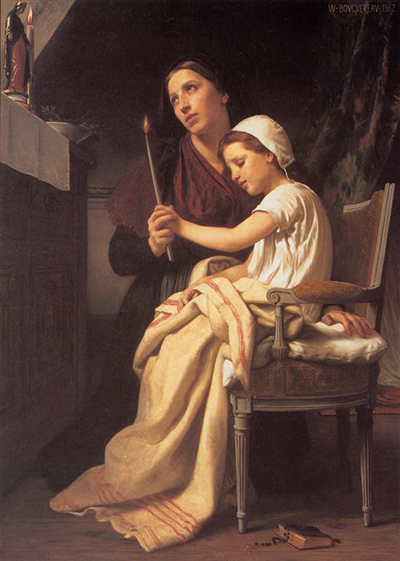
The Thank Offering is one of William-Adolphe Bouguereau's early images of domestic devotion. Painted in 1867, it shows a woman and a child gathered before a small religious focus, the child's body resting against the adult figure while a candle and rosary help define the scene as one of prayer. The Philadelphia Museum of Art identifies the work by title, artist, and date, and places it within a set of themes that include children, family life, interiors, religion and spirituality, Christianity, women, and motherhood. Those categories are a useful guide to the painting's public meaning: this is a work about piety made intimate through family feeling.
Bouguereau often moved between grand religious subjects and quieter scenes of private emotion. The Thank Offering belongs to the quieter side of that range. It does not present a monumental altarpiece or an episode crowded with figures. Instead, it compresses religious feeling into a domestic interior. A seated woman supports the child beside her, and the child's lowered head gives the scene a mood of fatigue, trust, or absorbed prayer. The small devotional setting makes the act of thanks feel close to everyday life rather than distant church ceremony.
At a Glance
- ArtistWilliam-Adolphe Bouguereau
- TitleThe Thank Offering [1]
- Date1867 [1]
- CollectionPhiladelphia Museum of Art [1]
- Object ResourcePhiladelphia Museum of Art object 104391 [1]
- Subject FamilyDomestic devotion, motherhood and childhood [2]
Contents
- Introduction
- Domestic Devotion and Family Feeling
- Devotional Objects and Academic Finish
- Religious Genre and Domestic Collecting
- Why the Painting Matters
Domestic Devotion and Family Feeling
The title matters. An offering of thanks is not simply a prayer request; it implies gratitude after danger, illness, anxiety, or need. Bouguereau leaves the exact occasion open. The painting does not explain what has happened before the moment we see. That restraint gives the scene its emotional reach. Viewers can understand the image without knowing a narrative source. A mother or guardian, a child, a candle, a religious image, and a rosary are enough to suggest a private act of thanksgiving, shaped by Catholic devotional culture and by the nineteenth-century taste for tender domestic subjects.
The rosary on the floor and the candle held upright are especially important because they make devotion physical. Prayer is not treated as an abstract idea. It is shown through objects that can be touched, held, dropped, lit, and kept close in the room. Bouguereau often made feeling visible through hands, fabric, and bodily support, and the same method works here. The religious theme is carried not by spectacle, but by small things: the child's leaning weight, the adult's steady arm, the candle flame, and the quiet nearness of sacred image and household chair.
Devotional Objects and Academic Finish
Bouguereau's academic discipline is visible in the way the scene is ordered. The figures are carefully staged, with the adult body forming a sheltering vertical presence and the child folded into that protection. The candle introduces a slim bright accent, while the warm interior tones keep the painting solemn rather than theatrical. Bouguereau's finish smooths the transition between religious seriousness and family tenderness. The viewer is invited to read the moment emotionally before thinking about its construction, but the construction is always there: pose, light, gesture, costume, and devotional objects all work together.
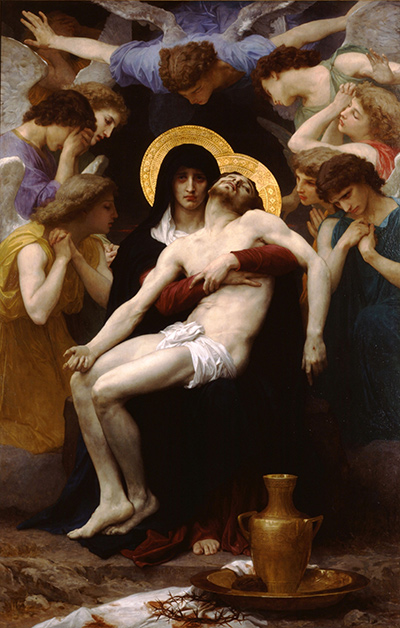
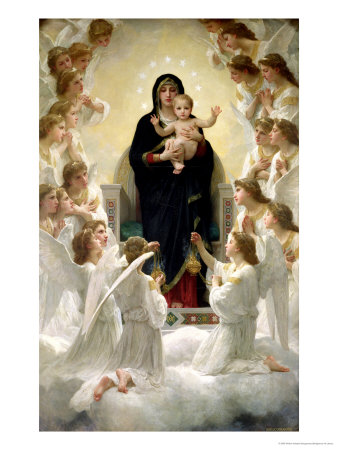
The painting also shows how Bouguereau made religious art accessible to domestic collectors. A subject such as Pieta or Virgin with Angels carries a more formal theological weight, while The Thank Offering brings devotion into the household. It is religious without being remote. The child's closeness to the adult figure gives the work an emotional language that overlaps with Bouguereau's many images of mothers, sisters, and children. In that sense, the painting sits between his religious and genre modes. It is not only about faith; it is about faith expressed through care.
That blending was one of Bouguereau's strengths in the market for nineteenth-century European painting. His public reputation rested on extraordinary finish, controlled drawing, and subjects that could be immediately understood. In The Thank Offering, the viewer does not need a complex iconographic key. The painting offers a clear emotional situation: a vulnerable child, a protective adult, and a quiet act of gratitude before a sacred presence. Bouguereau's polished surface turns that situation into an ideal image, removing accident and disorder so that the feeling appears purified.
Religious Genre and Domestic Collecting
Modern viewers may approach that idealization with mixed responses. The picture is tender, but it is also selective. It presents piety as graceful, poverty or hardship as softened, and childhood as morally legible. Bouguereau does not show the strain that might have led to a prayer of thanks; he shows the calm, beautiful aftermath. That choice is central to the painting's historical character. Like many academic works of family and faith, it transforms social and emotional realities into an image designed to console.
The Philadelphia Museum's custom-print resource reinforces how the work is still framed for modern audiences: as an image associated with children, family life, interiors, religion, Christianity, motherhood, and late nineteenth-century European painting. Those tags do not replace deeper scholarship, but they do capture the painting's most stable public categories. The Thank Offering is not a large historical drama. It is a devotional family image, and its power depends on the viewer recognizing the relationship between prayer and protection.
The interior setting is part of that recognition. Bouguereau keeps the room close around the figures, so the viewer's attention stays on the pair and on the devotional act. The darkness behind them is not an elaborate narrative space; it is a foil for the faces, clothing, candle, and small shrine. This compression gives the picture a chapel-like stillness without removing it from domestic life. The sacred presence is near, but the emotional drama remains human and familial.
Why the Painting Matters
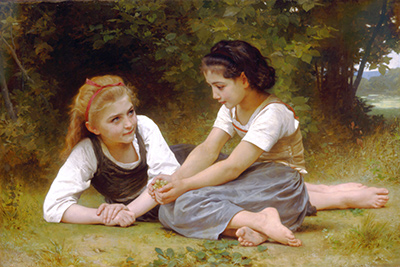
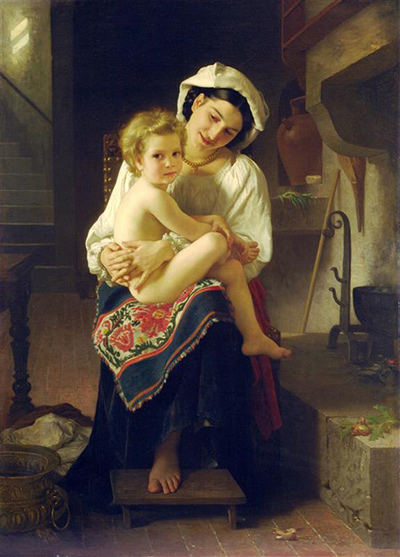
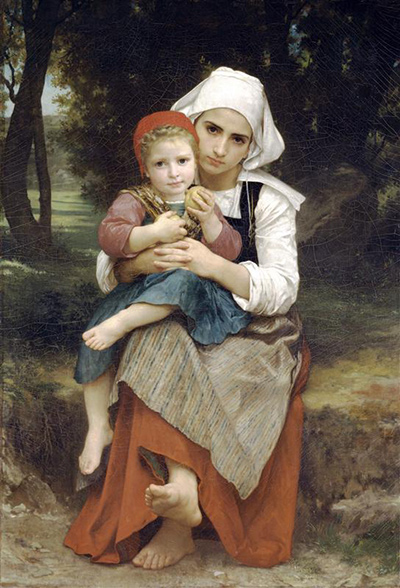
Within Bouguereau's larger body of work, the painting is useful because it connects several strands at once. It belongs near religious pages such as Pieta, Virgin with Angels, and Tobias Receives his Father's Blessing, but it also speaks to the child-and-family subjects represented by The Nut Gatherers, Breton Brother and Sister, and Young Mother Gazing at Her Child. Bouguereau's career was not divided neatly between sacred and sentimental painting. He repeatedly used the skills of academic figure painting to make tenderness, grief, gratitude, and protection visible.
The Thank Offering should therefore be read as a small but revealing work. Its devotional setting gives the scene seriousness; its mother-and-child structure gives it intimacy; its academic finish gives it authority. Bouguereau turns a private moment of thanks into a public image of care, faith, and emotional order. The result is a painting that may seem simple at first glance, but its simplicity is carefully made. It shows how Bouguereau could bring religious feeling into the domestic sphere and make that feeling legible through the quiet bond between adult and child.
Related Bouguereau Religious and Family Pages
Frequently Asked Questions
Discussion
The Thank Offering is a useful place to test how Bouguereau joins domestic care, religious devotion and academic finish without turning the scene into a grand public altarpiece.
Use the prompts below to connect the candle, rosary, child, protective adult figure and the broader Bouguereau cluster of religious and family subjects.
Reader Insights
Which devotional objects first tell you that the scene is about thanks rather than ordinary family life?
How does the adult figure's body shape the emotional shelter around the child?
How does this domestic devotional scene change when read beside Pieta or Virgin with Angels?
Join the Conversation
Share your reading of Bouguereau's The Thank Offering below.
References
- Philadelphia Museum of Art, The Thank Offering, accessed 28 July 2026.
- Philadelphia Museum of Art Custom Prints, The Thank Offering, 1867, accessed 28 July 2026.
- TheHistoryOfArt.org, William-Adolphe Bouguereau Biography, accessed 28 July 2026.
- TheHistoryOfArt.org, William-Adolphe Bouguereau Paintings, accessed 28 July 2026.
- TheHistoryOfArt.org, Pieta by William-Adolphe Bouguereau, accessed 28 July 2026.