



 by Tom Gurney
Tom Gurney BSc (Hons) is an art history expert with over 20 years experience
Published on June 19, 2020 / Updated on October 16, 2026
Email: tomgurney1@gmail.com / Phone: +44 7429 011000
Tobias Receives his Father's Blessing by William-Adolphe Bouguereau: Introduction
Tobias Receives his Father's Blessing is an early religious painting by William-Adolphe Bouguereau, dated 1860. The work is recorded in source-lineage routes as an oil on canvas measuring 153 x 119 cm and associated with the State Hermitage Museum in Saint Petersburg. Its title is not entirely fixed across public records. The local and common English route uses Tobias Receives his Father's Blessing, while Hermitage-linked structured records and image catalogues also preserve titles such as Tobias Saying Farewell to his Father, Tobias Saying Good-Bye to his Father, and the French Les adieux de Tobias avec son pere. Those variants are best understood as different emphases within the same devotional subject: a moment of departure, blessing, and family feeling from the story of Tobias.
The painting belongs to the religious side of Bouguereau's early career, before the late mythological triumphs and polished ideal figures that now dominate his reputation. In 1860 he was still close to the academic formation that had shaped his sense of drawing, gesture, and historical composition. Tobias Receives his Father's Blessing shows that discipline applied to a biblical family scene rather than to the classical subjects of The Birth of Venus, The Oreads, or Youth of Bacchus. The drama is quieter, but it is not casual. Bouguereau treats the exchange between father and son as a serious emotional and moral event.
At a Glance
- ArtistWilliam-Adolphe Bouguereau
- Page TitleTobias Receives his Father's Blessing
- Recorded VariantsTobias Saying Farewell to his Father; Tobias Saying Good-Bye to his Father [1] [2]
- Date1860 [1] [2] [3]
- MediumOil on canvas [1] [2]
- Dimensions153 x 119 cm [1] [3]
- Collection LineageState Hermitage Museum, Saint Petersburg [1] [2]
Contents
Title Variants
The title places the viewer at a threshold. Tobias is not shown in a triumphant return or a spectacular miracle, but in a moment organized around leave-taking and paternal blessing. The subject depends on relation: age and youth, vulnerability and obedience, spiritual duty and domestic affection. That makes the painting useful beside Bouguereau's other religious and family works. It has the sacred frame of a biblical scene, but much of its force comes from the human structure of the encounter.
The 1860 date also gives the painting a useful place in Bouguereau's development. He had already passed through the demanding system of French academic training, and his religious subjects still carried the weight of history painting, prize culture, and Italian study. This canvas should not be treated as a late decorative fantasy. It belongs to a moment when biblical narrative, learned composition, and academic seriousness could still define an ambitious young painter's public language. The work's sobriety is part of that ambition.
Early Religious Painting
Bouguereau's academic method makes that structure legible. Rather than crowding the scene with dramatic movement, he uses pose, scale, and bodily orientation to make the blessing readable. The father's presence anchors the composition; Tobias is defined by the act of receiving, listening, and preparing to depart. The painting therefore turns a narrative episode into a study of obligation and tenderness. It asks the viewer to understand faith through a family gesture.
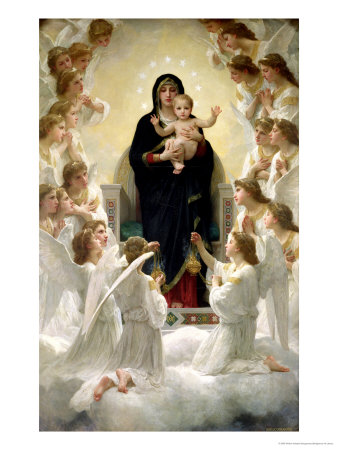
That balance between religious subject and human feeling became central to Bouguereau's art. In Pieta, grief is monumental and theological; in Virgin with Angels, sacred beauty becomes ceremonious and radiant; in The Thank Offering, devotion enters a domestic interior. Tobias Receives his Father's Blessing sits near the beginning of that range. It does not yet have the late-career polish of the grand mythological canvases, but it already shows Bouguereau's interest in making spiritual feeling visible through carefully arranged bodies.
Family and Devotion
The work also helps explain why Bouguereau remained persuasive to nineteenth-century audiences. His religious paintings do not rely only on doctrine. They rely on clarity. A viewer can read the scene through age, touch, posture, and expression before needing a detailed knowledge of the Book of Tobit. The blessing is both biblical and familial. The departure is both narrative and emotional. Bouguereau's finish brings those meanings together in a way that would have suited viewers who wanted religious art to be morally clear and emotionally accessible.
The title variants matter because they shift the emphasis slightly. `Receives his Father's Blessing` directs attention to the benediction itself, while `Saying Farewell` or `Saying Good-Bye` stresses the parting. Neither wording should be flattened into the other. The safest reading holds both together: the painting represents a farewell shaped by a father's blessing. That double emphasis gives the scene its tone. It is not simply a goodbye, and it is not an abstract rite. It is a departure made solemn by paternal authority and affection.
As a Bouguereau page, the painting should also be kept in proportion. It is not one of the artist's most famous public anchors, and the current source trail is less stable than a direct museum object page. But it fills an important gap in the cluster because it shows Bouguereau working with biblical history painting before the larger modern fame of his mythological, Marian, and child-centered subjects. It connects the biography, the paintings hub, the religious pages, and the domestic-devotional works into a fuller account of the artist's range.
Why the Painting Matters
Modern viewers may find the painting's emotional language formal, even restrained. That restraint is part of its historical character. Bouguereau idealizes the scene by removing accident and disorder, shaping the biblical episode into an image of composed feeling. The father's blessing becomes clear, dignified, and visually ordered. For some viewers, that idealization may feel distant; for others, it is precisely what gives the painting its devotional seriousness.
The strongest way to read Tobias Receives his Father's Blessing is therefore as an early religious painting about trust at the moment of departure. It shows Bouguereau using academic construction not for mythological display, but for family-centered sacred narrative. The painting's title history and source route require caution. Even so, the work has a clear public role: it reveals how Bouguereau translated biblical feeling into the lucid, polished language that would define his career.
Related Religious and Family Pages



Frequently Asked Questions
Discussion
Tobias Receives his Father's Blessing is a useful page for thinking about Bouguereau's early religious painting and family-centered sacred narrative.
Use the prompts below to connect title variants, biblical subject matter, academic composition and related Bouguereau devotional pages.
Reader Insights
How does the scene change when it is read as a blessing, a farewell, or both?
How does Bouguereau make a biblical episode feel like a family encounter?
How does this early religious painting compare with Pieta, Virgin with Angels or The Thank Offering?
Join the Conversation
Share your reading of Bouguereau's Tobias scene below.
References
- Wikimedia Commons, Tobias Saying Farewell to his Father - WGA2929, accessed 28 July 2026.
- Wikidata Q21716841, Tobias Saying Good-Bye to his Father, accessed 28 July 2026.
- WikiArt, Tobias Receives his Father's Blessing, accessed 28 July 2026.
- TopArtPrint, Tobias Receives his Father's Blessing, accessed 28 July 2026.
- FeelTheArt, Tobias Saying Good-Bye to his Father, accessed 28 July 2026.
- State Hermitage Museum, digital collection work 37481, accessed 28 July 2026.
- TheHistoryOfArt.org, William-Adolphe Bouguereau Biography, accessed 28 July 2026.
- TheHistoryOfArt.org, William-Adolphe Bouguereau Paintings, accessed 28 July 2026.


