



 by Tom Gurney
Tom Gurney BSc (Hons) is an art history expert with over 20 years experience
Published on June 19, 2020 / Updated on October 16, 2026
Email: tomgurney1@gmail.com / Phone: +44 7429 011000
Virgin Comforter by William-Adolphe Bouguereau: Introduction
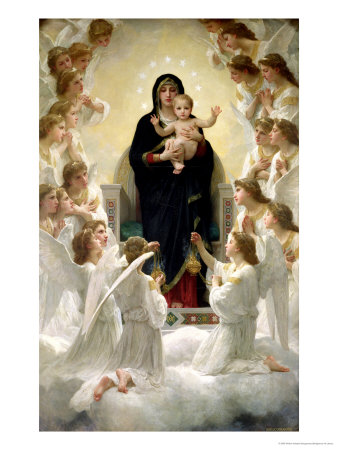
Virgin Comforter is the English title used on this page for William-Adolphe Bouguereau's Vierge consolatrice, a large religious painting recorded by the Musee d'Orsay. The Orsay object record gives the work as about 1877, oil on canvas, 204 x 148 cm, and identifies it with accession `RF 190`. It also records the painting as signed and dated `W. Bouguereau, 1877`, acquired by the French state at the Salon of 1877, and later assigned to the Musee d'Orsay. Those details make the painting one of the better source-anchored religious works in Bouguereau's later nineteenth-century output.
The composition is built around a stark devotional encounter. Mary sits enthroned, frontal and still, while a grieving woman bends across her lap. At the base of the group lies the body of a dead child. The scene is not crowded with narrative incident. Bouguereau concentrates the emotion into a few large forms: the vertical authority of the seated Virgin, the collapsed diagonal of the mourning mother, and the exposed stillness of the child below. The result is less a story unfolding in time than an image of suffering brought before a sacred figure.
At a Glance
- ArtistWilliam-Adolphe Bouguereau
- Page TitleVirgin Comforter
- Source TitleVierge consolatrice [1]
- DateAbout 1877 [1]
- MediumOil on canvas [1]
- Dimensions204 x 148 cm [1]
- AccessionRF 190 [1]
- AcquisitionState purchase at the Salon of 1877 [1]
- Institution NoteMusee d'Orsay responsible organism; place of conservation recorded as Musee des Beaux-Arts, Strasbourg [1]
Contents
- Introduction
- Composition and Title
- Salon and Institution History
- Drawing and Process Context
- Why the Painting Matters
Composition and Title
Orsay's subject terms are useful because they keep the description grounded. The record identifies the Virgin Mary, a group of figures, a kneeling woman, grief, and a dead child. From those elements, the painting can be read as a religious image of consolation, but the page should resist turning that reading into an invented narrative. Bouguereau does not provide a named biblical episode. Instead, he stages a human appeal to Mary, using the body of the grieving woman and the still child to make loss visible.
The title matters. Vierge consolatrice can be translated as Virgin Comforter or The Virgin of Consolation, and those English versions point to the same devotional idea: Mary as a figure to whom sorrow is brought. The title should not be confused with Bouguereau's other Marian paintings, such as Virgin with Angels or The Madonna of the Lilies. Those works share religious imagery and idealized form, but each has its own object history, scale and visual purpose.
In Virgin Comforter, Bouguereau's Academic method serves an unusually severe emotional subject. His polished surfaces, controlled anatomy and balanced composition are familiar from his mythological and childhood scenes, but here they are turned toward bereavement. The mother's body is not treated as picturesque sentiment. It bends under the weight of grief, while Mary's stillness creates a different kind of pressure. She does not move dramatically into the scene. She receives the grief, and the painting asks the viewer to sit with that stillness.
Salon and Institution History
That restraint can make the picture feel more powerful than a more theatrical treatment. Bouguereau often used clarity and finish to make emotion legible. Here, the clean drawing and smooth transitions of light do not soften the subject so much as stabilize it. The viewer is not distracted by rough handling or anecdotal detail. The painting's force comes from the contrast between the calm vertical Virgin and the vulnerable bodies below her.
The work also belongs to the public exhibition world of Bouguereau's career. Orsay records it as acquired by the state at the Salon of 1877 and exhibited at the Salon that year as no. 270. The record also lists the Exposition Universelle of 1878, where the painting appeared as no. 99, along with later exhibitions. This public history matters because Virgin Comforter was not simply a private devotional image. It entered the official exhibition system in which Bouguereau's reputation as a polished Academic painter was continually confirmed.
Its institutional history should be handled carefully. Orsay records the responsible organism as the Musee d'Orsay and the place of conservation as the Musee des Beaux-Arts, Strasbourg. The same record notes that the artwork is not currently exhibited in the Orsay museum. It also traces a complicated route through the Musee du Luxembourg, the Louvre, deposit at Strasbourg, disappearance, recovery and later assignment to Orsay. A responsible page should present that history as recorded, without turning it into a simplified claim about current display.
Drawing and Process Context
The related drawing records deepen the picture of Bouguereau's process. The Orsay and Louvre records identify an undated Vierge consolatrice drawing, accession `RF 22883, Recto`, made in graphite on blue paper with white heightening. The Louvre record describes it as a study for the painting shown at the Salon of 1877. That drawing should not be treated as the painting itself, but it helps show the kind of preparatory work behind Bouguereau's finished religious images: arrangement, figure placement and tonal planning before the final oil surface.
Seen within the wider Bouguereau cluster, Virgin Comforter sits close to Pieta, Virgin with Angels, `Madonna of the Lilies` and Flagellation of Christ. Each page touches a different religious mood. Pieta centers memorial grief and the dead Christ. Virgin with Angels presents Mary through music, scale and altarpiece-like grandeur. `Madonna of the Lilies` is smaller and more intimate. Virgin Comforter is different again: Mary becomes a still center before which ordinary grief is placed.
Why the Painting Matters
This gives the painting a distinctive emotional register. It is not the ideal childhood innocence of Bouguereau's domestic subjects, nor the sensual movement of his mythological paintings. It is an image of pain controlled by design. The dead child makes the subject direct, but the formal discipline keeps the scene from becoming melodrama. Bouguereau's skill lies in making the composition readable at once while leaving the emotional relationship between Mary, the grieving woman and the child unresolved enough to remain haunting.
For modern viewers, the painting may feel both moving and difficult. Its polished Academic language can seem distant from contemporary expectations of grief, yet that same polish is part of the work's argument. Bouguereau gives suffering a stable, public, devotional form. He does not show consolation as a simple answer. He shows grief gathered before an image of sacred stillness. That is why Virgin Comforter deserves a place beside Bouguereau's better-known religious works: it shows how his refined technique could carry a subject of loss without abandoning composure.
Related Religious and Marian Pages


Frequently Asked Questions
Discussion
Virgin Comforter opens a careful way into Bouguereau's religious painting, where grief, stillness and Academic finish meet.
Use the prompts below to compare the finished Orsay-recorded painting with Bouguereau's Marian and Passion subjects.
Reader Insights
How does the seated Virgin change the emotional balance between the grieving mother and the dead child?
How does Orsay's object record shape what can be said about title, date, institution history and display?
How does this image of consolation differ from Pieta, Virgin with Angels or The Madonna of the Lilies?
Join the Conversation
Share your reading of Bouguereau's image of grief and sacred stillness below.
References
- Musee d'Orsay, Vierge consolatrice, object 70031, accessed 28 July 2026.
- Musee d'Orsay, Vierge consolatrice drawing, object 233430, accessed 28 July 2026.
- Louvre Collections, Vierge consolatrice, RF 22883 Recto, accessed 28 July 2026.
- Wikimedia Commons, William Bouguereau-La Vierge consolatrice.jpg, accessed 28 July 2026.
- TheHistoryOfArt.org, Virgin with Angels, accessed 28 July 2026.
- TheHistoryOfArt.org, Pieta, accessed 28 July 2026.
- TheHistoryOfArt.org, The Madonna of the Lilies, accessed 28 July 2026.
- TheHistoryOfArt.org, The Flagellation of Christ, accessed 28 July 2026.


