 by Tom Gurney
Tom Gurney BSc (Hons) is an art history expert with over 20 years experience
Published on June 19, 2020 / Updated on October 16, 2026
Email: tomgurney1@gmail.com / Phone: +44 7429 011000
Young Mother Gazing at Her Child by William-Adolphe Bouguereau: Introduction
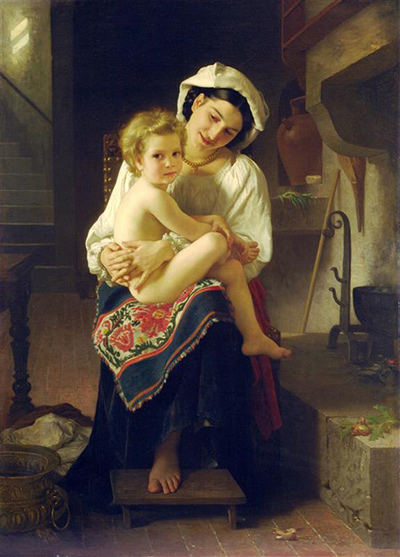
Young Mother Gazing at Her Child is one of William-Adolphe Bouguereau's most direct images of maternal tenderness. Painted in 1871, it shows a young woman in picturesque dress holding an infant close to her body, her attention absorbed by the child rather than by the viewer. The subject is intimate and accessible, but the painting is carefully constructed. Bouguereau gives a domestic moment the polish, balance, and finish of academic art, turning a quiet exchange between mother and child into a scene designed for lasting contemplation.
The painting is held by The Metropolitan Museum of Art in New York. The Met identifies it as an oil on canvas, measuring 56 x 40 1/2 inches, or 142.2 x 102.9 cm. It entered the museum through the Bequest of Zene Montgomery Pyle in 1993 and carries the object number 1993.402. Those details place the painting within a broader American history of collecting Bouguereau. Like many of his scenes of children and family life, it appealed to viewers who valued technical refinement, emotional clarity, and subjects that seemed gentle enough for domestic display.
At a Glance
- ArtistWilliam-Adolphe Bouguereau
- TitleYoung Mother Gazing at Her Child [1]
- Date1871 [1]
- MediumOil on canvas [1]
- Dimensions56 x 40 1/2 in. (142.2 x 102.9 cm) [1]
- CollectionThe Metropolitan Museum of Art, New York [1]
- Credit LineBequest of Zene Montgomery Pyle, 1993 [1]
- Object Number1993.402 [1]
Contents
- Introduction
- Met Pairing and American Collecting
- Maternal Gaze and Academic Finish
- Costume, Market and Idealization
- Why the Painting Matters
Met Pairing and American Collecting
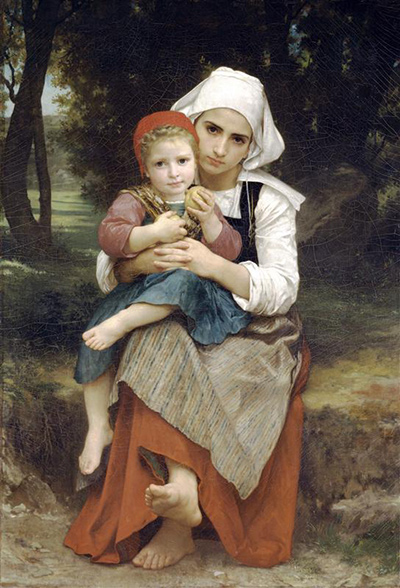
The Met also points out the painting's close relationship to Breton Brother and Sister, another Bouguereau canvas from 1871 that hangs nearby in the same gallery. That comparison is important. Both works show figures in picturesque regional dress, both turn family feeling into a carefully ordered composition, and both were acquired by New York collectors. Seen together, they reveal Bouguereau's ability to transform rural or domestic motifs into paintings that could travel easily across national boundaries. They feel local in costume, but international in finish and market appeal.
The pairing also shows how Bouguereau varied a formula without simply repeating it. Breton Brother and Sister faces outward, presenting children as a composed image of regional innocence. Young Mother Gazing at Her Child turns inward, making the bond between parent and infant the emotional event. The two paintings share a market and a visual language, but they ask the viewer to enter the scene in different ways.
Maternal Gaze and Academic Finish
In Young Mother Gazing at Her Child, Bouguereau avoids the frontal address of Breton Brother and Sister. The mother's gaze is turned downward, and the child becomes the center of her attention. This simple shift changes the emotional structure of the picture. The viewer is not directly confronted by the sitter; instead, we witness a closed circuit of affection. The mother's face, the curve of her body, and the infant's small form all draw inward. Bouguereau makes the act of looking itself the subject. The painting is not just about motherhood; it is about concentrated attention.
That concentration depends on Bouguereau's control of pose. The mother's body forms a protective arc around the child, while the child's presence softens the painting's vertical arrangement. The figure is composed enough to feel stable, but the tilt of the head and the closeness of the embrace keep the image from becoming merely formal. Bouguereau's academic training is visible in the clarity of contour and the smooth modeling of flesh. Yet the technical polish is placed in service of a sentiment that would have been instantly legible to nineteenth-century viewers.
Costume also plays a major role. Bouguereau often used regional or rustic dress to give his figures a picturesque identity without turning the painting into a documentary record. Here, clothing frames the mother's face and body, lending the scene a rural charm while also providing visual structure. The fabric creates rhythm and contrast; the child provides softness and focus. The result is a painting that feels natural at first glance but is actually built from a precise arrangement of forms, textures, and emotional cues.
Costume, Market and Idealization
The sweetness of the picture should not make its strategy invisible. Bouguereau was working for an art market that rewarded scenes of idealized childhood, motherhood, and rural simplicity. The Met notes that such works were made with an eye to international taste, and the painting's American collecting history confirms that appeal. Bouguereau's rural mothers and children offered collectors a reassuring vision: affection without disorder, poverty without harshness, regional character without social conflict. Young Mother Gazing at Her Child belongs to that world of carefully selected beauty.
At the same time, the painting is more than a formula. Its success lies in how fully Bouguereau commits to the quietness of the exchange. There is no dramatic narrative, no elaborate setting, and no symbolic complication. A mother looks at her child, and the painting asks the viewer to dwell inside that gaze. Bouguereau's finish slows the scene down. The even surface, controlled light, and gentle modeling make the moment feel suspended, as if affection itself has been given a durable pictorial form.
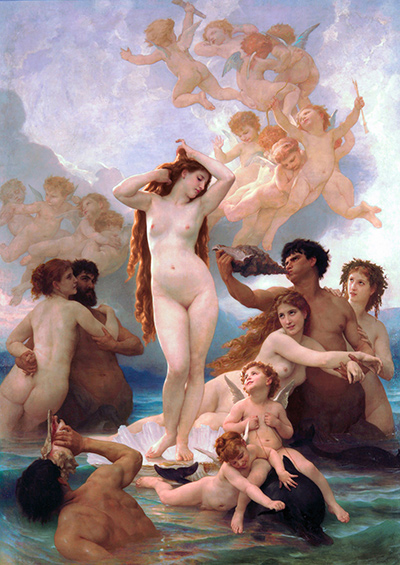
This was one of Bouguereau's great strengths. He could make familiar subjects appear complete. In mythological works such as The Birth of Venus, he used academic drawing to organize grand scale and ideal beauty. In family scenes like Young Mother Gazing at Her Child, he used the same discipline on a smaller emotional register. The painting shows that his technique was not reserved only for ambitious classical or religious subjects. It could also elevate a domestic theme into an image of grace, protection, and social reassurance.
Why the Painting Matters
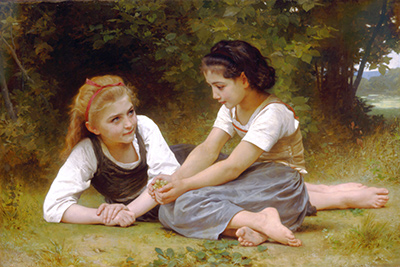
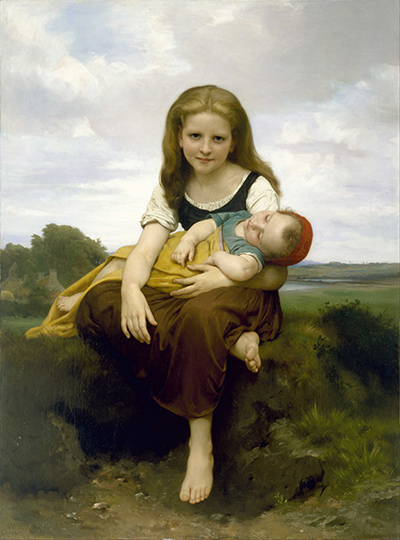
The painting's companion relationship with Breton Brother and Sister also helps place it within Bouguereau's wider cluster of child and family images. The Nut Gatherers, The Elder Sister, Innocence, and similar works show how persistently he returned to childhood as a subject. These paintings were not portraits in the modern documentary sense. They were ideals shaped from observed details, studio practice, and market expectation. Bouguereau's figures often seem individual, but they are also types: the mother, the sister, the child, the peasant girl, the innocent companion.
For modern viewers, that idealization can feel both beautiful and revealing. Young Mother Gazing at Her Child does not tell us everything about rural motherhood in nineteenth-century France. It tells us what Bouguereau and his patrons wanted such motherhood to look like: tender, orderly, graceful, and untouched by visible hardship. That is not a flaw to ignore or a virtue to accept without question. It is part of the painting's historical meaning. The work shows how academic art could turn everyday affection into a polished image of social and moral harmony.
Seen in that light, Young Mother Gazing at Her Child is a key small-scale work for understanding Bouguereau's appeal. It is technically assured, emotionally legible, and carefully shaped for collectors who prized beauty joined to sentiment. Its tenderness is sincere in effect, but also highly designed. The mother's gaze, the child's body, the costume, the smooth surface, and the painting's later American museum history all belong together. Bouguereau made a private-looking moment for a public world of taste, display, and desire.
Related Bouguereau Childhood and Genre Pages
Frequently Asked Questions
Discussion
Young Mother Gazing at Her Child is a useful place to test how Bouguereau turns maternal attention, picturesque costume and studio finish into a polished image of family feeling.
Use the prompts below to connect the mother's downward gaze, the child, American collecting history and the companion painting Breton Brother and Sister.
Reader Insights
How does the mother's downward gaze change the way the viewer enters the scene?
Where does picturesque dress feel documentary, and where does it become part of Bouguereau's studio design?
How does this painting change when read beside Breton Brother and Sister?
Join the Conversation
Share your reading of Bouguereau's Young Mother Gazing at Her Child below.
References
- The Metropolitan Museum of Art, Young Mother Gazing at Her Child, accessed 28 July 2026.
- The Metropolitan Museum of Art, Breton Brother and Sister, accessed 28 July 2026.
- TheHistoryOfArt.org, William-Adolphe Bouguereau Biography, accessed 28 July 2026.
- TheHistoryOfArt.org, William-Adolphe Bouguereau Paintings, accessed 28 July 2026.
- TheHistoryOfArt.org, The Nut Gatherers by William-Adolphe Bouguereau, accessed 28 July 2026.