 by Tom Gurney
Tom Gurney BSc (Hons) is an art history expert with over 20 years experience
Published on June 19, 2020 / Updated on August 29, 2026
Email: tomgurney1@gmail.com / Phone: +44 7429 011000
Introduction
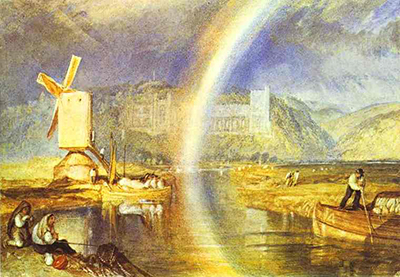
J. M. W. Turner's Arundel Castle on the River Arun, with a Rainbow is a small watercolour with a large weather system running through it. The familiar shortened title, Arundel Castle with Rainbow, catches the two most memorable features, but the fuller title is more useful: it names not only the castle and rainbow, but the River Arun, the element that gives the composition its slow, reflective movement. The work is dated about 1824-5 and belongs to the Turner Bequest under the reference CCVIII F, with Tate image and object material identifying it through D18139.[1][2][3]
The subject looks, at first, like a picturesque English view. A castle stands in the distance, a river leads the eye through the landscape, a mill or windmill belongs to the working terrain, and a rainbow bends through the sky. Yet Turner does not treat these details as separate attractions. The rainbow changes the status of everything beneath it. It turns the valley into a weather event, the river into a reflector of passing light, and the castle into a historical form seen through air. This is not a simple topographical souvenir. It is a work about how place becomes visible under unstable conditions.
The watercolour also belongs to Turner's 1820s print culture. The design sits close to The Rivers of England, also known as River Scenery, a group of river subjects that linked national geography with engraving and mezzotint publication.[6][7][8] Related George Henry Phillips prints and proofs after Turner, including Yale-associated material mirrored through PICRYL, show how the Arundel subject travelled from watercolour into reproductive form.[4][5] The original watercolour and the later print evidence should be kept distinct, but together they reveal the image's double life: intimate colour study and public river scenery.
At a Glance
- ArtistJoseph Mallord William Turner
- Full titleArundel Castle on the River Arun, with a Rainbow
- Familiar titleArundel Castle with Rainbow
- Datec.1824-5
- MediumWatercolour on paper
- Dimensions161 x 230 mm
- Bequest referenceCCVIII F
- Image/object referenceD18139
- AuthorityTate / Turner Bequest
- ProvenanceTurner Bequest, accepted 1856
The core object is a Turner watercolour on paper, dated about 1824-5. Turner Bequest indexing gives the title Arundel Castle on the River Arun, with a Rainbow, medium watercolour on paper, dimensions 161 by 230 millimetres, and Turner Bequest reference CCVIII F.[3] Tate image metadata connects the work with D18139 and records that it entered public ownership through Turner's bequest, accepted in 1856.[1][2] Those facts place it securely among the works that passed from Turner's studio into national care after his death.
The image should not be confused with related mezzotint or proof material. Yale catalogue access points and PICRYL mirrors refer to George Henry Phillips works after Turner, including Arundel Castle, with Rainbow and Arundel Castle, on the River Arun.[4][5] Those prints matter because they show the design's reproductive afterlife, but they are not the same thing as the Turner watercolour. The distinction is worth making at the outset because older local summaries and image mirrors sometimes mix Tate, British Museum and Yale signals in ways that can mislead a reader.
The topographical setting is Arundel in West Sussex. Arundel Castle overlooks the River Arun, and the town's history is deeply tied to the river's navigability, market function and former port activity.[10][11] In Turner's watercolour, the castle is not merely a landmark placed in the distance. It is one part of a river landscape: settlement, waterway, mill, valley, weather and history woven into a compact sheet.
Contents
- Introduction
- At a Glance
- Object Identity
- Arundel, Castle and River
- The Rainbow as Structure
- Watercolour and Light
- Rivers of England
- Sussex Weather
- Print Afterlife
- Arundel's Historical Weight
Object Identity
Object identity is the first job with this painting. The most secure formulation is Turner, Arundel Castle on the River Arun, with a Rainbow, c.1824-5, watercolour on paper, Turner Bequest CCVIII F, associated with Tate D18139.[1][2][3] The wording matters. "Arundel Castle, with Rainbow" is a convenient short title, but it trims away the River Arun. Turner's view depends on that river. The watercourse leads the eye, organizes depth, links castle and foreground, and gives the rainbow a surface on which to act.
Commons metadata, drawing from Tate image information, records a closely related long title with the same Arundel, River Arun and rainbow components, names Turner, and repeats the 1856 Turner Bequest transfer.[2] The same public metadata describes the medium as watercolour on paper and links to Tate's D18139 image file.[2] David Boeno's Turner Bequest index gives the same title and date range, and adds the compact size of 161 by 230 millimetres.[3]
The apparent British Museum signal in some mirrors should be handled cautiously. Commons includes a British Museum collection field and category, but the Tate-derived metadata and Turner Bequest identification point to the national Turner Bequest object as the working authority.[1][2][3] For the public article, the safest approach is to say that Tate/Tate-image and Turner Bequest evidence identify the watercolour, while related print and mirror records document later circulation and cataloguing complications.
That caution is not pedantry. With Turner, small works on paper often survive through several kinds of record at once: bequest numbering, image library descriptions, print catalogues, museum mirrors and later digital metadata. Each can preserve useful information, but each can also blur ownership, title or medium. The Arundel watercolour is a good example of why object identity has to be built from converging evidence rather than a single caption. Once the record is stable, the interpretation can become more adventurous without becoming careless. It lets the viewer trust both the facts and the feeling in equal measure.
The Yale/PICRYL material belongs in a different box. George Henry Phillips was the printmaker associated with reproductive versions after Turner. PICRYL records show Yale-linked Phillips entries under both the rainbow title and the River Arun title.[5] Those records are useful for the print afterlife, not for replacing the original watercolour's object facts.
Arundel, Castle and River
Arundel is a perfect Turner subject because it combines a commanding historical building with a river valley that can change character under weather. The castle rises above the town and the River Arun. The castle's own history account describes it as nearly a thousand years old, set in grounds overlooking the river, and originating with Roger de Montgomery at the end of the eleventh century.[10] That is the kind of long historical presence Turner could use without turning the image into architectural inventory.
Historic England gives the monument's official status as Grade I listed and records a layered building history: lower gatehouse possibly late eleventh century, keep and related structures from the late twelfth century, later medieval work, early sixteenth-century rebuilding, eighteenth-century works, and major nineteenth-century reconstruction.[9] The present castle is therefore not a single medieval fossil. It is a living historical accumulation. Turner's watercolour does not need to describe those phases in detail, but the distant castle carries their authority.
The River Arun adds another register. Arundel Town Council's history explains that the town was traditionally a market town, that the river was navigable far inland, and that Arundel became a bonding port in 1817, allowing goods to transfer toward London and beyond.[11] This economic and geographic context helps keep Turner's scene from becoming merely aristocratic. The castle belongs to hereditary power; the river belongs to movement, trade, reflection and everyday circulation.
The watercolour draws strength from holding those meanings together. The castle is elevated, old and socially charged. The river is lower, moving and practical. The rainbow belongs to weather, optics and sudden sensation. Turner binds them in one brief image, making a Sussex view feel both local and expansive.
The Rainbow as Structure
The rainbow is the image's most obvious effect, but it should not be treated as decoration. In a Turner landscape, weather often provides structure. The arc does not simply beautify the sky; it organizes the viewer's attention. It draws a relation between rain, light, river surface, castle and distance. It makes the whole view feel conditional, caught in a moment that might change almost at once.
The visible power of the rainbow lies partly in scale. A castle can dominate a town, but a rainbow dominates a valley. It arches across the scene in a way no human building can answer. Yet it is also fragile. Unlike masonry, it has no weight. It is made by light, rain and position. Turner understood that paradox and used it brilliantly: the most insubstantial form becomes the largest compositional force.
The rainbow also changes how the castle is read. Without it, the castle might become a stable historical endpoint. With it, the castle is seen through passing atmosphere. The building remains identifiable, but its meaning is softened by weather. It becomes part of a living environment rather than a fixed monument.
This is one of Turner's great gifts: he makes optical effects carry thought. A rainbow is not merely a meteorological incident; it is a way of showing that landscape is never neutral. The viewer sees Arundel at a particular instant, under a particular sky, with light caught between storm and clearing. Place is revealed through change.
Watercolour and Light
The medium matters because watercolour is unusually well suited to this kind of subject. Turner used watercolour not simply for convenience but for luminosity, transparency and speed of atmospheric suggestion. Tate's account of his watercolour practice emphasizes sketchbooks, portable equipment and the exploitation of light over mountains and lakes.[13] The same principles apply to river scenery. Watercolour can let paper act as light.
Joyce Townsend's Wallace Collection account of Turner's watercolour materials and techniques is especially relevant here. It describes his use of paper, washes, erasing, scraping, stopping-out and related methods, while also warning that technical claims must be grounded in evidence.[12] For Arundel Castle on the River Arun, with a Rainbow, without object-specific analysis, it is better to discuss appearances: pale brightness, thin colour, reflected light and delicate atmospheric transition.
The compact scale recorded for the watercolour, 161 by 230 millimetres, intensifies the achievement.[3] Turner compresses a valley, castle, river, sky and rainbow into a sheet smaller than many later printed images. That compression requires economy. Every tonal step has to carry spatial work. Every pale interval matters. The rainbow cannot be heavy; it has to remain airy while still commanding the composition.
Watercolour also makes the river an active participant. Paper brightness can suggest reflected light without laborious description. Thin washes can allow water and sky to communicate across the image. A darker bank, mill form or foreground accent can make the pale weather feel brighter. Turner understood that a small sheet could feel expansive if the light was arranged correctly.
Rivers of England
The Arundel design belongs in the world of Turner's river subjects of the 1820s. The Manchester J.M.W. Turner's Prints project places Rivers of England within the sequence of original publications derived from Rawlinson and later print scholarship.[6][7] Hind's public-domain account similarly associates the period with The Rivers of England, River Scenery, and the companion Ports or Harbours projects, published through the 1820s.[8]
This context is essential. The picture is not only "a castle with a rainbow." It belongs to a national language of rivers. Rivers in such projects could stand for movement, commerce, regional identity, antiquity, pastoral life and modern circulation. The River Arun gives Turner's Arundel its path through space and meaning. It is the line that connects valley and sea, castle and town, weather and reflection.
Hind singled out the Arundel rainbow as powerful, while also praising the breadth of space in Arundel Park and the rain effect in More Park.[8] That cluster is useful because it shows Turner working through related Sussex and river effects rather than producing one isolated view. Arundel was not just a postcard subject. It was a place through which Turner could explore how English scenery changes under air and water.
The print-series context also explains why the image had to translate well. A watercolour for reproductive use needed a clear tonal architecture. It had to supply engravers and mezzotint workers with forms that could survive the shift into black-and-white tonal media. The rainbow, paradoxically, becomes a test of translation: how can an effect associated with colour and light remain meaningful when remade through tone?
Sussex Weather
Turner's Arundel view is inseparable from Sussex weather. The county gave him a landscape in which river, downland, coast, town and castle could be understood within the same mental field. The River Arun moves toward the Channel, and Arundel's historic function as a river town makes the view more than rural scenery.[11] Weather travelling across such a valley is not a backdrop. It alters visibility, reflections and the perceived distance between landforms.
The rainbow announces that the scene follows rain. A viewer senses wet air, clearing light and a sky still divided between cloud and brightness. Turner makes the valley legible through this division. The darker passage of shower or cloud allows the brighter parts of the sheet to bloom. The castle's distance becomes more compelling because it is seen through weather rather than clean air. The river becomes a measure of illumination, carrying sky-colour through the lower half of the composition.
This is also a social landscape. Arundel's history as market town and port means that the river was an economic artery, not only a picturesque line.[11] The castle may provide the noble focus, but Turner spreads attention across the valley. His art is alert to the ordinary structures that make place work: mills, boats, banks, fields, roads, water channels, and the slow negotiation between land and river. A rainbow over such a view does not merely beautify it; it briefly unifies human and natural systems.
The Sussex setting also gives Turner a quieter alternative to mountain sublimity. There is no Alpine precipice, no catastrophic storm, no shipwreck, no erupting volcano. Instead, the drama lies in a temperate valley under changing light. This is one reason the picture is so revealing. Turner did not need extremity to create intensity. A small English river view could give him enough material: a castle with a long history, a working town, receding water, a mobile sky and a fleeting optical arc.
The same restraint sharpens the rainbow. In a more sensational scene, the arc might be swallowed by violence or spectacle. At Arundel, it becomes legible because the surrounding landscape is measured and calm. The viewer can feel the contrast between ordinary continuity and sudden optical event: river trade, castle history, fields and mill life continuing beneath a phenomenon that will vanish. That contrast gives the watercolour its distinctive poise. Turner is not forcing drama onto a quiet subject; he is showing how quiet places already contain drama when weather passes through them.
Print Afterlife
Turner's relationship with print was central to his career. The National Gallery artist record notes that his works include watercolours, oils and engravings, and that he moved across media throughout a long career.[14] By the 1820s, he was deeply engaged with projects that converted watercolour designs into published images for a wider audience.
In the case of Arundel, related George Henry Phillips records show the subject's migration into mezzotint/proof culture. PICRYL mirrors Yale-linked entries for Phillips's Arundel designs, including a rainbow version and a River Arun version.[5] These are not substitutes for the Turner watercolour. They are evidence of how the design was extended, adapted and circulated.
Mezzotint was well suited to Turner's atmospheric subjects because it could carry velvety tone, shadow, haze and luminous transitions. But it also imposed limits. Colour had to become value. A rainbow had to become a tonal arc, a shift in light, a difference between inner and outer sky, a relation between cloud and valley. That translation reveals how strong the design was beneath its colour.
The print afterlife also helps explain the title variation. A watercolour can be catalogued one way, a print another, a proof another, and later digital records yet another. Arundel Castle with Rainbow, Arundel Castle, with Rainbow, and Arundel Castle on the River Arun, with a Rainbow all point toward the same visual family, but they do not all describe the same physical object. Good interpretation keeps the family resemblance without flattening the records.
Arundel's Historical Weight
The castle's history is not incidental. Arundel Castle was founded in the wake of the Norman Conquest. The castle history account names Roger de Montgomery as founder and describes the motte, constructed in 1068, followed by the gatehouse in 1070.[10] It also traces the descent through d'Albini, Fitzalan and Howard inheritance, with the castle serving as the seat of the Dukes of Norfolk and their ancestors for more than eight centuries.[10]
Historic England's listing makes the architectural layering precise. It identifies the lower part of the gatehouse as possibly late eleventh century, the middle gatehouse stage and keep as likely late twelfth century, and later medieval elements including barbican, upper gatehouse and keep-related works.[9] It also records eighteenth- and nineteenth-century rebuilding.[9] This gives Turner a subject that was both old and visibly altered.
For a Romantic landscape artist, such a building offered more than antiquarian interest. It embodied continuity, restoration, aristocratic power, vulnerability and survival. Civil War damage, later repair and nineteenth-century rebuilding meant that Arundel was not a static relic.[10] It had been contested, repaired and reimagined. Turner's distant view lets the castle carry that weight without making the sheet a lesson in architectural history.
The rainbow complicates that weight. It places a temporary phenomenon above a monument of centuries. The contrast is quietly profound. Stone holds historical time; weather holds the moment. Turner makes them coexist.
River, Mill and Working Landscape
The visual tags attached to public image metadata include windmill, and the inherited local image also points viewers toward a mill/working element in the scene.[2] That detail matters because Turner did not isolate the castle from ordinary life. A mill or windmill brings labour, local economy and rural movement into the same frame as aristocratic architecture.
Arundel's town history supports such a reading. The town was not simply a scenic setting below a castle; it was a market place and former river-linked port, with the Arun navigable far inland and carrying goods through wider transport networks.[11] A river view of Arundel therefore has practical undercurrents. Boats, mills, fields and banks belong to the world that made the town function.
Turner often found poetry in such practical features. A river is never only water. It is a means of movement, a reflector, a boundary, a commercial channel, a source of atmospheric moisture and a compositional path. A mill is never only a building. It ties landscape to labour, wind, grain, local production and human time.
In Arundel Castle on the River Arun, with a Rainbow, the working landscape helps prevent the castle from becoming aloof. The whole view is relational. Castle and river, history and labour, weather and light, all hold each other in balance. The rainbow does not erase the ordinary world beneath it. It illuminates that world under changing weather.
Composition in Miniature
The small scale of the watercolour is easy to overlook, but it is central to the picture's success. A sheet measuring roughly 161 by 230 millimetres cannot rely on abundant descriptive detail.[3] It has to make hierarchy quickly. Turner does this by establishing a few major visual roles: the river as movement, the castle as historical anchor, the rainbow as atmospheric span, and the sky as the field in which the whole scene breathes.
The composition depends on recession. The foreground cannot be too busy, because the viewer needs to pass from near ground into the middle distance and then toward the castle. The river helps that movement by bending or opening through the view. Its reflective quality brings light downward, preventing the sky from becoming detached from the land. Even when the castle is the named subject, the visual energy is distributed through the whole sheet.
The rainbow gives the composition a second, larger curve. It answers the river's movement with an arc in the sky. This creates a quiet structural dialogue: water below, light above; horizontal movement across land, curved movement through air. Turner uses that dialogue to make the view feel complete without making it rigid. The scene remains open because both river and rainbow imply continuation beyond the limits of the sheet.
The castle's placement is equally intelligent. If it were too dominant, the watercolour would become a castle portrait. If it were too small, the historical charge of Arundel would fade. Turner keeps it distant enough to be atmospheric and clear enough to matter. The building's mass is not used to stop the eye. It is used to give the eye a destination before the weather opens the scene again.
This compression is part of Turner's professionalism. He was making images that could work as watercolour designs and, in related form, as prints. A successful design had to remain legible after translation. The major shapes had to be clear; the tonal logic had to survive; the emotional effect had to outlast the loss or reduction of colour. The Arundel sheet meets that challenge with unusual economy.
Looking Closely
Begin with the river. It gives the eye a path through the sheet and turns the landscape from a static prospect into a sequence. The viewer moves along water before fully settling on castle or sky. The river also creates the conditions for reflection, so that light from above can reappear below. Turner uses this vertical exchange between sky and water to make the small image feel open.
Then attend to the castle. It is distant enough not to dominate by detail, yet prominent enough to organize the view. Turner was not trying to produce a measured architectural elevation. The castle's role is pictorial and historical. It anchors the place while leaving room for weather to take command.
The rainbow should be read slowly. Its arc gives the image unity, but its delicacy prevents it from becoming a hard graphic device. It depends on the surrounding air. Its visibility changes with the tonal field around it. Turner makes the viewer sense that the whole scene has been caught between rain and clearing.
Finally, look at the working marks of the landscape: banks, trees, possible mill form, field divisions, small structures and open distance. These details support the image without crowding it. The composition's restraint is part of its sophistication. Turner trusts the viewer to feel scale through intervals rather than through descriptive overload.
The sheet also rewards attention to what Turner leaves understated. The castle is not described stone by stone. The river is not turned into a map. The rainbow is not converted into a hard band of colour. Instead, each element is given just enough force to hold its place within the larger weather effect. That balance is why the image can appear gentle at first and more rigorous after several minutes of looking.
The foreground deserves the same patience. Darker or firmer notes near the viewer help the eye understand the brightness beyond them. Turner often uses such anchoring passages to make light feel spatial rather than flat. In this watercolour, the near ground is not the main subject, but it gives the rainbow and river room to act. The image depends on contrasts between weight and air, locality and distance, description and suggestion.
There is also a rhythm between the named and unnamed parts of the view. The castle supplies name and history. The river supplies geography. The rainbow supplies event. But many of the small supporting forms remain less fixed: bank, field, vegetation, mill, track, boat-like or building-like accents. These partly anonymous details are not weak passages. They allow the composition to breathe, preventing the famous castle from hardening the whole view into a single-point attraction.
Rainbow and Memory
Rainbows recur throughout Turner's works on paper, from early studies to later colour experiments.[3] They suited him because they joined observation with symbol without belonging wholly to either. A rainbow can be measured as optics, experienced as weather, read as promise, used as composition and remembered as spectacle. Turner was alert to all of those possibilities.
In the Arundel watercolour, the rainbow is less theatrical than some of his later luminous effects, but it is no less important. Its force lies in how it alters ordinary topography. Arundel Castle could have been drawn as a dignified view. The River Arun could have been treated as a pleasant foreground. The rainbow makes the scene temporal. It asks the viewer to imagine the passing shower and the clearing light.
This temporal quality matters for memory. Many landscape views claim to preserve a place as if fixed. Turner's image preserves a place in change. The castle may endure, but the rainbow cannot. The river keeps moving. The weather will pass. The image therefore holds a paradox: the most memorable part of the scene is also the most transient.
That is why the watercolour feels larger than its size. It is not just a small record of Sussex scenery. It is a compact meditation on how landscape is known: through history, through travel, through weather, through reproduction, and through memory.
Why It Matters
Arundel Castle on the River Arun, with a Rainbow matters because it shows Turner making English topography ambitious without making it grandiose. The sheet is modest in scale, but its conception is broad. It brings together a Norman-founded castle, a river town, working landscape, watercolour luminosity, print culture and a commanding optical effect.
The work also helps correct a common simplification of Turner. He was not only the painter of vast storms, burning skies and late near-abstractions. He was also a disciplined maker of compact views in which a few carefully organized elements could carry a national landscape idea. The Arundel watercolour proves that ambition can be quiet.
It is especially valuable because it stands at the intersection of watercolour and reproduction. The original sheet shows Turner's colour and atmospheric touch. The related Phillips print evidence shows how such designs entered a wider print economy.[4][5] Together they reveal the practical intelligence behind Turner's river projects: he made images that could satisfy close looking and survive translation.
Above all, the rainbow gives the work its emotional intelligence. It is beautiful, yes, but it is not merely pretty. It changes the meaning of castle, river and valley. It makes history pass through weather. It makes place feel temporary and enduring at once. That balance is Turner's gift in miniature: a whole landscape, and a whole way of seeing, held inside a moment of light.
The watercolour is also a useful reminder that Turner's English subjects could be as conceptually rich as his more obviously spectacular scenes. A viewer does not need Rome, Venice, the Alps or the open sea to encounter his ambition. Arundel gives him history, topography, labour, water, weather and print potential in one compact field. The drama is compressed rather than absent.
For that reason, the work deserves a fuller reading than the shortened title usually invites. "Castle with rainbow" sounds like a motif. Turner's image is more than a motif: it is a river landscape that uses a rainbow to reorganize every other element. The castle remains important, but the weather teaches the viewer how to see it.
Discussion
How does Turner's rainbow reorganize the castle, river, working landscape and historical time beneath it?
Reader Insights
Where does the rainbow act as structure rather than decoration?
How does the River Arun connect foreground movement with the distant castle?
What changes when the watercolour design passes into mezzotint and proof culture?
Join the Conversation
Share a close observation or a source-based question for other readers.
References
- Tate Images, D18139, *Arundel Castle on the River Arun, with a Rainbow*. https://www.tate-images.com/preview.asp?item=D18139
- Wikimedia Commons file using Tate image metadata, *Arundel Castle, with Rainbow*. https://commons.wikimedia.org/wiki/File:William_Turner._Arundel_Castle,_with_Rainbow._c._1824._Watercolour_on_paper._British_Museum.jpg
- David Boeno Turner Bequest index, rainbow subjects. https://www.davidboeno.org/GROEUVRE/I1/TurnerBequestCXCV.html
- Yale Center for British Art catalogue target, tms:30959. https://collections.britishart.yale.edu/catalog/tms:30959
- PICRYL Arundel topic showing Yale records. https://picryl.com/topics/arundel%2Bcastle
- *J.M.W. Turner's Prints*, Original Publications. https://jmwturnersprints.manchester.ac.uk/original-publications/
- *J.M.W. Turner's Prints*, *Rivers of England*. https://jmwturnersprints.manchester.ac.uk/original-publications/87_ii_iii_riversengland/
- C. Lewis Hind, *Turner's Golden Visions*, Project Gutenberg. https://www.gutenberg.org/files/56923/56923-h/56923-h.htm
- Historic England, Arundel Castle, List Entry 1027926. https://historicengland.org.uk/listing/the-list/list-entry/1027926?section=overview
- Arundel Castle & Gardens, "Castle history." https://www.arundelcastle.org/castle-history/
- Arundel Town Council, "History of Arundel." https://www.arundeltowncouncil.gov.uk/history-of-arundel/
- Wallace Collection, "Turner's Watercolour Materials and Techniques." https://www.wallacecollection.org/explore/explore-in-depth/turner/turners-watercolors/turners-watercolour-materials-and-techniques/
- Tate Shop, David Blayney Brown, *JMW Turner Watercolours*. https://shop.tate.org.uk/jmw-turner-watercolours/23603.html
- National Gallery, Joseph Mallord William Turner artist record. https://www.nationalgallery.org.uk/artists/joseph-mallord-william-turner