 by Tom Gurney
Tom Gurney BSc (Hons) is an art history expert with over 20 years experience
Published on June 19, 2020 / Updated on August 29, 2026
Email: tomgurney1@gmail.com / Phone: +44 7429 011000
Twilight at the Mouth of the Medina
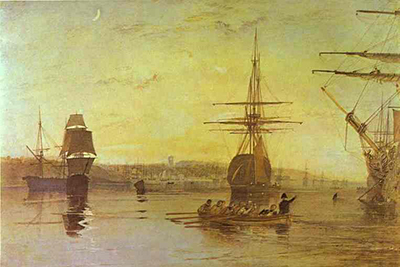
A crescent moon hangs in the pale blue-green sky above West Cowes. The sun has already gone down, but its last gold remains along the low horizon. Great ships lie at anchor without wind in their sails. A long boat crosses the foreground, six oarsmen carrying two uniformed officers away from a man-of-war that presses into the composition from the right. One officer stands and gestures back toward the ship. The harbour is quiet, but nothing in it is powerless.
J. M. W. Turner made West Cowes, Isle of Wight around 1827 as a finished design for Picturesque Views in England and Wales. It is watercolour over traces of pencil, heightened with bodycolour, with scratching out and stopping out, and measures 29.1 by 42.5 centimetres.[1] The work is privately owned. It sold at Sotheby's in London on 4 July 2018 for GBP 322,000 including premium, to a buyer described only as an Asian private collector.[2] No current public display is established.
The exact title matters. The work is sometimes shortened to Cowes, Isle of Wight, as it was when Robert William Wallis engraved it in 1830.[3] The inherited reproduction has also been associated with an MFA Houston drawing called View of a Seaport: East Cowes, Isle of Wight. That is a separate 1828 work in ink, ink wash and white chalk on blue paper, only 12.7 by 18.4 centimetres.[18] Turner's larger private watercolour is securely the West Cowes design sold in 2018.
The view is probably taken from the mouth of the River Medina, looking west toward the town. St Mary's Church rises as a small blue-grey tower in the distance. The broad Solent lies beyond and to the right, separating the Isle of Wight from mainland Hampshire. Turner gives the location enough definition to be recognised, but he allows ships, water and fading light to dominate architecture.
This is not a yacht race. Turner visited Cowes during the second season of Royal Yacht Club competition in 1827, and the experience generated racing drawings and two large oils. Yet the watercolour shows an anchorage after action or between movements. Sails hang. Warships rest. The only sustained propulsion comes from the oarsmen in the gig.
John Ruskin later identified the image's central paradox. He saw calm water and motionless naval power, but also recognised a vast underlying swell through the broken spacing of reflections. His phrase “power in repose” captures the design's unusual force.[7] Turner makes stillness active. The harbour holds military authority, tidal movement and human labour in suspension while day gives way to night.
Essential Details
Harbour View, Medium and Purpose
- ArtistJoseph Mallord William Turner (1775-1851)
- TitleWest Cowes, Isle of Wight
- Short print titleCowes, Isle of Wight
- Datecirca 1827
- Mediumwatercolour over traces of pencil, heightened with bodycolour, scratching out and stopping out
- Dimensions29.1 x 42.5 cm
- Collectionprivate collection
- 2018 resultGBP 322,000 including premium
- Catalogue numberWilton 816
- Purposefinished watercolour for Picturesque Views in England and Wales
- EngraverRobert William Wallis
- Print date1830
Contents
- Twilight at the Mouth of the Medina
- Looking West from the River Mouth
- Moon, Star and the Last Sunlight
- Ships at Anchor
- The Captain's Gig
- Calm Water and Hidden Swell
- Watercolour, Bodycolour and Reserve
- The First Isle of Wight Encounter
- Return in the First Regatta Year
- John Nash and the Summer of 1827
The work combines a named harbour with an exact time of day. Its topography places the spectator at the Medina mouth, but its title does not announce the summer twilight, crescent moon, warships or officer's gig that control the experience. Those elements turn a coastal prospect into a meditation on readiness and rest.[1][3]
Looking West from the River Mouth
Cowes occupies both banks of the Medina where the river meets the Solent. West Cowes lies on the left bank when looking inland; East Cowes lies opposite. Turner's title names the place seen rather than necessarily the ground from which he looked. Sotheby's locates the imagined spectator in the river mouth, facing west toward the low town and St Mary's Church.[1]
The viewpoint sits close to the water. No elevated terrace or bank separates the eye from the anchorage. Hulls rise against the horizon, and the foreground gig appears almost level with the spectator. That low position gives the vessels physical weight while allowing their masts to occupy a great expanse of sky.
The horizon is set well below the middle of the sheet. Sky therefore becomes the largest continuous field. Its pale upper blue shifts toward cream and gold near the shore, while small grey, yellow and rose cloud marks record the last colour of day. The town is compressed into a narrow band between sky and water.
Turner distributes ships rather than placing one central flagship in isolation. At far left, a blue hull with a thin mast begins the sequence. Beside it, a dark square-sterned vessel carries heavy black sails. A much smaller craft interrupts the open middle. Farther right, a tall ship seen almost from astern rises behind the foreground gig. The cropped man-of-war then enters forcefully from the edge.
This arrangement makes looking comparable to navigating. The eye passes between vessels, across gaps and through rigging. No single ship blocks the whole view toward Cowes. Masts and spars form a transparent architecture through which town, coast and sky remain visible.
St Mary's tower is tiny but strategically placed near the remains of sunset. It gives the low shoreline a vertical accent and confirms that the distant band is a settled town rather than an anonymous coast. The British Museum's engraved description likewise places the fading sun behind the church tower.[3]
The view toward the Solent is less a panorama than an occupied water space. Civilian and military vessels share the anchorage. Small boats pass among them. The Medina mouth links local harbour, island river and national sea lane. Turner conveys that connection through intervals rather than through a map-like survey.
An independent nineteenth-century Cowes watercolour by Frederick Calvert was long misidentified as Yarmouth before the British Museum corrected it through the visible relation of Cowes Castle, East Cowes Castle and the river mouth.[19] That history demonstrates how easily the two island ports and opposing banks can be confused. Turner's exact viewpoint must therefore remain grounded in the primary catalogue rather than inferred from a generic harbour title.
Moon, Star and the Last Sunlight
The crescent moon is one of the first forms the eye recognises. It hangs high at the left, small but materially bright against the washed sky. The sun itself is no longer visible. Its presence survives as a yellow-gold concentration above the town and as warm colour moving across hulls, figures and water.
The British Museum's record for Wallis's engraving identifies both a crescent moon and a star.[3] The star is not conspicuous in every reproduction of the watercolour, while the moon remains unmistakable. It is best understood as a securely transmitted detail whose visibility changes with scale, condition and reproduction, not as an invented ornament.
Turner makes evening through coexistence rather than a simple switch from light to dark. Upper sky cools first. The horizon retains warmth. The moon has sufficient brightness to register, but it has not become the sole source of illumination. The harbour belongs to the interval when day is gone in one sense and still present in another.
Sotheby's proposed a comparison with Byron's line about the moon being up before night.[1] The resemblance is evocative, but no document proves that Turner designed the work around that passage. The painting requires no literary key. Its colour establishes the transitional hour directly.
The crescent also changes the scale of the ships. Their masts are tall within the harbour, yet they remain under an immense atmospheric field. The small moon appears remote and weightless, while the dark vessels cluster near the bottom of the sky. Turner balances terrestrial force against celestial distance.
The last sunlight is strongest behind the town rather than around the moon. This separation prevents a false reading in which the crescent somehow causes the golden horizon. Two light conditions overlap. The sun's afterglow carries warmth from below, while the moon supplies a cool white point above.
That double structure is repeated on the water. Yellow and rose stains near the right foreground correspond to the late western sky. Paler reflections under the moon and ships lean toward cool grey and blue. The surface becomes a field where different moments of light meet.
Ruskin dated the represented moment to more than half an hour after sunset and called it a summer twilight.[7] His exact timing is criticism rather than meteorological proof, but it expresses the image's sustained afterglow. Turner is not painting the instant the sun touches the horizon. He is painting light that persists after its source has disappeared.
Ships at Anchor
The harbour contains vessels of very different scale, position and function. Turner avoids presenting them as a catalogue of naval architecture. Some hulls are partly concealed, and much rigging is abbreviated. Yet each ship has a distinct posture that contributes to the whole anchorage.
At left, the blue-hulled vessel spreads laterally against the low shore. Its colour separates it from the dark ship beside it, whose stern rises as a near-black vertical mass. Heavy sails or awnings create stacked shapes above that stern, producing one of the strongest reflections in the water.
The central vessel is seen almost end-on. Its rounded stern, brown-red sail and high mast make it narrower than its true bulk. Yards extend across the sky like horizontal arms, and fine rigging connects them in a web of controlled tension. Because the ship faces away or obliquely, it draws vision into the anchorage rather than presenting a broad side.
At right, the man-of-war cannot be contained. Turner crops its hull, masts and yards so severely that the spectator seems to have approached alongside it. A projecting spar descends diagonally toward the water. Dark rigging, carved structure and clustered figures accumulate at the edge. The ship's incomplete visibility makes it feel larger than a complete miniature would.
Sotheby's identifies a seaman on the main yard as preparing or unfurling a sail.[1] The figure is small, and the exact task remains an interpretation, but the human presence changes the apparently resting ship. Readiness continues above the calm water. Sail can be set, orders passed and the vessel made active.
The British Museum describes battleships mooring in the Solent.[3] Turner does not show cannon fire, chase or storm. Naval identity enters through mass, rigging, officers and disciplined boats. The warship's potential is more important than immediate violence.
Civilian shipping prevents the anchorage from becoming a purely military display. Cowes served vessels moving through the Solent and Medina as well as yachts, pilots and naval craft. Turner's mixed assembly communicates a harbour whose life depended on overlapping systems of transport, defence, leisure and service.
The spacing between hulls matters as much as the hulls themselves. Open water around the small centre-left craft makes it vulnerable. The gap between the central ship and man-of-war allows the officer's gesture to travel visually. Empty intervals keep the harbour breathable while suggesting channels through which boats can move.
Turner gives rigging different degrees of finish. Thick yards and spars assert structure; fine lines fade into air. The result avoids both diagrammatic precision and atmospheric vagueness. Each ship can be read as engineered equipment, but the harbour remains unified by twilight.
The vessels also establish several kinds of depth without conventional recession through buildings. The blue hull and black-sterned ship at left overlap the shoreline, the almost end-on vessel occupies the middle distance, and the man-of-war breaks the spectator's side of the frame. Turner lets differences of scale, cropping and orientation replace a sequence of foreground, middle-ground and distant architectural planes. The spectator is not looking at shipping from safety outside the harbour; the composition makes the viewing position part of the anchorage.
No vessel is shown under a full press of sail. Dark canvas on the left hangs with little indication of wind, the central yards extend laterally without driving the ship forward, and the great structure at right is being tended rather than propelled. Masts therefore become measures of vertical stability. They rise from a surface that moves slowly and connect the compressed human world below with the enormous open sky above.
Turner differentiates naval presence from the spectacle of battle. The cropped warship can be recognised through scale, disciplined rigging and the relationship between officers, gig and crew, yet there is no smoke, gunfire or enemy. Its authority is logistical: men move between ship and shore, sail is handled, and boats occupy an ordered roadstead. That emphasis makes the scene attentive to the routines by which maritime force was sustained.
The arrangement is also temporal. The left ships have already become dark silhouettes, the central vessel retains traces of warm colour, and the right-hand ship receives the strongest local activity. These need not represent consecutive moments, but they lead vision from evening mass toward a last pocket of work. Turner creates a harbour closing down while remaining capable of renewed movement.
The Captain's Gig
The foreground captain's gig supplies the picture's clearest human action. Six oarsmen sit in line, their bodies bent or turned within a long narrow boat. Two uniformed officers travel with them. One remains seated; the other stands near the stern and raises an arm toward the man-of-war.[1]
The boat is placed below the central ship, but its course carries it toward the right. Long oars project beyond the hull as red-brown diagonals. They convert rowing into a visible rhythm, each stroke implied by the repeated angle and spacing of blades.
Turner does not isolate individual faces. He differentiates the crew through posture, clothing and colour. Pale yellow, cream, green and dark jackets create a compact sequence of rounded forms. The standing officer's near-black uniform and hat make him the decisive vertical accent.
His gesture is small in relation to the warship but compositionally commanding. The raised arm continues toward the rigging at right. It may indicate an order to the seaman aloft, as Sotheby's suggests, or a last instruction while the gig departs.[1] The visual relation is secure; the precise conversation is not.
The gig gives scale to every large vessel. Its occupants fit beneath the central stern, while the right-hand ship rises beyond the edge. Naval power becomes understandable through the service boat that connects command on shore, officers and crew aboard ship.
Rowing also breaks the anchorage's silence without disturbing its calm. Ruskin later observed that in this design the quiet is interrupted by the dash of oars.[7] That imagined sound is brief and regular. It does not become commotion. The crew's labour measures stillness by giving the viewer one controlled motion against it.
The oars generate reflections and horizontal marks around the boat. Warm strokes spread across cool water, preventing the foreground from becoming an empty wash. The gig is therefore both narrative incident and compositional instrument. It animates the lower edge, ties the central and right ships together and brings colour close to the spectator.
It also complicates social hierarchy. Officers stand or sit as passengers while six men provide propulsion. Turner records rank without turning the scene into a portrait of named individuals. Uniform, gesture and labour establish relations of command through action.
The vessel moves away from the man-of-war, but the officer looks back. Direction and attention oppose one another. This tension keeps the gig psychologically attached to the ship even as the oars carry it across open water. The harbour's calm contains an unfinished exchange.
Calm Water and Hidden Swell
At first glance the water appears polished. Reflections descend beneath hulls, and broad pale areas preserve the sky's light. No breaking wave interrupts the foreground. The ships seem to rest on a glass-like plane.
Ruskin argued that this apparent smoothness conceals a much larger movement. In Modern Painters he examined the reflection of a distant buoy, represented by separated dark strokes that extend unexpectedly close to the spectator. The intervals, he reasoned, imply the far sides of enormous rises in the water.[7]
His analysis changes how the foreground is read. A continuous mirror would produce an unbroken vertical double. Turner instead spaces dark and light marks across long horizontal distances. Reflection appears, vanishes and reappears as the surface tilts toward and away from the eye.
The broad swell need not be dramatic. There is no evidence of storm or immediate danger. It belongs to tide, current and the living body of the Solent. The ships can remain anchored while the sea beneath them continues to move.
This is the basis of Ruskin's “power in repose.”[7] The phrase applies both to water and warships. The sea has the capacity to rise without breaking; the vessels have the capacity to sail or fight without doing so. Stillness becomes the temporary restraint of force.
Turner varies reflection according to object. The dark left ship produces a strong segmented column. The blue hull beside it has a softer, shorter echo. The central ship casts brown and blue marks that dissolve into the anchorage. The gig generates narrow warm strokes close to its oars. These differences make the surface responsive rather than formulaic.
Colour is equally important. Pale blue-grey establishes the large calm field, but ochre, rose, green, black and white move through it. A small dark mark can imply depth because it interrupts luminosity. A thin warm stroke can imply a low angle of sunset because it corresponds to the horizon.
The right foreground is more worked than the open left. Scraped or reserved lights, dragged strokes and darker passages accumulate beneath the man-of-war and gig. This unequal density gives the boat room to emerge while balancing the massive cropped ship above.
Ruskin's attention to distant and near marks shows why the work cannot be reduced to mood. Its calm is constructed through specific optical evidence. Turner does not merely wash the lower third in a tranquil colour. He makes the spectator infer a body of water whose scale exceeds the visible boats.
Watercolour, Bodycolour and Reserve
The 2018 catalogue identifies an unusually rich combination of processes: watercolour over pencil, bodycolour, scratching out and stopping out.[1] These are object-specific findings, not guesses based on Turner's general reputation. They help explain how the image moves between pale atmosphere and precise nautical detail.
Pencil supplied an underlying structure for hulls, masts, town and horizon. Watercolour washes then established the broad relation between cool upper sky, warm western light and reflective water. Because thin colour allows the paper to remain luminous, the same support can carry sky and sea without heavy covering.
Bodycolour adds opacity. Turner could use denser touches to reinforce the crescent moon, sail edges, uniforms, highlights and parts of the rigging. Opaque marks sit across earlier colour rather than merely tinting the paper, giving selected forms a material presence.
Stopping out protects light during the application of wash. Scratching out reopens bright lines or points after colour has been laid. In a harbour scene, those methods are particularly useful for rigging, reflections, moonlight and the thin flashes that separate overlapping structures.[1][21]
The high-resolution image shows how sparingly sharp definition is used. The right-hand ship receives dark concentrated marks, and the standing officer is firmly drawn. Much of the distant town remains a soft band. Turner spends precision where it controls scale, direction or identity.
Rigging tests the medium because it requires lines across already coloured air. Some cords and stays are fine and continuous; others dissolve or overlap. Scratching, pencil, brush and opaque accent can work together without every line being assigned to one tool from reproduction alone.
The moon demonstrates compression. It is a small pale curve with enough opacity to hold against the sky. Turner does not surround it with a theatrical halo. Subtle changes in the adjacent wash let its brightness appear atmospheric rather than pasted on.
Water is handled through marks of very different length. Long horizontal washes create extent. Short dark strokes interrupt reflection. Warm dragged colour near the gig records oars and afterglow. Light recovered through reserve or scratching gives the surface a flicker without turning it into sparkling daylight.
The 2018 examination also noted that the drawing was laid onto a board, possibly an original laminate, and recorded a small stain, slight foxing, small abrasions and minimal retouching.[1] Those observations describe its condition at that sale. They should not be converted into a present diagnosis or used to explain every visible irregularity.
General accounts of Turner's watercolour practice confirm his willingness to combine transparent and opaque means and to manipulate the paper's light.[21] The special achievement here is not the number of processes, but their coordination. Technical variety serves an image whose first impression is unity.
The First Isle of Wight Encounter
Turner's relationship with Cowes did not begin in 1827. Sotheby's records his first Isle of Wight visit in 1795, when he was about twenty.[1] That early journey belonged to his rapid development as a topographical draughtsman, moving through castles, churches, coasts and settlements with sketchbooks and commissioned publication in mind.
A substantial early watercolour survives as Tate D00667, Cowes Castle, Isle of Wight. Tate's open data records graphite and watercolour on paper, about 30.5 by 43.1 centimetres, accepted with the Turner Bequest in 1856.[4] The historic inventory describes fishermen and boats in the foreground, sailing vessels on the Solent and the Hampshire coast beyond.[6]
That work is close in scale to West Cowes but different in conception. Its title centres Cowes Castle and its active coastal setting. The later sheet gives the harbour a broader twilight order, with modern naval presence and the town subordinated to shipping.
The early watercolour was connected with an unfinished engraving in John Landseer's uncompleted Views in the Isle of Wight.[6] This provides an important precedent. From the beginning, Turner's Cowes subjects could move between direct travel, finished watercolour and intended reproduction.
The 1795 encounter also links Cowes to Turner's formative marine work without requiring a straight line of development. Fishermen, sails, Solent distance and coastal fortification provided one set of problems. Three decades later, he returned with much greater experience in marine oils, atmospheric watercolour and print collaboration.
West Cowes Castle itself began as a Henrician coastal fort built in 1539 to guard the Medina and the approach to Newport. Historic England records surviving portions of the low bastion and round tower, later incorporated into a private house.[12] The building was therefore both historical defence and inhabited coastal architecture when Turner first knew it.
It is important not to project its later identity backward. The Royal Yacht Squadron bought West Cowes Castle only in 1856.[12] In Turner's 1795 and 1827 visits, it had not yet become the clubhouse and racing landmark familiar from later Cowes history.
The early visit gave Turner direct knowledge of the Medina mouth long before organised cup racing transformed its public image. When he returned in the 1820s, he encountered a familiar geography under new social and maritime conditions.
The difference between the two finished watercolours is therefore historical as well as stylistic. The first belongs to youthful topography and a proposed island series. The second belongs to mature command, the England and Wales enterprise and a harbour newly prominent in elite yachting culture.
Return in the First Regatta Year
Turner came back to the Isle of Wight in 1826, the year organised Royal Yacht Club racing began at Cowes.[1] His Gosport and Isle of Wight material suggests that he saw aspects of the event, though Ian Warrell has proposed that much of the journey was spent near Niton with Colonel James Willoughby Gordon and Lady Juliette Gordon.[1]
The distinction matters because “Turner at the first regatta” can sound more certain and exclusive than the evidence allows. He moved around the island and worked through several patronal relationships. Cowes was one important focus within a broader visit.
The Royal Yacht Squadron's history traces the regatta's origins to local pilot cutters. Cowes pilots met incoming vessels, guided them through the Channel and Solent, and competed in reviews and races connected with licensing. Visiting yacht owners joined a parade of sail in 1814, helping to create the social setting from which the Yacht Club emerged.[10]
The club had been founded in London in 1815, became the Royal Yacht Club after George IV's accession in 1820, and began organised cup racing at Cowes in 1826.[11] It did not receive the Royal Yacht Squadron name until 1833. Using the correct contemporary title preserves how new the institution still was in Turner's moment.
The first Gold Cup race took place on 10 August 1826. It began from a cutter stationed in Cowes Roads off Cowes Castle and followed a course through the Solent, with thousands of spectators lining the West Cowes shore according to contemporary reporting assembled by the Squadron.[10]
Such an event joined practical seamanship, aristocratic sport, royal patronage and public spectacle. Pilot boats and elite yachts shared related technologies but different social meanings. Cowes became a place where maritime labour could be watched, celebrated and reorganised as competition.
Turner's 1826 experience prepared the way for a more intensive return. He could observe not only the form of yachts, but the harbour's changing rhythms during an event: mooring, racing, rowing between vessels, viewing from anchored ships and gathering along the shore.
The primary watercolour may draw upon that expanded knowledge even if it does not depict a race. Its captain's gig, officers and motionless fleet belong to the infrastructure around maritime spectacle. A regatta requires periods of preparation and rest as well as boats under sail.
The first racing year also explains why Cowes could serve the national ambitions of Picturesque Views in England and Wales. It was an old harbour becoming newly fashionable, where Tudor defence, naval authority, pilot skill and modern leisure met in one prospect.
John Nash and the Summer of 1827
In July and August 1827 Turner returned as a guest of John Nash and his wife Mary-Anne at East Cowes Castle.[1] Nash was one of the most prominent architects of the Regency, associated with royal London and the Brighton Pavilion as well as his own castellated island residence. His household placed Turner within a sociable, well-connected summer circle.
The visit coincided with the second season of Royal Yacht Club racing. Newfields records that Turner observed the regatta from shore and from a man-of-war, making a broad body of drawings and oil sketches.[13] Sotheby's counts more than forty rapid race drawings, while Newfields gives seventy drawings and eight oil studies for the wider campaign.[1][13] The numbers describe different scopes, but both establish extraordinary concentration.
Nash commissioned two large paintings. East Cowes Castle, the Seat of J. Nash, Esq., the Regatta Beating to Windward now belongs to Newfields. It is an 1828 oil on canvas measuring 35 1/2 by 47 1/2 inches.[13] Its companion, The Regatta Starting for Their Moorings, belongs to the Victoria and Albert Museum and measures 91.4 by 123.2 centimetres.[14]
The paintings were exhibited at the Royal Academy in 1828. They convert the 1827 spectacle into ambitious public marine art, with racing yachts, changing wind, crowds, castle and naval viewing station. Their movement contrasts sharply with the quiet anchorage of West Cowes.
Turner's stay also produced more intimate work. In 2025, two drawings descended from Harriet Petrie, another East Cowes guest, emerged at Christie's. Shipping in Cowes Harbour was made for her and sold after remaining with her family.[16] Its companion, The Regatta off East Cowes, is a signed pencil study that anticipates part of the Beating to Windward composition in reverse.[17]
These gifts challenge the stereotype of Turner as uniformly solitary. He observed within a house party, shared drawings and responded to fellow guests while sustaining demanding commissions. Social life and concentrated work were not opposites.
The watercolour's officer's gig may also reflect viewing practices Turner encountered. Christie's proposes that a large anchored vessel in the Petrie regatta drawing may have served as a station from which Turner watched action.[17] Moving between shore, host's residence and naval ship would make small service boats an ordinary part of experience.
A historic account preserves a letter in which Turner requested large prepared canvases and specified materials while at Nash's East Cowes address.[13] Even without treating every later anecdote as secure, the surviving oil sketches and finished paintings prove that substantial production was organised during or immediately around the stay.
The primary watercolour belongs to this fertile environment but has a separate purpose. It is smaller, worked on paper and intended for engraving. Nash's racing oils commemorate a patron's house and an event. West Cowes distils the harbour into twilight, latent power and national topography.
Drawings across Cowes Harbour
The Windsor and Cowes Sketchbook, Turner Bequest CCXXVI, is a principal record of the 1827 campaign. The historic inventory describes a board-bound book with red leather back, brass clasp and sixty-eight leaves, watermarked 1820. Turner's label reads “Windsor,” while Ruskin later characterised its contents as Eton, Windsor and marine material.[5]
Its mixed identity is instructive. Turner carried observations from royal inland architecture to the Solent without requiring a separate book for every subject. Windsor Castle, Eton, yachts, ships, figures and coast coexist as parts of one working journey.
Tate's open data identifies a dense Cowes sequence. D20623 and D20624 show vessels off Cowes. D20640 joins figures and shipping. D20648 studies yachts, D20657 and D20658 vessels off East Cowes Castle, and D20660 Cowes with Cowes Castle.[4] These are not duplicates; each tests another arrangement or activity.
The run continues through shipping off Cowes, groups watching vessels, yachts near Cowes Castle, the castle itself, the waterfront and yachts inside the harbour. D20711 and D20722 both bear the title Yachts in Cowes Harbour, while D20712 returns to yachts offshore.[4] Repetition records changing position, vessel and moment.
Most are graphite on paper, approximately 11.2 by 19.2 centimetres.[4] The portable scale favoured speed. Turner could seize mast angles, sail states, hull positions, crowd groups and coastline before boats or weather changed.
The surviving titles reveal how methodically he changed his attention. Some leaves name a general field of “Shipping off Cowes,” while others isolate yachts, a waterfront, Cowes Castle or figures watching from shore.[4] A change of a few boat lengths could alter the overlap of mast and tower; a turn of the tide or wind could reverse the visual character of a sail. Accumulating small observations gave Turner alternatives rather than binding him to the first satisfactory outline.
Figure studies were integral to that process. The finished gig depends on the compact relation of seated rowers, passenger and standing officer, while the regatta compositions required spectators and crews to register at tiny scale. A sketch need not contain the final group intact to provide useful evidence. Turner could carry a posture, a bend of an oar or a raised arm from one observation into a newly organised incident.
Sotheby's identifies two low prospects as especially relevant to West Cowes. One includes St Mary's and coast at left; the other expands the view.[1] The catalogue footnote assigns them to different Turner Bequest references, so they should not be casually described as two consecutive leaves in one book. Their value lies in the matching low viewpoint and distributed shoreline information.
The finished watercolour is not a coloured enlargement of either drawing. Its twilight, fleet arrangement and foreground gig require a broader act of selection. Sketches secure the harbour's structure; studio design coordinates separate observations into one tonal event.
That distinction is essential to Turner's truthfulness. Direct study does not oblige the final work to preserve one optical instant like a mechanical record. It supplies tested knowledge of coast, vessel, traffic and viewpoint. The finished sheet can then bring together facts observed at different times while remaining persuasive as a single evening. Its unity comes from controlled light and scale, not from pretending that invention played no part.
The 1827 record also includes oil sketches for the Nash paintings and coloured studies around East Cowes Castle. Tate holds three Beating to Windward studies, N01993-N01995, and three Starting for Their Moorings studies, N01997-N02000.[4] Their larger supports and vigorous paint answer different problems from the pencil book.
Across these materials, Turner treats Cowes as a system rather than a landmark. He studies moving yachts, anchored shipping, spectators, shore, castle, river mouth and interior social spaces. West Cowes gains depth from that distributed attention. Its calm harbour is one chosen state among many he had observed.
Racing Oils and a Still Watercolour
The two 1828 regatta oils are the closest major companions to West Cowes, but comparison works best when their differences remain clear. Both oils were commissioned by Nash and publicly exhibited. The watercolour belonged to Heath's engraved national series and entered private collections after publication.
In Beating to Windward, yachts strain through broken water under active wind. Newfields emphasises the dramatic pageant and Turner's engagement with seventeenth-century Dutch marine painting.[13] Movement is competitive, sails carry pressure and the viewer follows a race.
In Starting for Their Moorings, the V&A composition presents a calmer morning departure. Conservation evidence describes limpid glazes in the water and stronger impasto along shore and crowd.[15] Those findings concern an oil painting, not the private watercolour, but they demonstrate how deliberately Turner varied material means for related Cowes effects.
The primary sheet is evening rather than morning. Its sails are slack or furled, moon visible and town absorbed into afterglow. The officer's gig moves through an anchorage whose large ships remain stationary. Competition has been replaced by controlled service.
Scale changes the experience. The oils are roughly three times wider than the watercolour. They can stage crowds, yachts and castle as public spectacle. The 29.1 by 42.5 centimetre sheet concentrates attention on fine rigging, compressed figures and reflection.[1]
The difference also clarifies purpose. Nash's paintings commemorate a host, residence and fashionable event. Heath's commission required a named British view that could survive reduction into monochrome engraving. Turner therefore builds West Cowes around legible tonal masses and a distinctive twilight relation.
Augustus Wall Callcott exhibited Dead Calm: Boats off Cowes Castle at the Royal Academy in 1827, and Royal Museums Greenwich notes contemporary rivalry with Turner around Lord Egremont's patronage.[20] Callcott's title makes calm itself the subject, offering a useful period comparison. Yet his Italianate composite and fishing incident remain independent from Turner's harbour design.
Turner's answer to calm is not emptiness. Warships, officers, oarsmen, seaman and town remain present. The scene is socially and mechanically dense even when wind is absent. This distinction separates repose from inactivity.
The oils and watercolour together show that Cowes did not supply one fixed style. Turner could make the regatta turbulent, ceremonial or luminous; he could make the anchorage solemn and nearly silent. Place became a reservoir of conditions rather than a formula.
Picturesque Views in England and Wales
Charles Heath began planning Picturesque Views in England and Wales with Turner in 1825. The original scheme called for 120 views, engraved by leading specialists and issued to a wide purchasing public. Ninety-six appeared between 1827 and 1838.[8]
Turner supplied finished watercolours rather than rough prompts. They had to resolve colour, incident, atmosphere and tonal structure before an engraver could translate them. West Cowes exemplifies this double life: complete as a watercolour, yet designed with reproduction in mind.
The subject broadened the series beyond castles and rural scenery. Cowes was a harbour of pilots, shipping, naval presence and newly organised yacht sport. Its modern maritime identity could stand beside ancient ruins as part of a changing national landscape.
The composition already contains strong monochrome relations. Dark ships rise against pale sky. The crescent moon and horizon remain open. The gig forms a low dark accent. Reflections break the water into spaced tonal marks. These features could pass into etching and engraving even when blue, gold and rose disappeared.
Colour nevertheless gives the original an independent achievement. The blue hull at left, ochre crew, brown-red sails and cool moon create distinctions that line cannot reproduce directly. Turner does not merely decorate a black-and-white plan. He makes chromatic temperature essential to the hour.
The series also gave him reason to revisit old knowledge. An artist who had drawn Cowes in 1795 and returned in 1826-27 could combine decades of marine practice with current observation. The national project became a framework for mature reconsideration rather than a list of newly discovered locations.
In 1833, sixty-six England and Wales watercolours were shown at Moon, Boys and Graves in Pall Mall. West Cowes appeared as number 39 and was then owned by Thomas Tomkison or Tomkinson.[1] The exhibition allowed viewers to encounter the coloured designs as artworks beyond their printed reductions.
The enterprise was critically admired but financially difficult. Publication stopped at ninety-six views, and Turner later bought the plates and remaining stock for GBP 3,000.[8] That history reveals tension between artistic ambition and the economics of long serial publication.
For West Cowes, the commission produced an especially apt convergence. A harbour defined by circulation became an image designed to circulate. A unique sheet entered one private collection after another, while Wallis's plate carried its composition to many more viewers.
Robert William Wallis and the 1830 Print
The engraver was Robert William Wallis. Sotheby's calls him Richard Wallis in part of its account, but the British Museum, Tate and Rawlinson independently identify R. Wallis as Robert William Wallis.[3][4][9] Institutional agreement resolves the abbreviated signature.
The British Museum holds a first published state dated 1830, catalogued as Part VIII, number 4 of Picturesque Views in England and Wales. It combines etching and engraving on chine colle, with a sheet measuring 25 by 30 centimetres.[3] Tate records one engraved image at 16.5 by 23.8 centimetres.[4]
Wallis retained the essential incident. Warships moor in the Solent. The town lies beyond. An officer in the foreground rowing boat points toward the right. Sunset remains behind the church tower, while crescent moon and star occupy the sky.[3]
The published dimensions required substantial reduction from Turner's sheet. The engraved image is only about 56 per cent as high and wide as the watercolour, so a direct copying of every touch would have produced congestion.[1][4] Wallis had to decide which stays, figures, reflections and shoreline marks carried identity and which could be absorbed into tone. Reduction was therefore an act of visual editing as well as manual reproduction.
Engraving translates colour into density. Fine lines can preserve rigging, masts and town. Crossed or layered marks build dark sails and hulls. Open paper sustains sky and reflective light. Spaced strokes across the water reproduce the intervals that Ruskin later analysed.
The cropped man-of-war remains a demanding problem. Its dark construction must be legible without becoming a solid block. Wallis differentiates spar, rope, hull and figure through direction and thickness of line. The edge still feels crowded, but its crowding is organised.
The print also sharpens narrative legibility. A small officer's gesture or star that can recede in a coloured reproduction may become clearer through contrast. This is not necessarily correction of an unclear original. It is adaptation to a smaller monochrome field.
Chine colle supported that delicacy by printing the image on a thin paper adhered to a stronger sheet.[3] Fine engraved lines could sit on a receptive surface while the backing gave the finished impression stability. The material construction suited a design whose pale sky and hairline rigging depended on clean intervals as much as on dark ink.
Serial publication changed the conditions of viewing as well. A collector could hold the impression close enough to inspect the officer, star and separated reflections, then encounter Cowes beside other British prospects. The print's intimate scale differs from the public breadth of the Nash oils and from the unique colour of the watercolour. Each format invited another pace of attention.
What disappears is the watercolour's temperature. Engraved white cannot distinguish moonlight from the gold after sunset except through surrounding tone. The blue hull and warm crew become values of grey. The subtle relation between cool calm and residual warmth must be rebuilt as line.
Rawlinson catalogued the plate as number 240 and confirmed the 1830 Wallis attribution.[9] Tate preserves multiple impressions, including T04556, T06086 and T06087.[4] Those records show that the printed image has its own material history, not merely secondary status.
Wallis's success lies in preserving the design's paradox. The harbour remains intensely still while oars, gesture and rigging suggest action. Reproductive craft turns Turner's colour into another language without losing the fundamental idea of force held at rest.
Cowes, Pilots and the New Yachting Culture
Cowes's prominence did not begin with elite yacht racing. Its position at the Medina mouth made it a useful point for vessels entering the Solent and moving toward Southampton, Portsmouth or Newport. Local pilots met ships offshore and guided them through demanding waters.[10]
The Royal Yacht Squadron's history explains that pilot cutters were classified and licensed, with first-class pilots travelling down Channel to meet incoming traffic. Cowes also served as a customs outport. The annual review of pilot vessels became a public spectacle, and racing developed around practical craft and professional skill.[10]
Visiting yacht owners joined the parade in 1814. The Yacht Club followed in 1815, initially as a dining society for gentlemen interested in salt-water sailing.[11] Royal patronage and regular Cowes meetings helped turn an occupational harbour into a fashionable seasonal centre.
By 1827, however, old and new uses still overlapped. Pilot boats did not vanish because yachts raced for cups. Naval and commercial shipping continued to anchor. Officers moved between ships. Turner's mixed fleet is therefore more historically revealing than an image containing yachts alone.
The geography encouraged this concentration. The Medina provided access into the island, while the Solent formed a sheltered but heavily used passage between island and mainland. Vessels could wait, take pilots, transfer people or stores and prepare for onward movement. Turner's anchorage is convincing because it shows these activities indirectly through variety of craft and state: large hulls moored, a service boat under oars, a sailor aloft and open channels maintained between ships.
Elite yachting depended upon much of the same practical knowledge. Racing converted decisions about tide, wind, sail and handling into competition, but pilots and working mariners had developed those skills through necessity. The early Cowes meetings placed fashionable spectatorship beside an established culture of seamanship. Turner's view does not collapse the two, since rank remains visible in the officer's gig, but it lets labour and prestige occupy the same water.
West Cowes Castle adds another layer. Built as one of two forts guarding the Medina in 1539, it was altered into a house during the eighteenth century.[12] Its military origin suited a harbour where defence remained visible, but its domestic adaptation anticipated the merging of residence and maritime society.
The Royal Yacht Club did not occupy the castle during Turner's visit. Its premises were then Parade House opposite, and the club bought the fort only in 1856.[10][12] Later alterations made the building a famous starting-line landmark, but that future should not be inserted into the 1827 view.
The regatta itself drew spectators as well as participants. Reports of the 1826 race describe crowds along the shore, carriages near the King's House, salutes and yards manned in celebration.[10] Turner knew Cowes as a place where watching ships had become a major social activity.
His watercolour turns that outward spectacle inward. There is no crowd-lined beach. The spectator seems already among the vessels, close to the gig and warship. Instead of watching a winner cross a line, we attend to the subtle organisation that surrounds maritime power.
That choice makes the work more than a record of fashionable yachting. It acknowledges labour, command, navigation and historical defence while still benefiting from Cowes's new cultural fame. The modern harbour is picturesque because its systems can be perceived through light and spacing, not because work has been removed.
Ownership, Exhibition and Rediscovery
Charles Heath was the first recorded owner, consistent with the work's role in his publishing enterprise.[1] After the engraving appeared in 1830, he sold the watercolour to Thomas Tomkison, whose name also appears as Tomkinson and in other variants. Tomkison had known Turner since their Covent Garden youth and owned several England and Wales designs.
By 1833 the sheet belonged to him and appeared in the Moon, Boys and Graves exhibition. It then passed to John Heywood Hawkins, a collector and politician who represented Newport on the Isle of Wight. At Hawkins's 1850 sale it was acquired by William Leech.[1]
Leech's executor's sale at Christie's in 1887 brought the work to Agnew's, after which Edward Atkinson owned it. Agnew's handled it again in 1905, when it entered the collection of William Yates. Yates had strong interests in engineering, boats and yachting, giving the harbour subject a fitting domestic context.[1]
The watercolour remained with Yates's descendants until their 1967 Sotheby's sale. Agnew's bought it and sold it in 1968 to the father of the owner who consigned it in 2018. That family held it for exactly fifty years.[1]
Its exhibition history is unusually substantial for a private watercolour. After 1833, it appeared in Manchester's Art Treasures exhibitions of 1857 and 1878, the Royal Academy's Old Masters exhibition in 1886, the Guildhall Turner exhibition in 1899, Agnew's displays in 1907 and 1913, and the Royal Academy's Turner: The Great Watercolours in 2000-01.[1]
The 2018 auction returned it to broad attention after nearly two decades without recorded public display. Estimated at GBP 200,000-300,000, it achieved GBP 322,000 including premium.[2] The buyer's general description establishes private acquisition but not a present country, collection name or viewing opportunity.
This provenance allows ownership and reception to be followed without filling every interval through conjecture. It also shows how an image made for mass reproduction could remain highly valued as a singular sheet. Print multiplied the design; private collectors preserved the coloured original.
Ruskin's criticism forms another kind of afterlife. Writing in Modern Painters, he made the work evidence for Turner's truth to water and his ability to express repose.[7] The image thus moved from topographical publication into a major argument about modern landscape art.
The work matters because all these histories remain visible within its calm. Direct harbour observation supports the ships. Nash's circle and the regatta explain the intensity of Cowes study. Heath and Wallis connect colour to print. Ruskin reveals the thought contained in reflection. Collectors and exhibitions carried the sheet across two centuries.
Yet the watercolour never becomes merely documentary. Its deepest effect is still immediate: a crescent above fading gold, oars striking a broad swell, an officer looking back, and warships resting with all their power intact. Turner makes a national harbour feel both exact and immeasurable, held for one summer evening between movement and silence.
Discussion
How does Turner make a calm harbour communicate naval power, rowing labour and an underlying swell at once?
Reader Insights
How do the crescent moon and residual sunset divide the sky?
Where does movement persist among the anchored ships?
What can Wallis preserve when colour becomes engraved tone?
Join the Conversation
Share a close observation or a source-based question for other readers.
References
- Sotheby's, “Joseph Mallord William Turner, R.A., West Cowes, Isle of Wight,” lot 201, 4 July 2018, https://www.sothebys.com/en/auctions/ecatalogue/2018/old-master-british-works-on-paper-l18040/lot.201.html
- Sotheby's, *Old Master & British Works on Paper*, sale L18040 results, 4 July 2018, https://www.altertuemliches.at/files/l18040_old_master_british_works_on_paper_top_ten.pdf
- British Museum, “Cowes, Isle of Wight,” 1850,0112.17, https://www.britishmuseum.org/collection/object/P_1850-0112-17
- Tate, Open Collection Data, Turner Cowes drawings, oils and prints, https://github.com/tategallery/collection
- National Gallery, *A Complete Inventory of the Drawings of the Turner Bequest*, vol. 2, Windsor and Cowes Sketchbook CCXXVI, https://upload.wikimedia.org/wikipedia/commons/e/ed/A_complete_inventory_of_the_drawings_of_the_Turner_bequest_-_with_which_are_included_the_twenty-three_drawings_bequeathed_by_Mr._Henry_Vaughan_%28IA_completeinventor02nati_0%29.pdf
- National Gallery, *A Complete Inventory of the Drawings of the Turner Bequest*, vol. 1, *Cowes Castle, Isle of Wight*, https://upload.wikimedia.org/wikipedia/commons/b/bf/A_complete_inventory_of_the_drawings_of_the_Turner_bequest_-_with_which_are_included_the_twenty-three_drawings_bequeathed_by_Mr._Henry_Vaughan_%28IA_completeinventor01nati_0%29.pdf
- John Ruskin, *Modern Painters*, vol. 1, Project Gutenberg, https://www.gutenberg.org/files/29907/29907-h/29907-h.htm
- British Museum, “Stone Henge,” 1850,0112.15, series history for *Picturesque Views in England and Wales*, https://www.britishmuseum.org/collection/object/P_1850-0112-15
- W. G. Rawlinson, *The Engraved Work of J. M. W. Turner, R.A.*, https://upload.wikimedia.org/wikipedia/commons/4/40/The_engraved_work_of_J._M._W._Turner%2C_R.A._%28IA_gri_33125001464789%29.pdf
- Royal Yacht Squadron, “Cowes Week: A History,” https://www.rys.org.uk/the-rys/history/history-of-cowes-week
- Royal Yacht Squadron, “Timeline,” https://www.rys.org.uk/the-rys/history/timeline
- Historic England, “West Cowes Castle,” list entry 1267310, https://historicengland.org.uk/listing/the-list/list-entry/1267310
- Newfields, “East Cowes Castle, the Seat of J. Nash, Esq., the Regatta Beating to Windward,” 71.32, https://collections.discovernewfields.org/artwork/54889/
- National Gallery of Art, *J. M. W. Turner* exhibition checklist, 2007, https://www.nga.gov/content/dam/ngaweb/press/exh/2832/2832-list.pdf
- Jim Dimond, “The Cleaning of Two Paintings by Turner,” V&A Conservation Journal 46, https://www.vam.ac.uk/__data/assets/pdf_file/0004/177214/17122_file.pdf
- Christie's, “Shipping in Cowes Harbour,” lot 6562584, https://www.christies.com/lot/lot-6562584
- Christie's, “The Regatta off East Cowes,” lot 6562585, https://www.christies.com/en/lot/lot-6562585
- Museum of Fine Arts, Houston, “View of a Seaport: East Cowes, Isle of Wight,” 2002.455, https://emuseum.mfah.org/objects/56571/view-of-a-seaport-east-cowes-isle-of-wight
- British Museum, Frederick Calvert, “Cowes, Isle of Wight,” 1875,0508.808, https://www.britishmuseum.org/collection/object/P_1875-0508-808
- Royal Museums Greenwich, Augustus Wall Callcott, “Dead Calm: Boats off Cowes Castle,” BHC1154, https://www.rmg.co.uk/collections/objects/rmgc-object-12646
- Wallace Collection, “Turner's Watercolour Materials and Techniques,” https://www.wallacecollection.org/explore/explore-in-depth/turner/turners-watercolors/turners-watercolour-materials-and-techniques/