 by Tom Gurney
Tom Gurney BSc (Hons) is an art history expert with over 20 years experience
Published on June 19, 2020 / Updated on August 29, 2026
Email: tomgurney1@gmail.com / Phone: +44 7429 011000
Moonrise over Red Sandstone
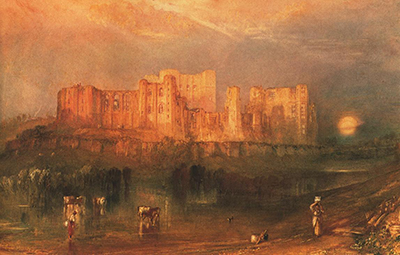
Kenilworth Castle stretches across the middle of J. M. W. Turner's watercolour like a long bank of dying fire. Its red sandstone walls still hold the warmth of sunset, although the sky has cooled to grey, violet and blue. Near the right horizon, a pale round moon has already risen. Below the ruins, cattle, reeds, shallow water and small figures occupy a low, reflective foreground. The entire scene rests between day and night, history and ordinary labour, direct observation and remembered spectacle.
The work is now titled View of Kenilworth Castle by the Fine Arts Museums of San Francisco. Turner made it around 1830 in transparent and opaque watercolour on wove paper; another institutional record describes the medium as watercolour and gouache on paper.[1][2][3] It measures 29.2 by 45.4 centimetres and belongs to the Fine Arts Museums of San Francisco, where it carries accession number 1967.4 and the credit Gift of Osgood Hooker.[2] Its earlier ownership has not been securely established in the available museum records, and its present display status should not be assumed.
The watercolour was designed for Picturesque Views in England and Wales, Turner's great engraved survey of British scenery. Thomas Jeavons translated it into a combination of etching and engraving, and the finished print appeared in 1832 as Part XV, number 2.[7][8] A working proof in the British Museum bears graphite touches made by Turner, preserving a rare material trace of his supervision as the coloured design passed into monochrome print.[7]
That publication history matters, but the watercolour is far more than an illustration waiting to be engraved. Turner constructed a complete pictorial world through colour. Warm architecture advances against cool cloud. Dark cattle punctuate pale ground. A woman in red near the left answers the glowing castle above her, while a pail-bearing figure approaches from the right. The broad horizontal sheet encourages the eye to travel, yet the moon arrests that movement with a quiet circular accent.
The image also contains a historical puzzle. What appears at first to be the castle's great medieval or Elizabethan lake cannot simply be identified as such. Parliament ordered Kenilworth to be made militarily useless in 1649, and the Great Mere was drained. The former lake bed became agricultural ground, though streams, wet depressions and seasonal flooding remained.[11][14] Turner therefore looks across a landscape in which water is both visibly present and historically absent. Reflection revives the memory of a vanished expanse without proving that the old lake had returned.
Turner knew Kenilworth intensively. His 1830 graphite sequence records the castle from west, south-west, south, south-east, north-east and within the Great Hall.[4][5] The finished watercolour does not merely report one fixed position. It concentrates the knowledge gained through repeated looking, then subjects the assembled monument to an evening transformation. Stone, weather, water and memory become inseparable.
At a Glance
The Work and Its Identity
- ArtistJoseph Mallord William Turner (1775-1851)
- TitleView of Kenilworth Castle
- Alternative catalogue titleKenilworth Castle, Warwickshire
- Datecirca 1830
- Mediumtransparent and opaque watercolour on wove paper; also catalogued as watercolour and gouache on paper
- Dimensions29.2 x 45.4 cm
- CollectionFine Arts Museums of San Francisco
- Accession1967.4
- CreditGift of Osgood Hooker
- Purposefinished design for Picturesque Views in England and Wales
- EngraverThomas Jeavons
- PublishedLondon, Moon, Boys and Graves, 1832, Part XV, no. 2
Contents
- Moonrise over Red Sandstone
- Looking across the Former Mere
- Sunset Colour and a Rising Moon
- A Castle Made from Many Centuries
- Cattle, Reeds and Evening Work
- The Water That Had Disappeared
- Turner's 1830 Midlands Journey
- Seventeen Records of the Castle
- From West and South-West to a New Whole
- Transparent Colour and Opaque Light
The present title emphasises a view rather than a narrated event. That distinction is useful. Turner offers no identifiable historical protagonists and no single episode from Kenilworth's long past. The castle is the subject, but it is encountered through a modern evening landscape inhabited by cattle and working figures. Its meaning gathers gradually from architecture, atmosphere and association.[1][7][11]
Looking across the Former Mere
The composition is built from broad horizontal layers. At the top, cloud spreads in long, uneven bands. The castle occupies a narrower belt beneath it, extending almost from the left edge to the right-hand slope. The low foreground opens widely across wet ground and reflection. This arrangement gives the ruins enormous lateral reach while denying them an isolated pedestal.
Turner's viewpoint lies to the south or south-west, across the ground once occupied by Kenilworth's Great Mere. The castle's principal masses overlap into a continuous red-orange front. Towers, roofless chambers, tall openings and broken wall lines rise and fall along the horizon. Their profile is varied enough to be recognisable but unified enough to read as one extended body.
The foreground initially seems simple, yet it is carefully graduated. Dark reeds at the left establish the nearest plane. Cattle stand or move farther back, some of their forms doubled or dissolved in the pale reflective surface. Small human figures mark both sides of the lower field. Toward the right, an inclined bank catches light and carries the eye upward, preventing the horizontal design from becoming static.
The spatial system depends less on exact linear recession than on changes of temperature, edge and density. Near forms are dark and decisive. The middle ground is thin, luminous and uncertain. The castle combines crisp interruptions with passages that merge into surrounding air. Cloud is broadest and least bounded of all. Turner lets the viewer move from tangible reeds to architecture partly absorbed by evening.
Reflection extends the castle downward without producing a mirror image. Colour passes into the wet ground as broken vertical stains and horizontal washes. This incomplete doubling is more convincing than a literal reflection would have been. Ripples, mud, vegetation and shallow channels interrupt continuity. The effect is a responsive surface rather than a polished theatrical device.
Turner also controls scale through emptiness. The castle is not large because it fills the sheet vertically; it is large because so much open ground is required to approach it. The breadth below the walls evokes the former mere even when the precise condition of the water remains ambiguous. Historical space is measured by the distance between spectator and ruin.
The painting rewards a slow left-to-right reading. Reeds introduce the lower edge, cattle spread across the centre, the warm structure carries the eye through successive architectural accents, and the moon waits beyond them. Yet the sequence can reverse. The moon draws attention toward the right, after which the illuminated bank and pail carrier lead back toward the castle and the woman in red. The scene circulates rather than concludes.
Sunset Colour and a Rising Moon
The bright orb at the right is the moon, not the setting sun. The British Museum's description of Jeavons's working proof explicitly identifies the moon above the right horizon.[7] A local historical account likewise reads the scene as evening with a full moon rising, although its separate attribution of the engraving is incorrect and should not be followed.[6] The surviving image itself supports the lunar reading: the disc is cool and pale while warm light remains concentrated on the castle and bank.
This creates a double illumination. The sun has dropped low or passed beyond the visible field, leaving the western sky's warmth on the red sandstone. At the same time, the moon rises into a cooler part of the atmosphere. Turner does not divide those effects mechanically. Instead, he suspends the landscape in the brief interval when both can be felt.
Kenilworth's local stone intensifies the effect. The castle is built largely from red sandstone, whose natural colour can hold and amplify low warm light.[12][15] Turner pushes that material quality toward orange and ember-like red, but the chromatic emphasis is rooted in the monument. The ruins appear illuminated from within because stone and sunset reinforce one another.
The sky moderates that heat. Grey-violet cloud lies behind and above the castle, with deeper passages toward the left and more open brightness toward the moon. These cool zones make the walls seem warmer by contrast. Turner does not need to cover the architecture with minute highlights; a large relation between complementary temperatures carries the principal effect.
The moon introduces a different order of time. Sunset belongs to a fading event, while moonrise announces what follows. Between them stands the ruin, a structure already marked by centuries of construction, siege, celebration and destruction. The astronomical transition is only minutes long, yet it makes long history momentarily visible. The building looks enduring and transient at once.
It would be misleading, however, to call the picture a moonlit nocturne. The moon does not account for the intense orange facade or the brightness of the right bank. Residual sunlight remains active. Nor is the sky uniformly dark. Turner's subject is precisely the overlap of conditions, before one source of light has fully surrendered to the other.
That overlap produces emotional ambiguity. Warm colour can suggest hospitality, recollection or splendour, while the cool sky and ruined walls suggest distance and loss. Turner refuses to settle the mood into simple nostalgia. The castle glows magnificently, but its light is passing. The moon promises continuity, but its pallor cannot restore what the building once contained.
The effect is also practical for a print design. Strong tonal contrasts between glowing architecture, darker cloud and pale water could be translated into engraved marks even when hue disappeared. Yet the original watercolour retains an experience the later print cannot duplicate: the vibration between red-orange masonry, green-brown earth and violet-grey air. Colour is not an added luxury. It is the work's temporal argument.
A Castle Made from Many Centuries
Turner presents Kenilworth as one commanding silhouette, but the visible complex was produced by different rulers for different purposes. Its earliest major survival is the great Norman keep associated with Geoffrey de Clinton, who founded the castle in the 1120s. Royal control followed later in the twelfth century. King John then spent heavily on defences, adding the outer curtain, towers and the dam that created the Great Mere.[11][12]
The castle's southern and western prospects gather this layered fabric into a broad architectural face. The Great Tower, or keep, contributes a massive block. John of Gaunt's later buildings include the celebrated Great Hall and residential ranges. Leicester's Building, erected for Robert Dudley in the sixteenth century, adds the remains of an ambitious courtly residence. Broken walls between them expose rooms that once formed enclosed interiors.[11][12]
Turner does not label those phases, and the overlaps resist a simple inventory. Tall voids may belong to windows that once lit chambers or the hall; lower walls may be hidden by the angle of approach. Atmospheric softness further joins one campaign to another. The painting is topographically persuasive without becoming a measured architectural elevation.
That synthesis suits the subject. At Kenilworth, political succession was expressed through reuse. Later owners did not begin on empty ground. They enlarged, converted and reframed earlier power. A Norman fortress became a royal stronghold, a Lancastrian palace and an Elizabethan setting for display. The castle's long facade is therefore a record of adaptation as much as decay.
Turner strengthens this cumulative character by allowing major masses to press together. The eye does not pass through neutral gaps between isolated monuments. Wall answers wall, opening answers opening, and warm colour travels across the ensemble. The result can differ from any one graphite observation while remaining faithful to the castle's composite identity.
The roofless state makes construction legible in another way. Openings reveal the thickness of masonry. Jagged parapets expose the boundary between built form and sky. Missing floors allow tall interior voids to be read from outside. Ruin removes the building's former functions but reveals its body.
At the same time, Turner's atmosphere resists archaeological certainty. Edges fade; shadows hide junctions; reflected colour extends walls into water. What the ruin discloses materially, evening partially conceals. This push between knowledge and obscurity is central to the image. Kenilworth can be studied, but it cannot be returned to a single, complete historical moment.
The long warm band also resembles a natural formation. Seen across low wet ground, the castle can appear like a cliff catching sunset. Turner frequently explored the border between architecture and landscape, but here that relation is especially apt. Stone quarried from the region has weathered back toward earth colour. Human power has become part of the terrain without losing its recognisable design.
Cattle, Reeds and Evening Work
The foreground figures and animals are small, but they govern the experience of the scene. The British Museum describes a figure at left looking toward cattle in the water and another approaching from the right with a pail on her head.[7] These details establish occupation rather than emptiness. Kenilworth is a ruin, yet the land before it remains worked and traversed.
The cattle provide the clearest scale. Their dark bodies are tiny against the castle, making the walls appear distant and extensive. Because the animals stand within the reflective zone, they also explain its physical character. This is not necessarily deep open water. It may be shallow flooding, a stream margin, pooled water or saturated former lake bed. Hooves and reflections coexist in an unstable middle ground.
Their slow movement gives the evening duration. A rider or carriage would imply passage through the view; grazing or wading cattle remain. They make the fading light feel observed over time. The monument's vast chronology is thus set against an ordinary cycle of tending animals before night.
The woman at the left wears or carries a vivid red accent. Turner uses that small note to connect human presence with the castle's warm facade. The colour jumps across the open foreground, creating a relation that size alone would deny. A few strokes can answer acres of masonry because chromatic intensity has its own scale.
On the right, the pail-bearing figure is placed near the bright inclined bank. Her vertical posture echoes distant towers while her movement directs attention inward. The vessel suggests work, perhaps connected with cattle or household provision, but no precise narrative is secure. Turner gives enough information to establish labour without fixing an anecdote.
Reeds and grasses complicate the lower edge. They form a dark screen through which the view opens, placing the spectator close to wet ground rather than on an elevated terrace. This low approach matters socially as well as compositionally. The castle is encountered from the level of pasture and work, not from an aristocratic chamber or triumphal avenue.
None of the figures should be identified as Elizabeth I, Robert Dudley or Amy Robsart. Their scale, clothing and activity belong to Turner's own landscape world, not to a dramatised reconstruction of the sixteenth century. Historical association surrounds them, especially after Walter Scott's novel, but it does not convert them into named characters.
Their anonymity is productive. These people represent continued use without becoming generic decoration. They carry, watch and move through a landscape shaped by decisions made centuries earlier. The drained mere created agricultural ground; ruined walls became a backdrop to local routines. The image joins political consequence to bodily action without forcing a moral lesson.
The foreground therefore prevents the castle from becoming a remote emblem. It remains visually dominant, but the present has not yielded to it. Cattle disturb the reflection. A pail must be carried. Reeds grow where courtly water once spread. Turner makes history powerful by showing that life continues around and across it.
The Water That Had Disappeared
The Great Mere was among Kenilworth's most extraordinary landscape features. King John's works used a dam to create a vast defensive lake south and west of the castle. It strengthened the fortress, supplied fish and later became part of a courtly setting. English Heritage describes an expanse roughly half a mile across, large enough to transform the approach to the buildings.[11][13]
In 1266, that watery defence contributed to the castle's resistance during one of medieval England's longest sieges. Royal forces surrounded supporters of Simon de Montfort for about six months before a negotiated settlement brought surrender in December.[11] The mere was not decorative scenery. It was military infrastructure integrated with walls, causeways and controlled access.
Its role changed as Kenilworth became more palatial. Under later Lancastrian and Tudor ownership, water helped stage privilege and spectacle. Robert Dudley's preparations for Elizabeth I included a long bridge across the mere and extensive gardens and hunting grounds.[11][12] The lake enlarged the apparent separation between court and surrounding country while offering a surface for entertainments and display.
That historic expanse did not survive into Turner's day. Following the Civil War, Parliament ordered Kenilworth to be made untenable in 1649. Part of the keep was destroyed, roofs and fittings were removed, and the dam was breached or otherwise rendered ineffective. The mere drained, and its bed passed into agricultural use.[11][14]
The distinction changes how the watercolour should be read. Turner did not stand before an intact Elizabethan lake. Historic England records the former mere as farmland crossed by the Inchford and Finham streams, within a broad low-lying depression that still preserves the old geography.[14] Rain, channels and seasonal water could make portions reflective without restoring the medieval reservoir.
The image allows more than one physical reading. Cattle appear to stand in shallow water. The castle sends broad stains downward. Pale washes may describe pools, wet mud or a widened stream. Turner may also have expanded the reflective effect to recover something of the place's historic magnitude. The painting does not tell us exactly where observed moisture ends and imaginative reconstruction begins.
That uncertainty is not a weakness. It enables the foreground to carry two times simultaneously. As nineteenth-century land, it supports cattle and working figures. As pictorial memory, it recalls the water that once made Kenilworth nearly insular and spectacular. Turner achieves historical evocation through a present landscape rather than through costume drama.
Reflection is the crucial mechanism. A literal reconstruction would require a continuous lake with defined banks. Turner's broken surface is less explicit. It lets red architecture descend into the low ground as colour, so the lost mere returns as an optical possibility. The viewer senses its former breadth without being shown an archaeological restoration.
The drained lake also changes the moral tone of the ruin. Kenilworth's decline was not simply nature reclaiming abandoned stone. It followed deliberate military disablement, private salvage and altered land use. Reeds, pasture and exposed banks are part of a political afterlife. The tranquil evening contains the consequence of civil conflict.
Turner's 1830 Midlands Journey
Turner's finished design was grounded in an unusually concentrated campaign of drawing. The Tate's open collection data identifies a sequence of graphite views of Kenilworth made in 1830, while the historic inventory places them in the Kenilworth Sketchbook, Turner Bequest CCXXXVIII, used in 1829-30.[4][5] The book once carried Turner's own label, “Kenilworth,” confirming the importance of the subject within that journey.[5]
The broader itinerary included Oxford, Blenheim, Leicester, Ashby, Dudley or Birmingham, Kenilworth and Warwick.[5] Such movement joined antiquarian monuments to rapidly changing Midlands towns. Turner was gathering material for commissioned and prospective images, but travel also allowed him to compare different kinds of historical and modern landscape.
At Kenilworth he did not settle for one picturesque outline. He walked around the complex and changed direction repeatedly. Surviving titles record views from the west, south-west, south-south-west, south, south-south-east, south-east, north-east and east-south-east.[4] He also entered the Great Hall and drew its interior in relation to the Great Tower.
The sheets are generally about 12 by 20.3 centimetres, a portable format suited to rapid graphite work.[4] Their modest scale did not prevent systematic attention. Turner could establish the relation of keep, hall, residential ranges, walls, slopes and surrounding ground, then move to test how those masses changed from another point.
This procedure differs from making a single preparatory study for enlargement. The sketchbook became a three-dimensional store of information. Each turn around the castle corrected or complicated the last. A tower concealed from the west could emerge from the south; an opening that read as a dark notch at distance could be understood from inside.
The density of the sequence is especially valuable because the final watercolour transforms the architecture boldly. Without the drawings, its compressed facade might be mistaken for casual invention. The records show the opposite: Turner earned freedom through inspection. He could alter relations because he had studied them from many sides.
Travel also exposed him to changing light. The graphite records preserve form more readily than colour, yet every viewpoint was selected under actual weather and illumination. The later evening effect need not reproduce the exact hour of any one drawing. It condenses a travelling artist's accumulated awareness of how the ruins met sky and low ground.
The year 1830 placed Turner at a mature stage of his career. He had decades of experience converting travel sketches into oils, watercolours and prints. His method no longer depended on carrying a finished coloured picture away from each location. Quick records could hold structural facts; memory, additional study and studio practice could supply the atmospheric unity required by the commission.
Kenilworth demonstrates how disciplined and imaginative that system could be. The finished sheet is not less observed because it is synthetic. Its broadest poetic liberties rest on repeated acts of measurement by eye. The journey gave Turner many Kenilworths; the watercolour creates one encounter from them.
Seventeen Records of the Castle
The secure 1830 group begins with drawings that combine Kenilworth material with other Midlands subjects. D22023 includes Birmingham from the East; Kenilworth Castle, while D22024 joins Holy Trinity Church, Camp Hill, Bordesley with Kenilworth.[4] These mixed leaves reveal the continuity of travel. One location enters the book before another has entirely disappeared.
D22026 studies Kenilworth Castle from Castle Hill. D22027 then turns to the west, and D22028 to the south-west.[4] These are especially relevant to the finished watercolour because its long front and low approach share information with both directions. Yet they are only the beginning of Turner's close examination.
D22029 and D22030 look from the south-south-west. D22031 and D22032 continue from the south. D22033 shifts to the south-south-east, and D22034 and D22035 move to the south-east.[4] Across these drawings, small directional changes alter the overlap of the principal structures. The series resembles an arc of visual testing rather than a set of repetitions.
D22036 records the castle from the north-east, taking Turner around the complex rather than confining him to the most familiar broad prospect. D22037 isolates the Great Hall. D22038 enters that hall and relates its interior to the Great Tower beyond.[4] These two studies are crucial reminders that the finished facade was informed by knowledge of spaces behind it.
D22039 completes the named run with a view from the east-south-east.[4] Taken together, D22023-D22039 contain at least seventeen records with Kenilworth material, counting the paired and successive observations individually. The old inventory's ordering and descriptive language are less exact in places than the Tate's current titles, but it independently confirms the sustained sequence in the Kenilworth Sketchbook.[5]
The drawings entered the Turner Bequest and were accepted by the nation in 1856.[4] Their survival makes it possible to separate direct evidence from later speculation. Turner was physically present at Kenilworth in 1830 and studied the castle extensively. No literary association or stylistic inference is needed to establish that foundation.
The sequence also reveals the limits of a finished image. The FAMSF watercolour cannot show every direction or interior relation at once. Turner had to choose what the broad horizontal format could carry. Much observed information was omitted, not because it was forgotten, but because pictorial concentration requires exclusion.
Conversely, the graphite sheets cannot anticipate the full meaning of colour. They supply edges, masses, openings and viewpoints. They do not contain the finished work's red-orange glow, violet cloud, pale moon or reflected chromatic field. Moving from sketchbook to watercolour was therefore an act of construction, not colouring in.
The seventeen records correct another common simplification. Turner's source was not merely two convenient outlines combined at a desk. Two drawings may be particularly important to the final arrangement, but the artist's understanding came from the whole encounter. West and south-west views were held within a wider circuit of looking.
This breadth explains the finished work's authority. Even where forms are enlarged or consolidated, they seem to possess weight behind the visible surface. Turner knew what lay around the corner and within the hall. The spectator receives only one evening prospect, but the image carries knowledge acquired from many positions.
From West and South-West to a New Whole
The Turner scholar Eric Shanes has been credited with proposing that the finished design synthesises the west view D22027 and the south-west view D22028.[6] The comparison is persuasive as a way of understanding the watercolour's assembled facade, provided that “synthesis” is not mistaken for a mechanical splice.
From the west, major masses establish one pattern of overlap. Moving toward the south-west changes the prominence of the keep, Great Hall and later residential structures. The watercolour can draw upon both sets of relations, expanding the breadth of the castle and clarifying its identifying features. Turner acts less like a camera fixed to one point than a spectator whose knowledge accumulates while walking.
The final composition also responds to format. Its wide sheet demands a sustained middle-distance band. A strictly copied prospect might have produced awkward gaps or excessive recession. Turner consolidates walls into a rhythmic sequence that can carry warm colour across nearly the entire field.
This does not make the image topographically false. Recognition depends upon selection. The castle's characteristic masses, ruined openings, red sandstone and position above the former mere remain secure. What changes is their pictorial relation. Turner converts survey into experience.
The keep appears especially powerful because its block can anchor the long complex. Other structures step away from it, while broken wall lines prevent the mass from becoming monotonous. Enlarging or strengthening such a form creates an architectural pulse: weight, opening, tower, gap and wall. The rhythm is more important than a neutral statement of distance.
Atmosphere assists the synthesis. Mist and evening shadow soften junctions where exact perspectival explanation would distract. Reflection extends selected forms while dissolving others. Cloud provides a continuous backdrop against which structures from different observed angles can coexist naturally.
The process resembles historical understanding itself. No visitor apprehends Kenilworth's eight centuries from a single position. One walks, reads, remembers and connects. Turner's image acknowledges that composite act. It offers a view, but one strengthened by the memory of other views.
The Shanes proposal should remain attributed because the drawings do not carry written instructions declaring how Turner used them. Other records in the sequence may also have informed individual details. The strongest conclusion is therefore layered: D22027 and D22028 offer close compositional precedents, and the larger 1830 group establishes an extensive observational base.[4][6]
Seen this way, transformation becomes evidence of control. Turner does not retreat from architecture into vagueness. He reorganises architecture so that the castle's material history, broad extent and evening presence can be grasped together. The finished whole is invented, but its invention is accountable to sustained looking.
Transparent Colour and Opaque Light
The Fine Arts Museums record describes the work as transparent and opaque watercolour on wove paper, while the National Gallery of Art checklist uses the concise formula watercolour and gouache on paper.[2][3] These descriptions are compatible. Gouache is an opaque form of water-based colour, and Turner's sheet depends on the contrast between light passing through thin washes and denser touches laid across them.
The sky shows the value of transparency. Broad diluted layers allow the paper's luminosity to remain active beneath grey, violet and blue. Cloud edges can soften because one wet or thin passage merges into another. The atmosphere seems continuous even where tonal changes are substantial.
The castle requires a different balance. Its warm facade has body. Red-orange colour must stand against the cool sky rather than sink entirely into it. Opaque touches can reinforce illuminated walls and openings, while transparent staining keeps the architecture from becoming a flat band of paint. Density and glow coexist.
The foreground brings these approaches together. Pale reflective areas depend upon reserved or lightly washed paper. Dark cattle, reeds and figures are placed over that field with more concentrated marks. Broken strokes and changes of opacity suggest interrupted reflection without describing every ripple.
Turner was highly experienced in manipulating watercolour's sequence of washes, reserves and accents. General accounts of his materials explain that he used both transparent and opaque colour and exploited the white support as an active source of brightness.[21] Such context helps explain the image, but it should not be turned into an object-specific recipe. No secure examination cited here identifies every pigment or named handling procedure in this particular sheet.
The work's surface nevertheless reveals broad decisions. Large atmospheric relations came before or around sharper incidents. The moon is a compact pale disc; reeds and cattle are darker interruptions; architectural openings articulate the warm mass. Detail is concentrated where it can change scale or direction.
Opaque colour is especially important to the sense of late light. If every layer remained equally transparent, the castle might recede into the paper. Denser warm passages make it appear to catch illumination physically. At the same time, thin colour around those passages prevents opacity from becoming heaviness.
The chromatic structure is economical. Red-orange dominates the architecture. Green-brown occupies the land. Grey-violet organises the sky. Small darks and a few bright accents connect those large fields. Turner does not distribute all colours evenly; he gives each region a prevailing temperature, then creates movement where they meet.
That organisation survives at reduced scale, which was necessary for an engraved design. Yet the original retains subtleties beyond reproduction: coloured greys within cloud, warm stains sinking into reflection, and minute exchanges between a figure's clothing and distant wall. The watercolour is complete because its meaning is carried by colour relations that no black-and-white plate can fully preserve.
Picturesque Views in England and Wales
Turner made View of Kenilworth Castle for Picturesque Views in England and Wales, the most ambitious engraved survey of Britain associated with his career. The enterprise began in the mid-1820s through the publisher and engraver Charles Heath, initially working with Jennings. A projected 120 views was reduced in practice to ninety-six, issued between 1827 and 1838.[9]
Turner's role was to provide finished watercolour designs. Specialist engravers then translated their colour and atmosphere into lines and tones suitable for printing. The resulting plates brought his compositions to a much larger audience than unique drawings could reach, while the original watercolours remained desirable works in their own right.
Kenilworth was an ideal subject for the series. It was a recognisable English monument with medieval, Lancastrian and Elizabethan associations. Its ruins offered irregular silhouette and rough texture. The former mere supplied a broad approach, reflection and pastoral incident. Walter Scott's novel had recently intensified public interest. Yet Turner avoided a conventional antiquarian record by making evening light the organising event.
The word “picturesque” did not require factual neutrality. It encouraged variety, broken form, historical association and carefully arranged recession. Turner inherited those expectations but expanded them. His Britain is shaped by weather, labour, commerce and unstable perception as much as by old buildings. At Kenilworth, cattle and a pail carrier share the visual field with royal architecture.
The design also demonstrates why these commissions demanded finished watercolours rather than rough instructions. An engraver needed a fully resolved hierarchy of light and dark. Jeavons had to know which walls advanced, where cloud deepened and how figures punctuated the foreground. Turner supplied a complete visual argument that could be converted, not merely an outline to be completed by someone else.
Publication transformed ownership and scale. The FAMSF sheet remained singular, measuring 29.2 by 45.4 centimetres.[2] The issued image recorded by the Folger Shakespeare Library measures about 6.5 by 9.875 inches, within a larger sheet.[8] Thousands of potential viewers could know the composition through a smaller monochrome impression while never seeing the original colour.
The project united national range with commercial risk. Steel engraving could support relatively large editions and fine detail, but the extended programme demanded sustained subscription and capital. Only ninety-six of the proposed views appeared. When the enterprise closed, Turner later bought the plates and remaining stock for £3,000.[9]
That difficult history should not make each design seem merely commercial. The commission gave Turner reason to revisit places with unusual seriousness and to coordinate travel, watercolour and reproductive craft. Kenilworth's 1830 drawing campaign suggests how much observation could stand behind one published view.
The series title promised England and Wales, but Turner's contribution was not a stable inventory of national landmarks. It was a sequence of encounters. Each location became distinct through weather and light. Kenilworth's identity rests on moonrise and residual sunset; another castle, city or coast would demand a different atmospheric logic.
Thomas Jeavons and the Engraved Image
Thomas Jeavons, not Robert Wallis, engraved Kenilworth Castle, Warwickshire after Turner. The British Museum identifies Jeavons as printmaker, dates the work to 1832 and places it in Part XV, number 2 of Picturesque Views in England and Wales.[7] The Folger impression independently records the formula “drawn by J. M. W. Turner” and “engraved by T. Jeavons,” with Moon, Boys and Graves as London publishers.[8]
Jeavons used etching and engraving to translate the watercolour. Line had to perform several tasks that colour handled in the original. Closely worked marks could darken cloud and architectural shadow. Finer parallel strokes could model walls. Open paper could preserve the moon, pale sky and reflective foreground. Variation in density replaced variation in hue.
The composition was well suited to this process because Turner had already established a strong tonal design. The castle forms a middle band against darker and lighter sky. Cattle and figures interrupt the low field. The moon supplies a distinct pale focus. Even without red, green or violet, the scene retains its principal sequence of weights.
Something inevitably changes. In watercolour, warm and cool colour can occupy similar tonal values while remaining strongly distinct. In monochrome, Jeavons must separate them through mark and contrast. The glowing red sandstone becomes engraved illumination rather than chromatic heat. Reflection becomes a pattern of lines and reserves rather than diluted colour sinking into paper.
British Museum impression 1894,0226.71 is especially revealing because it is an early engraver's proof touched with graphite by Turner.[7] A proof is a working state, made before final publication so that artist and engraver can assess the plate. Turner's graphite interventions show active supervision, though he did not engrave the image himself.
The museum notes that this proof state was not separately listed in William George Rawlinson's historic catalogue, even though Rawlinson correctly associated the Kenilworth plate with Jeavons.[7][10] That survival opens a window onto collaboration. Reproductive printmaking was neither passive copying nor solitary authorship. Jeavons interpreted; Turner reviewed and adjusted.
The engraved description also secures details that can be easy to misread in a small colour reproduction. It identifies the cattle in water, the figure looking toward them at left, the approaching pail carrier at right and the moon above the horizon.[7] These are not speculative additions to a vague landscape. They belong to the designed and published composition.
The final print appeared with a title that added county and series context. “Kenilworth Castle, Warwickshire” located the view for an audience encountering it within a national sequence. The FAMSF title, View of Kenilworth Castle, now places greater emphasis on the singular artwork. Both names refer to the same central design, but they reflect different institutional lives.
Print extended the image's reach while narrowing its sensory means. The exchange is central to Turner's mature practice. He designed colour with an awareness of line, then used proof correction to protect atmosphere during translation. Jeavons's plate is a distinct work of reproductive craft and the vehicle through which Kenilworth entered a broad illustrated culture.
Fortress, Siege and Lancastrian Palace
Kenilworth began as a baronial castle in the early twelfth century. Geoffrey de Clinton, chamberlain and treasurer to Henry I, established the stronghold in the 1120s and built the great keep.[11] Its massive walls asserted authority in a contested Midlands landscape and created the core around which later rulers would build.
The Crown gained control later in the twelfth century. Under King John, expenditure of about £1,100 greatly strengthened Kenilworth. The outer curtain and towers enlarged its defences, while the dam and Great Mere transformed the southern approach.[11] Architecture and engineered landscape operated as one military system.
That system was tested dramatically in 1266. After the defeat and death of Simon de Montfort, rebel supporters held Kenilworth against Henry III's forces. The siege lasted roughly six months, an exceptional duration for medieval England. Disease and shortage contributed to the eventual settlement and surrender in December.[11]
The survival of the castle through that assault enhanced its reputation, but later development shifted emphasis from defence toward residence. In 1361 Kenilworth passed to John of Gaunt, Duke of Lancaster and one of the most powerful figures in Europe. From 1371 he transformed it into a palace suited to status, household and ceremonial life.[11][12]
His Great Hall was an extraordinary achievement. English Heritage describes it as the widest roofed hall in England after Westminster Hall.[11] Large traceried windows, service arrangements and connected apartments made the western range an architecture of hospitality and governance rather than merely resistance.
The Lancastrian association later brought Kenilworth into royal hands. Henry IV inherited the throne and castle, and subsequent kings used the residence. Henry V built the Pleasance in the Marsh, a secluded retreat beyond the main walls.[11] Water, gardens and separate lodgings expanded the political geography of the estate.
Turner's southern prospect cannot narrate this chronology directly, but it places its material results side by side. The Norman keep supplies compact mass. John of Gaunt's hall introduces tall openings and palatial extension. Later Tudor construction adds another vertical residential block. The ruin becomes a compressed history of changing power.
The sunset colour complicates the military story. Warmth makes the walls appear splendid and vulnerable rather than forbidding. Their defensive purpose has ended; openings admit sky where roofs and floors once controlled movement. Cattle now occupy ground once kept clear or flooded against attackers.
This inversion is more than picturesque contrast. It reveals the changing ownership of space. Royal expenditure created walls and water on an immense scale. Civil conflict later disabled them. Agricultural use followed. Turner's quiet foreground is the final visible condition of decisions that began with conquest, finance and siege.
The castle's layered history also resists the idea of an untouched medieval relic. Kenilworth was repeatedly modernised by those who possessed it. Every celebrated phase altered what came before. Turner, in turn, does not preserve the monument neutrally. His synthesis continues a long history of remaking, but does so through perception rather than masonry.
Elizabeth, Leicester and the Summer of 1575
Elizabeth I granted Kenilworth to Robert Dudley in 1563. Dudley, later Earl of Leicester, was her close favourite and one of the most ambitious courtiers of the reign. He modernised the castle to receive the queen, creating Leicester's Building in 1571-72 and developing gardens, approaches and accommodation on a scale suited to royal display.[11][12]
The new building rose beside much older structures. Its tall windows and residential chambers represented a different kind of power from the Norman keep. Comfort, prospect and ceremonial access mattered alongside inherited fortification. From Turner's viewpoint, those phases appear joined in one ruined facade, but their contrasts would have been clear when intact.
Elizabeth visited Kenilworth four times. The final and most famous stay began in July 1575 and lasted nineteen days, her longest visit to a courtier.[11] Dudley organised entertainments involving music, dramatic performances, fireworks, hunting and elaborate welcomes. A long bridge across the mere helped stage the approach, while the surrounding chase and designed grounds expanded the event beyond the walls.
The festivities have often been interpreted as a magnificent declaration of loyalty and perhaps an attempt to persuade Elizabeth toward marriage. Whatever Dudley's private hopes, the visit displayed wealth, access and political imagination. Kenilworth became a theatre in which architecture, water and performance represented the relationship between subject and sovereign.
Turner's watercolour contains no reconstruction of that summer. The queen's retinue has vanished. The long bridge no longer crosses an intact mere. Gardens have changed, chambers are roofless, and ordinary figures tend the foreground. Yet knowledge of 1575 alters how the quiet scene feels. Empty openings once framed an exceptional concentration of court life.
The contrast between spectacle and evening labour can encourage narrative invention, but the painted people must remain anonymous. The woman in red is not Elizabeth. The pail carrier is not Amy Robsart. No figure is demonstrably Dudley or a participant in the festivities. Their nineteenth-century presence measures historical distance rather than reenacting Tudor drama.
Robert Dudley's additions are important because they place desire and vulnerability within the architecture. Leicester's Building was made for reception and royal presence, yet it survives as a tall shell. Its windows now admit weather. The very scale intended to secure memory makes loss visible.
The Great Mere once magnified that architecture through controlled approach and reflection. Turner's low wet ground provides a diminished echo. Where Dudley used water to produce spectacle, Turner uses broken reflection to evoke absence. The castle glows as though courtly magnificence has briefly returned, but the rising moon confirms that the effect will pass.
Elizabethan association became one of Kenilworth's strongest cultural identities, sometimes overshadowing its Norman, Plantagenet and Lancastrian histories. Turner's broad prospect restores their coexistence. The Tudor building does not stand alone. It is one luminous segment in a longer structure shaped by many political ambitions.
Civil War Ruin, Scott and the Visiting Public
Kenilworth's present form owes much to the aftermath of the English Civil War. Parliamentary forces occupied the castle, and in 1649 it was ordered to be made untenable. The north wall of the Great Tower was destroyed, interiors were stripped, roofs disappeared and the Great Mere was drained.[11][12][14] The ruin Turner studied was therefore made by deliberate policy as well as weather and neglect.
By the eighteenth century, those remains attracted visitors. A guidebook was available by the 1770s, and the Prince Regent visited in 1819.[11] Artists also found the long red ruins compelling. Thomas Smith of Derby had painted Kenilworth from the south before Turner's mature watercolour, and later viewers included James Ward and Thomas Cole.[20] The castle already belonged to a visual and tourist culture before Walter Scott transformed its fame.
English Heritage's own account of the monument's visual history specifically recognises Turner's 1830 prospect from the south.[16] That institutional identification supports the work's place within a longer tradition of looking across the former mere, while Turner's many graphite records show how thoroughly he reconsidered the inherited prospect.
Scott visited Kenilworth in 1815. His novel Kenilworth appeared in 1821 and carried the castle's name to an international readership.[11][18] The story centres on Elizabeth I, Robert Dudley and Amy Robsart, combining historical figures with invention and reshaped chronology.[17] Its emotional world of secrecy, ambition, jealousy and catastrophe intensified the romance of the ruins.
The novel should not be treated as a factual account of 1575. Amy Robsart died in 1560, fifteen years before the celebrated festivities. Scott deliberately rearranged history for dramatic effect. His Kenilworth is a literary construction, just as Turner's image is a pictorial construction, but their methods and claims differ.
There is no secure evidence that Turner's watercolour illustrates a specific scene from the novel. No narrative incident is represented, and no figure can be matched to Scott's characters. The safest relation is cultural: Turner worked in 1830, within the heightened interest that followed the book, and designed an image for a publishing enterprise addressed to a broad public.
Scott's influence may nevertheless shape a viewer's expectations. A moon, glowing ruins and distant figures can seem charged with concealed drama when one knows the novel. Turner leaves that association available without confirming it. Atmosphere creates emotional readiness, but topography and modern rural life hold the image outside fiction.
An earlier Kenilworth drawing tradition adds another caution. A watercolour once attributed to Turner and recently offered under his name has been reassessed within scholarship on Thomas Girtin, Turner and their work for Dr Thomas Monro after an image by James Moore.[19] The drawing may date from 1794-97, and there is no proof that its makers directly observed Kenilworth then.
That attribution problem belongs to a different body of work from Turner's 1830 sequence. The later graphite records securely document his presence and extensive study.[4] Keeping the groups separate prevents a disputed early collaboration from clouding the mature design's unusually strong observational foundation.
By Turner's time, Kenilworth therefore existed in several overlapping forms: protected ruin, tourist destination, antiquarian subject, Scottian setting and working rural landscape. The watercolour accommodates them without choosing only one. Its castle is materially specific, culturally famous and atmospherically transformed.
From Osgood Hooker to San Francisco
The early ownership of Turner's watercolour is not fully established in the accessible institutional records. Its secure modern history begins with its gift from Osgood Hooker to the Fine Arts Museums of San Francisco, where it is accessioned as 1967.4.[2] The absence of a complete earlier provenance should be preserved rather than filled with assumptions based on the print commission.
Museum records give the work two closely related descriptive identities. The Fine Arts Museums use View of Kenilworth Castle and date it circa 1830.[1][2] The National Gallery of Art's exhibition checklist calls it Kenilworth Castle, Warwickshire (from “Picturesque Views in England and Wales”).[3] One title emphasises the independent view; the other restores its reproductive purpose.
The same records explain the variation in medium. “Transparent and opaque watercolour on wove paper” describes the physical alternation visible across the sheet, while “watercolour and gouache on paper” names the opaque component more compactly.[2][3] Neither formula reduces the work to a preliminary drawing.
In 2007-08, the watercolour travelled as part of a major Turner exhibition. The recorded loan itinerary took it to the National Gallery of Art in Washington from October 2007 to January 2008, the Dallas Museum of Art from February to May 2008, and the Metropolitan Museum of Art in New York from June to September 2008.[2] This is a historical exhibition record, not evidence that the work is currently displayed.
The work's movement from an English publishing project to an American museum collection changes its audience but not its material intimacy. At 29.2 by 45.4 centimetres, it asks to be viewed closely.[2] The castle may describe enormous spaces, yet the effects depend upon small shifts of wash, opacity and touch.
Its engraved counterpart supplied a different afterlife. Published impressions dispersed the composition through libraries and collections, often under the fuller Warwickshire title.[7][8] The British Museum proof preserves Turner's intervention in production, while the Folger impression records the issued plate. Original, proof and final print together document creation as a sequence rather than a single act.
The watercolour's lasting importance rests on how many kinds of knowledge it unites. Direct graphite study gives the architecture authority. Historical awareness makes the drained foreground meaningful. Watercolour turns sandstone and cloud into a precise evening interval. Print collaboration extends the image beyond the unique object. Scott's cultural presence enriches association without controlling the scene.
Most of all, Turner avoids choosing between record and imagination. Kenilworth remains identifiable, but no single viewpoint exhausts it. The former mere is physically altered, but reflection revives its memory. The castle is ruined, but sunset makes it radiant. Modern figures are small, but their labour keeps history from becoming an empty spectacle.
The rising moon completes that balance. It does not illuminate the whole scene or explain every colour. It marks the passage into another condition. For a few moments, the red walls retain the day while the cool sky receives the night. Turner's achievement is to make that brief overlap carry eight centuries of building, loss, remembrance and continued life.
Discussion
How does Turner make direct topographical study, a drained lake bed and the transition from sunset to moonrise coexist in one image?
Reader Insights
Which passages belong to residual sunlight, and which to the rising moon?
How does the former Great Mere remain present after its drainage?
What changes when Jeavons converts Turner's colour into engraved tone?
Join the Conversation
Share a close observation or a source-based question for other readers.
References
- Fine Arts Museums of San Francisco, “View of Kenilworth Castle, ca. 1830,” Art on Demand, https://artondemand.famsf.org/detail/502950/turner-view-of-kenilworth-castle-ca.-1830
- Fine Arts Museums of San Francisco, “Request for Loan of Art Objects,” 2007, City and County of San Francisco archive, https://www.sfgov.org/sfc/sites/default/files/Fine%20Arts/ftp/archive/FineArtsMuseumsofSanFrancisco/sfgov3/archive053a.html?dept=2014&dtype=2025&file=63177&sub=&year=2007
- National Gallery of Art, *J. M. W. Turner* exhibition checklist, 2007, https://www.nga.gov/content/dam/ngaweb/press/exh/2832/2832-list.pdf
- Tate, Open Collection Data, Turner works including D22023-D22039, https://github.com/tategallery/collection
- National Gallery, *A Complete Inventory of the Drawings of the Turner Bequest*, vol. 2, Kenilworth Sketchbook CCXXXVIII, https://upload.wikimedia.org/wikipedia/commons/e/ed/A_complete_inventory_of_the_drawings_of_the_Turner_bequest_-_with_which_are_included_the_twenty-three_drawings_bequeathed_by_Mr._Henry_Vaughan_%28IA_completeinventor02nati_0%29.pdf
- Kenilworth History and Archaeology Society, “Turner at Kenilworth,” https://www.khas.co.uk/turner-at-kenilworth/
- British Museum, “Kenilworth Castle, Warwickshire,” 1894,0226.71, https://www.britishmuseum.org/collection/object/P_1894-0226-71
- Folger Shakespeare Library, “Kenilworth Castle, Warwickshire,” catalogue record 250260, https://catalog.folger.edu/record/250260
- British Museum, “Stone Henge,” 1850,0112.15, series history for *Picturesque Views in England and Wales*, https://www.britishmuseum.org/collection/object/P_1850-0112-15
- W. G. Rawlinson, *The Engraved Work of J. M. W. Turner, R.A.*, https://upload.wikimedia.org/wikipedia/commons/4/40/The_engraved_work_of_J._M._W._Turner%2C_R.A._%28IA_gri_33125001464789%29.pdf
- English Heritage, “History of Kenilworth Castle,” https://www.english-heritage.org.uk/visit/places/kenilworth-castle/history-and-stories/history/
- English Heritage, “Description of Kenilworth Castle,” https://www.english-heritage.org.uk/visit/places/kenilworth-castle/history-and-stories/history/description/
- English Heritage, “Significance of Kenilworth Castle,” https://www.english-heritage.org.uk/visit/places/kenilworth-castle/history-and-stories/history/significance/
- Historic England, “Kenilworth Castle,” registered park and garden, list entry 1000496, https://historicengland.org.uk/listing/the-list/list-entry/1000496
- Historic England, “Kenilworth Castle,” Grade I listed building, list entry 1035327, https://historicengland.org.uk/listing/the-list/list-entry/1035327
- English Heritage, “Sources for Kenilworth Castle,” https://www.english-heritage.org.uk/visit/places/kenilworth-castle/history-and-stories/history/sources/
- Walter Scott, *Kenilworth*, Project Gutenberg, https://www.gutenberg.org/ebooks/1606
- University of Edinburgh, Walter Scott Digital Archive, “Kenilworth,” https://www.walterscott.lib.ed.ac.uk/works/novels/kenilw.html
- Thomas Girtin, “Kenilworth Castle, Seen from the South-East,” catalogue entry, https://thomasgirtin.com/collection/catalogue/kenilworth-castle-seen-from-the-south-east
- Government Art Collection, Thomas Smith of Derby, “Kenilworth Castle,” https://artcollection.dcms.gov.uk/artwork/11228/
- Wallace Collection, “Turner's Watercolour Materials and Techniques,” https://www.wallacecollection.org/explore/explore-in-depth/turner/turners-watercolors/turners-watercolour-materials-and-techniques/