 by Tom Gurney
Tom Gurney BSc (Hons) is an art history expert with over 20 years experience
Published on June 19, 2020 / Updated on August 29, 2026
Email: tomgurney1@gmail.com / Phone: +44 7429 011000
Introduction
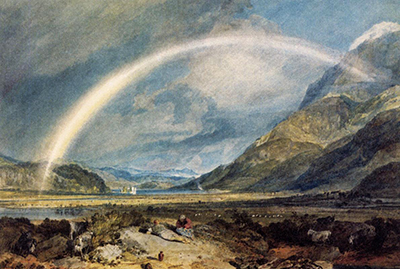
J. M. W. Turner's Kilchern Castle, With The Cruchan Ben Mountains, Scotland - Noon belongs to the moment when the young artist discovered that Scottish landscape could be more than picturesque scenery. It could become an arena of weather, antiquity, water, mountain mass and light. Exhibited at the Royal Academy in 1802, the large watercolour grew out of Turner's first Scottish journey of the previous year and brought together several of the ambitions that would define his maturity: a learned interest in place, a fascination with atmospheric drama, an appetite for scale and a willingness to make watercolour carry the force usually associated with oil painting.[1]
The subject is better known today through the modern spelling Kilchurn Castle. The historical title used "Kilchern" and "Cruchan Ben", while modern geography normally gives Kilchurn Castle and Ben Cruachan. That spelling difference is not a small typographical curiosity. It points to the way Turner's picture sits between travel record, exhibition art, later print culture and the evolving names by which landscapes are catalogued. The castle stood, and still stands, at the north-east end of Loch Awe. Behind and around it rises one of the most dramatic mountain settings in western Scotland. Turner used that combination of ruined architecture, lake surface, mountain profile and noon light to make a watercolour that was at once topographical and intensely theatrical.[4]
This is also a picture whose afterlife can cause confusion. The 1847 image called Kilchurn Castle, Loch Awe in the Detroit Institute of Arts is not the 1802 watercolour itself. It is an etching and engraving printed in black by William Miller after Turner, published for the Association for the Promotion of the Fine Arts in Scotland.[2] National Galleries of Scotland preserves a related engraver's proof, likewise attributed to Miller after Turner and dated 1847.[3] Those later prints matter because they show how Turner's Scottish vision circulated beyond the exhibition room, but they must be kept distinct from the original watercolour that had announced the subject to Royal Academy audiences more than four decades earlier.
At a Glance
- ArtistJoseph Mallord William Turner
- Historical titleKilchern Castle, With The Cruchan Ben Mountains, Scotland - Noon
- Modern place nameKilchurn Castle, Loch Awe
- ExhibitedRoyal Academy, 1802
- MediumWatercolour over pencil
- TechniquesStopping out and scratching out
- Dimensions625 x 957 mm
- JourneyScotland tour, 1801
- BuyerSir William Forbes, 1813
- Later printWilliam Miller after Turner, 1847
The original work was a large watercolour over pencil, heightened with stopping out and scratching out, measuring about 625 by 957 millimetres. It was exhibited at the Royal Academy in 1802 under the expansive title Kilchern Castle, With The Cruchan Ben Mountains, Scotland - Noon. A later sale report records that Sir William Forbes bought the watercolour from Turner in 1813, placing it within the world of Scottish collecting as well as English exhibition culture.[1] The title itself is important: castle, mountain range, nation and time of day all appear together. Turner was not merely naming a ruin. He was setting the ruin within a climatic and geographical system.
The engraving after Turner, issued in 1847, uses the title Kilchurn Castle, Loch Awe. Detroit's impression is an etching and engraving in black, with a plate size of 47.9 by 65.7 centimetres and a sheet size of 53.3 by 70.1 centimetres. Its inscription names Turner as the original designer and William Miller as engraver, and states that the work was made exclusively for Scottish association members.[2] The Scottish institutional proof gives a closely matching account: Miller after Turner, 1847, steel engraving on paper, with plate and image measurements recorded separately.[3]
Turner's subject therefore exists in several related forms: a travel encounter, a large exhibition watercolour, a private collection history and a later reproductive print. Each form alters what viewers can know. The watercolour reveals Turner's early ambition in colour, atmosphere and scale. The print preserves design and tonal structure while translating the colouristic work into engraved line. The historical castle record, meanwhile, anchors the image in a real monument: a late medieval stronghold on Loch Awe, transformed across centuries by Campbell, Glenorchy and Breadalbane ownership, later unroofed and made available to Romantic vision as a ruin.[4]
Contents
- Introduction
- At a Glance
- Kilchern and Kilchurn
- Scotland in 1801
- Castle, Loch and Mountain
- Watercolour Ambition
- Noon and Atmosphere
- Ruin and Power
- Travel and Transformation
- The 1802 Royal Academy Moment
Kilchern and Kilchurn
The name problem should be handled cleanly. "Kilchern" appears in the historical title associated with Turner's Royal Academy watercolour. "Kilchurn" is the modern spelling used for the castle, and it is also the spelling used by the later Miller engraving. The mountain is similarly split between the old title's "Cruchan Ben" and the modern Ben Cruachan. Rather than treating one form as a simple error, it is better to see the spellings as evidence of changing catalogue practice, older English handling of Scottish place names and the migration of a subject from exhibition lists into nineteenth-century print culture.
Turner often worked at the intersection of observation and later transformation. A place encountered during travel could become a finished watercolour, then a print, then a collector's object, then a museum record. Each stage fixed a different name around the same visual idea. The 1802 title sounds almost like a prospect description: castle, mountains, Scotland, noon. The 1847 engraved title is more compact and modern: Kilchurn Castle, Loch Awe.[2] Between the two sits Turner's own practice of making an observed place carry a broader aesthetic charge.
That matters because Kilchurn is an especially loaded subject. The ruin is not an invented Gothic prop. Historic Environment Scotland describes Kilchurn Castle as the substantial remains of a late medieval castle built on a rocky promontory at the north-east end of Loch Awe.[4] Its position already gives the picture a powerful spatial grammar: water before it, mountain beyond it, stone between elements, and sky overhead. When Turner placed the castle under noon light, he could use the building as a hinge between human history and natural force.
The old title's fullness also warns against shrinking the picture into a castle portrait. The phrase "With The Cruchan Ben Mountains" insists that the landscape is not background. Mountain and ruin form a joint subject. Turner had already made his name as a watercolourist of architecture and topography, but Scottish scenery pressed him toward a larger structure of feeling. The castle gives historical specificity; the mountain gives scale; the lake gives reflection and breadth; the hour gives an atmospheric problem.
Scotland in 1801
Turner's Scottish journey of 1801 was a decisive expansion of his field. By then he had trained within the Royal Academy world, built a career from architectural and topographical watercolours, and begun to seek subjects that would test him beyond polite view making.[7] Scotland offered a different order of scenery. A Sotheby's catalogue note for another early Scottish watercolour describes the 1801 journey as Turner's inaugural Scottish tour and records that he returned with sketchbooks and a portfolio of material.[6] The same account preserves the idea that Turner found Scottish mountain lines and rock masses more compelling than what he had seen in Wales.[6]
That response helps explain why Kilchurn mattered. Loch Awe and Ben Cruachan gave Turner the ingredients he wanted: a ruin that could be identified, a lake large enough to open the composition, and mountains whose bulk could resist tidy arrangement. This was a landscape of mass and atmosphere rather than merely contour. The Box Plymouth's record for the related image emphasizes that the watercolour followed soon after Turner's 1801 Scotland tour and links the subject to mountain scenery, the sublime, geology and atmospheric display.[5] Those terms suit the work because the castle is not isolated from its environment. It is locked into weather and terrain.
In 1801 Turner was still young, but not tentative. He had entered the Royal Academy Schools in 1789 and was already developing across watercolour, oil and engraving.[9] He had learned how architectural subjects could be made legible, but his greatest landscapes would depend on more unstable phenomena: haze, rain, brightness, spray, fire, mist, vaporous distance, and the moment when an object seems almost dissolved by the conditions around it. Scotland gave him a new laboratory for that art.
The date also places the Kilchurn watercolour close to Turner's early push for public status. Exhibition watercolours were not mere private studies. They were statements of ambition. Turner wanted watercolour to command wall space, attention and critical seriousness. The scale recorded for the original, almost a metre across, supports that ambition.[1] A subject like Kilchurn allowed him to claim the authority of topography while also enlarging watercolour into something physically and emotionally imposing.
Castle, Loch and Mountain
Kilchurn Castle's actual history strengthens the image rather than limiting it. Historic Environment Scotland identifies the monument as a late medieval stronghold positioned on projecting rock beside the north-eastern reach of Loch Awe.[4] The setting explains why the ruin attracted artists and travellers: it could be seen as a built form held within a theatre of water and mountain. Its masonry appears human, ancestral and local; its surroundings feel older and more commanding.
The castle originated with the Campbells of Glenorchy. Historic Environment Scotland records a four-storey tower at the eastern angle, built in the mid fifteenth century by Sir Colin Campbell, first of Glenorchy, with later work by another Sir Colin Campbell in the third quarter of the sixteenth century.[4] The monument also includes hall and range elements, with a range first recorded in 1614 and rebuilt in 1690-98. John, first Earl of Breadalbane, remade the north side as a three-storey barracks.[4]
Those building phases make Kilchurn more than a picturesque shell. It was a residence, a power base, a military structure and a marker of estate control. Historic Environment Scotland calls attention to its role at the western end of the Breadalbane estates and as a government military base in Argyll during the seventeenth century. It also notes that the barrack blocks are among the earliest purpose-built barracks in Europe.[4] By Turner's time, the building had been unroofed for decades, but its earlier political and military identity had not vanished. Romantic ruin and historical force occupy the same stones.
This matters for Turner's picture because the ruin is not an empty mood. The castle's broken condition allows nature to enter it visually. Rooflessness, open wall, exposed tower and rough masonry all invite light and air. Yet the building still retains mass. It is not a fragile ornament. Against Loch Awe and Ben Cruachan, it becomes a human scale measure, letting the viewer feel the greater reach of land and sky. Turner had the intelligence to use that contrast without needing anecdote.
Watercolour Ambition
Turner's Kilchurn subject is one of the early proofs that watercolour could be monumental. The medium was portable and swift, perfect for travel, but Turner refused to treat it as inherently minor. Tate's account of his watercolour practice emphasizes his travelling kit: loose-bound sketchbook, pencils and small colour case. It also stresses his exploitation of watercolour's luminosity and transparency, especially for effects of light over mountains and lakes.[8] Kilchurn is exactly the kind of subject in which those qualities matter.
Watercolour lets light pass through colour and reflect back from the paper. That property gives the medium a particular brilliance when handled with control. Turner's use of stopping out and scratching out, recorded for the original watercolour, suggests a technical effort to recover brightness, sharpen glints or articulate atmospheric passages after broader washes had been laid down.[1] Such techniques are not decorative extras. They are part of how the medium stages light as an active force.
The Wallace Collection's summary of Turner stresses that he began as a painter of architectural views in watercolour, then pushed the medium's potential in atmosphere and scale until it could rival oil painting.[7] Kilchurn sits along that path. The castle supplies architectural discipline, but the real achievement lies in how architecture is absorbed into a broader system of air, water and mountain illumination. The drawing has to hold the ruin. The colour has to make the noon.
The work's size reinforces this ambition. A watercolour measuring roughly 625 by 957 millimetres asks to be looked at as a major exhibition object, not as a pocket note.[1] Its breadth permits a panoramic relation between castle and surroundings. It also allows the mountain to become more than a descriptive silhouette. Turner could organize depth, reflection, haze and rocky mass across a wide field, turning watercolour from a recording instrument into a dramatic medium of landscape thought.
Noon and Atmosphere
The word "Noon" in the historical title is easy to pass over, but it is one of the keys to the work. Turner did not simply identify a location. He identified a condition of light. Noon might seem the least Romantic hour: high sun, clear visibility, reduced shadow. Yet in mountain country, noon can be complex. Light strikes water, catches stone, flattens some forms and makes distant masses shimmer. It can clarify and dazzle at once.
The Box Plymouth record associates the Kilchurn image with geology and atmospherics, noting the importance of mountain scenery for an artist seeking the sublime.[5] That reading fits the title's time-of-day emphasis. Noon is not merely chronological; it sets a pictorial challenge. How can a painter make bright daylight feel vast rather than prosaic? How can he use watercolour to show air between viewer, ruin and mountain? How can a view remain identifiable while also seeming physically alive?
Turner repeatedly answered such questions by refusing to treat atmosphere as background. In works like this, atmosphere is the medium through which all objects exist. The castle is seen through light; the mountain is measured by air; the lake becomes a reflecting plane that complicates distance. Even if the original watercolour is known today through description and reproductive afterlife more than universal direct access, the recorded subject and technique point toward the Turner who would later make light itself the ruling drama of landscape.
Noon also moderates the ruin's Gothic associations. A lesser artist might have chosen moonlight, storm, twilight or theatrical darkness. Turner's title promises daylight. That choice shifts the emotional register from spooky ruin to majestic clarity. The castle becomes part of a visible world, but the visibility does not domesticate the scene. Ben Cruachan and Loch Awe still exceed the building. The sublime arises from scale, brightness and exposure as much as from shadow.
Ruin and Power
Kilchurn Castle's ruinous condition offered Turner a way to hold history and nature in one image. By the early nineteenth century, British viewers had learned to value ruins as emblems of age, transience and poetic memory. Yet Kilchurn's history was not vague. Its connection with the Campbells of Glenorchy and the Breadalbane estate gave it a specific Highland political identity.[4] The later barracks also connected it with military administration rather than only medieval romance.[4]
Turner did not need to spell out those histories in narrative detail. The ruin's power lies partly in its silence. Broken architecture can suggest what has passed without illustrating an event. In a setting like Loch Awe, the castle becomes a mark left by human authority inside a landscape that seems larger than authority. The building once organized land, movement and defence. In Turner's vision it is itself organized by light, air and mountain.
That reversal is central to Romantic landscape. Human works remain visible, but they no longer dominate the scene. The castle gives the viewer a foothold; the surroundings take command. The promontory placement makes the building look both strategic and exposed. Loch Awe opens space around it. Ben Cruachan asserts vertical and geological time behind it. The watercolour can therefore register power in two senses: historical power embedded in masonry, and natural power unfolding through weather and scale.
The ruin also lets Turner avoid a purely descriptive tourist view. A complete castle can become architecture; a ruin becomes relation. We look through gaps, across surfaces and around broken masses. Light enters where roofs have gone. Distance appears through missing structures. Stone no longer seals itself off from the landscape. That openness suited Turner's increasingly atmospheric imagination.
Travel and Transformation
Turner's travel practice was never a simple matter of arriving, drawing and copying. He gathered material quickly, then transformed it through memory, studio work and exhibition aims. The Wallace Collection emphasizes his extensive sketching tours through the British Isles and continental Europe, while Tate's watercolour account stresses the portable tools that made such mobility possible.[7][8] Kilchurn belongs to that mobile culture, but its final form was not merely an enlarged travel note.
The 1801 Scottish tour supplied visual evidence. The 1802 Royal Academy exhibition supplied public ambition. The watercolour's large scale and finish turned observation into performance.[1] This sequence matters because it prevents a false opposition between accuracy and imagination. Turner could be attentive to a real castle and still make the scene resonate beyond documentation. He could use the title to specify place while using light to unsettle ordinary description.
The Scottish Highlands also offered Turner a different imaginative geography from the Wales and English subjects that had supported his early career. The reported comparison between Scottish and Welsh mountain forms suggests that he was thinking competitively and visually about landscape types.[6] Scotland was not just another destination. It pressed him to reconsider what mountains could do inside a picture: how ridgelines could move, how rock masses could pile, how water could magnify scale, how cloud and light could make geography feel unstable.
In the Kilchurn subject, travel becomes transformation through selection. Turner did not choose only Ben Cruachan, only Loch Awe or only the castle. He combined them. The result is a landscape identity built from relations. The castle makes the mountain legible as grandeur; the mountain makes the castle fragile; the lake makes both appear within a larger spatial calm. Noon light binds the ensemble.
The 1802 Royal Academy Moment
The 1802 exhibition date deserves emphasis. Turner was elected a Royal Academician that year, at the age of twenty-seven, according to the Wallace Collection's career summary.[7] A large Scottish watercolour shown at the Royal Academy therefore coincided with a major threshold in his public career. It helped present him as an artist who could bring ambitious landscape subjects into the most visible artistic arena in Britain.
The Royal Academy mattered because it shaped artistic hierarchy. Oil history painting still carried prestige, but Turner was one of the artists who made landscape and watercolour impossible to dismiss as merely secondary. His early career moved across watercolour, oil and engraving, and the National Gallery notes that he exhibited watercolours from 1790 and oils from 1796.[9] Kilchurn, shown in 1802, belongs to the period when those strands were intensifying together.
The title's complexity also reads like an exhibition strategy. It gives viewers enough information to understand the Scottish specificity, but it also emphasizes scale and light. It does not say simply "Kilchurn Castle". It says castle, mountain, Scotland and noon. This is landscape as event. The hour, place and natural setting are announced as coequal materials.
For modern viewers, this context helps explain why the work should not be treated as a minor regional subject. It formed part of Turner's public self-definition at a crucial age. He was demonstrating command over place, medium and atmosphere. He was also joining the growing appetite for Scottish scenery while giving it a pictorial seriousness that exceeded souvenir topography.
From Watercolour to Engraving
The 1847 Miller engraving shows how long Turner's early Scottish subjects remained valuable. More than forty years after the Royal Academy watercolour, Kilchurn Castle, Loch Awe was issued through the Scottish association that commissioned the plate.[2] That time gap is revealing. The subject had become not merely an early exhibition success but a design worth redistributing to a Scottish art audience.
Engraving after Turner always involves translation. Watercolour's brightness, washes and colour relations must become line, tone, hatch, plate pressure and ink. The Detroit impression is described as etching and engraving printed in black, while the Scottish proof is described as steel engraving on paper.[2][3] The change of medium shifts the viewer's experience. Colouristic atmosphere becomes tonal architecture. The relation between castle, mountain and lake has to be rebuilt through graphic means.
William Miller was one of the outstanding Scottish engravers of the period, and his association with this subject is apt. The plate's inscription, as recorded by Detroit, explicitly names Turner as designer and Miller as engraver.[2] That wording preserves the hierarchy and collaboration of reproductive print culture. Turner's composition supplies the authority; Miller's craft makes it circulate.
The engraved title, Kilchurn Castle, Loch Awe, is also more concise than the 1802 exhibition wording. The transformation from long title to shorter print title reflects the different needs of the medium. A Royal Academy title could guide viewers into a subject with topographical and temporal specificity. A later print title could depend on Kilchurn's established recognisability. The place had become an image.
William Miller's Print
Detroit's object record gives unusually useful evidence because it preserves the inscription. The lower left names Turner as the artist from whom the design was drawn, the lower right names William Miller as engraver, and the central inscription states the title and publication arrangement for members of the Association for the Promotion of the Fine Arts in Scotland.[2] A pencil note on the impression also connects the image with Ben Cruachan, noon and the Royal Academy exhibition of 1802.[2]
National Galleries of Scotland's proof reinforces the same identity from another institutional angle: Miller after Turner, 1847, engraving on paper, with the Rawlinson number included in the title.[3] Rawlinson's catalogue tradition matters because Turner's engraved work is a vast field, and later print records help fix which design, state and publication a viewer is considering. In this case, the proof and Detroit impression both point back to the same Turner subject while documenting the 1847 print as an object in its own right.
The print also extends the Scottish dimension of the image. The Association for the Promotion of the Fine Arts in Scotland gave the design a civic and cultural afterlife north of the border. A watercolour born from an English artist's Scottish tour became a Scottish association print. That return is significant. It shows that Turner's vision of Loch Awe could speak to Scottish audiences not simply as travel scenery but as a national landscape image mediated through high-quality engraving.
Still, the print should not be used as a substitute for the watercolour's material experience. Its value lies in relation. It lets us study composition, title, publication, and reception afterlife. It reminds us that Turner's landscapes moved through media. But the 1802 watercolour's colour, scale and surface handling remain central to understanding what Turner originally attempted.
Looking Closely
A close reading of the subject begins with the triangle of ruin, water and mountain. Kilchurn Castle is neither entirely foreground nor entirely distant. It is a middle term: near enough to be historically specific, far enough to belong to the larger vista. Loch Awe creates lateral breadth and reflective calm. Ben Cruachan supplies height and pressure. Noon light works across all three.
The castle's promontory position is crucial. A building on a rocky projection appears anchored and vulnerable at once. It commands the water, yet water surrounds and exposes it. Its walls imply former control, but the landscape now absorbs that control. Turner's ability lies in letting the architecture remain clear while making its authority relative. The viewer sees the castle, then understands that the castle is only one episode in a grander visual order.
The mountain offers a different kind of form. Architectural lines can be measured, but mountain mass resists exact containment. Ben Cruachan gives Turner's composition breadth of time as well as space: geology behind history, natural duration behind dynastic change. The Box Plymouth's emphasis on geology and atmospherics is helpful here, because it suggests that the subject was not simply scenic but elemental.[5]
The lake surface likely functioned as both interval and mirror. In such compositions, water can open distance, catch light, break reflections and slow the eye. It prevents the ruin from sitting heavily. It gives brightness a place to move. If the mountains rise, the lake extends. Between those axes, the castle holds human scale. Turner's picture therefore invites a layered gaze: across water, toward stone, beyond to mountain, up into atmosphere.
The Sublime Without Excess
Kilchurn is a sublime subject, but Turner does not need catastrophe to make it so. The sublime here comes from scale, exposure, antiquity and light. Unlike storm scenes, shipwrecks or burning cities, a noon view of Loch Awe does not depend on violent action. Its force is steadier. The viewer confronts a landscape in which human history is visible yet outmeasured.
This restraint is one reason the work matters. Turner could make landscape dramatic without adding incident. The castle's history supplies depth; the mountains supply magnitude; the light supplies sensation. Nothing has to happen. The picture's drama is structural. It lies in the relation between temporal scales: medieval building, seventeenth-century military adaptation, eighteenth-century ruin, 1801 travel encounter, 1802 exhibition, 1847 engraving.[1][2][4]
That layered time is characteristic of Turner's best landscape thinking. He was not merely interested in what a place looked like, but in how it existed within memory, weather and human use. Kilchurn Castle had been built, altered, militarized, abandoned and aestheticized. Turner entered that chain and changed it again, making the ruin part of a modern public artwork.
The absence of overt narrative also gives viewers room to think. There is no single event to decode. Instead, the image asks us to hold competing impressions: grandeur and decay, clarity and distance, record and imagination, Scotland as a real country and Scotland as a Romantic visual field. Turner's genius lies in preventing those terms from cancelling one another.
Why It Matters
Kilchern Castle, With The Cruchan Ben Mountains, Scotland - Noon is important because it captures Turner at a point of expansion. He had already mastered many conventions of topographical watercolour, but Scotland asked for something more forceful. The result was a work that used place as a vehicle for atmosphere and scale. It belongs to the early career, yet it anticipates the mature Turner who would make light and weather the dominant actors in landscape.
The subject also shows how carefully Turner could handle history. Kilchurn Castle was a real monument with a long Campbell, Glenorchy and Breadalbane past, not an interchangeable ruin.[4] But Turner did not turn that history into illustration. He allowed it to reside in the architecture while the landscape around it enlarged the emotional field. This balance between specificity and transformation is one of the reasons his topographical works remain alive.
The later Miller engraving adds another layer of significance. It proves that Turner's Scottish subject continued to matter in print culture long after its first exhibition. Through the 1847 engraving, the composition reached viewers as a black-and-white tonal design made for a Scottish association, with Turner's name and Miller's craftsmanship joined on the plate.[2][3] The image therefore belongs to both watercolour history and print history.
Above all, the Kilchurn subject reminds us that Turner's early greatness was not a sudden leap into abstraction, but a deepening of observed landscape. He began from recognisable places, architectural facts and travel studies. He then made them bear light, time, atmosphere and feeling. In the ruins of Kilchurn Castle, the surface of Loch Awe and the presence of Ben Cruachan, he found a subject broad enough for all those ambitions.
Discussion
How does Turner make a specific Scottish ruin carry mountain scale, atmospheric light and historical time?
Reader Insights
How do castle, Loch Awe and Ben Cruachan operate as a single subject?
What can stopping out and scratching out contribute to watercolour light?
What changes when Miller translates the exhibition watercolour into an 1847 engraving?
Join the Conversation
Share a close observation or a source-based question for other readers.
References
- Alain R. Truong reposting Sotheby's Turner sale information, "Masterpiece by J.M.W Turner unveiled at Sotheby's..." https://www.alaintruong.com/archives/2017/07/01/35436186.html
- Detroit Institute of Arts, *Kilchurn Castle, Loch Awe*. https://dia.org/collection/kilchurn-castle-loch-awe/54631
- National Galleries of Scotland, William Miller after J. M. W. Turner, *Kilchurn Castle, Loch Awe (Rawlinson no. 664 Engraver's Proof)*. https://www.nationalgalleries.org/art-and-artists/21937
- Historic Environment Scotland, Kilchurn Castle, Dalmally SM90179. https://portal.historicenvironment.scot/apex/f?p=1505:300:::::VIEWTYPE,VIEWREF:designation,SM90179
- The Box Plymouth, *Landscape surrounding Kilchurn Castle, with the Cruchan Ben Mountains, Noon, 1801*. https://shop.theboxplymouth.com/products/view-of-new-plymouth-from-beyond-stoke-1680-1692
- Sotheby's, *Loch Lomond, West Scotland* catalogue note. https://www.sothebys.com/en/buy/auction/2024/master-works-on-paper-from-five-centuries/loch-lomond-west-scotland
- Wallace Collection, "Discover the Artist: JMW Turner." https://www.wallacecollection.org/explore/explore-in-depth/turner/the-artist/
- Tate Shop, David Blayney Brown, *JMW Turner Watercolours*. https://shop.tate.org.uk/jmw-turner-watercolours/23603.html
- National Gallery, Joseph Mallord William Turner artist record. https://www.nationalgallery.org.uk/artists/joseph-mallord-william-turner