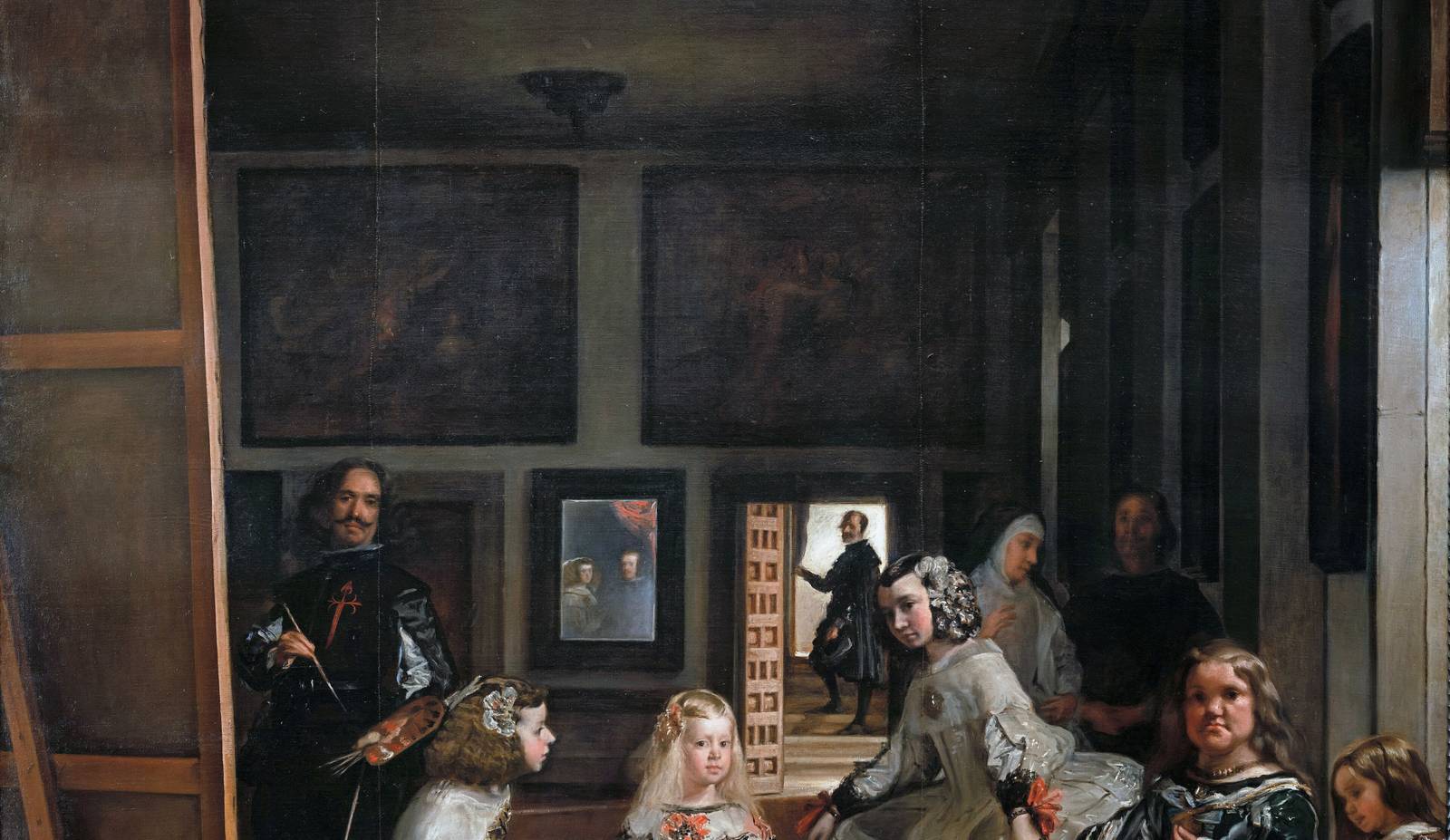
Image reference: Diego Velázquez, Las Meninas.
At a Glance
- Core periodc. 1570–1685, within a broader cultural age often extended to 1700
- Major centresMadrid · Seville · Toledo · Valencia · Valladolid · Granada · Spanish Naples
- Principal mediaoil painting · drawing · print · polychrome wood sculpture · terracotta · palace decoration
- Important patronsmonarchy · court · cathedrals · religious orders · confraternities · hospitals · collectors
- Leading artistsEl Greco · Velázquez · Zurbarán · Ribera · Murillo · Montañés · Fernández · Pareja · Roldán
- Characteristic subjectsaltarpieces · saints · portraits · mythology · bodegones · still life · genre · processional sculpture
- Wider connectionsItaly · Flanders · France · Dutch Republic · Spanish Naples · American viceroyalties
Contents
- Where the Spanish Golden Age fits
- A connected monarchy and art world
- Sacred images and material encounter
- El Greco and Toledo
- Many routes to naturalism
- Seville and Zurbarán
- Madrid, Velázquez and the court
- Still life and everyday life
- Sculpture in wood and colour
- Artists and places to know
Where the Spanish Golden Age fits
El Greco
Principal careerJuan Sánchez Cotán
Principal careerFrancisco Ribalta
Principal careerJuan Bautista Maíno
Principal careerJusepe de Ribera
Principal careerFrancisco de Zurbarán
Principal careerDiego Velázquez
Principal careerJuan Martínez Montañés
Principal careerGregorio Fernández
Principal careerAlonso Cano
Principal careerBartolomé Esteban Murillo
Principal careerLuisa Roldán
Principal careerThe Spanish Golden Age names one of the most inventive periods in European art, but it does not describe a single movement. No manifesto united its painters and sculptors, and no one style can contain the elongated visions of El Greco, the quiet gravity of Zurbarán, the searching court pictures of Velázquez, the warm narratives of Murillo or the coloured wooden figures carried through city streets. The phrase is better understood as a retrospective umbrella for an artistic culture that flourished across the later sixteenth and seventeenth centuries.
Its art was made in a world of striking contradictions. Royal collections grew while the monarchy fought expensive wars. Seville linked Europe to the Americas while plague and poverty transformed the city. Churches, monasteries and confraternities commissioned images of intense devotion, yet court portraits, mythologies, landscapes, kitchen scenes and still lifes also prospered. Artists argued that painting was an intellectual and liberal art even as workshops depended on apprentices, family members, artisans and enslaved labour. The period was “golden” in achievement and later reputation, not in the everyday conditions experienced by all who made or encountered its art.[1] [2]
The safest way to use “Spanish Golden Age” is as a practical period label. It overlaps with the late Renaissance, Mannerism and the Baroque, but it is identical to none of them. El Greco brought an international late-Renaissance formation to Toledo. The first decades of the seventeenth century saw several kinds of forceful naturalism. Later artists could combine close observation, brilliant colour, learned references, theatrical address or classical restraint in different proportions. The category therefore describes a historical field more successfully than a shared appearance.
Even the phrase itself has a history. “Siglo de Oro” was first associated with an admired literary past before scholars and museums extended it into a broad account of sixteenth- and seventeenth-century culture. A documented use from 1674 linked the idea of a Golden Age to the poet Garcilaso de la Vega; later period histories made the name increasingly capacious.[3] The label can help readers connect remarkable works, but it can also conceal disagreement about beginnings, endings and geography.
For visual art, approximately 1570–1685 provides a useful central span. It includes the mature patronage of Philip II, El Greco’s move to Spain in 1577, the rise of independent still life around 1600, the great court and religious projects of Philip IV’s reign, and the careers of Murillo and Luisa Roldán in the later century. A wider frame may begin earlier or continue to the death of Charles II in 1700. Dates should remain porous because workshops, institutions and styles did not change when a ruler died or a century turned.
The period sits between major political transformations. Philip II made Madrid the permanent court and built an international royal collection. Under Philip III and Philip IV, court display became still more elaborate even as military and financial pressures grew. Portugal broke from Habsburg rule in 1640, Catalonia revolted, and the monarchy’s European power contracted. Seville’s epidemic of 1649 devastated a major artistic centre. Yet crisis did not produce a simple decline in quality. Some of the period’s most searching works—including Las Meninas and Murillo’s Hospital de la Caridad paintings—belong to its troubled later decades.[4]
That coexistence matters. Pictures did not float above hardship, nor can hardship alone explain their form. Patronage could remain ambitious precisely because institutions used art to defend authority, devotion, memory and social order during uncertainty.
The word “Spanish” also needs care. The Habsburg monarchy governed distinct kingdoms and territories with their own institutions. Its artists and objects moved between the Iberian Peninsula, Italy, northern Europe and the Americas. Jusepe de Ribera was born near Valencia but established his mature career in Naples. El Greco was born in Crete and trained in Venice and Rome. Rubens visited Madrid; Titian was a constant presence through the royal collection; prints carried compositions across borders. This was not the sealed expression of an unchanging national character.
Nor should “school” imply that every artist learned in the same place. Seventeenth-century viewers could recognise painters by city, master, subject or patron long before later museums assembled a Spanish national sequence. Regional training remained strong, but careers crossed it: Cano moved between Seville, Madrid and Granada; Ribera’s pictures returned from Naples to Spanish collections; court artists studied works made in Venice and Antwerp. The most revealing map is consequently a network of workshops, ports, palaces and religious foundations. It allows common conditions to appear without forcing dissimilar pictures into one family resemblance.[1] [2]
A connected monarchy and art world
Art was produced through several overlapping systems. The royal household required portraits, palace decoration, festival designs and images of dynastic authority. Cathedrals, parish churches, monasteries and convents needed altarpieces, devotional pictures, reliquaries and sculpture. Confraternities commissioned works for chapels and public processions. Hospitals connected sacred narrative with charitable duty. Private collectors bought small religious pictures, portraits, landscapes, flowers and still lifes. American clients ordered individual works and large series from Seville.
The resulting art was not confined to today’s museum categories. A palace room brought paintings into relation with tapestries, furniture, mirrors, architecture and ceremony. A retablo could combine carved architecture, polychrome sculpture and painted panels. A processional figure was seen moving outdoors among candles, fabric, music and crowds. A print might provide a model that a painter substantially altered for another place. The Prado’s enormous Spanish collection, much of it shaped by royal collecting and later institutional transfer, preserves this variety while also reminding us that modern museums have rearranged works made for very different settings.[2]
Madrid became the principal court centre, but it did not absorb regional identities. Toledo’s ecclesiastical patrons sustained El Greco and his workshop. Seville joined religious demand to Atlantic commerce. Valencia developed powerful local naturalisms. Valladolid became a centre of Castilian sculpture, while Granada supported distinctive sculptural workshops. Naples, governed by Spanish viceroys, connected the monarchy to one of Europe’s most competitive painting cultures. The category is most useful when it keeps these centres in conversation rather than arranging them around one capital.
Movement depended on material routes. Artists travelled; ambassadors and viceroys transported pictures; merchants ordered works; royal gifts crossed borders; prints and illustrated books spread designs. Francisco Pacheco’s Arte de la pintura, published in 1649, joined workshop knowledge, artistic theory, iconographic guidance and an argument for painting’s dignity.[37] Engravings provided compositional resources, but copying a printed outline did not mean passive dependence. Scale, colour, material, setting and local demands could transform a borrowed design. Illustrated books and later artist biographies also helped organise knowledge about art long before modern movement histories.[38]
The material surface of painting reveals regional practice. Technical research into Spanish grounds shows that workshops prepared canvases with different mixtures and colours; Sevillian works by Velázquez, Zurbarán and Murillo often use brownish earth preparations containing calcium carbonate, charcoal black and lead white.[39] Such evidence replaces vague claims about a naturally “dark Spanish vision” with choices made from available materials, learned procedures and the desired effect of paint over a toned surface.
Sacred images and material encounter
Religion occupied an exceptional share of artistic production. A Prado survey notes that religious subjects make up more than eighty per cent of the catalogues of Ribera, Zurbarán, El Greco and Murillo.[1] The statistic matters, but it should not make every sacred image seem the same. A high altarpiece had to be legible from a distance. A convent cycle addressed a resident community. A small penitent saint might be used in private prayer. A hospital commission could make mercy visible to donors, members and those receiving care.
Catholic reform encouraged clarity, decorum and persuasive sacred images, yet it did not prescribe one recognisable “Counter-Reformation style.” El Greco’s compressed visions, Zurbarán’s solid figures, Ribera’s rough saints and Murillo’s luminous narratives could all serve Catholic patrons while offering markedly different experiences. Institutional setting, the theology of a subject, local precedent and an artist’s ambitions mattered alongside general religious policy.
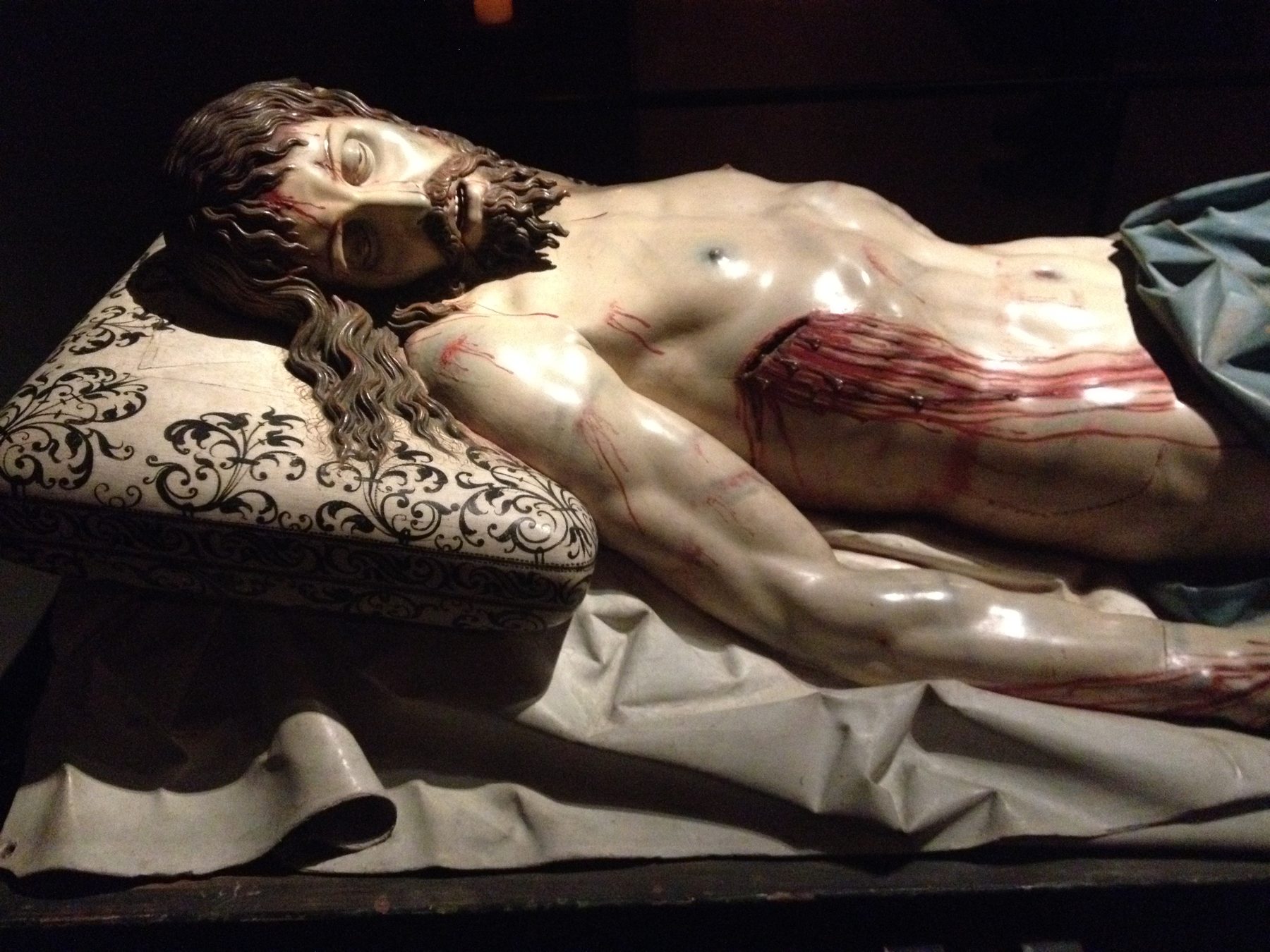
Polychrome sculpture made sacred presence especially physical. Spanish workshops carved figures in wood and then coloured their flesh and clothing. Glass eyes, horn fingernails, cork wounds, teeth, hair and fabric could be added. The Museo Nacional de Escultura preserves figures, retablos, tombs, choir stalls, reliquaries and processional pasos whose meaning changes with placement and movement.[5] These were collaborative objects: a sculptor shaped the body, while a specialist painter might apply flesh tones, gilding and patterned textiles.
The strongest works do more than imitate a body. Gregorio Fernández’s recumbent Christs organise touch, injury and stillness for close devotional attention. Juan Martínez Montañés uses controlled pose and carving to make sacred authority palpable. Alonso Cano and Pedro de Mena developed different balances of ideal form and intense encounter. Painting and sculpture learned from, competed with and completed one another; the exhibition The Sacred Made Real made that exchange its central argument.[6] Processions added time. A figure emerged from a church, moved through streets and returned, becoming part of a civic ritual rather than a stationary museum object.[7]
El Greco and Toledo
El Greco stands at the beginning of the period precisely because he unsettles simple national stories. Domenikos Theotokopoulos was born in Crete, then part of the Venetian world, and trained as an icon painter. In Venice he absorbed colour and expansive brushwork; in Rome he encountered ambitious figure painting, artistic theory and the competitive culture around Michelangelo. He arrived in Spain in 1577 and settled in Toledo, where ecclesiastical and private patrons sustained him for the rest of his career.[8] [13]
His mature figures stretch, turn and flare against spaces that resist stable measurement. That language is sometimes explained as pure mysticism or as the visual essence of Spain. Both ideas are too narrow. His style was a highly self-conscious synthesis of Greek, Venetian, Roman and Toledo experiences. He read widely, collected books and annotated artistic texts. His workshop made repetitions and variants for a continuing market, so the distinctiveness of his imagery coexisted with organised production.[10]
Toledo offered opportunity but also conflict. El Greco secured major commissions for Santo Domingo el Antiguo and Santo Tomé, while hoped-for royal favour did not develop into a lasting court career. Disagreements over payment and valuation reveal patrons assessing completed works and an artist defending their worth.[11] The Museo del Greco connects those disputes to his broader insistence on painting as an intellectual art rather than a taxable craft.[9] His elongated bodies were therefore not spontaneous eruptions outside professional life; they belonged to a learned painter negotiating contracts, reputation and workshop continuity.
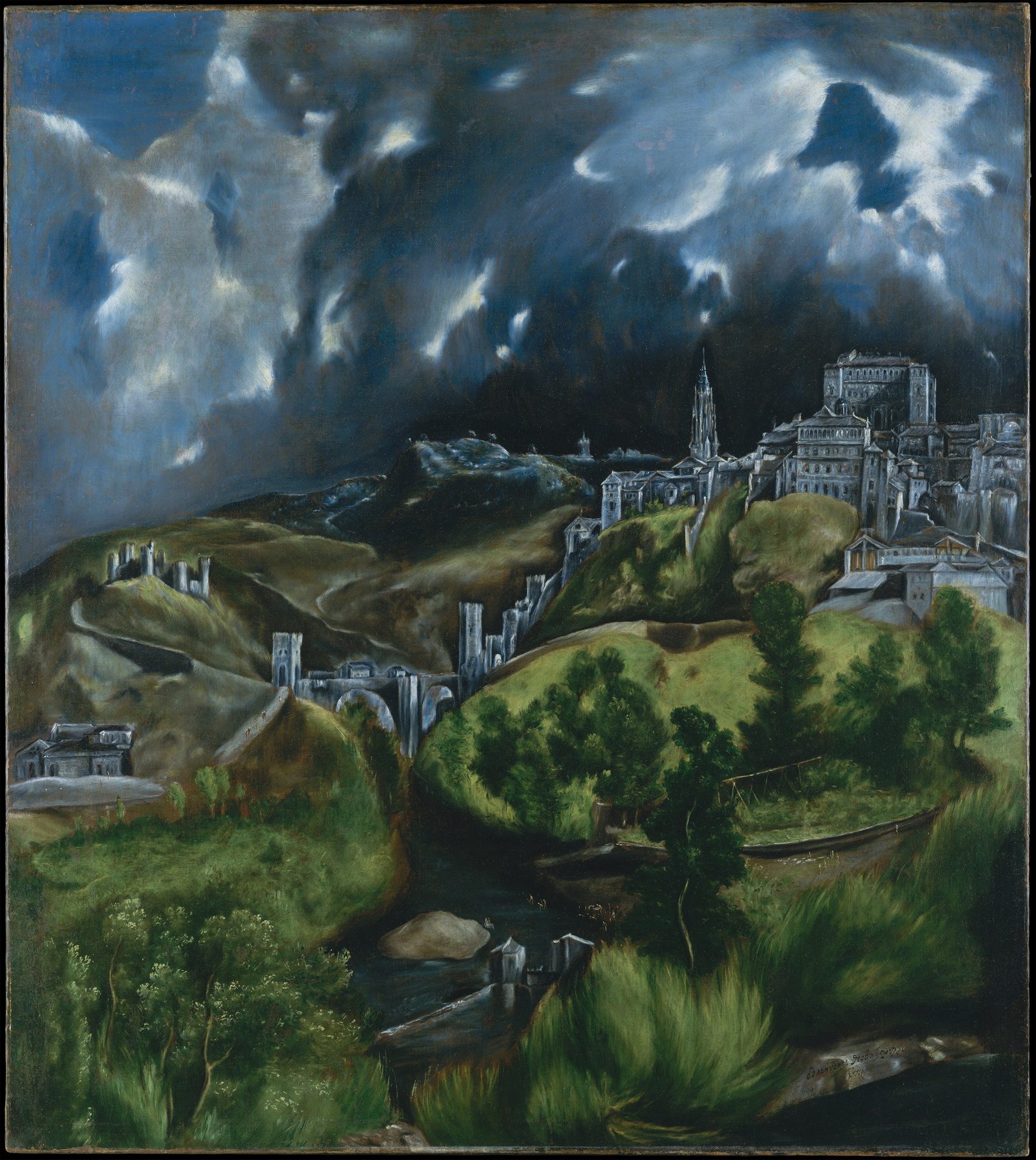
View of Toledo makes that intelligence visible without a human protagonist. The city rises above green slopes beneath a turbulent sky, but its buildings are not a neutral topographical record. El Greco rearranged and selected landmarks to create an expressive image of place.[12] Dark clouds press downward as pale architecture climbs toward them. Cool greens and blue-greys make the landscape feel electrically charged, while touches of light carry the eye from riverbank to skyline. Rather than searching for a weather report, look at how the city becomes a spiritual and civic idea through deliberate distortion.
El Greco also painted portraits of bracing reserve, small devotional works and rare genre subjects. His range matters because later reputation made him first an eccentric and then a visionary precursor of modern art. The recovery tells us as much about nineteenth- and twentieth-century taste as about seventeenth-century Toledo. Within the Golden Age, his real importance lies in proving that artistic identity could be international, local, scholarly and commercial at once.
Many routes to naturalism
Around 1600, painters across the monarchy began to give bodies, objects and illumination a more immediate weight. It is tempting to call every dark background or weathered face Caravaggist, but transmission was uneven. Some artists knew Caravaggio’s works in Italy; others encountered related ideas through paintings, prints, travellers or local experiments. Naturalism was never simply reality copied without artifice. Models were posed, gestures selected, lights controlled and surfaces carefully built.
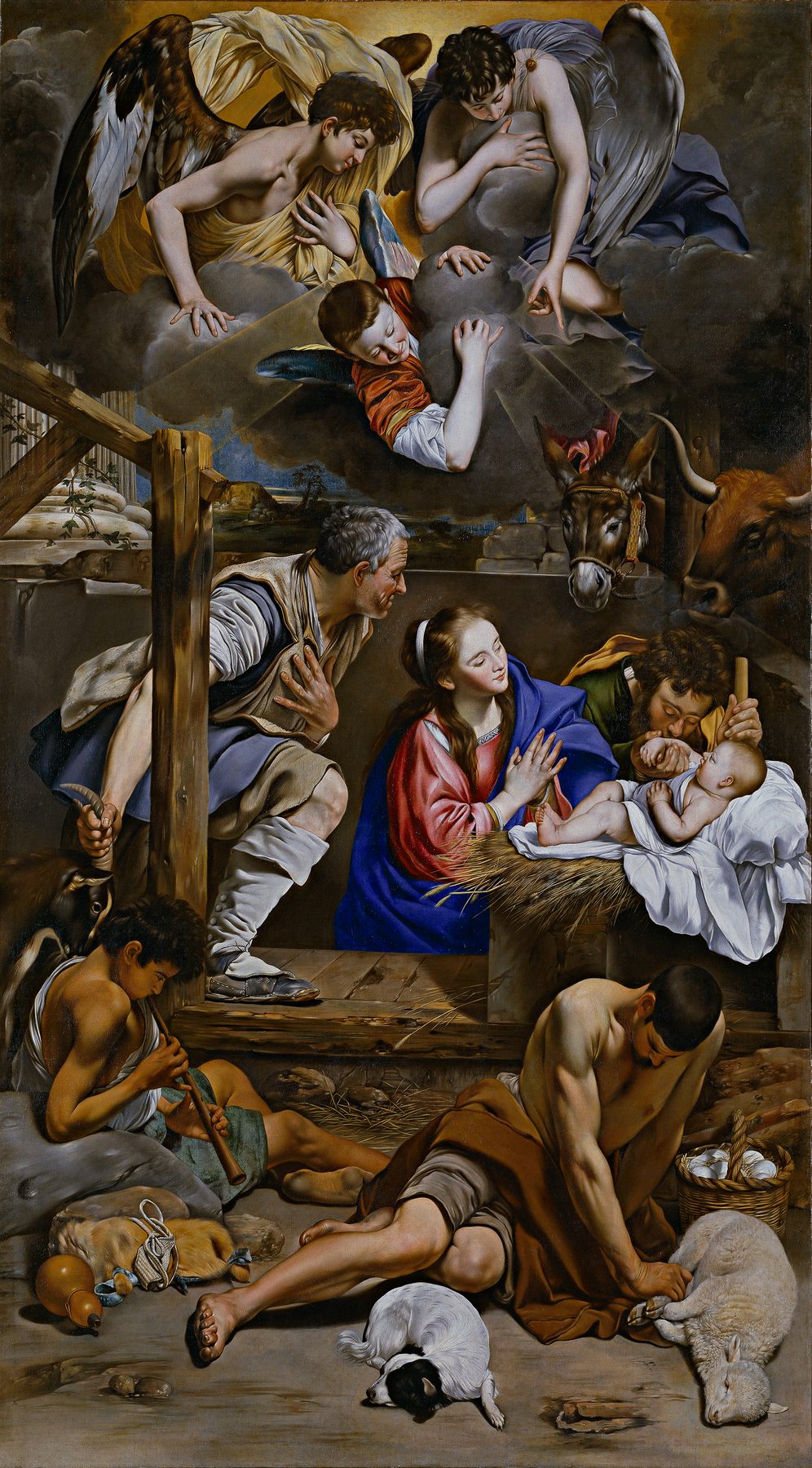
Francisco Ribalta and his circle in Valencia developed concentrated sacred scenes in which light isolates touch and emotional attention. Juan Bautista Maíno travelled in Italy and combined Caravaggist illumination with the composed colour and order associated with the Carracci. Ribera worked in Rome before settling in Naples, where his rough-skinned philosophers and martyrs joined severe observation to dense paint, drawing and a widening range of colour. Calling him Spanish acknowledges his origin and patrons, but Naples was the centre of his mature production.
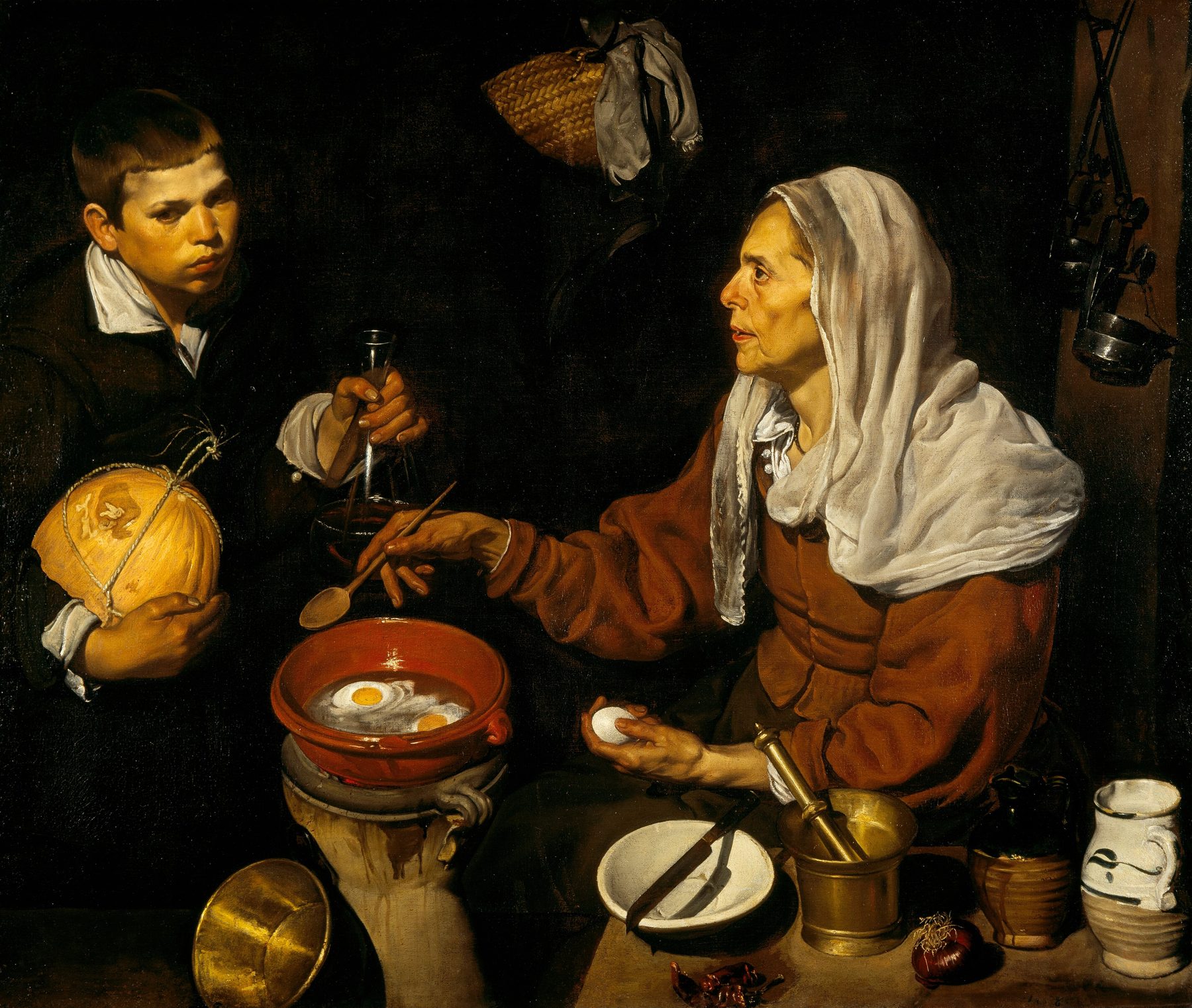
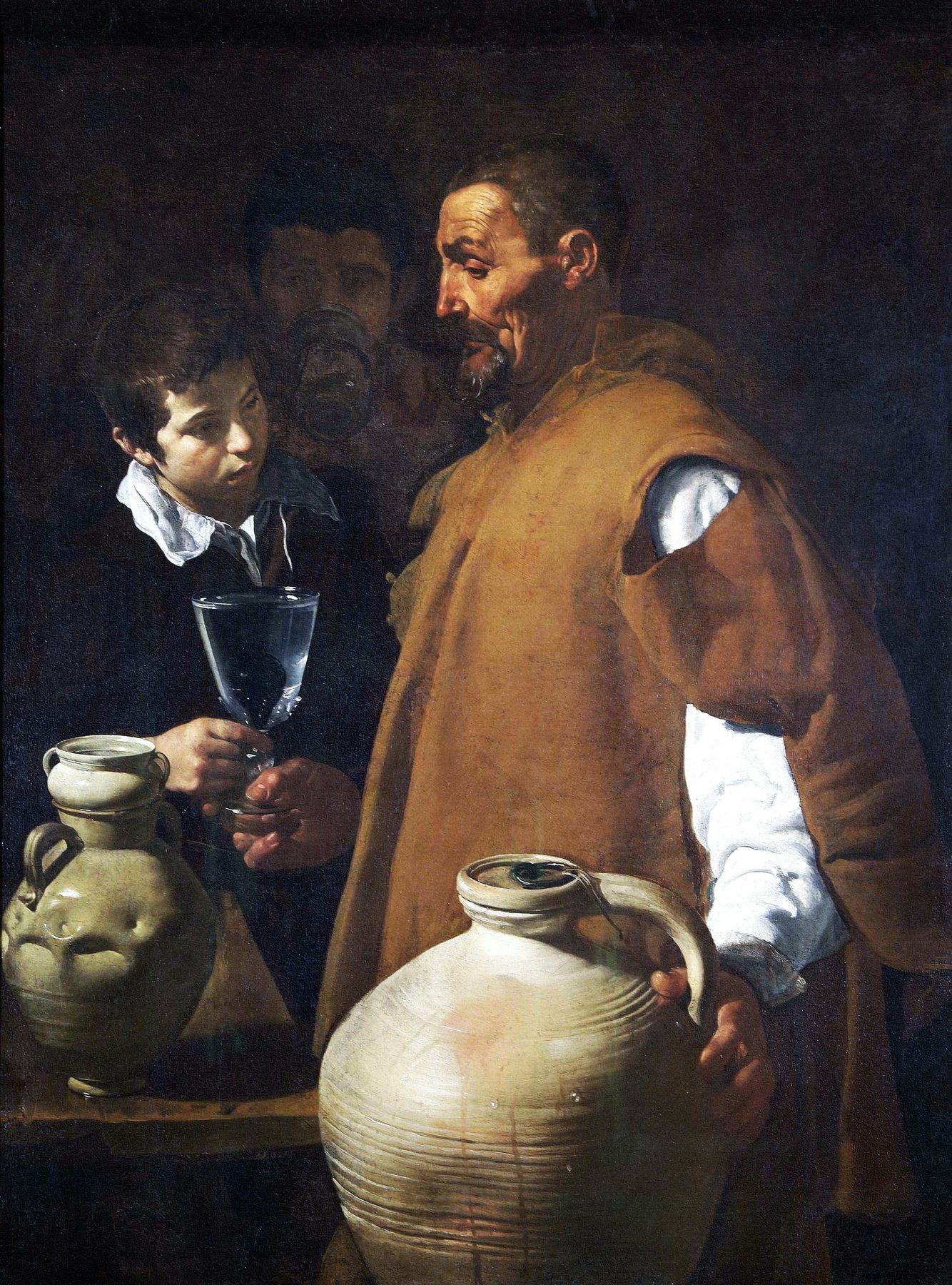
Seville’s route was different. Pacheco’s studio provided theory, drawing, religious guidance and useful professional connections. His pupils did not remain stylistically obedient. The young Velázquez gave kitchen workers, earthenware, eggs, water and worn faces an unprecedented visual authority. Zurbarán built figures from large volumes, sharp edges and saturated local colour. Their early darkness belongs to a broader European conversation, but neither needs a hypothetical direct encounter with every Caravaggio canvas to explain it.
This is why “Spanish naturalism” should be treated as a question, not an answer. What is being made present, for whom and by what means? Ribera’s tactile impasto, Velázquez’s optical uncertainty and Zurbarán’s sculptural stillness are not interchangeable. Each makes visibility carry a different moral, social or artistic pressure.
Essential works
View of Toledo
El Greco, c. 1596–1600
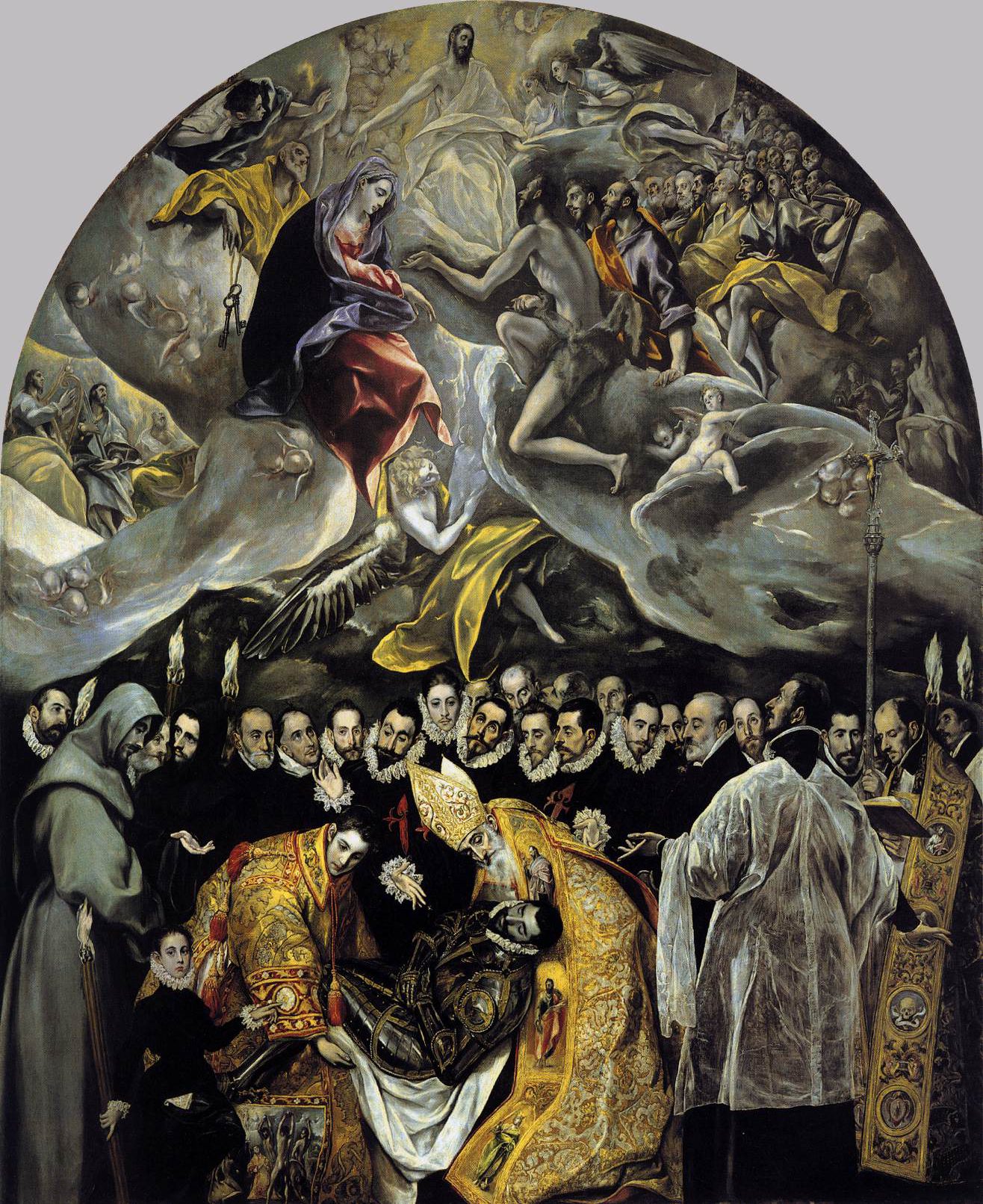
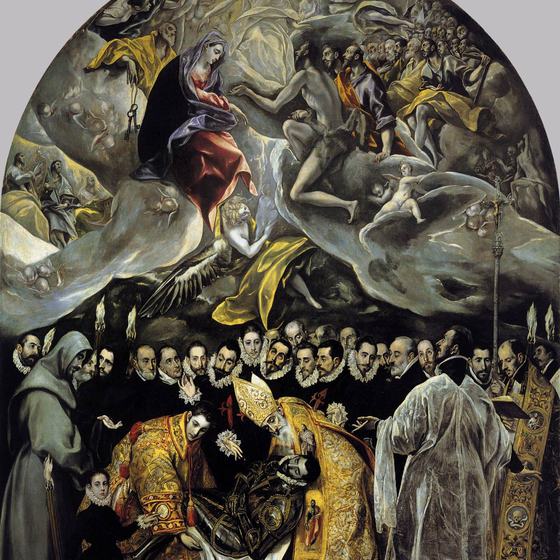
The Burial of the Count of Orgaz
El Greco, 1586–88
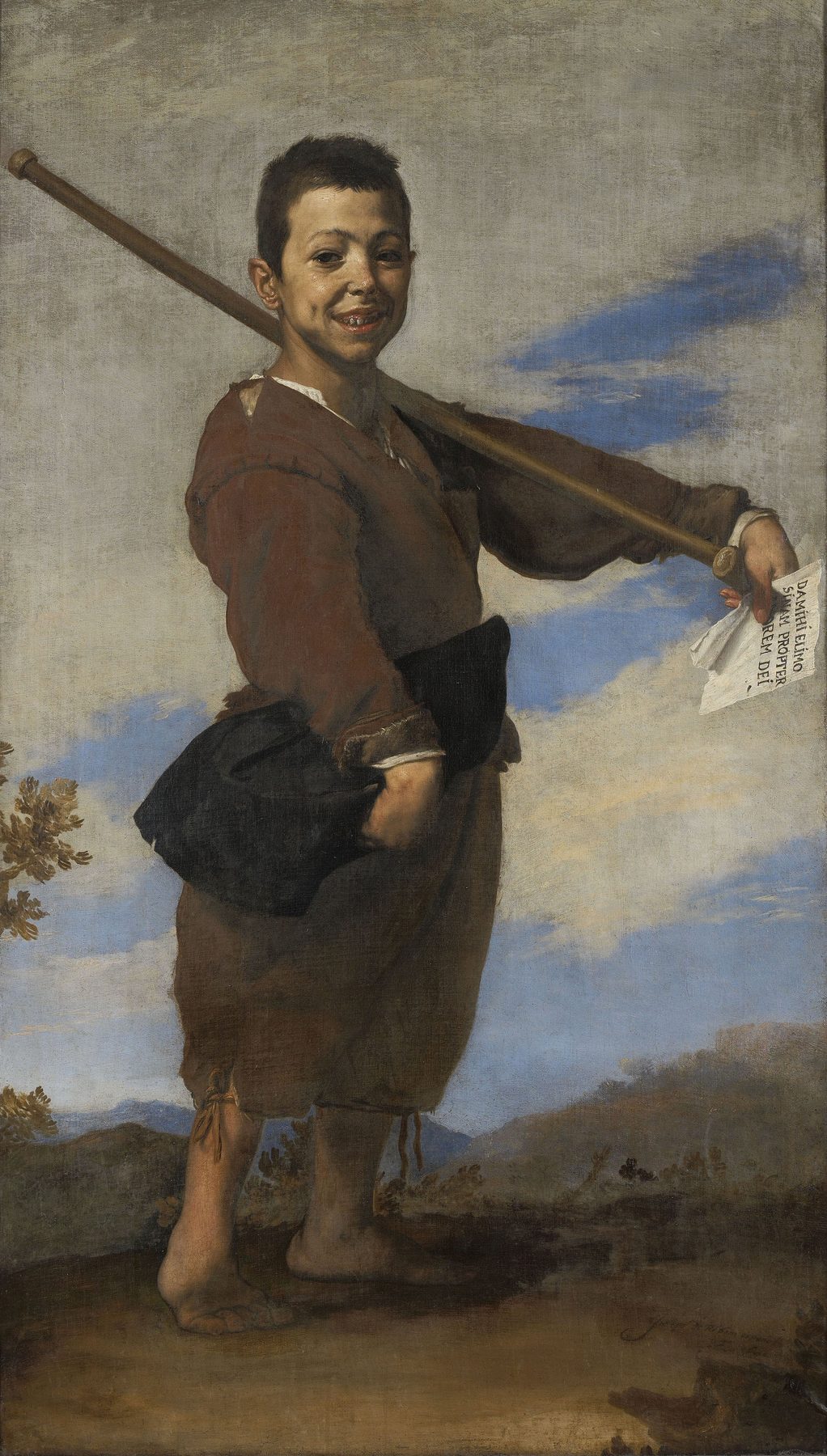
The Clubfooted Boy
Jusepe de Ribera, 1642
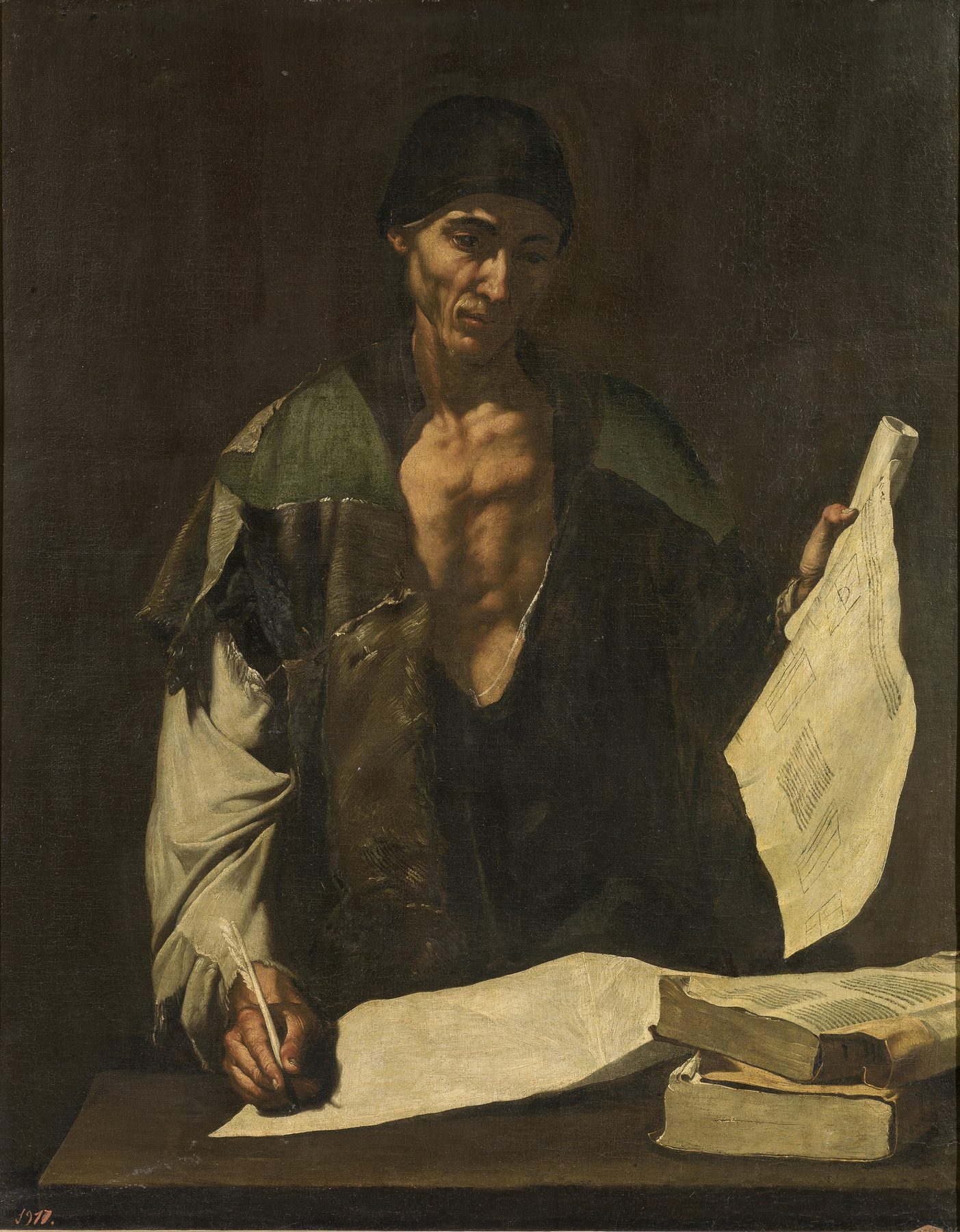
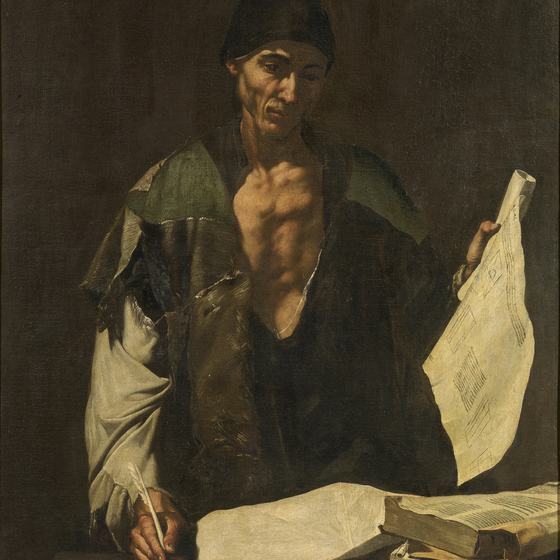
Archimedes
Jusepe de Ribera, 1630
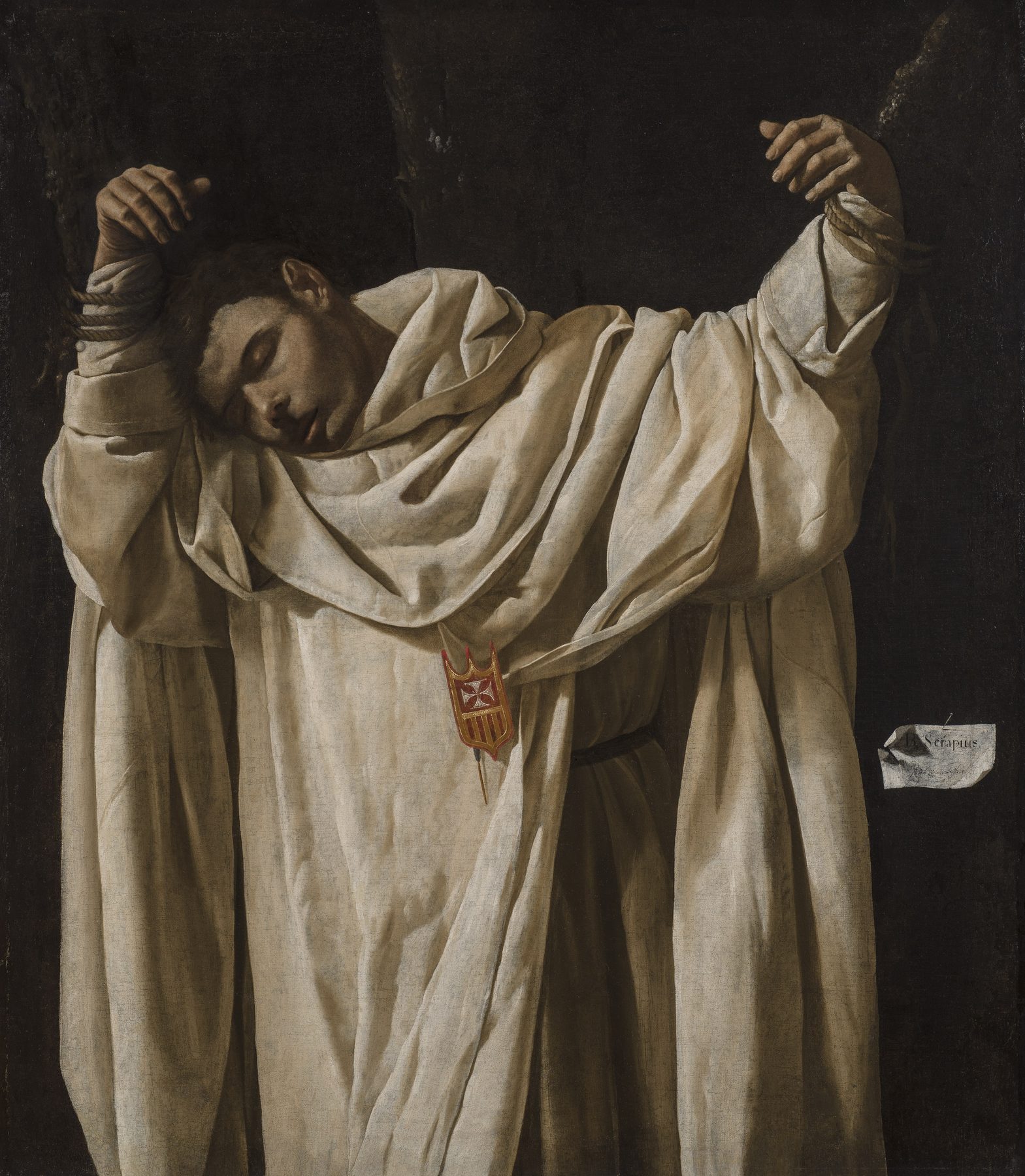
Saint Serapion
Francisco de Zurbarán, 1628
Seville and Zurbarán
Seville’s wealth rested on its privileged role in Atlantic trade, but prosperity was unevenly distributed. Merchants, clerics, religious orders, migrants, artisans, enslaved people and the poor lived in the same expanding city. Its churches and convents generated major commissions. Its port connected workshops to clients across the ocean. The plague of 1649 killed a huge part of the population and accelerated economic stress, yet artistic institutions adapted rather than vanishing.
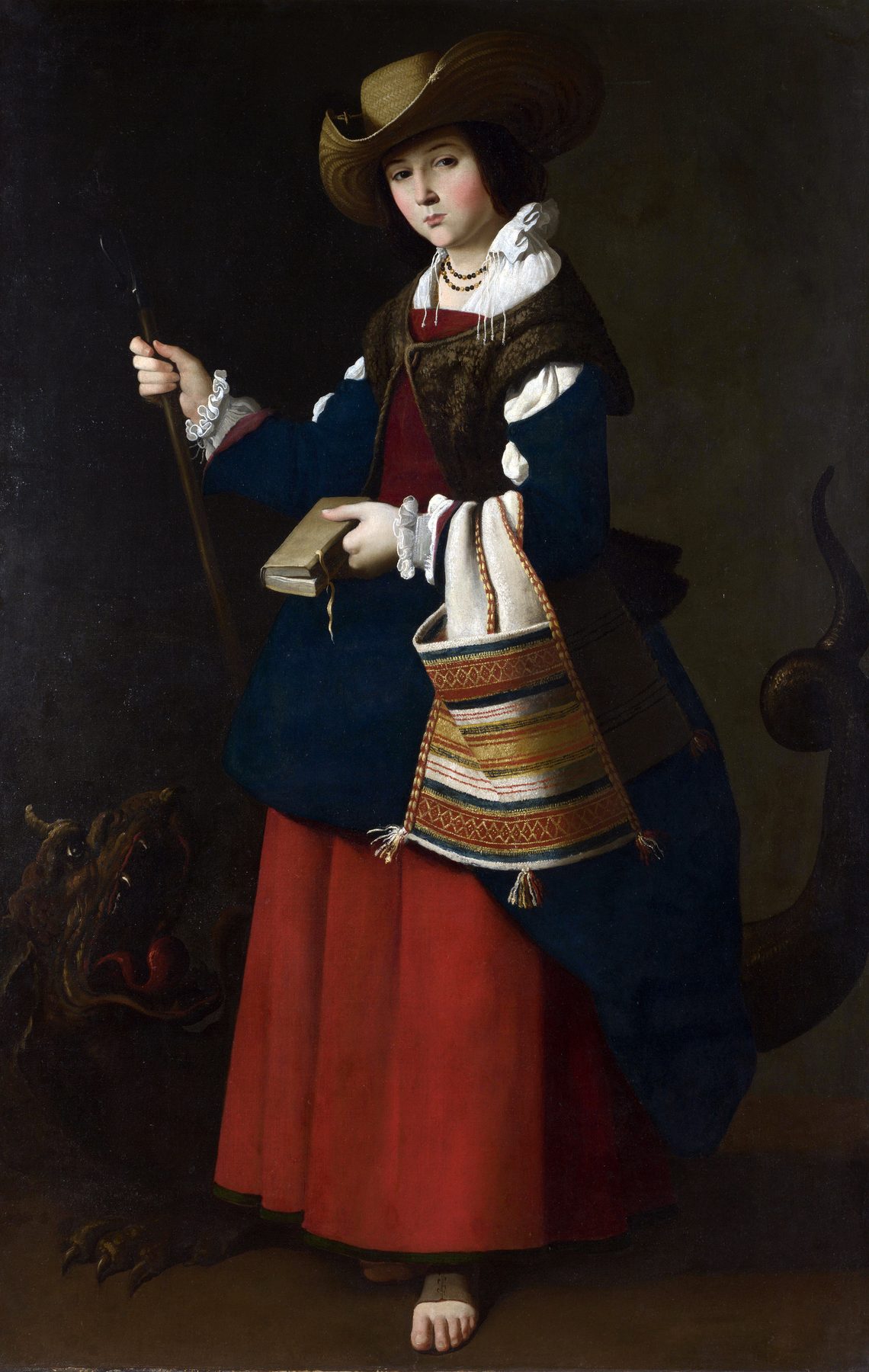
Francisco de Zurbarán became famous through large cycles for Sevillian religious communities. His standing saints often confront us frontally, their heavy fabrics arranged in broad, decisive shapes. Bowls, books and white habits can possess the same gravity as faces. Strong illumination does not dissolve matter; it clarifies weight, edge and texture. The result is devotional without being insubstantial.
The familiar image of Zurbarán as a solitary monastic ascetic is incomplete. He ran a workshop, used prints as sources, accepted court work in Madrid, painted portraits and still lifes, and produced series intended for the Americas. Prado research traces both his large Andalusian commissions and the later contraction of the Sevillian market, including his move to Madrid.[21] The Louvre’s modern reassessment is equally useful: it stresses brilliant colour, simplified volume and a striking naturalism beyond the older habit of treating him mainly as a Spanish follower of Caravaggio.[22]
His workshop’s Atlantic production changes the geography of the Golden Age. Sets of saints, founders, biblical figures and secular heroes could be commissioned for shipment to colonial buyers. Seville painters and sculptors worked through merchants and agents who carried finished objects and negotiated demands across the Indies.[23] Those works entered societies with their own Indigenous, African, European and mixed artistic communities. They belong to connected histories, not to a one-way story in which Spain simply exported a complete style. The Prado’s account of viceroyal painting accordingly emphasises shared identities and exchanges while preserving the agency of art made in the Americas.[24]
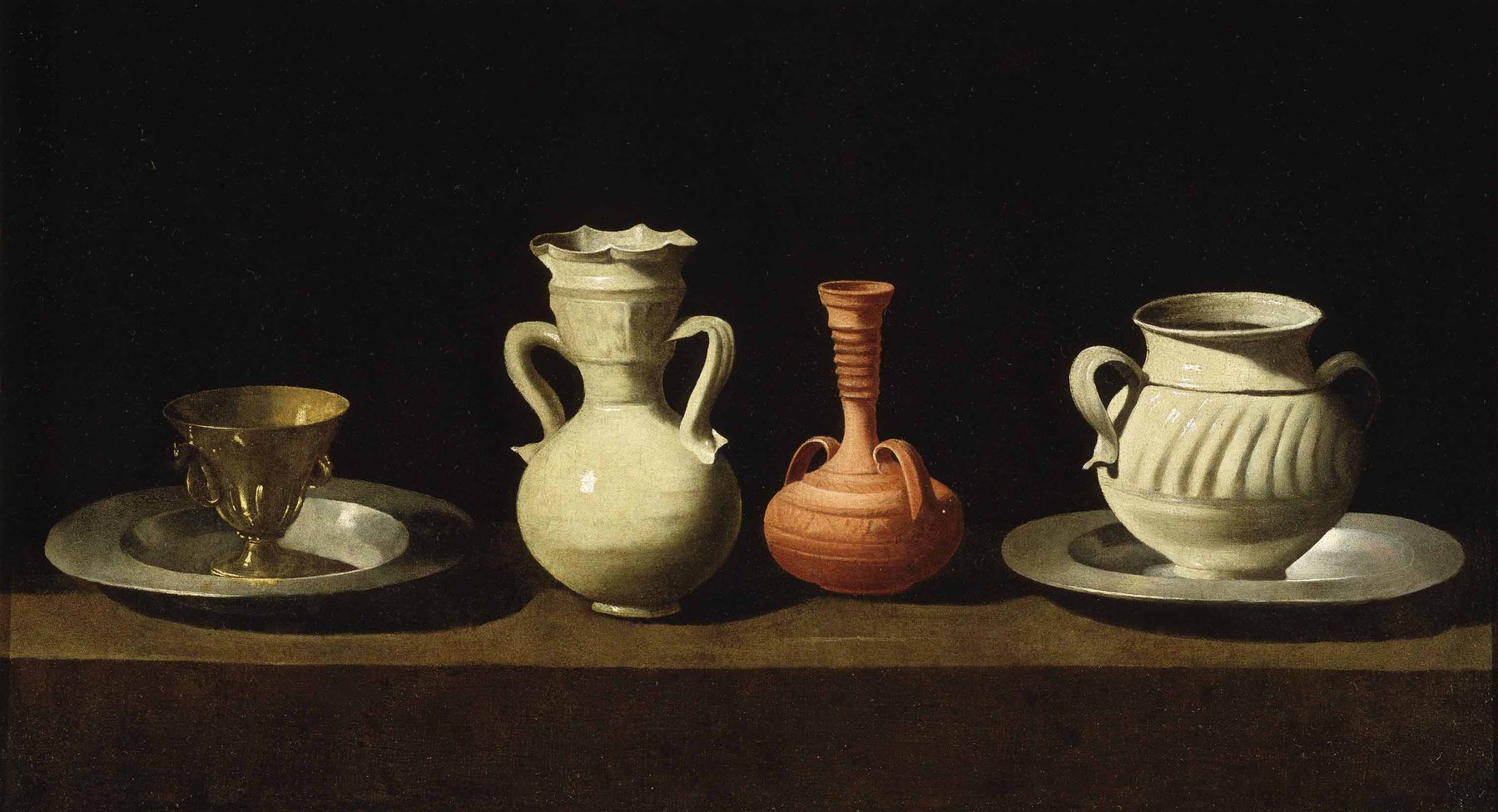
Zurbarán’s best pictures reward attention to difference within repetition. A series of female saints may use comparable formats, yet fabrics, attributes, colours and poses establish distinct presences. A group of vessels can become monumental through spacing and light without requiring a hidden symbol for every rim. His art shows how disciplined arrangement can make material things carry devotional or social meaning.
Follow the period through four stages
–1600
International foundations and regional centres
El Greco brings Cretan, Venetian and Roman experience to Toledo while court, church and regional workshops establish the period’s connected field.
–1625
Naturalism, still life and sacred encounter
Ribera, Zurbarán, Maíno and the young Velázquez give bodies and objects new weight while polychrome sculpture intensifies material presence.
–1660
Court culture and regional high points
Velázquez transforms portraiture, mythology and artistic labour as Zurbarán, Ribera, still-life painters and sculptors develop distinct local languages.
–1700
Later Seville, recovered artists and afterlives
Murillo’s narrative art, Pareja’s independent authorship and Roldán’s sculpture extend the period through changing markets, workshops and historical memory.
Madrid, Velázquez and the court
Diego Velázquez moved from Seville to Madrid in 1623 and soon became painter to Philip IV.[19] The move changed the scale of his professional world. Court service brought access to the king, royal children, ministers, jesters, diplomats and an extraordinary collection of Venetian and Flemish painting. It also brought duties that exceeded making pictures. Velázquez organised displays, acquired works, supervised palace spaces and pursued offices that raised his social standing.
The royal collection was an active education. Titian’s mythologies and portraits demonstrated how colour and brushwork could serve both sensual fiction and dynastic presence. Rubens’s visits and works offered another model of learned invention and courtly mobility. An exhibition bringing together Titian, Veronese, Allori, Rubens, Ribera, Poussin and Velázquez shows how mythological painting travelled through commissions, copies, collecting and rivalry.[18] Velázquez’s mature freedom did not emerge from isolation; it grew through prolonged looking and transformation.
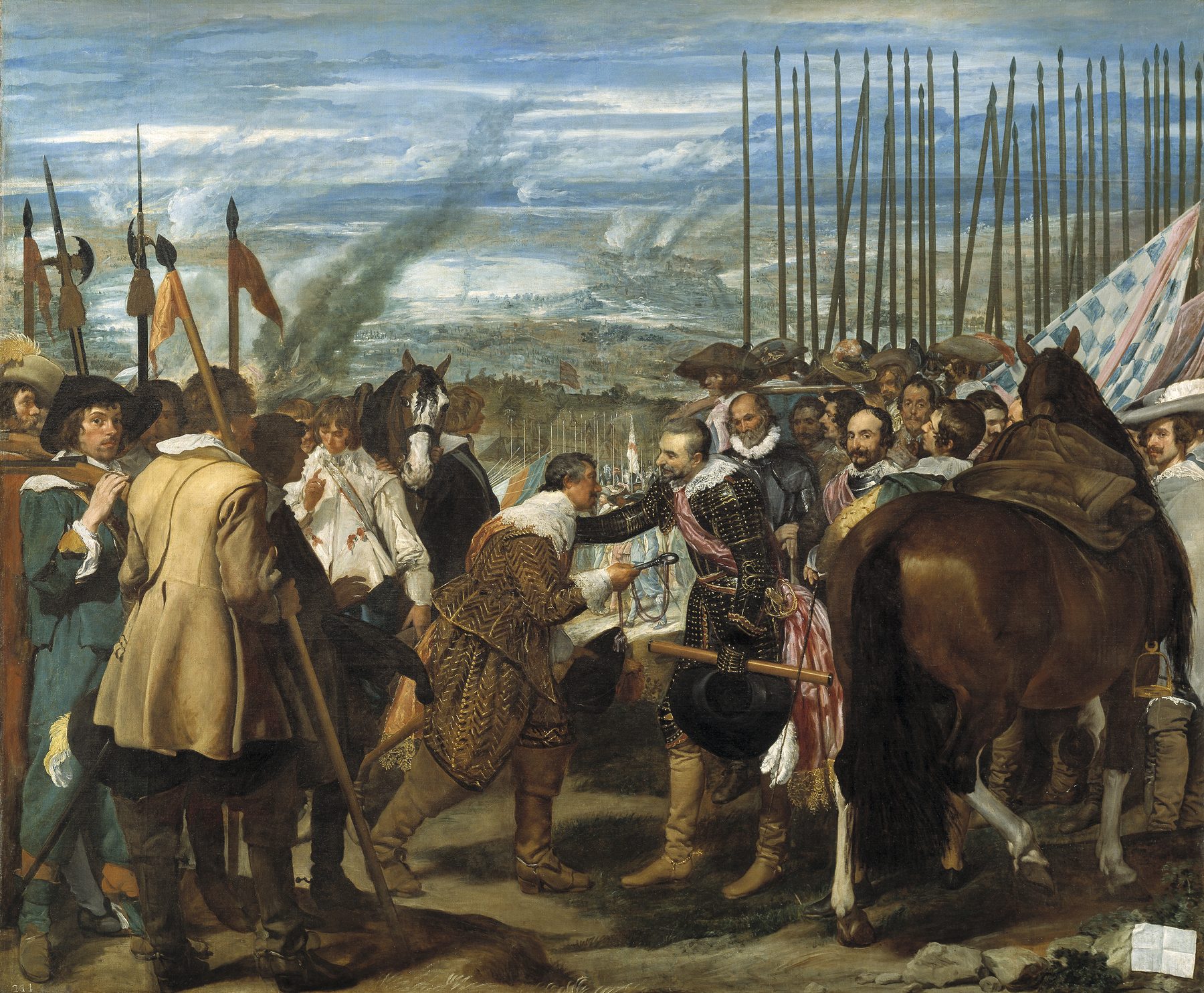
Court imagery coordinated magnificence with political argument. The Buen Retiro palace’s Salón de Reinos displayed twelve battle scenes, ten labours of Hercules and royal portraits beneath the heraldry of the monarchy’s kingdoms.[16] Velázquez’s Surrender of Breda belonged to this programme, but its restrained encounter between commanders complicates the simple rhetoric of victory. The palace as a whole made Philip IV the “Planet King,” arranging painting, architecture, theatre and ceremony into an image of rule.[17]
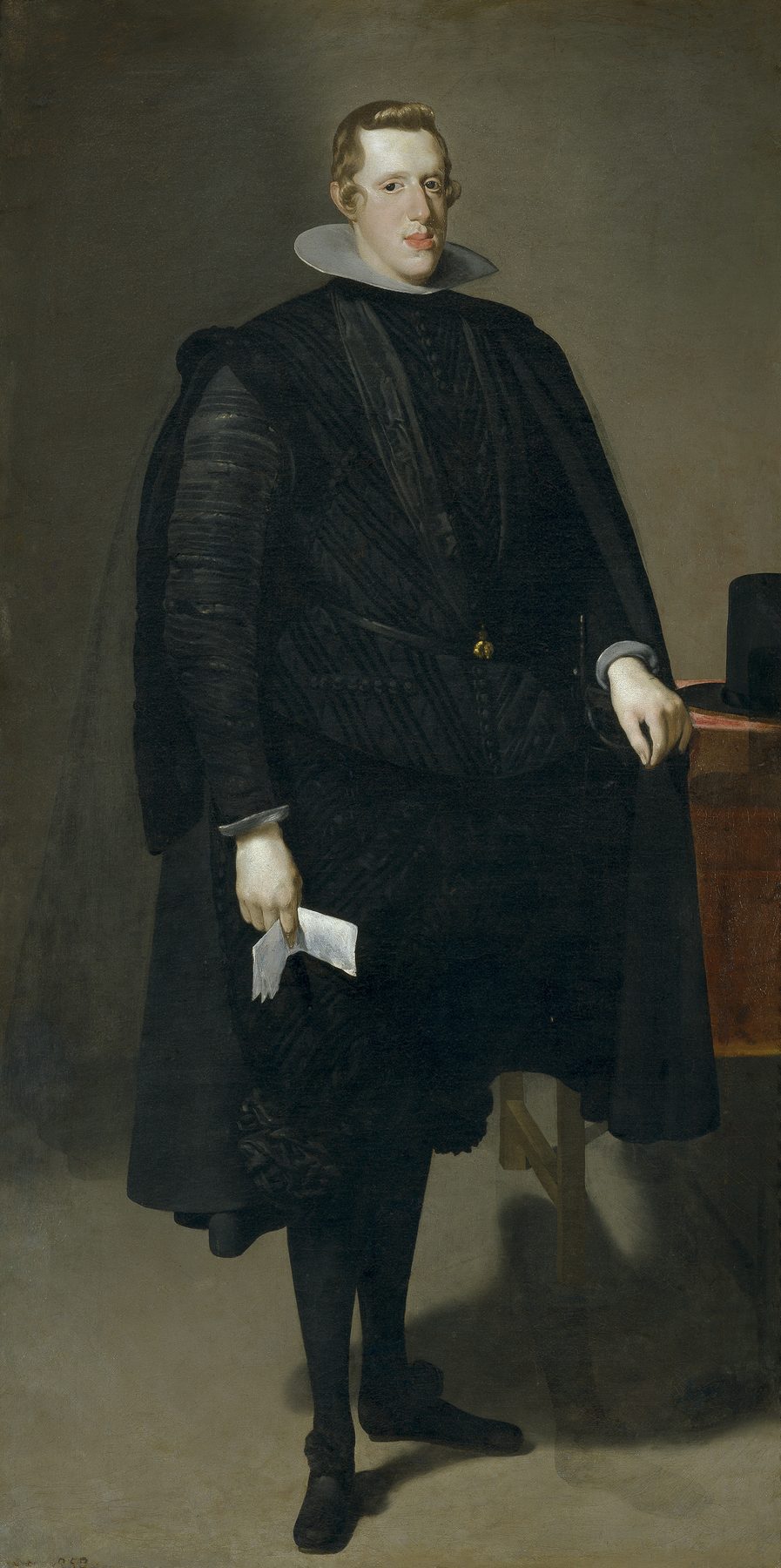
Portraits had equally specific work to do. They represented continuity, rank, marriage prospects and service. Velázquez learned to make black costume, silver embroidery, a gloved hand or the distance around a body communicate hierarchy. In the late Philip IV, outward magnificence recedes. The ageing king’s face, plain dark clothing and spare field produce an image of burdened authority, painted after decades of political loss.[20] Restraint becomes a court language rather than an escape from court function.
Looking closely at Las Meninas
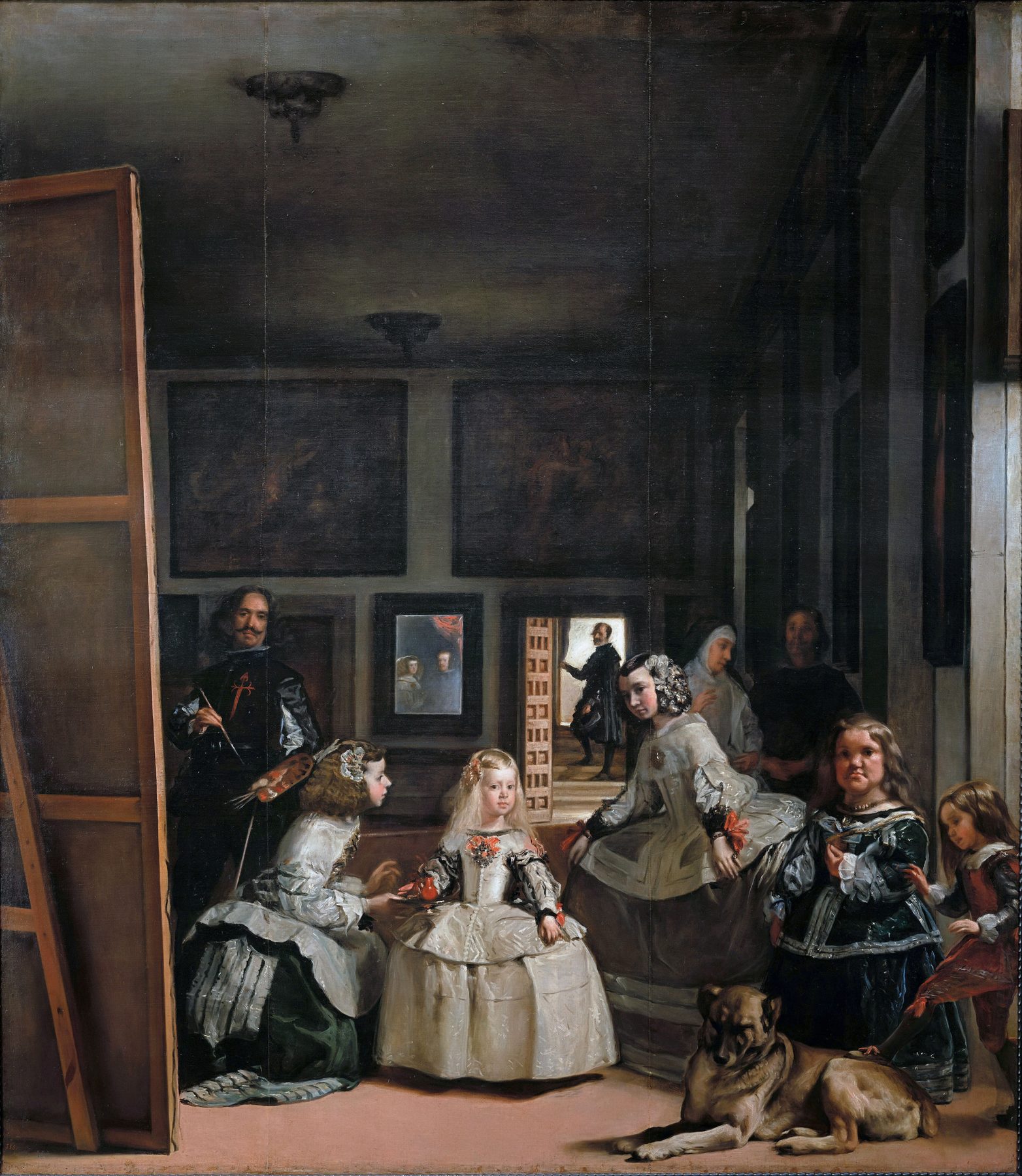
Painted in 1656, Las Meninas takes place in a room in the Alcázar used by Prince Baltasar Carlos before his death. The infanta Margarita stands near the centre with attendants, a chaperone, a guard, two court dwarfs and a dog. Velázquez appears at the left before a vast canvas. At the back, a mirror reflects Philip IV and Mariana of Austria, while a court official pauses in a bright doorway.[14]
The painting continually changes the viewer’s position. Are the king and queen standing where we stand, reflected as they sit for Velázquez? Are they represented on the unseen canvas? Have they entered the room and attracted the infanta’s attention? The picture supplies evidence for several possibilities without closing them. Glances cross the room, yet not every figure looks toward the same point.
The light is just as active. A window outside the frame illuminates the infanta and her immediate group; the open doorway creates a distant rectangle; the mirror holds a pale double portrait in a darker field. Between them lies an expanse of breathable but uncertain space. Velázquez’s loose marks become convincing only at viewing distance. A dab becomes a ribbon, a broken line becomes embroidery, and thin paint becomes reflected air.
The artist’s self-representation is inseparable from court service. He paints while wearing the key of a palace official, and the red cross of Santiago appears on his chest, probably added after he received the honour in 1659. Las Meninas argues for the intelligence and status of painting, but it does so from inside a hierarchy, surrounded by named and unnamed labour. Its greatness lies less in solving a puzzle than in making representation itself feel social, unstable and alive.
Looking closely at Las Hilanderas
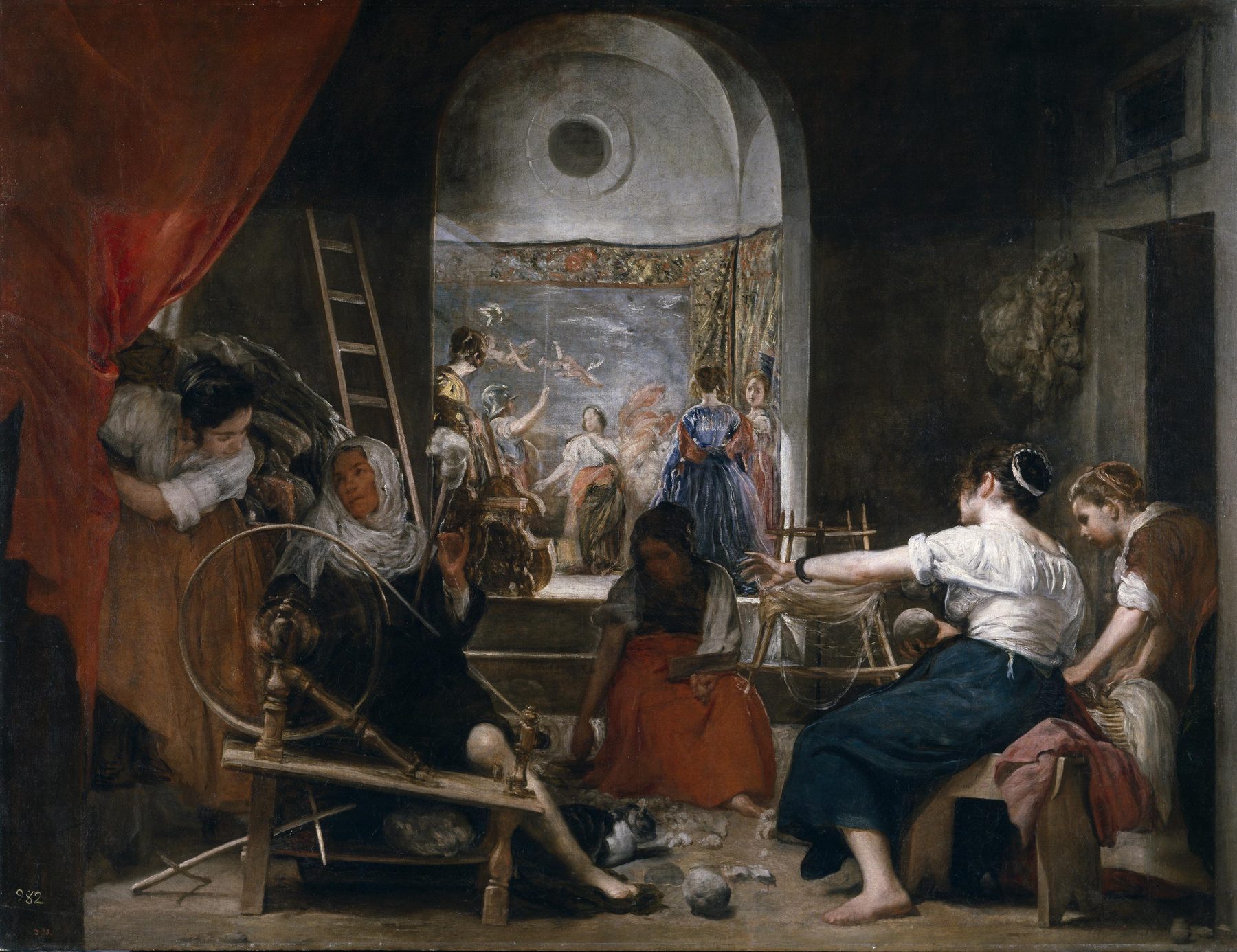
Las Hilanderas, or The Fable of Arachne, begins with women working wool in the foreground. A spinning wheel blurs with speed; sleeves are rolled; bodies bend into repeated tasks. Beyond them, in a brighter raised space, richly dressed figures stand before a tapestry derived from Titian’s Rape of Europa as known through the royal collection and Rubens’s copy.[15]
The rear scene identifies the subject as Arachne’s challenge to Minerva, a myth about making, rivalry and punishment. The workroom is therefore not a detachable “real-life” scene before a learned myth. Labour and artistic ambition form one structure. Velázquez links fibres, spinning, tapestry, borrowed image and painted canvas while asking who receives honour for making. Later additions enlarged the canvas and altered the balance, another reason to look at the object’s material history rather than assuming its present format was inevitable.
Still life and everyday life
The Spanish word bodegón has been used for both still life and scenes set around kitchens or taverns. That flexibility matters. The genre brought supposedly humble things—vegetables, game, ceramics, glass, food preparation and ordinary work—into ambitious paintings. Around the beginning of the seventeenth century, still life became increasingly independent across southern Europe, but local markets and pictorial traditions gave it many forms.[35] [36]
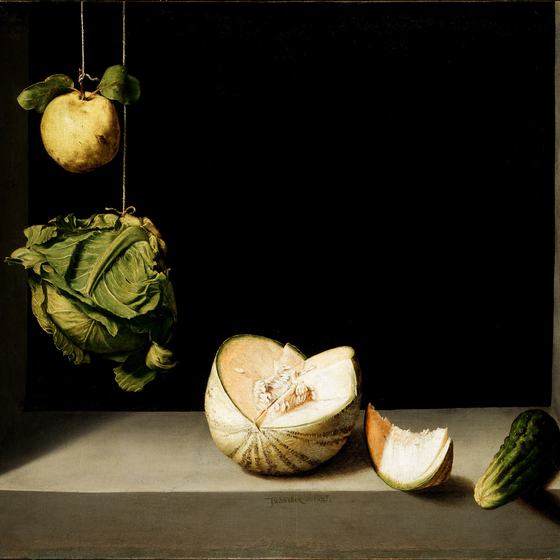
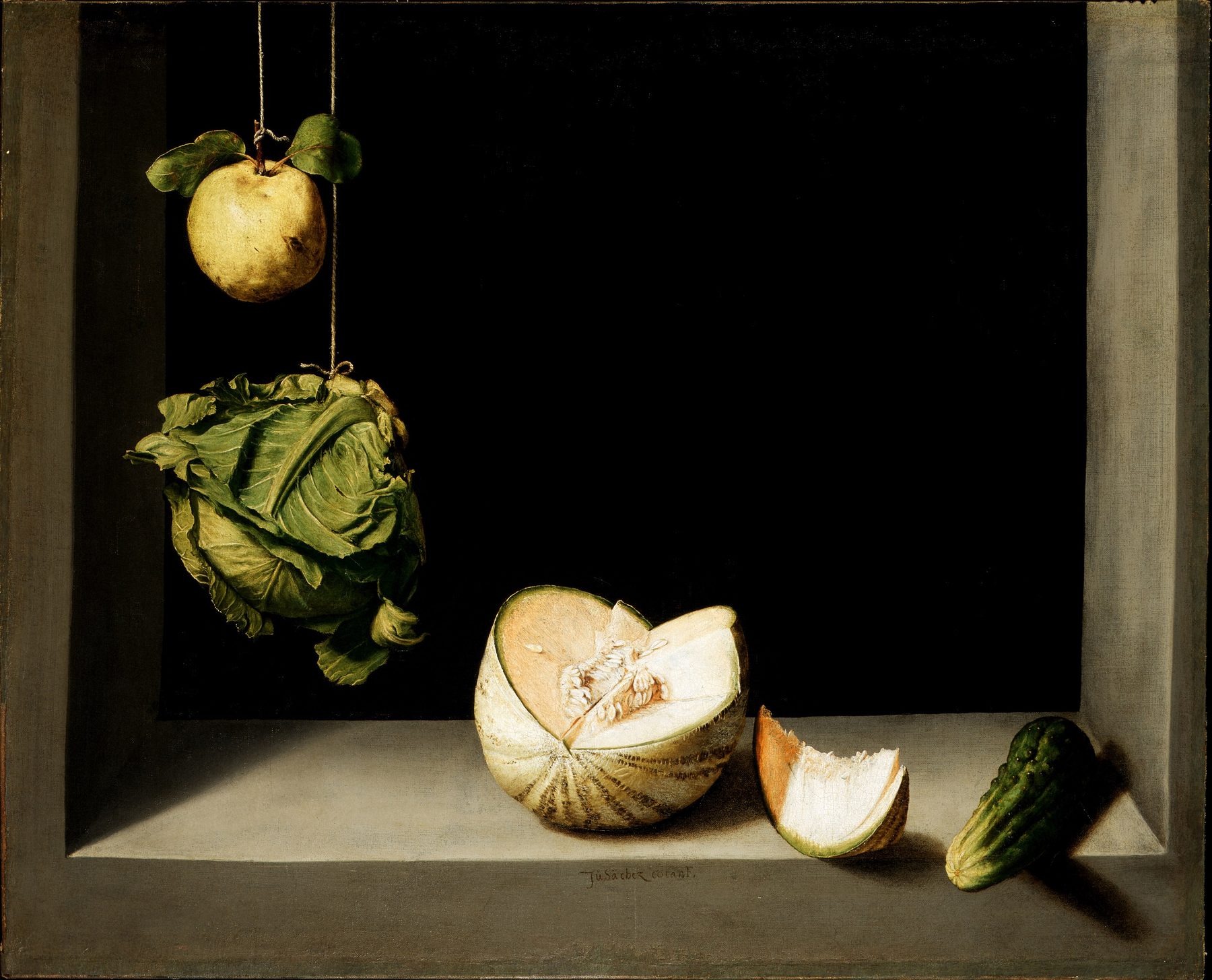
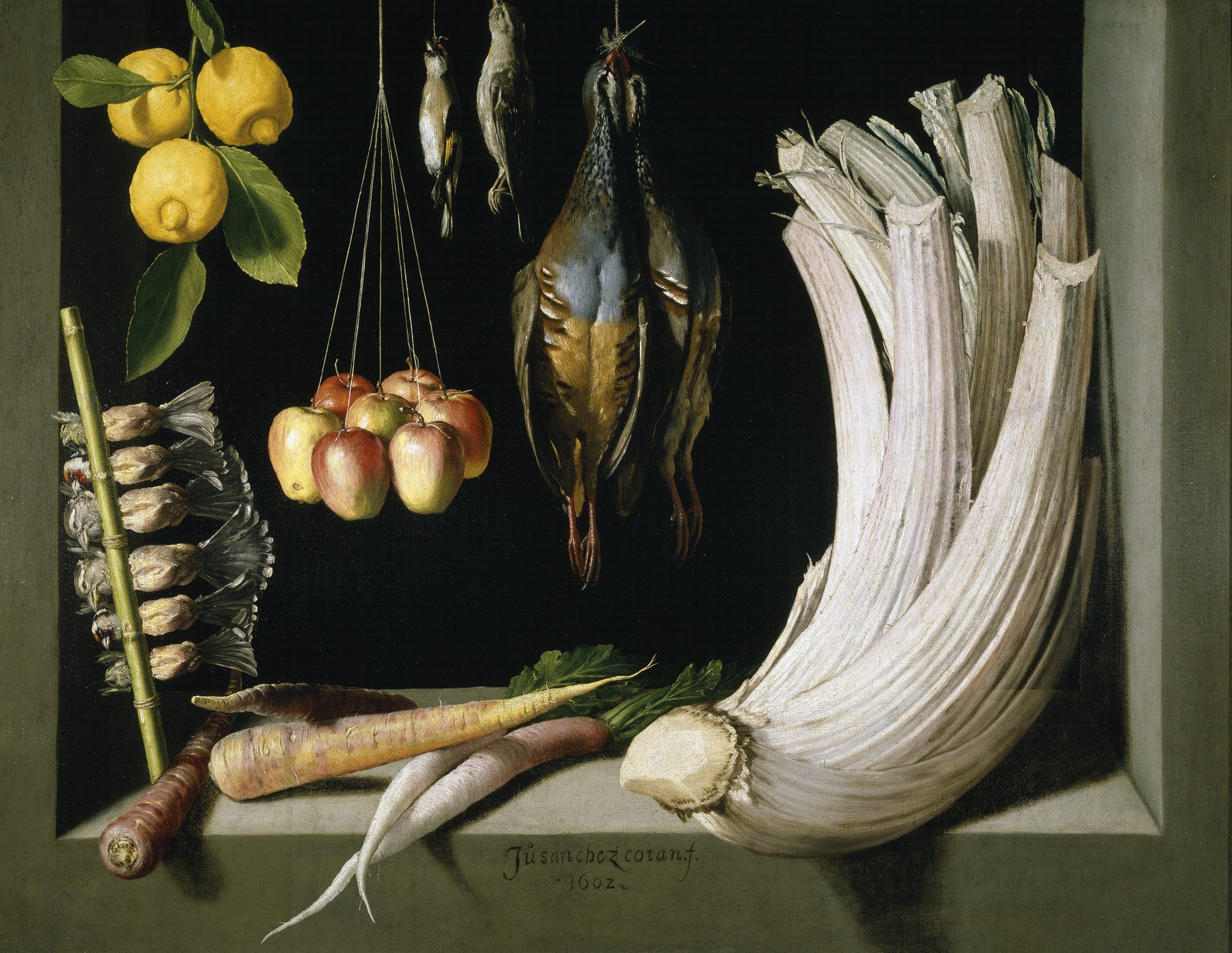
Juan Sánchez Cotán’s Bodegón de caza, hortalizas y frutas, signed and dated 1602, is a founding work of the Spanish tradition.[32] A cardoon and carrots rest on the lower ledge of a dark pantry opening. Birds, fruit and vegetables hang from strings above them. The curves descend across the square darkness with a precision that feels almost architectural. Gravity is both a physical force and a compositional instrument: suspended objects pull downward, while the cardoon’s arc seems to continue the invisible geometry.
The arrangement has often invited spiritual readings, especially because Sánchez Cotán later entered a Carthusian monastery. Yet biography should not turn every cabbage or bird into a fixed religious code. The picture also displays the painter’s knowledge of proportion, recession, surface and suspension. Perishable foods become instruments of durable order. Its darkness is not empty atmosphere but a field against which edges, intervals and weights can be measured.
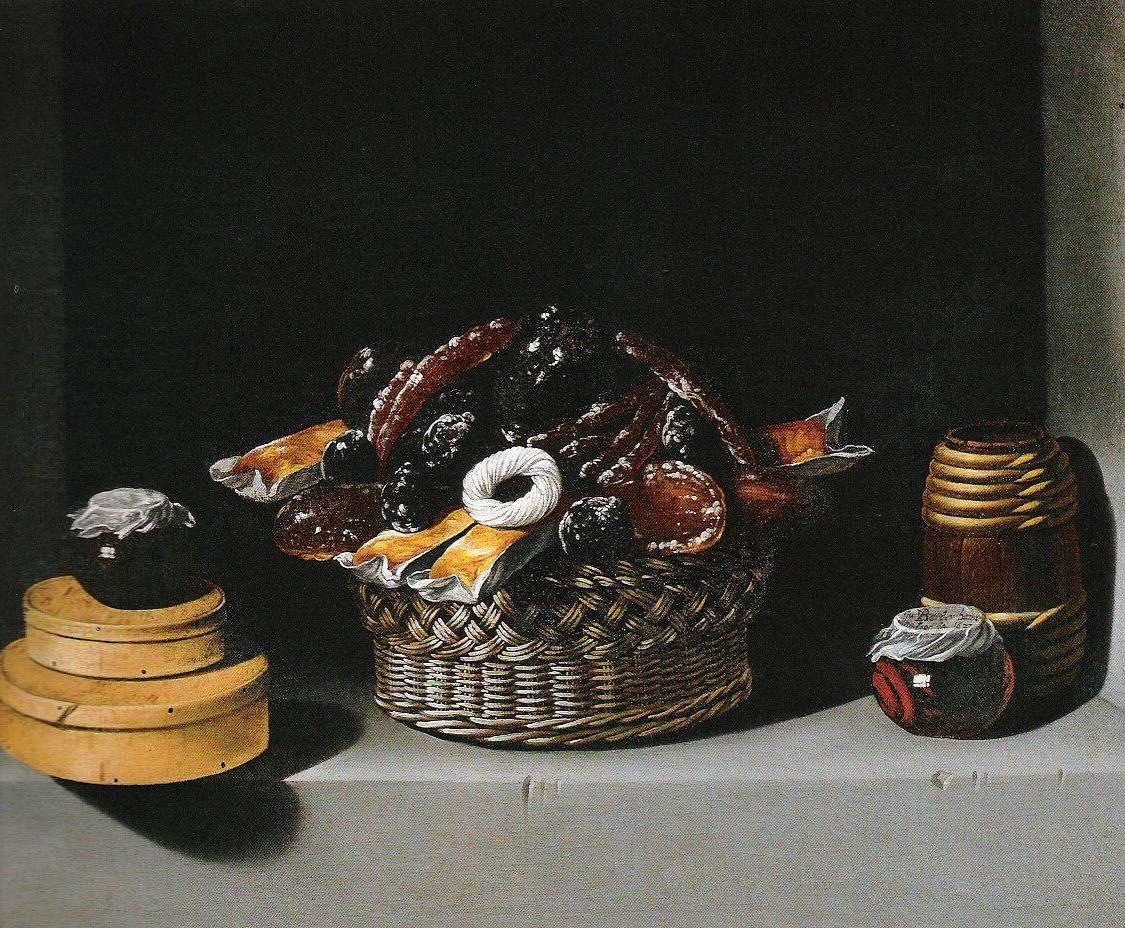
Juan van der Hamen y León developed a different still-life world for Madrid patrons. Fruit, sweets, flowers, costly vessels and imported goods occupy shelves or stepped ledges. Their abundance suited affluent interiors and announced the painter’s skill at representing glass, pastry, ceramic, skin and petal.[33] Still life remained low in academic hierarchies, yet it was popular, profitable and visually prestigious. Van der Hamen’s displays show why theoretical status and actual demand should not be confused.[34]
Velázquez’s early bodegones place objects in relation to people and work. In Old Woman Cooking Eggs, reflective metal, translucent whites, hot oil and earthenware are observed with astonishing concentration. But the scene is not only a catalogue of textures. The distance between the woman and boy, their diverted eyes and the exchange of objects create a quiet social drama. In The Waterseller of Seville, the beaded surface of a water jar and the exchange of a glass make service, touch and thirst central.
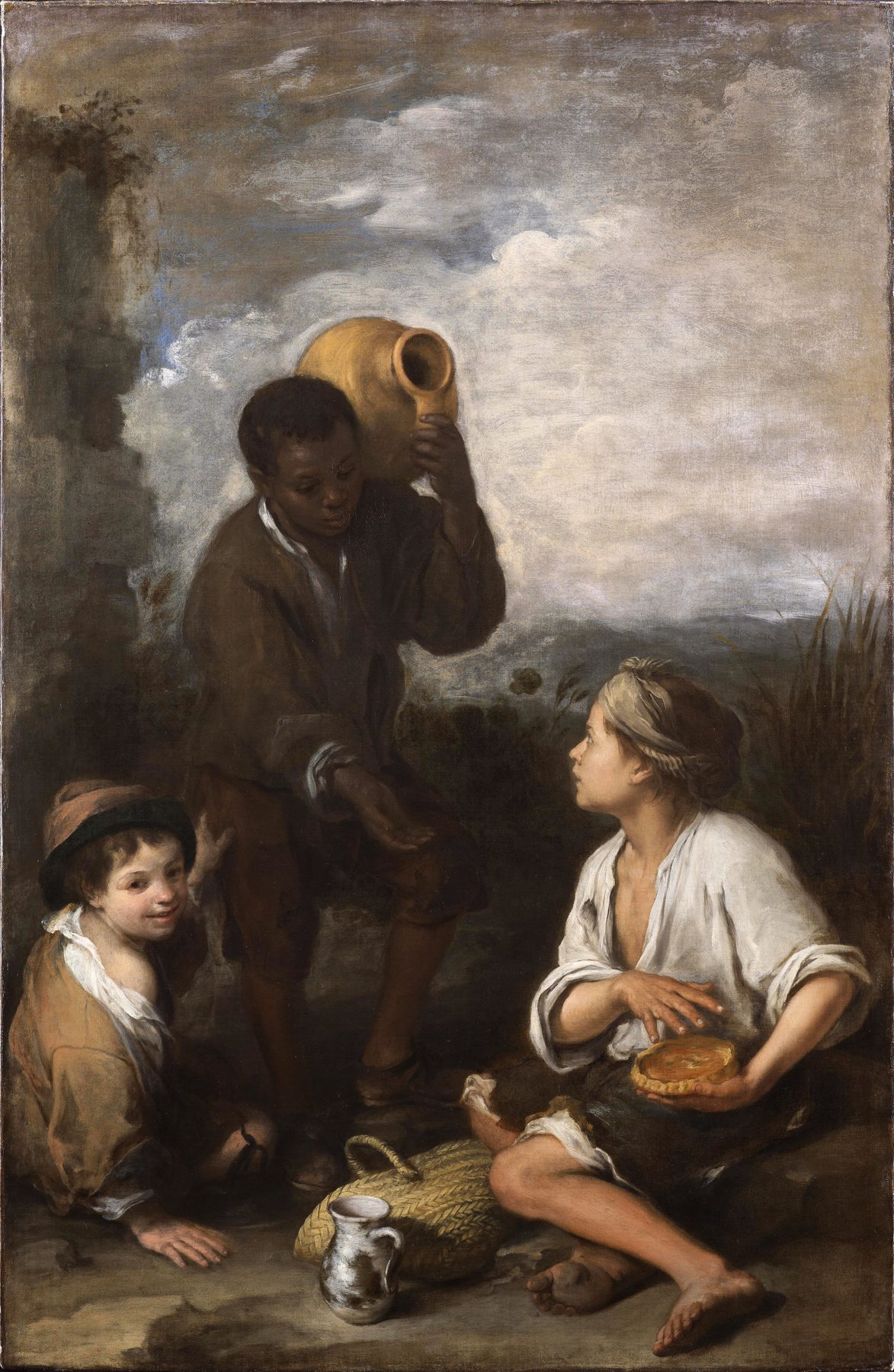
Murillo later painted children eating, playing or bargaining in street settings. These pictures found collectors beyond Spain, but they should not be mistaken for transparent reports on poverty. The artist organised poses, glances, food and torn clothing for viewers who could afford pictures of scarcity. Genre painting makes social conditions visible through a market relation; it does not abolish the distance between depicted child, model, purchaser and modern museum visitor.
Sculpture in wood and colour
Painting has dominated the international image of the Spanish Golden Age, partly because canvases travelled more easily into later collections. Sculpture was just as important to contemporary religious experience. Valladolid, Seville, Granada and Madrid developed powerful traditions whose differences matter. Castilian works often cultivate hard physical immediacy; Sevillian figures may balance ideal beauty with convincing presence; Granada supported refined, inward devotional types. These are tendencies, not rigid regional rules.[5] [7]
The making process joined specialised intelligence. Sculptors carved separate blocks and assembled figures. Polychromers prepared and painted surfaces, creating flesh, blood, tears, gilded textiles and patterned estofado. Added glass eyes or tears caught candlelight. Horn could imitate fingernails; cork and other materials could shape wounds. The point was not mere trickery. A sacred body occupied the worshipper’s space and asked for emotional, ethical and ritual response.[6]
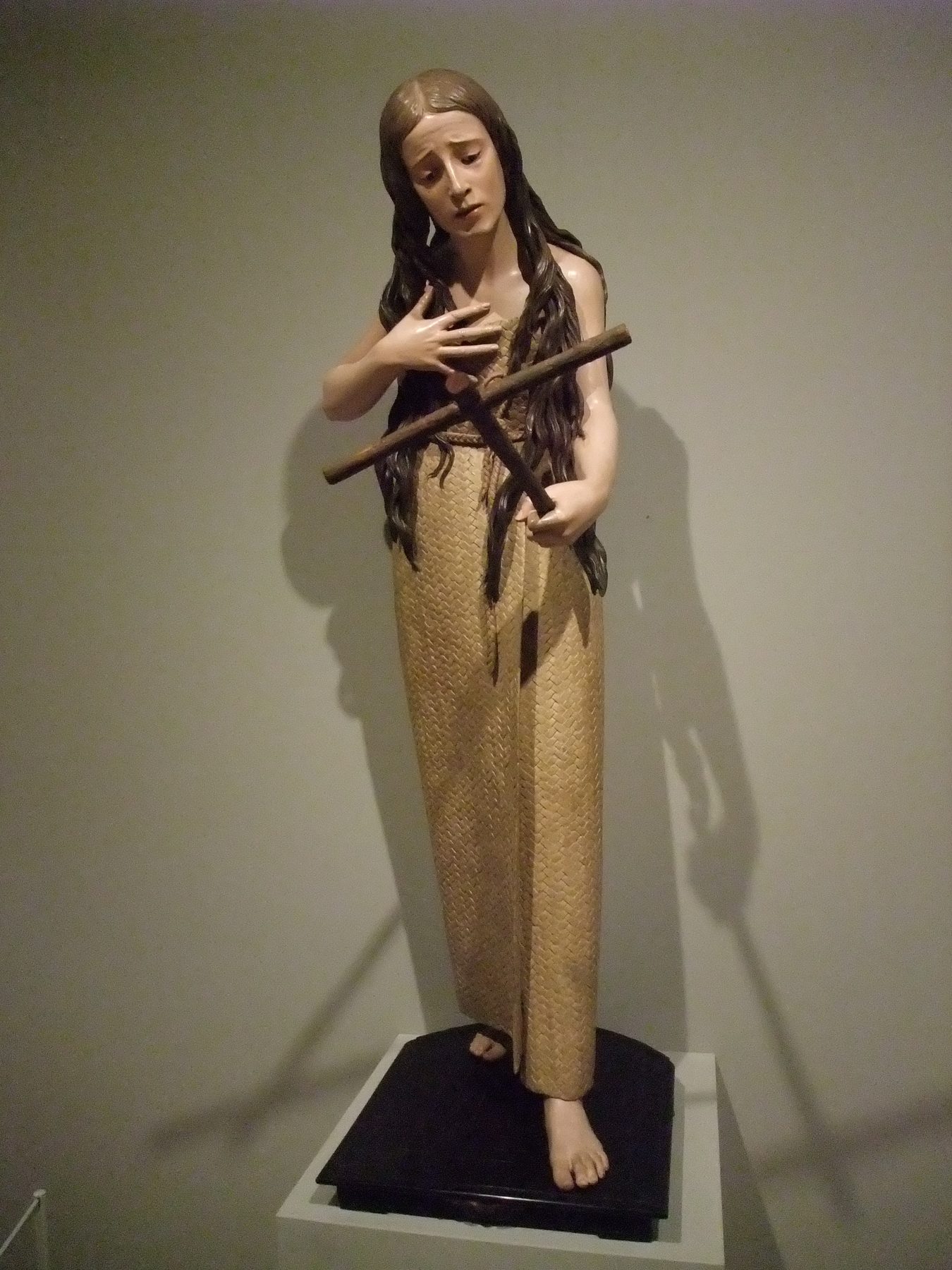
Gregorio Fernández’s processional and recumbent figures make stillness as powerful as action. His dead Christs expose wounds and weight while controlling the rhythm of the entire body. In Seville, Juan Martínez Montañés’s carvings show why Velázquez could honour him in a portrait: sculpture demanded design, anatomy, surface planning and command of collaborators. Alonso Cano moved among painting, sculpture and architecture; Pedro de Mena distilled grief and penitence into compact figures intended for close approach.
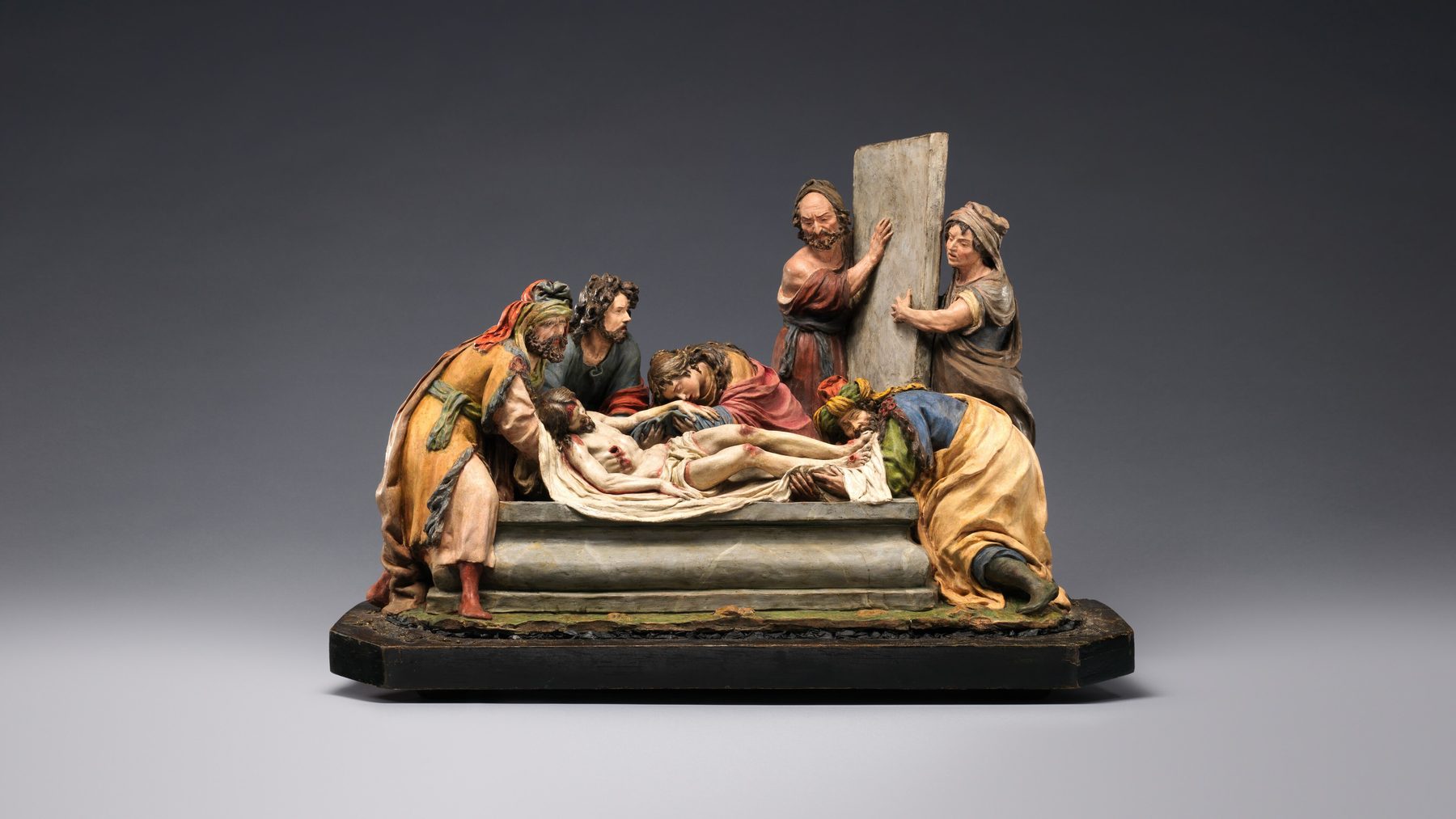
Luisa Roldán belongs at the centre of this story. Born into the workshop of Pedro Roldán in Seville, she developed a career in carved wood and small terracotta groups before serving as sculptor to Charles II and continuing under Philip V. Her crowded terracottas convert clay into colour, gesture and intimate narrative, while larger wooden works show command of public devotional scale.[45] [46] She was the first Spanish woman associated with the Accademia di San Luca, but exceptional honours did not guarantee financial security or accurate later attribution.
Roldán’s works were long assigned to her father, husband or other male sculptors. Archival recovery has helped rebuild her authorship and professional identity.[47] Her example changes more than a list of “women artists.” It reveals how family workshops could train and obscure makers, how signatures and documents affect the canon, and how the category of independent artist has been applied unevenly.
Murillo and later Seville
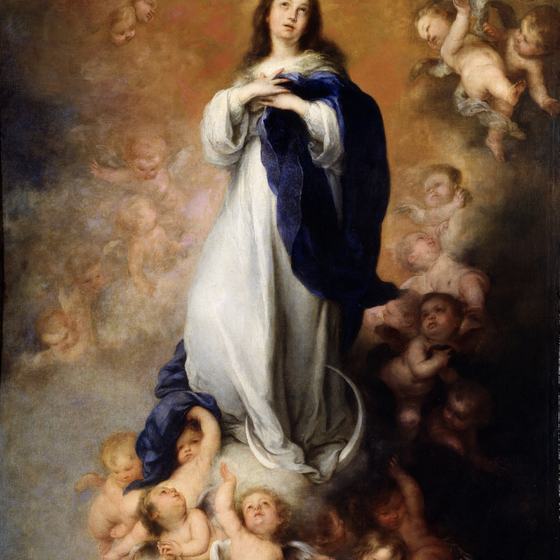
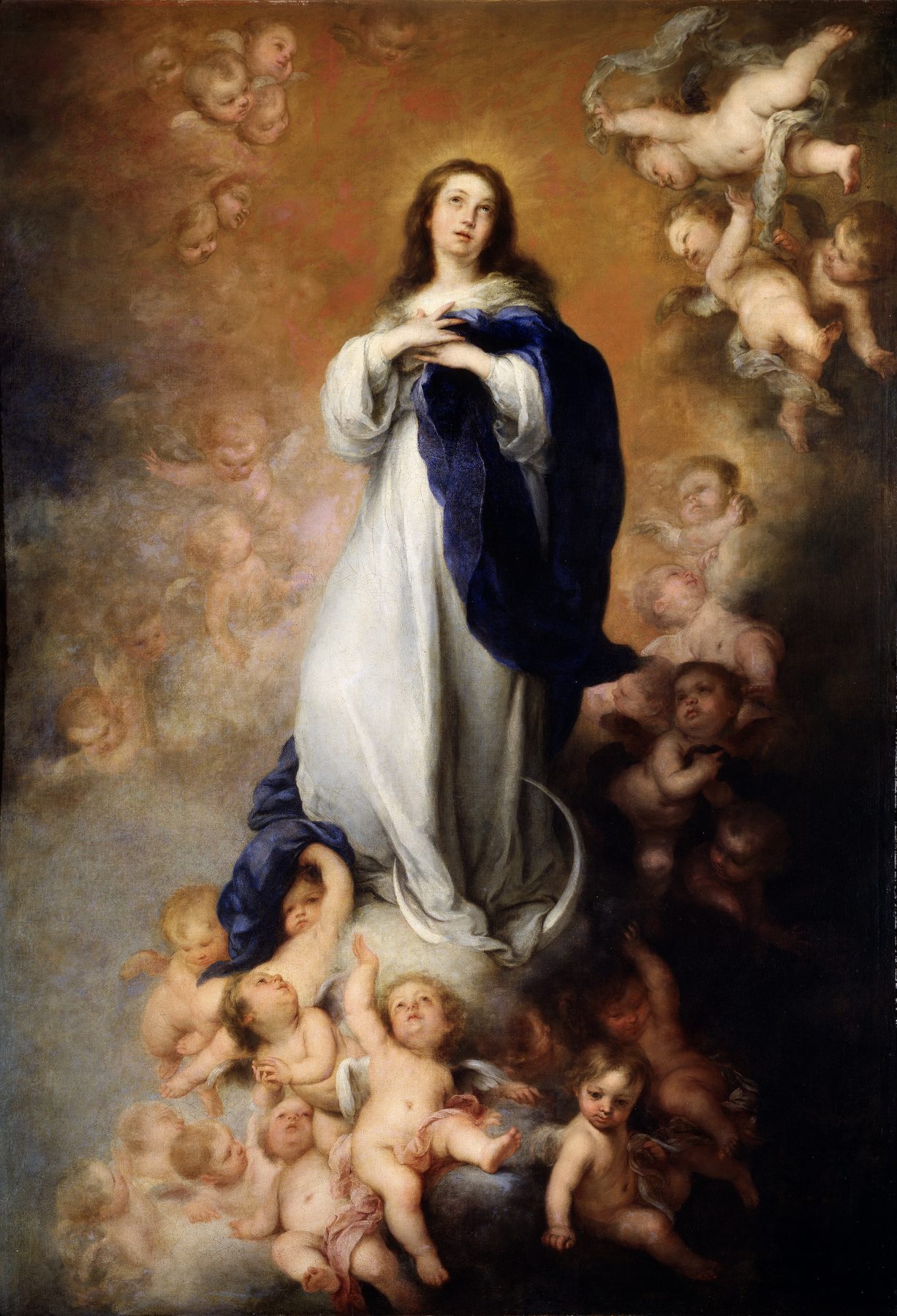
Bartolomé Esteban Murillo became Seville’s leading painter in the decades after the 1649 plague. His art is often recognised by soft light, fluid edges and tender expression, especially in images of the Immaculate Conception and the Virgin and Child. Those qualities made him extraordinarily admired from the late seventeenth through the nineteenth century. They also encouraged later critics to dismiss him as merely sweet. Both fame and reaction flatten a more varied artist.
Murillo painted devotional pictures, large narrative cycles, portraits and scenes of working or impoverished children. He designed with drawings and repeated studies rather than relying on unplanned feeling. In 1660 he helped establish a drawing academy in Seville, creating a shared setting for artists to work from the model.[25] [29] The academy did not erase workshops or guilds, but it made collective instruction and painting’s intellectual claims newly visible.
His religious pictures persuade through human sequence. Hands touch, bodies lean, faces respond and light clarifies a moment of recognition. The Immaculate Conception lifts a youthful Virgin in spiralling movement, translating a doctrine fiercely defended in Spain into an accessible image. Domestic holy families bring sacred figures near ordinary affection. These are not neutral expressions of popular faith; they are highly designed responses to patrons, sites and devotional habits.
Looking closely at The Return of the Prodigal Son
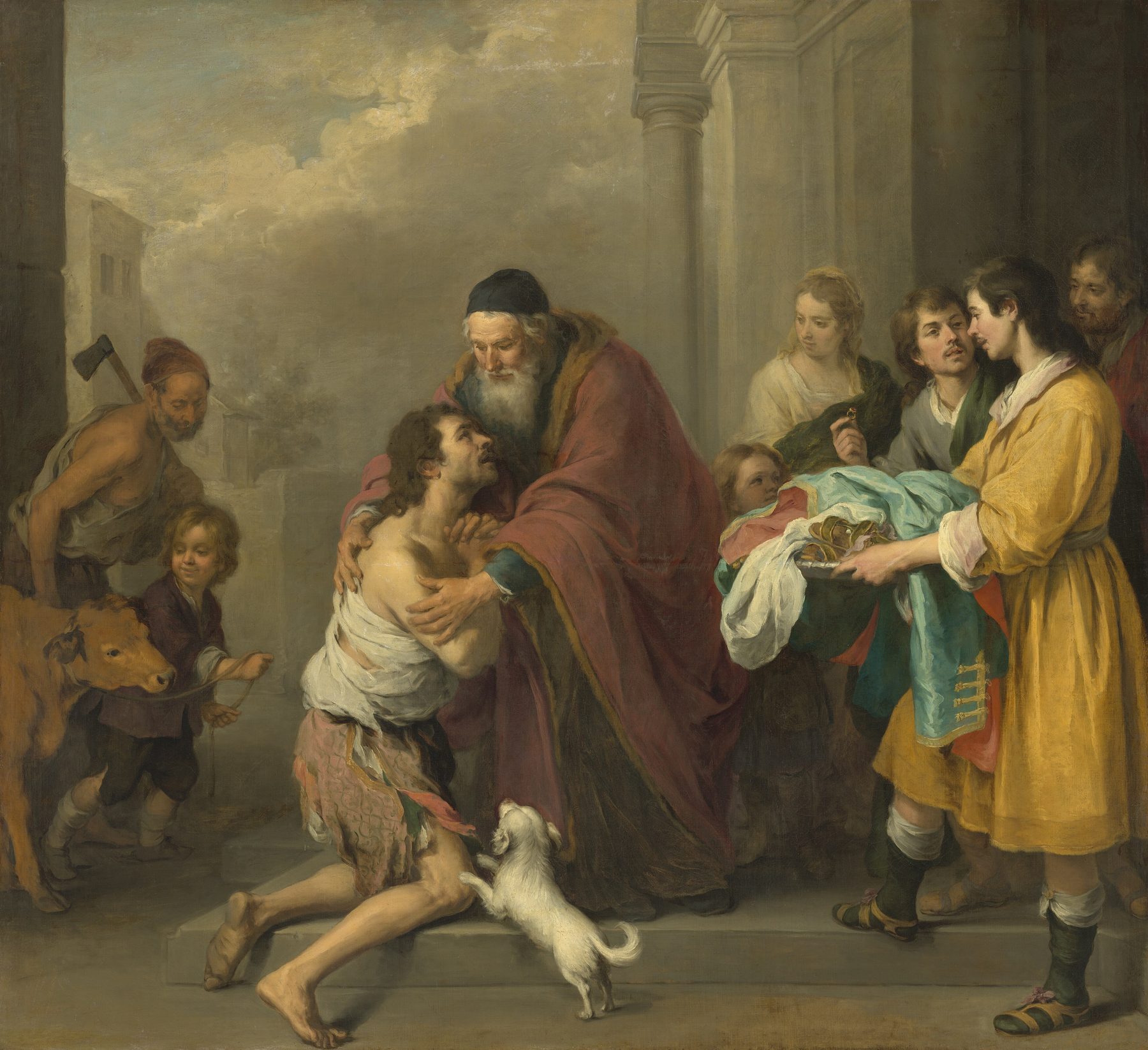
Murillo painted The Return of the Prodigal Son as one of eight large canvases for the church of the Hospital de la Caridad in Seville. The institution cared for the homeless and hungry, and its programme joined biblical acts of mercy to charitable identity.[27] The returning son collapses into his father’s embrace at the centre. Servants carry a robe and ring; the calf for the feast approaches; a small dog adds a burst of recognition near the ground.
The composition moves from exposure to restoration. The son’s dirty feet and ragged clothing remain visible while rich fabric arrives from the side. The father’s broad body forms shelter before any material gift reaches the son. Figures and props are distributed like a stage, but the varied speeds—kneeling, leaning, walking, jumping—prevent the scene from becoming static. Murillo’s surviving drawings and associated series reveal narrative calculation beneath apparent ease.[28]
Charity here has an institutional audience. Members of the brotherhood could see their works reflected in the father’s welcome, while people receiving aid encountered an image that framed need through repentance and paternal forgiveness. A close reading should preserve the painting’s compassion without ignoring this imbalance of power.
Murillo’s household also complicates the image of a gentle private genius. Research describes a prosperous workshop with pupils, servants and an enslaved person, within a city where slaveholding was not exceptional.[26] The works emerged from organised labour and a deeply unequal urban society. His Three Boys makes those tensions difficult to avoid. The central child has sometimes been identified through racialised titles, but the sitter’s precise identity and legal status are not known. The painting can support questions about Black presence, poverty and looking without turning uncertainty into biography.[31]
Seville’s openness to foreign merchants also shaped taste. Comparisons among Velázquez, Rembrandt, Vermeer and their circles show that supposedly national schools shared subjects, formats and commercial contacts.[30] Murillo’s genre scenes appealed strongly to northern European collectors. His late success therefore belonged to an international market as well as local devotion.
Labour, race, gender and empire
Golden Age art has often been told through a sequence of named male masters. That structure hides the workshops that made production possible. Apprentices ground pigments, prepared canvases, copied designs and assisted with repetitions. Family members managed households and businesses. Carvers and polychromers shared sculptural work. Printers, merchants, shippers and agents moved images. Some workshop labourers were enslaved.
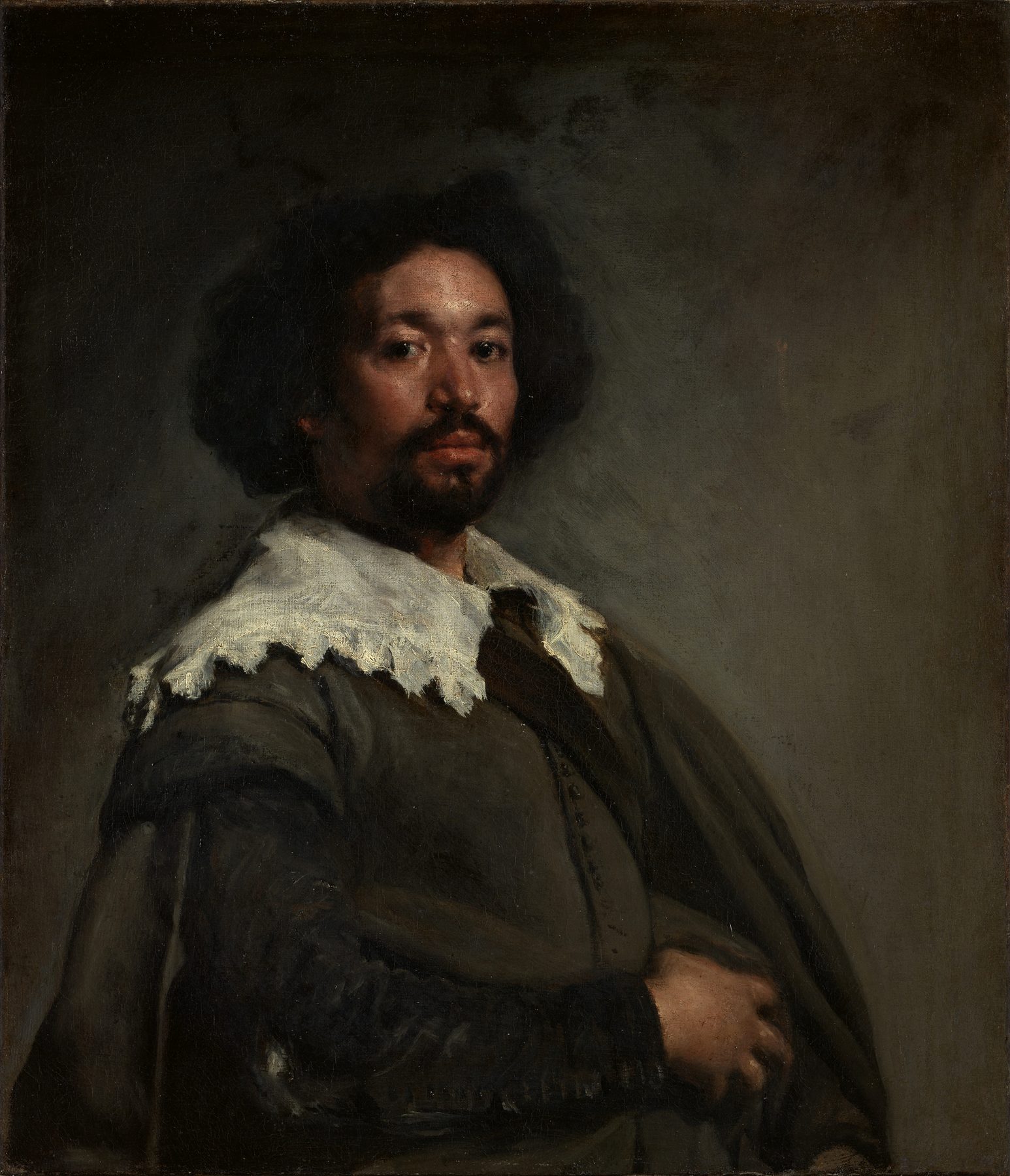
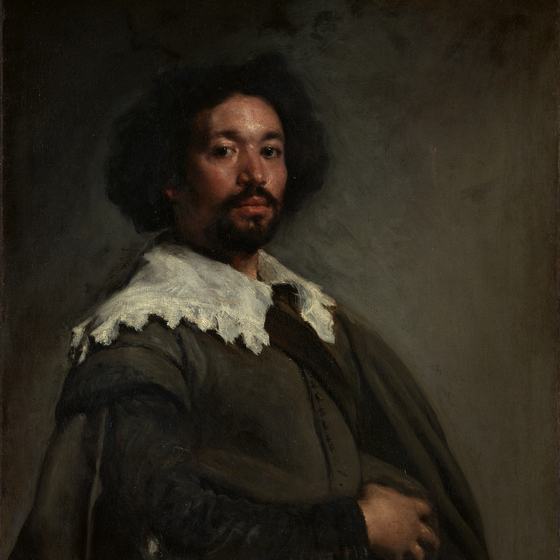
Juan de Pareja makes that hidden system visible. An Afro-Hispanic man, he worked in Velázquez’s household and studio while legally enslaved for more than two decades. Velázquez signed a manumission document in Rome in 1650, with freedom to take effect four years later. Pareja then built an independent career in Madrid, participating in the painting culture of the 1660s.[40] [41] Current scholarship replaces a comforting anecdote of a benevolent master discovering a secret talent with evidence about bondage, skilled labour and professional persistence.
Velázquez’s Juan de Pareja, displayed in Rome in 1650, is among the period’s most commanding portraits. The sitter turns slightly while meeting the viewer with direct, controlled attention. Broad paint describes dark clothing, a white collar and a face alive with reserve. Contemporary admiration for the portrait’s lifelikeness was also admiration for Velázquez. The sitter who enabled that triumph remained enslaved when the work was shown.[42] Visual dignity and legal coercion coexist; one must not be used to erase the other.
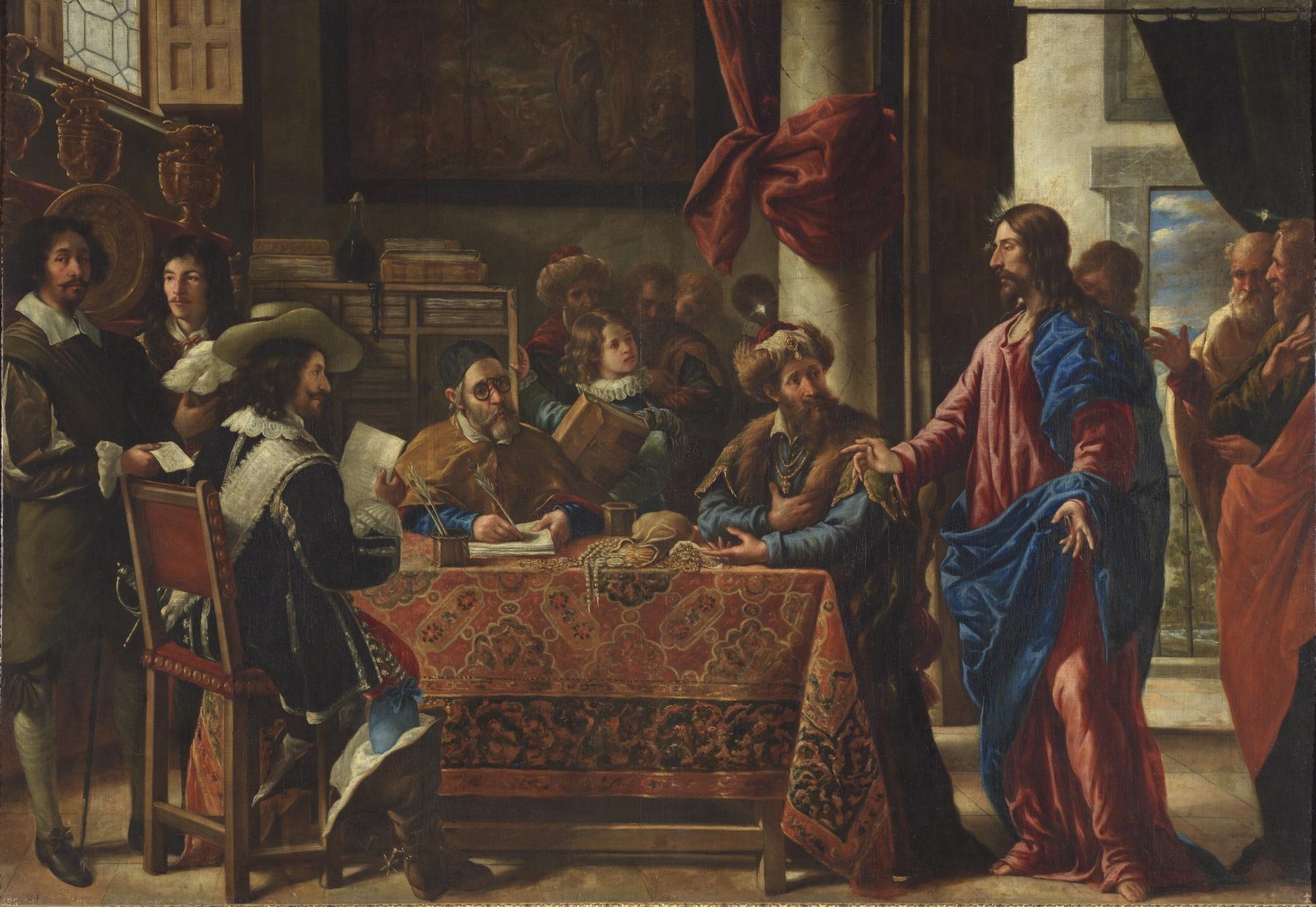
Pareja’s later Calling of Saint Matthew asserts his own status. The biblical conversion unfolds across a large, richly coloured composition, and Pareja includes himself at the edge holding a paper that identifies his authorship.[44] The gesture participates in the long Golden Age argument that painting was learned, inventive work. It also asks the canon to recognise an artist once remembered chiefly as another painter’s property.
Pareja was not an isolated anomaly. Prado research notes enslaved people in the workshops or households of Pacheco, Alonso Cano and Murillo as well as Velázquez.[43] Black confraternities, free and enslaved Africans, and mixed communities formed part of Seville’s religious and material culture. Their presence should not be treated as a modern addition to an otherwise complete story; it changes how we understand production, patronage and representation.
Gender shaped visibility differently. Luisa Roldán gained royal appointment, yet later attribution repeatedly folded her work into male careers. Women in family workshops could participate without receiving contracts or signatures under their own names. At the earlier edge of the period, Sofonisba Anguissola’s service at the Spanish court demonstrated that a woman could achieve international standing, although her position and chronology differ from Roldán’s.[47] The evidence does not justify inventing a large hidden canon, but it does require attention to the archival systems that made some authors legible and others difficult to recover.
Empire linked these inequalities across oceans. Silver, pigments, textiles, luxury goods and people moved through coercive as well as commercial systems. Seville sent paintings and sculpture to the Americas, while knowledge, objects and makers also travelled back toward Europe. Artists in New Spain, Peru and other viceroyalties adapted imported prints and pictures within local workshops, materials, devotional cultures and political conditions.[23] [24] “Spanish Golden Age” should therefore name one influential node in a connected world, not claim ownership of everything made under Spanish rule.
The afterlife of the Spanish school
The central generation ended gradually. Velázquez died in 1660, Zurbarán in 1664 and Murillo in 1682. Roldán’s court career continued into the reign of Philip V. Workshops, devotional types and late Baroque sculpture did not stop at 1685 or 1700. What changed were patronage systems, dynastic politics and later ways of classifying the past.
Many works now considered canonical were not broadly visible outside Spain during their makers’ lives. Velázquez painted largely for royal palaces. Monastic cycles and sculpture remained tied to institutions. War and collecting altered that geography. During the Napoleonic occupation, military looting and sales dispersed Spanish religious painting. Louis-Philippe’s Galerie Espagnole opened at the Louvre in 1838, presenting works that helped French viewers imagine a coherent “Spanish school.”[48]
The discovery came through violence and selective display. Murillo, Zurbarán, Ribera, Velázquez and later Goya were arranged into a national tradition, while regional, workshop and colonial differences receded. French Romantic and Realist artists valued the pictures’ dark grounds, direct figures, abbreviated brushwork and supposedly anti-academic truth. Manet’s engagement with Velázquez and Spanish subjects became especially influential.[49]
El Greco’s modern recovery followed a different path. Once treated as an eccentric whose late style reflected decline or defective vision, he became a model for expressive distortion and a figure in debates about Spanish identity. Modern museums and catalogues continued the process by changing attributions, reconstructing provenance and bringing once-separated works into new comparisons.[50] The Golden Age we see today is therefore both a seventeenth-century achievement and a later construction.
How to look at Spanish Golden Age art
Begin with place. Was the work made for a palace, a high altar, a convent corridor, a private room, a hospital chapel or a procession? Museum lighting and eye-level hanging may reverse its original conditions.
Then examine light. Does illumination enter from a believable source, isolate a sacred event, describe a material or connect separate zones? Darkness is not automatically tenebrism and not proof of a national temperament.
Notice materials. Thin paint, thick impasto, a brown ground, gilded estofado, glass eyes and real fabric create different kinds of presence. Ask which specialists made the surface and how collaboration has been recorded.[39]
Follow hands and gazes. In Velázquez and Murillo, attention often travels through a chain of looks, touches and exchanges. A hand may confer rank, offer charity, perform work, demand silence or expose uncertainty.
Look for borrowed images. A composition may transform Titian, Rubens or a printed source. Influence is not failure of originality; the significant question is what changed in a new medium, place and function.
Finally, consider labour and later history. Who prepared, carved, painted, transported or posed? Was someone enslaved? Has the object been cut, enlarged, looted, reattributed or retitled? The work’s history did not end when the artist put down the brush.
Artists and places to know
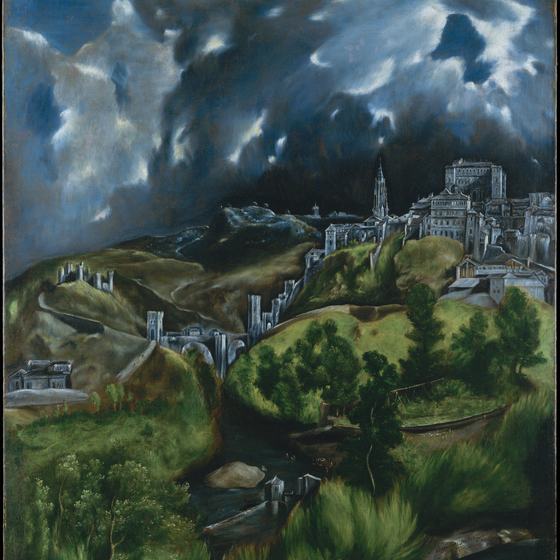
El Greco
Cretan-born, Italian-trained painter whose Toledo workshop created an unmistakable language of elongated form, flashing colour and compressed sacred space.
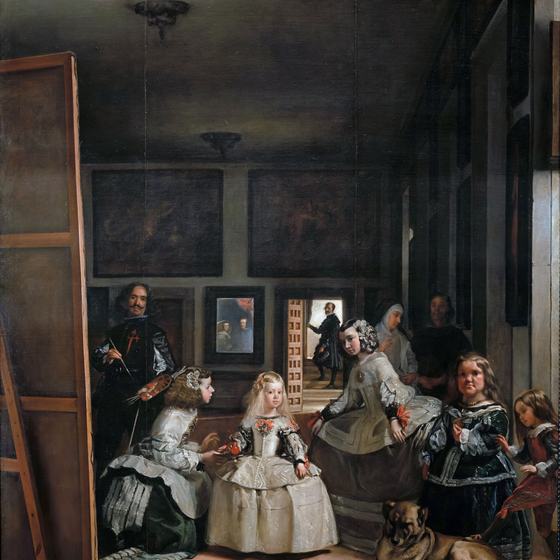
Diego Velázquez
Sevillian naturalist and court painter who transformed portraiture, mythology, history and the depiction of artistic labour.
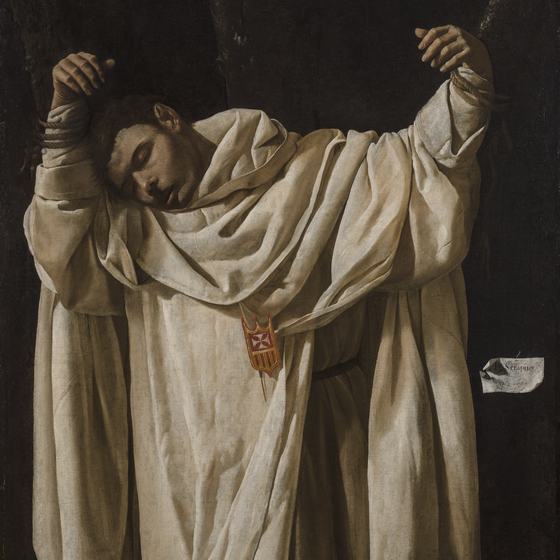
Francisco de Zurbarán
master of monumental religious figures, textiles, still life and workshop series, with important court and transatlantic connections.
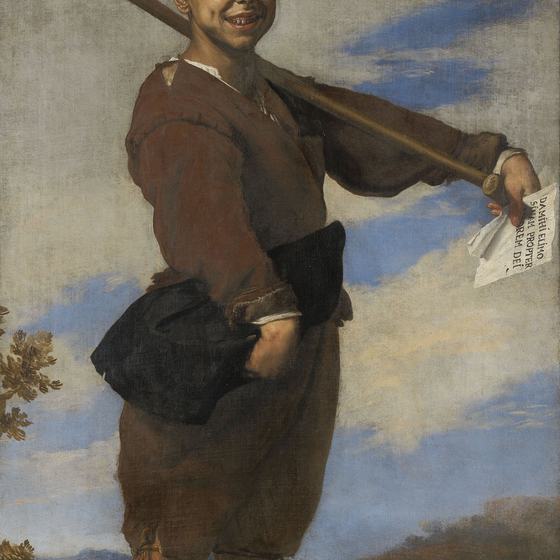
Jusepe de Ribera
Spanish-born, Naples-based painter and printmaker whose tactile naturalism expanded into radiant colour and learned subjects.
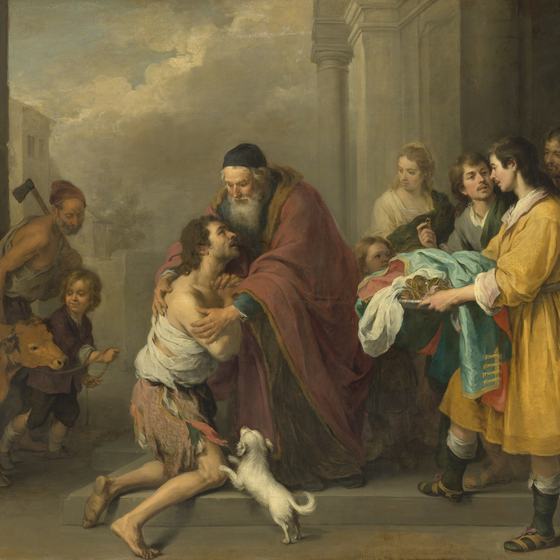
Bartolomé Esteban Murillo
later Sevillian painter of devotional narratives, Immaculate Conceptions, portraits and genre scenes, and co-founder of a drawing academy.
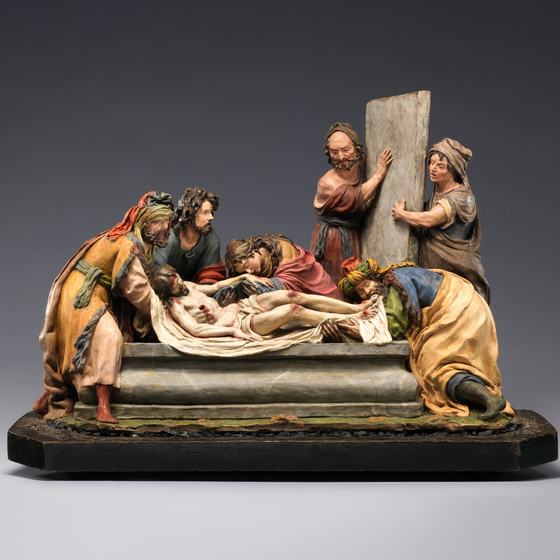
Luisa Roldán
Sevillian sculptor in wood and terracotta who became a royal sculptor and whose authorship has been substantially recovered.
Further artists and places
Juan Sánchez Cotán
early master of independent still life whose pantry-window arrangements make gravity and interval pictorial subjects.
Juan van der Hamen y León
Madrid still-life and portrait painter known for courtly abundance, flowers, sweets and luxury vessels.
Juan Martínez Montañés
leading Sevillian sculptor whose carved figures joined ideal design to persuasive sacred presence.
Gregorio Fernández
central Castilian sculptor of altarpiece and processional figures, especially forceful images of the Passion.
Alonso Cano
painter, sculptor and architect active in Seville, Madrid and Granada.
Pedro de Mena
Granada- and Málaga-based sculptor of concentrated devotional figures.
Juan de Pareja
Afro-Hispanic painter who emerged from enslavement in Velázquez’s workshop to an independent Madrid career.
Madrid
royal court, palace decoration, diplomatic exchange and the collections through which Velázquez studied Titian and Rubens.
Seville
Atlantic port, religious and commercial centre, home to Pacheco, Velázquez, Zurbarán, Montañés and Murillo.
Toledo
ecclesiastical and intellectual city where El Greco established his mature career and workshop.
Valencia
important centre of Ribalta’s naturalism and the early formation of Ribera.
Valladolid
major centre for Castilian polychrome sculpture and Gregorio Fernández.
Granada
centre associated with Alonso Cano, Pedro de Mena and a refined sculptural tradition.
Naples
Spanish-governed, internationally connected city in which Ribera made his mature career.
The American viceroyalties
distinct artistic worlds connected to Seville through commissions, shipping, prints, materials and migrating makers.
Major artists directory
| Name | Nationality | Key Works |
|---|---|---|
| Alonso Cano | Spanish | Immaculate Conception, Saint James the Greater |
| Bartolomé Esteban Murillo | Spanish | The Return of the Prodigal Son, Three Boys, The Immaculate Conception of Los Venerables |
| Claudio Coello | Spanish | Adoration of the Holy Sacrament |
| Diego Velázquez | Spanish | Old Woman Frying Eggs, The Waterseller of Seville, The Surrender of Breda, Las Meninas, Las Hilanderas, Philip IV, Juan de Pareja |
| El Greco | Greek · Spanish | View of Toledo, The Burial of the Count of Orgaz |
| Francisco de Zurbarán | Spanish | Saint Serapion, Still Life with Vessels, Saint Margaret of Antioch |
| Francisco Pacheco | Spanish | Last Judgement |
| Francisco Ribalta | Spanish | Christ Embracing Saint Bernard |
| Gregorio Fernández | Spanish | The Dead Christ |
| Herrera the Younger | Spanish | Triumph of Saint Hermenegild |
| Juan Bautista Maíno | Spanish | The Adoration of the Shepherds |
| Juan Carreño de Miranda | Spanish | Charles II |
| Juan de Pareja | Spanish | The Calling of Saint Matthew |
| Juan Martínez Montañés | Spanish | Christ of Clemency, Saint Bruno |
| Juan Sánchez Cotán | Spanish | Quince, Cabbage, Melon and Cucumber, Still Life with Game, Vegetables and Fruit |
| Juan van der Hamen y León | Spanish | Still Life with a Basket and Sweetmeats |
| Jusepe de Ribera | Spanish | The Clubfooted Boy, Archimedes |
| Luisa Roldán | Spanish | The Entombment of Christ |
| Pedro de Mena | Spanish | The Penitent Magdalene |
Where to see Spanish Golden Age art
These institutions offer especially strong and complementary routes through painting, sculpture, regional production and court culture. Displays and loans change, so check official collection information before travelling.
Museo Nacional del Prado
Madrid, Spain
The defining collection for Velázquez, El Greco, Zurbarán, Ribera, Murillo, Maíno, still life and royal patronage.
Painting and court cultureOfficial collection informationMuseo Nacional de Escultura
Valladolid, Spain
The strongest concentrated route into Spanish polychrome sculpture, retablos and processional objects.
Polychrome sculptureOfficial collection informationMuseo de Bellas Artes de Sevilla
Seville, Spain
A major regional collection for Zurbarán, Murillo, Pacheco, Valdés Leal and the institutions of Sevillian art.
Sevillian paintingOfficial collection informationMuseo del Greco
Toledo, Spain
A focused introduction to El Greco’s Toledo career, workshop, patrons and later reception.
El Greco and ToledoOfficial collection informationNational Gallery
London, United Kingdom
Important paintings by Velázquez, Zurbarán, Murillo and Ribera, with influential exhibitions on sacred realism.
International collectionOfficial collection informationMetropolitan Museum of Art
New York, United States
Home to View of Toledo and Velázquez’s Juan de Pareja, with major research on Pareja and Spanish painting.
El Greco, Velázquez and ParejaOfficial collection information
Landmark Spanish Golden Age exhibitions
Six exhibitions that materially changed how the period, its media and its social histories are understood.
El Greco
Metropolitan Museum of Art, New York
A major international reassessment of El Greco’s Cretan, Italian and Spanish career.
Manet/Velázquez: The French Taste for Spanish Painting
Metropolitan Museum of Art, New York
A landmark account of nineteenth-century rediscovery, collecting and the construction of a Spanish school.
The Sacred Made Real
National Gallery, London and National Gallery of Art, Washington
An influential reunion of painting and polychrome sculpture that restored materials, collaboration and ritual encounter to the story.
Velázquez, Rembrandt, Vermeer: Parallel Visions
Museo Nacional del Prado, Madrid
A comparative exhibition that replaced isolated national schools with shared seventeenth-century problems of realism and representation.
Murillo’s The Prodigal Son and the Art of Narrative
Museo Nacional del Prado, Madrid
A focused study of Murillo’s drawing, narrative planning and the charitable context of his mature Seville commissions.
Juan de Pareja: Afro-Hispanic Painter
Metropolitan Museum of Art, New York
The first major exhibition centred on Pareja revised the period through slavery, Black communities, labour and independent authorship.
Frequently Asked Questions
No. It was not an organised group with shared membership or a manifesto. The term is a later umbrella for a period containing several regional schools, generations and styles.
For visual art, approximately 1570–1685 is a useful core. Broader accounts may begin earlier in the sixteenth century or continue to the end of Habsburg rule in 1700.
They overlap substantially, especially in the seventeenth century, but they are not identical. The Golden Age includes El Greco’s late-Renaissance and Mannerist formation, while Spanish Baroque can extend beyond the core period.
Churches, religious orders, confraternities and charitable institutions were major patrons. Sacred images served altars, convents, hospitals, private devotion and public processions. Court, mythological, still-life, portrait and genre painting nevertheless remained important.
No. Artists such as Maíno and Ribera had direct Italian experience, but Valencia, Seville, Toledo, Madrid and Naples developed different naturalisms. Zurbarán and Velázquez transformed wider European ideas through local training, materials and patrons.
It is both an extraordinary court portrait and a complex meditation on looking, representation, rank and the painter’s position. Its mirror, doorway, glances and unseen canvas sustain several plausible readings rather than one final solution.[14]
Enslaved people worked in Spanish households and artists’ workshops, including Juan de Pareja in Velázquez’s studio. Atlantic trade moved works, materials, money and people between Seville and the Americas. Art from the viceroyalties developed through connected but distinct local histories.[23] [40] [43]
Discussion
Which Spanish Golden Age work most changes when you imagine it in its original setting rather than a museum: a Velázquez court portrait, a Zurbarán convent figure, a Murillo hospital canvas or a polychrome sculpture moving through the streets? Consider what light, distance, ritual, labour and audience add to the encounter.
Reader Insights
Ask whether the work belonged to a palace, retablo, convent, hospital, procession or private room before judging its visual choices.
Look for wood, paint, glass, fabric, ground colour and brushwork as active makers of presence rather than neutral carriers.
Notice workshops, servants, enslaved people, artisans and sitters whose work or status complicates the image’s authority.
Join the Conversation
Which work most changes your idea of what the Spanish Golden Age contained?
References
- Museo Nacional del Prado, “Velázquez y el Siglo de Oro”, museodelprado.es. View Source
- Museo Nacional del Prado, “Spanish Painting”, museodelprado.es. View Source
- Biblioteca Virtual Miguel de Cervantes, “Introducción a la literatura hispánica del tiempo de los novatores”, cervantesvirtual.com. View Source
- Museo Nacional del Prado, “Retrato de España: Obras maestras del Prado”, museodelprado.es. View Source
- Museo Nacional de Escultura, “Spanish Sculpture”, cultura.gob.es. View Source
- Museo Nacional de Escultura and National Gallery London, Lo sagrado hecho real, cultura.gob.es. View Source
- Museo Nacional de Escultura, Guía de la visita, cultura.gob.es. View Source
- Museo Nacional del Prado, “El Greco”, museodelprado.es. View Source
- Museo del Greco, “El Greco”, cultura.gob.es. View Source
- Museo del Greco, “El Greco rooms”, cultura.gob.es. View Source
- National Gallery of Art Washington, “El Greco provenance research”, nga.gov. View Source
- Metropolitan Museum of Art, “View of Toledo”, metmuseum.org. View Source
- Metropolitan Museum of Art, “El Greco”, metmuseum.org. View Source
- Museo Nacional del Prado, “Las Meninas”, museodelprado.es. View Source
- Museo Nacional del Prado, “Las Hilanderas o la fábula de Aracne”, museodelprado.es. View Source
- Museo Nacional del Prado, “Salón de Reinos”, museodelprado.es. View Source
- Museo Nacional del Prado, “El palacio del Rey Planeta”, museodelprado.es. View Source
- Museo Nacional del Prado, “Mythological Passions”, museodelprado.es. View Source
- Metropolitan Museum of Art, “Velázquez 1599–1660”, metmuseum.org. View Source
- Museo Nacional del Prado, “Felipe IV anciano”, museodelprado.es. View Source
- Museo Nacional del Prado, “Zurbarán, Francisco de”, museodelprado.es. View Source
- Musée du Louvre, “Zurbarán 1598–1664”, louvre.fr. View Source
- Museo de América, “Artistic commerce between Seville and the Indies”, cultura.gob.es. View Source
- Museo Nacional del Prado, “Painting from the Viceroyalties: Shared Identities”, museodelprado.es. View Source
- Museo Nacional del Prado, “Murillo, Bartolomé Esteban”, museodelprado.es. View Source
- Museo Nacional del Prado, “Murillo, Bartolomé Esteban”, museodelprado.es. View Source
- National Gallery of Art Washington, “The Return of the Prodigal Son”, nga.gov. View Source
- Museo Nacional del Prado, “Murillo's The Prodigal Son and the Art of Narrative”, museodelprado.es. View Source
- Museo Nacional del Prado, “Spanish Drawings from the Hamburger Kunsthalle”, museodelprado.es. View Source
- Museo Nacional del Prado, “Velázquez, Rembrandt, Vermeer: Parallel Visions”, museodelprado.es. View Source
- Dulwich Picture Gallery, “Three Boys”, dulwichpicturegallery.org.uk. View Source
- Museo Nacional del Prado, “Bodegón de caza, hortalizas y frutas”, museodelprado.es. View Source
- Museo Nacional del Prado, “Still Life with Fruit and Vegetables”, museodelprado.es. View Source
- Museo Nacional del Prado, “Still Life with a Basket and Sweetmeats”, museodelprado.es. View Source
- Metropolitan Museum of Art, “Still-Life Painting in Southern Europe, 1600–1800”, metmuseum.org. View Source
- Museo Nacional del Prado, “El bodegón español en el Prado”, museodelprado.es. View Source
- Biblioteca Nacional de España, “Miradas sobre los museos: Pacheco and Zurbarán”, bne.es. View Source
- Biblioteca Nacional de España, “El libro ilustrado español II: los grabados”, bne.es. View Source
- Museo Nacional del Prado, “Evolución de las preparaciones en la pintura de los siglos XVI y XVII en España”, museodelprado.es. View Source
- Metropolitan Museum of Art, “Juan de Pareja, Afro-Hispanic Painter”, metmuseum.org. View Source
- Metropolitan Museum of Art, Juan de Pareja: Afro-Hispanic Painter in the Age of Velázquez, metmuseum.org. View Source
- Metropolitan Museum of Art, “Juan de Pareja”, metmuseum.org. View Source
- Museo Nacional del Prado, “El esclavo del pintor”, museodelprado.es. View Source
- Museo Nacional del Prado, “La vocación de san Mateo”, museodelprado.es. View Source
- Museo Nacional de Escultura, “Luisa Roldán, escultora real”, cultura.gob.es. View Source
- Museo Nacional de Escultura, “Luisa Roldán catalogue”, cultura.gob.es. View Source
- Centro de Información Documental de Archivos, “Mujeres pioneras: Luisa Roldán y Sofonisba Anguissola”, cultura.gob.es. View Source
- Museo Nacional del Prado, “Galería Española de Luis Felipe en el Louvre”, museodelprado.es. View Source
- Metropolitan Museum of Art, “Manet/Velázquez: The French Taste for Spanish Painting”, metmuseum.org. View Source
- National Gallery of Art Washington, Spanish Paintings of the Fifteenth through Nineteenth Centuries, nga.gov. View Source
- Image references 51–75: open-access reproductions and institutional collection records.
View 25 image sources
01 · commons.wikimedia.org02 · commons.wikimedia.org03 · commons.wikimedia.org04 · commons.wikimedia.org05 · commons.wikimedia.org06 · commons.wikimedia.org07 · commons.wikimedia.org08 · commons.wikimedia.org09 · commons.wikimedia.org10 · commons.wikimedia.org11 · commons.wikimedia.org12 · commons.wikimedia.org13 · commons.wikimedia.org14 · commons.wikimedia.org15 · commons.wikimedia.org16 · commons.wikimedia.org17 · commons.wikimedia.org18 · commons.wikimedia.org19 · commons.wikimedia.org20 · commons.wikimedia.org21 · commons.wikimedia.org22 · commons.wikimedia.org23 · commons.wikimedia.org24 · commons.wikimedia.org25 · commons.wikimedia.org
More ART Movements
French Baroque