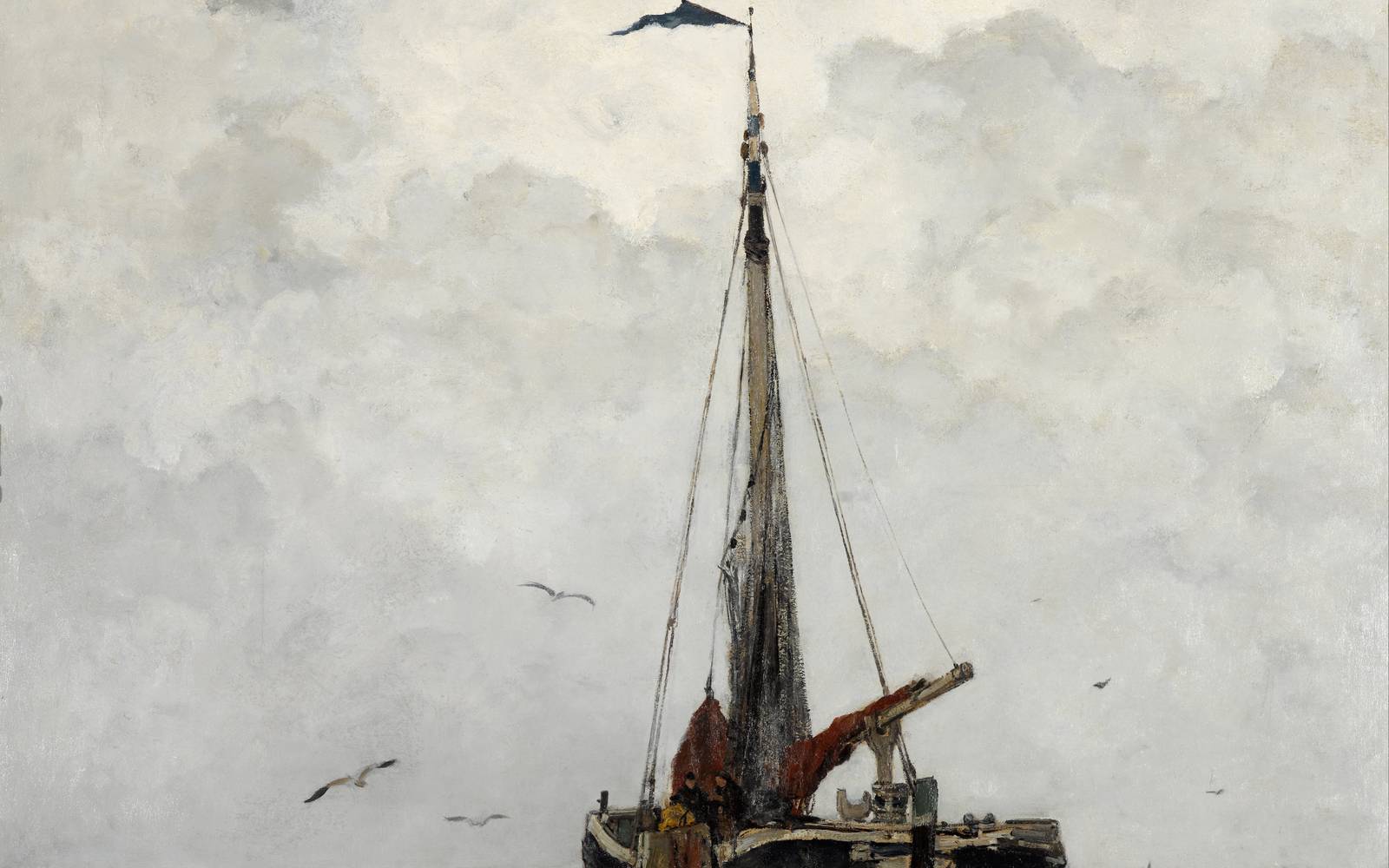
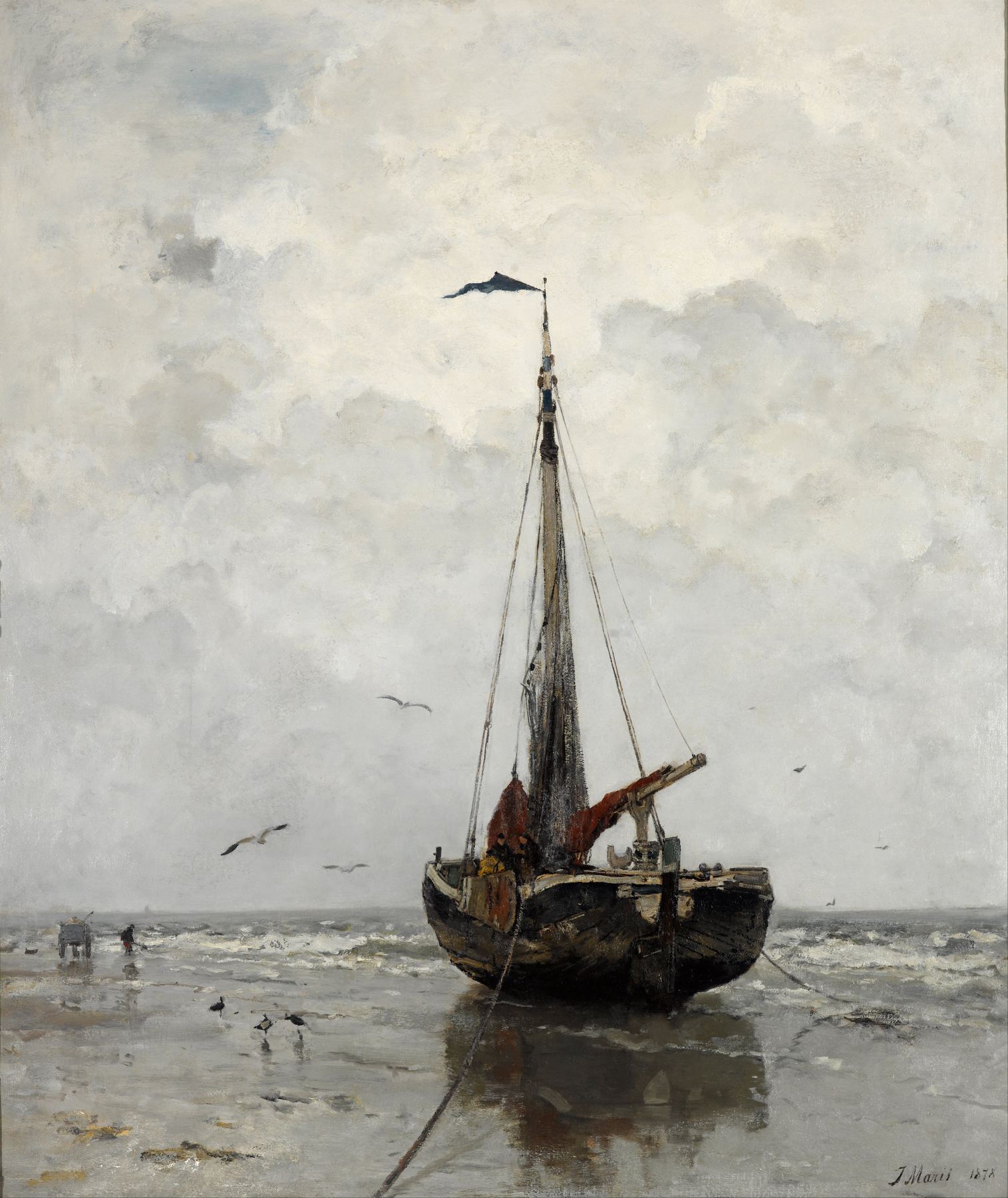
Image reference: Fishing Boat by Jacob Maris.
At a Glance
- Main periodApproximately 1860–1900
- Name introduced1875, by the critic Jacob van Santen Kolff
- Principal centreThe Hague, with important connections to Scheveningen, Oosterbeek, Laren, Brussels, Paris and Barbizon
- Leading artistsThe Maris brothers, Israëls, Mauve, Weissenbruch, Mesdag, Roelofs, Gabriël and Bosboom
- Important womenSientje Mesdag-van Houten and Geesje Mesdag-van Calcar; Suze Robertson belongs to the school's productive edge and afterlife
- Known forColoured greys, broad skies, reflected light, wet atmosphere, loose touch and everyday subjects
- Principal mediaOil paint, watercolour, drawing and the panoramic environment
- Key institutionsPulchri Studio, the Hollandsche Teeken-Maatschappij and the artist-led initiative behind today's Kunstmuseum Den Haag
- International marketsEspecially Britain, continental Europe and the United States
- Essential qualificationA critical and historical category, not a manifesto-led society
Contents
- Where it fits
- How the school was named
- What realism meant
- Romanticism and Barbizon
- Institutions and public
- The colours of grey
- Labour and sympathy
- Mesdag and the panorama
- Essential works
- Where to see it
Where the Hague School fits
Johannes Bosboom
Key career periodWillem Roelofs
Key career periodJozef Israëls
Key career periodJacob Maris
Key career periodAnton Mauve
Key career periodJan Hendrik Weissenbruch
Key career periodHendrik Willem Mesdag
Key career periodSientje Mesdag-van Houten
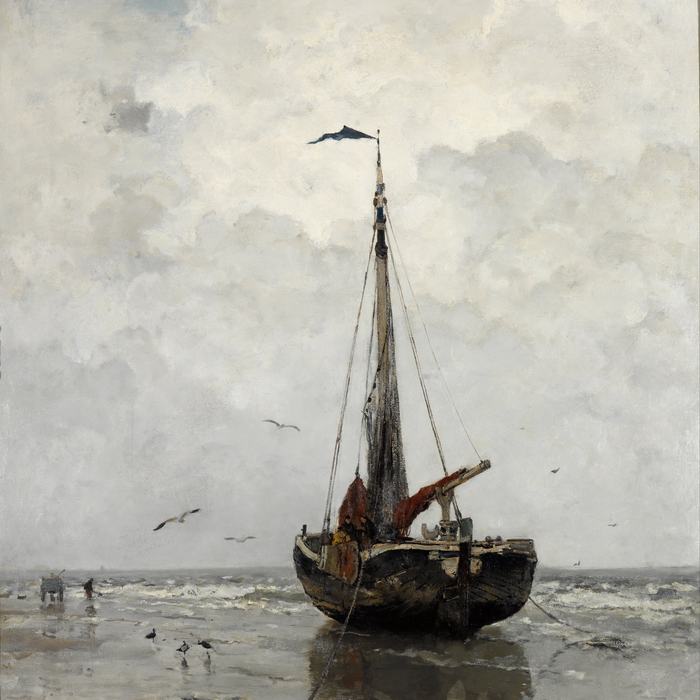
Key career periodIn Jacob Maris’s Bomschuit, a bluff-bowed fishing boat stands on wet Scheveningen sand beneath an enormous sky. The vessel is heavy enough to feel immovable, yet its mast, blue pennant and reflection draw a vertical thread through the pale atmosphere. Three fishermen on deck and a shell gatherer beside a cart are tiny against the cloud. Labour is present, but weather decides the scale of the world.
The picture is commonly called grey. Look longer and that word begins to fail. Green runs through the hull and damp sand; blue enters the pennant and reflected light; brown steadies the figures; white and violet animate the clouds. Maris does not remove colour. He brings colours into such close atmospheric relation that no single one breaks the mood.
That transformation of ordinary Dutch surroundings into an enveloping experience is central to the Hague School. From approximately 1860 to 1900, artists associated with The Hague renewed landscape and social painting through outdoor study, loose handling, tonal unity and sustained attention to light, water and weather. Jozef Israëls, Jacob and Willem Maris, Jan Hendrik Weissenbruch, Anton Mauve, Hendrik Willem Mesdag, Willem Roelofs, Paul Gabriël and Johannes Bosboom are among its principal figures.[1]
The Hague School was not one palette or an enrolled membership. It included landscapists, marine painters, animal painters, figure painters, watercolourists, collectors, teachers and organisers. They challenged idealised Romantic conventions, admired the seventeenth-century Dutch tradition and responded to the French Barbizon School. Their subjects ranged from polders and cattle to church interiors, fishing families, peat workers and fashionable beach riders.[2]
A school named after it had begun
The artists did not gather in 1860 and declare a Hague School. They belonged to different generations, trained with different teachers and moved between cities. Some lived in The Hague for most of their careers; others worked there for a period or participated in its institutions and friendships. Their common identity became clearest from the outside.
In 1875, the critic Jacob van Santen Kolff tried to describe a “young realist school” and proposed the geographical name. He admired its artists for finding subjects close to home and for making tone and atmosphere carry feeling. They had no manifesto and only partial stylistic unity. Wessel Krul has argued that they may be understood as an artistic interest group as much as an avant-garde: controversy, mutual support, exhibitions and a receptive Hague public made them appear collectively new.[3]
“School” therefore describes a convergence. It identifies shared places, working habits, institutions, buyers and problems of perception. Pulchri Studio was a real artists’ society; the Hague School was not. Van Santen Kolff did not found the movement. He gave a memorable name to relations already visible in paintings and public life.
The timing matters. By 1875, several leading artists had only recently settled in the city. Mesdag arrived in 1869; Jacob Maris, Israëls and Mauve came around 1871. Bosboom, Weissenbruch and Willem Maris had longer local roots. The label turned a changing population into a story about The Hague.
What did realism mean here?
The school’s Realism began with a claim about artistic worth: a drainage ditch, clouded beach, humble room or working animal could sustain attention without being elevated into myth or distant history. That choice challenged the hierarchy of subjects. It did not require a picture to become an unedited transcript of everything before the artist.
Selection remained fundamental. Painters moved a boat, simplified a bank, enlarged the sky, removed a building or combined weather remembered from different sessions. A scene could be recognisably Dutch and still be constructed in the studio. “Truth” meant fidelity to an experienced character—wetness, breadth, fatigue, passing light—as well as to individual objects.
This separates the Hague School from a narrow idea of photographic accuracy. The paintings often suppress exact narrative time. A fisherwoman may become a type rather than a named person; a polder may be assembled from studies made on several days. The resulting mood is not a veil laid over fact. It is the artist’s claim about which facts belong together.
Nor did realism guarantee radical politics. Choosing poor workers as serious subjects could challenge polite taste, but a sympathetic image might reassure the buyer that endurance was noble and social order natural. A landowner could purchase a peat worker; an American industrial fortune could purchase Mauve’s sheep. Subject, treatment and circulation need to be judged separately.
The word also changed across artists. Gabriël could make cold labour feel abrasive; Israëls could convert family grief into universal pathos; Willem Maris could approach cattle through reflected light; Bosboom could dissolve architecture into luminous interior space. Their realism was a field of competing decisions rather than one rule about finish.
Romantic teachers and a more immediate landscape
The Hague School is often introduced as a revolt against Romanticism, but its painters carried Romantic skills with them. Andreas Schelfhout taught younger landscapists how to organise trees, water, architecture and sky. Barend Cornelis Koekkoek and other admired painters showed how a studio composition could seem spacious and complete. Early works by Roelofs, the Maris brothers and their contemporaries retain this craft even as surfaces loosen and subjects become less theatrical.[4]
Change occurred through practice rather than one clean break. Artists sought nearby terrain, made studies before the motif and became less dependent on picturesque ruins or dramatic invention. A canal, muddy road, bleaching field or stand of willows could sustain a serious painting. The composition still selected and ordered reality, but it no longer needed to announce itself as an ideal scene.
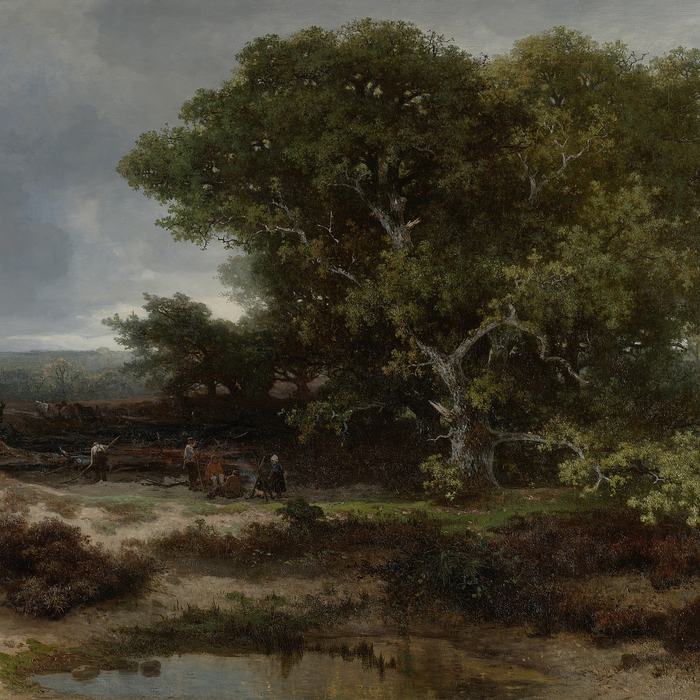
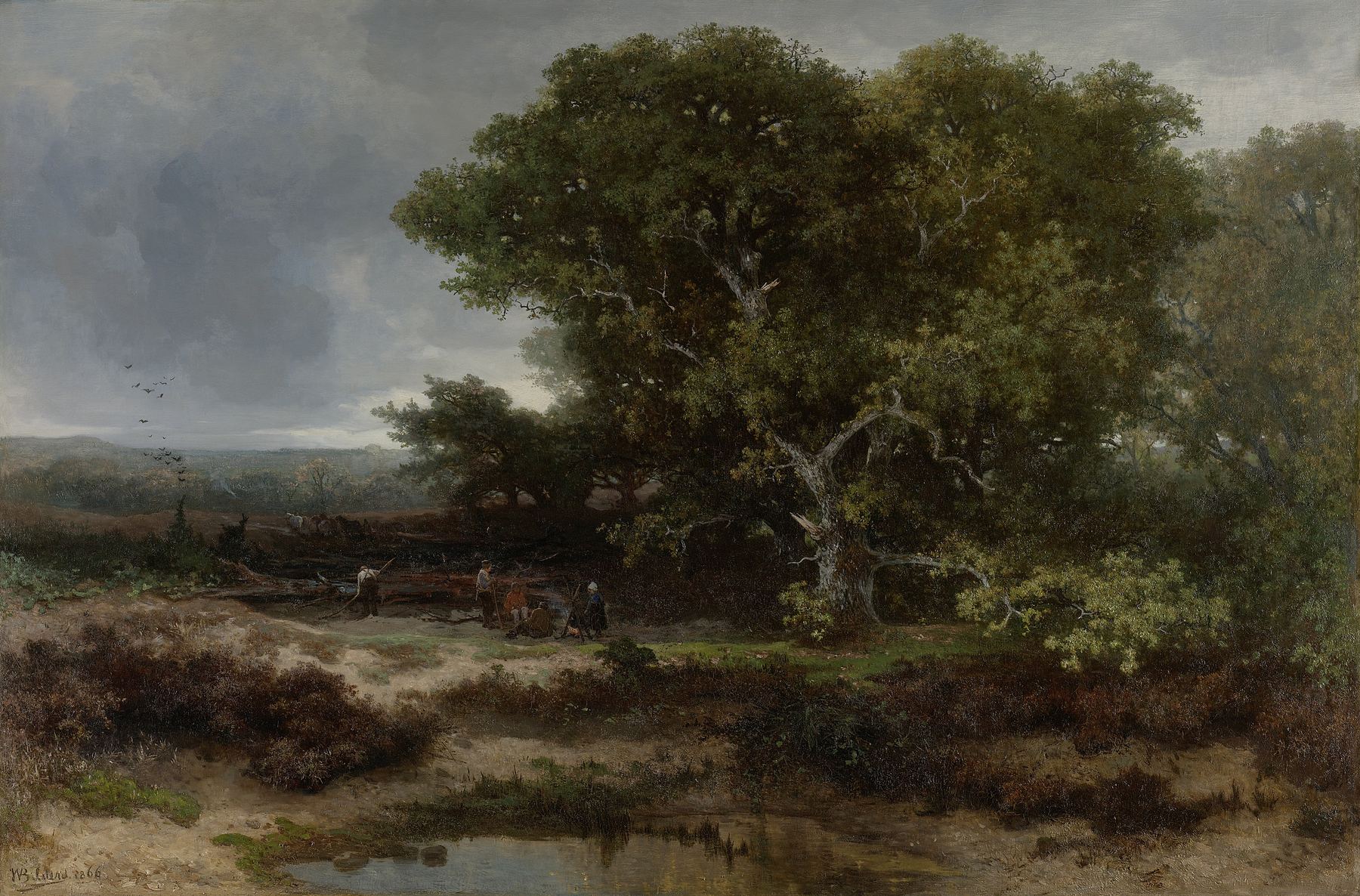
Oosterbeek, near Arnhem, became a crucial summer meeting place. Johannes Warnardus Bilders was the senior presence in a colony later called the “Dutch Barbizon.” His The Heath near Wolfheze preserves a traditional structure—towering trees to one side, a distant opening to the other—while broad brushwork and moderate tonal transitions create a more continuous atmosphere.[5] His son Gerard, along with Mauve, Willem Maris and others, learned through walking, sketching and comparing work.
Gerard Bilders searched for what he called “coloured grey”: colours could remain strong yet be tuned into one warm, fragrant whole. The phrase is more exact than the later nickname “grey school.” It describes relationship rather than pigment count.
The road through Barbizon
French landscape offered a second route out of academic polish. Théodore Rousseau, Jean-Baptiste-Camille Corot, Jean-François Millet, Charles-François Daubigny and Constant Troyon worked in and around Barbizon near the forest of Fontainebleau. Dutch artists travelled there, encountered their pictures in Brussels and Paris, or studied them in collections. Roelofs and Israëls visited; Jacob Maris, Mauve and Weissenbruch responded in different ways.
No single Barbizon formula was imported. Corot helped Gerard Bilders think about atmospheric tone. Millet made peasant labour morally weighty for Israëls. Daubigny’s watery landscapes and mobile studio practice appealed to marine and river painters. Troyon’s cattle mattered to Mauve and Willem Maris. At the same time, the French artists admired the Dutch Golden Age tradition. Seventeenth-century Dutch landscape passed through France and returned transformed.[6]
Mesdag’s collecting makes the exchange tangible. He owned numerous works by Rousseau, including the loosely handled Massacre of the Innocents, whose title refers not to biblical murder but to trees being cut down. Woodcutters are almost absorbed by the forest. Mesdag valued the work’s visible touch and unfinished energy, evidence that a Hague School painter could admire process as much as polished result.[7]
Railways made rural areas, coast and foreign centres easier to reach. Prepared paint in collapsible tubes made colour more portable. Neither invention automatically produced modern landscape, but both changed the practical radius of study. The irony is productive: modern transport carried artists towards places they framed as old, remote or unspoiled.
Pulchri Studio and an artist-built public
The social centre preceded the movement’s name. In 1847, painters including Willem Roelofs, Bart van Hove and members of the Weissenbruch family founded Pulchri Studio. Its purposes included drawing from the living model, protecting artistic interests, looking at art, discussion, exhibition and fellowship. King Willem II became its first patron, while the association gradually widened its disciplines and premises.[8]
Pulchri was not a Hague School membership office. Older Romantic painters, architects, sculptors and later artists all participated. Yet it gave the emerging school essential resources: models, rooms, professional recognition, exhibition opportunities and a place where artists and art-loving members met. Balloting created prestige and exclusion. Sociability and hierarchy were never opposites.
Watercolour gained its own infrastructure through the Hollandsche Teeken-Maatschappij, established in 1876. Mesdag served as its first long-term chairman; Maris, Israëls and Mauve were among the associated artists. The society helped present drawing and watercolour as finished, collectable art rather than merely preparation. Mesdag later chaired Pulchri, financed its move and used business experience to organise the cultural world around his peers.[9]
Artists also helped create a museum audience. In 1866, Mauve, Israëls, Bosboom and others supported a society intended to establish a museum of modern art in The Hague. Gifts and early purchases brought their work into public ownership during their lifetimes. The movement’s later museum authority was therefore partly built by the artists themselves.[10]
Follow the Hague School through four stages
–69
Romantic training, Oosterbeek and Barbizon exchange
Older compositional discipline, summer study around Wolfheze, Dutch seventeenth-century precedents and differentiated encounters with French landscape create the movement's practical and intellectual roots.
–79
The Hague network is named and organised
Artists settle in The Hague, Van Santen Kolff proposes the name, Pulchri provides a professional centre and the drawing society gives watercolour a dedicated public market.
–89
Atmosphere, labour and international demand
Marine, landscape, social subjects and watercolour reach a high point while the panorama turns Scheveningen into mass media and collectors in Europe, Britain and America reward recognisable motifs.
–1914
Dispersal, repetition and routes into modernism
Established artists continue as younger painters move towards urban Impressionism, Expressionism and abstraction; museums and markets stabilise the canon even as the inherited landscape changes.
Mood is not empty atmosphere
“Atmosphere” can sound as though the pictures have weather but no argument. Recent museum interpretation stresses sentiment, spontaneity, light, poetry, nature and landscape in transition. Human life gives many views their pressure. A road can suggest ageing; a shepherdess with a newborn lamb can evoke maternity and renewal; the sea can provide income and take lives.[11]
The strongest Hague School paintings make mood through concrete relations. A low horizon gives the sky physical weight. Wet ground repeats light rather than simply receiving it. One warm roof or red garment can organise an otherwise restrained field. A small figure tests the breadth of a polder. Brushwork shifts from open sky to resistant boat, reed or animal hide.
These are not neutral optical exercises. Tone decides whether work appears arduous, dignified, timeless or threatened. Distance can turn labour into part of the landscape; proximity can force the viewer towards a face, burden or worn interior. The school’s poetry remains inseparable from where it places people.
Scale changes that relationship too. A small watercolour invites close, private inspection; a large marine canvas turns weather into public spectacle; the panorama surrounds the body entirely. The same low horizon can therefore produce intimacy, national grandeur or physical disorientation. “Mood” is never only inside the painted scene. Format and viewing distance decide how strongly the spectator feels exposed to it.
The many colours of grey
Jacob Maris’s Bomschuit of 1878 offers a test. The upright format gives most of the surface to cloud. Beach occupies only the lowest band. The boat interrupts the horizon and reflects on wet sand, while a blue pennant, brown clothing, green-grey hull and pale air form a compressed spectrum.[12] The picture does not copy one instant so much as stabilise the coast’s changeability.
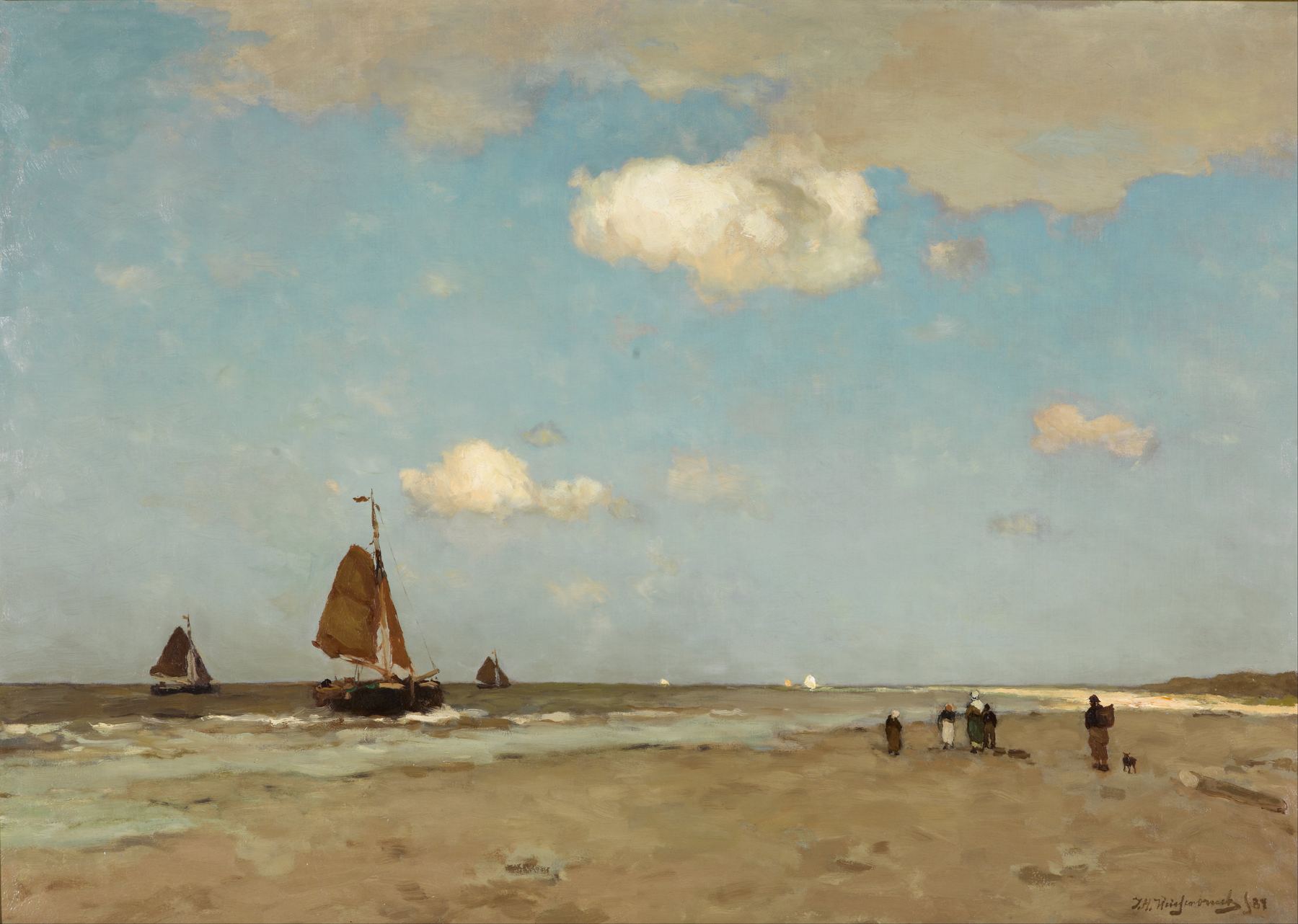
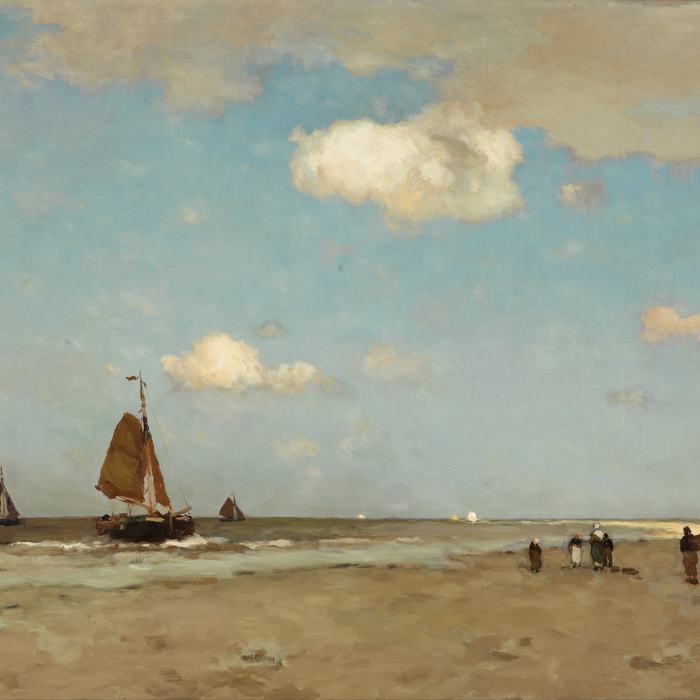
Jan Hendrik Weissenbruch could be equally luminous. In his 1887 Beach Scene, a vessel approaches under a sky made from thin touches of white, grey, green, dark blue and violet. The colours of sea and figures recur above, making sky and water breathe together.[13] “Grey” here names the balance that prevents any hue from becoming isolated.
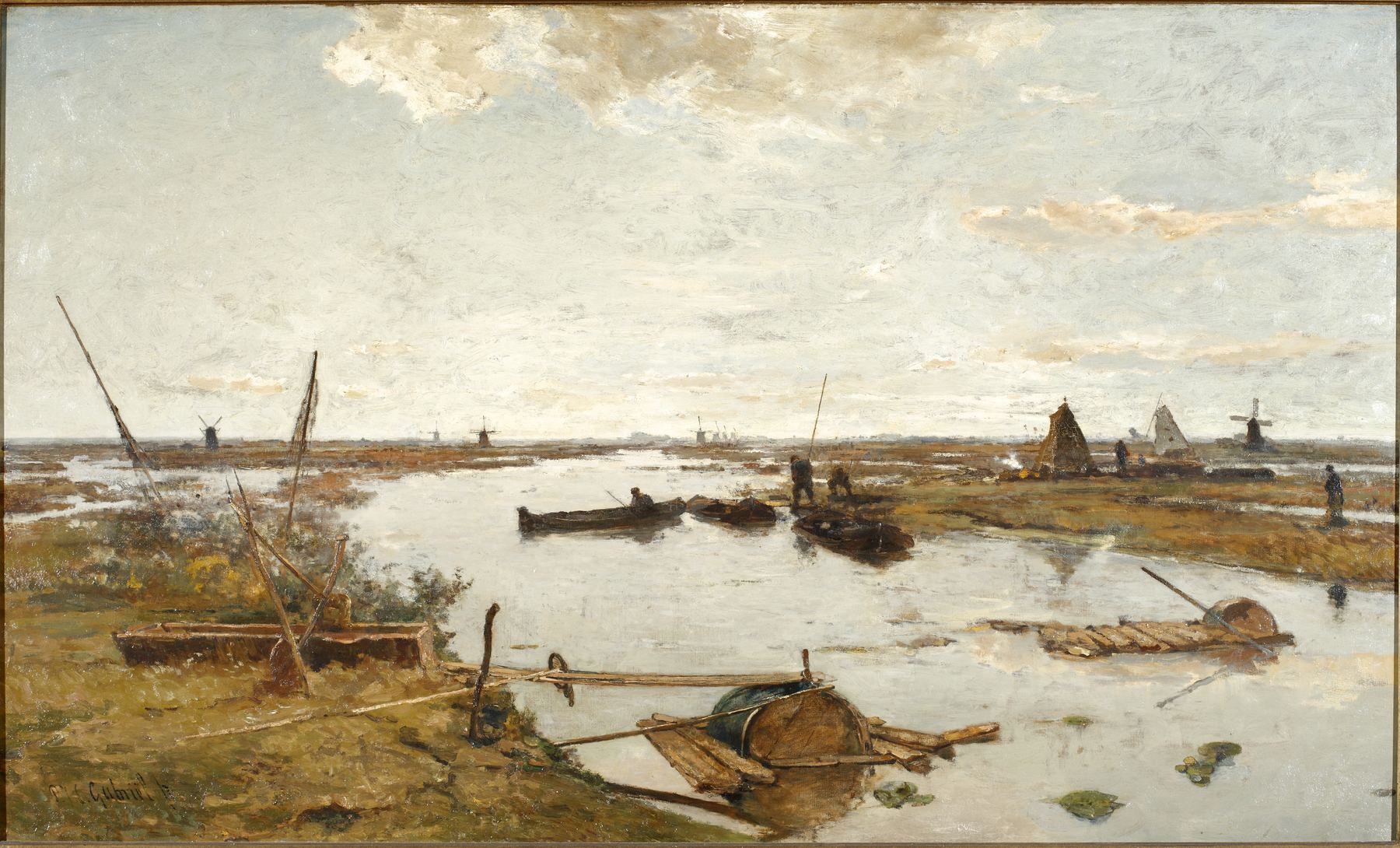
Paul Gabriël openly questioned the fashion for grey. His paintings often contain hard greens, cold blues and exact red accents. In The Kamper Peat Works, labourers dredge wet peat from flat vessels beneath a sky chosen to complete the scene’s mood. A critic found the picture steel-cold and brutally hard. It is atmospheric, but its subject is also energy and exhausting work at the moment peat was being displaced by coal and gas.[14]
Anton Mauve preferred soft, cool light and restrained contrast. His animal training gave sheep, horses and cattle convincing weight, but atmosphere made them more than specimens. Transparent watercolour was especially suited to rain, mist and silver light. Fishermen, smallholders and shepherds inhabit weather rather than pose before it.[15]
After moving to Laren, Mauve used outdoor studies to make larger studio compositions. The village attracted artists partly because expanding The Hague seemed to have lost its rural edge. Meanwhile industrial prosperity generated collectors, and American demand for Mauve’s flocks became intense.[16] An image of untouched pastoral life was supported by the modern international market.
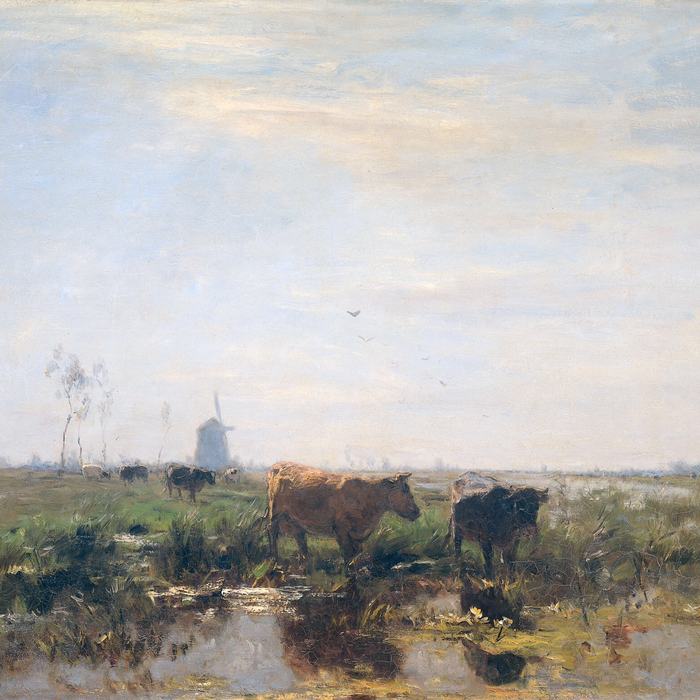
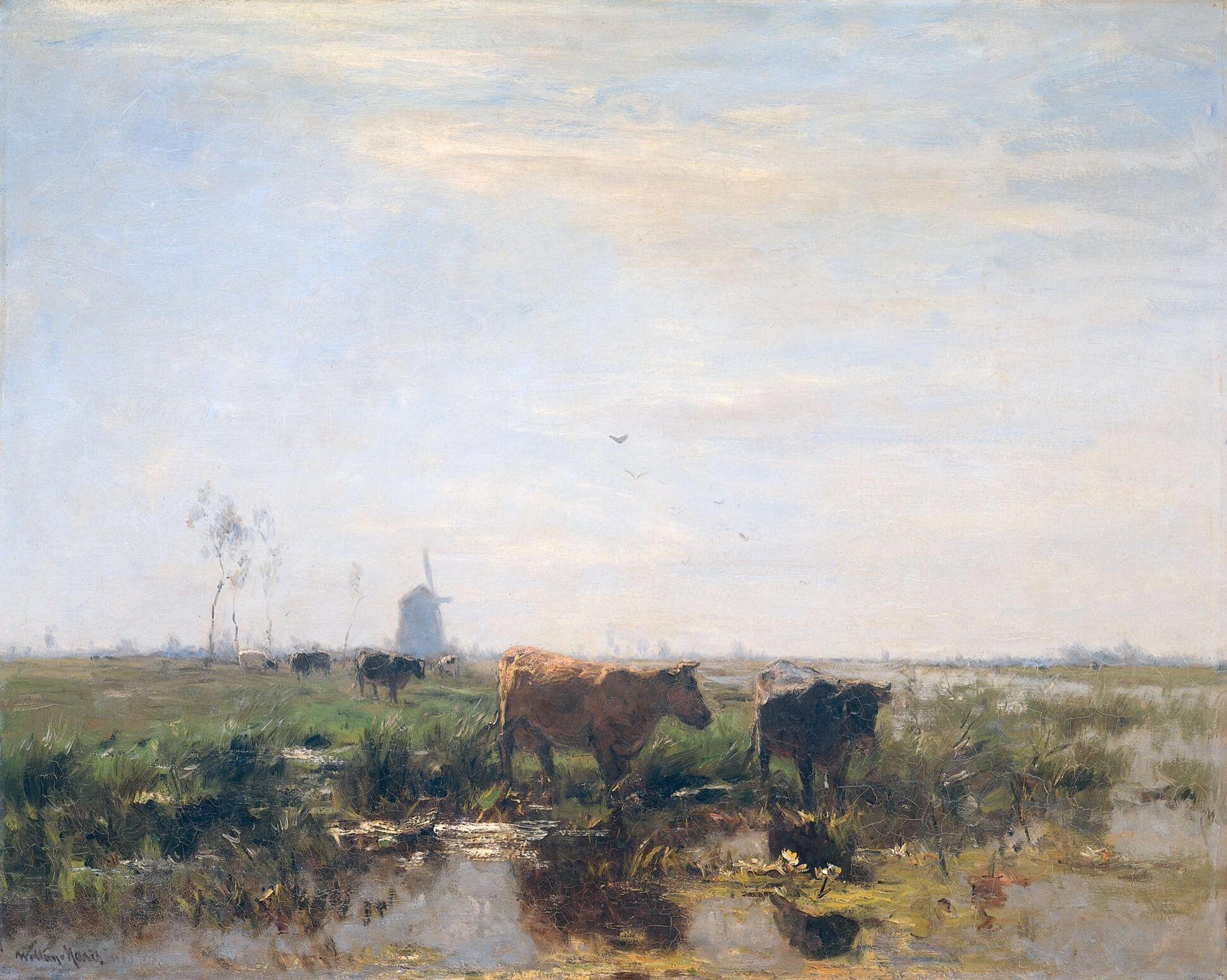
Willem Maris’s repeated cows and ducks create another kind of experiment. An animal breaks the horizontal field, disturbs water and catches sun along its back. Wet meadows, ditches and feathers make light visible through interruption.[17] Repetition need not mean lack of invention; changing weather can make the same motif behave differently.
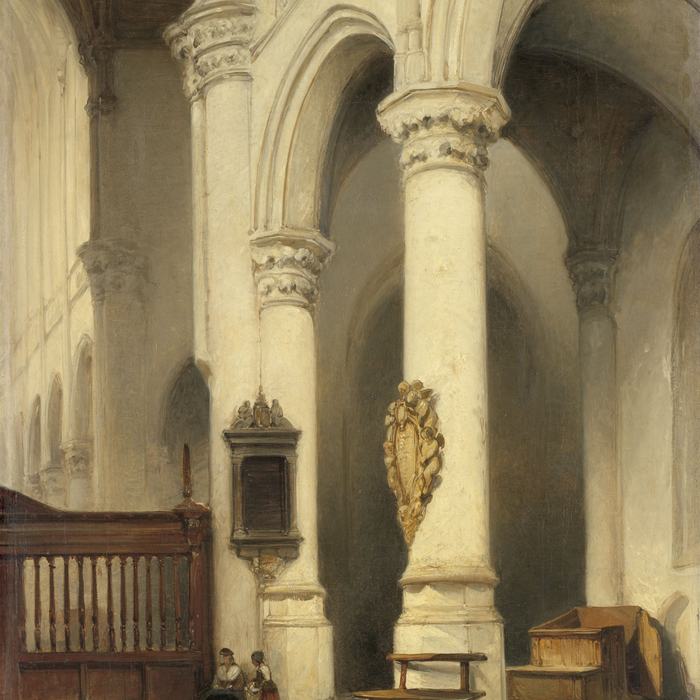
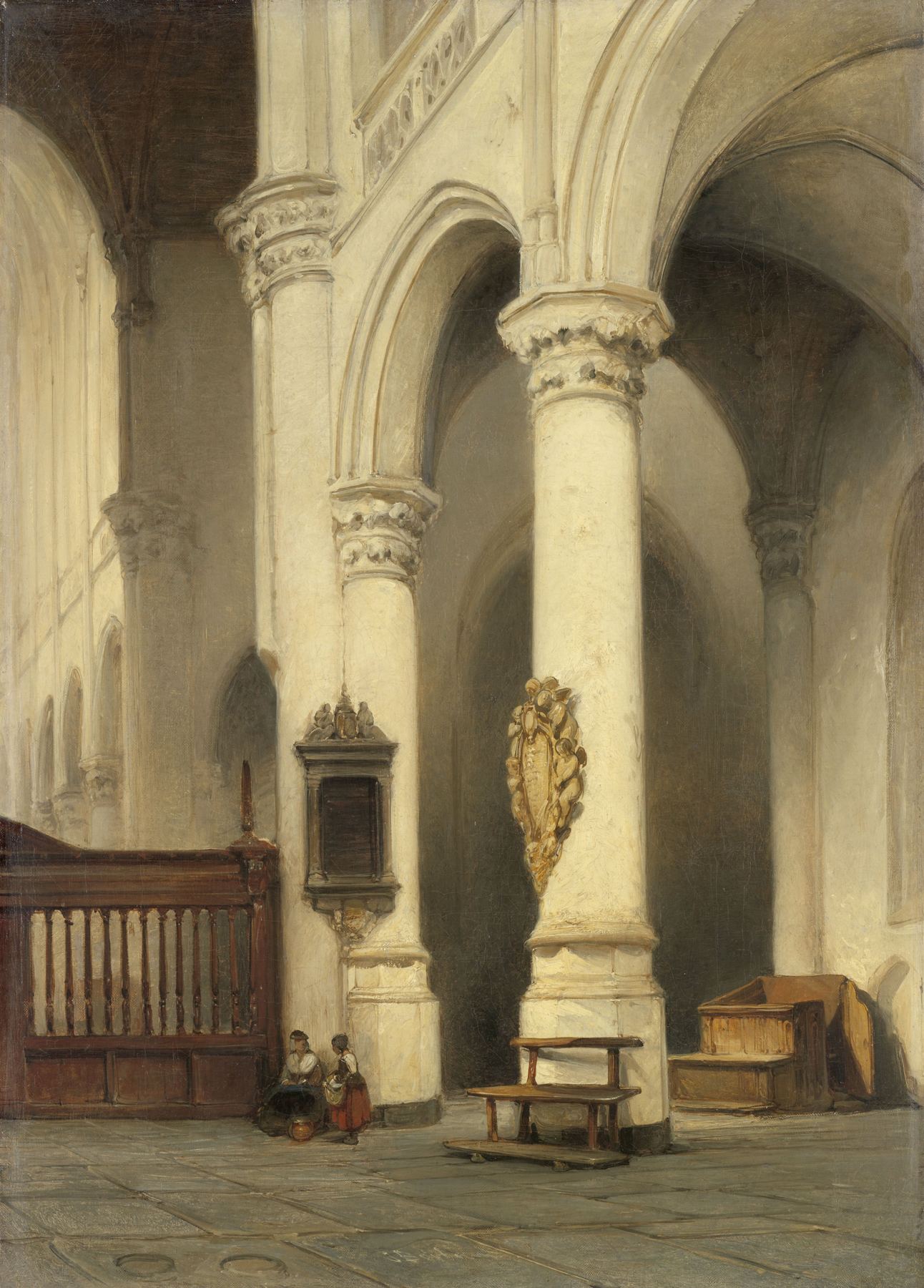
Johannes Bosboom carried atmosphere indoors. His church and synagogue studies observe sunlight crossing pillars, chandeliers, walls and worshippers. Mesdag bought loosely painted works from Bosboom’s estate, including a study of The Hague’s Great or German Synagogue. The visible speed that some viewers might call unfinished was precisely what the collector valued.[18]
Hague School artists to know
Jozef Israëls
Israëls made fishermen, farmers, children and domestic loss carry the ambitions of history painting, while repetition and international demand complicate the moral intimacy of his scenes.
Jacob Maris
Maris used compressed colour and commanding compositional structure to turn ordinary Dutch waterways and the Scheveningen fleet into public images of atmosphere, labour and national place.
Anton Mauve
Mauve combined convincing animal form with rain, mist and restrained tone; his Laren subjects and internationally requested flocks reveal the modern market behind pastoral continuity.
Jan Hendrik Weissenbruch
Weissenbruch made light pass between cloud, water and ground through finely judged blue, green, white and violet relationships that challenge the grey-school cliché.
Hendrik Willem Mesdag
Mesdag joined seascape specialisation to business, collecting, professional associations, museum-making and the collaborative Panorama of Scheveningen.
Sientje Mesdag-van Houten
Sientje developed an independent professional practice, contributed to the panorama and used landscape, still life and atmospheric colour to resist her reduction to spouse, inheritance or assistant.
Outdoor study and studio construction
The popular image of the Hague painter standing before a windy polder is true but incomplete. Artists drew in sketchbooks, made watercolours or oil studies, recorded clouds and travelled with portable materials. They also returned to studios, altered scale, combined observations and worked through winter. A finished canvas could preserve the sensation of immediacy while being highly constructed.
Look for differences between media. Watercolour depends on timing, absorbency and the light of the paper. An oil study may keep rapid, exposed strokes. A large exhibition painting can redistribute those discoveries into a stronger silhouette or more monumental sky. The important question is not whether the work is “really plein air,” but what each stage contributed.
Photography entered the same landscape culture. It offered another record of dunes, labour, buildings and routes while changing expectations of detail and instantaneity. Painters did not need to compete by becoming cameras. They could intensify duration: weather remembered across several visits, or an ordinary scene made to carry historical loss.
Watercolour as weather and finished art
Watercolour was particularly important because it could move between study and exhibition. A portable box and sheets of paper travelled more easily than a large canvas. Transparent washes let the white support become light, while bodycolour could recover an opaque cloud edge, sail or animal. Artists could work from pale to dark, allow passages to bleed while wet, or place dry marks over settled colour.
The medium also makes hesitation visible. A reserved highlight must often be planned before the surrounding wash arrives. A dark passage cannot always be removed without abrading the paper. Speed matters, but speed is not carelessness. Mauve’s wet roads and animals depend on controlled transitions; Weissenbruch’s sky can look instantaneous because years of judgement determine where to stop.
The Hollandsche Teeken-Maatschappij gave this technical intelligence a public stage. Framed watercolours entered exhibitions and collections as complete works. Their prices, criticism and prestige allowed painters to cultivate a recognisable manner without translating every successful idea into oil. Collectors such as the Drucker-Frasers built deep holdings that later preserved the breadth of the medium.
Watercolour also complicates the myth of a dark school. Paper sends light back through pigment, so even brown, grey and blue washes can appear radiant. Areas with little paint may carry as much atmospheric force as dense ones. The viewer is not only looking at colour laid on a surface, but at light passing through it and returning.
Drawings and sketchbooks broaden the story again. Black chalk can establish weight; pencil fixes perspective; touches of white make wet weather flash; annotations preserve colour for later work. These sheets are not simply evidence behind paintings. Many are independent encounters in which place, medium and decision remain unusually close.
Fisherfolk, children and the price of sympathy
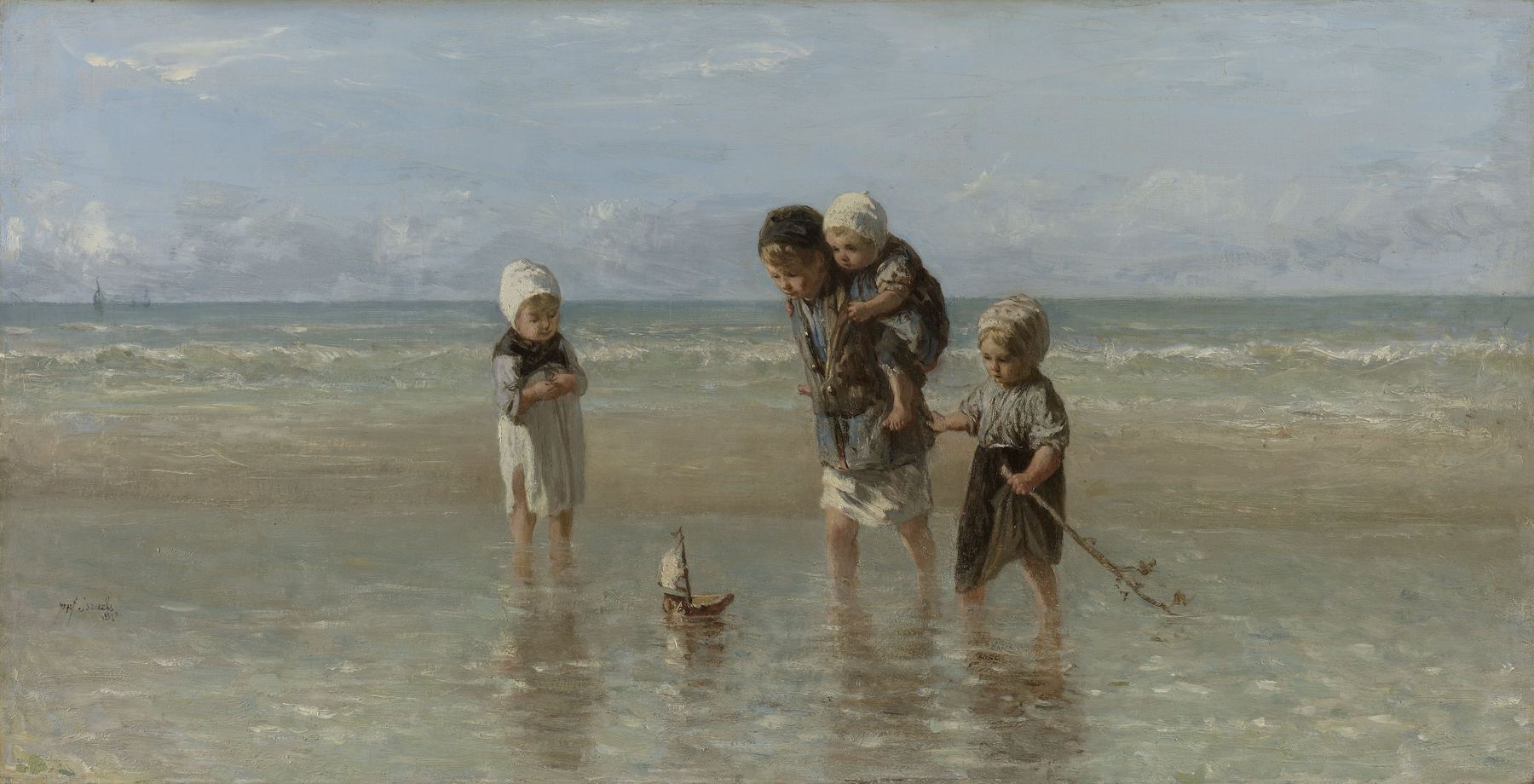
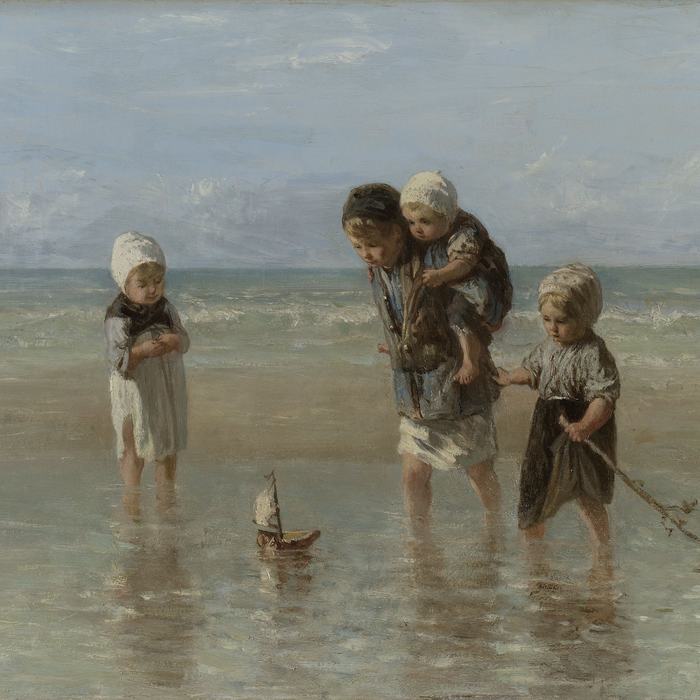
Jozef Israëls began with ambitious history painting, then around 1855 found that fishermen and farmers could carry equally large human themes. He painted sewing, waiting, widowhood, meals, work and death. In Children of the Sea, four poorly dressed children play with a toy boat in shallow water. The eldest carries a younger child; the fragile vessel prefigures the family’s dependence on the dangerous sea. The subject became so popular that Israëls repeated it.[19]
The painting’s tenderness should not cancel its social structure. The children are made available to viewers as symbols of a future already decided by poverty. Their play softens the entry into hardship. Repetition extended the message and also met demand.
Israëls’s own career moved far from material deprivation. In 1871 he settled in a modern villa overlooking the canal towards Scheveningen. He was internationally admired, cultivated collectors and increasingly used rapid, coarse strokes. He also remained a liberal religious Jew who painted biblical narratives and contemporary Jewish life. Around 1900, critics compared his late handling and subjects with Rembrandt, a comparison he consciously engaged.[20]
In Alone in the World, a deathbed interior turns private grief into a wide horizontal drama. The title removes locality and asks for universal identification.[21] That ambition is moving, but it can also smooth differences between the people represented and the comfortable audience invited to feel for them.
The Hague School’s images of workers should therefore be read twice. What do they reveal about tools, clothing, risk and family? What do they transform into timeless patience, noble endurance or national character? Sympathy can recognise humanity and still convert hardship into a beautiful commodity.
Scheveningen: work beside leisure
Scheveningen was close enough for repeated study and complicated enough to prevent one story. Fishing families launched bluff-bowed boats from the beach because there was no harbour. Horses hauled vessels through surf. Shell gatherers, net menders and children worked around the fleet. At the same time, an expanding resort brought elegant riders, donkey excursions, promenading visitors and bathing culture.
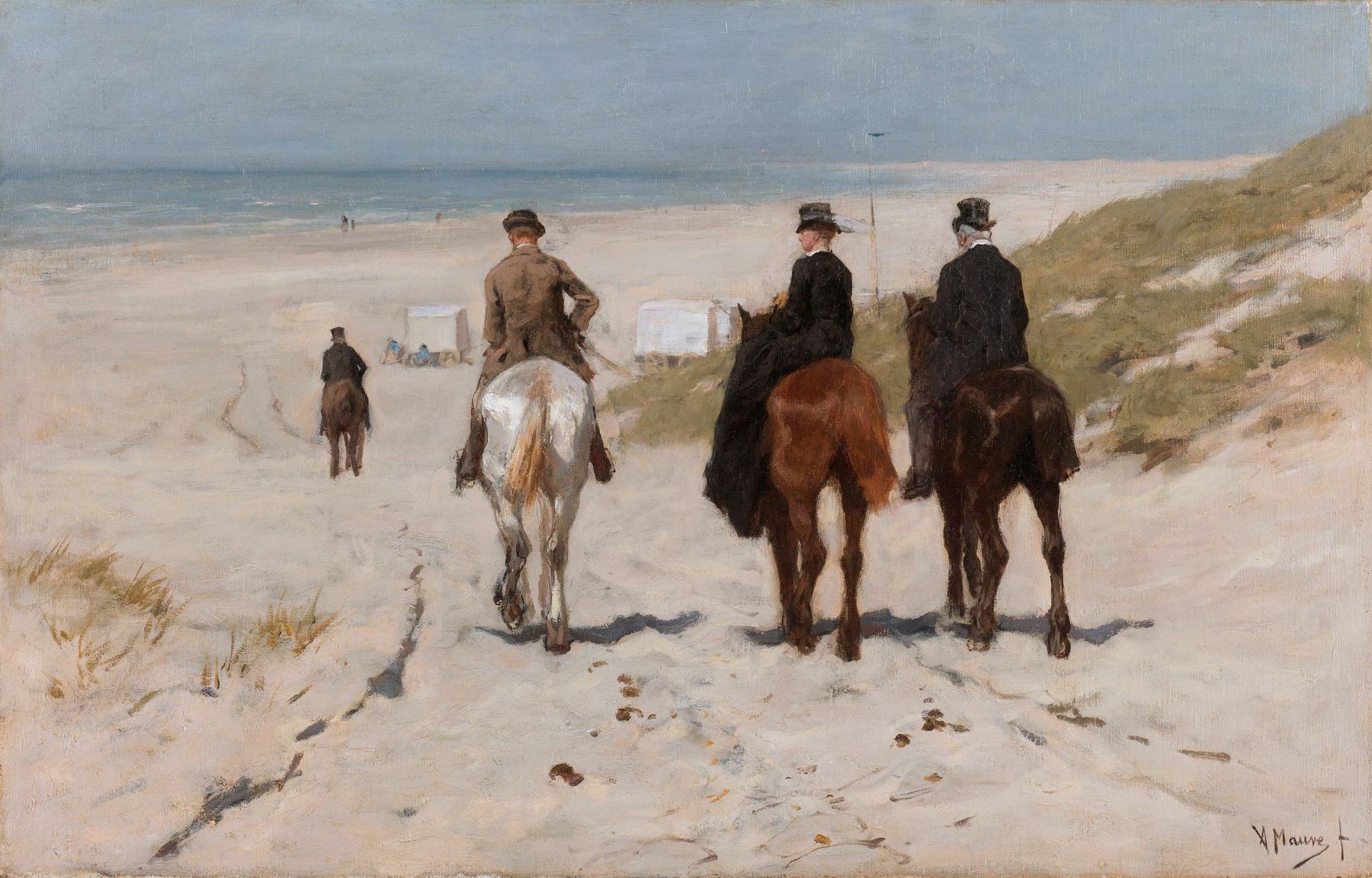
Kunstmuseum research shows these differences within the school: Jacob Maris could emphasise labouring fishermen, Willem Maris the donkeys used for visitors, and Mauve both hauling boats and fashionable recreation.[22] The same sand carried incompatible experiences.
Artists often framed the coast through silver light and apparently timeless custom just as rail, tram, tourism and urban growth transformed it. The pictures are valuable historical evidence, but their omissions matter. A large sky can make economic change seem small; a picturesque boat can conceal dangerous labour; a resort visitor can treat a working beach as scenery.
Mesdag and the business of the sea
Hendrik Willem Mesdag became a professional artist unusually late. He spent sixteen years in his father’s banking firm, then an inheritance received through Sientje enabled him to leave business. In Brussels he studied with Willem Roelofs and shifted decisively towards marine painting. Financial knowledge did not disappear when art began; it became part of his ability to organise, collect and promote.[23]
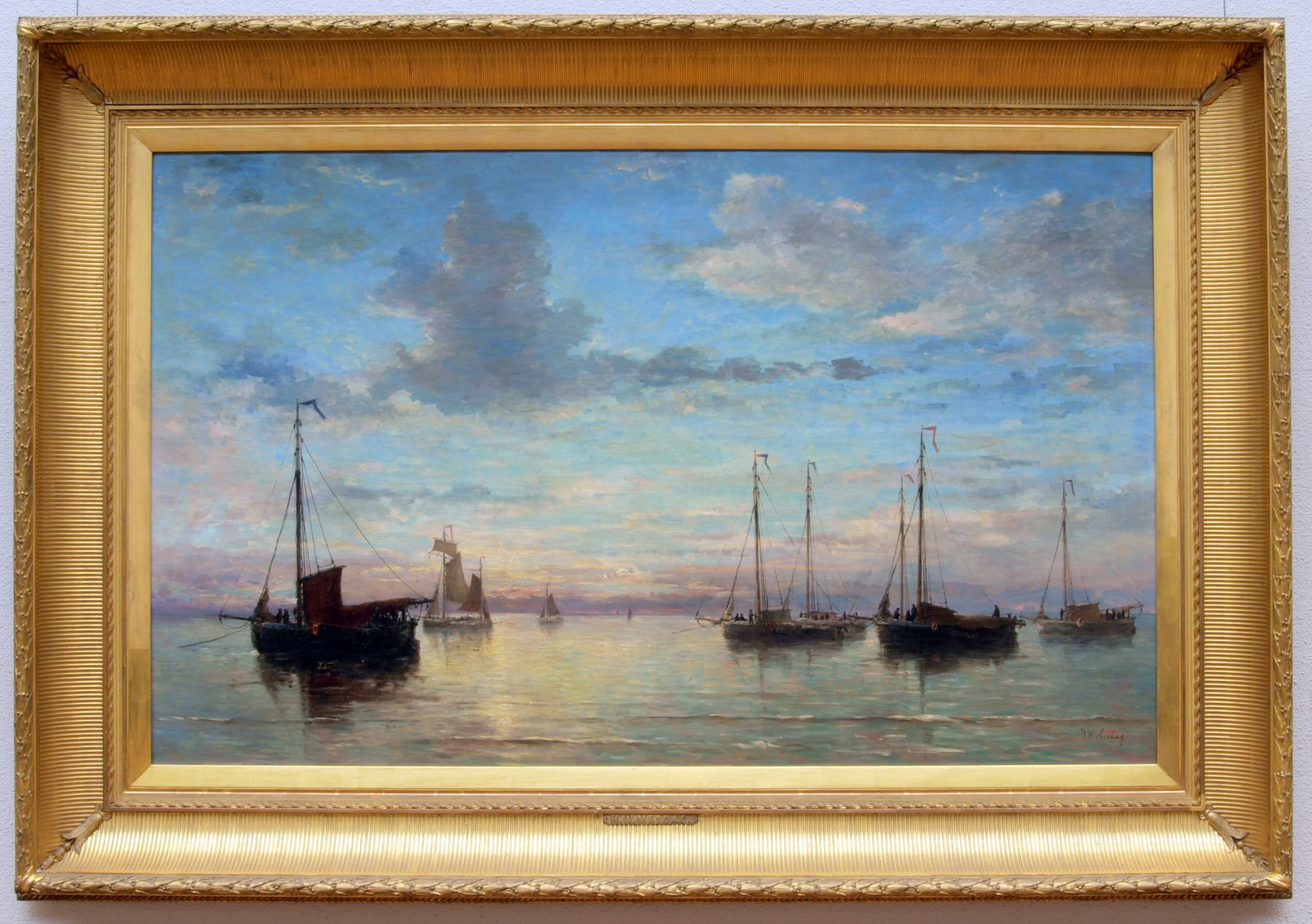
Mesdag’s sea is rarely empty. Fishing boats push through breaking waves, gather offshore or rest against broad horizons. He specialised enough to make maritime atmosphere an internationally recognisable identity. Initial Hague doubts about him as an amateur gave way to critical praise and institutional power.
The Panorama of Scheveningen, completed in 1881, enlarged this way of seeing into an environment. Approximately 120 metres of canvas and 14 metres of height surround a central platform. Mesdag did not paint it alone. Sientje Mesdag-van Houten, George Hendrik Breitner, Théophile de Bock and Bernard Blommers assisted, joining figure, landscape and architectural skills.[24]
An artificial dune hides the lower join between viewing platform and painted world. The spectator enters a manufactured viewpoint on the Seinpost dune and turns through coast, village, city, sea and sky. The work resembles direct presence while depending on perspective, construction, teamwork and controlled circulation.
Panoramas were a nineteenth-century mass medium. Belgian entrepreneurs commissioned this one during an international craze for immersive historical, biblical and place-based spectacles. Mesdag chose a familiar contemporary view rather than naval victory or exotic port.[25] Ordinary Scheveningen became worthy of monumental entertainment.
When the company failed, Mesdag bought the panorama and subsidised its continued operation. He and Sientje also built a museum beside their home in 1887. Their French and Dutch collection placed Barbizon and Hague School works among decorative arts and their own paintings; in 1903 they gave the institution to the Dutch state.[26] The painter was also impresario, patron, museum-maker and curator of his own lineage.
Sientje Mesdag-van Houten and women’s work
Sientje Mesdag-van Houten should not enter this history only as an inheritance or a helping hand. She developed a professional practice in landscape, flower and fruit still life, exhibited and took part in the movement’s networks. After the death of the couple’s young son in 1871, she committed herself more fully to art. Contemporary description insisted that she wished to be understood as an independent “art amazon.”[27]
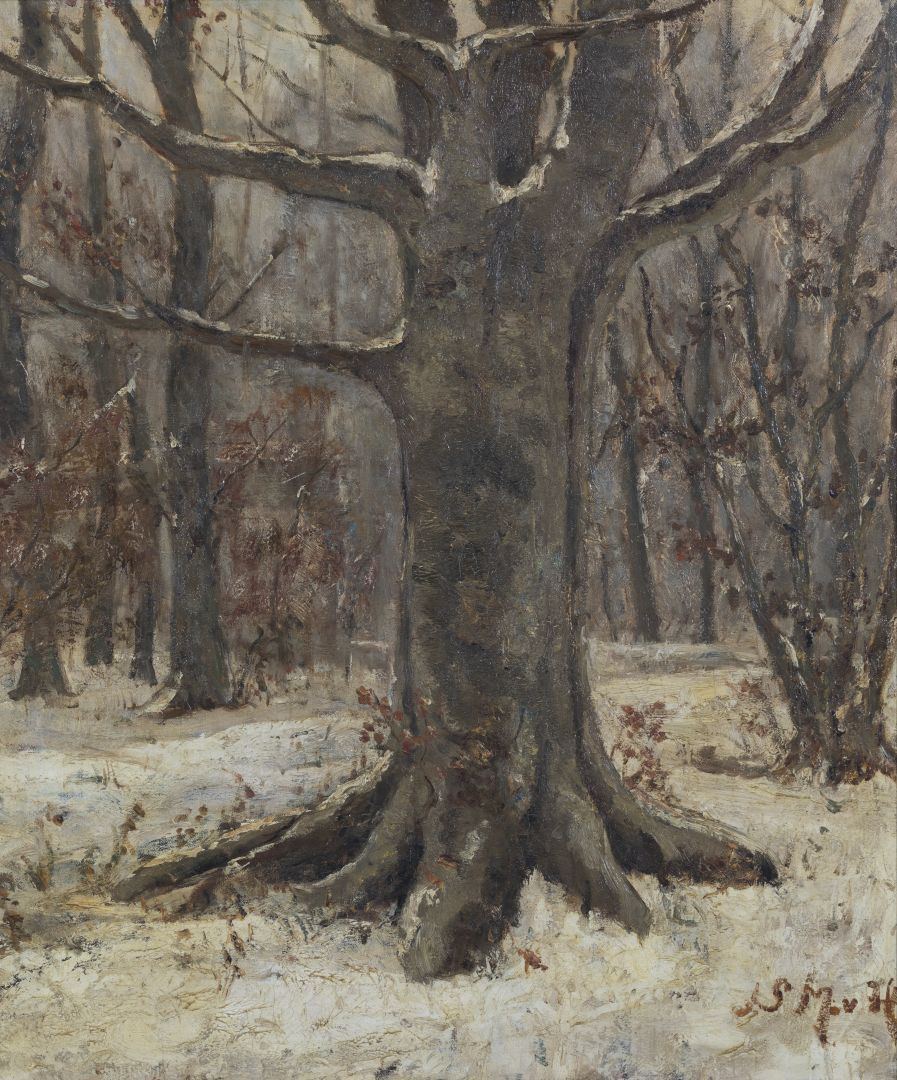
Her colour challenges the masculine shorthand of the grey school. In Sheepfold at Sunset, a glowing evening sky and warm faces create a strong atmospheric effect. Studies made in Drenthe, the Veluwe and the Scheveningen dunes supplied material, but her solution was not simply Mesdag’s marine manner in another subject.[28]
She belonged to a broader Groningen network that included Jozef Israëls, Hendrik and Taco Mesdag, and Geesje Mesdag-van Calcar. Several came from prosperous families able to support training, travel or collecting; their eventual fame was made in western cities and international markets. Geesje’s gift of her and Taco’s collection to the Groninger Museum created another institutional afterlife.[29]
Privilege opened doors without eliminating gendered judgement. Women’s access to academies, models, travel and associations expanded unevenly. Marriage could provide resources and collaboration while causing a woman’s authorship to be absorbed under a husband’s name. Restoring Sientje means examining both partnership and difference.
Suze Robertson belongs near the edge of the category. She studied and worked in The Hague, joined Pulchri and painted labouring women and working-class interiors. Her roots lie in Hague School realism, but her forceful contour, compressed figures and increasingly radical colour point towards Expressionism.[30] A useful movement history must allow artists to depart.
Market success and the danger of formula
The Hague School dominated Dutch taste and the art trade well beyond its first controversial decades. Dealers sent paintings through Britain, Europe and the United States. International collectors wanted an intelligible Holland: silver weather, patient cattle, old boats, modest interiors and hardworking people.
Demand could reward sustained variation. Mauve’s sheep change with season, direction, light and landscape. It could also reduce an artist to a product code. Dealers distinguished “sheep coming” from “sheep going,” reportedly pricing the more appealing view from the front more highly. The joke exposes a real pressure: market recognition encourages motifs that are easy to request.
Israëls repeated successful subjects; Mesdag specialised in seascapes; Maris returned to boats, mills and waterways. Repetition was not automatically cynical. Artists tested tone and composition through familiar forms. But the market helped turn selective images into an apparently natural national identity.
The school’s own institutions participated in canon-making. Exhibitions presented colleagues together. Artists donated works they wanted preserved. Mesdag collected the French ancestors and Dutch peers of the story he inhabited. Later bequests brought large Hague School holdings to the Rijksmuseum. A movement can construct its future while it is still contemporary.
Generations without a family tree
It is tempting to arrange the movement into neat generations: Romantic teachers, a mature Hague core and younger followers. The scheme helps with chronology but becomes misleading if treated as descent. Roelofs was older than Mauve, Jacob Maris and Gabriël, yet remained an active peer. Israëls changed technique across a long career. The three Maris brothers shared family history without sharing one artistic destination.
Matthijs Maris moved towards dreamlike, difficult images that sit uneasily within the school’s ordinary realism. Jacob became a master of Dutch water, towns and boats. Willem turned animals and wet pasture into light-bearing structures. The surname makes comparison useful precisely because difference survives it.
Other painters expanded particular subjects. Bernard Blommers worked with fishing families and children; Théophile de Bock specialised in landscape and assisted the panorama; Albert Neuhuys carried peasant interiors towards the Laren School; Philip Sadée represented fishing life. Their presence prevents a history composed only of nine famous names, but a list is less helpful than understanding the studios, exhibitions and places that joined them.
The edge of the category remained porous. An artist might share Pulchri membership, work in Scheveningen and use tonal colour without being consistently classified as Hague School. Another might spend formative years in the network and become known for a later movement. Rather than policing a timeless boundary, readers should ask when, where and for what purpose the label explains a work.
Van Gogh’s Hague apprenticeship
Vincent van Gogh arrived in The Hague in late 1881 to learn from Anton Mauve, a relative by marriage and an established painter. He also drew with George Hendrik Breitner in soup kitchens and third-class waiting rooms, knew Weissenbruch and visited Pulchri. This was not a passive period before the famous colour of France; it was an intensive education in figures, materials, labour and urban margins.[31]
Van Gogh’s letters make the teaching practical. In January 1882, Mauve instructed him in drawing hands and faces and keeping paint thin. Access to Pulchri allowed regular work from a model. Van Gogh regarded the lessons as more valuable than money and connected them to his difficult start in watercolour.[32]
Later that year he described rainy, chilly weather as full of atmosphere. Figures gained a range of tones from wet roads and reflected sky, an effect he thought Mauve achieved especially well.[33] The observation explains Hague tonality from ground level: grey is not a colour chart but a weather system linking body, street and cloud.
In View of the Sea at Scheveningen, Van Gogh worked through a “nasty little storm.” Wind made the act of painting difficult, and grains of sand became part of the work’s material history.[34] Outdoor study was bodily exposure, not merely an aesthetic principle.
Van Gogh and Mauve soon fell out, partly over Van Gogh’s relationship with Sien Hoornik and professional expectations. The younger artist developed far beyond Hague School restraint. Yet he carried forward its belief that workers, peasants and uncelebrated environments could support ambitious art.
From The Hague to the modern city
The school’s authority generated resistance from within families and studios. Jozef Israëls’s son Isaac trained early, but wanted a reputation separate from his internationally famous father. He dropped the diaeresis from his surname and rejected the older generation’s sentiment. In Amsterdam and later Paris, he pursued beach visitors, fashion, nightlife and streets through brighter colour and faster touch.[35]
George Hendrik Breitner also shifted attention towards the moving city. During the 1880s, the centre of Dutch painting increasingly appeared to move from The Hague to Amsterdam. The new “painters of Eighty” made trams, construction, shop windows, crowds and bad weather modern rather than timeless.[36] The difference was one of tempo and subject, not a total rejection of atmospheric study.
Early Piet Mondrian landscapes likewise began within the Hague School tradition. Farms, willows, water and subdued colour supplied a foundation. Yet his increasingly compact structures pushed buildings and trees forward, obscured conventional horizons and separated formal order from the description of place.[37] A national landscape tradition could become raw material for abstraction.
These afterlives prevent a simple decline story. Van Gogh intensified social and expressive colour; Isaac Israels and Breitner found modern crowds; Mondrian extracted line and relation. The Hague School mattered partly because later artists knew what they were leaving.
A national landscape already disappearing
Polders, mills, canals, cows, dunes, boats and immense skies still shape international expectations of Holland. The Hague School helped select and stabilise that image. By treating nearby everyday terrain as sufficient, its painters claimed continuity with seventeenth-century Dutch art and offered a shared national geography.
Yet the world they pictured was never outside history. Peat lost ground to coal and gas. Fishing methods and harbours changed. Cities expanded across dunes and meadows. Railways and trams brought artists and tourists. Seasonal labour continued in cold and rain while urban collectors acquired its image.[38]
The landscape can therefore be read as both perception and memory. Some occupations were vanishing while painters worked. A mill might still drain water but also serve as a national sign. A boat could be an instrument, an obsolete technology, a sculpture and an exportable emblem at once.
Museums fixed this modern landscape early. The 1866 Hague initiative and artists’ gifts built an unusually deep contemporary collection.[39] Teylers Museum completed a second picture gallery in 1893 partly to show living Dutch artists, including Hague School painters, with more space and calmer display than older crowded hangs.[40]
Later collections added other perspectives. Singer Laren connects Hague School painting with Barbizon, Amsterdam Impressionism and an international artist colony.[41] The Mesdags’ house joins paintings to furniture, ceramics and collecting taste. Different institutions reveal that “the school” survives as several histories: local network, national canon, market category and source for modern art.
Decline, dispersal and return
No single event ended the Hague School. Mauve died in 1888; Jacob Maris in 1899; Weissenbruch, Gabriël, Willem Maris, Israëls and Mesdag worked into the twentieth century. Individual palettes changed. Younger artists chose cities, stronger colour and new societies. Dealers continued to sell established motifs even when critics placed innovation elsewhere.
Mesdag’s career captures the contradiction. Hague art circles initially hesitated to accept him as more than a well-intentioned amateur, then critics praised him as part of an ultraradical tendency. Eventually he became an institutional patriarch, collector of Barbizon studies and owner of a monumental attraction.[42] Avant-garde and establishment can be phases of one life.
The school’s international success changed what Dutch artistic authority looked like. Groninger Museum research describes Israëls and Mesdag as famous well beyond the Netherlands, with sensitive images travelling rapidly to eager buyers in England and America.[43] Popularity did not mean aesthetic stasis, but it did make formulas profitable and turned regional origins into an exportable national brand.
The famous greyness remains a case study in canon formation. Van Santen Kolff’s phrase gave critics an efficient category; Gerard Bilders’s more subtle “coloured grey” shows what the shorthand loses. Modern exhibitions can reinforce the familiar landscape even while recovering colour, women and economic change.[44]
International collaboration continues to revise the story. A recent exhibition on Dutch artists in Barbizon brought the Mesdag Collection, Petit Palais and Netherlands Institute for Art History together to investigate Maris, Mauve, Weissenbruch and their French relations.[45] The school now looks less like an isolated national achievement and more like a node in European landscape culture.
How to look at a Hague School painting
Measure the sky
Find the horizon and compare the proportion of land, water and air. A low horizon may make weather the dominant actor rather than a background.
Rebuild the palette
Do not accept “grey” as a description. Locate green, violet, blue, brown, ochre and white. Ask how reflections and close values bind them.
Follow light through matter
Notice what light touches: cloud edge, wet sand, animal back, sail, chandelier, ditch or smoke. Different surfaces make atmosphere legible.
Separate study from exhibition picture
Look for drawings, watercolours and oil studies. Which observed elements were retained, enlarged or recomposed in the studio?
Read labour precisely
Identify tools, gestures and physical risks. Then ask whether distance, sentiment or picturesque costume softens the conditions of work.
Look for modernity outside the centre
Rail, tram, resort, fuel change and urban expansion may be absent, distant or disguised. Timelessness is often something the composition constructs.
Identify the medium’s decisions
Watercolour reserve, opaque bodycolour, broken oil paint and panoramic illusion create different kinds of immediacy. “Loose” is not one technique.
Reconstruct the market
Who exhibited, collected, reproduced or requested the subject? A repeated boat or flock may be artistic inquiry and recognisable merchandise at the same time.
Essential Hague School works
Fishing Boat (Bomschuit)
Jacob Maris · 1878 · An immense pale sky, wet sand, small workers and a bluff-bowed vessel show how coloured greys can join atmosphere, labour and monumental scale.
The Heath near Wolfheze
Johannes Warnardus Bilders · 1866 · Traditional spatial order and broad handling meet at Oosterbeek, where a Romantic landscape vocabulary begins to become a continuous tonal environment.
Beach Scene
Jan Hendrik Weissenbruch · 1887 · White, green, dark blue and violet recur across sea and cloud, proving that Hague School grey is a chromatic relationship rather than an absence of colour.
The Kamper Peat Works
Paul Gabriël · c. 1888–89 · Peat cutters, flat vessels and cold light connect atmosphere to exhausting work and to an energy economy already being displaced by coal and gas.
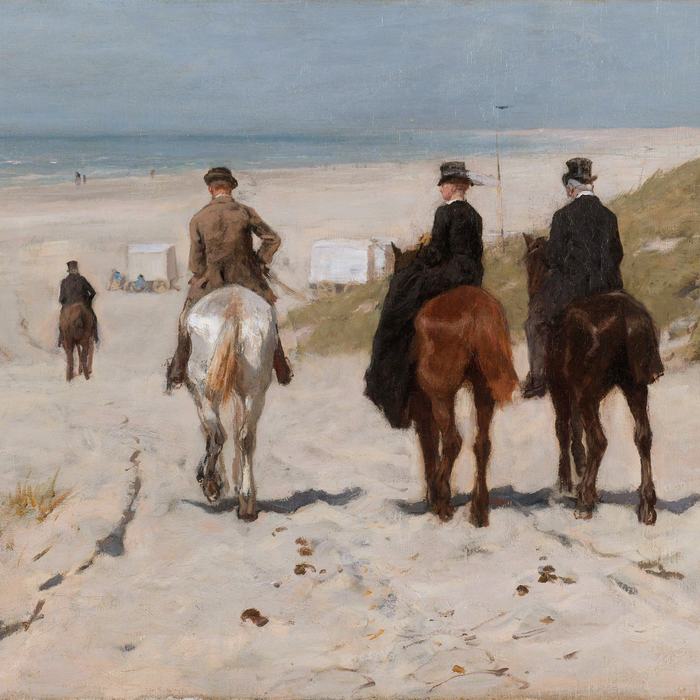
Morning Ride along the Beach
Anton Mauve · 1876 · Riders, donkeys, damp sand and restrained light place fashionable beach leisure beside the working coast that made Scheveningen a contested modern subject.
Meadow with Cows by the Water
Willem Maris · c. 1890–95 · Cattle break the horizontal field, catch sunlight and disturb reflected water, turning a repeated rural motif into an experiment in how light travels through matter.
Church Interior
Johannes Bosboom · c. 1840–48 · Architecture becomes atmospheric as light crosses pillars, fittings and small figures; Bosboom makes an enclosed interior behave like a polder under changing weather.
Children of the Sea
Jozef Israëls · 1872 · Play, worn clothing and a fragile toy boat transform fisher poverty into an image of tenderness, risk and a future already shaped by the sea.
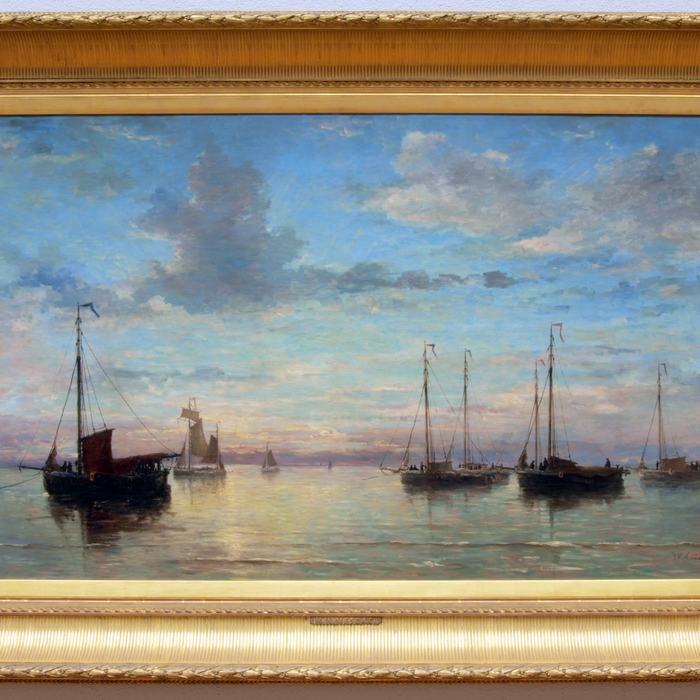
Evening on the Sea
Hendrik Willem Mesdag · 1870 · Mesdag gives marine weather an internationally legible identity while keeping vessels, horizon and changing light within a carefully organised spectacle.
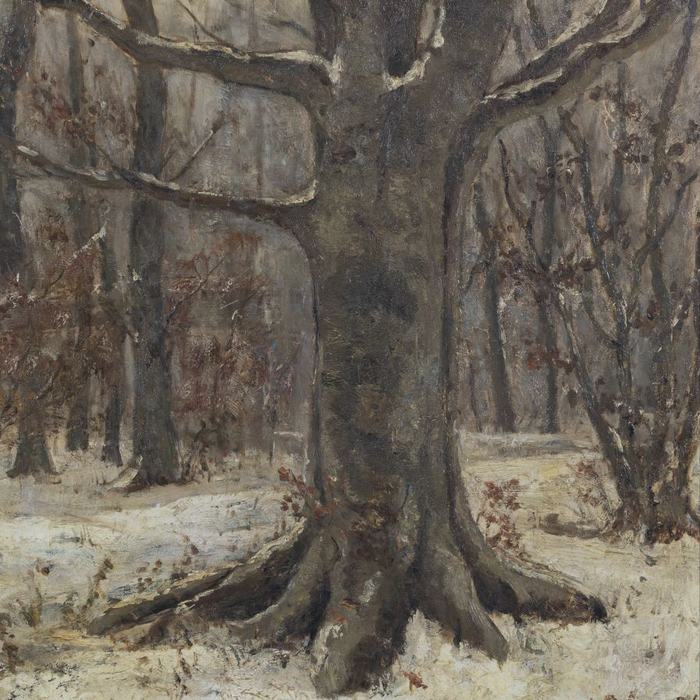
Forest View in Winter
Sientje Mesdag-van Houten · late 19th century · Sientje Mesdag-van Houten's landscape practice broadens the movement beyond its male canon and shows atmospheric unity as an individual decision rather than a shared formula.
Where to see the Hague School
Displays, loans, archive access and gallery opening arrangements change. Check current information before travelling.
- 01
Kunstmuseum Den Haag
The movement’s essential collection, formed partly through the artists’ own 1866 museum initiative, lifetime gifts and contemporary purchases. Its oils, drawings and sketchbooks support comparison across the principal figures.
The Hague, Netherlands
Collection and research guideVisit official resource - 02
Rijksmuseum
Major works by Israëls, Mauve, the Maris brothers, Gabriël, Mesdag, Weissenbruch and others, strengthened by important private bequests and an exceptional works-on-paper collection.
Amsterdam, Netherlands
Collection and research guideVisit official resource - 03
Museum Panorama Mesdag
The immersive 1881 panorama remains in its purpose-built environment, accompanied by works and archives relating to Hendrik Willem Mesdag, Sientje Mesdag-van Houten and their collaborators.
The Hague, Netherlands
Collection and research guideVisit official resource - 04
The Mesdag Collection
The couple's former house and museum places Hague School pictures beside Barbizon paintings, studies, decorative arts and the objects through which they constructed modern taste.
The Hague, Netherlands
Collection and research guideVisit official resource - 05
Groninger Museum
An important counterweight to a purely Hague-centred story, with Jozef Israëls, Hendrik and Sientje Mesdag, Taco Mesdag and Geesje Mesdag-van Calcar anchored in their Groningen origins.
Groningen, Netherlands
Collection and research guideVisit official resource - 06
Singer Laren
Mauve and the later Laren colony connect Hague atmosphere and rural subjects to international collecting, Dutch Impressionism and early modernism.
Laren, Netherlands
Collection and research guideVisit official resource - 07
Teylers Museum
Nineteenth-century painting galleries and works on paper show how Hague School art entered collections and display culture while its artists were still alive.
Haarlem, Netherlands
Collection and research guideVisit official resource - 08
Van Gogh Museum
Van Gogh's Hague works and letters allow readers to trace what Mauve's teaching, Scheveningen weather and working-class subjects gave to an artist who soon moved beyond the school.
Amsterdam, Netherlands
Collection and research guideVisit official resource
Suggested books
A Reflection of Holland: The Best of the Hague School in the Rijksmuseum — Renske Suijver
The strongest compact English introduction, organised around an outstanding national collection and spanning landscape, marine painting, interiors, social subjects and works on paper.[46]
The Hague School: Dutch Masters of the 19th Century — edited by Ronald de Leeuw and John Sillevis
The foundational catalogue for the major 1983 exhibitions in The Hague, London and Paris. Its international framework remains valuable for artists, institutions and reception.[47]
Der weite Blick: Landschaften der Haager Schule aus dem Rijksmuseum — edited by the Bayerische Staatsgemäldesammlungen
A substantial German-language study of how Hague School painting and historical photography shaped a national landscape during urbanisation and industrial change.[48]
Aquarellen van de Haagse School: de collectie Drucker-Fraser — Wiepke Loos
The focused Dutch catalogue for understanding watercolour as an independent exhibition medium and the importance of collectors Jean Charles Drucker and Maria Lydia Drucker-Fraser.[49]
Holland op z’n mooist: op pad met de Haagse School — Frouke van Dijke and contributors
A richly illustrated Dutch study that reconnects paintings to the actual landscapes, routes and environmental transformations represented in them.[50]
Major Hague School artists
This directory includes core figures alongside selected precursors, institutional participants and consequential successors; it does not imply one fixed membership or style.
| Name | Nationality | Key Works |
|---|---|---|
| Andreas Schelfhout | Dutch | Winter Landscape · Frozen Waterway |
| Johannes Warnardus Bilders | Dutch | The Heath near Wolfheze · View of the Forest near Wolfheze |
| Gerard Bilders | Dutch | Landscape with Cows at a Pool · Woodland Pond at Sunset |
| Willem Roelofs | Dutch | The Rainbow · River Landscape |
| Jozef Israëls | Dutch | Children of the Sea · Alone in the World |
| Jacob Maris | Dutch | Fishing Boat (Bomschuit) · The Bridge |
| Matthijs Maris | Dutch | The Bride · The Enchanted Castle |
| Willem Maris | Dutch | Meadow with Cows by the Water · Ducks |
| Jan Hendrik Weissenbruch | Dutch | Beach Scene · The Trekvliet Shipping Canal near Rijswijk |
| Anton Mauve | Dutch | Morning Ride along the Beach · The Return of the Flock |
| Hendrik Willem Mesdag | Dutch | Panorama of Scheveningen · Evening on the Sea |
| Paul Gabriël | Dutch | The Kamper Peat Works · In the Month of July |
| Johannes Bosboom | Dutch | Church Interior · Interior of the Nieuwe Kerk in Delft |
| Sientje Mesdag-van Houten | Dutch | Sheepfold at Sunset · Forest View in Winter |
| Geesje Mesdag-van Calcar | Dutch | Coastal and landscape paintings · Still lifes |
| Taco Mesdag | Dutch | Landscape near Vries · Drenthe landscapes |
| Bernard Blommers | Dutch | The Little Shrimp Fisher · Fisher Families |
| Théophile de Bock | Dutch | Avenue of Trees · Landscape near The Hague |
| Albert Neuhuys | Dutch | Peasant Interior · At the Cradle |
| Philip Sadée | Dutch | The Departure of the Fishing Fleet · Fisherwomen |
| Julius van de Sande Bakhuyzen | Dutch | Landscape near The Hague · Polder Landscape |
| Gerardine van de Sande Bakhuyzen | Dutch | Still Life with Flowers · Fruit and Flowers |
| Marie Bilders-van Bosse | Dutch | Forest Landscape · Landscape near Oosterbeek |
| Margaretha Roosenboom | Dutch | Still Life with Roses · Flowers in a Vase |
| George Hendrik Breitner | Dutch | The Singel Bridge at the Paleisstraat · The Damrak |
| Suze Robertson | Dutch | The Fish Gate at Harderwijk · The Card Players |
| Vincent van Gogh | Dutch | View of the Sea at Scheveningen · The Potato Eaters |
| Isaac Israels | Dutch | Donkey Riding on the Beach · Two Girls in the Snow |
| Piet Mondrian | Dutch | The Red Cloud · Mill in Sunlight |
| Willem Bastiaan Tholen | Dutch | The Sisters · River Landscape |
Frequently Asked Questions
A network of painters associated mainly with The Hague from approximately 1860 to 1900, known for atmospheric landscape, marine and social subjects, tonal colour and strong professional institutions.
No. It had no manifesto or fixed membership. Pulchri Studio and the Hollandsche Teeken-Maatschappij were formal organisations, while “Hague School” was a critical label applied to overlapping artists.
The critic Jacob van Santen Kolff proposed the term in 1875 while describing what he considered a young, radical realist tendency centred on The Hague.
Many artists used close tonal relationships suited to Dutch cloud, mist and reflected light. Their greys contain blue, green, violet, brown and white; several members used strong colour or resisted the label.
No. They made drawings, watercolours and oil studies outdoors, but often developed larger compositions in studios from observation, memory and several studies.
Barbizon artists offered models of sustained outdoor study, local labour and freer landscape handling. Dutch painters selected different lessons, and the French artists themselves admired older Dutch landscape.
Polders, rivers, canals, coast, cattle, sheep, church interiors, fishing families, farmers, peat workers, children and the beginnings of beach leisure.
Yes. Sientje Mesdag-van Houten was an important landscape and still-life painter and collaborator. Geesje Mesdag-van Calcar and other women also belonged to the wider network, although histories long centred men.
It turns Hague School attention to sea, sky and everyday Scheveningen into a 360-degree public environment. It also reveals collaborative production, optical engineering and artistic entrepreneurship.
He learned from Mauve and absorbed Hague subjects, materials and tonal observation during 1881–83, but his independent career moved far beyond the school. He is best understood as a consequential pupil and successor, not a core member.
There was no single replacement. Amsterdam Impressionists pursued modern city life, Van Gogh developed expressive colour, later rural colonies changed direction and Mondrian transformed landscape structure towards abstraction.
It demonstrates how weather, labour, national identity, markets and environmental change can converge in apparently modest scenes. It also shaped the international image of Dutch landscape that remains familiar today.
Discussion
Reader Insights
Locate blue, green, violet, brown, ochre and white before accepting “grey” as a description; reflected light often binds the colours across water, ground and cloud.
Identify tools, gestures and risk, then ask whether distance, sentiment or picturesque costume has softened the represented conditions for a comfortable buyer.
Follow a subject from drawing or watercolour through studio composition, exhibition, repetition, collecting and museum display to understand how immediacy became a public image.
Join the Conversation
When a landscape appears timeless, does that make us look more carefully at a place—or make it easier to overlook the labour and modern changes that the picture has placed beyond view?
References
- Haagse School, Kunstmuseum Den Haag (Dutch; consulted in Dutch), View Source
- Hague School, Rijksmuseum, View Source
- De Haagse School en het nationale landschap, Wessel Krul / DBNL (Dutch; consulted in Dutch), View Source
- De Romantiek en de Haagse School, Kunstmuseum Den Haag (Dutch; consulted in Dutch), View Source
- The Heath near Wolfheze, Rijksmuseum, View Source
- Plein Air, Kunstmuseum Den Haag (Dutch; consulted in Dutch), View Source
- Massacre of the Innocents, The Mesdag Collection, View Source
- Historie, Pulchri Studio (Dutch; consulted in Dutch), View Source
- Mesdag de ondernemer, Museum Panorama Mesdag (Dutch; consulted in Dutch), View Source
- De Haagse School in een ander licht, Kunstmuseum Den Haag (Dutch; consulted in Dutch), View Source
- Nieuw licht: De Haagse School onthuld, Kunstmuseum Den Haag (Dutch; consulted in Dutch), View Source
- Bomschuit, Kunstmuseum Den Haag (Dutch; consulted in Dutch), View Source
- Strandgezicht, Kunstmuseum Den Haag (Dutch; consulted in Dutch), View Source
- De Kamperveenderij: het Zwijnsleger bij Grafhorst, Kunstmuseum Den Haag (Dutch; consulted in Dutch), View Source
- Anton Mauve, Rijksmuseum, View Source
- Museum Singer Laren ready for the future, Singer Laren (Dutch; consulted in Dutch), View Source
- Willem Maris, Rijksmuseum, View Source
- Gallery texts for the ground floor, The Mesdag Collection, View Source
- Children of the Sea, Rijksmuseum, View Source
- Jozef Israëls, Rijksmuseum, View Source
- Alleen op de wereld, Rijksmuseum (Dutch; consulted in Dutch), View Source
- De Haagse School op Scheveningen, Kunstmuseum Den Haag (Dutch; consulted in Dutch), View Source
- Hendrik Willem Mesdag, Museum Panorama Mesdag (Dutch; consulted in Dutch), View Source
- De schilders van het Panorama, Museum Panorama Mesdag (Dutch; consulted in Dutch), View Source
- Totstandkoming van het Panorama, Museum Panorama Mesdag (Dutch; consulted in Dutch), View Source
- General factsheet The Mesdag Collection, The Mesdag Collection, View Source
- Sientje Mesdag-van Houten, Museum Panorama Mesdag (Dutch; consulted in Dutch), View Source
- Schaapskooi bij ondergaande zon, Museum Panorama Mesdag (Dutch; consulted in Dutch), View Source
- Groningse schilders en de Haagse School, Groninger Museum (Dutch; consulted in Dutch), View Source
- In gesprek met Kees van der Geer, Museum Panorama Mesdag (Dutch; consulted in Dutch), View Source
- De Haagse School en de jonge Van Gogh, Kunstmuseum Den Haag (Dutch; consulted in Dutch), View Source
- Letter 202 to Theo van Gogh, Vincent van Gogh Letters, View Source
- Letter 274 to Theo van Gogh, Vincent van Gogh Letters, View Source
- Gallery texts permanent collection, Van Gogh Museum, View Source
- Jozef en Isaac Israels, Kunstmuseum Den Haag (Dutch; consulted in Dutch), View Source
- Rumoer in de stad, Kunstmuseum Den Haag (Dutch; consulted in Dutch), View Source
- Nieuwe aanwinsten van Mondriaan, Kunstmuseum Den Haag (Dutch; consulted in Dutch), View Source
- Frisse wind, Kunstmuseum Den Haag (Dutch; consulted in Dutch), View Source
- Collectieplan Kunstmuseum Den Haag 2021-2024, Kunstmuseum Den Haag (Dutch; consulted in Dutch), View Source
- 19th-century expansions, Teylers Museum, View Source
- Museumcollectie Singer Laren, Singer Laren (Dutch; consulted in Dutch), View Source
- Mesdag en de Haagse School, Kunstmuseum Den Haag (Dutch; consulted in Dutch), View Source
- Groninger Museum collection magazine, Groninger Museum (Dutch; consulted in Dutch), View Source
- Holland op zijn mooist: De Haagse School, Kees Keijer / De Witte Raaf (Dutch; consulted in Dutch), View Source
- The Dutch in Barbizon: Maris Mauve Weissenbruch, Van Gogh Museum annual report, View Source
- A Reflection of Holland: The Best of the Hague School in the Rijksmuseum, Renske Suijver / Rijksmuseum, View Source
- De Haagse School: Hollandse meesters van de 19de eeuw, Ronald de Leeuw and John Sillevis / WorldCat (Dutch; consulted in Dutch), View Source
- Der weite Blick: Landschaften der Haager Schule aus dem Rijksmuseum, Hatje Cantz (German; consulted in German), View Source
- Aquarellen van de Haagse School: de collectie Drucker-Fraser, Wiepke Loos / Rijksmuseum (Dutch; consulted in Dutch), View Source
- Holland op z'n mooist, Frouke van Dijke et al. / Groninger Museum library (Dutch; consulted in Dutch), View Source
- The Hague School image records, Wikimedia Commons: Fishing Boat (Bomschuit) (Public domain; Jacob Maris, Fishing Boat (Bomschuit), 1878; Kunstmuseum Den Haag via Wikimedia Commons, public domain; cropped and compressed.), The Heath near Wolfheze (Public domain; Johannes Warnardus Bilders, The Heath near Wolfheze, 1866; Rijksmuseum via Wikimedia Commons, public domain; cropped and compressed.), Beach Scene (Public domain; Jan Hendrik Weissenbruch, Beach Scene, 1887; Kunstmuseum Den Haag via Wikimedia Commons, public domain; cropped and compressed.), The Kamper Peat Works (Public domain; Paul Gabriël, The Kamper Peat Works, c. 1888–89; Kunstmuseum Den Haag via Wikimedia Commons, public domain; cropped and compressed.), Morning Ride along the Beach (Public domain; Anton Mauve, Morning Ride along the Beach, 1876; Rijksmuseum via Wikimedia Commons, public domain; cropped and compressed.), Meadow with Cows by the Water (Public domain; Willem Maris, Meadow with Cows by the Water, c. 1890–95; Rijksmuseum via Wikimedia Commons, public domain; cropped and compressed.), Church Interior (CC0; Johannes Bosboom, Church Interior, c. 1840–48; Rijksmuseum via Wikimedia Commons, CC0; cropped and compressed.), Children of the Sea (Public domain; Jozef Israëls, Children of the Sea, 1872; Rijksmuseum via Wikimedia Commons, public domain; cropped and compressed.), Evening on the Sea (CC0; Hendrik Willem Mesdag, Evening on the Sea, 1870; Teylers Museum via Wikimedia Commons, CC0; cropped and compressed.), Forest View in Winter (Public domain; Sientje Mesdag-van Houten, Forest View in Winter, late nineteenth century; Groninger Museum via Wikimedia Commons, public domain; cropped and compressed.).