by Tom Gurney
Tom Gurney BSc (Hons) is an art history expert with over 20 years experience
Email: tomgurney1@gmail.com / Phone: +44 7429 011000
Bird in Space: Introduction
Bird in Space is a series of sculptures in which Constantin Brâncuși gave flight the shape of a rising curve. The first version, carved in marble in 1923, is in the Metropolitan Museum of Art. A polished bronze made in 1926 for Edward Steichen, now at the Seattle Art Museum, became the subject of a United States customs dispute. Other versions in marble and cast metal vary in height, curvature, finish and support. A photograph labelled Bird in Space can show any one of several distinct works. [1] [2] [3] [4]
At a Glance
- First versionThe series began with a marble sculpture made in 1923, now in the Metropolitan Museum of Art. [1]
- Steichen bronzeThe polished bronze that belonged to Edward Steichen is in the Seattle Art Museum. [2]
- Customs decisionA 1928 United States Customs Court judgment admitted the Steichen bronze as an original sculpture. [5]
Contents
- What does Bird in Space look like?
- From Maiastra to Golden Bird
- Why Brâncuși returned to the form
- Marble, bronze and brass versions in museums
- The 1926 customs dispute
- How to look at the sculpture in the round
What does Bird in Space look like?
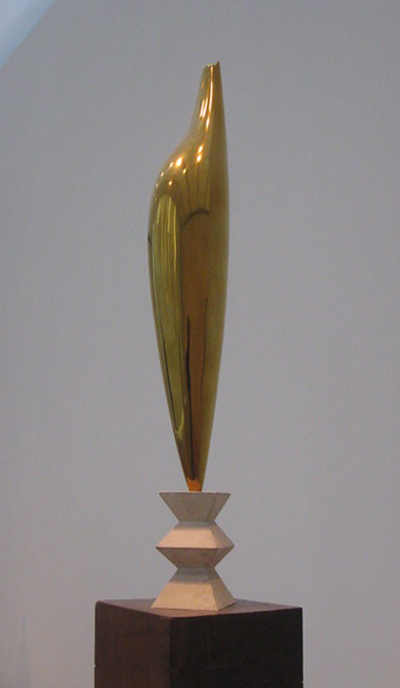
Start with the outline of the Metropolitan Museum’s 1923 marble. A narrow foot rises into a long body that widens gradually, then narrows towards the upper end. That end is cut on a slant. The Met interprets the slant as what remains of the head and beak. Seen from a suitable angle, the end has the breadth of a small plane. Viewed from the side, it approaches an edge and gives the upper contour a sense of direction. This is one reason a single photograph may give the impression of a needle point where a walk around the sculpture reveals a more complicated termination. [1]
The outline contains very few interruptions. The eye can follow a single edge for most of the sculpture’s height. Around the middle of the figure, the line curves out slowly enough that it takes a moment to see where the swelling begins. Below it, the narrowing leads into a more pronounced change of shape where the foot opens out. Watch that junction before looking back up. The foot establishes the vertical axis and gives a sense of how much the long contour departs from it. The structure is upright. The silhouette appears to be going somewhere. [1]
The title directs attention towards a particular kind of motion. An upright bird at rest could be distinguished by the position of its feet or the turn of its head. In Bird in Space, the continuous taper carries much of the information that might otherwise be supplied by those parts. An upward sweep can suggest a body passing through air even though there is no horizon, perch or landscape to locate it. The exact species is immaterial to the effect. The curved surface and the diagonally finished tip ask the viewer to reconstruct the movement. [1] [4]
The emphasis changes with the version. The first marble makes its volumes legible through gradations of light across the stone. In polished metal, a strip of reflected light can run along one edge, break at the swelling and reappear further up. As a viewer moves, that strip can appear to travel independently of the contour. Stand where the sculpture catches a dark reflection and the bright outline may become its most distinct feature. Move a little and the broad face comes forward again. This shift gives a stationary object a second, optical kind of movement. [1] [6] [7]
From Maiastra to Golden Bird
Brâncuși had already spent years sculpting birds by the time he carved the Metropolitan Museum’s marble. The sequence generally runs from Maiastra through the Golden Bird group to Bird in Space. The early birds offer a way to see which forms persisted and which became harder to identify. The relationship has as much to do with the bases and the disposition of weight as with the changing outline of the bird. [4] [8] [9]
The Museum of Modern Art’s Maiastra, dated 1910–12, takes its name from a mythical bird in Romanian folklore. Its white marble head and neck pull upward. The chest gathers into a conspicuous round body, with the beak and the suggestion of tail feathers still legible. It looks poised above the two human forms in the pedestal’s middle section. That section originated as an independent work, Double Caryatid, which Brâncuși exhibited in 1908. The blocks above and below it rise in angular steps, giving the whole assembly something of an architectural rhythm. The highest portion, the smooth bird, has a markedly different texture from the roughly worked carving in the base. [8]
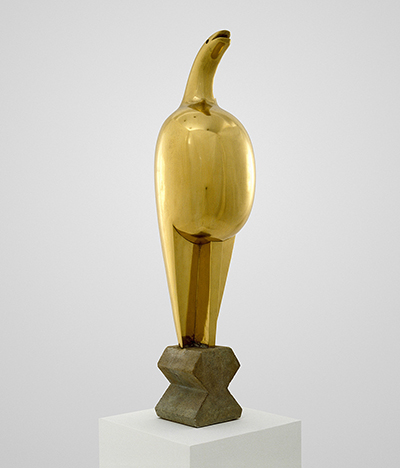
The proportions change in Chicago’s Golden Bird, dated 1919 by the Art Institute. The polished bronze has a much extended neck, a projecting point near the top and a body drawn into a more continuous vertical sweep. The textured elements beneath it lend the metal a particularly smooth appearance. A comparison from the side shows how the swelling that reads as a chest in Maiastra has been drawn out into a long change of width. Blades of reflected light on the metal also make this version feel less fixed than the whiteness of the earlier marble. [8] [9]
Golden Bird is especially informative at the transition between body and pedestal. The eye can still recognise a creature perched high up, even as its outline grows harder to separate into anatomical parts. The 1923 Bird in Space pushes that uncertainty further. Its upper slanted plane sits within the rising contour, and the long volume leaves little room for a division between neck and body. The sculpture retains a pronounced swell and a line of ascent. Those features carry an idea developed across the earlier works into a form that needs much less anatomical information. [1] [8] [9]
The stages in that comparison are visible in individual sculptures. The titles used over the years can be less orderly. The Art Institute’s bibliography shows that its Golden Bird circulated under several names, including The Bird and Flight of Bird. A title in a historical catalogue can therefore sound remarkably close to Bird in Space and still refer to the Chicago work. When comparing an old photograph or reference, its date, owner, medium and exhibition record can be more informative than the English title on its own. [9]
Brâncuși explored analogous problems with other creatures. The Centre Pompidou places his birds alongside fish, roosters and other animals in an essay on his bestiary. This comparison helps explain how far the title can guide a viewer. Give a sculpted fish a long horizontal profile and a narrow edge, and a change of viewpoint can make its body seem to slip away. Give the bird a steep axis and a taper that keeps pulling the eye higher, and the same insistence on a clean contour produces a different direction of movement. In each case the animal supplies a reason for the precise form the sculpture takes. [1] [10]
Why Brâncuși returned to the form
It would be easy to imagine a single sculpture reproduced for different collections. The museum records show a sustained investigation whose results differ at the level of the object. MoMA describes a working method in which Brâncuși took a plaster cast from a sculpture in marble and altered the proportions in plaster before casting the revised form in metal. The interval between stone and bronze included an opportunity to change the form. A taller version could call for changes in width, curvature and the strength of the foot. The contour gives little visual cover for any awkwardness between those decisions. [7]
Plaster is especially significant here because it connects an apparently simple outline to the work of refining it. It could preserve the state of a marble while giving the sculptor a separate object to modify. It also had a life in the studio as an object in its own right. The Centre Pompidou keeps a 1926 L’Oiseau dans l’espace in plaster, inventory AM 4002-98, which it says appears to have been used for the polished bronze made for Steichen that year. The museum’s wording leaves the exact relationship open. The plaster provides evidence of a possible intermediate stage, without establishing the complete sequence of objects and casts that produced the sculpture now in Seattle. [2] [11]
A separate Centre Pompidou record is for Edward Steichen’s photograph L’Oiseau dans l’espace, dated 1926. That date belongs to the print’s catalogue record, alongside its own authorship and collection history. A cast can be dated independently from its provenance and making. These two records show the range of objects that can sit behind the same French title. The plaster was made in the course of the sculptor’s work. The photograph frames a view of a sculpture and fixes the appearance of its surface, position and setting at one moment. [11] [12]
Kettle’s Yard in Cambridge has another photograph, taken by Brâncuși himself and dated 1926–27. The museum points to a dimension of 53 inches written on the back of the print. That measurement narrows the likely subject to one of two polished bronze versions, dated 1926 and 1927. It leaves the individual cast uncertain. The picture is evidence of how Brâncuși chose to present a Bird in Space, even with the identity of the bronze still open. His choice of angle and lighting controls where the eye meets the silhouette and where the metal catches the light. Put his photograph alongside a museum record of a standing bronze and the differences in framing show how much of a work’s appearance can depend on a single chosen view. A measurement on the print can answer a question that the most persuasive resemblance might leave unresolved. [13]
Brâncuși’s close attention to surface made the choice of material inseparable from the proportions. On a marble, the light softens across the curved face and helps the eye register a slight variation in width. A polished metal reflects the darker and lighter areas around it. That reflected pattern can accentuate one margin or appear to interrupt the continuity of the volume. Both surfaces can convey a clean sweep, but a gallery with large windows or bright spotlights will affect the metal especially strongly. Even a monochrome historical image that records the silhouette well can leave questions about how the sculpture appeared when seen in person. [1] [4] [6] [12]
The number of versions depends on the catalogue being cited. The Metropolitan Museum counts seven marbles and nine bronzes in the series. The Peggy Guggenheim Collection identifies sixteen examples dating from 1923 to 1940, while MoMA dates one of its bronzes to about 1941. A separate account published by MoMA gives fifteen versions in marble and bronze, with plaster casts mentioned separately. These summaries agree on the scale and duration of the project. Their totals and range endpoints differ, and they do not provide a shared list from which to reconcile each entry. The dates and materials attached to individual works are a sounder starting point than a single count for the series. [1] [3] [4] [7]
Marble, bronze and brass versions in museums
These examples show how the composition changed across collections. The dates and materials follow each museum’s catalogue. The dates refer to the specific works or, in the Los Angeles entry, to a model with a later cast.
| Collection | Catalogue date | Material and support | Accession |
|---|---|---|---|
| Metropolitan Museum of Art, New York | 1923 | Marble | 1996.403.7ab [1] |
| National Gallery of Art, Washington | 1925 | Marble, stone and wood | 1967.13.3 [14] |
| Seattle Art Museum | 1926 | Polished bronze on a marble and wood base | 2000.221 [2] |
| National Gallery of Art, Washington | 1927 | Brass, limestone and wood | 1989.31.3 [6] |
| Los Angeles County Museum of Art | 1927, cast later | Polished bronze, cast number 4/5 | M.2005.70.13 [15] |
| Museum of Modern Art, New York | 1928 | Bronze | 153.1934 [16] |
| Norton Simon Museum, Pasadena | 1931 | Polished bronze | F.1972.08.S [17] |
| Peggy Guggenheim Collection, Venice | 1932–40 | Polished brass on a limestone base | 76.2553 PG 51 [4] |
| Museum of Modern Art, New York | c. 1941 | Bronze on a two-part stone pedestal | 497.1964 [7] |
The 1923 and 1925 marbles
The Met’s Bird in Space measures 144.1 cm in height including its base. John Quinn, an American collector and important patron, first saw the sculpture in progress in Brâncuși’s Paris studio and became its first owner. The Met ultimately received it through the bequest of Florene M. Schoenborn. The work gives an early, clearly dated example of the long profile and oblique tip. Its collection history also shows American interest in the revised bird form before the trial made it a matter of public dispute. [1] [18]
The 1925 Washington marble makes a markedly different impression at full height. Its marble bird measures 181.9 cm and the museum gives 344.6 cm for the full assembly. Directly beneath the bird are two lighter stone elements. The dark wooden section below has an angular, hourglass-like shape. The base is tall enough to lift the swollen portion of the marble well above a standing viewer’s eye level. Its alternating forms also give the ascent several distinct stages. Eugene and Agnes Meyer acquired the work in 1925 and gave it to the National Gallery of Art in 1967. The gallery lists it as number 30 at Brummer in 1926. Seattle lists the Steichen bronze as number 33 in that exhibition. Two objects in the same show thus had distinct dates, owners and materials. [2] [14]
The paired Washington holdings
In the same Washington collection, the 1927 Bird in Space, accession 1989.31.3, has a polished figure catalogued as brass. The bird itself measures 185.4 cm, close to the height of the museum’s 1925 marble. The whole 1927 assembly measures 287.7 cm, more than half a metre shorter than the earlier work with its bases. A pale cylinder stands between the brass and the wood. The wooden pedestal has a rounded, disc-like middle, framed by curved forms above and below. The changes in the lower silhouette are apparent even when images of the two birds have been reproduced at the same size. [6] [14]
The brass version also has a separate provenance. Helena Rubinstein acquired it from Brâncuși around 1932. It passed through her estate sale and then to the Schreibers before Rita Schreiber’s gift to the gallery in memory of her husband in 1989. Pairing this object with the 1925 marble brings practical differences into view. The figures are close in height, yet the supports establish very different viewing levels, while the marble and brass respond differently to the room. A catalogue photograph cropped to the top part can disguise both points. [6] [14]
The later casts in Los Angeles, New York and Venice
The Los Angeles County Museum of Art records its polished bronze as 1927, cast later, and identifies it as cast number 4/5. Those fields give different kinds of information. The first supplies the model date and leaves the casting year open. The second identifies the museum’s cast in its recorded group. The accession number M.2005.70.13 distinguishes that object from other LACMA holdings and from Washington’s brass dated 1927. [6] [15]
MoMA has a bronze dated 1928, accession 153.1934, given anonymously, and the taller bronze of about 1941, accession 497.1964, given by Mr. and Mrs. William A. M. Burden. The latter’s bronze figure alone is 182.9 cm high, with another 44.1 cm for its two-part stone pedestal. MoMA’s account of the customs dispute illustrates the article with its own 1928 bronze but identifies the piece that came through customs in 1926 as the one now in Seattle. When an illustration accompanies an article about the trial, the caption can matter as much as the article for identifying the work. [2] [3] [7] [16]
In Venice, the Peggy Guggenheim Collection dates its polished brass to 1932–40. According to its catalogue, casting may have taken place as early as 1932, with the finish completed in 1940. The narrow, irregular stem is part of the metal form and stands on a limestone base. Where the upper contour appears especially regular and sleek, the stem shows a more uneven passage from the vertical bird into its foot. It lets the eye trace the attachment to the stone before following the broad sweep above it. The two dates capture an interval in the making of this particular sculpture. [4]
The birds associated with the Maharaja of Indore
The Norton Simon Museum’s polished bronze has a useful counterpart in Canberra. Its 1931 cast, 185.4 cm high, was acquired by Yashwant Rao Holkar II, the Maharaja of Indore, for his Art Deco palace. The museum records that the Maharaja also reserved two versions in marble, one black and one white, during a visit to Brâncuși’s studio in 1933. Those marbles are held by the National Gallery of Australia, which dates them to about 1931–36. Their association with the same patron makes the changes of material particularly telling. The light and dark stones offer quite different ways of seeing a comparable passage of form. A bright metal surface brings reflections from the room into that same comparison. [17] [19]
A posthumous example in Japan
The Shiga Museum of Art identifies 1926 as the year of the model for its Bird in Space (空間の鳥) and records a posthumous casting. The metal figure measures 135 cm, while the pedestal measures 149.2 cm. Even before colour or texture enters into the comparison, the relative heights give the Japanese work a different appearance from an installation in which the bird occupies most of the vertical span. The Shiga record is also a reminder of what a date can describe. A label reading only “1926” would leave out the distinction between the date of the model and the later making of the metal object. [20]
The 1926 customs dispute
Edward Steichen’s bronze comes to New York
Edward Steichen acquired his Bird in Space directly from Brâncuși in France in 1926. It went to New York for Brâncuși’s exhibition at the Brummer Gallery, organised with Marcel Duchamp’s involvement. The Seattle Art Museum records the show from 17 November to 15 December 1926, followed by the Arts Club of Chicago in January 1927. Although several works crossed the Atlantic for the exhibition, the original dispute and later ruling discussed here concern an identifiable bronze now catalogued as Seattle 2000.221. [2] [3]
The Chicago installation shows how prominently the disputed sculpture could be displayed while the classification was unresolved. In a letter written on the opening day, Duchamp told Brâncuși that he placed Steichen’s bronze in the middle of a gallery hung with grey canvas. The Golden Bird and Maiastra occupied positions towards the ends of the room, with an early Endless Column between the Steichen bronze and Golden Bird. A study by Margherita Andreotti reproduces installation photographs and uses the correspondence to reconstruct the arrangement. One of those photographs identifies the bronze then owned by Steichen. It survived in the exhibition record as a sculpture seen in the company of work from different points in Brâncuși’s career. [2] [21]
Approached along that gallery, the three birds would have come into sight at different distances and heights. The central bronze offered a long silhouette against the comparatively even cloth backdrop. The route through the exhibition made it possible to encounter a related form again in a different material and at another scale. Duchamp’s description gives substance to the comparison between the earlier bird sculptures and Bird in Space. It shows the works placed in deliberate proximity by someone acquainted with the artist’s own arrangements. The customs opinion later describes how difficult a single view of the object is to put into words. The installation had given visitors another way of making sense of it, by seeing it against other sculptures. [5] [21]
The importer claimed duty-free entry as art under paragraph 1704 of the Tariff Act of 1922. The customs collector assessed the object at 40 percent of its value under paragraph 399, as a manufacture of metal. Accounts of the case often call it a kitchen utensil. The published opinion identifies a general tariff provision for manufactured metal articles. It describes the imported object as invoiced as a bronze bird and also gives Bird in flight as a name used in the record. These details identify the legal disagreement more clearly than the familiar anecdote. The two tariff provisions assigned different treatment to objects that could both, in a literal sense, be made of cast metal. [3] [5]
That disagreement had a practical basis. The exemption covered original sculpture by a professional sculptor, with limits on replicas and with articles of utility excluded. Bronze and other metals were expressly among the materials it allowed. Once the object was accepted as an original work made by a professional, its relationship to the legal category of sculpture remained to be established. The importer and the government brought in people who had spent their lives looking at and making art. They gave different answers about what they were seeing. [5]
What the witnesses and judges saw
Steichen testified for Brâncuși, as did the sculptor Jacob Epstein and the Brooklyn Museum’s director, William Henry Fox. The critic Frank Crowninshield was asked what led him to regard the object as a bird. In MoMA’s account, his answer brings attention to the suggestion of flight. The witnesses supporting the sculpture could see the title as a way into the work, with the curve carrying the impression of a bird’s motion. Two government witnesses with experience in sculpture denied the work’s status as art or sculpture. The court accepted evidence of Brâncuși’s professional standing and found the object to be an original production. [3] [5]
The written decision is unusually attentive to the shape. Justice Waite describes how the piece expands towards its middle and then narrows before opening into a conical foot. He records the diagonal upper end and notices that the view from the side suggests a crescent. He refers to a photograph entered as an exhibit because putting this form into words is difficult. The judges acknowledged how little resemblance there was to a bird with identifiable features. Their detailed account of the object makes that acknowledgement especially interesting. They could describe exactly what they saw even as they differed from some witnesses on how readily it evoked the animal. [5]
The government cited United States v. Olivotti, a 1916 customs precedent that had described sculpture with reference to the imitation of natural objects in their proportions. Applied to the bronze on a strictly literal basis, that approach would leave little room for a work in which the significant thing was the bird’s passage through space. The court acknowledged that a school of artists had developed whose work addressed abstract ideas, and that its influence on the art world deserved to be considered. It also considered specific properties of the imported piece. It found an ornamental use comparable to that of established sculpture, commented on its outline and accepted it as the original work of a professional sculptor. [5]
What the court decided
On 26 November 1928, the United States Customs Court sustained the protest and held that the work qualified for duty-free entry under paragraph 1704. The decision is reported as C. Brancusi v. United States, 54 Treas. Dec. 428. Its scope was the classification of this import under the tariff then in force. The court’s acknowledgement of modern sculpture mattered because it allowed evidence of contemporary practice to inform a legal term that the government had tried to read through an earlier resemblance test. The force of the ruling came from what the judges found about Steichen’s specific object, its making and its purpose. [5]
This is also a case in which the object’s afterlife can clarify an old source. In 1934 MoMA announced the anonymous gift of a polished bronze that it described at the time as a duplicate of the one involved in the customs controversy. Its current catalogue dates the acquired work to 1928 and treats versions of the subject as individually worked. The museum’s 1934 wording helps show how quickly the customs story became part of the public identity of the series. Its collection record and the Seattle provenance establish which physical bronze each institution holds. [2] [7] [16] [22]
The Seattle bronze remained with Steichen until he gave it to Joanna Steichen in the 1960s. It passed to Harold and Hester Diamond in 1980 and subsequently to Jon and Mary Shirley through the dealer Vivian Horan. Seattle records it as a partial and promised gift from the Shirleys in 2000. The same accession connects the bronze to the Brummer catalogue and to this later ownership history. That continuity gives a basis for identifying it even in accounts where the historical illustration is of a different version. [2] [3]
How to look at the sculpture in the round
The tip and the curve
Begin by looking from as far back as the gallery allows. Follow one side of the figure upward from the base, then follow the other side down. On the Met’s marble, look for the instant the slanted upper plane becomes visible. Much of the rising effect comes from the gradual build-up of volume below that very brief change of angle. Looking from the opposite side can make the top feel less emphatic and the middle more pronounced. A face-on photograph and a profile can thus give distinct impressions even when the size and lighting are similar. [1] [5]
The court’s visual account of the Seattle example gives a useful exercise. Find the view in which the bend is most apparent. Then shift your position until that apparent crescent becomes shallower. The footprint remains in the same place, yet one view sends the eye along a bow and another moves it up a much closer approximation of a straight line. A photograph that makes a Bird in Space look like a thin blade can emphasise a real quality of the work and still leave much of its volume concealed. [2] [5]
The place where the bird meets its base
Move down to the shape just above the pedestal. This area often disappears first in a photograph composed to emphasise the soaring form. It is also where the bird settles onto a support. In the Venice brass, an irregular stem creates an intermediate step between the smooth upper curve and the low limestone beneath it. The tall Washington marble prepares the eye differently. The dark wooden lower section, two paler stone sections and the flared foot build a long ascent before the eye reaches the upper figure. Taken together, the parts can make the sculpture appear to begin at the floor. [4] [14]
The distinction affects where a standing viewer naturally looks. A figure a metre and a half high on a low base can be read in a sweep close to eye level. On a much higher support, the lower body and foot may be easier to see than the narrow upper end. The shape unfolds at a steeper viewing angle, which can make the tip appear further away and the pedestal more substantial. Brâncuși had explored the relationship between independently shaped supports and the sculpture they carried in Maiastra. In the later works, the base helps determine how the movement of the bird is perceived. [1] [6] [8] [14]
Light on polished metal
On a polished example, shift attention from the silhouette to what happens inside it. A dull band, a visible reflection of a neighbouring object and a narrow highlight can occupy the same face. As you move, the transitions can appear to shift up and down the curve. The National Gallery of Art draws attention to this experience in its discussion of the 1927 brass. Its polish may allow a spectator to catch something of their own reflection. Then look at a marble version for comparison. On the stone, the gradations of brightness are usually easier to follow as an account of the three-dimensional form itself. [1] [6]
This helps explain why the work rewards a little time in front of it. The outline can be taken in at a glance. The effects of the support, the angle of the top and the changing reflections emerge as you move. They draw attention to how much a sculptor can do with a slight difference in thickness or a careful turn of the surface. The title keeps that close observation directed towards a movement most people recognise, even if what they see from their particular position differs. [1] [4] [6] [7]
Browse sculptures and drawings
Browse articles on the sculptures and separately catalogued museum objects. A work can have several physical versions. Drawing records from the Tate catalogue retain their October 2014 snapshot wording where present.
| Name | Date | Medium |
|---|---|---|
| Arch | Sculpture | |
| Bird in Space | Sculpture | |
| The Blond Negress | Sculpture | |
| The Cock | Sculpture | |
| The Endless Column | Sculpture | |
| The First Cry | Sculpture | |
| Fish | Sculpture | |
| The Gate of the Kiss | Sculpture | |
| Golden Bird | Sculpture | |
| Head | Sculpture | |
| The Kiss | Sculpture | |
| Leda | Sculpture | |
| Madame L.R. | Sculpture | |
| Mademoiselle Pogany II | Sculpture | |
| Mademoiselle Pogany | Sculpture | |
| Maiastra | Sculpture | |
| The Newborn | Sculpture | |
| Phoque II | Sculpture | |
| The Prayer | Sculpture | |
| Princess X | Sculpture | |
| Prometheus | Sculpture | |
| Târgu Jiu monumental ensemble | Sculpture | |
| Sculpture for the Blind | Sculpture | |
| The Seal | Sculpture | |
| The Signal | Sculpture | |
| Sleeping Muse | Sculpture | |
| The Sorceress | Sculpture | |
| The Table of Silence | Sculpture | |
| Torso of a Young Man | Sculpture | |
| Two Lamps | Sculpture | |
| Vitellius | Sculpture | |
| The White Negress | Sculpture | |
| The Wisdom of the Earth | Sculpture | |
| Young Bird | Sculpture | |
| The Kiss (Philadelphia, fourth version) | 1916 | Sculpture Catalogue. |
| Sleeping Muse (Pompidou bronze) | 1910 | Sculpture Catalogue. |
| Mlle Pogany, version I (MoMA bronze) | 1913, after a marble of 1912 | Sculpture Catalogue. |
| Maiastra (Venice brass) | about 1912 | Sculpture Catalogue. |
| Bird in Space (MoMA bronze) | about 1941 | Sculpture Catalogue. |
| Bird in Space (Venice brass) | 1932–40 | Sculpture Catalogue. |
| Endless Column, version I (oak) | 1918 | Sculpture Catalogue. |
| Brâncuși Monumental Ensemble of Târgu Jiu | 1937–38 | Sculpture Catalogue. |
| Bust of a nude woman in profile, head inclined | about 1910 | Drawing Catalogue. |
| Nude study, head inclined (recto) | — | Drawing Catalogue. |
| Self-portrait (ink) | — | Drawing Catalogue. |
| View of the Artist’s Studio | 1918 | Drawing Catalogue. |
| Study for the cock (lost clay Grand Coq) | about 1923 | Drawing Catalogue. |
| Portrait of a woman in profile | — | Drawing Catalogue. |
| Animal head | — | Drawing Catalogue. |
| Animal sketch (2002 checklist) | 1929 | Drawing Catalogue. |
| Plans of the studio (verso) | about 1930–38 | Drawing Catalogue. |
| Danaïde (Tate T00296) | c.1918 | Sculpture Catalogue. |
| Maiastra (Tate T01751) | 1911 | Sculpture Catalogue. |
| Head (Tate T03066) | c.1919–23 | Sculpture Catalogue. |
| Fish (Tate T07107) | 1926 | Sculpture Catalogue. |
Frequently Asked Questions
It depends on the version. The 1923 work in the Met is marble, the Steichen example in Seattle is polished bronze and the Peggy Guggenheim Collection’s version is polished brass. Surviving plaster examples provide evidence about Brâncuși’s working process. Bases can incorporate other materials, including limestone and wood. [1] [2] [4] [6] [11]
Under the tariff in force, original sculpture could qualify for duty-free entry. Customs treated the shipment’s disputed item as a manufacture of metal and charged 40 percent of its value. In 1928, the United States Customs Court ruled that Brâncuși’s original bronze qualified as sculpture under the tariff. [5]
Discussion
Look again at the images and ideas explored in Bird in Space. These editorial prompts invite your observations.
Reader Insights
Which part of the sculpture gives you the strongest sense of rising motion?
How might the same outline feel different in marble and polished bronze?
Join the Conversation
Share a detail, comparison or question about Bird in Space below.
References
- The Metropolitan Museum of Art , Bird in Space , 1923, 1996.403.7ab. View source.
- Seattle Art Museum , Bird in Space , 1926, 2000.221, including provenance and exhibition history. View source.
- MaryKate Cleary, Museum of Modern Art , “But Is It Art?” Constantin Brancusi vs. the United States, 24 July 2014. View source.
- Peggy Guggenheim Collection , Bird in Space , 1932–40, 76.2553 PG 51. View source.
- United States Customs Court , C. Brancusi v. United States , T.D. 43063, 54 Treas. Dec. 428, 26 November 1928, opinion by Justice Waite. View source.
- National Gallery of Art, Washington , Bird in Space , 1927, 1989.31.3. View source.
- Museum of Modern Art , Bird in Space , c. 1941, 497.1964, with 2018–19 gallery label. View source.
- Museum of Modern Art , Maiastra , 1910–12, catalogue record 81018 and gallery labels. View source.
- Art Institute of Chicago , Golden Bird , 1919, collection record 91194 and bibliography. View source.
- Centre Pompidou , Le bestiaire poétique de Constantin Brancusi. View source.
- Centre Pompidou , Constantin Brancusi, L’Oiseau dans l’espace , 1926, plaster, AM 4002-98. View source.
- Centre Pompidou , Edward Steichen, L’Oiseau dans l’espace , 1926, gelatin silver print. View source.
- Kettle’s Yard, University of Cambridge , Constantin Brâncuși, Oiseau dans l’espace (Bird in Space) , 1926–27, photograph, KY00719.E. View source.
- National Gallery of Art, Washington , Bird in Space , 1925, 1967.13.3. View source.
- Los Angeles County Museum of Art , Bird in Space , 1927, cast later, M.2005.70.13. View source.
- Museum of Modern Art , Bird in Space , 1928, 153.1934. View source.
- Norton Simon Museum , Bird in Space , 1931, F.1972.08.S. View source.
- The Metropolitan Museum of Art , Recent Acquisitions: A Selection, 1996–1997 , Metropolitan Museum of Art Bulletin 55, no. 2, 1923 Bird in Space acquisition entry. View source.
- National Gallery of Australia , How to fly Brancusi’s Birds , essay on the Canberra works. View source.
- Shiga Museum of Art , 空間の鳥 ( Bird in Space ), object catalogue. View source.
- Margherita Andreotti, Art Institute of Chicago , “Brancusi’s Golden Bird: A New Species of Modern Sculpture,” Art Institute of Chicago Museum Studies 19, no. 2, 1993, pp. 149–151 and figs. 15–16. View source.
- Museum of Modern Art , Brancusi “Bird in Space” acquired by MoMA through gift , press release, August 1934. View source.
More BRÂNCUȘI Sculptures
Bird in Space
Compare the marble and metal versions of Brâncuși’s sculpture.