by Tom Gurney
Tom Gurney BSc (Hons) is an art history expert with over 20 years experience
Email: tomgurney1@gmail.com / Phone: +44 7429 011000
Fish: Introduction
From the side, Constantin Brâncuși’s Fish is a broad sweep of blue-grey marble nearly six feet long. Walk towards one end and the stone thins to a sliver. Brâncuși could also turn the sculpture itself with a push. The 1930 marble at the Museum of Modern Art in New York brings those two kinds of movement together in a form that suggests a fish slipping through water. [1] [2]
At a Glance
- ArtistConstantin Brâncuși
- Date and placeParis, 1930
- BodyBlue-grey marble, 21 × 71 × 5½ in. (53.3 × 180.3 × 14 cm)
- Three-part pedestalOne marble element 5⅛ in. (13 cm) high and two limestone cylinders 13 in. (33 cm) and 11 in. (27.9 cm) high. The diameter at the widest point is 32⅛ in. (81.5 cm).
- MovementThe body rested on a pivot. Brâncuși could set it turning by hand.
- CollectionThe Museum of Modern Art, New York, 695.1949.a–d
- AcquisitionPurchased from the artist in 1949. Acquired through the Lillie P. Bliss Bequest (by exchange).
MoMA gives the measurements for the marble body and pedestal components separately. [1] [2]
Contents
- How the shape changes as you walk
- The pedestal and the pivot
- Philadelphia’s smaller marble and the early bronze
- Two plaster objects, two histories
- The large form in bronze at Mannheim
- The fish in the studio and in New York
How the shape changes as you walk
At its greatest extent, the marble is nearly thirteen times as long as it is thick. The broad view makes the top and bottom contours easy to follow. Each runs for a long stretch before meeting the other at the end. Along the way the edge rises, falls and tapers with little interruption. With scarcely any features inside the outline to anchor the eye, that shallow arc has to do much of the work of suggesting a living body. The title supplies a subject, and the silhouette makes it plausible. [1]
Take a few steps around the pedestal and the relationship between length and thickness begins to change. The outer contours draw closer, the nearer end comes forward and the far end recedes. As the long face turns away from the line of sight, the flat-looking shape reveals enough thickness to register as a solid body. Farther around, length almost disappears again. The eye can follow something like the path of a fish rolling in the water through the simple change from a side view to an end view. [1]
The sculpture leaves its direction of travel open. A realistically modelled tail would mark one end as the rear, and an eye or a mouth would identify the head. Here the slight shifts in curvature and the angle of approach carry that burden. Along a particular line of sight one end can seem to lead, but the impression can ease or reverse as the observer changes position. What stays consistent is the sweep of the form away from its support. Very little of its long edge is occupied by the place where it is held up. [1]
MoMA conservator Lynda Zycherman draws attention to the stone itself. Brâncuși visited stone yards, as the business cards he kept attest. Zycherman suggests that he may have noticed how the blue-grey marble resembles rippling water. The suggestion concerns the look of this piece of stone and leaves Brâncuși’s exact thought at the yard open. Across the wide face, the veins and flecks can suggest currents running through the form. A return to the edge changes how much of that pattern the eye can take in. The same walk that alters the outline also alters the view of the marble. [1] [3]
The six-foot length matters at the scale of a person’s body. A small fish can be turned over in the hand or taken in from one spot. This one invites a longer walk. From broadside the body has room to extend well beyond the stone immediately below. Seen from an end, the pedestal occupies a much larger share of the view. The shifting balance between sculpture and support makes the sides of the work feel unequal in emphasis even though the material itself stays in place. [1]
The pedestal and the pivot
The support steps down from the thin marble body through a 13 cm-high marble element to two limestone cylinders, 33 cm and 27.9 cm high. At its widest, the pedestal’s diameter of 81.5 cm is under half the body’s length. The long reach above and the squat, spreading forms below give the work two distinct rhythms. One runs out towards the ends and encourages the eye to follow. The other draws attention back down, through rounded stone shapes that gather the weight towards the floor. [1]
A pedestal also sets the height at which a viewer meets the carving. On this support, the eye can range along the edge and see into the thickness of the body without looking down at it as one might at a specimen. A low viewpoint gives the side silhouette and the overhang particular force. A higher viewpoint makes the top of the support and the junction with the marble easier to read. The amount of visible stone around that junction changes with the viewer’s height as well as position. [1]
MoMA’s object label describes a pivot that once allowed Fish to spin. In the museum’s audio guide, assistant curator Mia Matthias identifies ball bearings and explains that Brâncuși could activate the sculpture by pushing it. A person standing in place could then see the shape pass from one aspect to the next as the stone turned. Walking around a stationary example brings about a comparable change in profile, with a different sense of time. Each viewer sets the pace and can pause with the outline half formed between its broadest and narrowest views. [1] [2]
Brâncuși pursued a related effect with the 1926 bronze Leda. The works share the potential for rotation, but the arrangements were different. MoMA describes a gramophone motor adapted for Leda and set into its base. The Centre Pompidou records the sculpture’s 1932 reflective disc and describes the motor and bearings beneath it. The polished bronze catches the room and the viewer in its reflections as it turns. On the 1930 Fish, a push brings the marble into motion and the veins remain features of the stone as it changes aspect. Each work makes a display of what happens between successive views, through different materials and different ways of setting them in motion. [2] [4] [5]
There is also a difference in what the moving silhouette describes. Leda has an offset upper curve whose relationship to the fuller lower body shifts with the rotation. In Fish, the wide face and thin edge can look so unlike one another that the eye has to keep joining them back together. There is a useful moment between the two, when one end is visibly foreshortened and the other still looks long. At that point, the fish seems to turn through the water as well as through the space above its base. [1] [2] [5]
Philadelphia’s smaller marble and the early bronze
Brâncuși had already made a markedly smaller Fish in 1922. The Philadelphia Museum of Art holds that veined marble on a two-part support of mirror and oak. The carving is about 43 cm across, less than a quarter of the length of the MoMA marble. The support gives it height, so the length of the fish itself tells only part of the story of how much space it takes up. The mirror puts a second image of the body close beneath the first, above the dark grain and much greater height of the oak. [6] [7]
In the Philadelphia version, the patterned marble remains visible as stone even as the reflection suggests a body moving just above a surface. From an angle where both body and reflection can be seen, the gap between them is part of the effect. Shift position and the reflected image changes independently of the stone’s veining. At MoMA, the marble and limestone pedestal has a different visual role. Its repeated rounded shapes give the long form a place from which to extend, leaving the suggestion of water chiefly to the stone’s coloration and the behaviour of its outline. [1] [3] [7]
A small plaster at the Centre Pompidou connects the Philadelphia marble with Brâncuși’s early work in metal. Dated 1924, it measures 13.5 × 43 × 2.5 cm. The museum identifies it as an impression taken from the 1922 marble and considers it very likely to have served in making two polished bronze versions dated 1924. The two carvings in Philadelphia and New York show how far he could change the scale of a subject. The plaster shows a separate process, in which he could carry a form close to its original scale into another material. [1] [6] [8]
A photograph Brâncuși made around 1926 documents the effect of polished bronze above polished steel. In the Centre Pompidou record, the sculpture pictured is dated 1924–26, while the gelatin silver print itself is dated around 1926. The metal disc reflects the illuminated bronze. Light runs unevenly across the curved surface, leaving bands that are repeated below in the reflection. The doubling makes it difficult at a glance to locate the point where the bronze ends and its image begins. In a single photograph Brâncuși could use the camera angle and lighting to show that overlap at its most legible. [9]
A much later casting makes the names and dates especially important. The Artizon Museum in Tokyo exhibited a polished bronze belonging to the Brancusi Estate under the title Fish, dating the work 1924–26 and identifying the casting year as 1992. At 42 cm wide it is close in scale to the early marble and plaster. The checklist separates the dating of the form from the manufacture of the bronze on display. That distinction matters when comparing illustrations of Fish from different collections. Two nearly identical titles can refer to objects made in different materials and decades. [6] [8] [10]
Two plaster objects, two histories
The Centre Pompidou has a second plaster Fish, catalogued 1930–49. At 183 cm across it belongs to the scale of the MoMA sculpture. The museum identifies it as an impression of the 1930 blue marble and records it on a grey marble support shaped like a hemisphere. There are traces of ochre paint. The museum reads those traces as evidence of experiments towards a metal casting that was never carried out. The large plaster therefore links directly to the New York marble without supplying a route from that marble to the smaller bronzes. [8] [11]
Compare the two plasters and the different roles come into focus. The small one records the narrow dimensions of the 1922 carving, and the Pompidou connects it to subsequent bronzes. The large one carries the sweep of the 1930 stone into a paler, patinated surface. It stayed in Brâncuși’s studio collection and entered the museum with his 1957 bequest. Its display on a plaster table next to a Sleeping Muse II is a recorded studio arrangement. It offers a way to study the large form alongside another sculpture and to see how differently a support can set the height and surroundings of a familiar silhouette. [8] [11]
The large plaster also isolates something that is hard to separate from the natural pattern in the MoMA version. The outline persists through a change in material. In the plaster, the eye has fewer naturally occurring markings to follow, so the contours and the relation of thickness to length carry more of the effect. The marble puts the visual weight back inside the silhouette through its veins and flecks. Seeing the two together, even through museum photographs, helps explain why both the geometry and the particular piece of stone matter to the finished work. [1] [3] [11]
The large form in bronze at Mannheim
A bronze almost the size of the MoMA marble is at the Kunsthalle Mannheim. Its record distinguishes the date of the form, 1930, from its posthumous casting in 1968. The body of Le grand poisson measures 53.7 × 181 × 14 cm and stands on marble and limestone supports. That brings it close enough to MoMA’s sculpture in height, length and thickness for the surface to be the most striking point of comparison. The German museum describes the polished bronze picking up reflections from the room. The blue-grey marble shows markings that belong to the stone itself. [1] [12] [13]
A bright patch in a polished bronze can lengthen across the surface or disappear as the viewer moves. A vein in the marble stays in the same part of the carving, even as more or less of it comes into view. The two surfaces can suggest a fish moving through water in different ways. One catches a momentary flash from outside the sculpture. The other lets the eye follow a pattern that seems to run through the body. The two pieces reach a comparable scale by very different routes, as a finished marble and as a later casting in bronze. [1] [3] [12] [13]
Mannheim also documents a different pedestal. It lists a small marble support 18 cm high and a large limestone support 57 cm high. Its education material describes the upper support as rounded, a short transition from the bronze to the heavier stone below. At MoMA, the change from the top marble element through two separate limestone cylinders is visible in three stages. These are choices about where the fish appears to float and where the stone begins to look like an anchor. The museum records give each body its own support measurements, which is especially helpful when photographs are reproduced at the same size. [1] [12] [13]
The fish in the studio and in New York
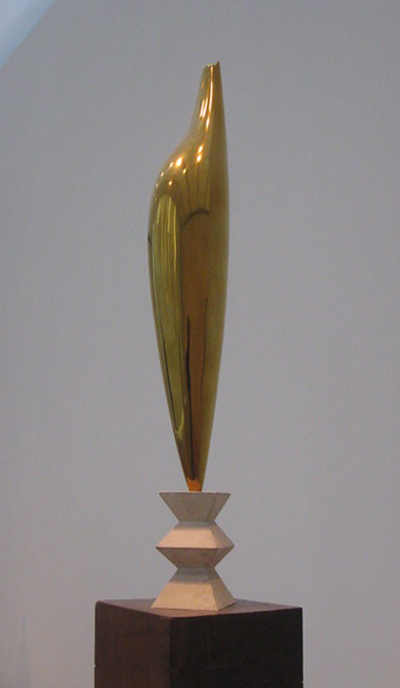
A studio negative from 1926 puts an earlier Fish in the same frame as a white marble Bird in Space dated 1925. The two bodies describe almost perpendicular courses through the picture. The fish spreads its length through the lower register, while the bird draws the eye upwards. The setting makes the comparison more concrete than the titles do. Both subjects lose the identifying detail of an animal’s body, and the angle of the long form does much to suggest whether it is rising or passing horizontally. The negative records one arrangement at the impasse Ronsin studio. [14]
In another studio print, dated around 1934, the large Fish appears with Leda, a white marble Bird in Space and several Endless Columns. The extended crosswise form can be read against uprights that vary in shape and interval. A pillar repeats its units for a long stretch, whereas the fish completes its sweep in a single continuous contour. The photographs from 1926 and around 1934 show Brâncuși returning to the way a horizontal sculpture changes the space around taller works, at different scales and with different neighbours. [14] [15]
The photographs could also help Brâncuși communicate with people installing a show. A gelatin silver print titled Le Poisson (1930) by the Centre Pompidou dates from autumn 1933. Brâncuși made it for Marcel Duchamp and Joseph Brummer as part of a set used to prepare his solo exhibition at the Brummer Gallery in New York, which ran from November 1933 to January 1934. The sculpture’s date appears in the title. The later date belongs to the print, and the print documents the preparation for the exhibition. These are three distinct records of the work’s life. [16]
MoMA’s provenance entry records that it purchased the large marble directly from Brâncuși in 1949. The credit line records the acquisition through the Lillie P. Bliss Bequest, by exchange. In January 1950 the museum announced the acquisition, calling the carving its first Brâncuși in stone and the third of his sculptures to enter its collection. The announcement says Brâncuși worked on it for several years and finished it in 1930. The announcement already singled out its nearly six-foot length and distinguished it from smaller treatments of the fish subject in other media. [1] [17]
The dates of the studio print and purchase bracket two ways of meeting the work. In a photograph taken for people arranging an exhibition, a chosen angle can communicate the profile and the relation of body to support immediately. On the gallery floor, looking across the sculpture from a single spot gives a smaller share of the total experience. A turning point comes when the viewer has moved far enough to lose the long face and has to recover it on the other side. The distinctive achievement of this marble is that the passage between those views can suggest life as decisively as any single silhouette. [1] [16]
Browse sculptures and drawings
Browse articles on the sculptures and separately catalogued museum objects. A work can have several physical versions. Drawing records from the Tate catalogue retain their October 2014 snapshot wording where present.
| Name | Date | Medium |
|---|---|---|
| Arch | Sculpture | |
| Bird in Space | Sculpture | |
| The Blond Negress | Sculpture | |
| The Cock | Sculpture | |
| The Endless Column | Sculpture | |
| The First Cry | Sculpture | |
| Fish | Sculpture | |
| The Gate of the Kiss | Sculpture | |
| Golden Bird | Sculpture | |
| Head | Sculpture | |
| The Kiss | Sculpture | |
| Leda | Sculpture | |
| Madame L.R. | Sculpture | |
| Mademoiselle Pogany II | Sculpture | |
| Mademoiselle Pogany | Sculpture | |
| Maiastra | Sculpture | |
| The Newborn | Sculpture | |
| Phoque II | Sculpture | |
| The Prayer | Sculpture | |
| Princess X | Sculpture | |
| Prometheus | Sculpture | |
| Târgu Jiu monumental ensemble | Sculpture | |
| Sculpture for the Blind | Sculpture | |
| The Seal | Sculpture | |
| The Signal | Sculpture | |
| Sleeping Muse | Sculpture | |
| The Sorceress | Sculpture | |
| The Table of Silence | Sculpture | |
| Torso of a Young Man | Sculpture | |
| Two Lamps | Sculpture | |
| Vitellius | Sculpture | |
| The White Negress | Sculpture | |
| The Wisdom of the Earth | Sculpture | |
| Young Bird | Sculpture | |
| The Kiss (Philadelphia, fourth version) | 1916 | Sculpture Catalogue. |
| Sleeping Muse (Pompidou bronze) | 1910 | Sculpture Catalogue. |
| Mlle Pogany, version I (MoMA bronze) | 1913, after a marble of 1912 | Sculpture Catalogue. |
| Maiastra (Venice brass) | about 1912 | Sculpture Catalogue. |
| Bird in Space (MoMA bronze) | about 1941 | Sculpture Catalogue. |
| Bird in Space (Venice brass) | 1932–40 | Sculpture Catalogue. |
| Endless Column, version I (oak) | 1918 | Sculpture Catalogue. |
| Brâncuși Monumental Ensemble of Târgu Jiu | 1937–38 | Sculpture Catalogue. |
| Bust of a nude woman in profile, head inclined | about 1910 | Drawing Catalogue. |
| Nude study, head inclined (recto) | — | Drawing Catalogue. |
| Self-portrait (ink) | — | Drawing Catalogue. |
| View of the Artist’s Studio | 1918 | Drawing Catalogue. |
| Study for the cock (lost clay Grand Coq) | about 1923 | Drawing Catalogue. |
| Portrait of a woman in profile | — | Drawing Catalogue. |
| Animal head | — | Drawing Catalogue. |
| Animal sketch (2002 checklist) | 1929 | Drawing Catalogue. |
| Plans of the studio (verso) | about 1930–38 | Drawing Catalogue. |
| Danaïde (Tate T00296) | c.1918 | Sculpture Catalogue. |
| Maiastra (Tate T01751) | 1911 | Sculpture Catalogue. |
| Head (Tate T03066) | c.1919–23 | Sculpture Catalogue. |
| Fish (Tate T07107) | 1926 | Sculpture Catalogue. |
Frequently Asked Questions
MoMA holds the 1930 Paris version, a blue-grey marble 180.3 cm long on a three-part pedestal of marble and limestone. The museum identifies it as the last and largest of the seven examples Brâncuși made. [1]
Discussion
Look again at the images and ideas explored in Fish. These editorial prompts invite your observations.
Reader Insights
Where in a walk around the 1930 marble does the form most clearly suggest a fish, and what becomes visible when that resemblance weakens?
How does the mirror in the Philadelphia version change the relationship between the fish and its support?
Imagine watching the marble turn from one position. What could you see differently if you walked around it while it stayed still?
Join the Conversation
Share a detail, comparison or question about Fish below.
References
- Museum of Modern Art. Fish, Paris 1930, 695.1949.a–d. Collection record, gallery label and provenance. View source.
- Museum of Modern Art. Movement and Stillness. Mia Matthias on Fish and Leda. View source.
- Museum of Modern Art. Constantin Brancusi. Fish. 1930. Lynda Zycherman on the blue-grey marble. View source.
- Centre Pompidou. Léda, 1926, AM 4002-85. Collection record for the bronze and the 1932 disc. View source.
- Centre Pompidou. Léda. Educational dossier on form, reflections and the turntable. View source.
- Philadelphia Museum of Art. Fish, 1922. Collection record. View source.
- DNP Art Communications. Fish, 1922, Philadelphia Museum of Art 1950-134-18. Japanese image archive with measurements and support details supplied with the Philadelphia Museum of Art and Art Resource credit. View source.
- Centre Pompidou. Le Poisson, 1924, AM 4002-89. Plaster and its documented relationship to the earlier marble and bronzes. View source.
- Centre Pompidou. Le Poisson (1924–1926), c. 1926, PH 437 A. Brâncuși’s gelatin silver print of the bronze on polished steel. View source.
- Artizon Museum. Brancusi: Carving the Essence. Exhibition press material, selected works list, no. 5. View source.
- Centre Pompidou. Le Poisson, 1930–49, AM 4002-90. Record for the patinated plaster on its grey marble support. View source.
- Kunsthalle Mannheim. Le grand poisson, 1930/1968, LS54. Collection data for the posthumous bronze and its separate supports. View source.
- Kunsthalle Mannheim. Le Grand Poisson. Education resource on the 1968 casting, display and early Philadelphia version. View source.
- Centre Pompidou. Studio view with Bird in Space and Fish, 1926, PH 75. Brâncuși’s gelatin silver negative. View source.
- Centre Pompidou. Studio view with Bird in Space, Endless Columns, Fish and Leda, c. 1934, PH 124 A. Brâncuși’s gelatin silver print. View source.
- Centre Pompidou. Le Poisson (1930), autumn 1933, PH 449 E. Brâncuși’s print for Duchamp and Brummer. View source.
- Museum of Modern Art. Sculptures, Watercolors and Drawings Added to MoMA Collection. January 1950 acquisition announcement. View source.
More BRÂNCUȘI Sculptures
Bird in Space
Compare the marble and metal versions of Brâncuși’s sculpture.