by Tom Gurney
Tom Gurney BSc (Hons) is an art history expert with over 20 years experience
Email: tomgurney1@gmail.com / Phone: +44 7429 011000
Brâncuși’s Style and Technique: Introduction
From the side, Constantin Brâncuși’s Fish at the Museum of Modern Art stretches almost the length of a person. Walk towards one end and that broad expanse of blue-grey marble narrows to a sliver. A pivot once allowed the stone to turn, but the sculpture can change just as dramatically when it stands still and the visitor moves. The effect depends on how thin Brâncuși made the marble, how he set it on a pedestal and how the viewer approaches it. [1]
Brâncuși made surfaces and supports do much of the work that sculptors traditionally entrusted to descriptive detail. He could suggest the embrace of two people through a seam in a stone block, the crest of a rooster through a jagged edge in cherry wood, or flight through the line of a polished casting. Across his sculptures, he arrived at these concentrated forms through quite different procedures. Comparing particular objects brings those procedures into view. [2]
At a Glance
- Direct carvingThe shape Brâncuși cut into a block of stone or piece of wood, including any support carved continuously with the figure.
- CastingA metal sculpture formed in a mould, sometimes from a plaster that Brâncuși reshaped to change its proportions.
- Polish, patina and gildingDifferent ways of working a surface, visible in moving reflections, darkened areas and applied gold.
- BasesPieces that set the height, pace and orientation of a work. Some were carved with the figure, while others had lives of their own.
- Movement and photographyRotation, changing viewpoints and reflected light, each capable of transforming the same object.
Contents
- Direct carving in stone and wood
- Casting and the different jobs of plaster
- Polish, patina and gilding
- The base as part of the composition
- Movement in the work and around it
- What the photographs show
- How to compare versions
Direct carving in stone and wood
Direct carving means shaping the material that will remain in the finished object by cutting it away. A tool changes the form at the point of contact. As the block gets smaller, each cut limits what the sculptor can do next. The term describes where the work takes place and allows for planning, sketches, tools and revisions. It also leaves room for finishing. Abrading a carved surface until it is smooth still involves working the same material from which the form emerged. Brâncuși’s surviving workshop equipment included hand tools and powered grinders and sanders for smoothing and polishing. [3]
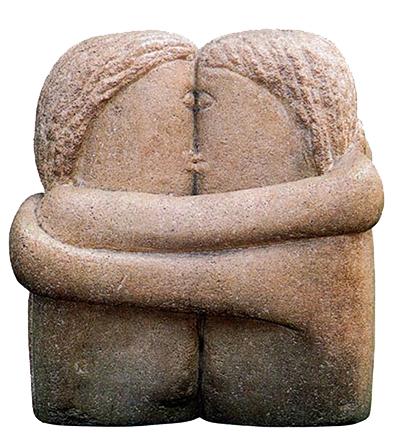
In the Philadelphia Museum of Art’s 1916 version of The Kiss, the original block remains easy to imagine. The embrace broadens into a band that crosses the front and continues around the sides. Two eyes join into a single oval across the seam between the faces, and an arch of hair runs over both heads. Look first at the meeting line, then at an outside corner. The seam distinguishes the lovers and the corner holds them in a common volume. Philadelphia identifies this as the fourth version of the theme. The earlier versions gave Brâncuși a form he could revisit, and the solution here depends on just how far he carried that interlocking pattern. [4]
Wood allowed him to develop sharp changes of direction. Look at MoMA’s 1924 The Cock, carved from one piece of wild cherry, including the cylinder at its foot. The sawtooth profile evokes the rooster’s comb at a scale that makes the edge more prominent than any single feature of the animal. The solid cylinder gathers the form below and makes it stand as one piece. A sawtooth edge and a round foot could have been made separately, but knowing that these were cut from the same piece tells us where to look for continuity. Follow the upright from its round footing into the thinner, irregular body above. [5]
The Guggenheim’s The Sorceress (1916–24) gives wood a different presence. The walnut figure was also carved from a single piece, and its outline pitches forward. A projection interrupts that movement near the middle, so the silhouette pulls in two directions. The Guggenheim has shown it with Watchdog, an oak sculpture made separately and later combined with it. Their pairing adds a second reading to the tilt of the figure above. The Guggenheim discusses an interpretation of the figure as a flying witch from Romanian folk tales and describes the broader influence of Romanian vernacular carving and African sculpture as a subject of debate. The one-piece construction is documented. The connection to a particular story is an interpretation. [6] [7]
Casting and the different jobs of plaster
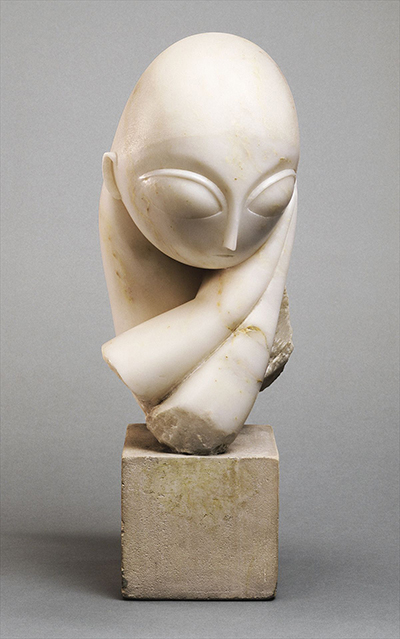
A bronze cast takes its shape from a mould. The cast metal can then be worked to sharpen a boundary, even out an irregularity or change the way the surface reflects light. A carved stone can enter that process as the source for a cast. MoMA’s Mlle Pogany, version I, is a 1913 bronze that followed a marble carved in 1912. The Hungarian painter Margit Pogany had sat for Brâncuși. MoMA records that he carved the marble from memory after she had left Paris and took a plaster mould from it for the bronzes. The marble and bronze have a documented relationship even though each required different operations to make. [8]
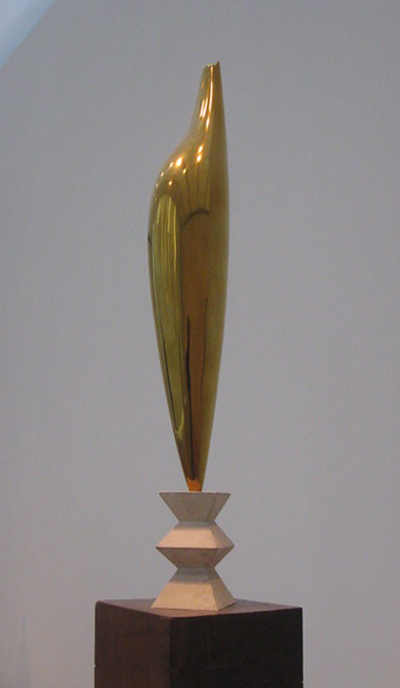
The intermediate plaster could also become a place to make decisions about shape. The Metropolitan Museum of Art’s 1923 marble Bird in Space gives a clear view of the composition. The base of the figure contracts to a narrow footing, the body gathers into a long swell, and the top ends in an angled plane. Wings and feathers would have interrupted that long movement. For the bronzes in the series, MoMA describes Brâncuși taking a plaster cast from a marble and then changing its proportions before casting in metal. An adjustment to the swell changes how the narrow foot appears to carry it and how gradually the top tapers. The plaster gives the sculptor a chance to work through those relationships again. [9] [10]
The Norton Simon Museum’s 1931 Bird in Space shows how much could also happen inside a metal cast. Conservator John Griswold reports that X-rays revealed variations in the thickness of the metal walls. The taper in thickness helped compensate for the concentration of weight above the narrow foot. The investigation also found small air pockets near the surface and no significant internal cracks or cavities. The casting had to support a tall, narrow form, while the finish Brâncuși wanted called attention to the continuity of its outer surface. The X-rays provide evidence of the foundry’s contribution to this particular object. [11] [12]
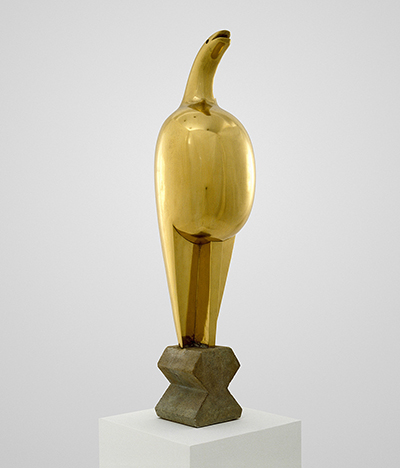
Plaster could survive as a distinct object in the studio. The Centre Pompidou holds both its 1935 polished bronze Le Coq (AM 817 S) and the original plaster model (AM 4002-115). The museum records the plaster on a different stack of supports from the limestone and oak elements under the bronze. It also describes a parallel group of taller cocks developed directly in plaster, with more irregular surfaces. The model for a bronze and the large plaster sculptures therefore belong to different lines of work, even when an upright silhouette or serrated edge makes them look closely related. [13] [14]
The studio supplied a further use for plasters. According to the Centre Pompidou, Brâncuși sometimes slipped a plaster cast into the place left empty by a sculpture he had sold. The placement maintained a relationship with the objects around it. To understand a plaster, ask where it sat in the life of a sculpture. It might have been a stage on the way to metal, a work developed in its own material, or a presence that kept a studio arrangement intact. [15]
Polish, patina and gilding
Polishing smooths a surface, producing more concentrated reflections as its small irregularities are reduced. Its effect depends on the shape underneath. On a broad curve, a bright band can move a long way as a viewer changes position. A tight curve can take that same light and compress it into a thin streak. The polish on Brâncuși’s bronzes therefore does more than provide a lustrous finish. It makes shallow changes in shape visible, although at some angles the light can spill across the contour and make it harder to follow. [16]
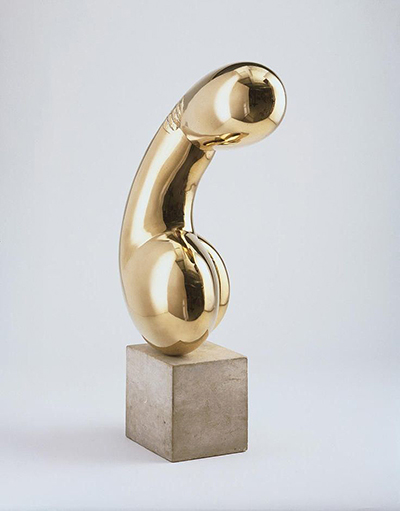
A patina is a surface alteration that can arise over time or be deliberately produced. Brâncuși used it to organise a portrait in Mlle Pogany. On MoMA’s 1913 bronze, black patina marks the hair over the crown and around the chignon, setting off the broad oval of the face and its oversized almond-shaped eyes. The dark area follows the way the hair is arranged, so colour on the surface carries a piece of information that could have required many small ridges or individual strands. The decision belongs to the bronze portrait’s own treatment. [8]
Gilding adds actual gold at the surface. Conservators at the Portland Art Museum studying Brâncuși’s A Muse saw glittering particles in the recesses of the hair under a microscope. They had learned that the related sculpture in Houston had gold leaf on its hair. A team used portable X-ray fluorescence, which identifies elements, to confirm that the particles in the Portland work contained gold. Working from a related object gave the conservators a specific question to ask of their own sculpture. The gleam itself could have come from more than one material. [17]
Time complicates the appearance of a polished casting. At the Norton Simon Museum, traces of a transparent lacquer applied around the time of acquisition had worn and yellowed. The conservator also found that some material in the surface pits was largely old polishing residue. The museum removed what remained of that lacquer, cleaned and polished the sculpture, and installed it without a fresh coating. In this case a discoloured patch could carry evidence of a later treatment, while a dark area on Mlle Pogany formed part of Brâncuși’s rendering of the sitter. Surface observations mean more when they can be joined to the history of the object. [8] [11]
The base as part of the composition
Start at the bottom of MoMA’s Fish. Two pale limestone cylinders and a marble element make up the recorded pedestal. Along the top of that stack, the fish flares to either side like a broad horizontal blade. The cylinders establish a centre under a form whose ends seem to reach away from it. The broad stone and the vertical stack also give the eye different measures of space. Looking straight across the marble makes the upper piece seem thin and agile, although the dimensions of the pedestal keep its weight in view. [1]
The Centre Pompidou’s bronze Le Coq takes a more emphatically vertical route. In the group of four limestone and oak support elements, zigzags answer the serrated outline of the figure above. The intervening blocks give those edges room to be seen. The effect differs from the continuous piece of wood in MoMA’s The Cock, where a cylinder and the standing form share the same material all the way up. In Paris the repeated changes of profile belong to an arrangement of parts, and the rise of the whole thing depends on how they are stacked. [5] [13]
Brâncuși also treated some bases as independent objects. The Centre Pompidou notes that he presented five bases by themselves at New York’s Brummer Gallery in 1926. His studio photographs show supports moving between different sculptures, where their height and weight alter the spacing of a group. This makes a dated collection record or a dated photograph particularly valuable when identifying a pairing. The Sorceress and Watchdog make a strong unit, and their separate origins help explain why each part still has a recognisable character. [6] [7] [15]
A later support can shape the experience, too. The Norton Simon Museum’s Bird in Space originally stood on a limestone cylinder and carved sandstone pedestal made by Brâncuși. A photograph by the designer Eckart Muthesius records both components in Indore in 1933. They did not travel with the bronze to America, and the museum eventually installed the work on a new elevated support with protection against earthquakes. The higher position restores an upward view, drawing attention to the length of the rising form. The historic photograph supplies evidence for how this bronze once stood, and the museum’s conservation report explains how it stands today. [11]
Movement in the work and around it
The late marble Fish can be read through the veining alone. The pale flecks travel through the blue-grey body, which has no legible rows of scales to suspend the eye in place. From a broad view the size of the stone is apparent. An end view compresses much of that mass into a fine edge. Brâncuși could also push the sculpture around a pivot made with ball bearings. Shape, viewpoint and actual rotation can all contribute to its appearance of movement. [1] [18]
The Centre Pompidou’s Leda offers a second kind of rotation. Its collection record identifies a sand-cast bronze dated 1926 and a nickel-silver disc dated 1932. MoMA explains that Brâncuși adapted a gramophone motor to turn the sculpture. As the metal turns, its profile changes along with the reflections it gathers from the room. A stationary polished bronze can pick up movement too. A person walking past it becomes a shifting shape in the metal, and the reflected figure may stretch across a curve. The dates of the bronze and disc also tell us that the work’s presentation continued to develop after the figure was cast. [18] [19]
For Bird in Space, the impression of movement lies in the relation of parts that stay still. Follow the curve up from the foot and notice where the form reaches its greatest width. From there it tapers towards the slanted tip, encouraging the eye to continue upward. Fish asks the eye to travel chiefly along the horizontal and makes the work’s changing width a surprise. These animals and the upright Coq gave Brâncuși distinct problems of balance, direction and silhouette. The Centre Pompidou’s Philippe-Alain Michaud discusses the wider interplay between the stylised movement of the animals and the myths behind specific works, including the Romanian legendary bird Maiastra and Leda from Greek mythology. [1] [9] [13] [20]
What the photographs show
Brâncuși photographed his own sculptures in the studio. With help from Man Ray he acquired equipment and set up a darkroom in the 1920s. The Centre Pompidou describes his interest in following reflections on polished metal over the course of a day and in studying how sculptures appeared alongside one another. In one documented approach, he set a white marble Bird in Space against a dark cloth, giving its narrow outline unusual clarity. Against a lighter field a similar sculpture might be read through graduations on its surface. Photographing the work gave Brâncuși a way to examine both readings. [21] [3]
The difficulty of recording reflection became clear when MoMA’s imaging studio photographed its 1920 bronze The Newborn. An even lighting enclosure reduced distracting reflections but also softened the changes in the egg-shaped volume and made surface wear conspicuous. Directional lighting produced strong shadows and highlights that sometimes cut across features the team wanted to show. The final photograph blended elements from about ten exposures. The imaging account allows readers to compare the results on a documented single object. Its lip and flattened area remain in place even as the treatment of their shadows changes how readily we see them. [16] [22]
The studio pictures and the museum’s experiment ask different things of the camera. Brâncuși could choose an arrangement or lighting condition for what it made newly visible. MoMA’s team wanted a legible record of an object whose surface looks different as the lighting changes, even from a fixed position. When two photographs seem to show different surface colours or shapes, look for the accession number and compare the placement of physical features first. A shift in the position of a long highlight may tell you more about the light source than about the particular cast. [16] [21]
How to compare versions
A title can name a series of related sculptures. Start with two individual records. The Met’s marble Bird in Space of 1923 is 144.1 cm high with its base. In MoMA’s circa 1941 version the bronze alone is 182.9 cm high and the two-part stone pedestal adds 44.1 cm. Even before studying their different surfaces, those measurements establish a change in scale. The qualifications are worth keeping with the numbers because the height of the artwork as installed and the length of the rising form answer different questions. Then compare the angle at the tip and how much length the eye has to travel between the widest part and the foot. [9] [10]
The two Coqs offer a change of proportion that can be seen without measuring. The cherry sculpture has a longer sweep behind its jagged upper profile. The later bronze stands closer to the vertical, has a shorter tail and narrows to a more extended foot. The contour in wood carries the eye backward, while the bronze and its alternating supports draw it up. This difference survives the change from daylight to museum light and can be traced in the outline even when reproductions disagree in colour. [5] [13]
Across the animals, the portraits and the studio supports, simplification changed the work that each remaining detail had to do. An enlarged eye, a dark strip of hair, a sawtooth edge or a cylinder under a slab could carry a disproportionate share of the effect. Look first at the outline, then move close enough to read the material and finally step back to take in the supports. With the cherry Cock, for example, the distant view shows how strongly the round foot steadies the jagged profile. Up close the continuous wood explains why the two shapes seem so closely bound. [5]
Browse sculptures and drawings
Browse articles on the sculptures and separately catalogued museum objects. A work can have several physical versions. Drawing records from the Tate catalogue retain their October 2014 snapshot wording where present.
| Name | Date | Medium |
|---|---|---|
| Arch | Sculpture | |
| Bird in Space | Sculpture | |
| The Blond Negress | Sculpture | |
| The Cock | Sculpture | |
| The Endless Column | Sculpture | |
| The First Cry | Sculpture | |
| Fish | Sculpture | |
| The Gate of the Kiss | Sculpture | |
| Golden Bird | Sculpture | |
| Head | Sculpture | |
| The Kiss | Sculpture | |
| Leda | Sculpture | |
| Madame L.R. | Sculpture | |
| Mademoiselle Pogany II | Sculpture | |
| Mademoiselle Pogany | Sculpture | |
| Maiastra | Sculpture | |
| The Newborn | Sculpture | |
| Phoque II | Sculpture | |
| The Prayer | Sculpture | |
| Princess X | Sculpture | |
| Prometheus | Sculpture | |
| Târgu Jiu monumental ensemble | Sculpture | |
| Sculpture for the Blind | Sculpture | |
| The Seal | Sculpture | |
| The Signal | Sculpture | |
| Sleeping Muse | Sculpture | |
| The Sorceress | Sculpture | |
| The Table of Silence | Sculpture | |
| Torso of a Young Man | Sculpture | |
| Two Lamps | Sculpture | |
| Vitellius | Sculpture | |
| The White Negress | Sculpture | |
| The Wisdom of the Earth | Sculpture | |
| Young Bird | Sculpture | |
| The Kiss (Philadelphia, fourth version) | 1916 | Sculpture Catalogue. |
| Sleeping Muse (Pompidou bronze) | 1910 | Sculpture Catalogue. |
| Mlle Pogany, version I (MoMA bronze) | 1913, after a marble of 1912 | Sculpture Catalogue. |
| Maiastra (Venice brass) | about 1912 | Sculpture Catalogue. |
| Bird in Space (MoMA bronze) | about 1941 | Sculpture Catalogue. |
| Bird in Space (Venice brass) | 1932–40 | Sculpture Catalogue. |
| Endless Column, version I (oak) | 1918 | Sculpture Catalogue. |
| Brâncuși Monumental Ensemble of Târgu Jiu | 1937–38 | Sculpture Catalogue. |
| Bust of a nude woman in profile, head inclined | about 1910 | Drawing Catalogue. |
| Nude study, head inclined (recto) | — | Drawing Catalogue. |
| Self-portrait (ink) | — | Drawing Catalogue. |
| View of the Artist’s Studio | 1918 | Drawing Catalogue. |
| Study for the cock (lost clay Grand Coq) | about 1923 | Drawing Catalogue. |
| Portrait of a woman in profile | — | Drawing Catalogue. |
| Animal head | — | Drawing Catalogue. |
| Animal sketch (2002 checklist) | 1929 | Drawing Catalogue. |
| Plans of the studio (verso) | about 1930–38 | Drawing Catalogue. |
| Danaïde (Tate T00296) | c.1918 | Sculpture Catalogue. |
| Maiastra (Tate T01751) | 1911 | Sculpture Catalogue. |
| Head (Tate T03066) | c.1919–23 | Sculpture Catalogue. |
| Fish (Tate T07107) | 1926 | Sculpture Catalogue. |
Frequently Asked Questions
Discussion
Look again at the images and ideas explored in Brâncuși’s Style and Technique. These editorial prompts invite your observations.
Reader Insights
Pick one object and follow its outline all the way to the floor. Where did you first feel that the sculpture had ended, and did a second view change your mind?
Compare the marble Fish with a Bird in Space in polished metal. Which gives you a stronger impression of motion, and what produces it?
Join the Conversation
Share a detail, comparison or question about Brâncuși’s Style and Technique below.
References
- Museum of Modern Art. Fish, 1930. Collection record and gallery label. View source.
- Museum of Modern Art. Constantin Brancusi Sculpture. Exhibition collection group. View source.
- Centre Pompidou. Histoire de l’Atelier Brancusi. Studio tools and photographic arrangements (in French). View source.
- Philadelphia Museum of Art. The Kiss, 1916. Collection record. View source.
- Museum of Modern Art. The Cock, 1924. Collection record and exhibition label. View source.
- Solomon R. Guggenheim Museum. The Sorceress, 1916–24. Collection record and commentary by Nancy Spector. View source.
- Museum of Modern Art. The Sorceress, 1916–24. Audio transcript with Mia Matthias and Maria Tatar. View source.
- Museum of Modern Art. Mlle Pogany, version I, 1913. Collection record and gallery label. View source.
- Metropolitan Museum of Art. Bird in Space, 1923. Collection record. View source.
- Museum of Modern Art. Bird in Space, circa 1941. Collection record and exhibition label. View source.
- John Griswold, Norton Simon Museum. Brancusi’s “Bird in Space” Soars Again. Conservation report. View source.
- Norton Simon Museum. Bird in Space, 1931. Collection record. View source.
- Centre Pompidou. Le Coq, 1935, polished bronze. Collection record and catalogue essay by Marielle Tabart (in French). View source.
- Centre Pompidou. Le Coq, 1935, original plaster. Collection record (object notes in French). View source.
- Centre Pompidou. L’atelier Brancusi. Study of the studio and bases (in French). View source.
- Museum of Modern Art. From the Imaging Studio: Reflections on Brancusi’s Newborn. 2010 account of the photography of The Newborn. View source.
- Portland Art Museum. All that glitters is not gold…but sometimes it is!. Conservation account of A Muse. View source.
- Museum of Modern Art. Movement and Stillness. Audio transcript with Mia Matthias. View source.
- Centre Pompidou. Léda, 1926. Collection record for the bronze and its nickel-silver disc (in French). View source.
- Philippe-Alain Michaud, Centre Pompidou. Le bestiaire poétique de Constantin Brancusi. Exhibition catalogue excerpt (in French). View source.
- Centre Pompidou. Brancusi et la photographie. Study of Brâncuși’s photographic practice (in French). View source.
- Museum of Modern Art. The Newborn, version I, 1920. Collection record. View source.
More BRÂNCUȘI Sculptures
Bird in Space
Compare the marble and metal versions of Brâncuși’s sculpture.