by Tom Gurney
Tom Gurney BSc (Hons) is an art history expert with over 20 years experience
Email: tomgurney1@gmail.com / Phone: +44 7429 011000
Brâncuși’s Paris Studio: Introduction
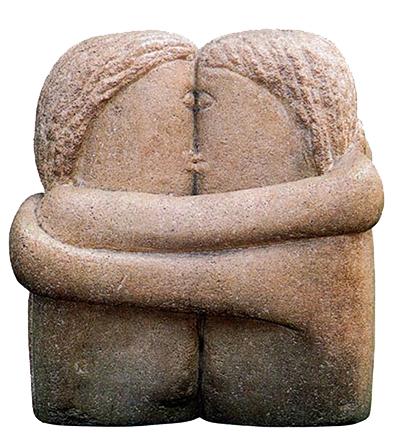
In a photograph taken in 1925, a white marble Bird in Space shares Constantin Brâncuși’s Paris studio with a brown limestone version of The Kiss and two wooden columns. The tall forms repeat one another across the room, even though their surfaces behave differently in the light. The bird narrows into a single rising line. The columns widen and contract in a regular rhythm. Brâncuși took the photograph at night, when he could choose how much of each object emerged from the dark. One of the columns was subsequently destroyed. The photograph preserves both a sculpture that is gone and a set of relationships the artist could change the next day. [1] [2]
From 1916 until his death in 1957, the studio at Impasse Ronsin was where Brâncuși worked, lived, received visitors and presented his sculpture. Its rooms offer a way into a question that runs through his career. How much of a sculpture’s effect comes from the object itself, and how much comes from its height, lighting and company? He could explore that question by turning a piece, changing its support, shifting a nearby work or photographing the group from a new position. The French state inherited the contents and the responsibility of reconstructing the rooms as they stood at his death. [3] [4]
At a Glance
- Historic locationImpasse Ronsin, near Montparnasse in Paris’s 15th arrondissement. [5]
- Period of useBrâncuși moved into No. 8 in 1916 and to No. 11 in 1928. He stayed at Impasse Ronsin until his death in 1957. [3] [6]
- What happened thereCarving, assembling, photography, film, entertaining and the display of sculpture in changing groups. [3] [4]
- The bequestA 1956 testament left the atelier and its contents to the French state, with a condition about reconstituting the studio. The collection entered the museum in 1957. [4] [7]
- The Beaubourg reconstructionRenzo Piano’s pavilion opened in 1997. The studio display closed in 2023 and the building now houses Maison Pompidou during the Centre’s renovation. [4] [7] [8] [9]
Contents
- Two addresses at Impasse Ronsin
- The workshop, the hearth and the visitors
- Mobile groups and the work a base can do
- What the camera saw
- What the French state inherited
- Three Paris reconstructions
- The atelier in later exhibitions
Two addresses at Impasse Ronsin
Brâncuși established his residence at 8 Impasse Ronsin on 6 January 1916. He was already an established sculptor and brought works with him. MoMA describes three rooms, high ceilings, windows facing north and a bedroom upstairs. The setting was part of an artists’ enclave tucked behind the streets near Montparnasse. The sculptor Alfred Boucher had helped build inexpensive ateliers there in the late nineteenth century. They accommodated successive generations whose tenancies and activities sometimes overlapped. Decades later artists including Jean Tinguely and Niki de Saint Phalle worked in the same lane. The history of the neighbourhood therefore continues beyond the history of Brâncuși’s rooms. [3] [5] [10]
After flooding at No. 8, Brâncuși moved to No. 11 in 1928. Marcel Duchamp had rented a studio opposite Brâncuși for storage. A January 1929 receipt addressed to Duchamp, preserved in the Brancusi archive at the Bibliothèque Kandinsky, helps document the lease arrangements during the move. At his new address Brâncuși removed partitions to make a large space for his sculpture and visitors. The Centre Pompidou traces successive additions, including space at No. 9 where he installed a bed on a mezzanine. Further rooms gave him more space for work in progress, materials, tools and a workbench. An oak doorframe marked a threshold between the more public and private areas. [4] [6] [10]
Brâncuși also drew the space. The Centre Pompidou catalogues Plans de l’atelier, a graphite drawing attributed to him and dated approximately 1930–38, among the objects from the bequest. It offers a different kind of evidence from a photograph of the sculptures. A plan makes it possible to think about the rooms in relation to one another, while a photograph shows what could be seen from a particular position. The drawing dates to his occupancy of the lane, years after he first arrived. The museum’s graphite-on-paper classification and approximate dating make it evidence of how Brâncuși studied the studio during his occupancy. [11]
The workshop, the hearth and the visitors
A visitor might have seen a gleaming bronze near a rough block of wood, then walked past tables and stools made by the sculptor. Brâncuși’s circular plaster tables could support a work or serve as furniture. He incorporated loudspeakers into blocks of stone, and he made a large limestone fireplace. The studio’s appearance was bound up with things he used regularly. A surface that looked like a carpenter’s exercise in cutting and joining could also belong to a finished furnishing. The same material could appear somewhere else in the room as part of a figure, column or support. [6]
The fireplace is unusually well documented. A film discussed in MoMA’s exhibition labels shows Brâncuși cutting the limestone and making a long lintel and two upright supports. The work involves both hand tools and electrically powered equipment. Dust periodically cuts across the camera’s view of the room, and the footage shows him moving heavy pieces of stone as well as shaping them. The fireplace later became a setting for gatherings. This makes it possible to follow one object all the way from raw material through fabrication to use in the studio. [10]
Brâncuși carved wood and stone directly, using tools such as chisels, hatchets and saws. The workshop collection includes tools whose scars and residues show the repeated work behind the sculptures. The smoothness of a polished bronze or rounded stone form was one possible outcome. In carved wood, cuts and texture could remain legible as part of the finished object. The studio made it possible to see these surfaces together. The eye could move from the grain of a support to a reflection on the bronze above it, then to a raw piece awaiting work. [3] [10]
The people who entered the atelier brought their own interests. A letter from Henri-Pierre Roché, probably from late 1919, accepts an invitation and asks whether he can bring the composer Erik Satie. A letter from the sculptor Isamu Noguchi in 1933 recalls listening to Balinese recordings with Brâncuși. The two documents give the studio a social life beyond exhibition photographs. Visitors came to see particular sculptures or meet the artist, and evenings might also involve music and conversation. Brâncuși could decide which forms greeted them on entering and which would appear when they stood further inside. [10]
By the 1920s, the atelier had become a particularly important place to see his work. The Centre Pompidou connects Brâncuși’s increasing preference for showing at home with the controversy over Princess X at the Salon des Indépendants in 1920. In his own rooms he could arrange the objects and attend to the light, scale and sequence of what a guest saw. When dealer René Drouin approached him about an exhibition in 1947, Brâncuși suggested holding it at the studio. Even late in his career he saw the room as a place where his work could be encountered on his terms. [6]
Mobile groups and the work a base can do
The Centre Pompidou traces Brâncuși’s groupes mobiles, or mobile groups, to arrangements he began making in the 1910s. Their mobility lay first in his freedom to change them. He could bring sculptures almost into contact, leave a long interval between them or replace one element. A foreground figure might seem to answer the shape of another across the room. Shifting one work could reveal a passage of light, put a taller form behind a smaller one or change which edges appeared to line up. Brâncuși could take the group apart while leaving every sculpture intact. Some arrangements lasted. MoMA identifies a group including columns, a plaster base and a bird that he photographed across from the entrance of No. 11 after moving in. It stayed in place as he moved other works around it. [4] [10] [8]
A pedestal gave him just as many choices. The studio photographs show supports migrating between works. Brâncuși also displayed five pedestals on their own at the Brummer Gallery in New York in 1926, a useful instance of his willingness to exhibit a support as a sculpture. An upright with repeated ridges gives a viewer a measure of height and a rhythm to follow. A plain cylinder sets up a continuous contour for an object above it. The dark or light character of a material can establish a clear boundary at the join, while similar materials can make adjoining parts seem to flow together. [4]
A patinated plaster portrait of Nancy Cunard from 1928 gives a sense of the scale involved. The figure is 55.5 centimetres high. With its three-part pedestal, made from a plaster section and two oak sections, the overall height listed by MoMA is 118 centimetres. The visible effect of the support is almost as consequential as that of the figure. Large areas of oak lead the eye up from the widest section towards the small plaster element at the top. In a tightly cropped photograph of the head, the viewer would miss how much of the sculpture’s encounter with the room happens lower down. [12]
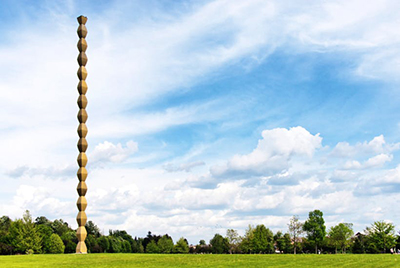
The studio versions of the Endless Column extend this principle. The repeating unit can be imagined as part of a support or as the entire visible subject. Stacked units turn a pattern into a sustained vertical motion, and the ceiling becomes a significant limit in any room that contains one. Against a bird sculpture, a column’s changes of width look measured and emphatic beside the bird’s continuous taper. That relationship is available in the 1925 night photograph. Different columns and birds appear in later views, so the pattern recurs even as its particular components change. [1] [7] [13]
Some sculptures could move physically as well. MoMA’s large blue-grey marble Fish of 1930 rests on a pivot that once allowed it to spin. That construction makes the changing outline part of the work’s effect. A separate film sequence, probably filmed by Man Ray according to MoMA, shows a bronze Fish being turned with a small stick. The marble object and the bronze in the film are different versions. Together they show two ways of judging movement: in the hardware of a surviving sculpture and in a moving image of another sculpture being activated. [10] [14]
As Brâncuși made fewer new sculptures late in his life, he gave more attention to placing the works he had. He sometimes put a cast in the place of a sculpture he sold, preserving a shape and its position within the group while allowing an individual object to leave. At the level of the room, the opening left by a sale could matter as much as the sale itself. A cast kept a particular profile or height in play and could shift the local balance of colour, texture and reflected light. [4] [6]
What the camera saw
Brâncuși pictured the rooms in several media. MoMA’s View of the Artist’s Studio of 1918, a gouache and pencil drawing, compresses the space into overlapping forms. The columnar Kiss appears in the background. MoMA identifies the small profile at upper left as a likeness of Brâncuși’s Danaïde. The works are recognisable enough to establish their presence, while the narrow range of colours and the cropping distribute attention across the whole view. An image of the studio could bring sculpture together on a surface just as a shift of furniture could bring it together on the floor. [10] [15]
The photographs can be compared by date and point of view. The Centre Pompidou holds both the 1925 night view with The Kiss and a separate glass negative showing a detail from the back of the atelier, including white marble Bird in Space and a group of unfinished forms. A larger night view from around 1935 records a different white marble bird, four Endless Columns and sculptures including Fish, The Cock and Leda. The familiar silhouette of a bird can obscure the differences of date and object between such pictures. The museum’s identifications help establish which version is visible and what surrounded it at the moment the shutter opened. [1] [13] [16]
Brâncuși also used photographs to make a point about his sculpture. In one image he placed a plaster Head of a Sleeping Child near The Newborn II. The first retains more of a recognisable head and face. Its proximity to the simpler Newborn sharpens the difference between the two approaches, even for a viewer unfamiliar with their chronology. Other pictures were more overtly experimental. In a group of multiple exposures, Brâncuși combined his own likeness, with his body perched on a pedestal, and a view of a chestnut stump. The superimposition joins things the eye could never have seen together from one place in the room. [10]
A surviving photograph can show what was in front of the camera. It may tell us less about what a particular guest would have seen or what was still in place a week later. His choices about where to stand, how to light a surface and which objects to include make each photograph evidence of an intervention. Comparing multiple views is especially revealing when the sculptures remain recognisable but the foreground, shadows or relations of height change around them. [1] [4] [10] [13]
What the French state inherited
The testament dated 12 April 1956 gave the French state the atelier and its contents, with a condition that the Musée national d’art moderne reconstitute it as it stood at Brâncuși’s death. The objects ranged from finished sculpture and pedestals to tools, workbenches, furniture, photographs, books and music recordings. That breadth makes the bequest an unusually rich record of one sculptor’s career. The tools help explain how surfaces were formed. The photographs show arrangements across decades. The furniture and records show something of the life sustained alongside the work. [4] [7]
The museum described the holdings at the 1997 pavilion opening as including 137 sculptures, 87 bases and more than 1,600 photographic glass plates and prints. These are historical inventory figures for the collection, distinct from the count of objects visible at any one time. The sheer number of bases gives a sense of how far the inheritance extended beyond finished works understood in isolation. A single support could have belonged to several photographed configurations, each of which matters for a different reason. [4] [7]
There is a tension between the date specified by the bequest and the length of time Brâncuși spent moving things around. The arrangement at his death has particular legal and historical significance. Earlier photographs offer evidence of other states of the work, such as the presence of a sculpture later destroyed or the use of a different pedestal. Preserving the final arrangement gives those earlier views a reference point and encourages a question about every reconstruction. Which moment, room and set of relationships is it bringing into view? [1] [4] [7]
Three Paris reconstructions
The first partial reconstruction went on view in 1962 at the Musée national d’art moderne, then at the Palais de Tokyo. The museum’s account describes low ceilings that made it difficult to accommodate the larger works, as well as differences in room dimensions and natural light. Those constraints affect the sculptures directly. A tall column seen beneath a relatively low ceiling occupies space differently from a column with room to rise above a viewer’s head. Natural light can change the contrast between a marble form and the bronze nearby over the course of a day. [7]
A second installation opened in 1977 at Beaubourg, across the piazza from the Centre Pompidou. Built to recall the modest scale of the old atelier, it stood in a very different public setting. Flooding forced it to close in 1990. Renzo Piano’s replacement, inaugurated in January 1997, placed the reconstructed interior inside a purpose-built pavilion. A peripheral viewing route and glazing offered sightlines into the rooms. A walled garden provided a transition from the piazza, and the shed roof above the atelier was designed to admit north light. The design brought some of the spatial conditions of the old studio into a building that could accommodate museum visitors. [4] [7]
Standing outside the rooms gave those visitors a series of framed views. They could see where works met on the floor or where a studio wall set off a sculptural profile, while the visitor route controlled the available angles. The Centre Pompidou’s historical Visite de l’atelier Brancusi records objects room by room. Its fourth atelier, for example, lists several plaster Bird in Space versions and a 1926 plaster bird with a wood and black marble base. Read alongside the building plans and lifetime photographs, the guide shows how much a reconstruction depends on the exact versions and supports used. [7] [17]
The atelier in later exhibitions
In 2024, as the Centre Pompidou prepared for renovation, its Paris Brancusi retrospective drew on the relocation of the studio collection. The exhibition included a reconstruction within a much larger presentation of sculpture, images and archives. H’ART Museum took another approach in Amsterdam in 2025–26. Its Brancusi, The Birth of Modern Sculpture included a film projection about the studio and excerpts from the artist’s record collection. Music gave visitors something that a still photograph or a set of objects behind glass cannot convey. At Berlin’s Neue Nationalgalerie in 2026, a partial reconstruction was part of a larger exhibition organised in cooperation with the Centre Pompidou. The Berlin museum described it as the first showing of such a reconstruction outside Paris since the 1957 bequest. [18] [19] [20]
MoMA’s Brancusi: The Artist and His Studio, dated 25 October 2026 to 27 February 2027, brought objects from the Paris atelier into contact with its own holdings and other loans. Its installation included a walk-through evocation built to scale. The approach gave the museum room to show how visitors, sculptures, pedestals and tools occupied the same environment. A sheet-metal mailbox from Impasse Ronsin stood outside the evocation. It carries the names of Brâncuși and the painters Alexandre Istrati and Natalia Dumitresco, who moved across the lane in 1947. Seen at the threshold, the object evokes an address with neighbours and deliveries as much as a place where sculpture was made. [10] [12] [21]
Piano’s pavilion, a temporary reconstruction in an exhibition and a photograph by Brâncuși offer different experiences of the same rooms. The sculptor’s images preserve his judgement about a particular grouping and light. A reconstruction can give the viewer a sense of how much room the objects occupied. An exhibition can bring together a surviving base, a work that left the studio and a photograph showing them in use, even when they now belong to different collections. The value of each view grows when its date and circumstances are clear. [4] [10] [12] [17] [21]
Browse sculptures and drawings
Browse articles on the sculptures and separately catalogued museum objects. A work can have several physical versions. Drawing records from the Tate catalogue retain their October 2014 snapshot wording where present.
| Name | Date | Medium |
|---|---|---|
| Arch | Sculpture | |
| Bird in Space | Sculpture | |
| The Blond Negress | Sculpture | |
| The Cock | Sculpture | |
| The Endless Column | Sculpture | |
| The First Cry | Sculpture | |
| Fish | Sculpture | |
| The Gate of the Kiss | Sculpture | |
| Golden Bird | Sculpture | |
| Head | Sculpture | |
| The Kiss | Sculpture | |
| Leda | Sculpture | |
| Madame L.R. | Sculpture | |
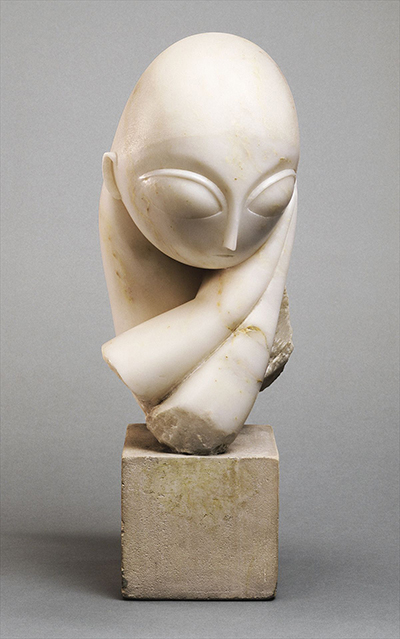
| Mademoiselle Pogany II | Sculpture | |
| Mademoiselle Pogany | Sculpture | |
| Maiastra | Sculpture | |
| The Newborn | Sculpture | |
| Phoque II | Sculpture | |
| The Prayer | Sculpture | |
| Princess X | Sculpture | |
| Prometheus | Sculpture | |
| Târgu Jiu monumental ensemble | Sculpture | |
| Sculpture for the Blind | Sculpture | |
| The Seal | Sculpture | |
| The Signal | Sculpture | |
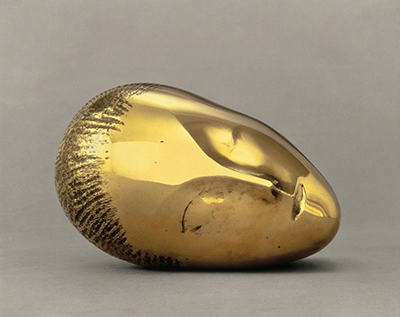
| Sleeping Muse | Sculpture | |
| The Sorceress | Sculpture | |
| The Table of Silence | Sculpture | |
| Torso of a Young Man | Sculpture | |
| Two Lamps | Sculpture | |
| Vitellius | Sculpture | |
| The White Negress | Sculpture | |
| The Wisdom of the Earth | Sculpture | |
| Young Bird | Sculpture | |
| The Kiss (Philadelphia, fourth version) | 1916 | Sculpture Catalogue. |
| Sleeping Muse (Pompidou bronze) | 1910 | Sculpture Catalogue. |
| Mlle Pogany, version I (MoMA bronze) | 1913, after a marble of 1912 | Sculpture Catalogue. |
| Maiastra (Venice brass) | about 1912 | Sculpture Catalogue. |
| Bird in Space (MoMA bronze) | about 1941 | Sculpture Catalogue. |
| Bird in Space (Venice brass) | 1932–40 | Sculpture Catalogue. |
| Endless Column, version I (oak) | 1918 | Sculpture Catalogue. |
| Brâncuși Monumental Ensemble of Târgu Jiu | 1937–38 | Sculpture Catalogue. |
| Bust of a nude woman in profile, head inclined | about 1910 | Drawing Catalogue. |
| Nude study, head inclined (recto) | — | Drawing Catalogue. |
| Self-portrait (ink) | — | Drawing Catalogue. |
| View of the Artist’s Studio | 1918 | Drawing Catalogue. |
| Study for the cock (lost clay Grand Coq) | about 1923 | Drawing Catalogue. |
| Portrait of a woman in profile | — | Drawing Catalogue. |
| Animal head | — | Drawing Catalogue. |
| Animal sketch (2002 checklist) | 1929 | Drawing Catalogue. |
| Plans of the studio (verso) | about 1930–38 | Drawing Catalogue. |
| Danaïde (Tate T00296) | c.1918 | Sculpture Catalogue. |
| Maiastra (Tate T01751) | 1911 | Sculpture Catalogue. |
| Head (Tate T03066) | c.1919–23 | Sculpture Catalogue. |
| Fish (Tate T07107) | 1926 | Sculpture Catalogue. |
Frequently Asked Questions
As of November 2026 the atelier display at Beaubourg is closed. The Centre Pompidou reports that the works were taken back into the museum and its reserves for the renovation, with selected works also appearing in exhibitions. The former pavilion currently houses Maison Pompidou, which presents programmes about the Centre and its renovation. Its official venue listing gives current access details. [4] [9] [21]
MoMA’s dates, exhibition information and associated materials are available on its official listing. The exhibition guide introduces the New York presentation and its connection to Impasse Ronsin. [21]
Discussion
Look again at the images and ideas explored in Brâncuși’s Paris Studio. These editorial prompts invite your observations.
Reader Insights
Find a studio photograph with a distinct foreground and background. Which work directs your eye into the room, and which work brings it back?
Choose a sculpture with a visible base. How would bringing it closer to the floor change the way you see its outline and surface?
If a museum could show one room at full scale or three documented arrangements from different years, what would you most want to learn from each approach?
Join the Conversation
Share a detail, comparison or question about Brâncuși’s Paris Studio below.
References
- Centre Pompidou, Vue de nuit de l’ensemble de l’atelier, 1925. Gelatin silver print, PH 59 A. View source.
- Centre Pompidou, Le Baiser, 1923–25. Brown limestone sculpture, AM 4002-3. View source.
- Museum of Modern Art, Brancusi: The Artist and His Studio, exhibition section texts. Arrival at Impasse Ronsin and direct carving. View source.
- Centre Pompidou, Brancusi’s Studio, teaching dossier. The enlarged rooms, pedestals, bequest, reconstructions and current pavilion use. View source.
- Centre Pompidou, Where Art Happened: Impasse Ronsin. History of the artists’ enclave. View source.
- Centre Pompidou, L’atelier de Brancusi, matrice de tout son œuvre. Rooms, furniture, hospitality and exhibition in the studio. View source.
- Centre Georges Pompidou, 1997 anniversary press dossier. Atelier inauguration, bequest inventory and reconstruction history, especially pp. 7–10. View source.
- Centre Pompidou, Brancusi’s Studio, archival visitor listing. Description of mobile groups and notice of closure. View source.
- Centre Pompidou, Maison Pompidou. Venue and renovation programme. View source.
- Museum of Modern Art, Brancusi: The Artist and His Studio, extended artwork labels. Tools and fireplace, photographs and film, mailbox, Noguchi letter, rent receipt and residency certificate. View source.
- Centre Pompidou, Plans de l’atelier. Graphite drawing, c. 1930–38, AM 3733 D (V). View source.
- Museum of Modern Art, Brancusi: The Artist and His Studio, press dossier. Exhibition scope and Portrait of Nancy Cunard dimensions. View source.
- Centre Pompidou, Vue de nuit de l’atelier, c. 1935. Gelatin silver print, PH 128 A. View source.
- Museum of Modern Art, Fish, 1930. Marble version with revolving support. View source.
- Museum of Modern Art, View of the Artist’s Studio, 1918. Gouache and pencil on board. View source.
- Centre Pompidou, Vue de nuit de l’atelier, 1925. Glass negative, PH 63. View source.
- Centre Pompidou, Visite de l’atelier Brancusi. Historic visit dossier and itemised atelier displays. View source.
- Centre Pompidou, Brancusi, 2024 retrospective. The reconstructed atelier at the heart of the retrospective. View source.
- H’ART Museum, Brancusi, The Birth of Modern Sculpture. Amsterdam presentation, film and music from the studio. View source.
- Neue Nationalgalerie, Brancusi, 2026. Berlin dates and partial reconstruction. View source.
- Museum of Modern Art, Brancusi: The Artist and His Studio. Official dates, exhibition overview and related resources. View source.
More BRÂNCUȘI Sculptures
Bird in Space
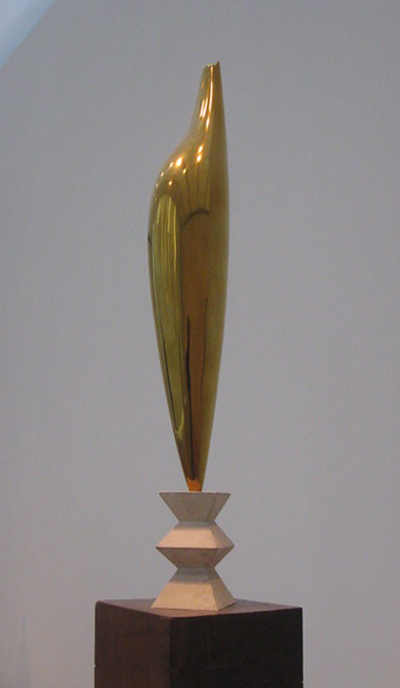
Compare the marble and metal versions of Brâncuși’s sculpture.