 by Tom Gurney
Page Updated October 2, 2026
Introduction
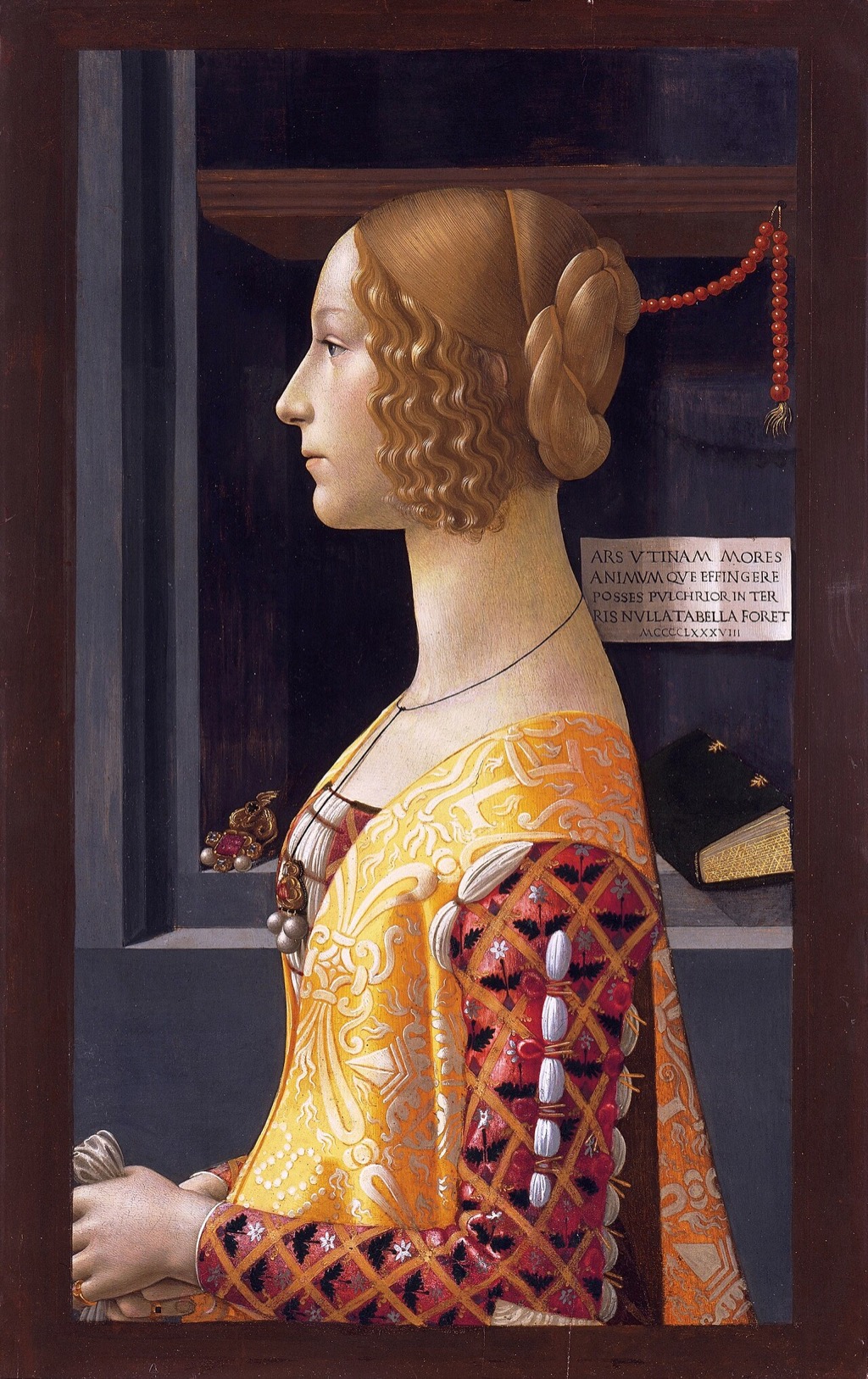
Domenico Ghirlandaio's Portrait of Giovanna degli Albizzi Tornabuoni is one of the most controlled and moving portraits of the Florentine Renaissance. It does not ask for quick psychological drama. Giovanna appears in strict profile, composed, still and almost ceremonial, with objects behind her that turn the picture into a statement about beauty, virtue, marriage and memory. The Museo Nacional Thyssen-Bornemisza dates the painting to 1489-1490, records it as mixed media on panel, and identifies it as part of the museum's collection in Madrid. [1]
The portrait's calm surface carries a difficult biography. Thyssen records Giovanna's birth on 18 December 1468, her marriage to Lorenzo Tornabuoni on 15 June 1486, and her death on 7 October 1488 during childbirth. The museum describes the painting as possibly posthumous, which makes its cool perfection feel less like distance and more like remembrance. It is a likeness shaped by family, status and loss. [1]
The painting also sits at the centre of Ghirlandaio's larger world. Thyssen relates the panel portrait to Giovanna's appearance in the Visitation fresco in the Tornabuoni Chapel at Santa Maria Novella. That connection matters because Ghirlandaio was not only a maker of single portraits. He was a workshop head whose art moved between panel painting, chapel decoration, patronage and public religious narrative. [1][2]
At a Glance
- ArtistDomenico Ghirlandaio.
- Full titlePortrait of Giovanna degli Albizzi Tornabuoni.
- Date1489-1490.
- Mediummixed media on panel.
- Dimensions77 x 49 cm.
- CollectionMuseo Nacional Thyssen-Bornemisza, Madrid.
- Inventory number158 (1935.6).
- Display location recorded by ThyssenRoom 5, Level 2.
- SitterGiovanna degli Albizzi Tornabuoni, identified through a medal by Niccolo Fiorentino.
- Biographical frameborn 18 December 1468, married Lorenzo Tornabuoni on 15 June 1486, died 7 October 1488 during childbirth.
Contents
- Introduction
- Object Facts
- Giovanna degli Albizzi Tornabuoni
- Profile Portraiture and Ideal Beauty
- The Objects in the Niche
- The Tornabuoni Chapel Connection
- Technical Construction
- Provenance and the Thyssen Collection
- Why the Portrait Endures
Object Facts
The Thyssen-Bornemisza collection record gives the essential object facts: Portrait of Giovanna degli Albizzi Tornabuoni, dated 1489-1490, mixed media on panel, 77 x 49 cm, inventory number 158 (1935.6), in the Museo Nacional Thyssen-Bornemisza, Madrid. Those facts place the work securely within Ghirlandaio's late career, close to the moment when his Florentine portrait language had become both precise and highly polished. [1]
The portrait is a panel painting, not a fresco, but it belongs to the same artistic world as Ghirlandaio's chapel work. The homepage and paintings routes introduce him as a painter of fresco cycles, portraits and devotional panels; this work shows how his gift for ordered composition could become intimate without becoming casual. The sitter is not placed in a busy narrative. She is isolated, clarified and held in profile, with each surrounding object made to count. [1][2]
Thyssen records the medium as mixed media on panel. That wording keeps the object distinct from generic descriptions of Renaissance panel painting and from the broader debate over Ghirlandaio's materials. Institutional records include several nuanced medium descriptions across his work, but this portrait should not be simplified into a generic "oil painting" or used to make a broad claim about his whole practice. [1][3]
Giovanna degli Albizzi Tornabuoni
Giovanna was born into the Albizzi family and married into the Tornabuoni family, two names that carry substantial weight in late fifteenth-century Florence. Thyssen records her birth on 18 December 1468 and her marriage to Lorenzo Tornabuoni on 15 June 1486. The portrait therefore represents a young woman whose image is bound to family alliance as well as individual identity. [1]
Giovanna's death changes the tone of the portrait. Thyssen records that she died on 7 October 1488 during childbirth, before the date range assigned to the painting. The museum describes the portrait as possibly posthumous, so the safest reading is conditional: the image may preserve memory after death, but the commission history should not be stated more firmly than the source allows. [1]
The sitter's identification rests on visual and documentary connections rather than a simple modern label. Thyssen identifies Giovanna through a medal by Niccolo Fiorentino and relates the portrait to her appearance in the Tornabuoni Chapel fresco of the Visitation. These links connect the panel to other images of the same woman and to the broader Tornabuoni visual program. [1]
Profile Portraiture and Ideal Beauty
The portrait uses a strict profile format. Giovanna is shown from the side, her body and head held with remarkable stillness. This format gives the picture a sculptural clarity: the line of the forehead, nose, mouth, chin, neck and dress reads almost like a silhouette. The effect is not informal resemblance, but controlled display. [1]
Profile portraiture was especially suited to ideals of dignity and legibility. In Giovanna's portrait, the format keeps the sitter poised and distant, while her costume and surrounding objects make her social identity readable. The picture does not try to catch an accidental moment. It turns Giovanna into an image of disciplined beauty, family honour and remembered virtue. [1][4]
That idealisation should not be mistaken for emptiness. The portrait's emotional force comes partly from the tension between perfection and loss. Giovanna's face is immobile, but the biographical facts around the painting make the stillness poignant. The viewer is looking at a young woman represented through the codes of Florentine status, after a life that Thyssen records as ending in childbirth in 1488. [1]
The Objects in the Niche
Behind Giovanna is a shallow niche containing carefully chosen objects. Thyssen discusses the cartellino, or small painted label, with part of an epigram by Martial. The painted text gives the image a literary and moral register, turning the portrait into more than an arrangement of face, dress and jewellery. [1]
The objects near Giovanna help define how she is meant to be remembered. The portrait includes personal and devotional elements, including a jewel, a prayer book and beads. These items work with the sitter's profile and costume to build an image of refinement, piety and social role. In Ghirlandaio's hands, still objects become a kind of portrait evidence. [1]
The niche also gives the picture its special balance between flatness and depth. Giovanna's profile is clear and frontal in its social meaning, while the objects behind her create a quiet second space for interpretation. The viewer reads the person, then the objects, then the relationship between them. [1][5]
The Tornabuoni Chapel Connection
The portrait should not be isolated from Ghirlandaio's fresco practice. Thyssen relates Giovanna's panel portrait to her appearance in the Visitation fresco in the Tornabuoni Chapel at Santa Maria Novella. That connection places the painting inside a larger family and devotional context, where a private likeness and a chapel image help reinforce one another. [1][2]
This relationship is one reason the portrait is so important for understanding Ghirlandaio. In the chapel, the Tornabuoni family appears within sacred narrative; in the panel portrait, Giovanna is drawn out into a single, concentrated image. Both modes translate family memory into visual form. The panel is smaller and more private, but it belongs to the same language of status, devotion and remembrance. [1][2]
The link to the Visitation also explains the importance of clothing and accessories. Thyssen notes the relationship between Giovanna's panel image and her fresco appearance, including pose, dress and accessories. Those visual correspondences help identify the sitter and connect the portrait to the broader image world created for the Tornabuoni family. [1]
Technical Construction
Thyssen's technical material makes clear that the portrait is not simply a graceful surface. The museum's technical study supports a reading of the painting as a carefully planned composition, with attention to geometry, incisions, underdrawing and material structure. These details matter because they show how Ghirlandaio's precision was built, not merely improvised. [5]
The strictness of the profile depends on this construction. A face in profile can become harsh if the design is not controlled, but Giovanna's image is balanced by the measured placement of the body, the edge of the dress, the niche and the objects behind her. Technical evidence gives later readers a way to understand that balance as the result of planning and adjustment. [1][5]
The medium line should remain attached to this technical discussion. Thyssen records the portrait as mixed media on panel, and the technical study belongs to that object-specific record. Later publication should avoid swapping in generic medium language or treating the painting as interchangeable with other panel portraits. The technical story is strongest when it stays with Thyssen's own object facts. [1][5]
Provenance and the Thyssen Collection
The portrait is now one of the defining Old Master works of the Museo Nacional Thyssen-Bornemisza in Madrid. Thyssen records it under inventory number 158 (1935.6), and the collection page locates it in Room 5, Level 2. The museum's exhibition material frames the painting as an iconic image within its collection and a central work in Ghirlandaio's oeuvre. [1][4]
That collection status makes Thyssen the controlling source for the painting's public facts: title, date, medium, dimensions, sitter biography, iconography, technical discussion and collection context. The portrait's jewellery, dress and carefully ordered setting can then be read alongside those documented facts without treating every iconographic detail as certain. [1]
Why the Portrait Endures
The portrait endures because it holds several kinds of meaning in one compact image. It is a likeness, a memorial, a dynastic statement and a demonstration of Ghirlandaio's exacting design. It belongs to the world of Florentine marriage and family politics, but it also speaks through quieter things: a profile, a jewel, a book, beads and a written label. [1]
It also endures because it shows Ghirlandaio at his most concentrated. The qualities often associated with his frescoes - clarity, order, social observation and a gift for placing people within meaningful structures - are compressed into one panel. The painting is restrained, but it is not cold. Its restraint is the form through which memory becomes durable. [1][2][4]
Within the broader Ghirlandaio cluster, Giovanna's portrait links panel painting to chapel patronage. It connects private portraiture with the Tornabuoni fresco context and shows Ghirlandaio's own language of Florentine remembrance apart from his later association with Michelangelo. [1][2]
Frequently Asked Questions
Discussion
This portrait is quiet in the way a locked room is quiet: everything inside it has been placed with intention. Giovanna's profile may seem distant at first, but the objects, biography and chapel connection make the distance increasingly moving. [1] Profile and Memory: Try reading the portrait first as a line, from forehead to nose to mouth to chin. The strict profile turns Giovanna into a memorable form before the viewer begins decoding the objects. [1] Objects as Evidence: The jewel, prayer book, beads and cartellino are not background filler. They help state what kind of person the portrait asks the viewer to remember. [1] Panel and Chapel: Giovanna's portrait gains depth when seen beside the Tornabuoni Chapel Visitation connection. The single panel and the fresco program belong to the same family world. [1][2] What changes your reading of Giovanna most: the profile, the objects behind her, the possibility that the portrait is posthumous, or its connection to the Tornabuoni Chapel?
Reader Insights
What detail most changes how you read Portrait of Giovanna Tornabuoni?
How do source, setting and provenance affect the interpretation?
Which internal link gives the most useful next step through this cluster?
Join the Conversation
Share your reading of this page below.
References
- Museo Nacional Thyssen-Bornemisza, "Portrait of Giovanna degli Albizzi Tornabuoni", , accessed 4 August 2026: View Source
- Museo Thyssen-Bornemisza, "Ghirlandaio and Renaissance Florence", , accessed 4 August 2026: View Source
- National Gallery of Art, "Lucrezia Tornabuoni", , accessed 4 August 2026: View Source
- Museo Thyssen-Bornemisza, "The Private Portrait in Renaissance Florence", , accessed 4 August 2026: View Source
- Museo Thyssen-Bornemisza, "Technical Analysis of Portrait of Giovanna Tornabuoni", , accessed 4 August 2026: View Source