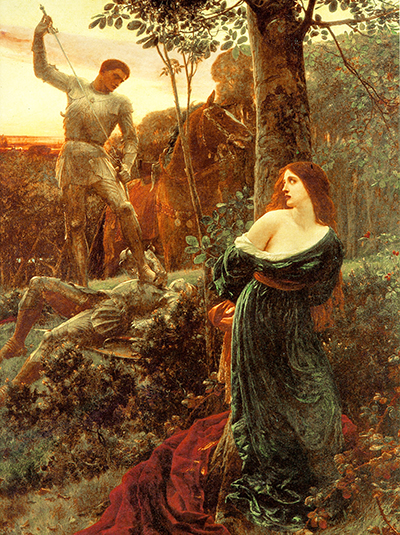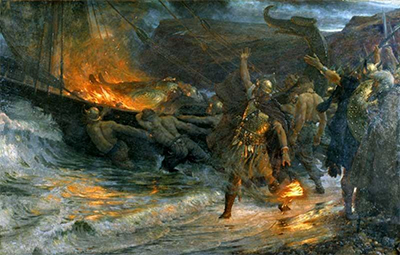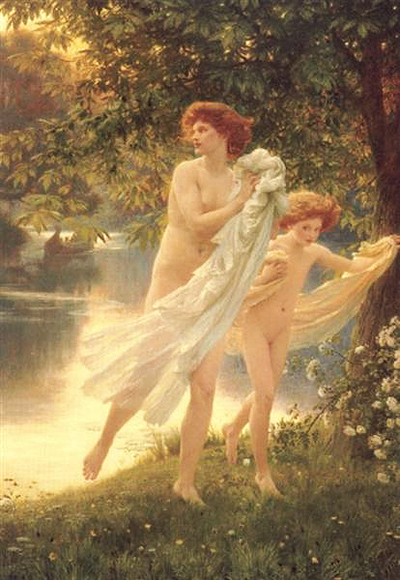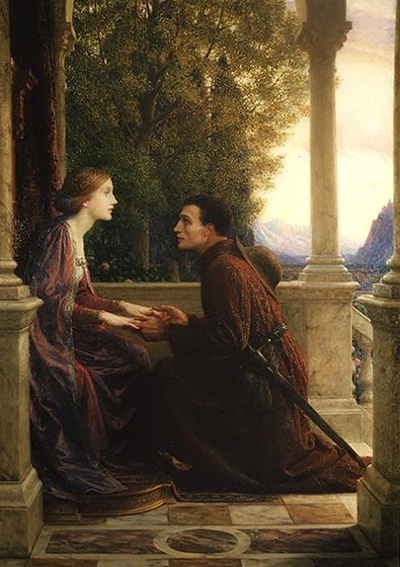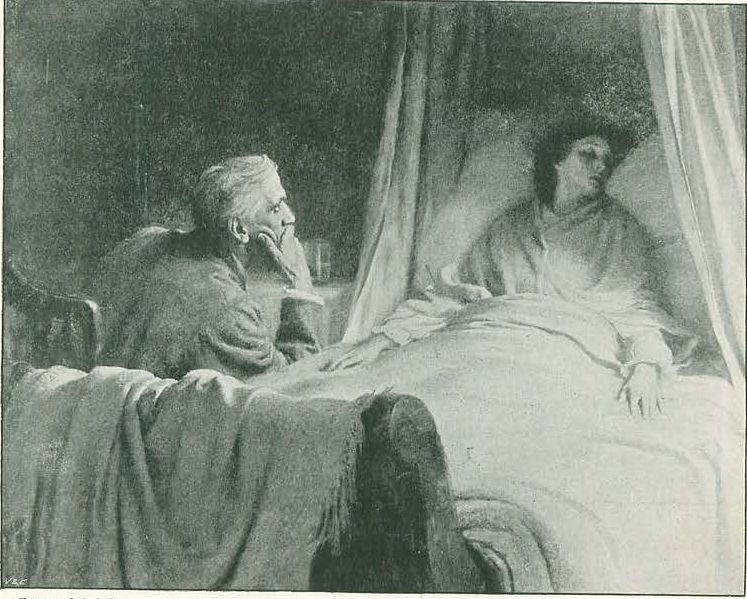
The Crisis, as reproduced from a photograph credited to Dixon in The Windsor Magazine, vol. 5, p. 389. A photograph credited to Dixon after Frank Dicksee, The Crisis. The Windsor Magazine, 1897, p. 389. Image source. Public domain.
 by Tom Gurney
Tom Gurney BSc (Hons) is an art history expert with over 20 years experience
Email: tomgurney1@gmail.com / Phone: +44 7429 011000
The Crisis: Introduction
A man sits beside a bed with his hand against his face. Across from him a woman lies still, her head sunk into a pillow and her hands resting on the covers. Frank Dicksee gives this quiet scene the urgency of a turning point. The man is close enough to watch for the smallest change, and the dark curtains draw our attention to the same narrow patch of light. The question is what, if anything, he will see. [1]
Dicksee signed and dated The Crisis in brown paint at the lower left before it went on show at the Royal Academy in London in 1891. Amid an exhibition where viewers could see gods, heroes and scenes of public life, he devoted a canvas more than a metre and a half wide to a bedside vigil. The picture soon went to Melbourne, where the National Gallery of Victoria preserves both the painting and its original London frame. [1] [2] [3]
At a Glance
- Artist and dateFrank Dicksee, 1891.
- Medium and sizeOil on canvas, 122.4 × 158.1 cm. [1]
- First exhibitionRoyal Academy, London, 1891, no. 115. [1] [2]
- CollectionNational Gallery of Victoria, Melbourne, purchased in 1891, accession p.396.2-1. [1]
- FrameOriginal gilded timber frame by Smith & Uppard, London. [1]
This work across Frank Dicksee’s career
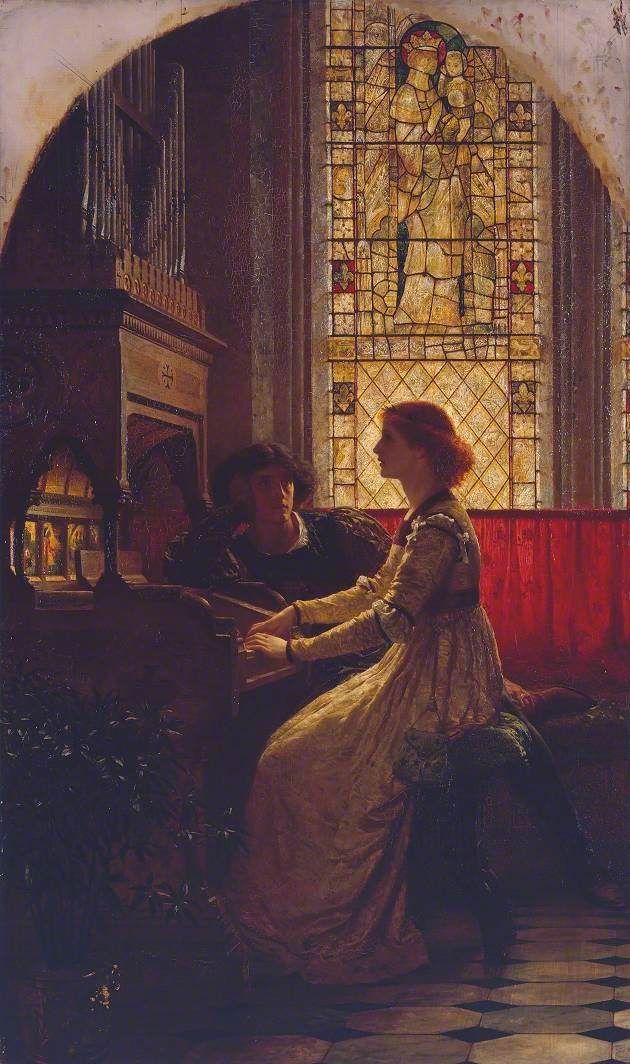
Harmony
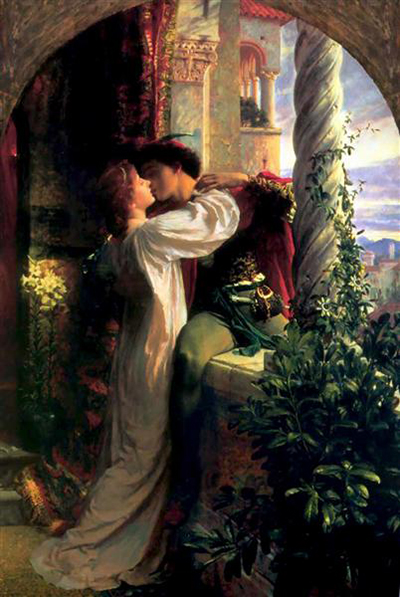
1877Romeo and Juliet
1884Chivalry
1885Startled
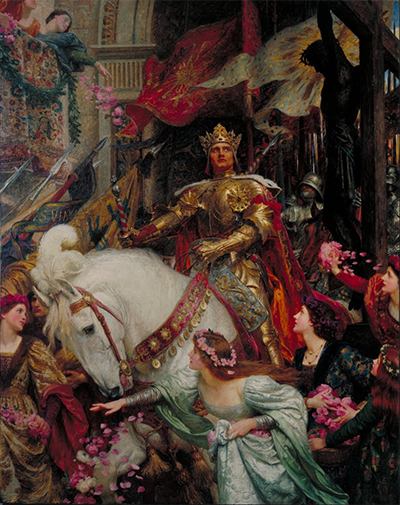
1892The Two Crowns
1900Contents
- How Dicksee paints the wait
- A studio practice and a picture in print
- Two sickrooms at the Royal Academy
- Melbourne and the problem picture
- What survives of the original frame
How Dicksee paints the wait
The seated man’s body inclines towards the woman, but his hand braces his head and holds him in place. His posture suggests that the vigil has already lasted some time. The woman's head turns into the pillow and her arms rest apart, with her hands on top of the bedclothes. Those hands make the breadth of the bed palpable. One can almost imagine a hand stirring, which is part of the reason their stillness is so affecting. Dicksee makes a tiny movement seem as though it might change the meaning of the whole scene. [1]
The bed is the largest shape in the room, yet Dicksee keeps its occupant partly sheltered. Drapery folds around her head, and the brightest stretch of linen runs out towards the viewer. The light on the cloth makes a broad passage by comparison with the small areas of exposed skin. Your eye can travel along the white bedding and then slow down over the face and fingers, looking for much the same evidence as the man. His dark clothing and the shadows around the bed help keep the eye inside this circuit. The picture gives little space to the room beyond the bed, making it hard to look away from the vigil. [1]
The title promises a decisive moment, yet the scene could precede either recovery or loss. Dicksee gives the man an especially expressive pose without explaining his connection to the woman. His vigil admits a reading as a husband’s, which a contemporary reviewer took for granted. The gallery’s own account describes him more broadly as a bedside visitor. The woman's illness is central to either reading, but the canvas leaves its cause and outcome open. E. Rimbault Dibdin, writing about Dicksee in 1905, recognised how deliberately the climax is deferred, an observation the NGV curator Ted Gott uses to explain the picture's emotional effect. [1] [4] [5]
A studio practice and a picture in print
A few years later the writer Mary Angela Dickens profiled Dicksee in The Windsor Magazine. A monochrome reproduction of The Crisis, credited to a photograph by Dixon, gives nearly the whole width of page 389 to the vigil. A magazine reader could follow the figures and curtains in tones of grey even if the painting itself was an ocean away. The location of the picture within the article matters. The account beside it of successive evening studies belongs to Evangeline and describes Dicksee watching the changing sea and sky at Lynmouth. Dickens later discusses his broader habit of trying poses and studying drapery, tone and detail. Her account illuminates his practice, while the photograph records how The Crisis was presented to readers. [6]
A separate work gives a more specific, if tentative, clue. An initialled pencil drawing dated 1891, catalogued by Christie’s as Portrait of a young girl, in profile, has been proposed as a study associated with the oil. Christie’s points to similarities of hair and dress, and to Dicksee’s interest in a face at rest. The drawing and the painting ask different things of a viewer. A profile study gives sustained attention to the features of one person. The completed scene gives the woman a role in a drama, partly through the placement of the watcher and the fall of shadow across her face. The likeness and date make the comparison worth pursuing. The girl's identity and the drawing’s precise role in the preparation of the canvas remain open. [1] [7]
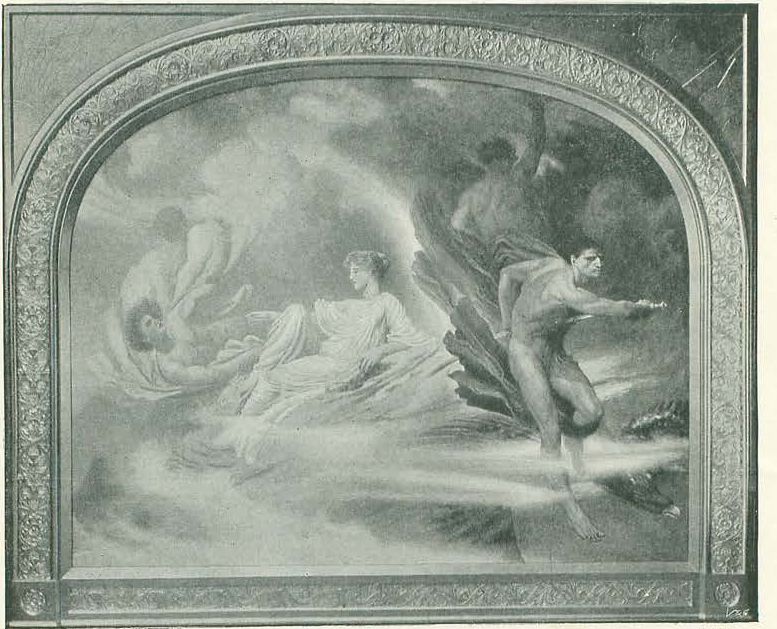
The Mountain of the Winds also appeared in the Windsor profile. Photograph credited to Dixon, vol. 5, p. 388. A photograph credited to Dixon after Frank Dicksee, The Mountain of the Winds. The Windsor Magazine, vol. 5, p. 388. Image source. Public domain.
Two sickrooms at the Royal Academy
At the 1891 Summer Exhibition, The Crisis appeared as no. 115. Algernon Graves’s register also lists Dicksee’s The Mountain of the Winds, accompanied by a passage evoking the winds gathering on an Arcadian mountain. The Crisis is entered under its bare title. Visitors could thus see two sides of his work at the same exhibition, one inviting them to imagine a world of myth and the other leaving them to read the smallest change of expression in a contemporary room. Dicksee had been an Associate since 1881. He was elected a full Royal Academician on 23 June 1891, during the run of the exhibition. [1] [2] [3] [8]
The show also contained Luke Fildes’s The Doctor. Fildes puts a sick child on two chairs in a modest cottage and gives the doctor a conspicuous place beside the makeshift bed. The parents wait farther back. Their position allows the face and bearing of the doctor to carry much of the painting’s feeling, and the title assigns him a definite role. Dicksee makes his two figures almost sufficient to fill the world of his painting. Everything we glean about the seated man comes from the attention he pays to the woman, and that attention gives the scene its emotional charge. [1] [3] [9]
Viewers compared the canvases from the start. An unsigned piece in The Hospital on 9 May 1891 treated the Academy display as crowded with farewells and deathbed scenes. It admired Fildes’s doctor and found Dicksee’s treatment more sentimental and less convincing. In July 1892, the New Zealand Herald grouped the two again when discussing coincidences of subject in the annual exhibitions. Its writer thought the paintings made a similar emotional appeal. Herkomer, whose recommendation secured The Crisis for Melbourne, regarded its emotional force as achieved without stage tricks. The two judgements bring out an enduring tension in the painting. The carefully lit, curtained space can feel staged, while the watcher’s restrained gesture feels familiar from life. [4] [5] [10]
Melbourne and the problem picture
Hubert von Herkomer advised the National Gallery of Victoria to buy The Crisis directly from the Academy exhibition. Its acquisition belonged to a varied year in the gallery’s collecting. Herkomer also acquired John William Waterhouse’s Ulysses and the Sirens and a group of prints including examples by Rembrandt and Dürer. In a statement printed in Melbourne’s Argus in July 1892, he defended his selection of the Waterhouse and described Waterhouse’s practice of painting connected passages together as the reverse of Dicksee’s method for The Crisis. The comparison comes from the buying adviser and a painter in his own right. His comparison helps explain why he valued the two paintings for their handling as well as their subjects. [1] [11] [12]
The picture reached exhibition audiences elsewhere in Australia. The NGV records it as no. 3 in the 1894 First Interchange Exhibition, a loan collection of oils shown in Melbourne, Sydney and Adelaide. The original purchase gave the picture a home in Melbourne, while the loan allowed viewers in three colonies to encounter it at full scale. Later exhibitions brought other ways of looking at the same scene. The NGV records a loan to the Western Australian State Centenary Celebrations in Perth and a showing in Victorian Social Conscience at the Art Gallery of New South Wales in 1976. [1]
Writing about Constance Jenkins’s Friendly critics, Jillian Dwyer places The Crisis and William Quiller Orchardson’s The First Cloud among the late Victorian precursors of the Edwardian problem picture, a genre closely associated with John Collier. The two earlier works were already in the Melbourne collection before Jenkins painted her own interior in 1907. The connection is structural. An ordinary room contains people at a consequential moment, and the relationships have to be worked out from small signs such as a glance or the distance between figures. Part of the pleasure for viewers was that several readings might fit. In Dicksee’s room the impending change is felt strongly, while its nature is still to be discovered. [13]
What survives of the original frame
At just over two metres wide, the original frame makes the object considerably larger than the canvas measurements suggest. It measures 169 × 204 × 11 cm, with a visible opening of 120.5 × 155 cm. Its gilded surface catches light around a painting that is deliberately dark at the edges. The gallery describes the form as drawing on Pre-Raphaelite and Italian cassetta frames. The effect depends partly on the wide, nearly flat band around the picture and partly on the bold outer profile. The gilding is water-applied over a prepared base, and the traces of the leaf are most apparent on the oak-veneered flat. The mouldings are formed from timber without cast decoration. Cleaning and repairs to two small damaged areas of the inner lip were carried out in 2002. [1]
On the back, labels connect the frame to Smith & Uppard at 77 Mortimer Street, London. They describe the firm as successor to W. A. Smith and advertise French colours and brushes alongside its work as carvers and gilders. The National Portrait Gallery’s suppliers directory confirms that the business sold artists’ materials as well as making frames. A separate paper label and ink stamp bearing the name of Charles Roberson & Co. of 99 Long Acre are on the stretcher, the wooden support that holds the canvas taut. The National Portrait Gallery’s directory also documents Roberson’s connection with the Fildes painting. The two artists gave the Academy strikingly different versions of a sickroom, but both drew on the same London trade in artists’ supplies. The two London addresses preserve traces of the trades that enabled Dicksee’s picture to be painted, framed and sent out into the world. [1] [14] [15]
Frank Dicksee artworks directory
Browse documented paintings, studies, illustration designs and prints. Where an article is available, the title opens it. Simon Toll’s catalogue
| Name | Date | Medium |
|---|---|---|
| A Love Story | 1882 | Painting |
| A Reverie | 1895 | Painting |
| An Offering | 1898 | Painting |
| Chivalry | 1885 | Painting |
| Dawn | 1897 | Painting |
| Elijah Confronting Ahab and Jezebel in Naboth’s Vineyard | By 1875 | Painting |
| Harmony | 1877 | Painting |
| Harmony, etching by Charles-Albert Waltner after Dicksee | 1880 | |
| Harmony, the smaller Towneley version | Late 1870s | Painting |
| Hesperia | 1887 | Painting |
| Hesperia, watercolour version | Late 1880s | Painting |
| Italian Coast from La Mortola | 1925 | Painting |
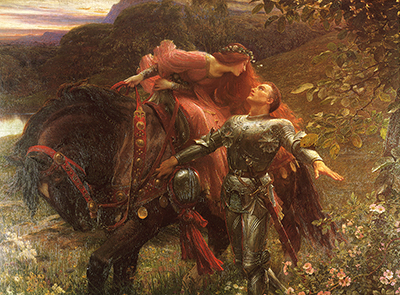
| La Belle Dame sans Merci | c. 1901 | Painting |
| Memories | 1886 | Painting |
| Paolo and Francesca | 1894 | Painting |
| Portrait of Camille Sutton Palmer | 1914 | Painting |
| Portrait of Elsa | 1927 | Painting |
| Portrait of the Duchess of Buckingham and Chandos | 1901 | Painting |
| Romeo and Juliet | 1884 | Painting |
| Romeo and Juliet, monochrome design on joined wood | c. 1880s | Painting |
| Sir Edmund William Gosse, collotype after Dicksee | 1912 | |
| Startled | 1892 | Painting |
| Study for Startled | Early 1890s | Drawing |
| The Confession | 1896 | Painting |
| The Crisis | 1891 | Painting |
| The Daughters of Eve | 1925 | Painting |
| The Embarkation | 1879 | Painting |
| The End of the Quest | 1921 | Painting |
| The Funeral of a Viking | 1893 | Painting |
| The House Builders | 1880 | Painting |
| The Magic Crystal | 1894 | Painting |
| The Passing of Arthur | 1889 | Painting |
| The Redemption of Tannhäuser | 1890 | Painting |
| The Symbol | 1881 | Painting |
| The Two Crowns | 1900 | Painting |
| Yseult | 1901 | Painting |
Discussion
Look again at the images and ideas explored in The Crisis. These editorial prompts invite your observations.
Reader Insights
Where did your eye first settle in the room, and did any small detail give you reason to expect the woman’s condition to change?
What about the man’s posture or position shapes your sense of his relationship to the woman?
How might the broad original gilded frame affect your impression of the intimacy of the painted scene?
Join the Conversation
Share the detail that most shaped your reading of The Crisis. If you have seen the original in Melbourne, how did its scale and frame affect the experience?
References
- National Gallery of Victoria, Frank Dicksee, The crisis, 1891, object 3915, accession p.396.2-1, collection, exhibition history, inscriptions and frame record. View source.
- Algernon Graves, The Royal Academy of Arts: A Complete Dictionary of Contributors and Their Work from Its Foundation in 1769 to 1904, vol. 2, p. 324, Frank Dicksee’s 1891 entries. View source.
- Helen Valentine, ‘1891: On Strike’, The Royal Academy Summer Exhibition: A Chronicle, 1769–2018, Paul Mellon Centre for Studies in British Art, 2018. View source.
- National Gallery of Victoria, The crisis, European Salon entry, including Ted Gott’s 2003 text and its references to E. Rimbault Dibdin and Hubert von Herkomer. View source.
- The Hospital, ‘Notes and News’, vol. 10, no. 241, 9 May 1891, pp. 66–67. View source.
- Mary Angela Dickens, ‘A Popular Painter: Mr. Frank Dicksee, R.A.’, The Windsor Magazine, vol. 5 (December 1896–May 1897), pp. 385–391, reproduction after Dixon’s photograph on p. 389. View source.
- Christie’s, Frank Dicksee, Portrait of a young girl, in profile, signed and dated 1891, sale catalogue and lot essay. View source.
- University of Glasgow, History of Art and HATII, Frank Dicksee, Mapping the Practice and Profession of Sculpture in Britain and Ireland 1851–1951, Royal Academy membership dates. View source.
- Tate, Luke Fildes, The Doctor, 1891, description and object details. View source.
- New Zealand Herald, ‘Literature and Art’, 9 July 1892, supplement. View source.
- National Gallery of Victoria, 1891 acquisition timeline. View source.
- Michelle Bonollo, ‘J. W. Waterhouse’s Ulysses and the Sirens: Breaking Tradition and Revealing Fears’, National Gallery of Victoria, including Herkomer’s statement from the Argus, 23 July 1892, p. 5. View source.
- Jillian Dwyer, ‘Constance Jenkins, her painting Friendly critics and the National Gallery of Victoria Travelling Scholarship’, Art Journal 53, National Gallery of Victoria, 2014. View source.
- National Portrait Gallery, British artists’ suppliers, 1650–1950, Smith & Uppard entry. View source.
- National Portrait Gallery, British artists’ suppliers, 1650–1950, Charles Roberson entry. View source.