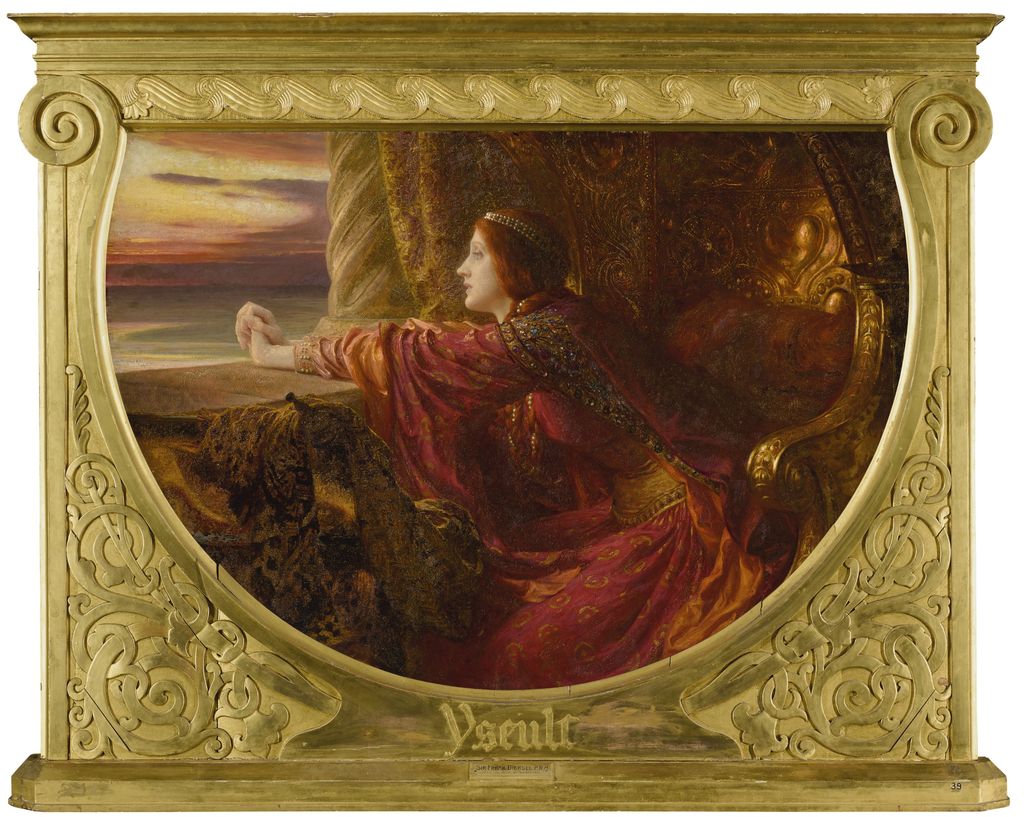
Yseult, 1901. The shaped image and its surrounding frame are visible in this photograph. Image source. Public domain.
 by Tom Gurney
Tom Gurney BSc (Hons) is an art history expert with over 20 years experience
Email: tomgurney1@gmail.com / Phone: +44 7429 011000
Yseult: Introduction
In Frank Dicksee’s Yseult, a woman in red leans across a stone balustrade and searches a narrow stretch of sea. Her hands have come together on the ledge. Behind her, a high-backed chair and heavy fabrics crowd the picture with ornament. Beyond her hands lie a few bands of colour and an open horizon. Dicksee makes the eye travel from the crowded room to the empty water, where the woman appears to expect an answer. The painting was signed and dated 1901. [1] [2] [3]
At a Glance
- Artist and dateFrank Dicksee, 1901. Signed and dated at the lower left. [1] [2]
- Medium and sizeOil on canvas, approximately 104 × 153 cm. The image is set within a rounded gilt frame. [1] [2]
- SubjectUsually identified as Yseult of the White Hands, Tristan’s wife in Brittany, watching for the ship that may bring her rival. [1] [2]
- ExhibitionsRoyal Academy Summer Exhibition, London, 1901, no. 52, and the Liverpool Autumn Exhibition later that year. [1] [2]
This work across Frank Dicksee’s career
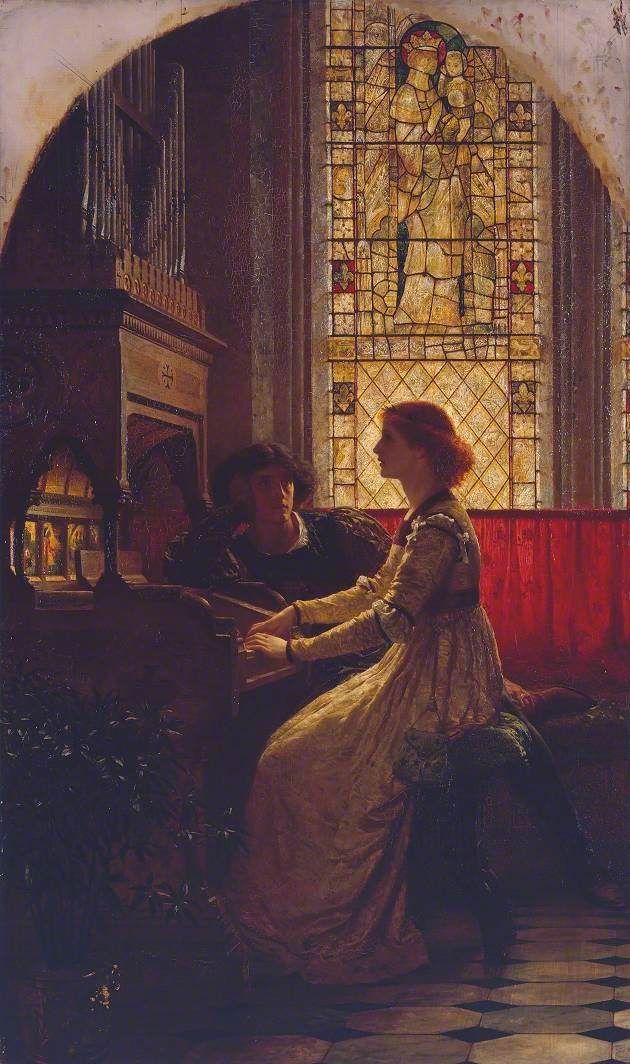
Harmony
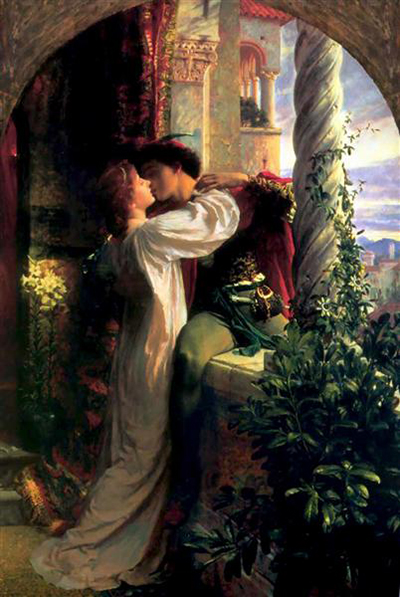
1877Romeo and Juliet
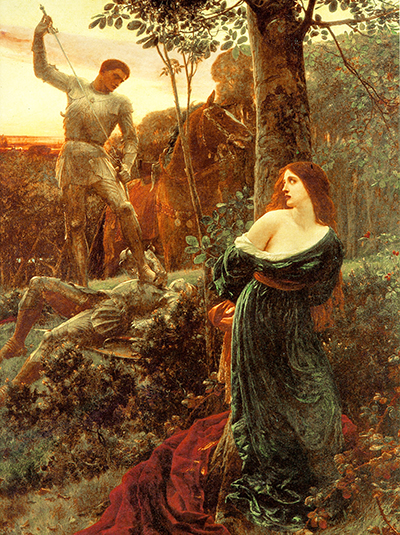
1884Chivalry
1885Startled
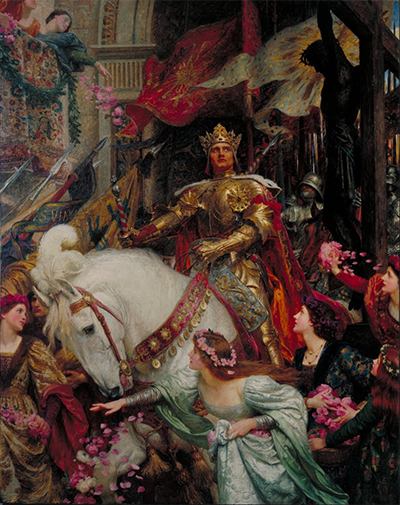
1892The Two Crowns
1900Contents
- A figure at the edge of the sea
- The two women called Yseult
- The gesture and the frame
- Readers at the Royal Academy in 1901
- The oil and the smaller Iseult
- Annotated details
A figure at the edge of the sea
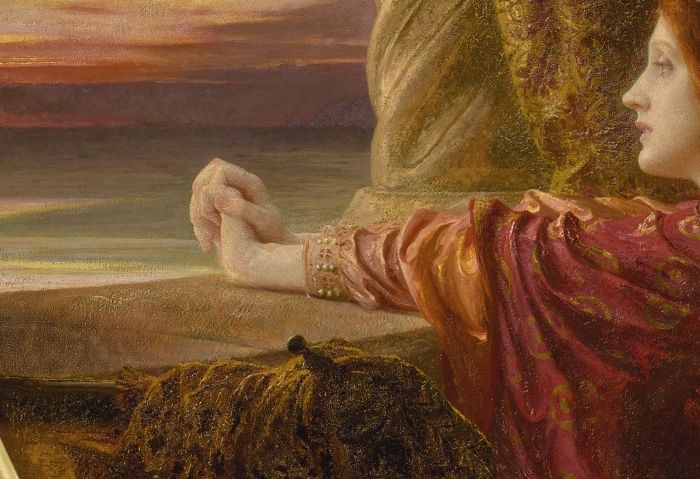
Yseult’s body still rests against the chair, but her shoulders and forearms have shifted towards the opening. The curve of the chair’s gilded arm rises behind her and follows the sweep of the dark cloak. Her sleeve runs out from those heavy folds towards the ledge, narrowing to a light cuff and the bare shapes of her fingers. The hands rise a little above the stone. Their compact shape, set against the water, makes them easier to read than much larger stretches of ornament. [3]
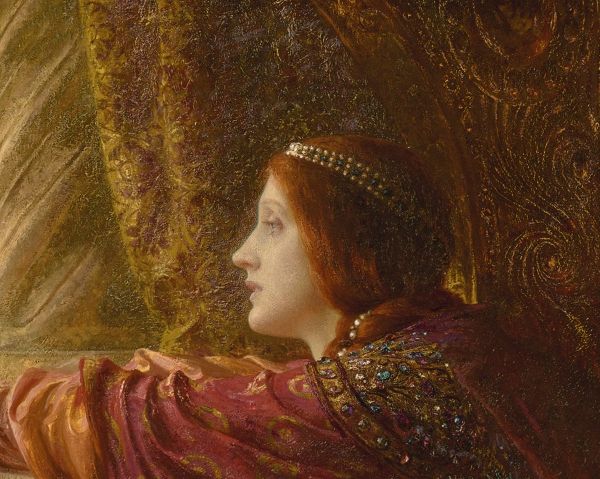
The column beside Yseult’s face divides two kinds of space. On one side are the glowing panels of sky, the dark line of the horizon and a lighter passage near the shore. On the other, the chair, twisting stone and patterned fabric give the eye a succession of surfaces to explore. Yseult’s face lies just inside that threshold. A narrow rim of light catches her brow, nose and chin, while much of her hair and dress remains in shadow. Her gaze carries us left again, past the hands and into a view whose scale is hard to judge. The reproduction yields no clearly legible sail. [3]
The fabrics carry much of the effect at close range. Small highlights in the cloak’s edging pick up the beaded line across her hair, while broader strokes of orange and crimson describe the dress where it gathers across her lap. The 2019 sale catalogue includes a conservator’s account of the raised texture of the preparation and of Dicksee scraping back pigment to uncover parts of the design underneath. That observation helps explain why pattern feels bound into the surface even in passages where individual marks seem to catch the light. [1] [3]
The two women called Yseult
Yseult, Iseult and Isolde are familiar spellings of a name that belongs to two women in the legend. In Thomas Malory’s Le Morte d’Arthur, La Beale Isoud is the Irish princess who becomes King Mark’s queen in Cornwall. Isoud la Blanche Mains is the daughter of Howel of Brittany and the woman Tristan, whom Malory calls Tristram, marries. The news so angers Lancelot that he sends word repudiating their friendship. Malory later has Lancelot recall that Mark killed Tristram as he played the harp before the Irish Isoud. [4] [5]
The Breton princess matters in a different way in the ending retold by Joseph Bédier in Le Roman de Tristan et Iseut, published in 1900. There the wounded Tristan sends his friend Kaherdin to bring Iseut the Fair to him. They agree on a signal. A white sail means the queen is aboard, and a black one means she is absent. Iseut of the White Hands overhears the plan. After a storm and then a calm delay the return, the white sail comes into sight. Tristan is too weak to keep watch for himself. His wife tells him the sail is black, and he dies before the queen reaches him. When the two women meet at his side, the Breton Iseut is already in anguish at what she has done. [6]
In 1886, Bédier compared the death episode in a medieval French manuscript and the German poem of Eilhart von Oberg, tracing the two sails and the wife’s deception across versions. The watch by the sea takes on a different feeling in Matthew Arnold’s Tristram and Iseult. The poet recalls the gentle Breton Iseult spending her days spinning with her attendants and looking out from her tower. The same seaward gaze can suggest habit, loneliness or a terrible decision. Dicksee’s choice of text for this particular picture remains uncertain. [6] [7] [8]
Sotheby’s and Christie’s both identify Dicksee’s figure as the Breton wife. They read the light as dawn, with Yseult watching for the ship after a night at her tapestry. In this reading the watcher holds the power of the story. She will see what Tristan can no longer see, and the distance between the balcony and the sickroom gives her time to decide what to tell him. Dicksee devotes relatively little space to the sea, yet the scene turns on the piece of information it is about to give her. [1] [2] [3] [6]
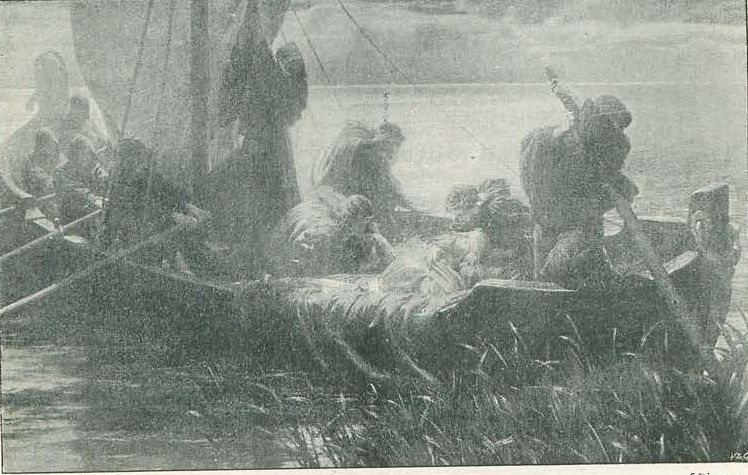
The Passing of Arthur, a separate subject from Arthurian legend. Printed in The Windsor Magazine from a photograph credited to Dixon. A photograph credited to Dixon after Frank Dicksee, The Passing of Arthur. The Windsor Magazine, vol. 5, p. 390. Image source. Public domain.
Annotated Details from Yseult
The numbered points identify visible features discussed in this article. Return from each detail to the numbered overview. Yseult looks towards the sea in Dicksee’s painting with the shaped title frame visible. Image source. Public domain.
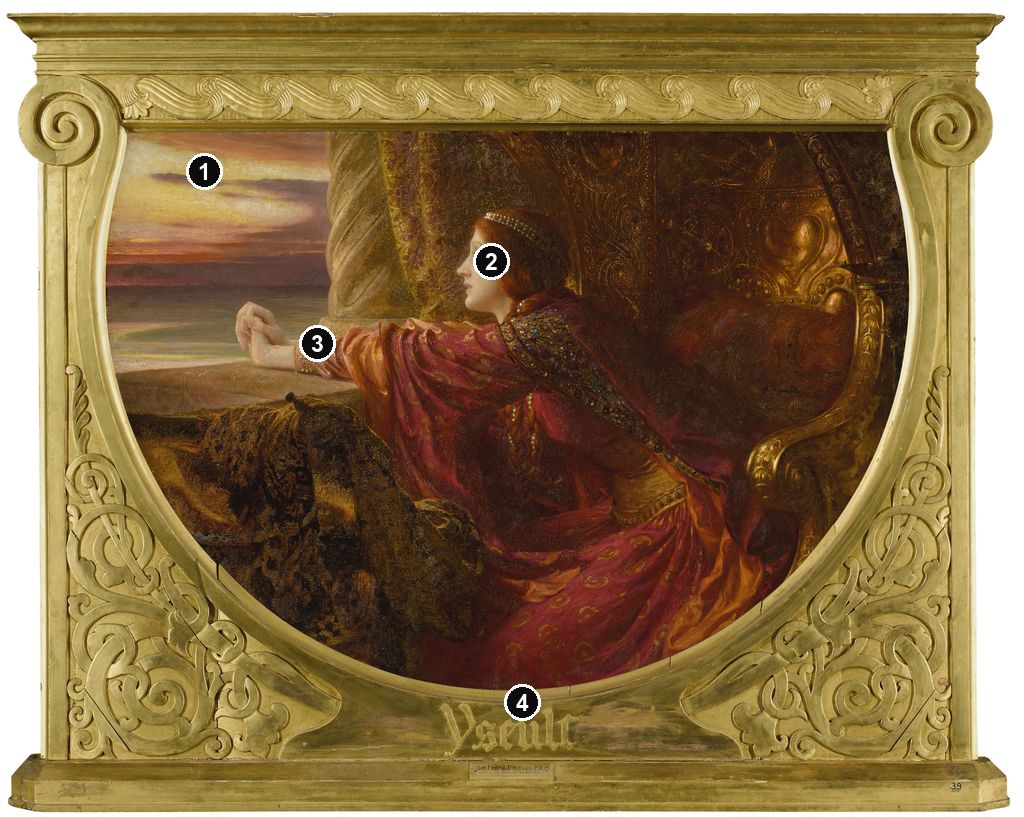
Details from YSEULT
Compare the cropped details with the source images above. Notice how their colours, shapes and positions contribute to the larger compositions.
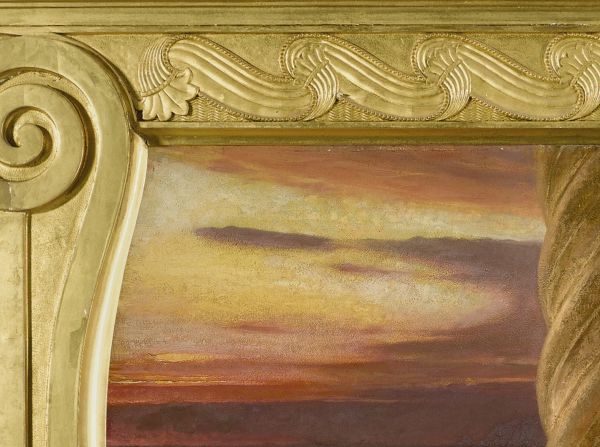
The pale horizon
A narrow band of water and sky opens at the left of the sheltered space. The far horizon gives the figure’s attention a direction and keeps the object of her concern beyond the immediate scene.
The face turned outwards
The profile is lit along its left edge against the darker room. It repeats the outward movement of the hands towards the opening.
Hands on the balustrade
The figure’s hands reach across the horizontal ledge. The gestures occupy the space where the view of water meets the warm interior.
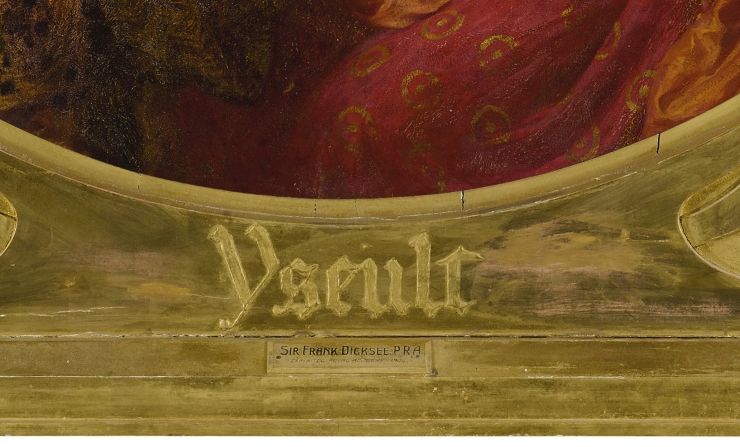
The lower curve and title
The painted surface curves into the gilded surround. The title at the foot belongs to the illustrated frame, which is why the full view preserves it.
The gesture and the frame
Sotheby’s traces the composition to a Langham Sketching Club exercise on the theme of evening and compares Yseult’s pose to the anxious young woman in Dicksee’s The Confession of 1896. The old Wantage collection catalogue describes that earlier figure leaning forward with outstretched arms and tightly clasped hands, her attention fixed on the man across from her. The resemblance helps explain the way Dicksee conveys expectation through the body. In The Confession the person returning her gaze is inside the room. In Yseult the pose reaches towards a distant horizon, so the direction of the look carries as much of the story as the hands. [1] [3] [9]
The sale catalogues credit Dicksee with the design of the gilt frame and describe its shape as a Celtic lyre. The picture has a level top and a deep curve below, with broad gilt corners filled by interlacing ornament. A wave-like band runs above the opening, and the title sits below the curve. The frame brings the gilding of the painted chair into contact with the gilding around the picture. Its lower arc also follows the movement of the folds across the figure’s lap and then leads back up towards the arm on the stone. Christie’s connects the lyre form with the Irish ancestry of Yseult’s rival. The association adds another way to read the ornament, while the visible design makes its own contribution to the picture. [1] [2] [3]
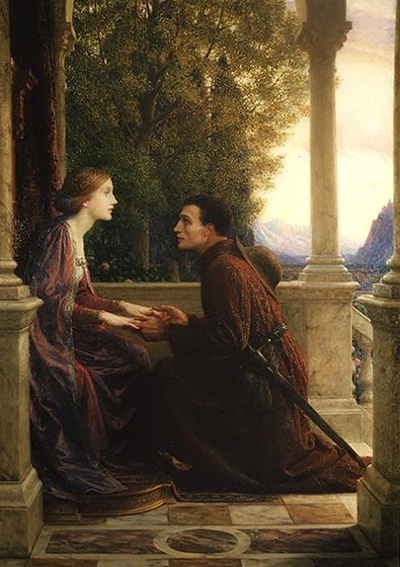
Christie’s compares the richness of the clothes to designs by Edward Burne-Jones for the 1895 Lyceum production of King Arthur. The catalogue also points to the twisted column in Dicksee’s Romeo and Juliet of 1884. There, the architecture gives Romeo a place to begin his descent after the couple’s farewell. In Yseult, a similar column marks the opening through which the watcher looks. Details like these turn a balcony into a setting for action, even when the figure barely moves. Rachel Lee, whom the catalogue identifies as a model for Dicksee’s Dawn and An Offering, has been suggested as a possible model for Yseult. Her identification remains open. [2] [3] [10] [11]
Readers at the Royal Academy in 1901
Dicksee’s canvas appeared as Yseult, no. 52 in the Royal Academy’s 1901 exhibition. The title gave visitors a name shared by the two women, and the clothes suited a person of high rank on either side of the story. Henry Blackburn’s Academy Notes placed her in Cornwall as Mark’s bride, looking out near sunset. The June Art Journal review also imagined the scene in Mark’s palace, with the queen thinking of Tristram as he wandered in Spain. In these readings, the horizon holds the possibility of return, and the woman herself is the lover on land who waits. [11] [12]
Critics also disagreed over what the decoration did for the scene. In The Magazine of Art, Marion H. Spielmann admired the colour sequence from yellow through coppery reds to purple and singled out the expression and the drawing of the hands. Writing in The Athenaeum, Frederic George Stephens thought the expensive-looking accessories took the place of convincing feeling. Spend time with the shadows and gilding and the hall seems to enclose the figure. Follow her arms out to the edge of the sea and the same setting makes her concentration feel keener. [3] [11]
Visitors that year could also see Herbert Draper’s Tristram and Ysolt, no. 561. Draper chose the voyage before the Irish princess’s marriage to Mark. On the ship, beside the woman he is escorting, Tristram has the cup that will bind them to each other. The 1901 illustrated exhibition supplement used a passage about their drinking to explain the moment. Draper brings the prop that sets the story in motion within reach of both figures. Dicksee makes us search the sea with his watcher for the sign that ends it. [3] [13]
The painting even made its way into a fictional gallery conversation in Punch on 5 June 1901. Mrs Onslow admires the warmth of Dicksee’s colour, while Captain Dormer replies that Yseult herself is hardly his type. The joke turns on the ease with which the two can look at the same picture and talk past each other. Its telling detail is that neither has to name the episode to find something immediately recognisable in the painting. [14]
The oil and the smaller Iseult
Dicksee also made a small version titled Iseult, now in the collection of Leighton House, London. It is a work in watercolour and gouache, heightened with white, and measures 25 × 33 cm. The scholar Dennis T. Lanigan dates it to 1901, the same year as the oil. The small picture repeats the woman at her balustrade and the unusual frame profile. The painted scene on that scale invites close viewing of the gesture and profile that had to carry across a gallery in the larger oil. The title Iseult also appears in the Art Journal review of the oil. Medium and dimensions are the surest way to distinguish the two works in a catalogue. [1] [2] [11]
The oil had a buyer at the 1901 Academy exhibition. Wolf Harris, a merchant who had settled in London after living in New Zealand, acquired it there. The recorded provenance then runs through the London dealer William Walker Sampson to Ranjitsinhji Vibhaji, Maharaja Jam Sahib of Nawanagar. In his collection at Staines, Yseult was joined by another Dicksee subject from Arthurian romance, The Passing of Arthur. The oil passed through Ranjitsinhji’s family before Fred and Sherry Ross acquired it in 1995. Christie’s 2021 record explicitly cites the Rosses’ sale at Sotheby’s, New York, on 1 February 2019, lot 426. The two catalogues describe the same signed canvas, with slightly different measurements. [1] [2]
Frank Dicksee artworks directory
Browse documented paintings, studies, illustration designs and prints. Where an article is available, the title opens it. Simon Toll’s catalogue
| Name | Date | Medium |
|---|---|---|
| A Love Story | 1882 | Painting |
| A Reverie | 1895 | Painting |
| An Offering | 1898 | Painting |
| Chivalry | 1885 | Painting |
| Dawn | 1897 | Painting |
| Elijah Confronting Ahab and Jezebel in Naboth’s Vineyard | By 1875 | Painting |
| Harmony | 1877 | Painting |
| Harmony, etching by Charles-Albert Waltner after Dicksee | 1880 | |
| Harmony, the smaller Towneley version | Late 1870s | Painting |
| Hesperia | 1887 | Painting |
| Hesperia, watercolour version | Late 1880s | Painting |
| Italian Coast from La Mortola | 1925 | Painting |
| La Belle Dame sans Merci | c. 1901 | Painting |
| Memories | 1886 | Painting |
| Paolo and Francesca | 1894 | Painting |
| Portrait of Camille Sutton Palmer | 1914 | Painting |
| Portrait of Elsa | 1927 | Painting |
| Portrait of the Duchess of Buckingham and Chandos | 1901 | Painting |
| Romeo and Juliet | 1884 | Painting |
| Romeo and Juliet, monochrome design on joined wood | c. 1880s | Painting |
| Sir Edmund William Gosse, collotype after Dicksee | 1912 | |
| Startled | 1892 | Painting |
| Study for Startled | Early 1890s | Drawing |
| The Confession | 1896 | Painting |
| The Crisis | 1891 | Painting |
| The Daughters of Eve | 1925 | Painting |
| The Embarkation | 1879 | Painting |
| The End of the Quest | 1921 | Painting |
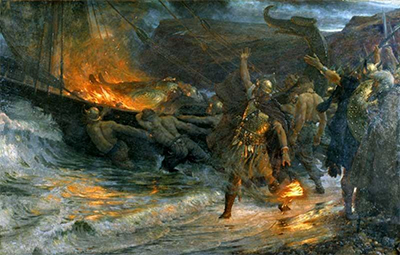
| The Funeral of a Viking | 1893 | Painting |
| The House Builders | 1880 | Painting |
| The Magic Crystal | 1894 | Painting |
| The Passing of Arthur | 1889 | Painting |
| The Redemption of Tannhäuser | 1890 | Painting |
| The Symbol | 1881 | Painting |
| The Two Crowns | 1900 | Painting |
| Yseult | 1901 | Painting |
Discussion
Look again at the images and ideas explored in Yseult. These editorial prompts invite your observations.
Reader Insights
Does Yseult seem to be holding herself still or about to rise? Follow the line of her sleeve from elbow to wrist and see where the movement stops.
How does knowing about the two sails change the way you look at the narrow strip of water?
Which part of the painting echoes the gilt surround most strongly for you, the chair, the winding fabrics or the balustrade?
Join the Conversation
Where does your eye settle first in Yseult? Share the detail that determines how you read the waiting figure.
References
- Sotheby’s, Yseult, 19th Century European Art, New York, 1 February 2019, lot 426, including Simon Parkes Art Conservation’s report. View source.
- Christie’s, Yseult, European Art Part I, New York, 13 October 2021, lot 8. View source.
- Image source, Frank Dicksee, Yseult (1901), Sotheby’s photograph of the framed oil via Wikimedia Commons. View source.
- Thomas Malory, Le Morte Darthur, Book VIII, chapter XXXVI, on the marriage of Tristram and Isoud of the White Hands. View source.
- Thomas Malory, Le Morte D’Arthur, Book XX, chapter VI, Lancelot’s account of Tristram’s death, George Mason University transcription. View source.
- Joseph Bédier, Le Roman de Tristan et Iseut, H. Piazza, 1900, chapter XIX, ‘La mort’. View source.
- Joseph Bédier, ‘La mort de Tristan et d’Iseut, d’après le manuscrit fr. 103 de la Bibliothèque nationale comparé au poème allemand d’Eilhart d’Oberg’, Romania, 1886. View source.
- Matthew Arnold, ‘Tristram and Iseult’, part I, in Poetical Works of Matthew Arnold. View source.
- Lord and Lady Wantage collection catalogue, The Confession, p. 57, no. 57. View source.
- Southampton City Art Gallery, Frank Dicksee, Romeo and Juliet (1884), SOTAG 1006. View source.
- Dennis T. Lanigan, ‘Yseult and Iseult by Sir Frank Dicksee’, The Victorian Web, including the Leighton House watercolour and extracts from the reviews of 1901. View source.
- Algernon Graves, The Royal Academy of Arts, vol. II, 1905, Frank Dicksee’s exhibition entries for 1901. View source.
- Royal Academy Pictures, 1901, notes and p. 111, Herbert J. Draper, Tristram and Ysolt, exhibition no. 561. View source.
- Punch, or The London Charivari, ‘Cultured Conversations. II.—Artistic’, 5 June 1901, p. 416. View source.