by Tom Gurney
Tom Gurney BSc (Hons) is an art history expert with over 20 years experience
Published on June 19, 2020 / Updated on August 21, 2026
Email: tomgurney1@gmail.com / Phone: +44 7429 011000
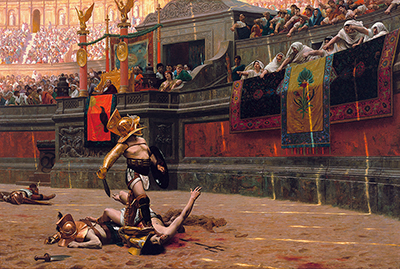
A line of armed fighters raises weapons towards the emperor while bodies from an earlier combat lie on the arena floor. Spectators fill the curving tiers behind them. Jean-Léon Gérôme's Ave Caesar! Morituri te salutant presents Rome as a perfectly organised machine of spectacle: the living salute, the dead remain visible and authority watches from above.
The Latin title is usually translated “Hail Caesar! We who are about to die salute you.” Popular culture has made it sound like the standard greeting of every gladiator. The ancient text is much narrower. Suetonius records the phrase from condemned men in a staged naval battle under Claudius, not as a routine formula spoken before gladiatorial combat.[1][2]
Gérôme turns that exceptional literary episode into a universal image of the arena. His archaeological research was serious, but the picture's historical world is composite. Precision and invention operate together.
At a Glance
- ArtistJean-Léon Gérôme
- TitleAve Caesar! Morituri te salutant (Hail Caesar! We Who Are about to Die Salute You)
- Date1859
- MediumOil on canvas
- Dimensions93.1 × 145.4 cm (36 5/8 × 57 1/4 in.)
- CollectionYale University Art Gallery
- AccessionGift of C. Ruxton Love, Jr.; 1969.85
- ExhibitionParis Salon, 1859[1]
The Salute as a Visual Order
The fighters form a broad horizontal line across the foreground. Their bodies and weapons vary, but the shared gesture unifies them. All attention moves upwards towards the imperial box.
The emperor receives the salute from a protected and elevated position. Architecture makes hierarchy physical: fighters stand on sand, spectators sit behind barriers and the ruler occupies the point towards which the arena is organised.
Gérôme includes bodies already fallen. Their presence gives the title its consequence. “About to die” is not theatrical exaggeration when death is visible beside the speakers.
The surviving fighters do not appear as an uncontrolled mob. Their spacing and equipment create a disciplined display. Even people sent towards violence must present themselves as a legible group before power.
The viewer receives a position between levels. We can examine armour, bodies, emperor and audience in one survey. No actual arena spectator would possess this exact, unobstructed synthesis.
That clarity is Gérôme's construction. The painting makes Roman spectacle understandable at a glance by giving us more access than history could.
What Did the Latin Phrase Mean?
In Suetonius' Life of Claudius, condemned combatants preparing for a mock naval battle address the emperor with the words Ave imperator, morituri te salutant—“Hail, emperor, those about to die salute you.” Claudius replies in a way they interpret as a pardon, briefly disrupting the spectacle.[2]
The episode concerns a specific naumachia, an elaborate staged sea battle. It does not establish a standard greeting required of gladiators before every fight.
Gérôme's title changes the cultural afterlife of the phrase. By attaching it to a visually authoritative arena scene, he helped make an exceptional report feel customary. Later novels, films and popular histories repeated the association.
This does not mean Gérôme invented the Latin or used it carelessly. He drew on a genuine ancient text and adapted it to a broader dramatic purpose. The correction lies in scope: ancient source, yes; universal gladiator formula, no.
The word “Caesar” in the familiar English title also functions generically. The ruler in Suetonius' account is Emperor Claudius, not Julius Caesar. Roman imperial names and titles became compressed in popular usage.
Researching an Imagined Arena
Yale's record describes Gérôme's close study of archaeological excavations and ancient weaponry. He examined armour associated with Pompeii, museum collections and literary sources, and even used small three-dimensional models to study gladiatorial bodies.[1]
That effort is visible in the varied equipment. Fighters are not represented as identical swordsmen. Helmets, shields, padding, greaves and weapons create different silhouettes.
Research did not remove uncertainty. The architecture evokes the Colosseum, but the amphitheatre was completed decades after Claudius' staged naval battle. Gérôme combines a memorable imperial arena with an earlier textual episode.[1]
The ancient world of the picture is therefore synthetic. The best-known architecture, plausible weapons, an exceptional phrase and a composed group share one time.
This method was typical of nineteenth-century historical reconstruction. An artist did not need one source containing the whole scene. Separate fragments could be assembled into an image that felt more complete than the evidence.
The danger is that visible precision transfers authority to the invented combination. The reward is a painting that exposes how historical memory itself is built.
The 1858 Preparatory Study
Yale also owns a preparatory study dated 1858. Made in graphite, pen and ink, the sheet bears accession 1994.24.1.[3]
The drawing concentrates on the fighters' anatomy, equipment and distribution. Comparison with the painting shows Gérôme changing details, including the direction of weapons and the scale of the line.[1][3]
Those alterations reveal that archaeological detail served composition. A historically plausible trident could still be shifted if its angle made the salute more legible.
The sheet also corrects the myth of effortless finish. Gérôme's painted surface hides adjustment; the drawing keeps it visible.
Because the study is securely connected by Yale to the finished canvas, it can support a specific process argument. It should not be used to claim that every Gérôme painting followed the same sequence.
The current Yale accession is important. Earlier derivative notes sometimes repeat another number, but 1994.24.1 controls the live object.
The Arena and Its Audience
The crowd transforms combat into public culture. Spectators fill the tiers, turning individual danger into collective entertainment.
Gérôme keeps most faces small. Their mass matters more than personal biography. The emperor concentrates authority; the crowd supplies scale and appetite.
The modern viewer resembles both. Like the emperor, we receive a comprehensive view. Like the crowd, we consume bodies and suspense from safety.
The painting does not display the same overt demand for death found in Pollice Verso. Its violence is more administrative. The salute, ranks and architecture make killing appear ceremonial.
That ceremony can dignify the fighters while also revealing their lack of control. They raise weapons, but the form of their gesture belongs to the institution that may kill them.
The bodies already on the sand prevent the spectacle from becoming abstract. Death is the arena's residue, left in sight while the next performance begins.
From Salon to Screen
The canvas was shown at the Paris Salon in 1859 and entered a culture in which paintings reached large audiences through exhibitions, criticism and reproduction.[1]
Later viewers have frequently described Gérôme's arena scenes as cinematic. Yale notes the importance of such historical paintings to the visual traditions later inherited by film.[1] The composition offers qualities screen spectacle values: broad establishing view, legible hierarchy, dramatic pause and massed extras.
The relationship should not be treated as a direct line from one canvas to every Roman film. Theatre, novels, archaeology, other paintings and earlier screen productions also shaped cinematic antiquity.
Gérôme's contribution was to give uncertain history an extraordinarily memorable arrangement. The salute is now often recalled through a scene like his even by people who have never seen the painting.
Its popular afterlife demonstrates the power of images to turn a rare text into an imagined custom.
Artist Up Close
Begin with the dead bodies. They establish the cost before the saluting fighters' identities can become heroic.
Then follow the raised weapons towards the emperor. Gérôme uses gesture to connect vulnerable bodies to remote authority.
Finally, compare the varied equipment with the uniform salute. Individual material detail exists inside an institutional order.
Frequently Asked Questions
Discussion
Which detail in Ave Caesar! Morituri te salutant most changes how you read Gérôme's balance of spectacle, evidence and invention?
Reader Insights
Which detail in Ave Caesar! Morituri te salutant most changes how you read the scene's balance of evidence, staging and spectacle?
Set this page beside the Gérôme biography, paintings overview and related works to test how travel, studio practice and the Salon shaped the image.
What should a careful modern reading preserve, question or leave uncertain when looking at this work today?
Join the Conversation
Share a thoughtful observation about Ave Caesar! Morituri te salutant, Gérôme's method, or the wider context that would help another reader look more carefully.
References
- Yale University Art Gallery. “Ave Caesar! Morituri te salutant (Hail Caesar! We Who Are about to Die Salute You).” Collection record, 1969.85 View source.
- Suetonius. Life of Claudius, 21.6. Perseus Digital Library, Tufts University View source.
- Yale University Art Gallery. “Preparatory Study for ‘Ave Caesar, Morituri te Salutant.’” Collection record, 1994.24.1 View source.