 by Tom Gurney
Tom Gurney BSc (Hons) is an art history expert with over 20 years experience
Published on June 19, 2020 / Updated on August 21, 2026
Email: tomgurney1@gmail.com / Phone: +44 7429 011000
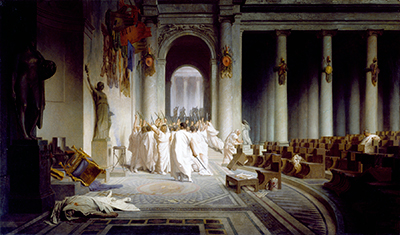
The murder is over. Julius Caesar lies abandoned beside an overturned chair, the conspirators are disappearing into daylight, and a single spectator remains seated among the empty benches. In The Death of Caesar, Jean-Léon Gérôme begins where a conventional climax would end.
That choice changes the viewer's role. We do not witness the first blow or search the crowd for Brutus. We enter too late, confronted with traces that must be assembled into a story. The painting's polished architecture appears to offer complete historical knowledge, yet its central event is missing. Gérôme makes absence—not action—the source of suspense.
At a Glance
- ArtistJean-Léon Gérôme
- TitleThe Death of Caesar (La Mort de César)
- Date1859–67
- MediumOil on canvas
- Dimensions85.5 × 145.5 cm (33 11/16 × 57 5/16 in.)
- CollectionWalters Art Museum, Baltimore
- AccessionAcquired by Henry Walters in 1917; 37.884[1]
After the Ides of March
Julius Caesar was assassinated on 15 March—the Ides of March—in 44 BCE. A group of senators attacked him during a meeting held in the complex associated with Pompey's theatre. The conspiracy arose amid fears that Caesar's accumulation of power threatened the Roman Republic, although the motives and later reputations of the assassins were never simple.[2]
Ancient accounts supplied later artists with a sequence full of dramatic possibilities: warnings and omens, the conspirators closing around Caesar, the stabbing and the chaotic aftermath. Plutarch reports that after the killing the other senators fled, while Brutus and his allies went out together displaying their bare daggers and calling the people to liberty.[2]
Gérôme takes that last movement and turns it into the painting's distant action. The conspirators are already far from the body, clustered near an exit and raising their weapons as they move into bright exterior space. Caesar remains in the dimmer foreground. Between the dead man and his killers stretches a broad expanse of floor.
The historical event is famous enough that viewers can supply what Gérôme withholds. The title names the victim; the body and toppled seat establish the result; the armed group completes the inference. Instead of explaining the assassination through expressive faces and colliding bodies, the painting asks us to reconstruct it from separated evidence.
The Empty Centre
The canvas is unusually wide in relation to its height. Gérôme uses that horizontal field to keep the main elements apart. Caesar's body lies close to the front edge at the left. The departing conspirators gather in the distance. The solitary seated figure occupies the tiered benches to the right. None of these groups fills the middle.
That empty centre is the painting's most active device. It measures how quickly a crowded political assembly has become a deserted crime scene. It also delays the eye. After noticing the body, we travel across stone pavement and architectural divisions before reaching the small, animated group beyond.
The viewpoint is low enough to make the floor seem extensive. Caesar is close, but Gérôme does not place him upright for heroic recognition. His foreshortened body appears as a heavy form that the departing men have left behind. The overturned seat beside him records a violent interruption without showing the struggle itself.
Light separates moments as well as spaces. The foreground is controlled and shadowed; the conspirators move toward brightness. The contrast does not turn their exit into moral illumination. Instead, it makes their distance unmistakable. They have passed from the enclosed site of the killing toward its public consequences.
At the right, the lone seated man breaks the pattern of flight. The Walters Art Museum describes him as brooding over the scene but does not assign him a secure historical identity.[1] His stillness acts as a counterweight to the raised weapons. He has seen what we have missed, yet he offers no explanation.
A Crime Reconstructed by the Viewer
Gérôme's method resembles retrospective investigation. We encounter the outcome, observe clues and imagine the sequence that produced them. Art historian Nina Lübbren has examined the painting in relation to crime and narrative time, showing how its after-the-event structure makes temporal reconstruction central to its effect.[3]
The picture contains at least three times at once. The body and fallen seat preserve the immediate past. The conspirators' movement occupies a rapidly receding present. The empty chamber anticipates a near future in which the site will be silent but the political effects of the murder will spread through Rome.
This layered time explains why the polished surface does not make the scene static. Gérôme's controlled finish suppresses visible brushwork, but the narrative remains unsettled. The eye repeatedly crosses the gap between cause and consequence. Because the central action cannot be seen, no amount of close looking can recover it directly.
The arrangement also avoids a familiar moral shortcut. An assassination scene centred on the stabbing could organise sympathy through facial expression: Caesar's shock, Brutus's resolve, another conspirator's rage. Here, the killers are too distant for individual psychology. Caesar's face cannot carry the whole meaning. Viewers confront a political act after bodies and intentions have broken apart.
The result is both spectacular and strangely anti-spectacular. Gérôme gives us grand architecture, a notorious death and a carefully staged vista. He denies us the bodily collision that would normally justify those resources.
Architecture as Stage
Ancient sources place Caesar's death at a senate meeting in Pompey's complex rather than in the permanent Senate House often imagined today.[2] Gérôme constructs a monumental Roman interior around the event, but the painting should not be treated as a measured archaeological reconstruction of the Curia of Pompey.
Its architecture works first as scenography. Tall walls and disciplined perspective enlarge the distance between foreground and exit. Repeated steps and benches establish an orderly civic space from which order has abruptly vanished. Hard stone surfaces make the fallen body appear more exposed.
Gérôme's training and reputation encouraged viewers to trust such details. The Musée d'Orsay describes the balance in his history paintings between historical knowledge, imagination and an “illusion of reality.” It also stresses his theatrical inheritance from his teacher Paul Delaroche, who used anecdote and staging to make historical subjects accessible.[4]
That account is useful because the room looks authoritative without being neutral evidence. Architectural plausibility helps us enter the fiction. It does not prove that every moulding, seat or spatial relation reproduces the ancient site exactly.
The stage-like construction also makes the viewer conscious of position. We stand near the corpse, below the seating and opposite the exit. Gérôme grants us an unobstructed view that no figure inside the room shares. The lone spectator sees the aftermath from the side; the conspirators turn away; Caesar sees nothing. Historical “eyewitness” access is therefore produced through an impossible privilege.
Why the Date Is 1859–67
The Walters dates the painting 1859–67, and a Spanish government schedule prepared for the 2010–11 Gérôme exhibition confirms that range.[1][5] The inscription at lower left begins with the Roman numerals MDCCCLIX—1859—but its final two digits are abraded.[1] The damaged inscription should not be used to force the completed canvas into a single year.
The distinction matters because Gérôme exhibited a related, reduced Caesar composition at the Salon of 1859. Scholars Gülru Çakmak and Nina Lübbren have studied that Salon picture and its relationship to the later, larger arrangement, but the two objects should not be collapsed into one.[3][6]
At the 1859 Salon, Gérôme's classical submissions entered a fierce argument about the future of history painting. Critics questioned whether archaeological detail and anecdotal staging could replace the elevated action traditionally expected from the genre. The Musée d'Orsay places the related Dead Caesar within Gérôme's transition between academic history painting and its eclectic reinvention.[4]
The Walters canvas extends that experiment. Its larger field makes vacancy and lateral distance more imposing. Whatever stages lay between the related compositions, the current museum date preserves a period of development rather than pretending that every element arrived fully resolved in 1859.
A Painting Made to Circulate
The subject began circulating early through reproduction. The Museo Nacional del Prado holds an albumen photograph published by Goupil & Cie in its Galerie photographique in 1859. The print is explicitly labelled after Gérôme's La Mort de César and was issued on 1 October that year.[7]
This photograph concerns the 1859 composition, not documentary proof that the Walters canvas had already reached its final state. It nevertheless shows how quickly the image moved beyond the Salon. Gérôme's sharply arranged narratives translated effectively into monochrome photographs and engravings, allowing a subject to become familiar even when the original painting was elsewhere.
The Musée d'Orsay describes Gérôme's later success within Goupil's international reproduction system, through which briefly exhibited works could reach much larger audiences.[4] The Death of Caesar is particularly suited to that economy. Its story remains legible through silhouette, spacing and tonal contrast. Colour enriches the canvas, but the body, empty floor and raised daggers survive in black and white.
This wide circulation helps explain why Gérôme's ancient scenes are often discussed in relation to cinema. The comparison is strongest at the level of visual organisation: controlled sets, distant group movement, props and a viewpoint that directs attention through space. It does not establish that one specific film copied this canvas without further evidence. The painting already behaves like a scene whose decisive action occurred just before the frame began.
Artist Up Close
Start with the overturned seat. Its angled legs interrupt the stable horizontals of the floor and direct attention toward Caesar's body. It is a small prop carrying the physical memory of the attack.
Next, cross the empty centre slowly. Notice how little Gérôme gives the eye to hold. The vacant floor is not a pause between two subjects; it is the distance the conspirators have already placed between themselves and their victim.
Finally, compare the two forms of witness. The seated man remains inside the scene, isolated and unreadable. We stand closer to Caesar but arrived too late. Gérôme gives us a better view and less knowledge.
Frequently Asked Questions
Discussion
Which detail in The Death of Caesar most changes how you read Gérôme's balance of spectacle, evidence and invention?
Reader Insights
Which detail in The Death of Caesar most changes how you read the scene's balance of evidence, staging and spectacle?
Set this page beside the Gérôme biography, paintings overview and related works to test how travel, studio practice and the Salon shaped the image.
What should a careful modern reading preserve, question or leave uncertain when looking at this work today?
Join the Conversation
Share a thoughtful observation about The Death of Caesar, Gérôme's method, or the wider context that would help another reader look more carefully.
References
- The Walters Art Museum. “The Death of Caesar.” Collection record, object 37.884 View source.
- Plutarch. Life of Caesar, chapters 66–67. Translated by Bernadotte Perrin, 1919. Perseus Digital Library, Tufts University View source.
- Nina Lübbren. “Crime, Time, and Gérôme's Death of Caesar.” In Reconsidering Gérôme, edited by Scott Allan and Mary Morton, 81–91. Los Angeles: J. Paul Getty Museum, 2010 View source.
- Musée d'Orsay. “The Spectacular Art of Jean-Léon Gérôme (1824–1904).” Exhibition presentation, 19 October 2010–23 January 2011 View source.
- Boletín Oficial del Estado, Spanish Ministry of Culture. Order CUL/3433/2010, state-guarantee schedule for the exhibition Jean-Léon Gérôme, entry for The Death of Caesar View source.
- Gülru Çakmak. “The Salon of 1859 and Caesar: The Limits of Painting.” In Reconsidering Gérôme, edited by Scott Allan and Mary Morton, 65–80. Los Angeles: J. Paul Getty Museum, 2010 View source.
- Museo Nacional del Prado. “La muerte de César.” Albumen photograph by Goupil after Jean-Léon Gérôme, 1859, HF00003 View source.