 by Tom Gurney
Tom Gurney BSc (Hons) is an art history expert with over 20 years experience
Published on June 19, 2020 / Updated on August 21, 2026
Email: tomgurney1@gmail.com / Phone: +44 7429 011000
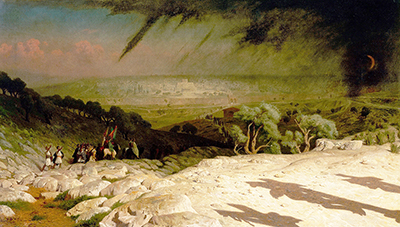
Three crosses cast long shadows across barren ground, but the crucified bodies are outside the frame. Soldiers and spectators descend towards Jerusalem beneath a darkening sky. Jean-Léon Gérôme's Jerusalem represents the Crucifixion through what it withholds.
Painted in 1867 and exhibited at the Salon in 1868, the work is also known as Golgotha, Consummatum est and The Crucifixion. Each title shifts emphasis: place, Christ's final words or the biblical event. The principal institutional title, Jérusalem, directs attention towards the distant city and the landscape carrying the aftermath.[1]
Gérôme had become famous for precise historical reconstruction, but here his most powerful invention is absence. The crosses exist only as shadows. The viewer stands where the event has occurred yet cannot inspect Christ's body.
At a Glance
- ArtistJean-Léon Gérôme
- Principal titleJérusalem / Jerusalem
- Alternative titlesGolgotha, Consummatum est; The Crucifixion
- Date1867
- MediumOil on canvas
- Dimensions82 × 144.5 cm (32 5/16 × 56 7/8 in.)
- CollectionMusée d'Orsay, Paris
- AccessionRF 1990 7
- ExhibitionParis Salon, 1868, no. 1072[1]
The Crucifixion outside the Frame
Traditional Crucifixion paintings place Christ's body at the centre. Gérôme reverses that hierarchy. The cross and figure extend beyond the viewer's field; their shadows enter from the foreground edge.
The central shadow is flanked by two others, identifying Christ between the two crucified men described in the Gospels. Their elongated forms lie across the ground like dark evidence.
This arrangement makes the viewer's position unsettling. We stand close to the crosses—perhaps beneath or behind them—while looking away towards the departing crowd. The event is physically near but visually inaccessible.
The omission prevents direct contemplation of Christ's expression and wounds. Gérôme replaces devotional encounter with inference. We know what casts the shadows because the title and Christian visual tradition complete what the canvas refuses to show.
The Musée d'Orsay describes this as a powerful visual ellipsis and compares it to an “off-camera” effect.[1] The analogy is useful because the decisive subject occupies a space adjacent to the image. It should not be turned into a claim that Gérôme copied cinema, which did not yet exist.
Shadows as Evidence
A shadow proves that something blocks the light, but it does not reveal the object fully. Gérôme exploits that difference. The crosses are simultaneously present and absent.
The shadows also transform the ground into a second picture. Dark lines create a solemn geometry across the rough foreground. Unlike painted bodies, they contain almost no detail. Their power comes from reduction.
Light must be low enough to stretch them towards the city. At the same time, a storm-darkened sky suggests the supernatural darkness associated with the Crucifixion narratives. Gérôme joins natural observation and biblical atmosphere without illustrating one verse literally.
The result changes the viewer's labour. Instead of reading faces gathered around Christ, we read traces: shadow, movement, weather and the crowd's retreat. The painting makes aftermath into a form of belief.
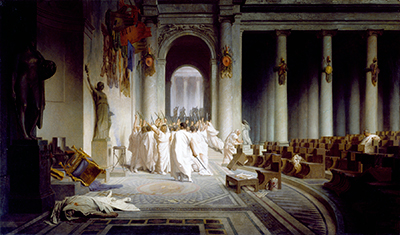
This strategy connects Jerusalem to Gérôme's other history paintings of absence. The Death of Caesar shows the killers leaving a body; The Execution of Marshal Ney shows the squad already gone. Here even the central body has been withheld.
The Crowd Leaves Golgotha
The human action unfolds at middle distance. Figures move away from the execution site towards the city. Soldiers on horseback and people on foot form a long, descending rhythm.
Because faces are too distant to read clearly, the crowd is understood through collective movement. They have witnessed the event and are returning to ordinary space. The painting's emotional force lies partly in that transition: catastrophe remains behind while social life continues.
A few figures may turn or linger, but Gérôme avoids one dominant mourner. The Gospel story contains distinct followers, soldiers and spectators; the canvas compresses them into a departing population.
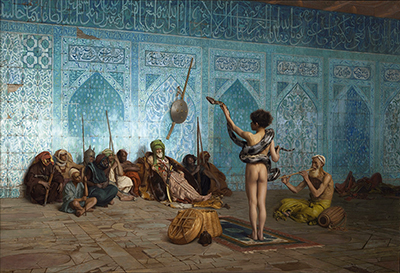
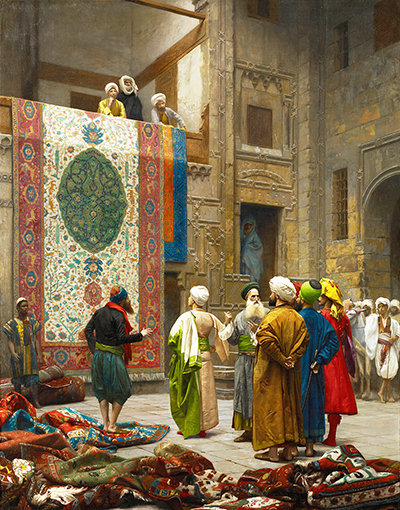
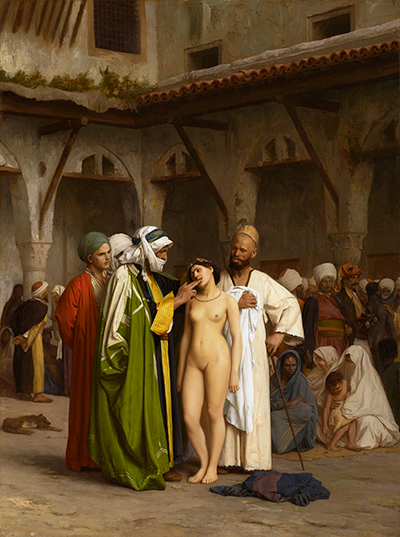
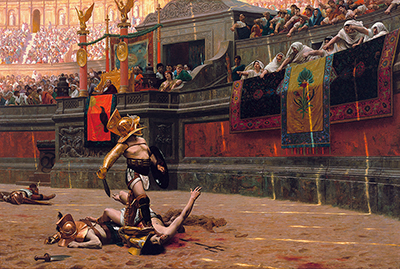
This distance differs from the privilege Gérôme often gives his audiences. In arena and market scenes, viewers can inspect exposed bodies closely. In Jerusalem, we are denied both Christ's face and the crowd's individual reactions.
The restriction can be read as reverence, narrative daring or emotional coldness. Contemporary critics did not agree, and the Musée d'Orsay notes that the break with established iconography drew some of the harshest criticism of Gérôme's career.[1]
Travel, Topography and Historical Ambition
Gérôme travelled in the Holy Land and sought topographical conviction in biblical painting. The distant Jerusalem and rocky terrain draw authority from that experience.[1][2]
Travel cannot make the biblical event witnessed. Nineteenth-century landscape, archaeological information and scripture have been combined to imagine first-century Golgotha. The work's “truth” lies in the persuasive arrangement of sources, not direct access to the Crucifixion.
This distinction matters because Gérôme's finish can make reconstruction appear inevitable. A particular hill, city profile and light condition may look exact even when their relation to the event is interpretive.
The Musée d'Orsay connects the painting's historical and topographical ambition to the naturalised view of Christ developed in Ernest Renan's Vie de Jésus of 1863.[1] Renan's controversial book treated Jesus within human history and the landscape of the Holy Land, challenging traditional theological accounts.[3]
Gérôme's painting is not an illustration of Renan. It belongs to the same nineteenth-century effort to make biblical history physically imaginable through place, weather and human aftermath.
Consummatum est
One alternative title, Consummatum est, is the Latin Vulgate form of Christ's words in John 19:30, commonly translated “It is finished.” The phrase fixes the scene after death rather than during suffering.
That timing explains the departing crowd. The decisive action is complete. The long shadows become the visual equivalent of a final statement: the event continues to occupy the world after movement has ceased.
The title Golgotha places emphasis on the execution site. Jerusalem looks outward towards the city. The Crucifixion names the unseen action. Rather than choosing one correct title and discarding the others, the manuscript can use them to show how the painting's meaning has been framed.
The current Musée d'Orsay record preserves these variants and controls the accession as RF 1990 7.[1] That number is important because older derivative pages can repeat incorrect identifiers.
Landscape as Religious Drama
The sky carries much of the emotion usually assigned to faces. Heavy cloud and an unusual, failing light transform the landscape into a participant.
Gérôme does not abandon naturalism for a visible miracle. The storm can be read as weather while recalling sacred darkness. That double status allows the picture to address religious and historically minded viewers at once.
The city remains distant and compact, an inhabited world beyond the site of death. Between crosses and Jerusalem, the crowd forms a link from sacred event to human history.
The horizontal format strengthens this relation. The eye moves from shadowed foreground through departing figures to city and sky. Christ is vertically above or behind us, but the painting directs vision across the world affected by his death.
Reception and Modern Afterlife
The absence of Christ challenged expectations at the 1868 Salon. Viewers accustomed to a devotional centre encountered landscape, shadows and backs instead. Some critics considered the device too calculated or theatrically novel.[1]
Later audiences have often found the omission modern, especially because screen storytelling made off-frame action familiar. The comparison should remain a way of describing composition, not a historical influence running backwards.
Gérôme's image nevertheless participated in the development of a visual culture that valued framing, suspense and the withheld event. His works circulated through reproduction and helped make history legible as a sequence of selected views.[2]
Jerusalem remains striking because it trusts the audience to construct the subject. What Gérôme declines to paint becomes more vivid through absence.
Artist Up Close
Begin at the lower edge and follow each shadow towards its unseen source. The painting places your body closer to the crosses than to the crowd.
Then trace the procession towards Jerusalem. Notice how distance removes individual expression and turns witnesses into a historical movement.
Finally, look at the sky. Gérôme uses changing light to connect physical landscape with the sacred meaning supplied by the story.
Frequently Asked Questions
Discussion
Which detail in Jerusalem most changes how you read Gérôme's balance of spectacle, evidence and invention?
Reader Insights
Which detail in Jerusalem most changes how you read the scene's balance of evidence, staging and spectacle?
Set this page beside the Gérôme biography, paintings overview and related works to test how travel, studio practice and the Salon shaped the image.
What should a careful modern reading preserve, question or leave uncertain when looking at this work today?
Join the Conversation
Share a thoughtful observation about Jerusalem, Gérôme's method, or the wider context that would help another reader look more carefully.
References
- Musée d'Orsay. “Jérusalem.” Collection record, RF 1990 7 View source.
- Musée d'Orsay. “The Spectacular Art of Jean-Léon Gérôme (1824–1904).” Exhibition presentation View source.
- Ernest Renan. Vie de Jésus. Paris: Michel Lévy frères, 1863. Bibliothèque nationale de France, Gallica View source.