 by Tom Gurney
Tom Gurney BSc (Hons) is an art history expert with over 20 years experience
Published on June 19, 2020 / Updated on August 21, 2026
Email: tomgurney1@gmail.com / Phone: +44 7429 011000
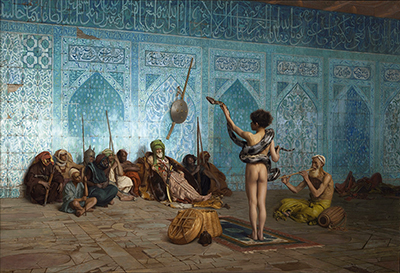
A naked boy stands with his back to us, a large snake wound around his body. Beside him, an older man plays a flute. Across the tiled room, armed men watch. Jean-Léon Gérôme paints every surface—the boy's skin, the snake's scales, woven rugs, metal weapons and brilliant wall tiles—with an assurance that makes the scene look observed.
Yet this room never existed in the form Gérôme gives it. Its tiled wall comes from Topkapı Palace in Istanbul, its patterned floor recalls a mosque in Cairo, and its performance belongs to another cultural setting. Photographs, travel studies and objects gathered in a Paris studio allowed the painter to join these fragments so seamlessly that invention takes on the authority of evidence.[1][3]
Painted around 1879, Snake Charmer is therefore more than a feat of illusion. It is a painting about looking: the seated men watch the exposed child, the external viewer watches them, and Gérôme's controlled finish makes that access seem effortless. The picture later became famous as a cover image for Edward Said's Orientalism, although Said did not discuss it in the book. Its visual power and politics have been debated together ever since.[1][5][10]
At a Glance
- ArtistJean-Léon Gérôme
- TitleSnake Charmer
- Datec. 1879
- MediumOil on canvas
- Dimensions82.2 × 121 cm
- Signature
J.L GEROME., below centre near the left edge - CollectionSterling and Francine Clark Art Institute, Williamstown, Massachusetts
- Accession1955.51[1]
What Is Happening in the Painting?
The young performer occupies the centre of a shallow, enclosed space. He stands on a small rug with his weight shifted onto one leg. The snake coils around his waist and rises diagonally across his back before bending over his shoulder. Because the boy faces away, we cannot read his expression. His body becomes the pale, uninterrupted vertical around which the darker, more intricately dressed audience is organised.
The seated musician at the right of the boy brings a flute to his lips. A large wicker basket, presumably used to carry snakes, rests nearby. The performance is thus legible without a theatrical crowd or broad gesture: snake, instrument, basket and attentive spectators establish the event.
The audience consists of about ten adult men seated or crouched against the wall. Their garments, weapons and headgear vary. A turbaned figure at the centre appears to command particular status, while rifles, swords, a round shield and an unusual helmet give the gathering a military character. It is tempting to assign every man a precise ethnicity or rank, but the evidence does not support that confidence. Gérôme drew on travel studies, costumes and objects kept in or available to his studio, assembling a range of visual types rather than recording one securely identified company.[1]
Almost everything important happens through attention. The flute player looks towards the performer. The men across the room face him from different angles. Some sit upright; others lean, fold their arms or rest against the wall. Gérôme varies their poses enough to make them look individually observed, yet their collective gaze binds them into a single audience.
That order is reinforced by the room. The tiled wall forms an immense decorative screen behind the men, and the low viewpoint keeps figures, weapons and ornament compressed into horizontal bands. The boy is isolated in front of them like a figure on a stage. His nakedness is not simply a detail within the performance: it is the most emphatic visual contrast in the painting.
The Viewer's Place Among the Spectators
Gérôme positions us directly behind the child. We see the surface of his back and the snake across it, while the men enjoy the frontal view that the painting withholds from us. This makes the composition more complicated than an uncomplicated display of a body. The viewer is both close to the boy and separated from his face; both invited into the room and made aware that other people are already looking.
The external viewer does not stand in the same physical place as the painted spectators, but the picture links their acts of attention. We can inspect the men while sharing their unobstructed access to the performance. No figure decisively turns to challenge our presence. Gérôme has removed the social friction that an outsider entering such a room would encounter.
The polish of the painting helps naturalise that privileged viewpoint. There is little visible brushwork to remind us that the room has been manufactured on canvas. Materials seem to identify themselves: hard tile, soft flesh, patterned textile, plaited basket, metal armour. Because the surfaces appear so knowable, the viewer may extend the same confidence to the culture and event being represented.
This is one reason Snake Charmer has become a central example in discussions of Orientalism. Its politics do not sit outside its technique as an objection attached after the pleasure of looking. The technique organises that pleasure. Gérôme's clarity allows a Western audience to occupy an impossible vantage point and experience a constructed encounter as immediate visual knowledge.[6]
Why Is the Boy Nude?
The boy's nudity has prompted different, sometimes competing explanations. One historical context comes from the French writer and traveller Maxime du Camp. Describing a snake charmer whom he encountered in Cairo during his journey of 1849–51, du Camp wrote that the young performer removed his clothes to disprove the charge that a concealed device or trick made the act possible. Snake charming was practised in nineteenth-century Egypt, and the Clark catalogue finds this account meaningfully comparable to Gérôme's scene.[1]
That evidence helps explain why a performer might disrobe, but it does not prove that Gérôme illustrated du Camp's precise encounter. Nor does it convert the painting into an eyewitness record. The artist set an Egyptian practice within a room assembled substantially from Turkish palace architecture, then presented the event to a European and American art market.
Historical explanation also does not end the ethical question. Gérôme makes the exposed performer a child or adolescent surrounded by clothed, armed adults. The boy cannot meet our gaze, and the composition grants spectators—inside and outside the picture—sustained access to his body. Scholars have consequently discussed erotic and homoerotic dimensions of the work as well as its Orientalist framing.[1][6]
These readings need not erase one another. A practice intended to demonstrate that no trick was hidden could supply the narrative reason for nudity, while Gérôme's choice of viewpoint, age contrast and audience could still sexualise the display for the painting's buyers. Calling the nudity merely documentary ignores the composition's power relations; treating it only as coded desire flattens its historical context. Meaning lies in both the practice and the way Gérôme asks others to look.
A Room That Never Existed
The tiled interior feels specific enough to be located, and it has often been described as a mosque. That identification is doubtful. The armed audience and entertainment would be improbable in a sacred space, and Gérôme's experience of Islamic buildings makes a simple mistake less convincing than deliberate synthesis. The Clark catalogue cautiously raises the possibility of a leader's quarters but concludes that the room's exact function remains uncertain.[1]
What can be identified are its components. Walter B. Denny traced the arch-shaped blue-and-white tiles across the rear wall to three panels in the Golden Passage, or Altın Yol, within the harem of Topkapı Palace in Istanbul. The panels had originally been associated with a bath chamber. Gérôme also drew part of the long inscription near the top of the painting from the Golden Passage, then extended it with material from the Baghdad Kiosk elsewhere in the palace.[1]
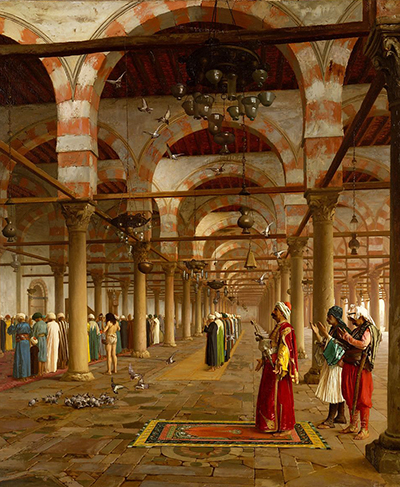
The floor belongs to a different source geography. Its pattern closely resembles the floor in Gérôme's Prayer in the Mosque of 1871, a painting based on the mosque of Amr in Cairo. An Egyptian performance, Ottoman palace tiles and a Cairo floor thus meet inside one convincing enclosure. The combination does not document a building; it manufactures one.
Calling the room fictional does not make every element false. Real objects and architectural records gave the invention density. The tiles retain histories, languages and original functions; the floor has a visual source; the helmet and shield recur because physical props could be rearranged in the studio. What changes is the relationship among the fragments.
The result is a form of pictorial authority built from displacement. Architectural decoration connected with Ottoman royal and bathing spaces becomes the backdrop for an Egyptian popular performance. Sacred text becomes part of a visual atmosphere. Weapons from different contexts create a generalized audience of power. A viewer unfamiliar with the sources is likely to read the accumulation as proof that Gérôme has shown one authentic place.
Tracing those sources is therefore not pedantry. It reveals how the “reality effect” works. The more persuasively each fragment is rendered, the less likely the combination is to be questioned.[1][3]
The Photograph Behind the Wall
Gérôme had travelled to Constantinople and Egypt, and he sometimes recorded buildings directly. Access to the private harem spaces of Topkapı Palace, however, was restricted. Modern scholarship has identified a more likely route by which the Golden Passage entered Snake Charmer: a black-and-white photograph by the Istanbul firm Abdullah Frères.[1][3]
The rare albumen print known as Interior of Topkapi Palace, made around 1865, shows the same stretch of tiled wall from approximately the same angle used in the painting. The correspondence is strong enough for the photograph to be treated as an almost certain source. Pera Museum's account of Gérôme's cultural exchanges likewise places Abdullah Frères photographs at the centre of his reconstruction of the Golden Passage and Baghdad Kiosk.[4]
Photography did not mechanically determine the finished picture. It supplied an organised record of pattern, value and perspective that Gérôme could select, extend and recolour. The differences are instructive. The original tiles contain more red than appears in the painting, a feature difficult to recover from a monochrome print. Gérôme retained a predominantly blue-and-white harmony that makes the wall feel continuous and cool.
The photograph also helps explain the inscriptions. Only six inscribed cartouches are visible in it. Where visual information runs out towards the right of the painted wall, Gérôme's script becomes less reliable and eventually appears invented. The boundary between record and imagination can almost be followed across the composition.[1]
This use of photography complicates any simple opposition between academic tradition and modern technology. Gérôme's finish can look old-fashioned beside Impressionism, yet this apparently historic world depended on travel photography, reproducible images, collecting, dealing and the movement of objects between Istanbul, Paris and international buyers. Modern media helped him make timelessness believable.
Are the Inscriptions Meaningless?
The inscriptions have frequently been dismissed as decorative nonsense. Detailed comparison with the Topkapı tiles shows something more revealing: the painting moves from considerable accuracy to partial comprehension and then invention.[1]
In the leftmost arch-shaped panels, Gérôme made a serious attempt to copy Persian verse. Two cartouches are close to their originals, even preserving a small tulip that pierces one character, although some letters and most diacritical marks disappear. In the next panel, one cartouche remains reasonably faithful while another merges separate short strokes into long curling forms. Farther to the right, decorative fields are rearranged and the written forms lose correspondence with known panels.
The direction of this change is significant. A French reader habitually moves from left to right and would encounter the most accurate inscriptions first, followed by increasingly script-like invention. Someone reading Persian would normally approach from the other direction and encounter the least convincing passages first. There is no need to assume a calculated deception to recognise how the composition privileges one audience's habits of seeing.[1]
The upper band is also more than ornament. Gérôme combined material from the Golden Passage with a Qur'anic frieze on the Baghdad Kiosk. Scholars have identified substantial passages from Qur'an 2:256 and the beginning of 2:257. Some stretches were copied quite accurately, though not consistently throughout.[1]
The arch-panel verses are Persian; the Qur'anic passages are Arabic. The languages use related script traditions but are not interchangeable. Gérôme knew that the writing communicated meaning, yet he could not fully read or transcribe it. He copied enough to establish authority, altered what he could not recover, and subordinated text to visual unity. This mixed result—neither random marks nor transparent preservation—is more informative than the label “gibberish.”
Travel, Objects and the Paris Studio
Gérôme's journeys mattered. They provided sketches, memories, encounters and access to a growing photographic culture. But the finished paintings were normally acts of reconstruction in Paris rather than reports completed before their subjects.
The spectators in Snake Charmer exemplify this practice. Their varied clothing and equipment need not indicate one documented gathering. Studies made during travel could be combined with textiles, weapons and armour available in the studio. Caroline Williams identified the unusual helmet worn by a man at the left as a Persian object collected by Gérôme's brother-in-law Albert Goupil. The same helmet and the nearby round shield appear in other Gérôme paintings, where their settings differ.[1]
Reuse exposes the studio's hidden continuity. To the viewer, the helmet functions as evidence for this particular room. To the artist, it was a portable form whose detail could increase the credibility of several imagined worlds. The object was real; the social relationship it seems to certify was made for the picture.
This does not make travel irrelevant or every element interchangeable. On-site knowledge helped Gérôme recognise what a photograph, garment or architectural fragment could contribute. The problem begins when exact detail is mistaken for an exact event. Snake Charmer contains observation, mediation and fantasy at the same time.
Orientalism gave that synthesis a market and a hierarchy. European audiences could acquire images of restricted, distant or socially inaccessible spaces. Islamic architecture and objects circulated through photographs, collections, exhibitions and dealers, while colonial and imperial power shaped the conditions of travel and looking. Ottoman and Middle Eastern photographers, craftspeople and intermediaries were active participants in that circulation, not invisible suppliers. Yet their agency did not make the exchange equal or give them control over the meanings Gérôme's painting produced.[3][7]
How Gérôme Built the Illusion
Technical examination shows that the painting's precision began before its final colour. Gérôme worked on a fine-weave linen canvas with at least twenty-two threads per centimetre. Its white, even ground was probably commercially prepared, giving him a bright, regular base for clean modelling and patterned detail.[1]
The underdrawing appears to have been made with thinned black ink and a nibbed pen. In the floral tile forms, lines sometimes run in paired tracks, the trace left by a pen point. Some remain visible beneath the colour; others were reinforced above it. This graphic framework was especially well suited to ornament whose authority depended on repeated curves and controlled boundaries.
A preliminary grey layer lies below the tiled wall, and conservators detected what is probably a brown sketch beneath the figures. Gérôme then applied the final paint in small, blended strokes. Some shadows and tonal transitions use marks resembling hatching, as though the habits of drawing continued through the painted surface.
There is remarkably little reworking. The principal detected change occurs in the calves of the cross-legged boy at the left. That does not mean the composition sprang fully formed from the painter's mind. It means selection and adjustment had largely been settled before or during the careful drawing stage.
The method helps explain the picture's stillness. Broad painterly incident would compete with the patterned wall and invite attention to the canvas as a made object. Gérôme instead suppresses conspicuous touch. The eye moves across distinct materials while the act of painting recedes. His world appears finished before we arrive.
Conservation has shaped what viewers see today. In 1977 a failing 1942 starch-paste lining was removed, the canvas received a wax-resin lining, and discoloured varnish was taken away. The surviving ground, ink and paint still make Gérôme's construction unusually legible.[1]
From Edward Said's Cover to Linda Nochlin's Analysis
In 1978 a reproduction of Snake Charmer appeared on the cover of Edward W. Said's Orientalism. The association became so strong that the painting can seem like an illustration chosen and analysed by Said. In fact, he did not mention Gérôme or the canvas in the book's text.[1]
The distinction is important. Said examined Orientalism as a broad Western system of knowledge and authority: a way in which many different texts and institutions constructed “the Orient” as an object to be described, managed and possessed.[5] His framework made Gérôme's picture newly visible as a cultural argument, but the detailed art-historical application came from later writers.
Linda Nochlin's 1983 essay “The Imaginary Orient” was especially influential. She asked viewers to distrust the apparent neutrality of Gérôme's naturalism. Exact finish did not simply reflect a ready-made reality; it produced meanings. She drew attention to erotic spectacle, to the Western viewer's secure access and to the apparent absence of modern European colonial presence from scenes that colonial power had helped make available.[6]
In Snake Charmer, the painted audience appears enclosed within its own self-sufficient world. No tourist, photographer, dealer or imperial official enters the room. The Western buyer is absent as a figure but present as the person for whom the view has been arranged. History disappears behind the sense of a timeless, mysterious encounter.
Nochlin's essay did not end interpretation. Denny's identification of the Topkapı tiles, Williams's work on the objects, Roberts's study of photographs and Ottoman networks, and Lees's close account of the inscriptions gave the painting a more exact material history. Their findings make it possible to distinguish Persian from Arabic text, palace wall from Cairo floor, known photograph from invented extension.[1][3]
These discoveries do not refute the critique of Orientalism by proving that Gérôme sometimes copied accurately. They show why accuracy was effective: a real fragment can encourage belief in an imaginary whole. The painting's authority is constructed, but not carelessly constructed.
Provenance and the Reversal of Gérôme's Reputation
Gérôme sold Snake Charmer to his dealer and publisher Goupil on 24 August 1880. Goupil sold it to the New York collector Albert Spencer that October. When Spencer's collection was auctioned in 1888, Alfred Corning Clark bought the painting for $19,500, a substantial price that reflected Gérôme's international prestige.[1]
Clark lent the canvas to the World's Columbian Exposition in Chicago in 1893, where it appeared under the French title Le Montreur de Serpents. After his death, his widow Elizabeth Scriven Clark inherited it. She lent it to the Metropolitan Museum of Art in 1897–98 and later sold it through Schaus Art Galleries around the turn of the century. It subsequently belonged to August Heckscher and then to his wife, Virginia Henry Curtiss Heckscher.[1]
The painting returned to market at Parke-Bernet in January 1942. Durand-Ruel, acting for Alfred's son Robert Sterling Clark, acquired it for just $500. Comparing prices from 1888 and 1942 is not a precise measure of value across changing economies, but the fall from $19,500 is too dramatic to miss. Gérôme's academic finish and narrative spectacle, once admired internationally, had become deeply unfashionable within a modernist history centred on innovation, visible touch and the avant-garde.
Sterling Clark's purchase was personal as well as contrarian. He remembered the painting from his parents' home and still regarded it as a masterpiece of its kind. In 1955 it entered the Sterling and Francine Clark Art Institute as accession 1955.51.[1][2]
The ownership history compresses a larger history of taste. The painting moved from Gérôme's successful dealer network to a Gilded Age American home, from celebrated exposition picture to market discard, and then into a museum whose scholarship would help make it central to the reassessment of academic art and Orientalism. Its later fame did not simply restore the admiration of 1888. It changed the questions viewers asked.
Snake Charmer at the Met in 2026–27
As of August 2026, Snake Charmer is temporarily on loan to the Metropolitan Museum of Art for Orientalism: Between Fact and Fantasy, an exhibition open through 28 February 2027. The Met includes the painting in a section titled “Hard and Soft Power: Orientalism and Design,” where it appears in conversation with the 1978 edition of Said's book, Islamic works of art and helmets once owned by Gérôme.[7][8]
That installation makes the painting's networks visible. The viewer can consider a represented helmet beside actual objects, a famous cover beside the canvas it reproduced, and Gérôme's imaginary interior beside the histories of Islamic design it rearranged. Such juxtapositions resist the idea that Orientalism was produced by painters alone.
The exhibition's broader framework connects travel, collecting and technological change to colonial and imperial power. It also attends to European, American, Ottoman and Middle Eastern artists, patrons, photographers, collectors and dealers whose actions moved images and objects across borders.[7][9] This expanded field matters for Snake Charmer. Abdullah Frères were not simply a neutral optical instrument for a French painter: their photographs participated in a modern Ottoman visual culture. The Topkapı tiles had histories before they became a backdrop. The painting's American collectors also shaped its status.
Bringing those agents into view does not dissolve unequal power. Gérôme still controlled the final combination, and his Western buyers received the imagined access it offered. The richer history helps identify how that authority was assembled and whose work it absorbed.
Why the Painting Still Matters
Snake Charmer does not allow visual mastery and cultural criticism to be cleanly separated. Its finish makes displaced architecture, partly understood writing and studio types into a believable encounter. Beauty is not an innocent layer placed over its politics; it is how the politics of looking becomes pleasurable.
The painting also warns against two opposite shortcuts. One is to accept precision as proof of documentary truth. The other is to call the whole scene fantasy and stop looking at its sources. Gérôme copied some inscriptions closely and invented others. He used a real photograph but altered its colour and extent. He represented a documented Egyptian practice within an impossible Turkish-Egyptian room. The work operates in the tension between those facts.
Its critical history is equally layered. Said supplied a transformative framework without analysing the picture; Nochlin examined its viewing structure; later scholars reconstructed its architectural, linguistic and photographic sources; and current museum interpretation places it among objects, technologies and makers moving through imperial networks. The boy and snake remain central, but so do the people who look at them, the photograph behind the tiles, the imperfectly copied writing and the viewer outside the frame. The painting's deepest subject may be the confidence with which seeing turns into believing.
Artist Up Close
Begin at the left end of the tiled wall. The inscriptions there retain close contact with actual Persian verse panels. Move slowly to the right and watch letters stretch, merge and become increasingly invented. The wall records the changing reach of Gérôme's information.
Next, compare the boy with the audience. He is exposed, upright and seen from behind; they are clothed, seated and granted the frontal view. Notice how the small rug isolates him and how weapons reinforce the unequal distribution of power.
Finally, look for the labour hidden by the smooth finish. Pen-like contours organise flowers in the tiles, and small blended strokes model bodies and cloth. Gérôme makes the act of construction difficult to see, but technical examination shows that drawing governs the illusion.
Frequently Asked Questions
Discussion
Which detail in Snake Charmer most changes how you read Gérôme's balance of spectacle, evidence and invention?
Reader Insights
Which detail in Snake Charmer most changes how you read the scene's balance of evidence, staging and spectacle?
Set this page beside the Gérôme biography, paintings overview and related works to test how travel, studio practice and the Salon shaped the image.
What should a careful modern reading preserve, question or leave uncertain when looking at this work today?
Join the Conversation
Share a thoughtful observation about Snake Charmer, Gérôme's method, or the wider context that would help another reader look more carefully.
References
- Sarah Lees. “Jean-Léon Gérôme, Snake Charmer.” In Sarah Lees, ed., Nineteenth-Century European Paintings at the Sterling and Francine Clark Art Institute, vol. 1, cat. 154, pp. 367–71. Williamstown, MA: Sterling and Francine Clark Art Institute, 2012 View source.
- Clark Art Institute. “Clark Brothers Collect: Snake Charmer.” Collecting-history exhibition resource View source.
- Mary Roberts. “Gérôme in Istanbul.” In Scott Allan and Mary Morton, eds., Reconsidering Gérôme, pp. 118–34. Los Angeles: J. Paul Getty Museum, 2010 View source.
- Pera Museum. “Jean-Léon Gérôme: Cultural Interactions in the Age of Change.” Museum blog feature View source.
- Edward W. Said. Orientalism. New York: Pantheon Books, 1978
- Linda Nochlin. “The Imaginary Orient.” Art in America 71, no. 5 (May 1983): 118–31, 187–91. Reprinted in The Politics of Vision, pp. 33–59. New York: Harper & Row, 1989
- The Metropolitan Museum of Art. “Orientalism: Between Fact and Fantasy.” Exhibition overview, 2026–27 View source.
- The Metropolitan Museum of Art. “Inside the Exhibition: Orientalism: Between Fact and Fantasy.” 2026 View source.
- Deniz Beyazit, Maryam Ekhtiar and Asher Miller. Orientalism: Between Fact and Fantasy. New York: The Metropolitan Museum of Art, 2026 View source.
- Letha Ch'ien. “Jean-Léon Gérôme, Snake Charmer.” Smarthistory, 2025 View source.