


 by Tom Gurney
Tom Gurney BSc (Hons) is an art history expert with over 20 years experience
Published on June 19, 2020 / Updated on October 11, 2026
Email: tomgurney1@gmail.com / Phone: +44 7429 011000
Bird on Money by Jean-Michel Basquiat: introduction
Jean-Michel Basquiat's Bird On Money brings a dark, sharply outlined bird into a wide field of blue, yellow, cream and restless drawing. The bird suggests Charlie Parker, the jazz saxophonist known as “Bird” or “Yardbird.” Around it, words and marks complicate a straightforward tribute. “GREEN WOOD” appears at the left, while a yellow area at the right carries Spanish words usually transcribed as “PARA MORIR.” The title adds money to the encounter between a musician, a living creature and language about death.[1][2][3]
The painting was made in 1981, earlier than several of Basquiat's better-known Parker-related works. It does not need to be treated as a quick sketch of the jazz player's sound. Its physical size, strong colour areas, named bird and writing create a visual problem of their own: how can a musician be honoured in an image that also asks the viewer to think about mortality and value?[1][4]
At a glance
- ArtistJean-Michel Basquiat
- TitleBird On Money, capitalised this way by the Rubell Museum
- Date1981
- MaterialsAcrylic and oil on canvas
- Dimensions66 × 90 in. (167.6 × 228.6 cm), height × width
- CollectionRubell Museum / Rubell Family Collection; acquired in 1981
- Current displayThe collection record does not establish whether the painting is on view now
The Rubell Museum's collection entry and its 30 Americans checklist agree on the object data. A 2012 Chrysler Museum publication and a 2024 Gagosian interview repeat the acrylic-and-oil description. These sources matter because reproductions and older summaries sometimes call the work crayon on canvas. The institution that acquired the painting in its year of making provides the stronger label for this object. An image or label on a commercial print may refer to a different physical item.[1][5][6]
This work in Basquiat’s career
Contents
- The bird at the centre
- “Green Wood” and words about dying
- What does “money” do in the title?
- An early Parker work among later tributes
- Collection, exhibitions and seeing the work
- Looking again
The bird at the centre
The bird is the main recognisable shape in a field crowded with writing, loops, boxes, arrows and abrupt changes of colour. It has a dark body and a white outline that pulls it forward from the blue around it. The form is too spare to serve as a natural-history drawing of a particular species. Its importance comes from the title and Parker's nickname, which let an animal shape stand for a named human subject without becoming a conventional likeness.[2][3]
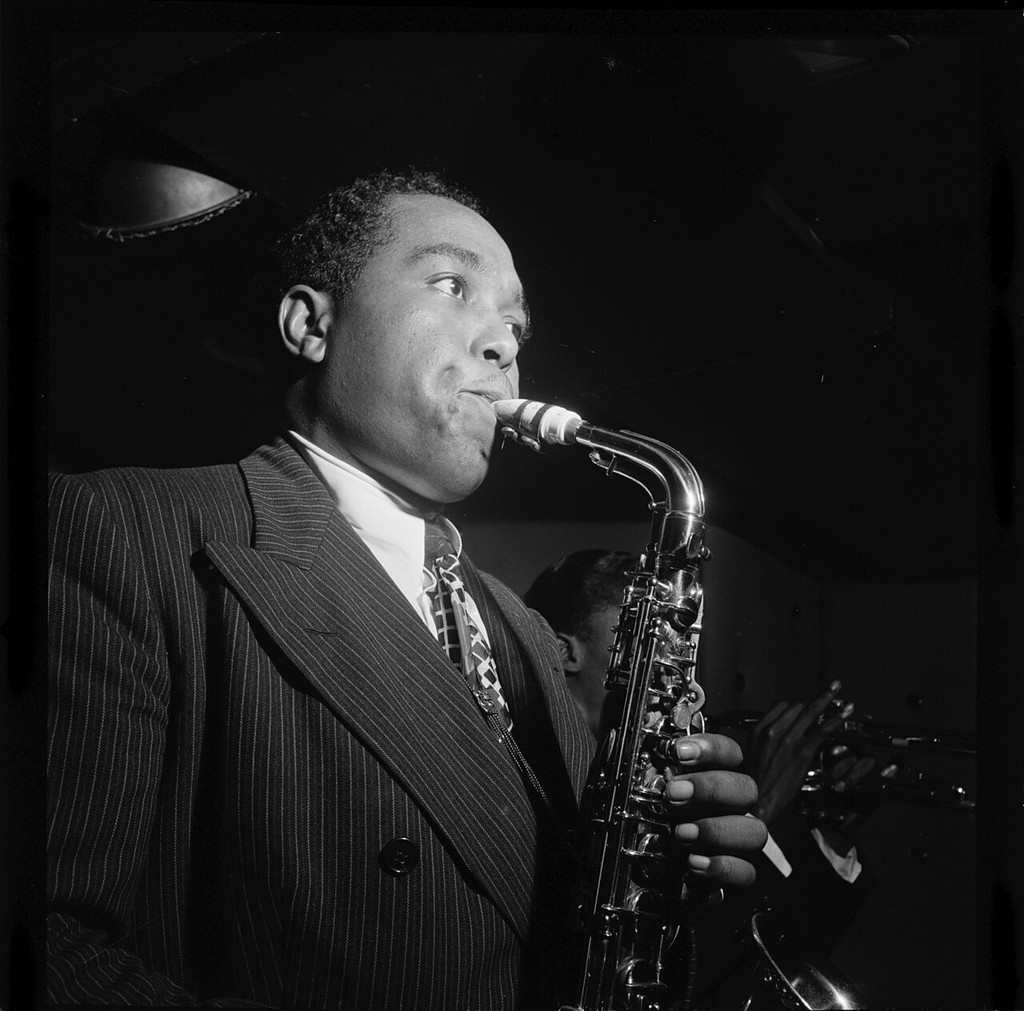
The Library of Congress identifies Charlie Parker as an alto saxophonist and uses both “Bird” and “Yardbird” for him. His recordings and improvising helped shape bebop. The painting's bird can therefore be read as a deliberate musical reference, but it is a visual construction, not a diagram of Parker's phrasing or a picture of an actual performance. The title helps make the connection, while the rest of the canvas keeps the subject broader than a single nickname.[3]
Basquiat did not need to paint a saxophone or a realistic face to bring Parker into the work. The substitute figure is striking because it is both readable and incomplete: viewers can name “Bird,” then must deal with the many marks that surround it. The painting's black, white and blue centre attracts the eye first. Blocks of yellow and cream demand a second look at the edges, where words carry their own associations. Honouring Parker here is an act of naming and placing as much as an act of portraiture.[1][2][4]
The bird's central position should not make the surrounding drawing look like meaningless noise. Dense white loops cross dark fields; red and orange marks appear among the blues; the pale lower-left area holds writing. None is merely an illustrated staff of music. The work can feel energetic or syncopated to a viewer, but “it looks like jazz” is too vague to explain these particular relationships. A more careful description asks which marks direct the eye, which words can be read, and which connections have independent evidence.[2][4]
“Green Wood” and words about dying
“GREEN WOOD” is written in the lower-left region of the painting. It resembles the name of Brooklyn's Green-Wood Cemetery, where Basquiat was later buried. The cemetery's own archival account lists him among its notable interments. That later biographical fact can make the painted words feel startling, but the chronology is clear: the painting dates to 1981, while Basquiat died in 1988. The inscription is not evidence that he predicted his burial place or made a private declaration about his own death.[1][2][7]
The yellow block on the right contains words commonly rendered “PARA MORIR,” Spanish for “to die” or “in order to die,” depending on the sentence around it. Small reproductions do not settle every painted letter cleanly, so a published close-up or an authorised object image should decide the final transcription. The visible pairing of a death-related phrase and “GREEN WOOD” is enough to give the painting a mortality register without imposing a single allegory on the bird.[2]
Words on this canvas are also shapes. “GREEN WOOD” is not a caption printed beneath a detailed cemetery view. It is painted among boxes, lines and colour. The yellow field makes the right-hand phrase stand out but also contains gestural black marks. A viewer can read the language, step back to see its placement, and then ask how the two activities change each other. That movement between reading and looking is more revealing than assigning each word a fixed symbolic meaning.[2]
One error worth setting aside is the claim that Basquiat was born at Green-Wood Cemetery. The Rubell Museum's own biography says he was born in Brooklyn, New York. Green-Wood is a Brooklyn burial ground, and Basquiat's burial there belongs to his later history. Keeping birthplace, painted name and burial distinct avoids turning a real location into a false life story.[1][7]
The painting's language also resists a simple translation into biography. Spanish words appear in Basquiat's art, but the presence of Spanish here does not prove that this work is a direct message about his Puerto Rican mother or a coded diary entry. The phrase and its painted position are the evidence at hand. An account of family, language and identity can enrich the biography, while the specific marks in Bird On Money must still be read on their own terms.[2]
What does “money” do in the title?
The title offers a second named subject beyond the bird. Money can mean price, earnings, market value or exchange; those are different ideas. The title may prompt the viewer to consider what a revered Black musician's achievement was worth in a commercial culture. Jessica Beck, discussing Basquiat's jazz subjects in 2024, argues that he honoured musicians celebrated in Black communities while also registering the prejudice and social treatment they faced. Her broader curatorial account provides a way to ask about recognition and reward here, but it should be presented as her interpretation, not as Basquiat's written explanation of this one painting.[4]
The painting itself does not lay out a financial transaction in words. Its wide canvas joins a living emblem, death-related terms, energetic marks and the title's “money.” That juxtaposition is enough to open a question about value without claiming to know the exact answer. A viewer might see an image of artistic achievement measured in cash, or a warning that money cannot protect a celebrated life. These are possible readings of the same arrangement, not catalogue facts.[1][2][4]
Its collection history gives the title a separate, documented context. The Rubells state that they acquired the work in 1981. That is a fact about the object's early ownership, not a clue that the painting comments on its particular buyers. The distinction matters because Basquiat's later fame and market prices can too easily be projected back onto every word he painted. In 1981 he made a specific image whose early acquisition is known; the meaning of “money” still needs to be argued from the composition rather than the future art market.[1]
An early Parker work among later tributes
The Estate of Jean-Michel Basquiat identifies a group of jazz-related paintings that includes Charles the First, CPRKR, the two Discography works and Horn Players. Fondation Louis Vuitton's 2018 exhibition organised five works around Parker, including Charles the First and Horn Players. Bird On Money belongs to the same sustained interest, but its 1981 date makes it earlier than those 1982–85 examples. The sequence suggests return and variation, not the repetition of a fixed formula.[4][8]
In Charles the First, a three-panel painting from 1982, the Parker connection runs through the title, crowns and a written “CHEROKEE,” a tune bound to his musical history. Horn Players of 1983 names both Parker and Dizzy Gillespie within a larger triptych. Here the bird is the immediate visual cue, and the Green Wood and death-related language forms a different constellation. Comparing the works helps locate a recurring hero while keeping their formats and individual claims distinct.[3][4][8]
Beck's Gagosian discussion says jazz references became especially frequent in Basquiat's paintings in 1982–83. That general pattern does not erase the earlier 1981 work. It helps show why a date matters: Bird On Money is an early case in a developing practice. Its “Bird” is neither a rough rehearsal for a later masterpiece nor a stand-in for everything Basquiat thought about music. It is one resolved canvas with its own words, scale and history.[1][4]
The music and boxing guide follows Basquiat's named performers and athletes across separate works. Such a comparison can reveal a repeated concern with Black excellence, visibility and vulnerability. It works best when object details remain anchored: Parker is named indirectly here; he is one of two identified musicians in Horn Players; a boxer in another painting has a different body and career. The shared interest does not mean the paintings form one continuous story.[4][8]
Collection, exhibitions and seeing the work
The Rubell's 30 Americans checklist includes Bird On Money. The travelling exhibition later appeared at the Chrysler Museum of Art and the Frist Art Museum, whose materials identify the painting and the Rubell Family Collection. The exhibition placed it among works by multiple generations of African American artists. That context can shape reception, but it is a later curatorial setting, not a description of the circumstances in which Basquiat painted the canvas in 1981.[1][5][6]
The Rubell Museum's current website still lists the painting in its collection. It does not say on the object page whether Bird On Money is hanging in Miami, Washington or elsewhere today. Past loan records should not be mistaken for current display information. Anyone making a visit specifically to see it should check the institution's present gallery listings.[1]
The artwork has also circulated through licensed reproductions and merchandise. Such visibility can bring viewers to the painting, but a small product photograph cannot convey a canvas more than two metres wide, and a product's medium line describes that object for sale. The original remains an acrylic-and-oil painting. Its collection record, not a poster or puzzle listing, determines its identity.[1][4]
Looking again
Start with the bird's dark contour, then step outward to the blue, yellow and cream areas. Read “GREEN WOOD” at the left and the Spanish-looking phrase at the right without immediately converting either into a prophecy. Return to the title and ask what adding “money” changes. The answer may be less a single symbol than a relationship among a musician's name, the fragility of life and the ways a culture assigns value.[1][2][3][4]
The Rubell Museum collection record gives the strongest public object facts, while the Library of Congress Parker essay establishes the musician behind the nickname. Those sources clarify what can be known. The open questions belong to the painted relationships, which become richer when they are not reduced to a generic claim that energetic marks imitate jazz.[1][3]
Explore the Basquiat guide
Basquiat artworks in this guide
| Name | Date | Medium |
|---|---|---|
| Bird on Money | 1981 | Acrylic and oil on canvas |
| Boy and Dog in a Johnnypump | 1982 | Acrylic, oil stick and spray paint on canvas |
| Charles the First | 1982 | Acrylic and oil pastel on three canvas panels |
| Defacement (The Death of Michael Stewart) | 1983 | Acrylic and marker on wall-derived support (support records differ) |
| Dos Cabezas | 1982 | Acrylic and oilstick on canvas with wood supports |
| Dustheads | 1982 | Acrylic, oilstick, spray enamel and metallic paint on canvas |
| Eyes and Eggs | 1983 | Acrylic, oilstick and paper collage on hinged cotton drop cloth |
| Flexible | 1984 | Acrylic and oilstick on wood |
| God, Law | 1981 | Drawing; precise materials not established |
| Hollywood Africans | 1983 | Acrylic and oil stick on canvas |
| Horn Players | 1983 | Acrylic and oil stick on three canvas panels mounted on wood |
| In Italian | 1983 | Acrylic, oil stick and marker on canvas mounted on wood |
| Irony of a Negro Policeman | 1981 | Acrylic and oilstick on wood |
| King Alphonso | 1982–83 | Works on paper; suite materials vary by record |
| Obnoxious Liberals | 1982 | Acrylic, oilstick and spray paint on canvas |
| Pez Dispenser | 1984 | Acrylic and oil stick on canvas |
| Riding with Death | 1988 | Acrylic and oil crayon on canvas |
| Self-Portrait with Suzanne | 1982 | Oil pastel on paper (Paris dossier) |
| Self-Portrait | 1984 | Acrylic and oil stick on paper mounted on canvas |
| Untitled (Head), often called Skull | 1981 | Acrylic and oilstick on canvas |
| Slave Auction | 1982 | Crumpled-paper collage, oil pastel and acrylic on canvas |
| Untitled (Sugar Ray Robinson) | 1982 | Acrylic and oil pastel/oil stick on canvas (record terms differ) |
| Untitled (Titian) | 1982 | Oil stick on canvas |
| Trumpet | 1984 | Acrylic and oil paintstick on canvas |
| Tuxedo | 1982–83 | Silkscreen on canvas, edition of ten |
| Untitled (Rotterdam figure) | 1982 | Acrylic paint and oil stick on canvas |
| Untitled (Crown) | 1982 | Acrylic, ink and paper collage on paper |
| Untitled (Boxer) | 1982 | Acrylic and oil paintstick on linen |
| Untitled (Fallen Angel) | 1981 | Acrylic and oil pastel on canvas; aerosol appears in a second record |
Frequently Asked Questions
Jean-Michel Basquiat's Bird On Money brings a dark, sharply outlined bird into a wide field of blue, yellow, cream and restless drawing. The bird suggests Charlie Parker, the jazz saxophonist known as “Bird” or “Yardbird.” Around it, words and marks complicate a straightforward tribute. “GREEN WOOD” appears at the left, while a yellow area at the right carries Spanish words usually transcribed as “PARA MORIR.” The title adds money to the encounter between a musician, a living creature and language about death.[1][2][3]
The bird is the main recognisable shape in a field crowded with writing, loops, boxes, arrows and abrupt changes of colour. It has a dark body and a white outline that pulls it forward from the blue around it. The form is too spare to serve as a natural-history drawing of a particular species. Its importance comes from the title and Parker's nickname, which let an animal shape stand for a named human subject without becoming a conventional likeness.[2][3]
“GREEN WOOD” is written in the lower-left region of the painting. It resembles the name of Brooklyn's Green-Wood Cemetery, where Basquiat was later buried. The cemetery's own archival account lists him among its notable interments. That later biographical fact can make the painted words feel startling, but the chronology is clear: the painting dates to 1981, while Basquiat died in 1988. The inscription is not evidence that he predicted his burial place or made a private declaration about his own death.[1][2][7]
The Estate of Jean-Michel Basquiat identifies a group of jazz-related paintings that includes Charles the First, CPRKR, the two Discography works and Horn Players. Fondation Louis Vuitton's 2018 exhibition organised five works around Parker, including Charles the First and Horn Players. Bird On Money belongs to the same sustained interest, but its 1981 date makes it earlier than those 1982–85 examples. The sequence suggests return and variation, not the repetition of a fixed formula.[4][8]
Discussion
Which documented detail changes how you read Bird on Money?
Reader Insights
Start with a visible mark, material or word.
Check date, support and collection before comparing images.
Which reading still needs an object-specific source?
Join the Conversation
Share an observation grounded in the work or its documented history.
References and further reading
- Rubell Museum, Jean-Michel Basquiat collection entry and 30 Americans checklist, title, 1981 date, acrylic and oil on canvas, dimensions and acquisition year; the entry also says Basquiat was born in Brooklyn.
- Visual observation of the painting's major bird shape, coloured fields and prominent words, checked against the Rubell collection image; fine lettering and any claimed cemetery diagram remain to be verified at higher resolution.
- Library of Congress, Gerry Mulligan collection essay on Charlie Parker, Parker's “Bird”/“Yardbird” names, alto saxophone and bebop role.
- Gagosian Quarterly, Jessica Beck and Lee Mergner, “Jazz & Jean-Michel Basquiat” (6 November 2024), object caption and Beck's attributed account of musicians, recognition and Basquiat's musical practice.
- Frist Art Museum, 30 Americans exhibition history, Rubell Family Collection loan and Basquiat inclusion.
- Chrysler Museum of Art, March–April 2012 museum magazine, PDF p. 5, Bird On Money on the exhibition cover and object label.
- Green-Wood Cemetery, 2022 archival white paper, identifying Basquiat among those buried there; Rubell object entry in note 1 gives his Brooklyn birthplace.
- Estate of Jean-Michel Basquiat, 1980s chronology, jazz-related works; Fondation Louis Vuitton, 2018 Basquiat retrospective, Parker-focused group and dates of selected works.
