


 by Tom Gurney
Tom Gurney BSc (Hons) is an art history expert with over 20 years experience
Published on June 19, 2020 / Updated on October 11, 2026
Email: tomgurney1@gmail.com / Phone: +44 7429 011000
Charles the First by Jean-Michel Basquiat: introduction
Jean-Michel Basquiat's Charles the First is a 1982 painting across three tall canvas panels. Words and signs share the surface: crowns, crossed-out lettering, blue and yellow fields, a central white oval and the name “CHEROKEE” on the right. Its title sounds like a royal portrait, yet institutions also place the work among Basquiat's tributes to jazz saxophonist Charlie Parker. The tension is productive. Basquiat uses the language of kings, heads and music without turning the painting into a straightforward picture of one person.[1][2][3]
The original three-panel painting differs from the printed reproductions that circulate under its name. Its visible words are painted marks, whose spelling and deletion matter, rather than a literary quotation to be silently corrected. The result is a work about recognition and vulnerability that resists any one-symbol key.[1][3]
At a glance
- ArtistJean-Michel Basquiat
- TitleCharles the First
- Date1982
- MaterialsAcrylic and oil pastel on three canvas panels, in the Musée d'Art Moderne de Paris 2010 checklist
- Dimensions198.1 × 158.1 cm (about 78 × 62¼ in.), height × overall width
- CollectionEstate of Jean-Michel Basquiat, credited by Paris in 2010 and identified as owner by Gagosian in 2024
- Subject connectionsCharlie Parker in estate, Fondation Louis Vuitton and PAMM accounts; English King Charles I as a possible title and beheading resonance
The Paris checklist supplies the object label and size. Its “three canvas panels” identifies the original painting rather than a screenprint. A later paper print can reproduce the composition, but its medium, support and edition history are different from those of the 1982 painting. A reader comparing online listings should identify which object each listing describes before borrowing its measurements or claims about process.[1][4]
This work in Basquiat’s career
Contents
- Why three panels matter
- Charlie Parker and the name “Cherokee”
- Kings and cut heads
- Words that remain difficult
- The original painting and later prints
- Looking again
Why three panels matter
The three vertical parts give Charles the First a strong overall rhythm without becoming three separate narratives. The left is mainly cream and yellow. A wide blue centre carries dense crossings-out and a white oval. The right moves between dark blue and pale yellow, with lettering and linear drawing. Panel edges remain visible, so the eye repeatedly crosses a real join while moving among words and marks. The work is a painting whose physical construction shapes its reading.[1][4]
One can begin in any panel. A crown and “THOR” appear high on the left, while a long written statement about kings gathers near its foot. In the middle, black marks cut across earlier-looking material, and “CUT OFF” appears close to the bottom. On the right, “OPERA” and the circled “CHEROKEE” occupy separate areas amid another crown and branching white strokes. Small reproductions can make individual letters uncertain, so the painted words deserve a close look at full scale.[4]
The panels make reading slow and discontinuous. The sentence starts on the left but reaches its final words at the base of the centre. A crown on the left is not the only crown. “CHEROKEE” sits apart from the line about kings, yet it can pull the reader back toward the musician whom museums connect to the painting. The work offers relationships through position and repetition; it does not provide arrows that prescribe one correct sequence.[2][3][4]
It is possible to compare the overall format with a triptych, a three-part form familiar in art history. The comparison is about construction, not proof that Basquiat copied a particular altarpiece. The panels are unevenly filled with rapid marks, boxes, words and colours. The formal divisions hold together a surface that otherwise invites a wandering eye. Calling it a triptych can help describe the support, provided that the term does not force a religious story onto every sign.[1][4]
Charlie Parker and the name “Cherokee”
The Estate of Jean-Michel Basquiat lists Charles the First among works that express the artist's affinity for jazz musicians. Fondation Louis Vuitton placed it in a group focused on Charlie Parker, alongside CPRKR, Horn Players, Discography (One) and Now's the Time. Pérez Art Museum Miami calls it a tribute to Parker. These are stronger grounds for the jazz connection than simply noticing that “Charles” can be a formal version of “Charlie.” They also show that the work sits within a sustained group, not an isolated pun.[2][3][5]
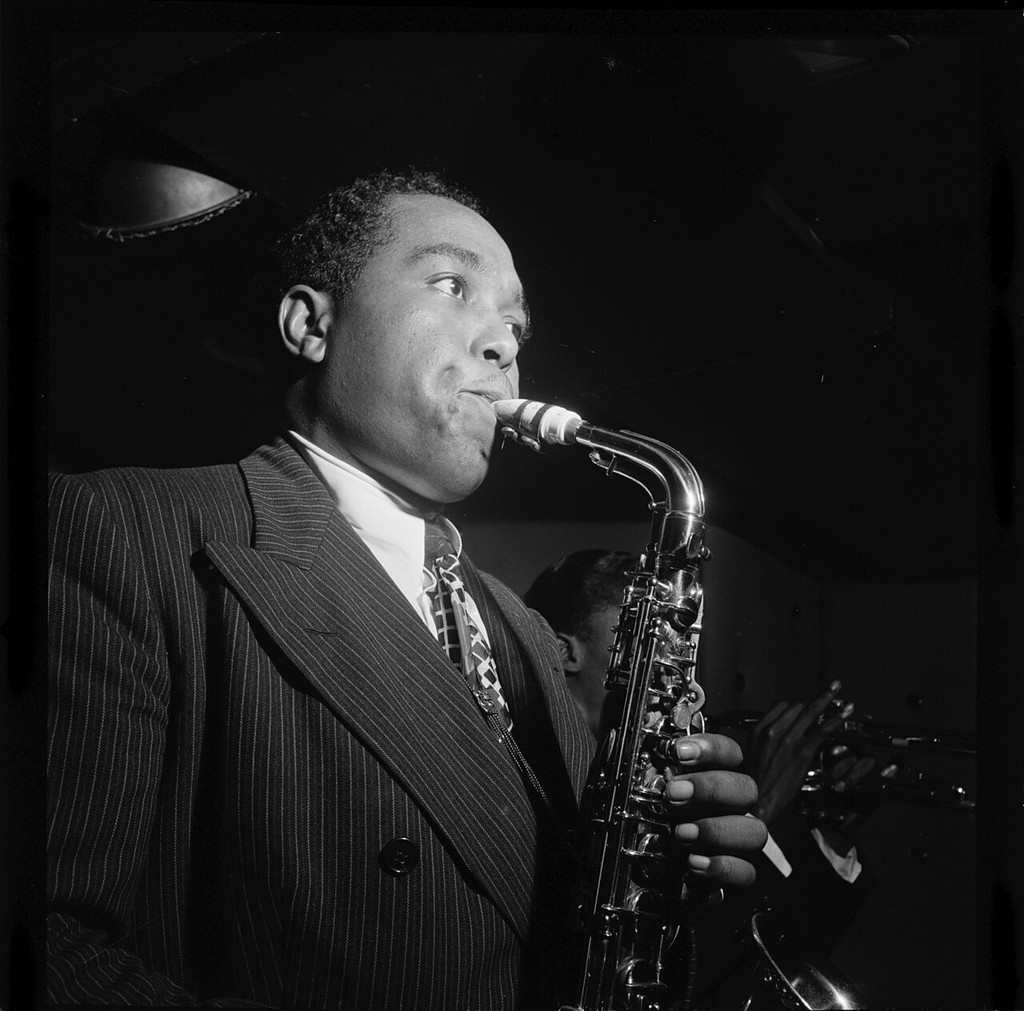
The estate chronology gives a further, more personal context without pretending to decode the entire surface. Artist Shenge Kapharoah recalls discussions with Basquiat about African ideologies and the position of artists in the diaspora, specifically mentioning Charles the First and the line about kings. The chronology also places the painting in Basquiat's November 1982 Fun Gallery exhibition and says it was among works he kept for his own collection. That account is valuable as a sourced recollection and exhibition history. It still does not make Kapharoah the author of the image's meaning or prove that every painted noun has one biographical counterpart.[5]
The word “CHEROKEE” provides a more particular link. Ray Noble's song “Cherokee” mattered to Parker's musical development. The Library of Congress explains that Parker's 1945 recording “Ko Ko” uses its harmonic framework, and a Gerry Mulligan collection essay identifies the relationship between the pieces. The painted title of the tune can therefore be read as a named reference to Parker's music. It would be a leap, however, to say every number, crown or crossed-out shape is a coded detail of that recording. The one secure connection should sharpen looking at the work, not license a full invented score.[4][6]
Parker was an alto saxophonist and an important figure in bebop. The Library of Congress's recording history gives concrete musical reasons for his standing: the speed, harmonic invention and new phrases of “Ko Ko” made it a landmark. Basquiat's painting does not depict a conventional portrait of Parker holding a saxophone. It places a musician in a field of language, royalty and danger. That difference matters. The work honours a named cultural figure while asking what happens when honour takes the form of a crown.[3][6]
The Bird on Money guide considers a 1981 work that also connects Basquiat to Parker, while Horn Players shows Parker with Dizzy Gillespie in a much larger three-panel painting from 1983. The recurrence does not make the works interchangeable. Charles the First is word-heavy and oblique about the musician; Horn Players names and places two performers more directly. Their different structures show why “jazz influence” needs to be explained through each specific object.[2][3][5]
Kings and cut heads
PAMM draws attention to a line in the lower painting about young kings and severed heads. The word “YOUNG” is crossed out, and the handwritten spelling looks less regular than a modern printed transcription. The crucial observations are the threatened kings, the deletion and the words carried across a panel join. PAMM's transcription is a useful reading aid, while the painted letters and erasures remain part of the work.[3][4]
The deletion changes the line's range. With “YOUNG” visible but marked through, it can be read both as a statement about young crowned people and as a broader warning about kings. The erased word remains present to the eye. Such a mark does not necessarily mean Basquiat changed his mind in a linear draft-and-correction process. It lets two formulations coexist, one subdued and one more direct. The painting's title makes the question of who counts as a king especially pointed.[3][4]
King Charles I of England was beheaded at Whitehall in 1649 after trial during the Civil Wars, according to the Royal Family's historical account. That real event makes the title and the phrase about heads capable of a royal-historical resonance. It is not evidence that the whole painting narrates the English Civil War. Nor does the title cancel the museum-documented Parker connection. The name can carry more than one association, and the painting's words allow those associations to rub against each other without resolving into a single history lesson.[2][3][7]
The crowns are equally open. A crown might confer distinction, but one accompanied by a line about decapitation is no guarantee of safety. PAMM reads Basquiat's crowns in terms of recognition and vulnerability rather than a universal badge of victory. On this specific canvas, the left crown near “THOR” and another on the right are placed among words about kings, music and deletion. Their force comes from those local relationships. The crown guide follows their different roles in other works without treating one meaning as a rule.[3][4]
The line is sometimes used as if it were a transparent forecast of Basquiat's own life. That approach imports later biography into a painting made in 1982 and overlooks Parker, the three-panel composition and the historical title. The phrase may speak about fame's exposure and the risk attached to honour; that is an interpretation grounded in the words and institutional context. It need not be converted into a claim that Basquiat predicted a particular death, either Parker's past one or his own future one.[3][5]
Words that remain difficult
“THOR,” “OPERA,” “CHEROKEE” and “COPYRIGHT” are visible or partly visible in the painting. They do not all belong to the same category. One may name a deity, another a performance form, another a composition with a documented Parker connection, and another a legal concept. On the painting, however, they are also differently sized, boxed, circled or crossed by other marks. Translating each into a single definition would flatten the work's visual organisation.[4][6]
“COPYRIGHT” is especially tempting to turn into a claim about Basquiat's own rights or the music business. Its painted presence can support a question about ownership and reproduction, but a detailed story about what transaction it names needs evidence. That caution is useful in a work that later circulated widely as prints. The original painted word and a later print's copyright notice belong to different moments and should not be confused.[1][4]
The middle's white oval and dark crossings-out also resist secure naming from a small image. They may appear like a head, a record shape or an abstract sign depending on scale and detail. It is safer to describe form, colour and placement than to declare a portrait or a musical instrument. A well-sourced close reading does not require every mark to be solved. It needs to show which evidence is visible, which is catalogued, and where interpretation begins.[4]
The words, anatomy and symbols guide explores Basquiat's habit of putting legible language into material contact with drawing and paint. In Charles the First, one sentence extends across panels while separate nouns interrupt it. Deletion does not make a word disappear. This arrangement rewards repeated looking: read a phrase, step back to see the three sections, then return to the way a word is marked and situated.[3][4]
The original painting and later prints
Some descriptions of Charles the First call the object a screenprint, creating confusion when they are applied to the painting. The Paris museum record identifies the 1982 original as acrylic and oil pastel on three canvas panels. That distinction is not merely technical. A print made from the painting's image would present the composition on another support, at another scale and often in an edition. The original panel joins and painted crossings-out are material features of one specific object.[1]
Printed versions and posters can help the composition reach more viewers, but their retail descriptions cannot replace an object record for the original. A buyer might see a listing titled Charles the First that calls its item an offset lithograph or screenprint. Such terms describe the item being sold, not a retrospective change to Basquiat's 1982 painting. The best identifying questions are support, dimensions, production date, publisher and whether the listing claims an edition. An unauthorised or poorly documented print listing should not be promoted into an authority on the original.[1][4]
The collection credit has a more recent source than the 2010 Paris checklist alone. In a 2024 Gagosian Quarterly conversation, curator Jessica Beck said that Charles the First and Pink Parker were owned by the Basquiat estate. Fondation Louis Vuitton's 2018 exhibition account confirms a later display in its Parker-focused gallery. Ownership and display are separate: those records do not establish that Charles the First is currently on public view. A reader seeking to see it now needs a current exhibition or lender record.[1][2][8]
Looking again
Begin with the three panels as one surface. Find the two crowns and the colour shift from cream to blue to dark and pale areas. Trace the words about kings from the lower left across the join, noticing the crossed-out term and the uneven letter shapes. Then move to circled “CHEROKEE” on the right, carrying the documented Parker connection back through the rest of the work. It is possible to hold Charlie Parker and King Charles I as different title associations without making either the sole subject.[3][4][6][7]
The most durable interpretation follows what the painting actually stages: a crown offered amid the risk of losing a head; musical recognition placed among other kinds of naming; a sentence broken across real supports; words kept visible even when crossed through. A generic style label or a single broad statement about alienation would miss those relationships. Basquiat's 1982 painting has more specific things to show.[1][3][4]
The 2010 Paris object checklist, Fondation Louis Vuitton's exhibition account and PAMM's crown guide give readers institutional ways to check the object facts, jazz context and curatorial reading. A close encounter with the original would add the scale of its panels, surface and handwritten words to those records.[1][2][3]
Explore the Basquiat guide
Basquiat artworks in this guide
| Name | Date | Medium |
|---|---|---|
| Bird on Money | 1981 | Acrylic and oil on canvas |
| Boy and Dog in a Johnnypump | 1982 | Acrylic, oil stick and spray paint on canvas |
| Charles the First | 1982 | Acrylic and oil pastel on three canvas panels |
| Defacement (The Death of Michael Stewart) | 1983 | Acrylic and marker on wall-derived support (support records differ) |
| Dos Cabezas | 1982 | Acrylic and oilstick on canvas with wood supports |
| Dustheads | 1982 | Acrylic, oilstick, spray enamel and metallic paint on canvas |
| Eyes and Eggs | 1983 | Acrylic, oilstick and paper collage on hinged cotton drop cloth |
| Flexible | 1984 | Acrylic and oilstick on wood |
| God, Law | 1981 | Drawing; precise materials not established |
| Hollywood Africans | 1983 | Acrylic and oil stick on canvas |
| Horn Players | 1983 | Acrylic and oil stick on three canvas panels mounted on wood |
| In Italian | 1983 | Acrylic, oil stick and marker on canvas mounted on wood |
| Irony of a Negro Policeman | 1981 | Acrylic and oilstick on wood |
| King Alphonso | 1982–83 | Works on paper; suite materials vary by record |
| Obnoxious Liberals | 1982 | Acrylic, oilstick and spray paint on canvas |
| Pez Dispenser | 1984 | Acrylic and oil stick on canvas |
| Riding with Death | 1988 | Acrylic and oil crayon on canvas |
| Self-Portrait with Suzanne | 1982 | Oil pastel on paper (Paris dossier) |
| Self-Portrait | 1984 | Acrylic and oil stick on paper mounted on canvas |
| Untitled (Head), often called Skull | 1981 | Acrylic and oilstick on canvas |
| Slave Auction | 1982 | Crumpled-paper collage, oil pastel and acrylic on canvas |
| Untitled (Sugar Ray Robinson) | 1982 | Acrylic and oil pastel/oil stick on canvas (record terms differ) |
| Untitled (Titian) | 1982 | Oil stick on canvas |
| Trumpet | 1984 | Acrylic and oil paintstick on canvas |
| Tuxedo | 1982–83 | Silkscreen on canvas, edition of ten |
| Untitled (Rotterdam figure) | 1982 | Acrylic paint and oil stick on canvas |
| Untitled (Crown) | 1982 | Acrylic, ink and paper collage on paper |
| Untitled (Boxer) | 1982 | Acrylic and oil paintstick on linen |
| Untitled (Fallen Angel) | 1981 | Acrylic and oil pastel on canvas; aerosol appears in a second record |
Frequently Asked Questions
Jean-Michel Basquiat's Charles the First is a 1982 painting across three tall canvas panels. Words and signs share the surface: crowns, crossed-out lettering, blue and yellow fields, a central white oval and the name “CHEROKEE” on the right. Its title sounds like a royal portrait, yet institutions also place the work among Basquiat's tributes to jazz saxophonist Charlie Parker. The tension is productive. Basquiat uses the language of kings, heads and music without turning the painting into a straightforward picture of one person.[1][2][3]
The three vertical parts give Charles the First a strong overall rhythm without becoming three separate narratives. The left is mainly cream and yellow. A wide blue centre carries dense crossings-out and a white oval. The right moves between dark blue and pale yellow, with lettering and linear drawing. Panel edges remain visible, so the eye repeatedly crosses a real join while moving among words and marks. The work is a painting whose physical construction shapes its reading.[1][4]
The Estate of Jean-Michel Basquiat lists Charles the First among works that express the artist's affinity for jazz musicians. Fondation Louis Vuitton placed it in a group focused on Charlie Parker, alongside CPRKR, Horn Players, Discography (One) and Now's the Time. Pérez Art Museum Miami calls it a tribute to Parker. These are stronger grounds for the jazz connection than simply noticing that “Charles” can be a formal version of “Charlie.” They also show that the work sits within a sustained group, not an isolated pun.[2][3][5]
Some descriptions of Charles the First call the object a screenprint, creating confusion when they are applied to the painting. The Paris museum record identifies the 1982 original as acrylic and oil pastel on three canvas panels. That distinction is not merely technical. A print made from the painting's image would present the composition on another support, at another scale and often in an edition. The original panel joins and painted crossings-out are material features of one specific object.[1]
Discussion
Which documented detail changes how you read Charles the First?
Reader Insights
Start with a visible mark, material or word.
Check date, support and collection before comparing images.
Which reading still needs an object-specific source?
Join the Conversation
Share an observation grounded in the work or its documented history.
References and further reading
- Musée d'Art Moderne de Paris, 2010 Basquiat exhibition press dossier, PDF p. 18, Charles the First object entry, date, medium, dimensions and historical estate credit.
- Fondation Louis Vuitton, 2018 Jean-Michel Basquiat retrospective account, Parker group including Charles the First.
- Pérez Art Museum Miami, Basquiat: Figures, Signs, Symbols exhibition guide, crown section, Parker identification, kings inscription and curatorial interpretation.
- Visual reading of the painting's panel layout and prominent words, cross-checked against the institutional title, support and kings-inscription accounts in the Paris exhibition dossier and PAMM guide. The Paris source does not transcribe each small word.
- Estate of Jean-Michel Basquiat, 1980s chronology, jazz-related works and named musicians.
- Library of Congress, Gerry Mulligan collection essay on Charlie Parker and National Recording Registry essay on “Ko Ko”, Parker's use of “Cherokee.”
- The Royal Family, history of Charles I, execution at Whitehall in 1649; this supports only a possible historical resonance for the painting's title and inscription.
- Gagosian Quarterly, Jessica Beck and Lee Mergner, “Jazz & Jean-Michel Basquiat” (6 November 2024), Beck's stated estate ownership of Charles the First and Pink Parker.
