


 by Tom Gurney
Tom Gurney BSc (Hons) is an art history expert with over 20 years experience
Published on June 19, 2020 / Updated on October 11, 2026
Email: tomgurney1@gmail.com / Phone: +44 7429 011000
Untitled (Sugar Ray Robinson) by Jean-Michel Basquiat: introduction
Jean-Michel Basquiat's Untitled (Sugar Ray Robinson) gives a famous boxer a spare, forceful image. Across a nearly black square, the fighter's name is written near the top. Below it are a small crown and an even smaller face-like sign. Large areas of dark surface remain open. The painting asks the viewer to measure the size of a champion's name against the few marks chosen to represent him. It is an image about recognition that does not need to imitate a boxing photograph.[1][2]
Basquiat made it in 1982, during a year when boxers and other Black cultural figures entered his paintings in different ways. The exact catalogue title begins with Untitled; “Sugar Ray Robinson” in parentheses identifies the named subject. That distinction is useful because the lettering on the surface and the later object title are related, but not the same kind of evidence. The work's physical support also matters: a 2010 Basel exhibition guide places it among boxer paintings mounted on industrial pallets, while a Paris checklist records an 11.5-centimetre depth. The apparently simple frontal image is a constructed object.[1][3][4]
At a glance
- ArtistJean-Michel Basquiat
- Catalogue titleUntitled (Sugar Ray Robinson)
- Date1982
- MaterialsAcrylic and oil pastel on canvas in Paris's 2010 checklist; acrylic and oil stick on canvas in Gagosian's 2013 label
- Dimensions106.5 × 105.5 × 11.5 cm in the 2010 Paris record; Gagosian rounds the frontal dimensions to 42 × 42 in. (106.7 × 106.7 cm)
- SupportBasel's 2010 guide groups this work with boxer paintings attached to industrial pallets
- CollectionListed as a private collection courtesy The Brant Foundation in 2010; current owner and display require confirmation
The Paris and Gagosian records use slightly different material words and measurements. Oil pastel and oil stick may be descriptions of related materials, but they should not be silently merged into a new object label. Paris includes the third dimension; Gagosian's square frontal measure omits it and rounds the sides. Neither record says Gagosian owns the painting. The 2013 Gagosian page documents an exhibition, and the 2010 Brant credit documents an earlier courtesy arrangement. Present ownership needs a current lender or collection statement.[1][2]
This work in Basquiat’s career
Contents
- The name, crown and face
- Who was Sugar Ray Robinson?
- A canvas with depth
- In Basquiat's 1982 boxer group
- Exhibitions and present limits
- Looking again
The name, crown and face
The name runs in pale, irregular letters along the upper edge of the black field. A small three-point crown sits below, around the centre. A face-like mark appears beneath the crown, with eyes, a simplified head and short pale strokes at the mouth. The relative sizes are striking: the named boxer occupies the width of the work as language, while his drawn head is compact. Basquiat did not choose between words and portraiture. He made the two carry different kinds of presence.[2]
The open dark surface is as consequential as the marks. There is no detailed ring, glove, opponent or crowd to situate a fight. The viewer encounters an individual name, a mark of honour and a reduced figure. Calling the work “simple” can describe its economy, but calling it childlike or unplanned does not follow from that economy. Spacing the elements this far apart across a painted canvas is a compositional decision. The dark ground gives the pale writing unusual weight.[2]
The letterforms resist perfectly typeset transcription from ordinary reproductions. A V-shaped stroke appears in the word “SUGAR” in some images, and parts of the surname are uneven. Such marks matter visually; they do not change the clearly identified subject in the Paris and Gagosian catalogues. A reader can notice how handwriting differs from a printed caption without inventing an alternative boxer or claiming that Basquiat made an accidental spelling mistake.[1][2]
The crown is central but smaller than the name. It can honour Robinson's achievement, and Fondation Louis Vuitton places him among the Black boxers and fighters who were Basquiat's personal heroes. Yet the crown is not a transcript of the artist saying that this boxer was literally the only true king. In different works Basquiat sets crowns near figures, words, merchandise and scenes of vulnerability. Here its placement between name and face offers a focused question: what kind of distinction is being granted, and who gets to grant it?[4][5]
The crown guide compares those uses through documented objects. A crown above a named boxer is different from one above the dinosaur in Pez Dispenser. The repeated sign can lead viewers from one page to another, but it gains its meaning from each painting's company of words, figures and materials.[2][5]
Who was Sugar Ray Robinson?
Sugar Ray Robinson was the professional name of Walker Smith Jr. He boxed professionally from 1940 to 1965, held the world welterweight title from 1946 to 1951 and held the middleweight title in five separate reigns. The Michigan Sports Hall of Fame records his induction into the International Boxing Hall of Fame in 1990. These are more useful facts for identifying Basquiat's named subject than an unexamined claim that Robinson was simply “the greatest boxer.” Historical rankings may make that judgment, but a portrait does not require a single league table.[6]
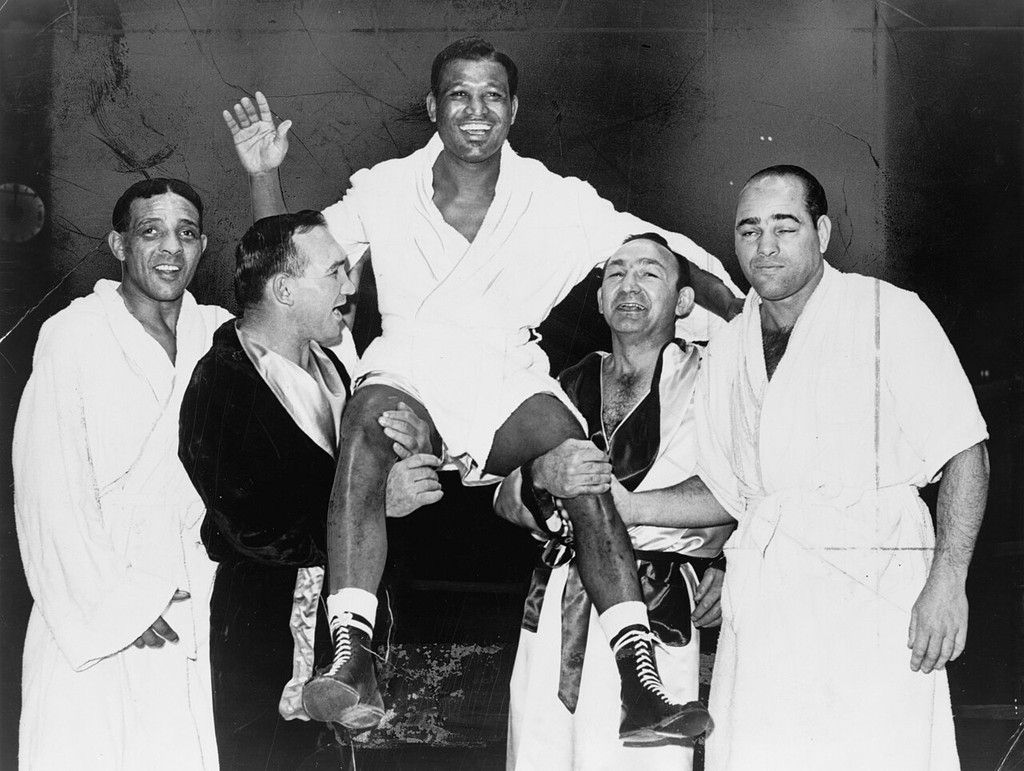
Robinson's public fame and repeated championship success make the crown legible as honour. They also explain why a viewer in 1982 could recognise his name without an illustrated boxing scene. Basquiat's generation inherited images of celebrated Black athletes who were visible in American popular culture yet whose careers and treatment could not be reduced to victories. Jessica Beck's broader account of Basquiat's musician subjects suggests a comparable interest in achievement, recognition and prejudice. This is a contextual comparison, not a documented interview in which Basquiat states the precise meaning of Robinson's crown.[5][7]
The boxer was still alive when Basquiat painted the canvas in 1982; Robinson died in 1989, according to the Michigan Hall of Fame. The painting is thus a work about an existing public figure rather than a posthumous memorial. Its lack of a fight scene leaves space for the name itself to function like an announcement. That does not tell us whether Basquiat wanted the image to celebrate a specific bout, a whole career or the boxer as a cultural emblem. The recorded painting supplies the subject; an account of exact artist intention would need a direct source.[1][6]
Basquiat's use of a famous Black sports figure also sits alongside his portraits and references to jazz musicians. The connection is not that a boxer and a saxophonist do the same work. Both kinds of subject had public names, histories of performance and audiences capable of recognising them. The painter could write a name, add a crown or compress a face, then let those devices raise questions about recognition. The music and boxing guide compares those strategies across particular works rather than treating athletes and musicians as interchangeable symbols.[5][7]
A canvas with depth
The surface looks spare in a photograph, but the object is not merely a drawing on loose black cloth. The 2010 Musée d'Art Moderne de Paris checklist records a depth of 11.5 cm. Fondation Beyeler's German gallery guide groups Untitled (Sugar Ray Robinson) with Cassius Clay and Jack Johnson as works for which Basquiat fixed painted canvas to an industrial pallet. That support brings the painting forward from the wall. It is part of how the picture enters space, even when a frontal reproduction hides its sides.[1][3]
The Basel guide then explains the visible folds and attachment process in detail for Cassius Clay. It describes canvas hanging over the pallet and partly revealing rough wood. That passage should not be copied unqualified onto Robinson's work: the guide uses Cassius Clay as its detailed example. Its grouping nevertheless supports the shared pallet method. The Paris depth and the uneven edges visible in Gagosian's reproduction make it especially important not to call the Robinson canvas flat paper or an unmounted sketch.[1][2][3]
An industrial pallet is a transport object before it is a painting support. Beyeler's curator reads Basquiat's reuse as a transformation of a standard commercial platform into a three-dimensional art object. That is a curatorial interpretation of materials, not proof that the named boxer is a metaphor for shipping or trade. The material fact and the proposed symbolic analogy should remain separate. A viewer may connect the rough support to the unpolished head and lettering, but that connection should be argued from the work rather than declared a hidden code.[3]
The 11.5-centimetre depth also helps explain a record difference. Paris gives height, width and depth because the painting projects from the wall; Gagosian's 42-by-42-inch caption supplies the front's approximate size. A reader should not assume the two captions identify different versions solely because their numbers do not match to the millimetre. Both name the same 1982 subject and use canvas, while each document serves a different exhibition context.[1][2]
In Basquiat's 1982 boxer group
The estate's chronology places Untitled (Sugar Ray Robinson) in Basquiat's November 1982 Fun Gallery exhibition and says it was among works he then kept for his personal collection. This is a dated historical claim about the artist's own choices, not proof of the painting's current owner. Fondation Louis Vuitton's 2018 exhibition account groups Robinson with St. Joe Louis Surrounded by Snakes and Cassius Clay as images of Black fighters. The grouping shows a recurring interest that year while making room for each work's different figure and format.[4][8]
The Untitled (Boxer) guide treats another 1982 fighter image. Its raised-arm figure and monumental scale ask for a different kind of encounter from the dark, square Robinson work. A title that names Robinson fixes this page's subject; an unnamed boxer should not be identified with him merely because Basquiat made both paintings in the same period. Cassius Clay and Jack Johnson name still other athletes, each with a distinct object record.[3][4]
Some later photographs show Basquiat posing with boxing equipment, including with Andy Warhol. Those images may be relevant to the artist's later public image, but they cannot explain how this 1982 canvas was made. The old habit of reading every boxing work as Basquiat's self-portrait likewise needs work-specific evidence. A small face under Robinson's name is a portrait device; it does not automatically become a disguised image of Basquiat. The painting already gives a named subject, and the physical and historical sources are sufficient to begin reading it.[1][2]
Exhibitions and present limits
The Paris museum included Untitled (Sugar Ray Robinson) in its 2010 Basquiat exhibition list, with private-collection and Brant Foundation courtesy language. Fondation Beyeler's 2010 guide discussed it in a room devoted to boxer paintings. Gagosian's New York exhibition page identifies a 2013 showing and reproduces an object caption. Fondation Louis Vuitton placed it in a broader fighter section in 2018. This sequence documents repeated exhibition attention, not a permanent museum home.[1][2][3][4]
The 2013 Gagosian page does not claim gallery ownership, and the 2010 Brant courtesy is not a current provenance statement. A reader seeking the original today needs an up-to-date collection or exhibition record. The available documented chain is enough to say where it was shown and how earlier institutions labelled it, not where it hangs in October 2026.[1][2]
Looking again
The first encounter may take only seconds: a written name, a crown, a face. A second look notices their unequal scales and the expanse of dark paint between them. A side view would add the pallet support that a frontal image conceals. The boxer behind the name was a welterweight and middleweight champion; the picture does not narrate a specific round or victory. Its power comes from how little Basquiat needed to mark in order to make that person present.[2][3][6]
An interpretation can then ask what naming and crowning do for a Black champion in a painting from 1982. It should keep the historical Robinson, the material object and the painted signs visible at once. No claim that the crown has one universal meaning, or that rough lettering proves an unplanned childish method, is needed to understand the work's concentrated form.[2][5][6]
Explore the Basquiat guide
Basquiat artworks in this guide
| Name | Date | Medium |
|---|---|---|
| Bird on Money | 1981 | Acrylic and oil on canvas |
| Boy and Dog in a Johnnypump | 1982 | Acrylic, oil stick and spray paint on canvas |
| Charles the First | 1982 | Acrylic and oil pastel on three canvas panels |
| Defacement (The Death of Michael Stewart) | 1983 | Acrylic and marker on wall-derived support (support records differ) |
| Dos Cabezas | 1982 | Acrylic and oilstick on canvas with wood supports |
| Dustheads | 1982 | Acrylic, oilstick, spray enamel and metallic paint on canvas |
| Eyes and Eggs | 1983 | Acrylic, oilstick and paper collage on hinged cotton drop cloth |
| Flexible | 1984 | Acrylic and oilstick on wood |
| God, Law | 1981 | Drawing; precise materials not established |
| Hollywood Africans | 1983 | Acrylic and oil stick on canvas |
| Horn Players | 1983 | Acrylic and oil stick on three canvas panels mounted on wood |
| In Italian | 1983 | Acrylic, oil stick and marker on canvas mounted on wood |
| Irony of a Negro Policeman | 1981 | Acrylic and oilstick on wood |
| King Alphonso | 1982–83 | Works on paper; suite materials vary by record |
| Obnoxious Liberals | 1982 | Acrylic, oilstick and spray paint on canvas |
| Pez Dispenser | 1984 | Acrylic and oil stick on canvas |
| Riding with Death | 1988 | Acrylic and oil crayon on canvas |
| Self-Portrait with Suzanne | 1982 | Oil pastel on paper (Paris dossier) |
| Self-Portrait | 1984 | Acrylic and oil stick on paper mounted on canvas |
| Untitled (Head), often called Skull | 1981 | Acrylic and oilstick on canvas |
| Slave Auction | 1982 | Crumpled-paper collage, oil pastel and acrylic on canvas |
| Untitled (Sugar Ray Robinson) | 1982 | Acrylic and oil pastel/oil stick on canvas (record terms differ) |
| Untitled (Titian) | 1982 | Oil stick on canvas |
| Trumpet | 1984 | Acrylic and oil paintstick on canvas |
| Tuxedo | 1982–83 | Silkscreen on canvas, edition of ten |
| Untitled (Rotterdam figure) | 1982 | Acrylic paint and oil stick on canvas |
| Untitled (Crown) | 1982 | Acrylic, ink and paper collage on paper |
| Untitled (Boxer) | 1982 | Acrylic and oil paintstick on linen |
| Untitled (Fallen Angel) | 1981 | Acrylic and oil pastel on canvas; aerosol appears in a second record |
Frequently Asked Questions
Jean-Michel Basquiat's Untitled (Sugar Ray Robinson) gives a famous boxer a spare, forceful image. Across a nearly black square, the fighter's name is written near the top. Below it are a small crown and an even smaller face-like sign. Large areas of dark surface remain open. The painting asks the viewer to measure the size of a champion's name against the few marks chosen to represent him. It is an image about recognition that does not need to imitate a boxing photograph.[1][2]
Sugar Ray Robinson was the professional name of Walker Smith Jr. He boxed professionally from 1940 to 1965, held the world welterweight title from 1946 to 1951 and held the middleweight title in five separate reigns. The Michigan Sports Hall of Fame records his induction into the International Boxing Hall of Fame in 1990. These are more useful facts for identifying Basquiat's named subject than an unexamined claim that Robinson was simply “the greatest boxer.” Historical rankings may make that judgment, but a portrait does not require a single league table.[6]
The name runs in pale, irregular letters along the upper edge of the black field. A small three-point crown sits below, around the centre. A face-like mark appears beneath the crown, with eyes, a simplified head and short pale strokes at the mouth. The relative sizes are striking: the named boxer occupies the width of the work as language, while his drawn head is compact. Basquiat did not choose between words and portraiture. He made the two carry different kinds of presence.[2]
The estate's chronology places Untitled (Sugar Ray Robinson) in Basquiat's November 1982 Fun Gallery exhibition and says it was among works he then kept for his personal collection. This is a dated historical claim about the artist's own choices, not proof of the painting's current owner. Fondation Louis Vuitton's 2018 exhibition account groups Robinson with St. Joe Louis Surrounded by Snakes and Cassius Clay as images of Black fighters. The grouping shows a recurring interest that year while making room for each work's different figure and format.[4][8]
Discussion
Which documented detail changes how you read Untitled (Sugar Ray Robinson)?
Reader Insights
Start with a visible mark, material or word.
Check date, support and collection before comparing images.
Which reading still needs an object-specific source?
Join the Conversation
Share an observation grounded in the work or its documented history.
References and further reading
- Musée d'Art Moderne de Paris, 2010 Basquiat exhibition press dossier, PDF p. 17, Untitled (Sugar Ray Robinson) entry, medium, three-dimensional measurement and historical collection credit.
- Gagosian, Jean-Michel Basquiat, New York exhibition page (2013), work image, acrylic/oil-stick caption and rounded frontal dimensions.
- Fondation Beyeler, Basquiat German gallery guide (2010), room 13, PDF p. 10, industrial-pallet support grouping and the more detailed Cassius Clay construction discussion.
- Fondation Louis Vuitton, 2018 Basquiat retrospective, boxer/fighter grouping and Untitled (Sugar Ray Robinson) among personal heroes.
- Pérez Art Museum Miami, Basquiat: Figures, Signs, Symbols guide, curatorial range of crown meanings; applied here as context, not as an interpretation PAMM makes of this particular work.
- Michigan Sports Hall of Fame, Sugar Ray Robinson profile, birth name, professional span, 1990 induction and death; ESPN Classic, Robinson biography, welterweight and middleweight championship history.
- Gagosian Quarterly, Jessica Beck and Lee Mergner, “Jazz & Jean-Michel Basquiat” (2024), attributed general comparison of Basquiat's Black musician and athlete subjects.
- Estate of Jean-Michel Basquiat, 1982 chronology, November Fun Gallery exhibition and the works Basquiat then kept.
