


 by Tom Gurney
Tom Gurney BSc (Hons) is an art history expert with over 20 years experience
Published on October 11, 2026 / Updated on October 11, 2026
Email: tomgurney1@gmail.com / Phone: +44 7429 011000
Horn Players by Jean-Michel Basquiat: introduction
Charlie Parker and Dizzy Gillespie occupy opposite sides of Jean-Michel Basquiat's Horn Players. Between them, a third painted head, repeated names and a field of marks keep the eye moving. The work honours two musicians central to bebop, but it does not ask us simply to spot them and stop. It brings their instruments, names and musical history into a tall painting whose three parts can be read together and separately.[1]
Made in 1983, Horn Players belongs to Basquiat's sustained engagement with Black musical achievement. The Broad identifies Parker with an alto saxophone at left and Gillespie with a trumpet at right. In the middle, Basquiat refers to “Ornithology,” a piece associated with Parker. Those identifications make the painting much more specific than a general tribute to jazz. They also leave space for looking at what Basquiat has done with scale, support, writing and repetition.[1][2]
At a glance
- TitleHorn Players
- ArtistJean-Michel Basquiat
- Date1983
- MediumAcrylic and oil stick on three canvas panels mounted on wood supports
- Dimensions96 × 75 in. (243.8 × 190.5 cm)
- CollectionThe Broad, Los Angeles; accession F-BASQ-1P97.23
The medium line is important. This is a painting on canvas in three sections, held on wooden supports; it is not simply paint applied to three wooden boards. At eight feet high, it faces a viewer as a group of near-human-scale presences. A small image conveys its main layout, but it shrinks the distance the eye travels from one musician to the other and across the marks in between.[1]
This work in Basquiat’s career
Contents
- A painting in three parts
- Charlie Parker on the left
- Dizzy Gillespie on the right
- Why “Ornithology” is in the middle
- Words, marks and the space between musicians
- Basquiat, music and recognition
- A later museum encounter
- Looking again
A painting in three parts
Two vertical boundaries divide the work into panels. They are visible intervals in the painted field, not incidental seams to ignore. A viewer can begin with Parker on the left, cross a middle area crowded with letters and a face, then arrive at Gillespie on the right. The panels give each region some independence while the repeated writing pulls them together.[1]
The largely dark ground strengthens the effect of the pale marks and faces. White strokes and letters jump forward, but orange, red, blue and yellow also appear in the portraits and written field. Basquiat does not use a smooth studio portrait style. Lines switch between describing a face, naming a musician, marking an instrument and crossing other marks. The work is readable in parts without becoming a single continuous scene.[1]
That structure gives the title its plural force. There are two named horn players, and each occupies a side of the composition. The centre does not merely separate them; it is busy with another face and with the language of music. The painting can be experienced as a conversation across three surfaces. This is a description of its arrangement, not a claim that the panels correspond to three movements of a particular piece.[1]
The old Basquiat site called the object a triptych of wooden panels. “Triptych” captures the visual division, but the support description was inaccurate. The Broad's record distinguishes the canvas painting surface from the wood supporting it. That distinction matters whenever a page promises readers object facts, because support and surface affect how the work was made and how it appears.[1]
Charlie Parker on the left
The Broad identifies the left figure as Charlie Parker, the alto saxophonist whose innovations helped shape bebop. An instrument and a face occupy the left-hand panel among written fragments. The figure is unmistakably a painted presence, yet it is not a polished photographic likeness. Basquiat gives Parker visual weight through placement, marks and the company of other musical references.[1]
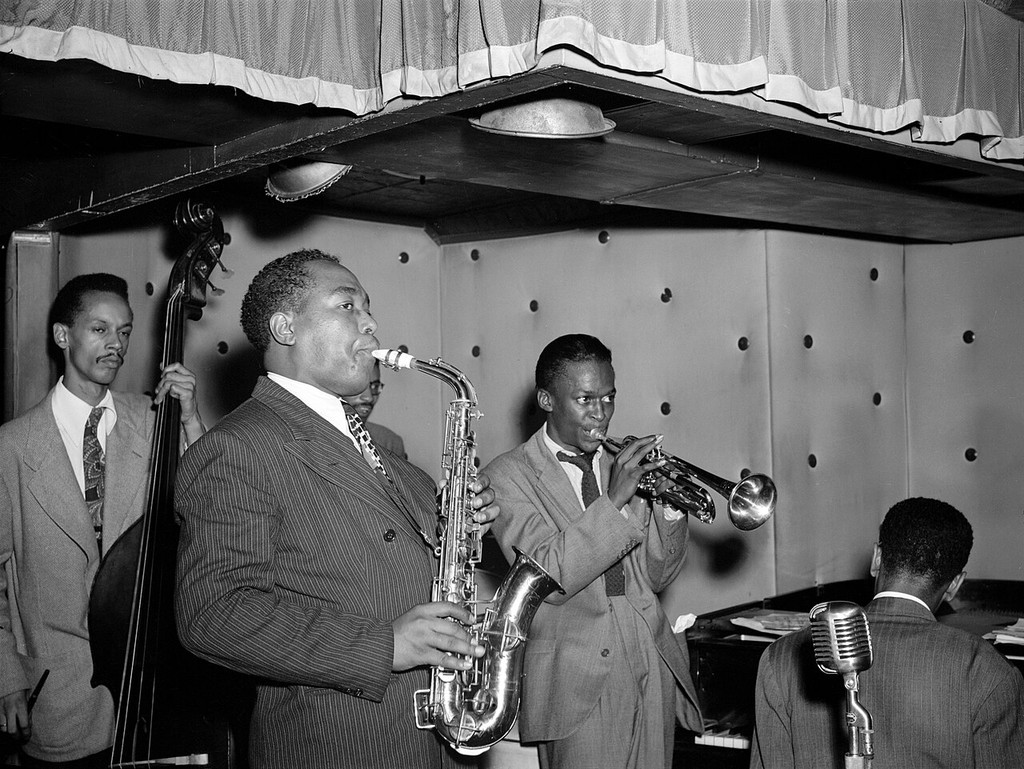
Parker was more than a name in a list of Basquiat's influences. The Barbican exhibition guide describes Basquiat's deep interest in his music and in books about him, including Ross Russell's Bird Lives!. It places that interest within a wider collection of jazz and blues recordings and notes that many of the musicians Basquiat admired had also encountered serious racial prejudice. A tribute in Basquiat's work can therefore carry both artistic respect and a question about how Black achievement has been remembered.[3]
That context helps explain why Parker appears in several Basquiat works. Fondation Louis Vuitton grouped Horn Players with CPRKR, Charles the First, Discography (One) and Now's the Time in its retrospective account. They are not versions of a single picture. They are separate works that return to a musician through different materials, titles and arrangements. The return itself suggests a sustained interest rather than a one-off decoration.[4]
The Charles the First page explores a work linked to Parker in 1982. Horn Players follows with a distinct format and another musician beside him. Looking at both can show how Basquiat revised his approach to honour: a name may appear, disappear or become entangled with a larger field of written and painted marks. The recognisable motif is an invitation to compare, not a shortcut to assigning identical meanings.[4]
Dizzy Gillespie on the right
The Broad names Dizzy Gillespie as the right-hand figure and identifies his trumpet. Parker and Gillespie worked within the history of bebop, but the painting does not flatten them into a single anonymous jazz musician. Their positions, instruments and names let each hold a separate identity inside the larger composition.[1]
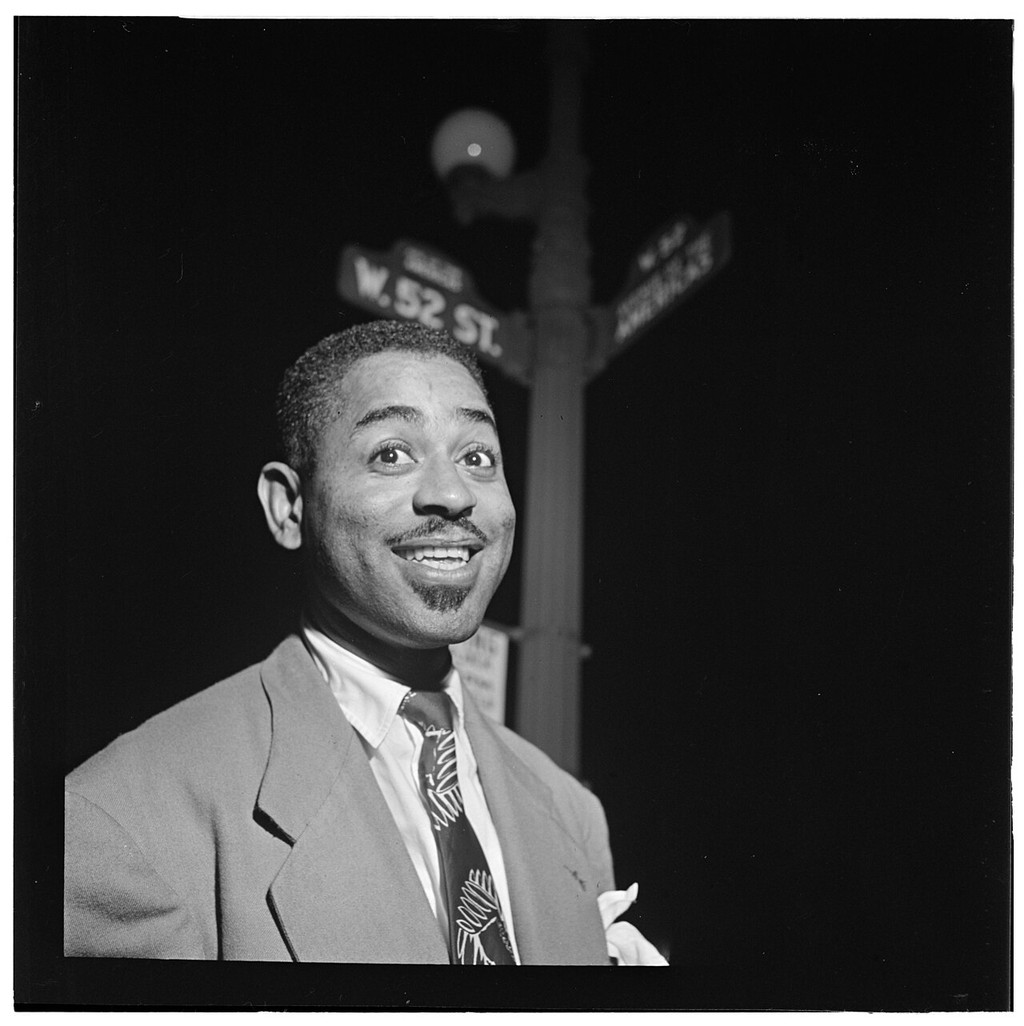
Gillespie's portrait shares the work's rough, marked surface. Letters sit near the figure, and the instrument cuts through the lower part of the panel. The right side does not function as a calm endpoint to a left-to-right story. It draws the eye back toward the middle, where musical terms and another face complicate the relation between the two named performers.[1]
It is tempting to read the portrait pair as a literal duet. The painting supports the comparison at a broad level: two musicians who helped form bebop appear side by side. It does not document a specific performance, concert or recording session. No collection source used here assigns the depicted arrangement to an event at which Parker and Gillespie played together. A close reading gains more from what is actually identified in the work than from inventing a scene outside it.[1][3]
The musicians' identities also matter within Basquiat's wider work about Black figures. In paintings of athletes, performers and historical subjects, naming can act as a form of recognition. Here the names are not discreet labels below a portrait. They are part of the painting's surface, competing with other inscriptions. That choice places the act of naming in the same visual register as the subjects themselves.[1][3]
Why “Ornithology” is in the middle
“Ornithology” is a Parker composition recorded in 1946. The Broad identifies it in the central section of Horn Players. It is a concrete musical reference: Basquiat put the title of a piece associated with one of his depicted musicians into the painting. The word also has a visual life here. It can be read as writing, repeated marks and an element of the panel's rhythm.[1][2]
The title may look like a strange interruption if the viewer does not know Parker's music. With the identification in place, the centre joins the left portrait to a particular work Parker played. Yet Horn Players remains a painting, not a transcription. The Broad's account compares the relation of structure and mobile brushwork to aspects of jazz composition. That is the museum's interpretive analogy; it does not establish that the letters or marks encode the notes of “Ornithology.”[1]
The distinction protects the richness of both art forms. Jazz improvisation has musical rules, histories and performances of its own. Basquiat's painting has a support, scale, colour and arrangement that a recording cannot supply. Comparison becomes useful when it helps us notice movement and repetition across the surface. It becomes misleading when every stroke is given a one-to-one sonic equivalent without evidence.[1]
Basquiat had a wider vocabulary of Parker references. The Broad's digital guide discusses a separate 1983 painting, With Strings Two, in which the word “Ornithology” also appears. The guide says that work was previously titled Charlie Parker. The same word can therefore recur across distinct objects while serving a different visual arrangement in each. Keeping those objects apart is as important as noticing their connection.[2]
The Bird on Money page offers another Parker comparison, this time from 1981. “Bird” was a name associated with the saxophonist. Reading several works side by side can show Basquiat returning to the musician rather than treating Horn Players as a single illustration for a jazz article. Each object's museum record should still govern its facts.[4][5]
Words, marks and the space between musicians
The painting's writing does not sit below its imagery as a caption. Names and terms occupy the same dark field as the faces. Some appear more than once; some are interrupted by brushwork or other letters. In reproduction, the dark ground and strong pale marks can make the text look like a score at first glance. The resemblance is evocative, but the words also have ordinary meanings that can be checked against the musicians and recordings.[1]
The difference between a written name and a painted likeness is worth lingering over. A portrait can suggest a person even when its features are simplified; a name identifies that person through language. Basquiat uses both routes, then lets the surrounding marks interfere with the easy confidence of either one. The eye may reach Parker's face before it reaches “Ornithology,” or find the word first and look back for the player. A viewer unfamiliar with bebop can begin with the museum's identifications and return to the canvas; a listener who knows the music may enter through the composition title. Neither route exhausts the work.[1][2]
Basquiat used written language throughout his practice, from early street texts and notebooks to paintings crowded with names, lists and fragments. The Barbican's exhibition materials describe the artist's interest in sound and in the visual behaviour of text. In Horn Players, writing can guide recognition while also delaying it: a viewer moves between identifying a word and following the line or colour that carries it.[3]
There is no requirement to solve every small inscription into a biographical clue. A letter sequence can be visible without its supposed referent being established. The Broad identifies Parker, Gillespie and “Ornithology”; other fragments deserve the same care before they are assigned to family members, song titles or private events. Some may be meaningful names, while others may function mainly as visual marks. Reading the supported references closely is more rewarding than filling every gap with a confident but untested story.[1]
That restraint does not empty the painting of meaning. It lets us look at the act of accumulation. Written fragments gather around the central figure and across the panels; a listener might likewise hold a tune, a player's name and a remembered performance together. The comparison describes a viewer's experience. It does not claim access to Basquiat's exact studio decisions or a hidden key to the canvas.[1][3]
Basquiat, music and recognition
The Barbican records music as a major part of Basquiat's working environment and subject matter. Its 2017 exhibition guide describes his large record collection and his attention to Parker in particular. Fondation Louis Vuitton places the Parker-related paintings together in its 2018 retrospective. Those institutional accounts support a sustained musical interest that goes beyond the title of this one work.[3][4]
Basquiat also made music himself. The Barbican documents his involvement in Beat Bop, a 1983 record with Rammellzee and K-Rob, and The Broad describes him as a musician as well as a listener. These facts explain why musical subjects were part of his creative world. They do not prove that he planned Horn Players as a score or that its three sections reproduce a recorded track.[1][3]
The question of recognition runs alongside the musical one. The Barbican notes that admired jazz musicians faced racial prejudice, and its exhibition framing treats Basquiat's tributes as a way of confronting how their work was valued. Naming Parker and Gillespie at monumental scale can be read in that light. The argument is strongest when tied to the painting's identified subjects and physical presence, rather than to a general claim that every jazz reference in Basquiat has one political meaning.[3]
Other guides can help readers trace the connection. The music and boxing guide considers how Basquiat returned to performers and athletes in different works. Hollywood Africans follows three contemporary artist-musicians through a different question of visibility, this time in relation to Los Angeles film culture. The links matter because Basquiat's works address recognition through several histories and forms, not because they all make the same statement.[3][4]
A later museum encounter
The Broad's collection record names the work and its materials, dimensions and accession number. Its guide adds the Parker, Gillespie and “Ornithology” reading. The museum has also placed Basquiat's musical interests in conversation with living musicians through its Time Decorated programme, including an event with saxophonist Terrace Martin. Such programming shows how the work can continue to invite musical responses. A present-day response is part of reception, not evidence that Basquiat expected that exact sound or interpretation in 1983.[1][2][6]

The Broad's comparison between free-moving paint and jazz has an appeal: the work resists stillness. The letters, strong contrasts and split panels repeatedly redirect attention. Yet the canvas is not formless. Its three-part support and placement of two named musicians give it structure. That tension between arrangement and movement is a more precise way to use the musical analogy than calling the picture itself “improvised” and leaving the word unexplained.[1]
A historical photograph of Parker or Gillespie would offer context for the musicians' lives, but it would not by itself show which source image, if any, Basquiat used for this painting.[1]
Looking again
Start with the visible breaks between the three canvases. Find Parker and the alto saxophone on the left, then Gillespie and the trumpet on the right. Return to the middle and read “Ornithology” as a reference to Parker, noticing what the surrounding marks do to the word's visibility. The work offers two distinct musicians and a crowded shared space, rather than a tidy illustration of a single tune.[1]
Its scale, materials and words make recognition an active process. Basquiat names figures he admired and gives them a powerful visual setting, while asking the viewer to work through the painted surface instead of taking a caption at face value. Horn Players pays homage by keeping the musicians present in paint and language. It remains compelling because the act of seeing them takes time.
The three supports also make a second look productive. Instead of treating the middle panel as a mere gap between two portraits, notice how written and painted marks carry attention across it. The centre gives the named musicians a shared visual field while retaining their separate positions. That arrangement can be described without claiming that each panel corresponds to a particular musical phrase.[1]
Explore the Basquiat guide
Basquiat artworks in this guide
| Name | Date | Medium |
|---|---|---|
| Bird on Money | 1981 | Acrylic and oil on canvas |
| Boy and Dog in a Johnnypump | 1982 | Acrylic, oil stick and spray paint on canvas |
| Charles the First | 1982 | Acrylic and oil pastel on three canvas panels |
| Defacement (The Death of Michael Stewart) | 1983 | Acrylic and marker on wall-derived support (support records differ) |
| Dos Cabezas | 1982 | Acrylic and oilstick on canvas with wood supports |
| Dustheads | 1982 | Acrylic, oilstick, spray enamel and metallic paint on canvas |
| Eyes and Eggs | 1983 | Acrylic, oilstick and paper collage on hinged cotton drop cloth |
| Flexible | 1984 | Acrylic and oilstick on wood |
| God, Law | 1981 | Drawing; precise materials not established |
| Hollywood Africans | 1983 | Acrylic and oil stick on canvas |
| Horn Players | 1983 | Acrylic and oil stick on three canvas panels mounted on wood |
| In Italian | 1983 | Acrylic, oil stick and marker on canvas mounted on wood |
| Irony of a Negro Policeman | 1981 | Acrylic and oilstick on wood |
| King Alphonso | 1982–83 | Works on paper; suite materials vary by record |
| Obnoxious Liberals | 1982 | Acrylic, oilstick and spray paint on canvas |
| Pez Dispenser | 1984 | Acrylic and oil stick on canvas |
| Riding with Death | 1988 | Acrylic and oil crayon on canvas |
| Self-Portrait with Suzanne | 1982 | Oil pastel on paper (Paris dossier) |
| Self-Portrait | 1984 | Acrylic and oil stick on paper mounted on canvas |
| Untitled (Head), often called Skull | 1981 | Acrylic and oilstick on canvas |
| Slave Auction | 1982 | Crumpled-paper collage, oil pastel and acrylic on canvas |
| Untitled (Sugar Ray Robinson) | 1982 | Acrylic and oil pastel/oil stick on canvas (record terms differ) |
| Untitled (Titian) | 1982 | Oil stick on canvas |
| Trumpet | 1984 | Acrylic and oil paintstick on canvas |
| Tuxedo | 1982–83 | Silkscreen on canvas, edition of ten |
| Untitled (Rotterdam figure) | 1982 | Acrylic paint and oil stick on canvas |
| Untitled (Crown) | 1982 | Acrylic, ink and paper collage on paper |
| Untitled (Boxer) | 1982 | Acrylic and oil paintstick on linen |
| Untitled (Fallen Angel) | 1981 | Acrylic and oil pastel on canvas; aerosol appears in a second record |
Frequently Asked Questions
Charlie Parker and Dizzy Gillespie occupy opposite sides of Jean-Michel Basquiat's Horn Players. Between them, a third painted head, repeated names and a field of marks keep the eye moving. The work honours two musicians central to bebop, but it does not ask us simply to spot them and stop. It brings their instruments, names and musical history into a tall painting whose three parts can be read together and separately.[1]
The Broad identifies the left figure as Charlie Parker, the alto saxophonist whose innovations helped shape bebop. An instrument and a face occupy the left-hand panel among written fragments. The figure is unmistakably a painted presence, yet it is not a polished photographic likeness. Basquiat gives Parker visual weight through placement, marks and the company of other musical references.[1]
The Broad names Dizzy Gillespie as the right-hand figure and identifies his trumpet. Parker and Gillespie worked within the history of bebop, but the painting does not flatten them into a single anonymous jazz musician. Their positions, instruments and names let each hold a separate identity inside the larger composition.[1]
“Ornithology” is a Parker composition recorded in 1946. The Broad identifies it in the central section of Horn Players. It is a concrete musical reference: Basquiat put the title of a piece associated with one of his depicted musicians into the painting. The word also has a visual life here. It can be read as writing, repeated marks and an element of the panel's rhythm.[1][2]
Discussion
Which documented detail changes how you read Horn Players?
Reader Insights
Start with a visible mark, material or word.
Check date, support and collection before comparing images.
Which reading still needs an object-specific source?
Join the Conversation
Share an observation grounded in the work or its documented history.
References and further reading
- The Broad, Horn Players collection record, object metadata, named figures and instruments, Ornithology reference and the museum's music/painting analogy.
- The Broad, digital Basquiat guide, pp. 9–10, separate entries for Horn Players and With Strings Two.
- Barbican, Basquiat: Boom for Real gallery guide, pp. 15 and 21–22, on Beat Bop, Basquiat's music sources and Parker; see also its jazz close looks.
- Fondation Louis Vuitton, Jean-Michel Basquiat retrospective account, 2018 exhibition grouping of Parker-related works.
- Rubell Museum, Bird on Money collection record, 1981 painting and object metadata.
- The Broad, Time Decorated: Terrace Martin Responds to Jean-Michel Basquiat, institutional account of later musical response.
