 by Tom Gurney
Tom Gurney BSc (Hons) is an art history expert with over 20 years experience
Published on July 26, 2026 / Updated on September 6, 2026
Email: tomgurney1@gmail.com / Phone: +44 7429 011000
American White Pelican: Introduction
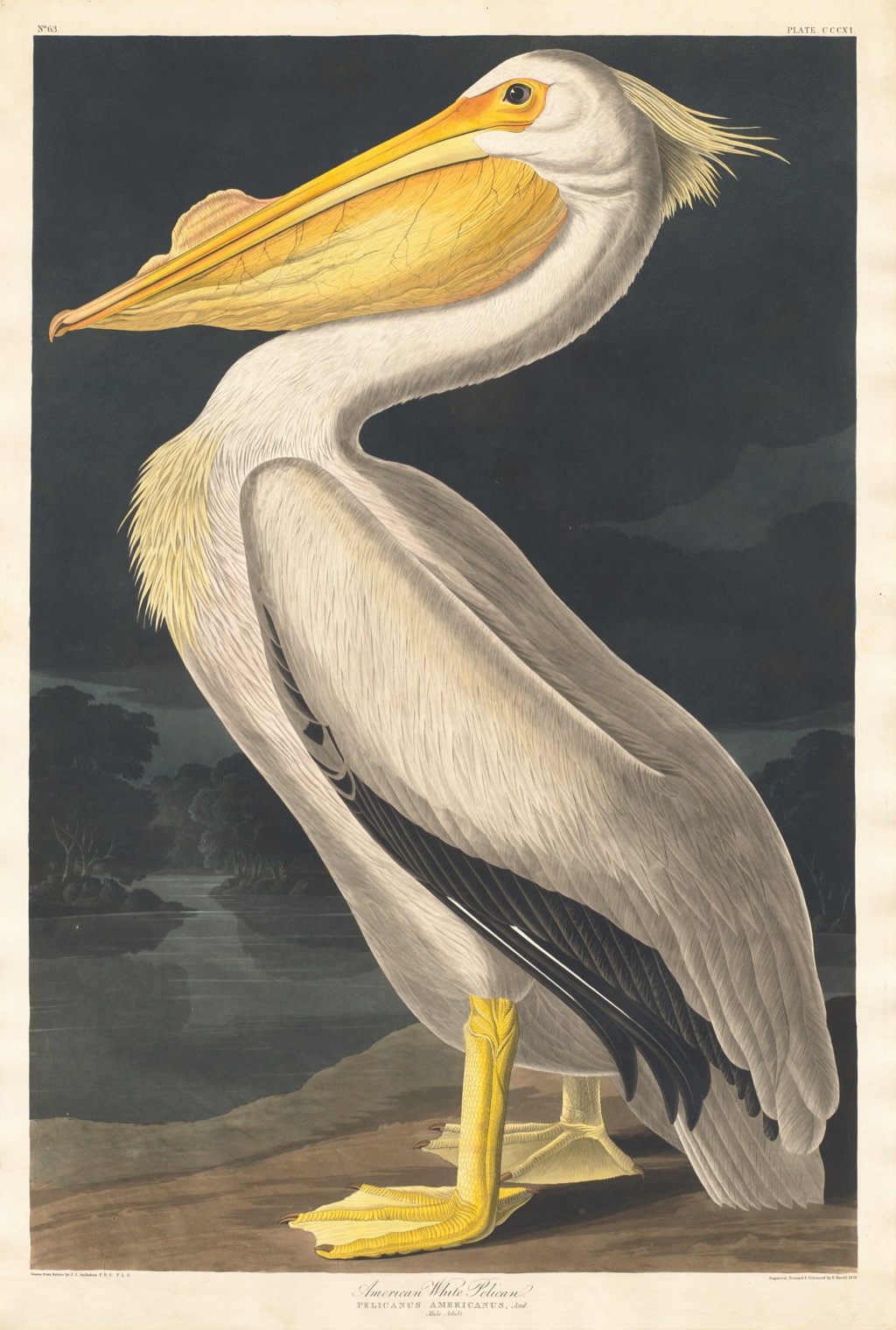
John James Audubon's American White Pelican is one of the great large-bird plates from The Birds of America. Published in 1836 as Plate CCCXI, it shows a single pelican standing at the edge of dark water, its huge bill and pouch hanging from a long pale neck. The bird faces left, wings folded, body upright and monumental. Behind it, water and trees recede into a sombre background. The result is calmer than many of Audubon's most theatrical hunting or feeding scenes, but no less commanding. The plate turns a massive waterbird into an object of stillness, weight and sculptural presence. [1]
The National Gallery of Art identifies the work as a hand-colored engraving and aquatint on Whatman wove paper by Robert Havell Jr. after John James Audubon. Its accession number is 1945.8.311, and its catalogue reference is Birds of America, no. 311. Those facts matter because Audubon images circulate so widely that the historic object can disappear behind generic reproductions. This plate is not just a pleasant pelican picture. It is a specific folio print from the most famous bird publication of the nineteenth century, made through drawing, engraving, aquatint, printing and hand coloring. [1]
The bird itself is the American White Pelican, Pelecanus erythrorhynchos, one of the largest birds in North America. Modern ornithological sources describe a species associated with inland breeding lakes, shallow wetlands, broad white wings with black flight feathers, cooperative surface feeding and long-distance movement between breeding and wintering grounds. Audubon's plate does not show a group feeding in formation or a flock soaring overhead. Instead, it concentrates on one bird's body. The image asks the viewer to study bulk, bill, pouch, posture and scale. [5], [6], [7]
At a Glance
- Public titleAmerican White Pelican
- SeriesThe Birds of America, Plate CCCXI [1]
- Catalogue referenceBirds of America, no. 311 [1]
- Date1836 [1]
- Maker lineRobert Havell Jr. after John James Audubon [1]
- Mediumhand-colored engraving and aquatint on Whatman wove paper [1]
- AccessionNational Gallery of Art, 1945.8.311 [1]
- Current species namePelecanus erythrorhynchos [5], [7]
- Image statusNGA public-domain media route [1]
Contents
- Introduction
- Annotated Details
- Object Facts
- What the Plate Shows
- Scale and the Double-Elephant Folio
- The Bird Behind the Image
- Bill, Pouch and Breeding Form
- Place in The Birds of America
- Printmaking and Collaboration
- Natural History and Modern Conservation
- Why This Plate Matters
Annotated Details from American White Pelican
These annotated details follow the American White Pelican through the enormous bill, bright pouch, eye, crest, white plumage, black wing feathers, yellow feet and dark water setting that make the page one of Audubon's most imposing bird images.
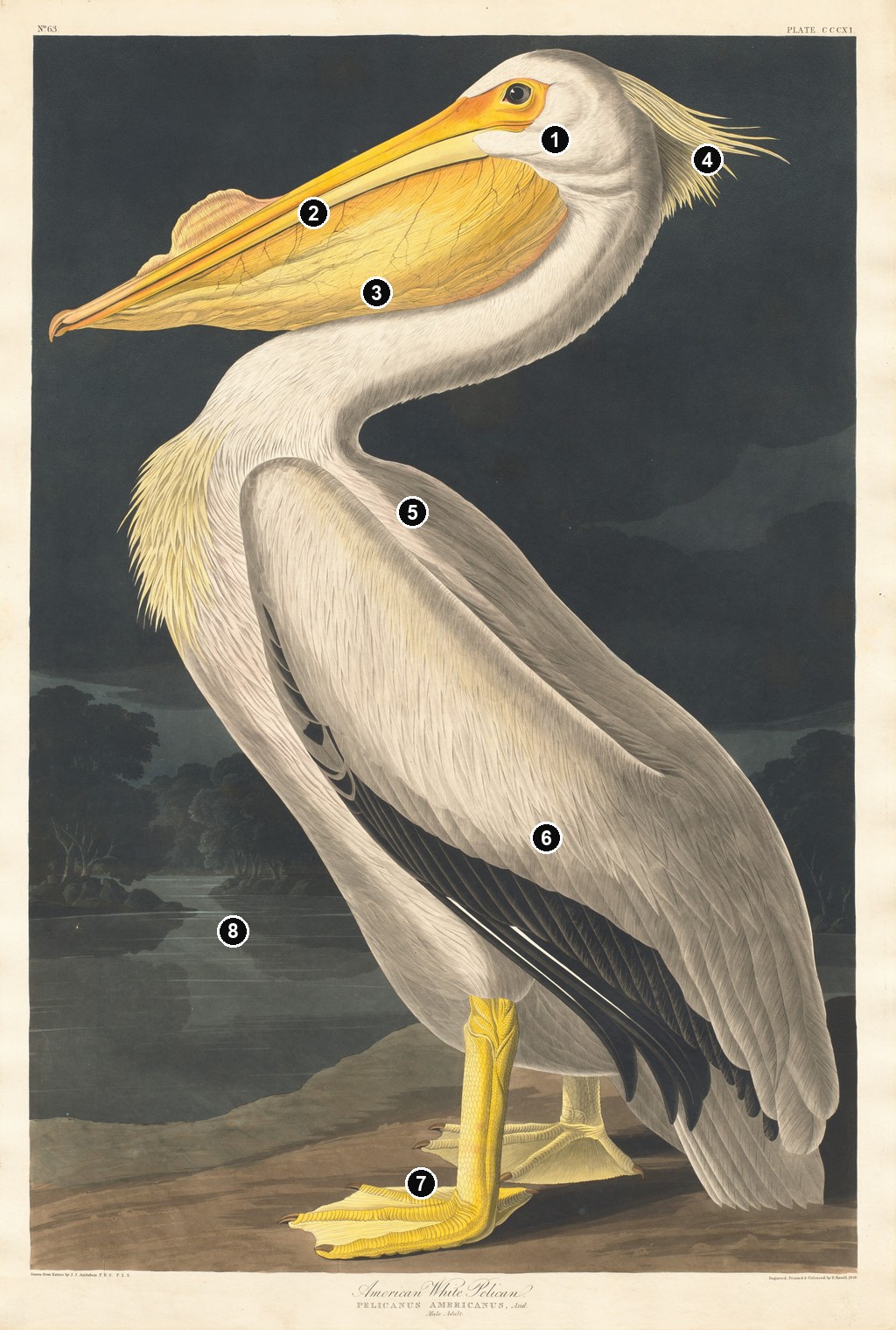
Details from AMERICAN WHITE PELICAN
Close looking shows how Audubon turns a large white bird into a graphic study of scale, surface, silhouette and controlled colour.
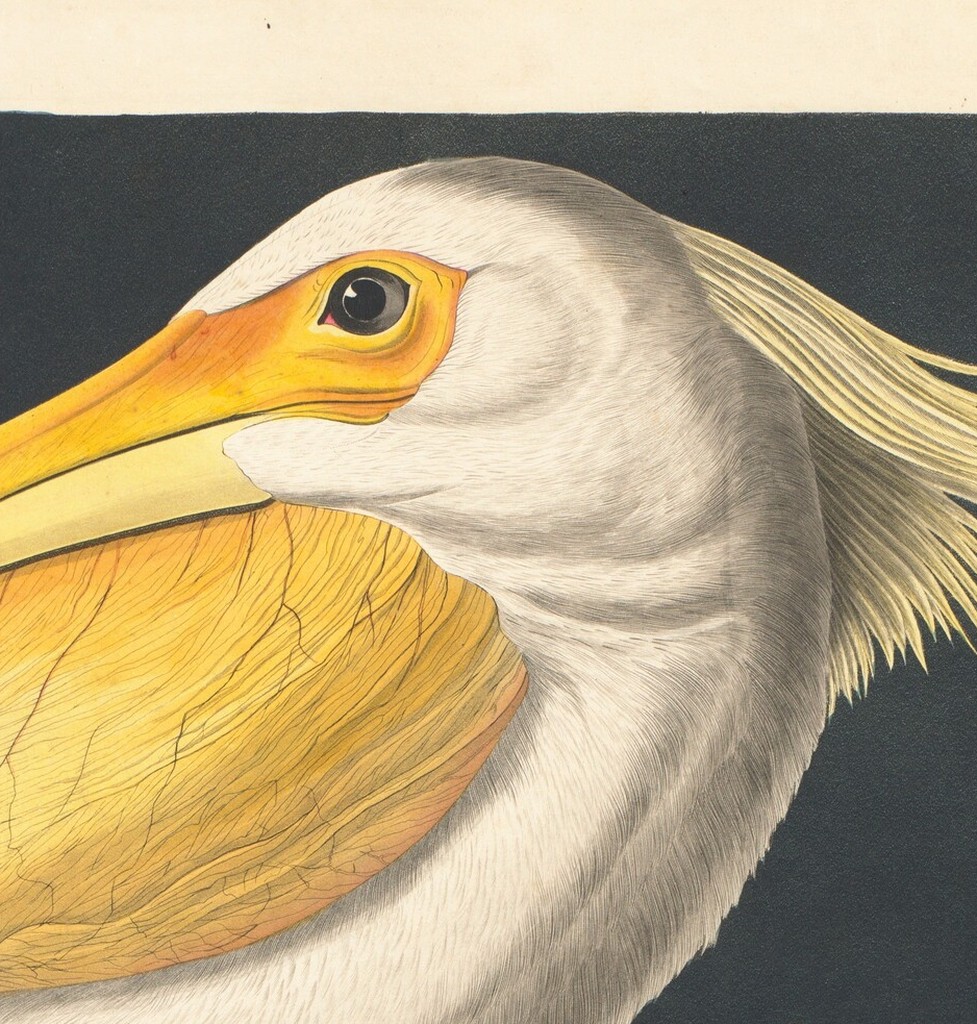
Eye and facial colour
The eye is ringed by bright yellow and orange, a small but powerful note against the white head. It fixes the bird's alertness near the top of the sheet.
Long bill
The bill stretches across the upper composition like a measured line. Its length is one reason the bird feels so large, even before the full body is read.
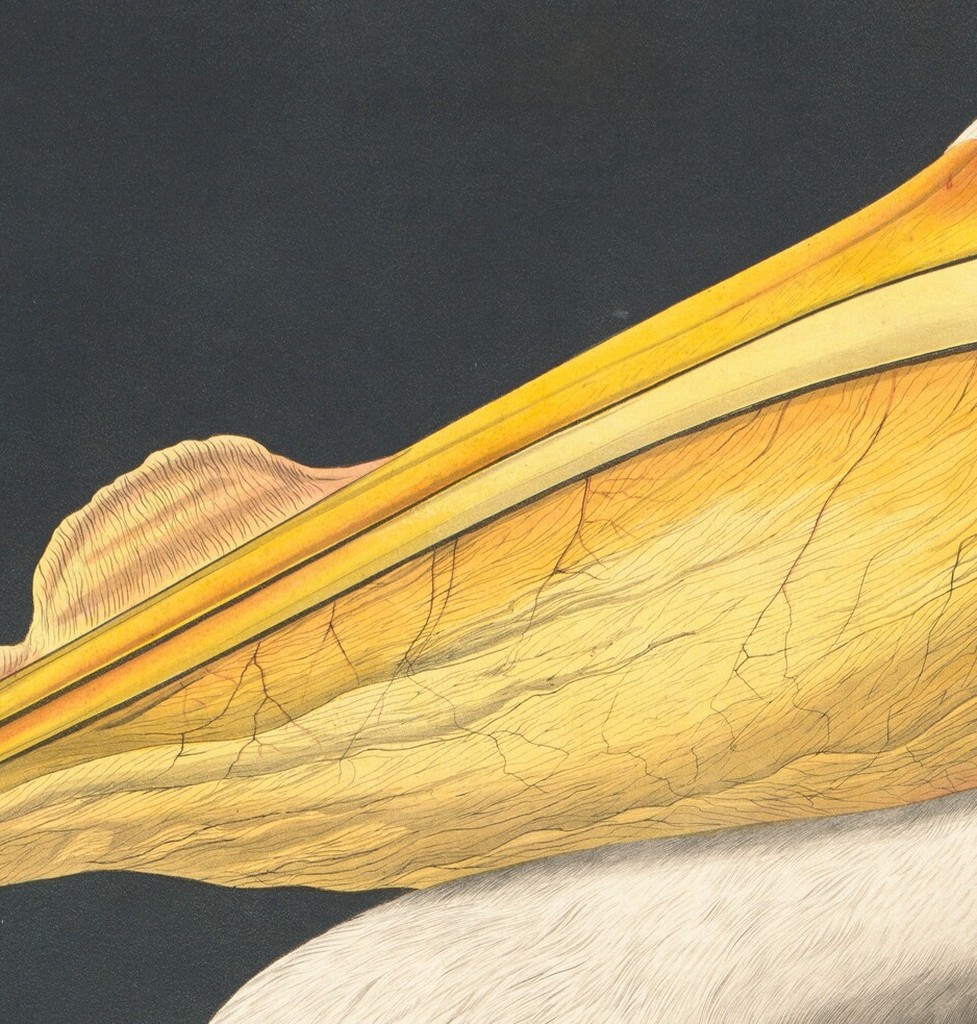
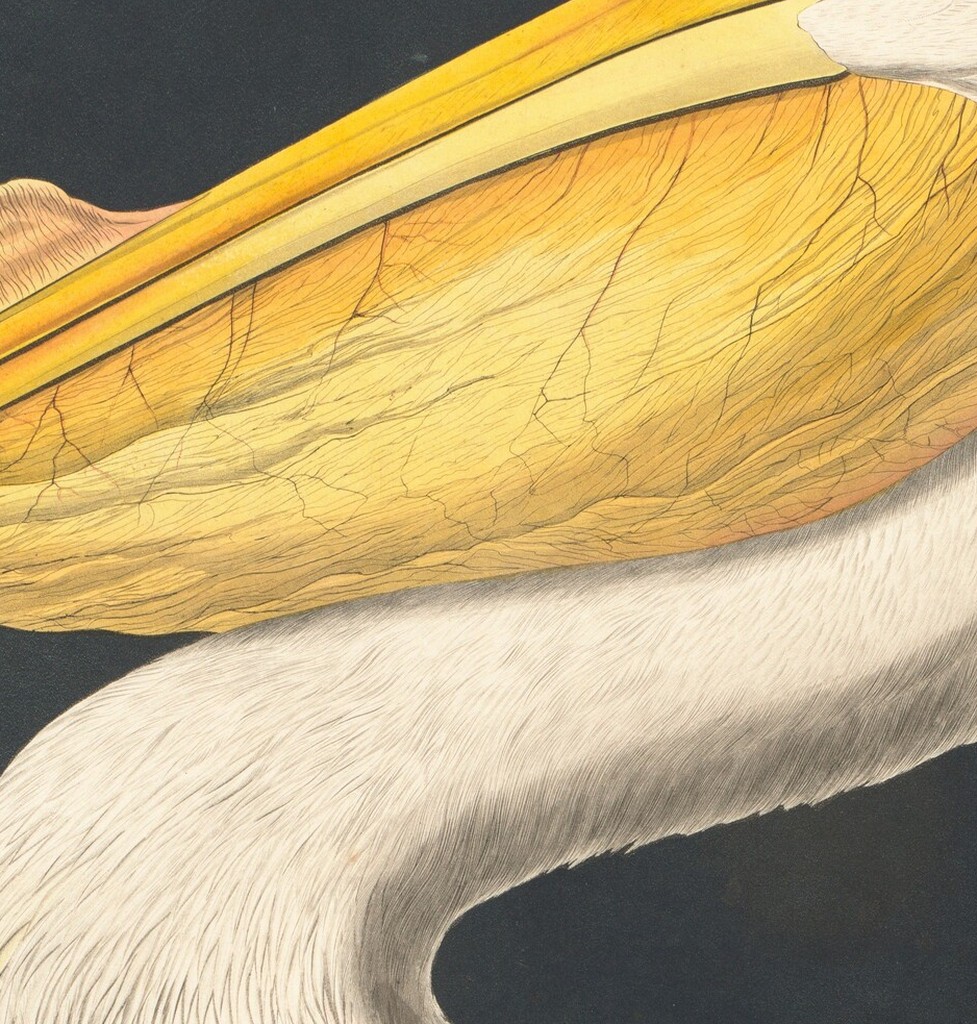
Throat pouch
The pouch is rendered as a broad yellow plane with veins and folds. Audubon makes a functional anatomical feature carry much of the plate's colour.
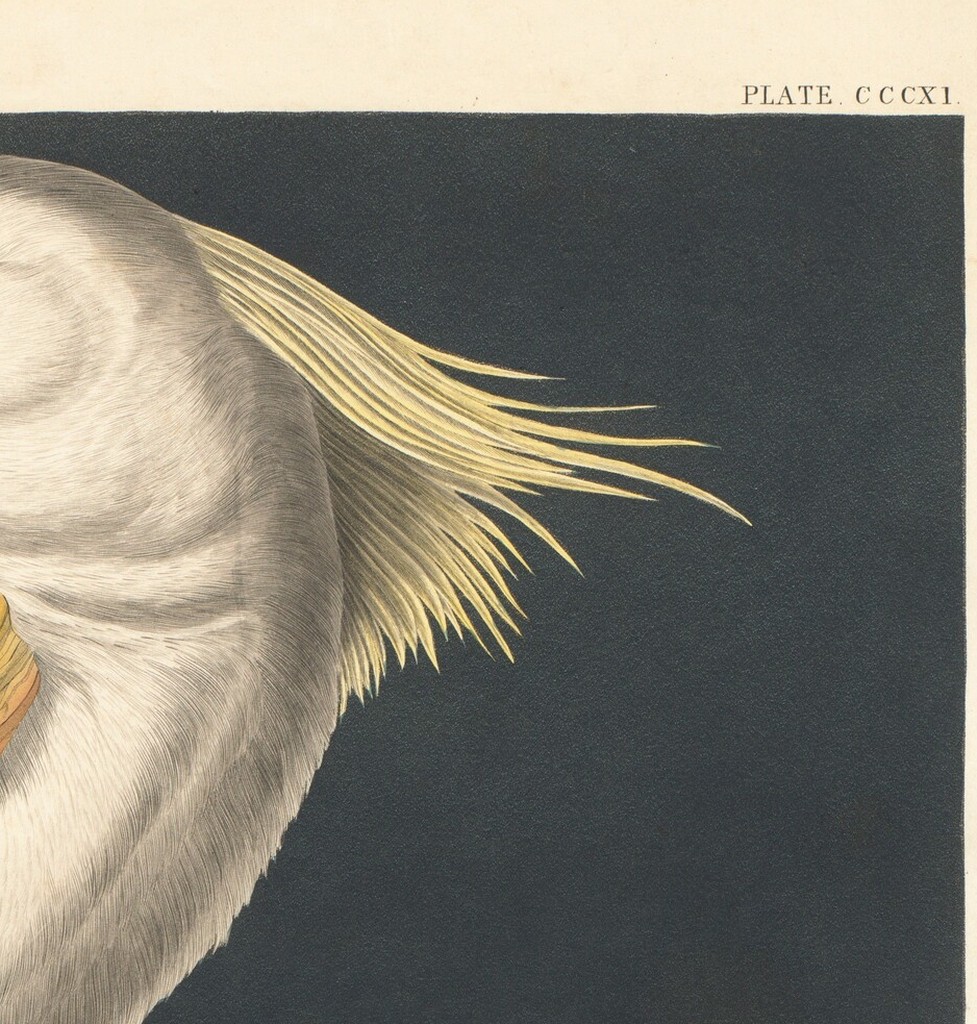
Trailing head plumes
Fine plumes extend from the back of the head into the dark ground. Their thin lines make the white head feel delicate despite the bird's mass.
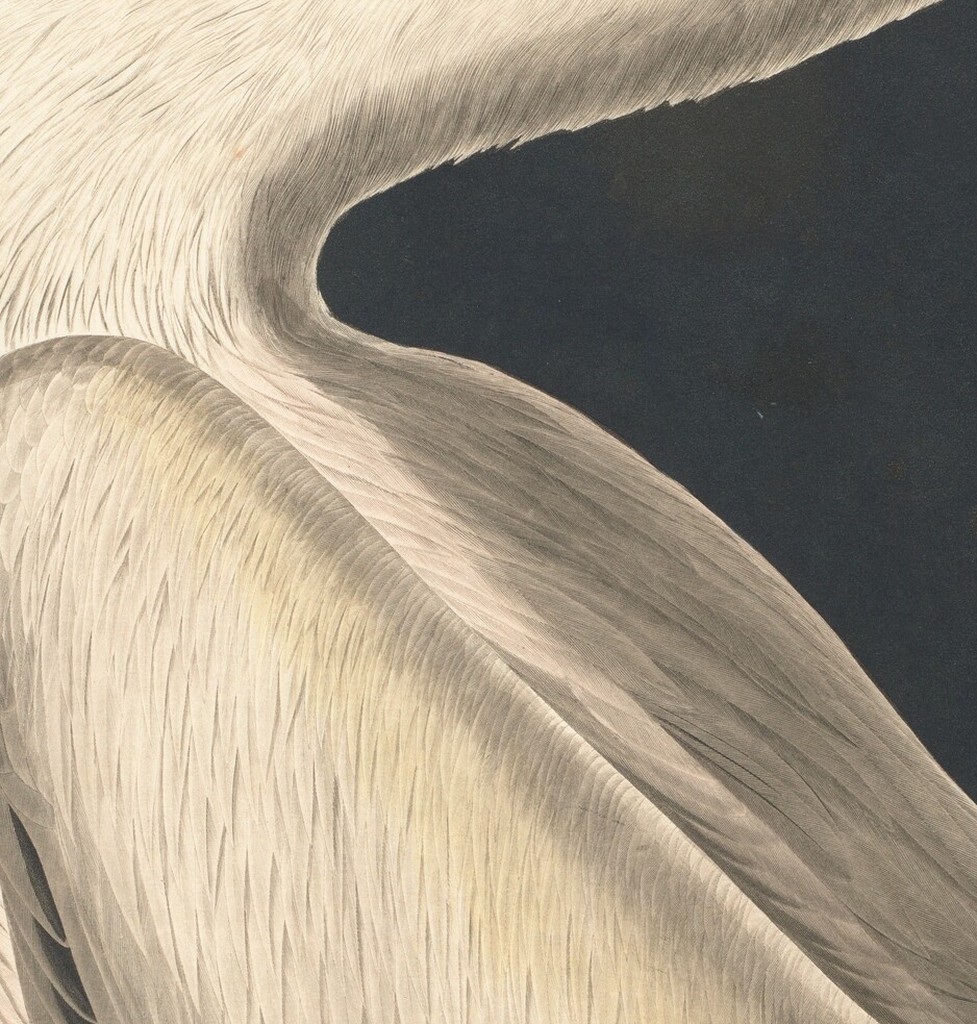
Curved neck
The neck folds into a strong S-curve below the bill. It links head, body and wing while keeping the large form graceful.
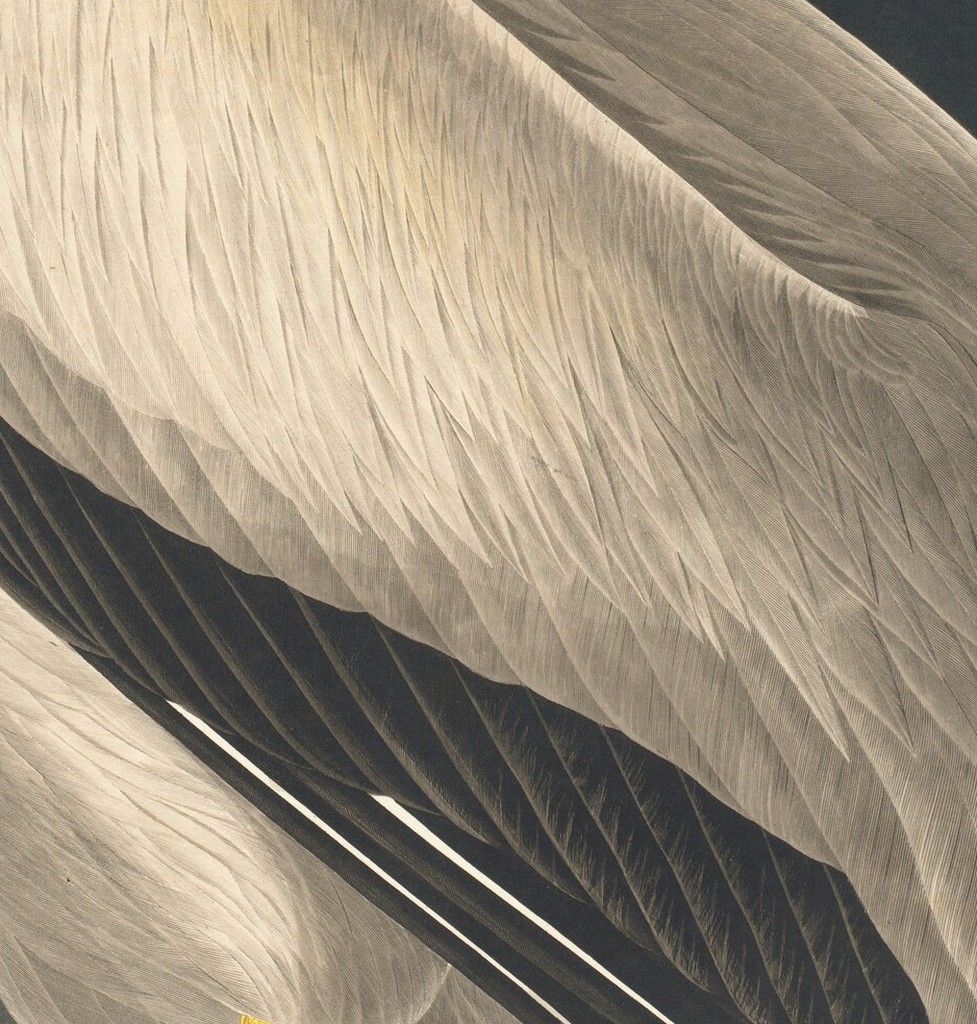
Wing and dark primaries
The grey-white wing and black primaries give the lower half its structure. Dark feathers cut through the pale body and prevent it from dissolving into the background.
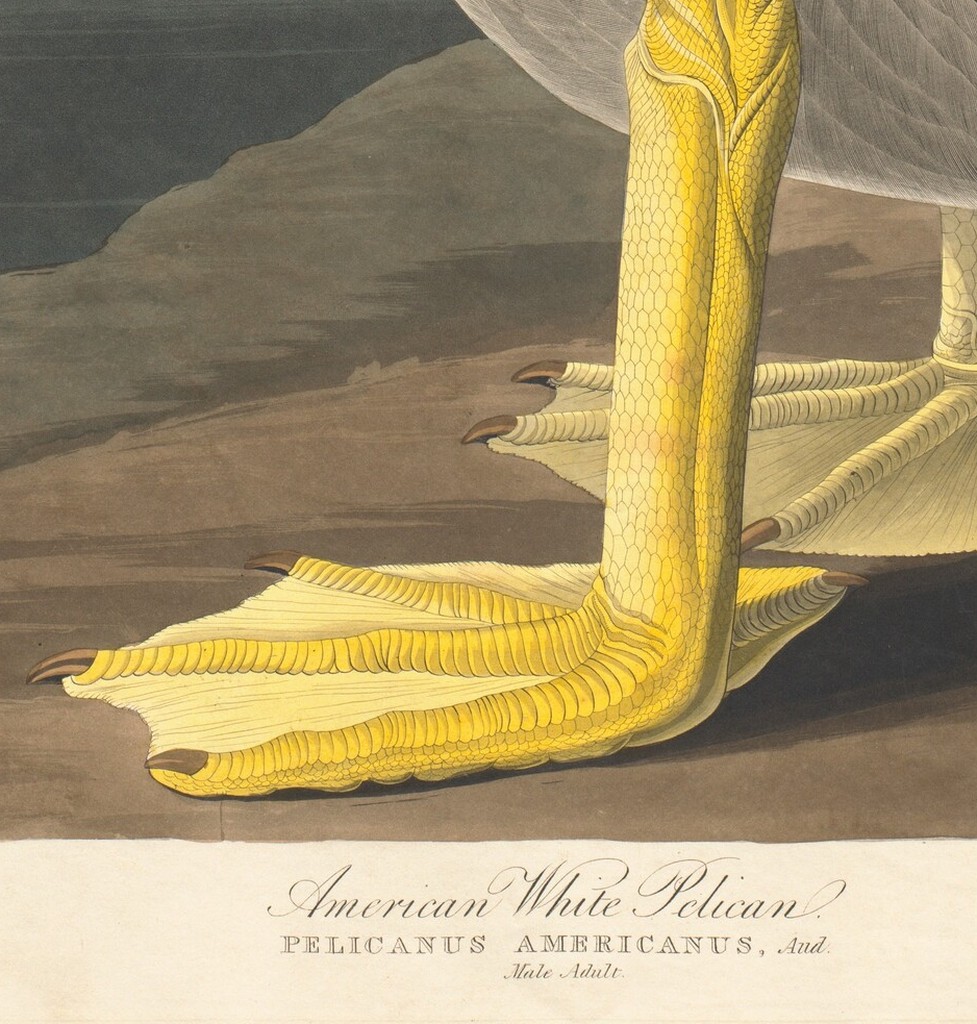
Yellow webbed feet
The large yellow feet bring the monumental bird back to the ground. Their webbed form is both descriptive detail and compositional anchor.
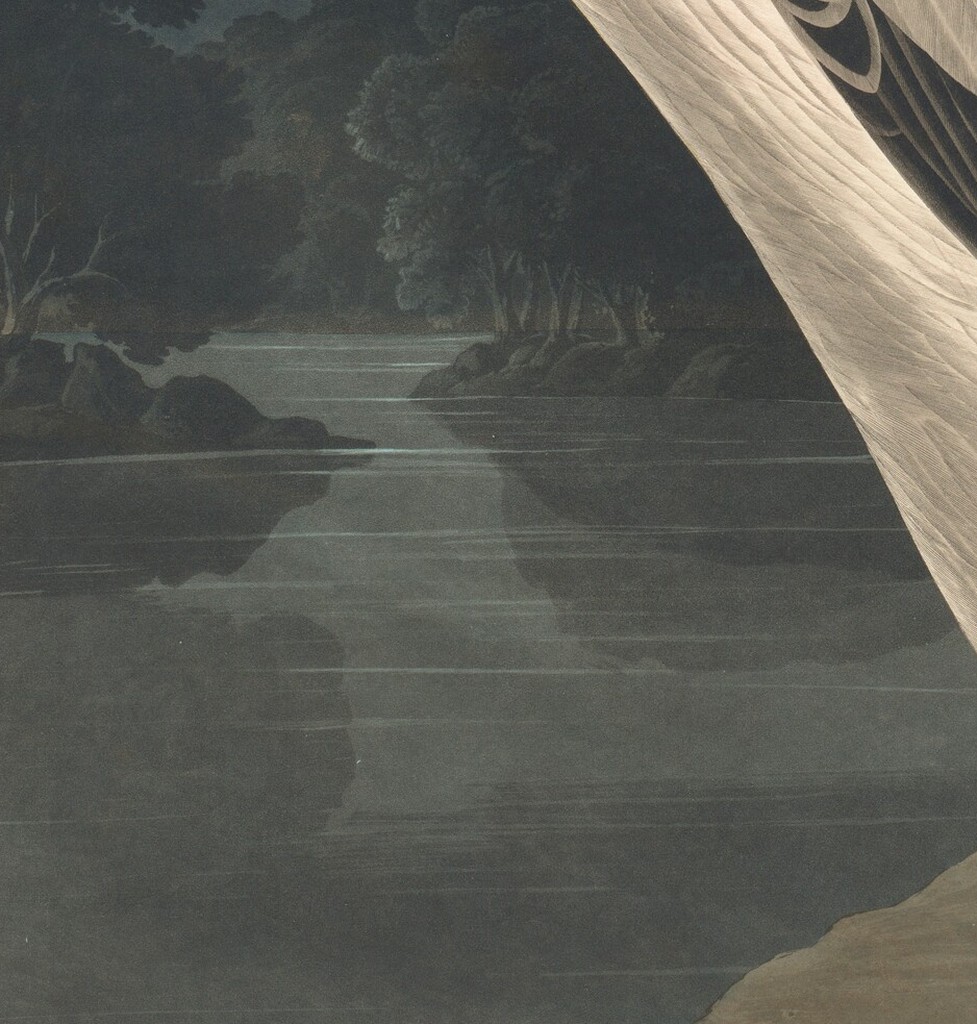
Dark water landscape
The dark water and low trees create a quiet setting behind the bird. The landscape lets the pale body stand out without becoming a plain studio backdrop.
Object Facts
Audubon's American White Pelican belongs to The Birds of America, the double-elephant folio publication issued between 1827 and 1838. The National Gallery of Art records the plate as number 311 in the sequence and as The Birds of America: Plate CCCXI. It dates the impression to 1836 and gives the maker line as Robert Havell Jr. after John James Audubon. That wording captures the collaborative nature of the work: Audubon supplied the design and naturalist vision, while Havell translated it into the printed plate. [1], [2]
The medium is hand-colored engraving and aquatint on Whatman wove paper. The National Gallery gives the image dimensions as 89.54 by 60.01 centimetres, with a plate size of 97 by 64.8 centimetres and a sheet size of 100.4 by 67.6 centimetres. Those measurements are part of the meaning. The pelican is presented on a sheet large enough to make its physical presence plausible. This was the core ambition of The Birds of America: to show birds at or near life size wherever possible. [1], [4]
The plate's credit line is the Gift of Mrs. Walter B. James. NGA also records the work's media as free and in the public domain. That institutional route is important because Audubon images circulate widely in modern reproductions. A reliable version of the plate should be tied to a specific museum or library record, not treated as an anonymous historic bird picture. [1]
What the Plate Shows
The pelican stands near dark water, facing left. Its wings are folded, so the bird's black wing feathers appear only as accents along the edges. The body is mostly white, with warmer pale tones around the head and neck. The bill and pouch dominate the image. They are long, heavy and strongly shaped, with delicate linear markings that keep the pouch from becoming a blank mass. [1]
Audubon and Havell make the bird feel both still and immense. There is no plunging movement, no chase, no dramatic prey. The action is in the posture. The bird's neck drops into the pouch, the bill projects forward, the legs hold the body just above the ground, and the folded wings make the body seem compact but powerful. The surrounding landscape is subdued, which pushes the viewer's attention back to the pelican's anatomy.
This restraint is part of the plate's force. Many Audubon images are remembered for drama: birds attacking, feeding, fighting or curving through vegetation. American White Pelican uses a quieter form of drama. It makes scale visible through stillness. The bird is not doing much, but the viewer feels the difficulty of fitting such a creature into the page.
Scale and the Double-Elephant Folio
The American White Pelican was exactly the kind of subject that made Audubon's folio format necessary. Yale's Beinecke Library describes the double-elephant sheets as approximately 38 by 26 inches, the largest paper size available for the work, chosen so Audubon could print large birds at life size or close to it. The Natural History Museum in London similarly describes the original plates as double-elephant folio size, about 90 by 67 centimetres, and identifies the American White Pelican as Plate 311. [3], [4]
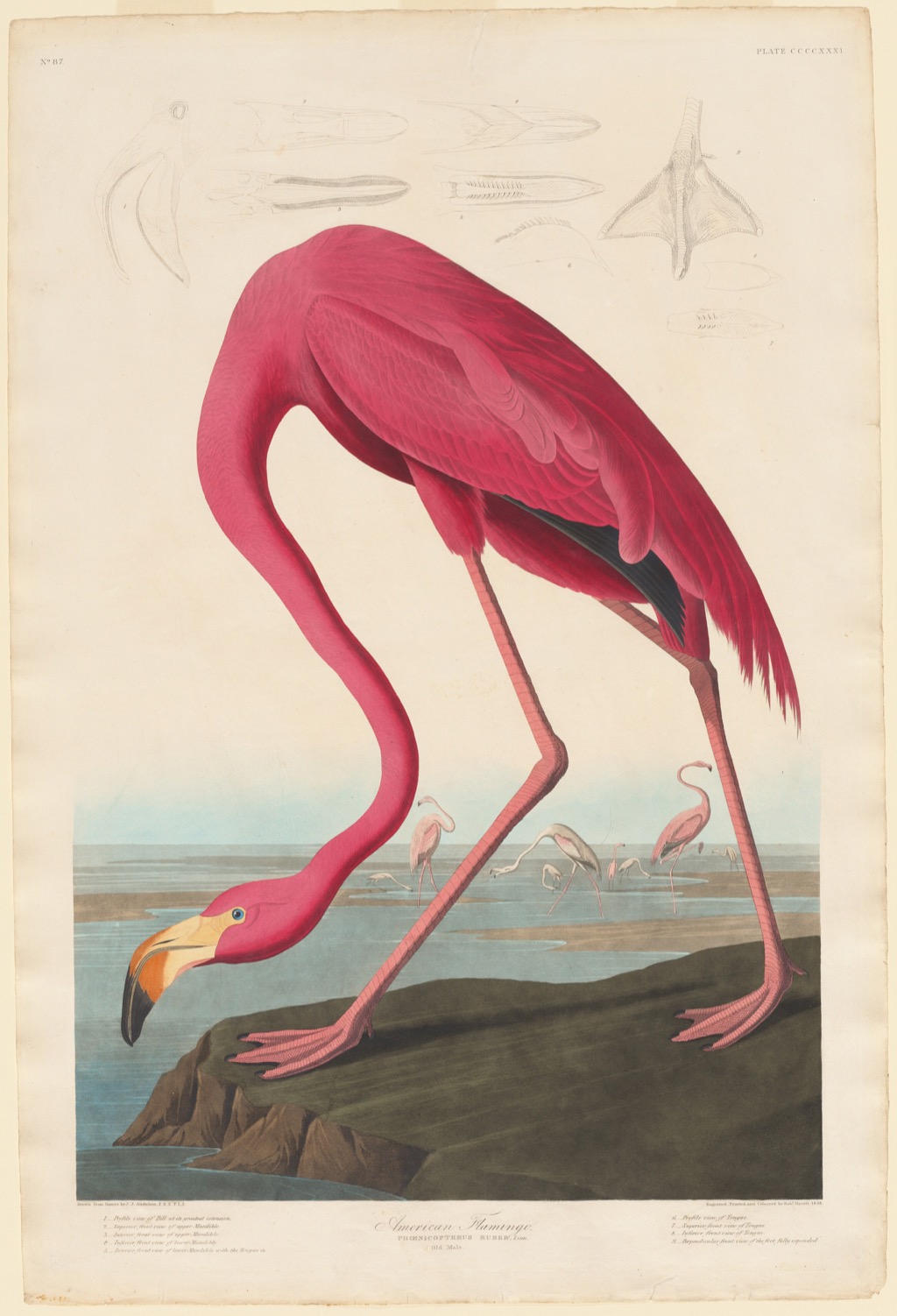
The pelican's body tests the limits of that format. Unlike the American Flamingo, which Audubon bends into a compressed curve, the pelican is broad and heavy. It cannot be made elegant simply by folding the neck into an ornamental line. Instead, the plate presents a standing mass: large bill, long neck, rounded body, wide wings tucked in. The bird's form has to be organised without losing its blunt power.
This is where the composition succeeds. The pelican's bill gives the image a strong horizontal movement. The body supplies bulk. The vertical legs and neck hold the figure in place. The dark water behind the bird gives contrast and makes the white body stand out. Audubon does not need a busy setting. The folio scale and the bird's anatomy provide enough drama.
The background also changes the emotional temperature of the plate. A bright open sky would have made the pelican look more decorative and perhaps more graceful. Instead, the darker setting makes the bird feel solitary and almost solemn. Its whiteness is not ornamental in a light, airy way. It is a large pale form held against depth. That contrast helps the viewer notice the folded wing, the heavy pouch, the firm feet and the quiet balance of the pose.
The Bird Behind the Image
The American White Pelican is a large waterbird of inland lakes, rivers, marshes and winter coastal habitats. Cornell's All About Birds identifies it as one of the largest North American birds and emphasizes its broad white-and-black wings, enormous bill and steady soaring flight. Animal Diversity Web gives the current scientific name as Pelecanus erythrorhynchos, with the species in the pelican family, Pelecanidae. [5], [7]
Modern sources also make clear that this bird behaves differently from the Brown Pelican, the other North American pelican many readers may know. The American White Pelican usually feeds from the water surface rather than diving from the air. Groups often work together, swimming and dipping their bills to push fish toward shallows where they can be scooped more easily. Cornell describes the food mainly as fish from shallow wetlands, with opportunistic variation by place and season. [5], [6], [7]
Audubon's plate does not show cooperative feeding. That absence is revealing. Instead of choosing the most social or active behaviour, he presents the pelican as a monumental individual. The bill and pouch still tell the viewer how the bird feeds, but the image is not a behaviour diagram. It is a portrait of presence.
The choice is especially interesting because the species is strongly social. It moves in flocks, breeds in colonies and can forage with striking coordination. A modern photograph often shows American White Pelicans as groups: lines of birds on the water, synchronized bills dipping, or white bodies circling high in the sky. Audubon's single standing bird removes that social setting. He isolates the form so the viewer can understand the species through anatomy and scale first. [5], [6], [7]
Bill, Pouch and Breeding Form
The American White Pelican's bill is one of the key visual facts of the species. It is long, heavy and attached to an expandable pouch used for scooping prey from the water. Cornell notes that the pouch is used to scoop and drain, not to carry food around. Animal Diversity Web describes the bill and pouch as flesh-coloured or yellow, with legs ranging from pale yellow to bright orange. [5], [7]
In breeding season, both males and females develop a flattened structure on the upper bill that is later shed. Audubon's plate emphasizes the long bill and pouch rather than turning the bird into a scene of courtship display. The bill remains the centre of the image, but the viewer is encouraged to read it as form: line, weight, pattern, volume. [7]
Havell's printmaking is especially important here. The pouch could easily become a flat shape, but the engraved lines and hand coloring make it feel veined, flexible and suspended. The head and bill are not simply descriptive; they are the compositional hinge of the whole plate. They draw the eye forward and downward, giving the standing bird its particular gravity.
The breeding-bill detail also reminds us that a plate can preserve more than general identification. The American White Pelican changes visibly across the year, and modern bird sources describe the temporary upper-bill structure associated with breeding adults. For a viewer, that detail helps explain why the head can seem so unusual. Audubon was not only showing a white bird with a pouch. He was making the species recognizable through features that belong to its seasonal life. [7]
Place in The Birds of America
As Plate CCCXI, American White Pelican appears in the later part of The Birds of America. By this point the project had already demonstrated its range: small songbirds, owls, extinct species, wading birds, waterbirds and enormous display subjects. The pelican belongs with the large water-bird plates that reveal the practical challenge of Audubon's life-size ambition. [1], [2]
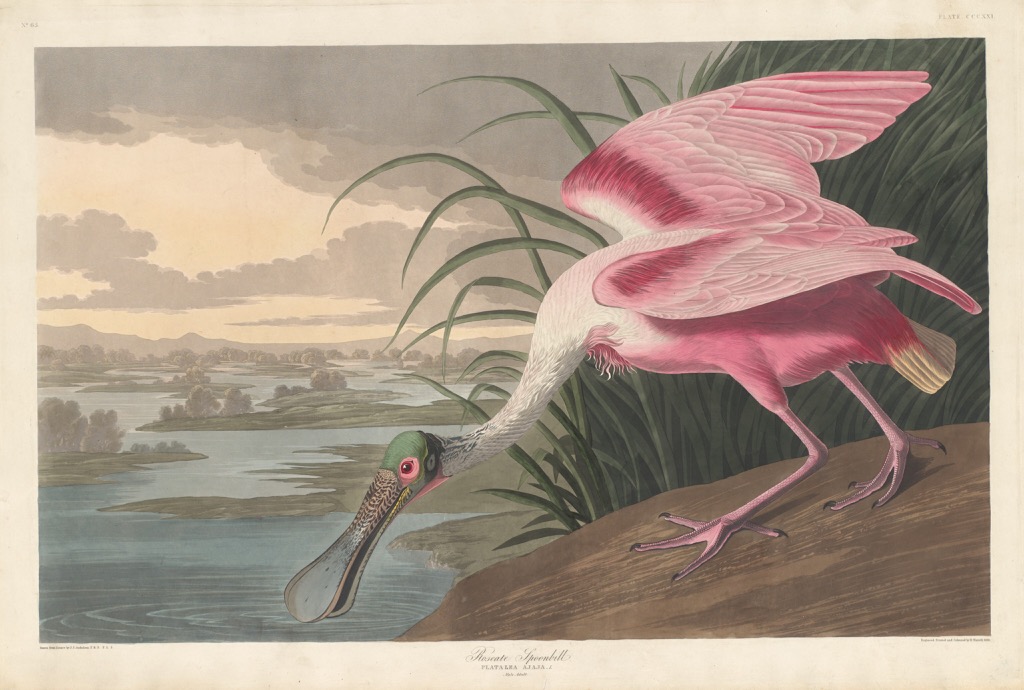
It is useful to compare the plate with nearby reader pathways. The Roseate Spoonbill uses color and bill shape to create immediate decorative impact. The Great Blue Heron works through long-legged verticality and wary wetland presence. The Louisiana Heron depends on slenderness and current-name complexity. American White Pelican has a different strength: breadth, whiteness, bill structure and the implied weight of a bird that is majestic in flight but cumbersome on land.
The plate also connects back to the wider publication hub for The Birds of America. Audubon's project was not just to catalogue birds. It was to make them physically and visually memorable. The pelican plate shows how a single bird, standing still, could justify the grand format.
Printmaking and Collaboration
The maker line Robert Havell Jr. after John James Audubon should not be skimmed past. It tells the story of the printed object. Audubon observed, collected, drew and composed. Havell engraved, printed and helped realize the design as a folio plate. Hand coloring then gave the print its final surface. [1]
This matters because the qualities that make the plate persuasive are print qualities as well as drawing qualities. The bird's white body needs subtle tonal variation so it does not vanish into the paper. The water and trees need enough darkness to hold the background back. The pouch needs fine linear definition. The black wing feathers need to register without overpowering the largely pale bird.
The double-elephant folio made all of this harder. Large paper required large plates, skilled handling and a subscription audience willing to fund the result. Yale notes that the format created logistical difficulty for engravers and printers. American White Pelican is therefore not only a natural-history image. It is evidence of a printmaking system capable of turning Audubon's large-bird ambition into a finished sheet. [4]
This helps explain why the plate feels different from a later reduced edition or modern poster. The size, medium and paper are not neutral containers. They are part of the promise. In the original folio context, the pelican's large body was meant to confront the viewer at a scale that smaller books could not match. Reproductions can preserve the outline and color, but they cannot fully reproduce the physical argument of the sheet.
Natural History and Modern Conservation
Modern readers see the American White Pelican with knowledge Audubon did not have. Cornell currently lists the species as of low conservation concern, while also noting its sensitivity to disturbance at breeding colonies and the importance of wetland conditions. Animal Diversity Web similarly notes broad range and Least Concern status, while recording historical pressures such as habitat destruction, disturbance and pesticide effects. [6], [7]
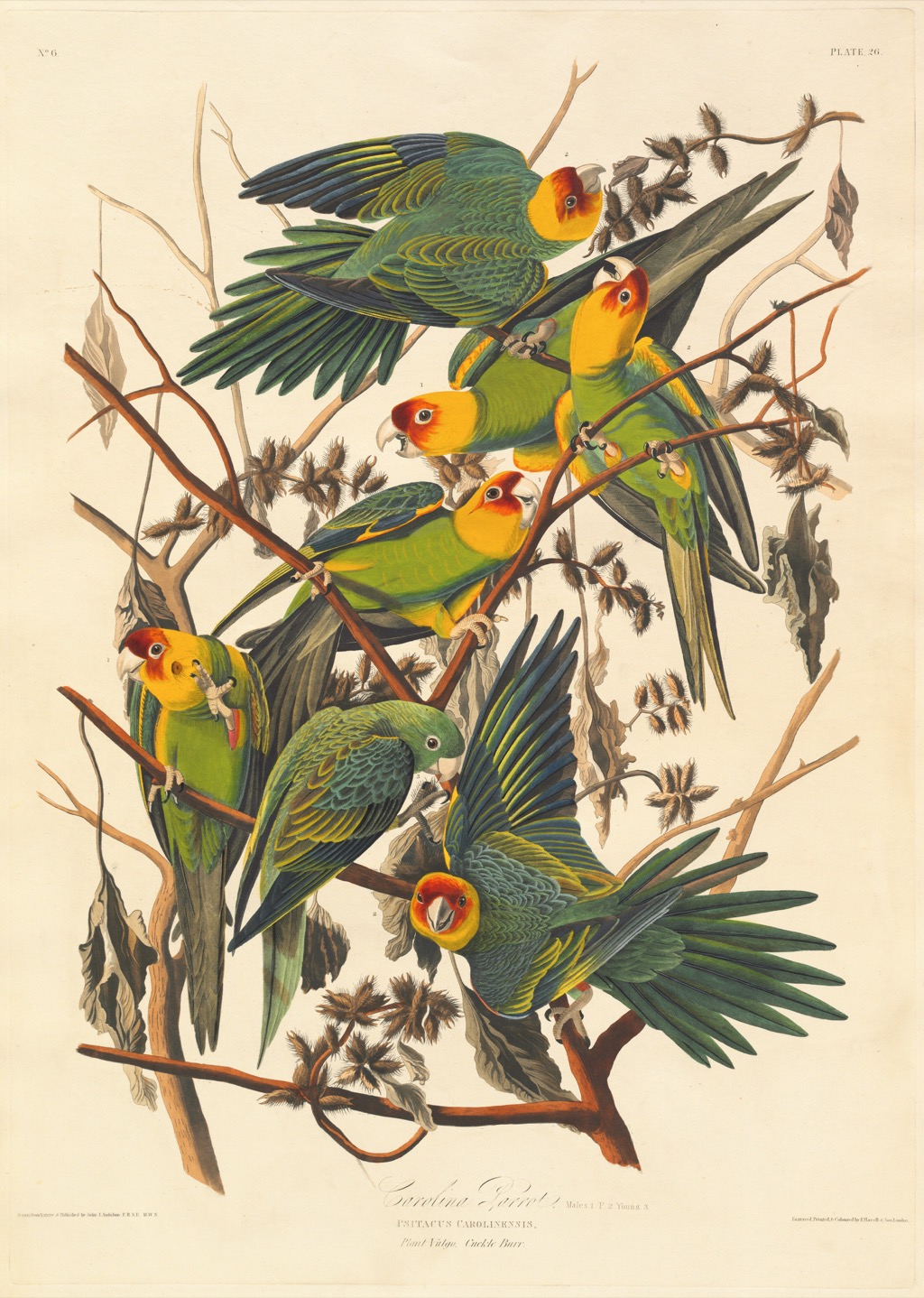
This makes the pelican different from Audubon's images of the Carolina Parakeet or Passenger Pigeon, where extinction changes the image into a memorial. The American White Pelican is still a living, observable species. Yet the plate is not free from environmental history. It asks us to think about wetlands, breeding colonies, migration routes, water management and the human tendency to misunderstand fish-eating birds. [6], [7]
The plate's stillness can therefore feel contemporary. It gives the pelican dignity without sentimentality. The bird is not cute, miniature or decorative in a simple way. It is large, awkward, pale, watchful and self-possessed. That is part of why the image works so well for modern nature readers: it respects the bird's strangeness.
Why This Plate Matters
American White Pelican matters because it shows Audubon solving one of his central artistic problems: how to make a large bird legible, impressive and believable on a printed sheet. It is not among the most violent or crowded plates. It does not rely on extinction drama. Its power comes from scale, restraint and anatomical concentration.
The plate also shows why The Birds of America remains more than a scientific catalogue. A field guide might show the bird clearly. Audubon gives it weight, setting and mood. The pelican becomes an image to look at slowly: bill first, then pouch, neck, body, wing edge, water and sky. The viewer moves from species recognition into visual analysis.
Within the Audubon cluster, this plate is a natural bridge between the publication story and the individual bird pages. It shares the large-bird ambition of the flamingo, the wetland world of the herons and spoonbill, and the modern ecological relevance of the living species pages. It is one of the clearest examples of Audubon turning a bird's physical scale into artistic authority.
Frequently Asked Questions
Discussion
American White Pelican turns a huge waterbird into a quiet study of scale, bill, pouch and printed presence.
Use the prompts below to think about folio scale, natural-history detail and the difference between stillness and inactivity.
Reader Insights
How does the double-elephant format change the way the pelican's body feels on the page?
What does the long bill tell you before any species description begins?
Does the calm pose make the plate feel less dramatic, or does it create another kind of drama?
Join the Conversation
Share your reading of Audubon's American White Pelican and its monumental stillness below.
References
- National Gallery of Art, American White Pelican, accession 1945.8.311, accessed 26 July 2026.
- Biodiversity Heritage Library, The Birds of America, accessed 26 July 2026.
- Natural History Museum, London, The Birds of American Animals, accessed 26 July 2026.
- Yale Beinecke Library, The Double Elephant Folio, accessed 26 July 2026.
- Cornell Lab of Ornithology, All About Birds, American White Pelican overview, accessed 26 July 2026.
- Cornell Lab of Ornithology, All About Birds, American White Pelican life history, accessed 26 July 2026.
- Animal Diversity Web, Pelecanus erythrorhynchos, accessed 26 July 2026.