 by Tom Gurney
Tom Gurney BSc (Hons) is an art history expert with over 20 years experience
Published on July 26, 2026 / Updated on September 6, 2026
Email: tomgurney1@gmail.com / Phone: +44 7429 011000
Ivory-billed Woodpecker: Introduction
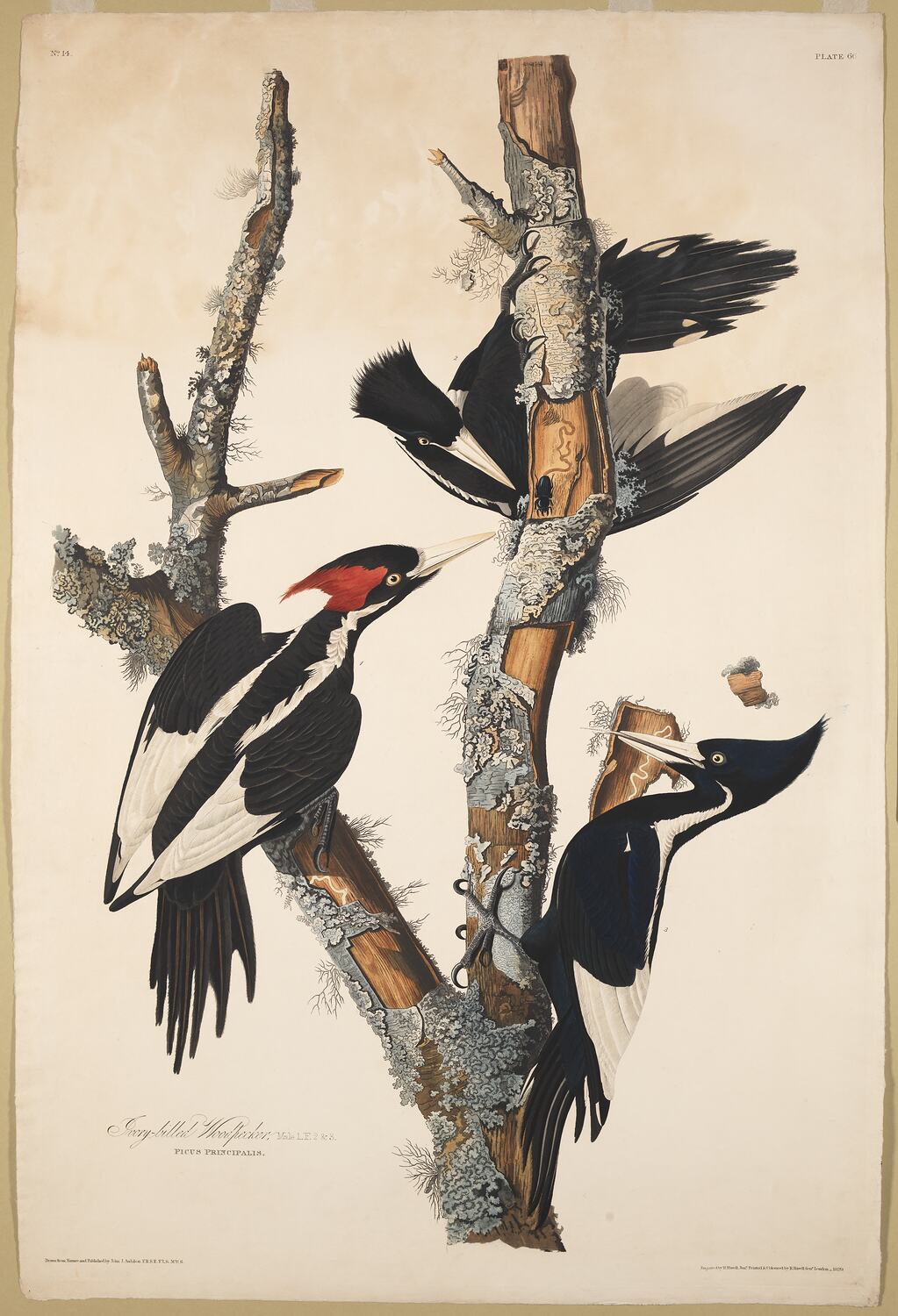
John James Audubon's Ivory-billed Woodpecker is one of the most charged plates in The Birds of America. It shows a great black-and-white woodpecker of southern forests, a bird with a pale bill, bold wing patches and a crest that separates male from female. It is also an image shadowed by uncertainty. The species is federally endangered in the United States and listed as Critically Endangered internationally, yet many authorities describe it as probably extinct or lost because no widely accepted modern population has been confirmed. [2], [5], [6]
That tension gives the plate its modern force. Audubon was not making an image of disappearance. He was recording a spectacular bird that still belonged to the living forests of his time. Today, the same image stands between art history, natural history and conservation memory. It is a print from an ambitious nineteenth-century book, a record of a species tied to old-growth habitat, and a reminder that some losses remain difficult to name with finality.
The active species name is Ivory-billed Woodpecker, Campephilus principalis. Museums Victoria records Audubon's print as Plate 66 from The Birds of America, showing a male and two females. The same record notes the original scientific name used by the artist as Picus principalis. Those names should be kept separate. Audubon's plate belongs to nineteenth-century taxonomy; modern sources use current names and current conservation language. [1]
At a Glance
- Public titleIvory-billed Woodpecker
- PlateThe Birds of America, Plate 66 [1]
- ObjectMuseums Victoria Item BA 18 [1]
- MakerJohn James Audubon [1]
- Mediumhand-coloured aquatint engraving on paper [1]
- Current nameCampephilus principalis [1], [2]
- Historic namePicus principalis [1]
- Status wordingFederally endangered; often described as probably extinct or lost [2], [5], [6]
- Image creditJohn James Audubon / Museums Victoria [1]
Contents
- Introduction
- Annotated Details
- Object Facts
- What the Plate Shows
- The Bird Behind the Image
- Forest, Damage and Survival
- Current Status, Carefully Stated
- Place in The Birds of America
- How to Read the Plate Today
- Why This Plate Matters
Annotated Details from Ivory-billed Woodpecker
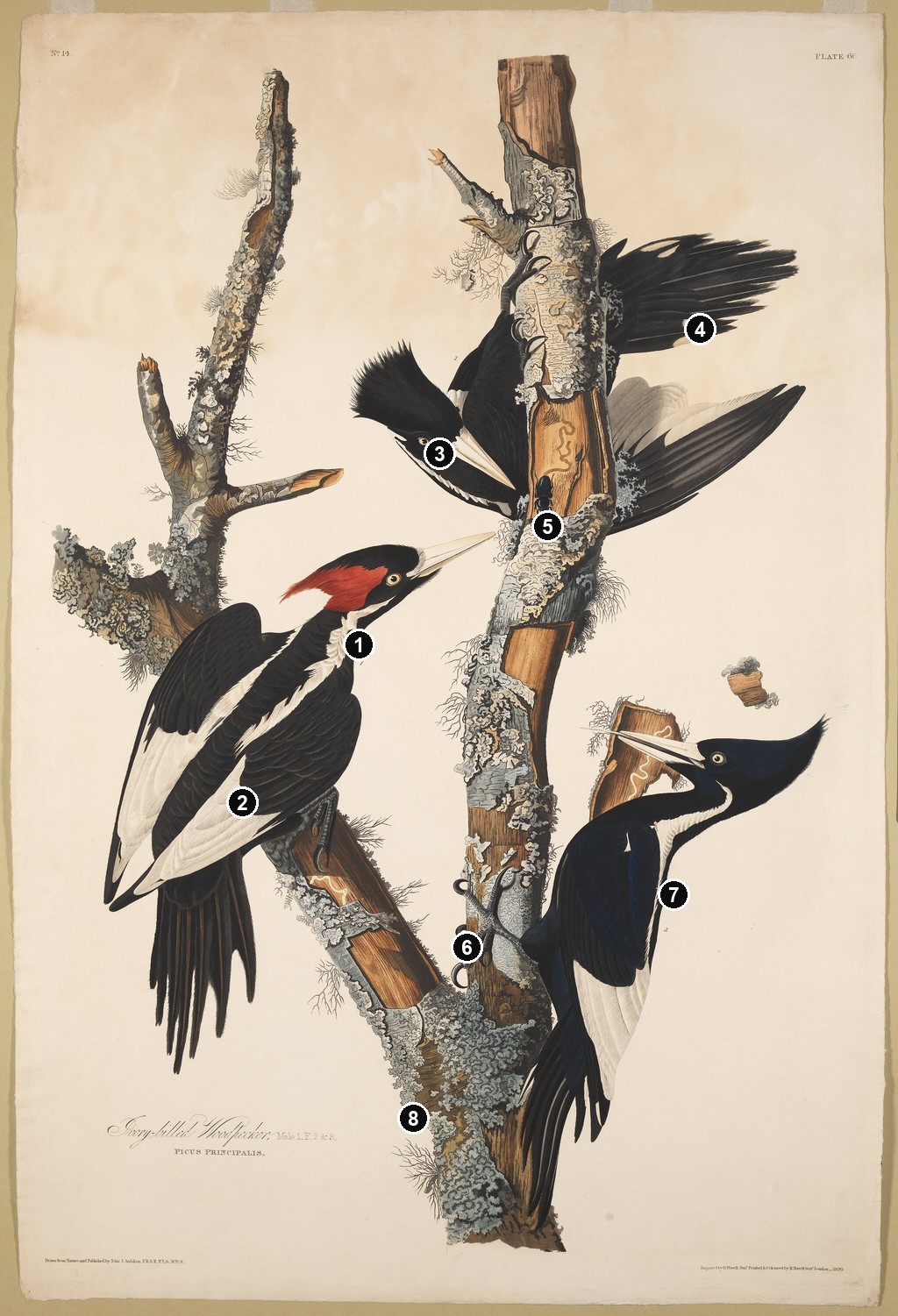
These annotated details follow Audubon's Ivory-billed Woodpecker through the red crest, pale bill, black-and-white plumage, tree trunks, bark texture and multiple bird poses.
Details from IVORY-BILLED WOODPECKER
Close looking shows how the plate builds drama from repeated birds, broken wood, high-contrast plumage and the active surface of a dead tree.
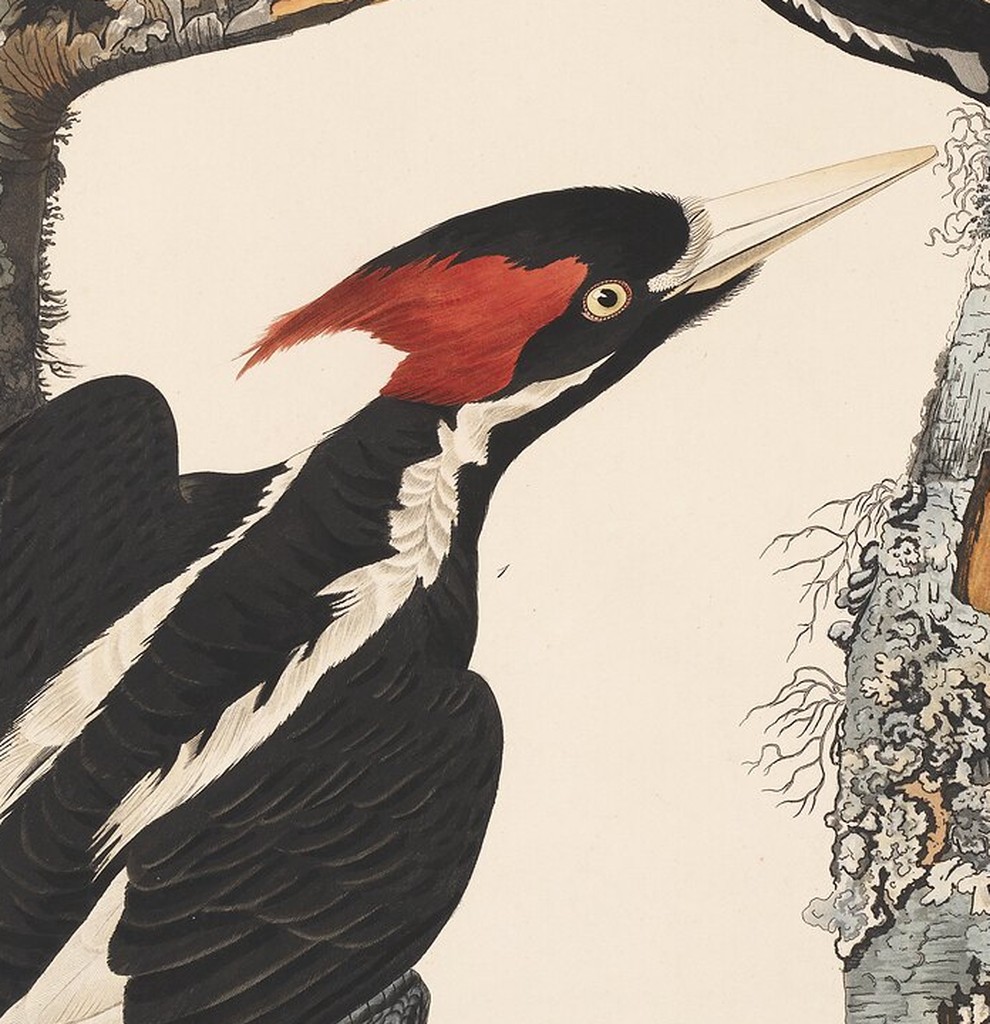
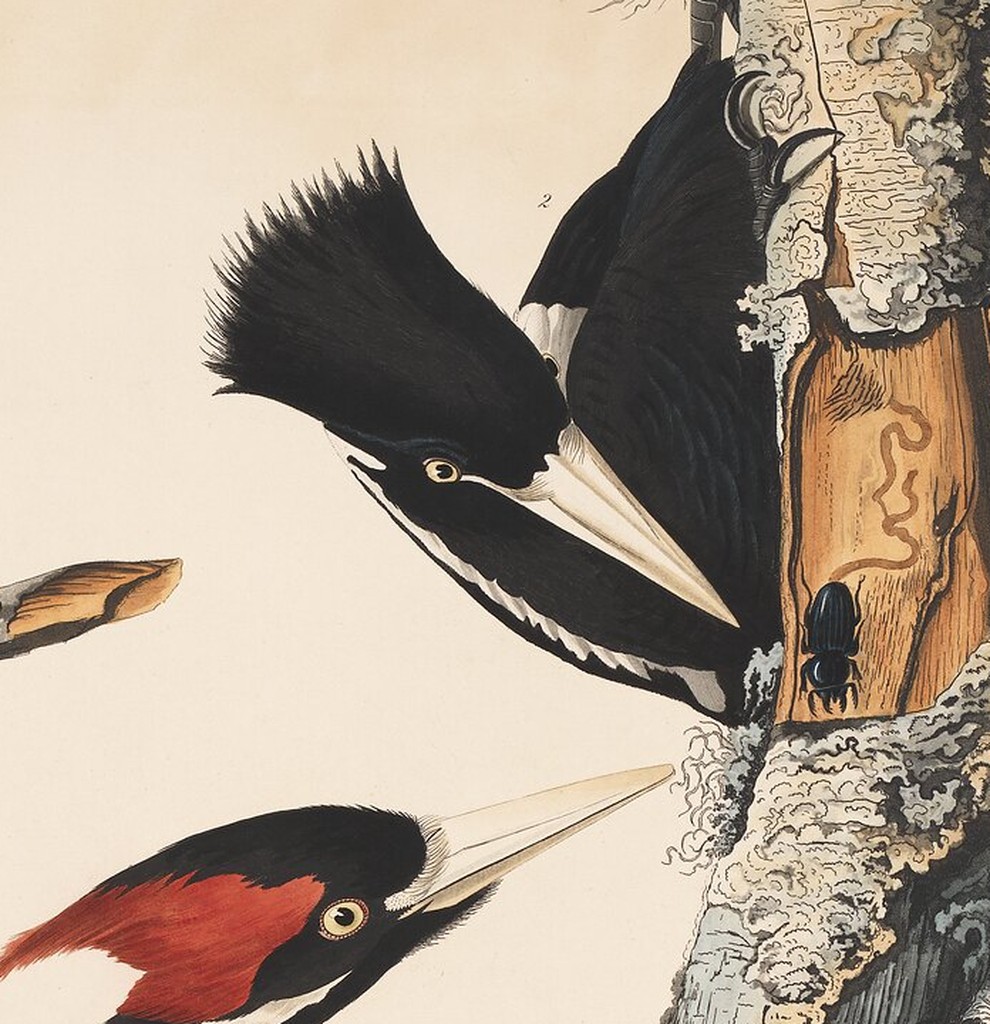
Red crest and pale bill
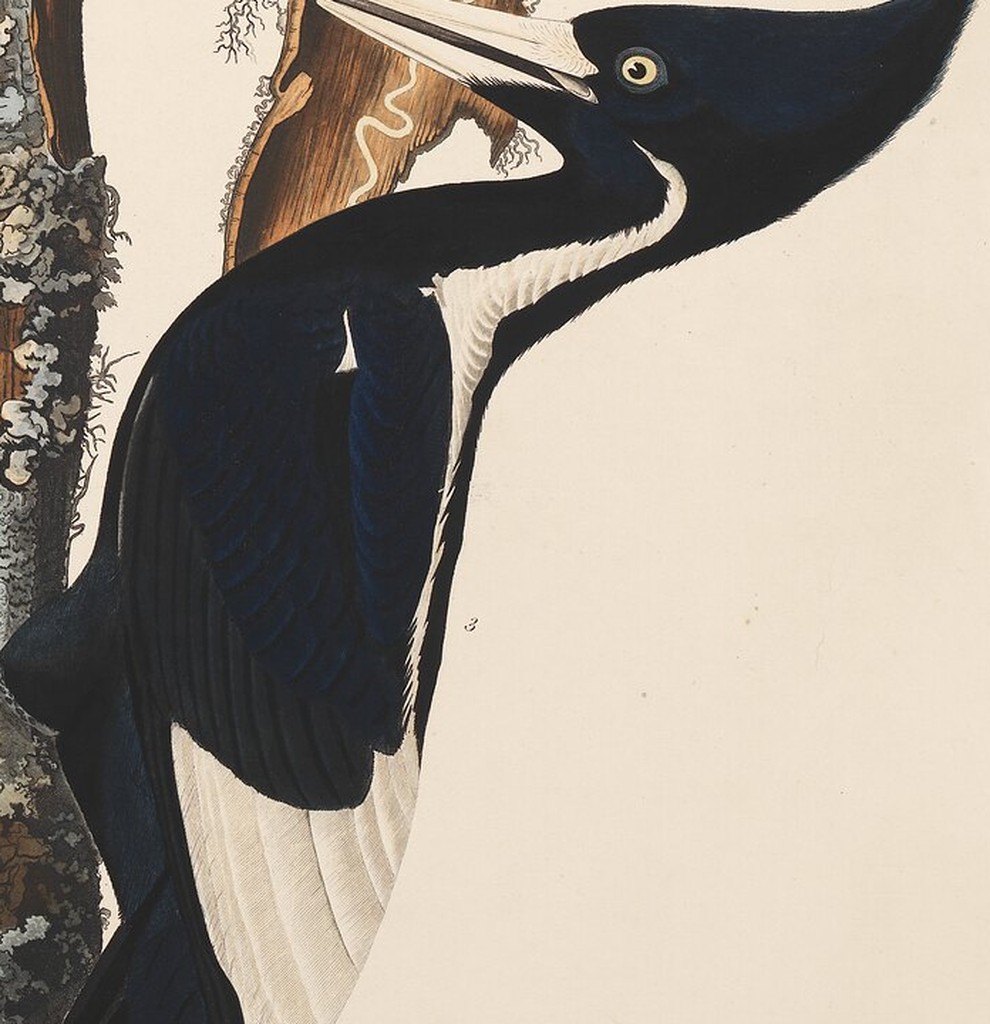
The red crest and long pale bill make the left bird immediately distinctive. The head turns upward, linking bird and tree trunk.
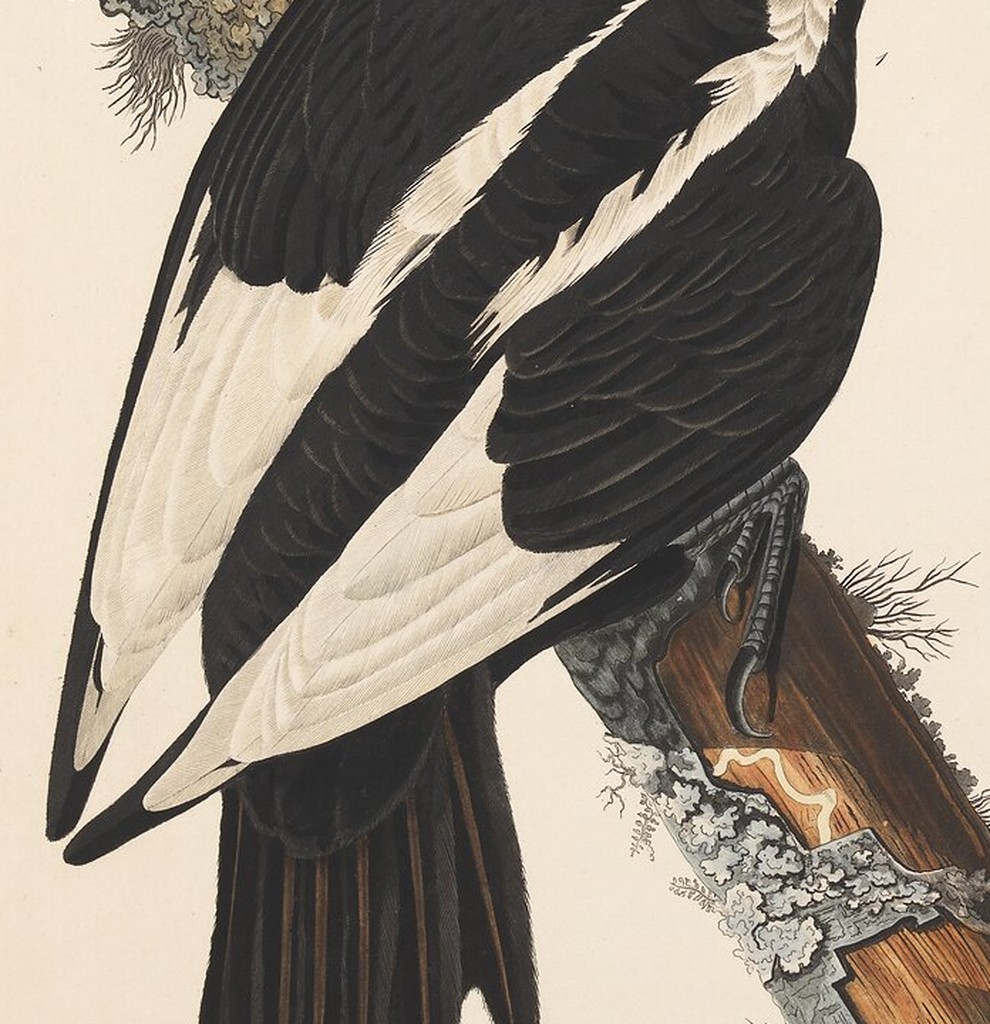
White wing stripe
The white wing stripe cuts through the black body in a clean, graphic band. Audubon uses the contrast to keep the large dark bird readable.
Black crest and eye
The upper bird's black crest and pale eye appear from behind the trunk. This partially hidden pose makes the tree feel inhabited from several sides.
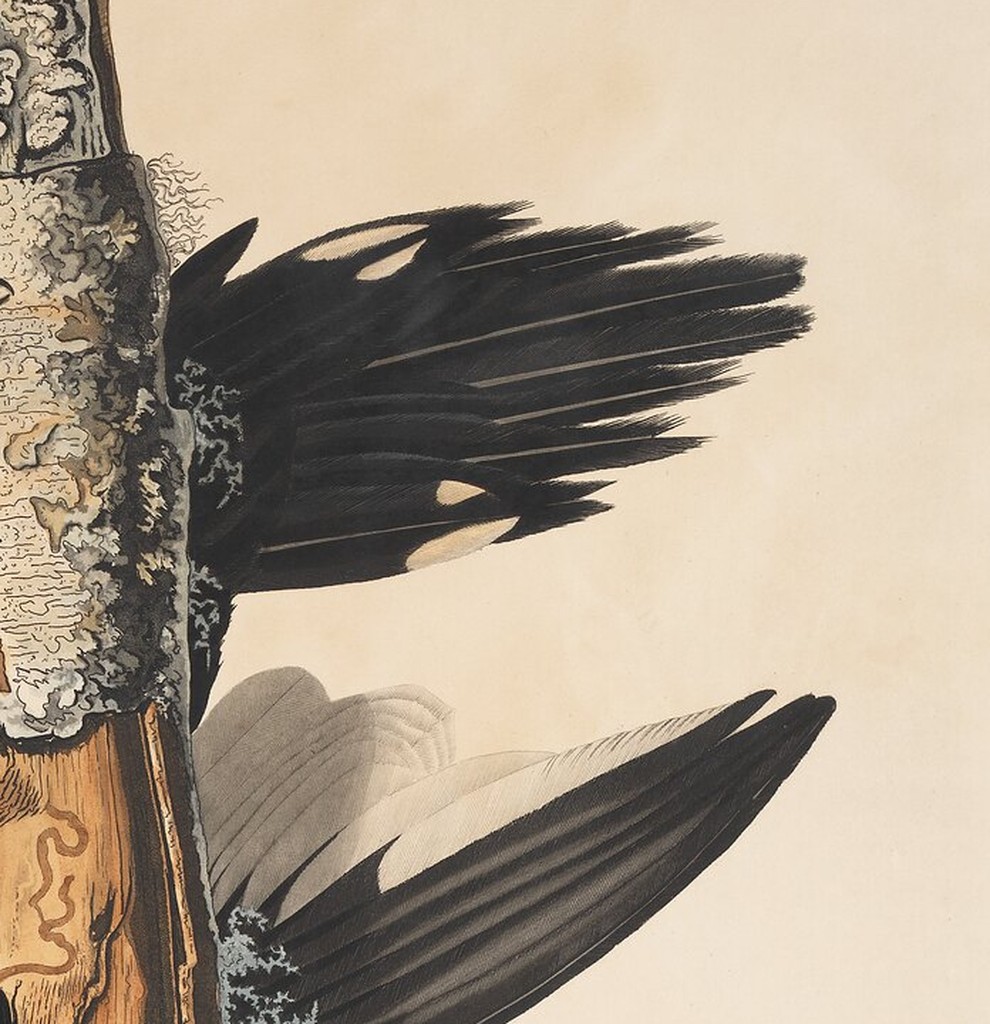
Raised dark wing
A raised dark wing opens out from behind the central trunk. Its feather tips add motion to an otherwise vertical composition.
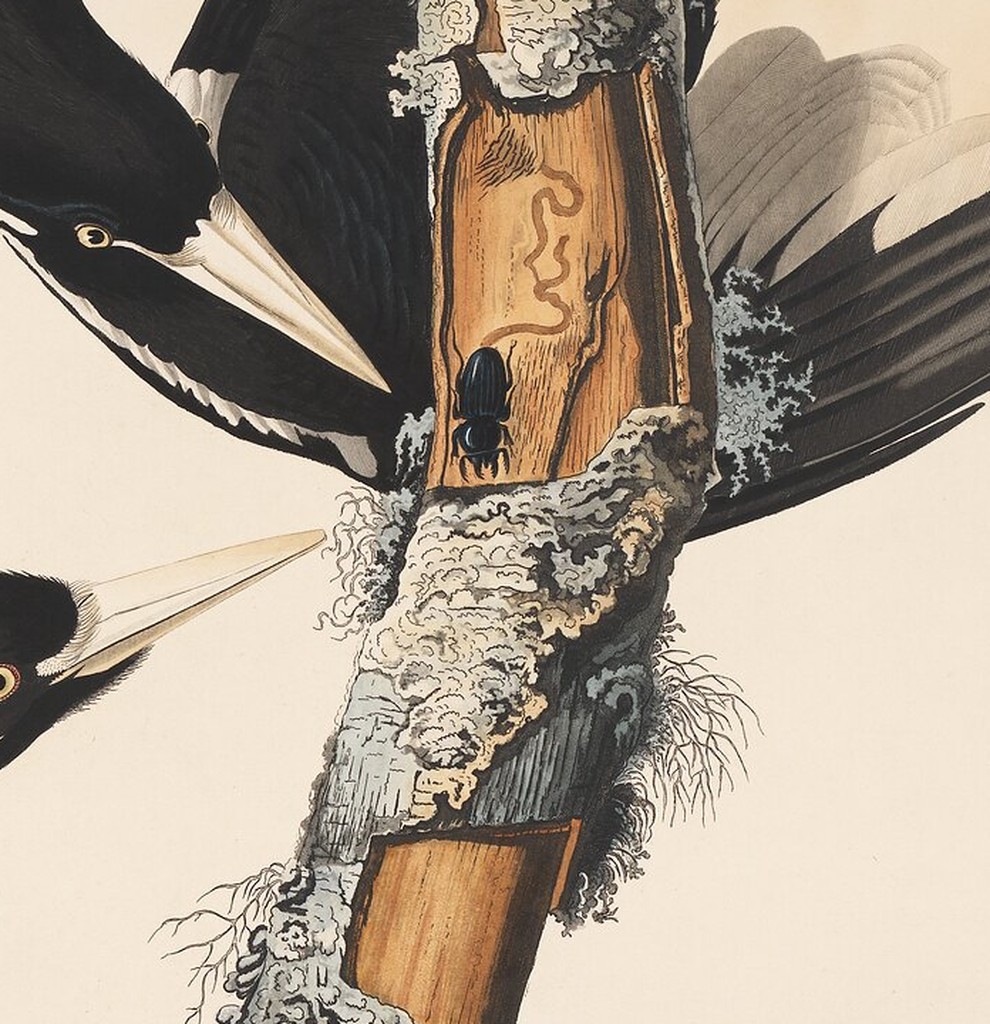
Exposed orange wood
Exposed orange wood interrupts the grey bark. The cut and peeled surfaces make the trunk part of the bird's active world.
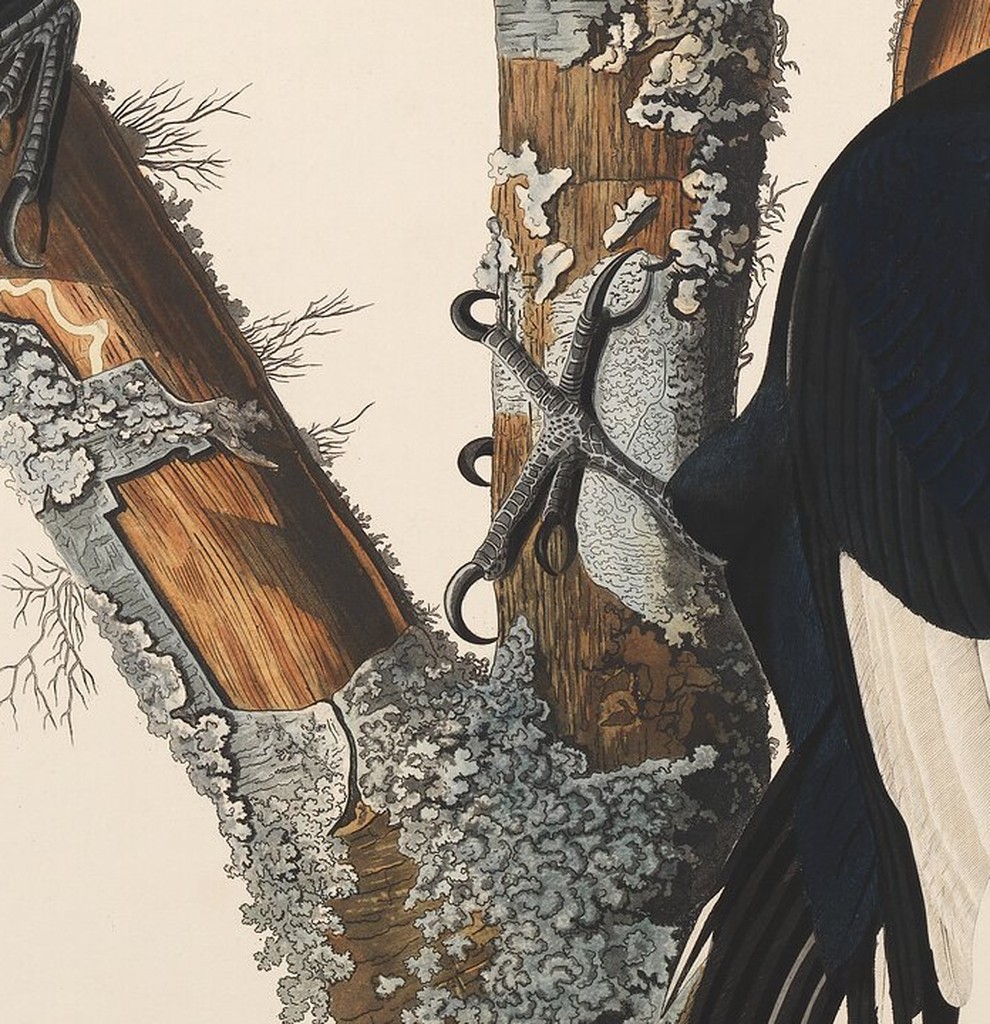
Claws on trunk
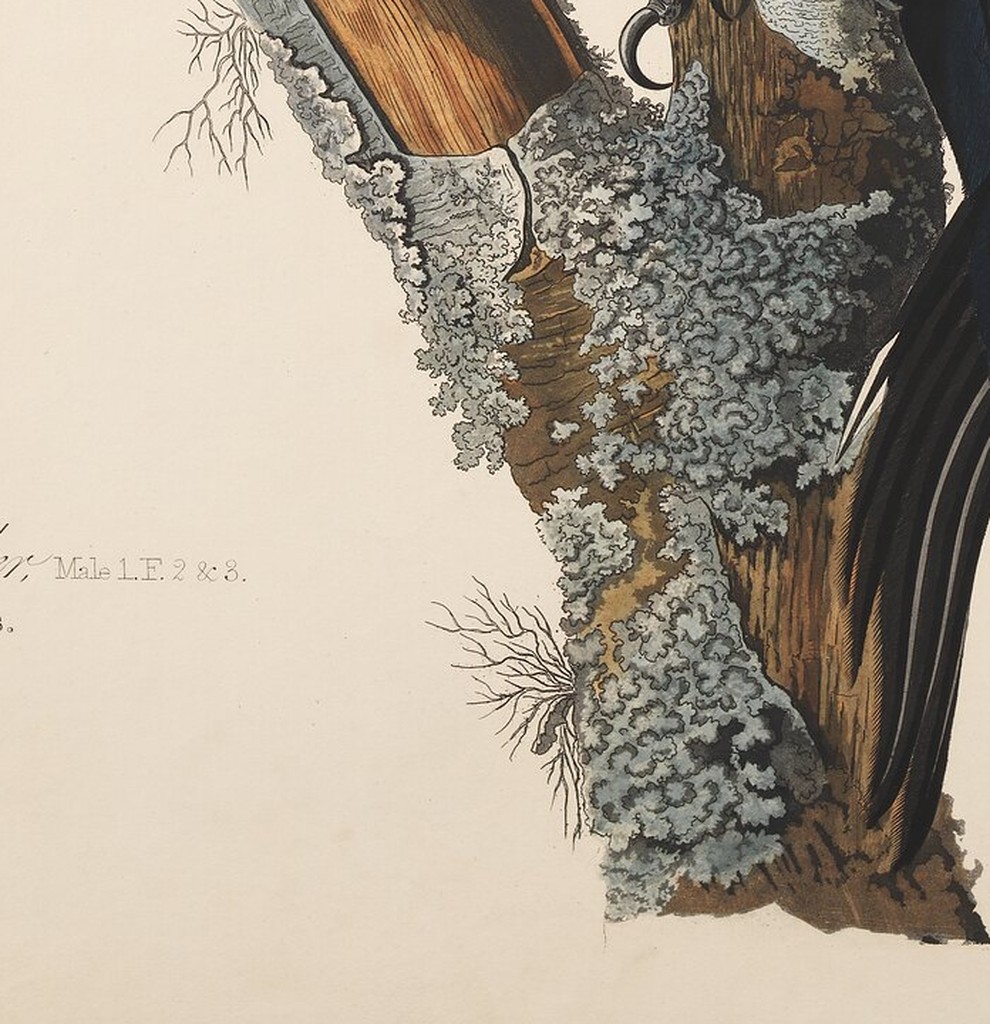
Large claws grip the central trunk below the birds. This detail connects the woodpecker's body to the vertical support it climbs.
Lower black-and-white bird
The lower bird turns in profile with a strong white shoulder mark. Its dark body adds another silhouette against the pale page.
Lichen and broken bark
Lichen, broken bark and exposed wood fill the lower trunk with small textures. The setting is as carefully worked as the birds.
Object Facts
Museums Victoria catalogues its Audubon print as Item BA 18, Print - Ivory-billed Woodpecker, Campephilus principalis, John James Audubon. The object is identified as a hand-coloured aquatint engraving on paper and as Plate 66 from The Birds of America. The record states that the plate shows a male and two females and gives the current taxon name as Campephilus principalis. It also records the original scientific name used by Audubon as Picus principalis. [1]
The reproduction basis is especially strong because Museums Victoria marks the image Public Domain and states that it may be reused without permission. The institution asks users to acknowledge Museums Victoria and cite the object URL. That makes this record the safest primary institutional path for illustrated local production, subject to the normal later release checks around exact file, credit line and access date. [1]
The object record includes some date complexity, with the page title and item heading not fully aligned and the summary connecting the print to The Birds of America. For a public article, the safest approach is to lock the object through Plate 66, Audubon's title, the subject, the maker, the medium and the holding institution rather than overbuild around one date line. The essential facts are clear: this is an Audubon Ivory-billed Woodpecker plate from the Birds of America tradition, preserved as a public-domain museum object. [1]
What the Plate Shows
The plate presents three Ivory-billed Woodpeckers arranged on and around a broken tree trunk. A male, identifiable by his red crest, clings high on the damaged wood. The females have dark crests. The birds' black bodies, white wing areas and pale bills form a bold pattern against the tree surface. The composition is vertical, keyed to the trunk rather than to open sky or distant landscape. [1], [2]
This is not a decorative branch scene in the manner of some smaller Audubon birds. The tree is part of the drama. Ivory-billed Woodpeckers were associated with large forests, dead or decaying wood, and the search for beetle larvae under bark. The battered trunk therefore does more than hold the birds. It signals the ecological world in which the species fed, nested and made its presence known. [2], [5]
Audubon often arranged birds in ways that combined observation with theatrical clarity. Here the strong bills, claws, crests and wood surface all matter. The viewer feels the vertical labour of woodpeckers moving on a trunk. The birds are not shown as passive specimens. They grip, climb and occupy the tree as working animals.
The plate also asks the reader to look at sexual difference. The male's red crest draws the eye quickly, while the females create a quieter balance. Modern descriptions of the species note that males had red crests and females black crests, with both sharing the striking black-and-white pattern and the pale ivory bill. Audubon's three-bird grouping turns that identification feature into composition. [2]
The Bird Behind the Image
The Ivory-billed Woodpecker was one of the largest woodpeckers north of Mexico. Cornell's All About Birds describes it as a bird of old-growth forests in the southeastern United States and Cuba, and the U.S. Fish and Wildlife Service describes it as a large, charismatic woodpecker associated in historical sources with large forests and decaying trees. [2], [4]
Its food habits help explain the look of Audubon's plate. Cornell describes Ivory-billed Woodpeckers as feeding mostly on large beetle larvae, especially in dead or disturbed trees where fire, flood or other events had created suitable wood. The birds used their large bills to strip bark from dead trees and fallen logs, and they also ate some fruits and nuts. Their lives depended on forest structure as much as on forest presence. They needed old, dying, damaged and fallen wood, not simply any stand of trees. [5]
That dependence made the species vulnerable. Mature and old-growth forests in the southeastern United States were cut heavily in the nineteenth and twentieth centuries. Cornell places severe decline in the context of habitat destruction, with the bird rare by the 1880s. The Fish and Wildlife Service names loss of mature forest habitat and collection for feathers and parts as primary threats. [2], [5]
The species also has a Cuban history. Search for Lost Birds notes that Ivory-billed Woodpeckers once occurred in parts of Cuba as well as the southeastern United States, with two recognized subspecies: Campephilus principalis principalis in the United States and Campephilus principalis bairdii in Cuba. Cornell records the last confirmed Cuban sighting in 1986, while Search for Lost Birds treats 1956 as the last widely accepted photo or video documentation. That difference is a useful reminder that not every status statement uses exactly the same evidentiary threshold. [4], [6]
Forest, Damage and Survival
Audubon's trunk looks dramatic, but the drama is ecological as well as pictorial. Cornell describes Ivory-billed Woodpeckers as seeking out places where fire, flood or other disturbance created stands of dead trees. Those conditions could produce the beetle larvae the birds fed on, and they could also create softened wood for nesting cavities. The damaged tree in the plate therefore points toward a habitat made of age, decay, disturbance and renewal. [5]
This matters because the species' decline was not only the loss of individual birds. It was the loss of a forest system large enough to support their way of life. A small patch of trees could not easily replace great tracts of mature forest with abundant dead and dying wood. The bird's bill, the stripped bark, the nest cavity and the old tree all belonged to one connected structure. [5]
The plate also helps readers understand why later searches became so difficult. A rare large woodpecker in remote swamp forest is not easy to prove present or absent. Sounds, glimpses, distant flight views and damaged trees can invite hope, but they are not the same as widely accepted documentation. The best modern accounts therefore keep sighting claims, search history and legal status separate. [2], [5], [6]
That separation protects the artwork too. Audubon's plate does not need the species to be rediscovered in order to matter. It already preserves a powerful image of a bird whose habitat, behaviour and uncertain survival all remain bound to the old forests of the southeastern United States and Cuba.
Current Status, Carefully Stated
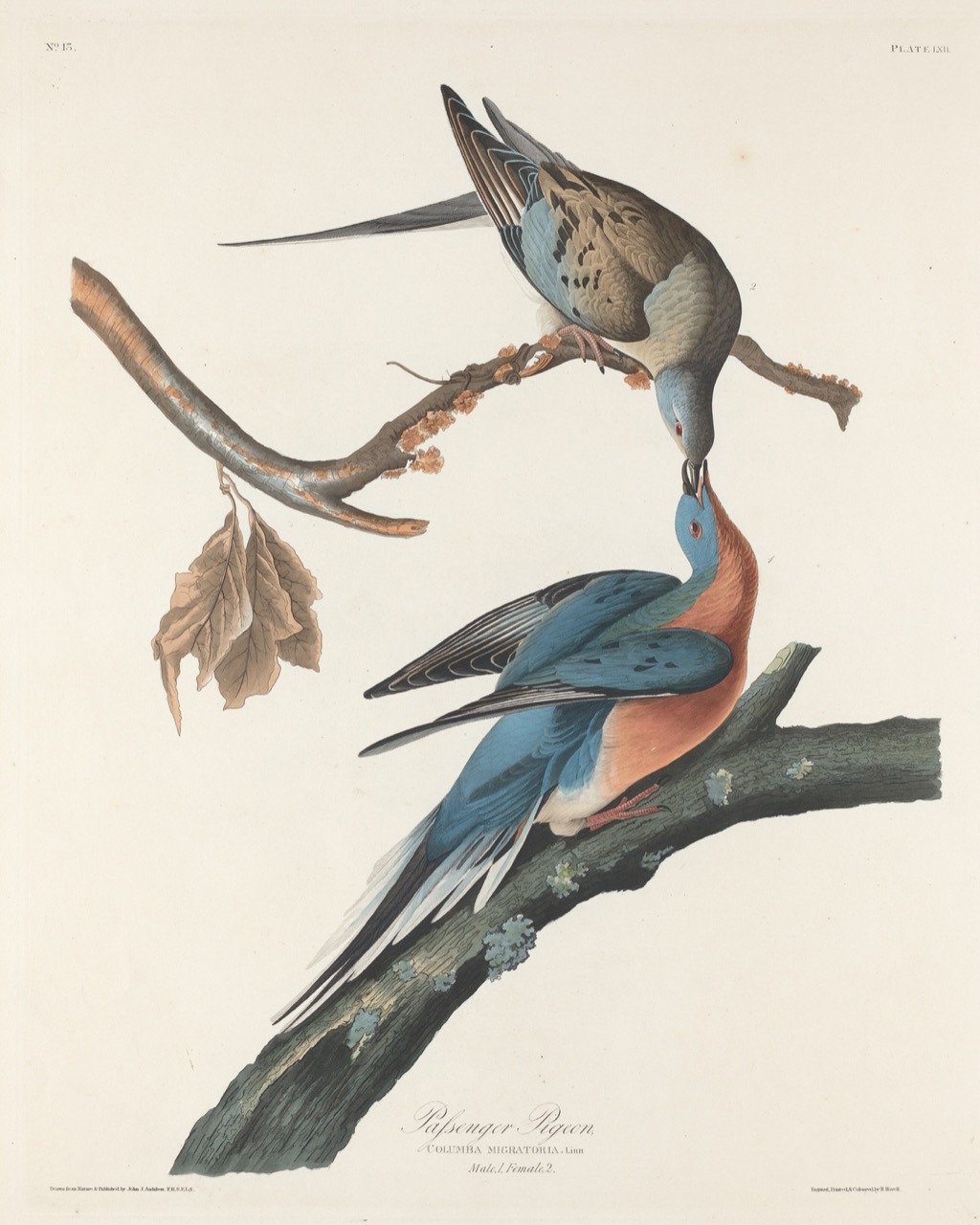
The current status of the Ivory-billed Woodpecker requires unusual care. It is not accurate to write as if a known surviving population exists. It is also not quite the same as writing about the Passenger Pigeon, whose extinction date is fixed by Martha's death in 1914, or the Carolina Parakeet, whose last-known-bird story is clearer in public memory.
The U.S. Fish and Wildlife Service states that the last commonly agreed upon sighting in the United States was in April 1944 on the Singer Tract in the Tensas River region of northeast Louisiana. The species remains federally endangered. In 2021, the Service proposed removing it from the endangered list because of extinction, but in 2023 the Service said it would continue to analyze and review information before deciding whether to delist the Ivory-billed Woodpecker. That means the public status is still cautious and unresolved, not cleanly closed. [2], [3]
Cornell's All About Birds uses the plain phrase probably extinct, while also explaining that the bird was reported rediscovered in Arkansas in 2004 and that extensive searches from 2006 to 2010 did not produce definitive evidence of a surviving population. Search for Lost Birds lists the species as Critically Endangered, gives 1956 as the last documented year, and notes that more recent documentation has been contested. [4], [5], [6]
The safest reader-facing wording is therefore: the Ivory-billed Woodpecker is federally endangered and internationally treated as Critically Endangered, but no widely accepted surviving population has been confirmed. Many authorities describe it as probably extinct or lost. Reports and searches remain part of the modern story, but they should not be presented as proof that the species still survives. [2], [5], [6]
Place in The Birds of America
Ivory-billed Woodpecker belongs to The Birds of America, Audubon's defining publication of North American birds. The larger project appeared between 1827 and 1838, with hundreds of hand-coloured plates issued for subscribers. The finished images combined Audubon's designs with printmaking, engraving, aquatint and hand colouring, creating one of the most ambitious natural history books of the nineteenth century. [7], [8]
Plate 66 sits naturally among Audubon's strongest images of large birds. It has the scale and physicality that made the book famous: a strong bird, a life-bound pose and a supporting environment that helps explain the species. The broken trunk is as important here as water is in many of the heron and pelican plates. It turns the page into a habitat argument as well as a bird portrait. [1]
The image also gives the cluster a different rhythm from the extinction pair of Carolina Parakeet and Passenger Pigeon. Those species are extinct. The Ivory-billed Woodpecker occupies a more uncertain place in public language: historically devastated, perhaps gone, officially still protected in the United States, and still powerful as a search story. That uncertainty should remain visible.
For the broader publication context, readers should continue to The Birds of America. For Audubon's wider range as a draughtsman, painter and printmaker, John James Audubon Works gives the plate a larger art-historical frame. For the life story behind the book, John James Audubon Biography explains the fieldwork, ambition and controversy around the artist.
How to Read the Plate Today
A first reading begins with the bill. The pale bill is not merely a naming feature. It is the tool that made the bird's life possible: a chisel-like instrument for bark-stripping, probing and working dead wood. In Audubon's plate, the bills align with the tree surface and the birds' gripping feet, making feeding behaviour feel physically plausible even when the scene is formally arranged. [2], [5]
A second reading begins with the crest. The red crest of the male and the dark crests of the females turn identity into a visual hierarchy. The male immediately catches the eye, but the females keep the composition from becoming a single-bird portrait. The grouping suggests a species, not just a specimen. [1], [2]
A third reading begins with the tree. The broken trunk is rough, wounded and structurally dominant. It anticipates the conservation story because the species' decline is inseparable from forest loss. The tree is not a neutral prop. It stands for the kind of old, damaged, insect-rich wood that the bird needed. [5]
A fourth reading begins with uncertainty. Looking at Ivory-billed Woodpecker today means resisting two easy reactions. One is romantic certainty that the bird must still be hidden somewhere. The other is premature finality that closes every question. The responsible reading sits between them: the plate preserves a bird of extraordinary presence, while current sources require cautious language about whether any survive. [2], [5], [6]
Why This Plate Matters
Ivory-billed Woodpecker matters because it is beautiful, dramatic and difficult. As an artwork, it shows Audubon's ability to build a page around motion, anatomy and environment. As natural history, it records a large forest woodpecker whose life depended on old trees, dead wood and southern forest systems. As conservation memory, it asks what it means to protect a species that may already have vanished.
The plate also matters because it differs from a clean extinction memorial. Passenger Pigeon and Carolina Parakeet speak from the far side of confirmed loss. Ivory-billed Woodpecker still sits in a zone of official protection, disputed evidence, long searches and cautious scientific language. That makes it an especially important page for careful wording. The strength of the image should not tempt a writer into certainty the sources do not support. [2], [3], [5], [6]
Audubon's image gives readers a way to hold that uncertainty without making it vague. The bird has a name, a body, a bill, a crest, a tree and a place in a famous book. It also has an unresolved modern status. The combination is why the plate remains one of Audubon's most compelling bird images.
For readers interested in the broader tradition of bird drawing and natural history illustration, the site's bird drawings section offers a useful wider route. Ivory-billed Woodpecker belongs in that tradition, but it also presses beyond it. It is not only a study of a striking bird. It is an image that makes the fragility of evidence, habitat and survival visible.
Frequently Asked Questions
Discussion
Ivory-billed Woodpecker asks readers to hold a dramatic Audubon image and an unresolved modern status in the same view.
Use the prompts below to think about habitat, evidence, species-status language and the force of Audubon's vertical composition.
Reader Insights
How does the page change when a species is not confirmed alive but not cleanly closed in public status?
What does the broken trunk tell you about the bird before the conservation story is introduced?
How do the red crest, dark crests and pale bills organise the three-bird composition?
Join the Conversation
Share your reading of Audubon's Ivory-billed Woodpecker and its uncertain modern afterlife below.
References
- Museums Victoria Collections, Print - Ivory-billed Woodpecker, Campephilus principalis, John James Audubon, Item BA 18, accessed 26 July 2026.
- U.S. Fish and Wildlife Service, Ivory-billed Woodpecker species account, accessed 26 July 2026.
- U.S. Fish and Wildlife Service, 2023 delisting press release, accessed 26 July 2026.
- Cornell Lab of Ornithology, All About Birds, Ivory-billed Woodpecker overview, accessed 26 July 2026.
- Cornell Lab of Ornithology, All About Birds, Ivory-billed Woodpecker life history, accessed 26 July 2026.
- Search for Lost Birds, Ivory-billed Woodpecker, accessed 26 July 2026.
- Biodiversity Heritage Library, The Birds of America, accessed 26 July 2026.
- Yale Beinecke Library, The Double Elephant Folio, accessed 26 July 2026.