 Buy Art Prints Now
from Amazon
* As an Amazon Associate I earn from qualifying purchases.
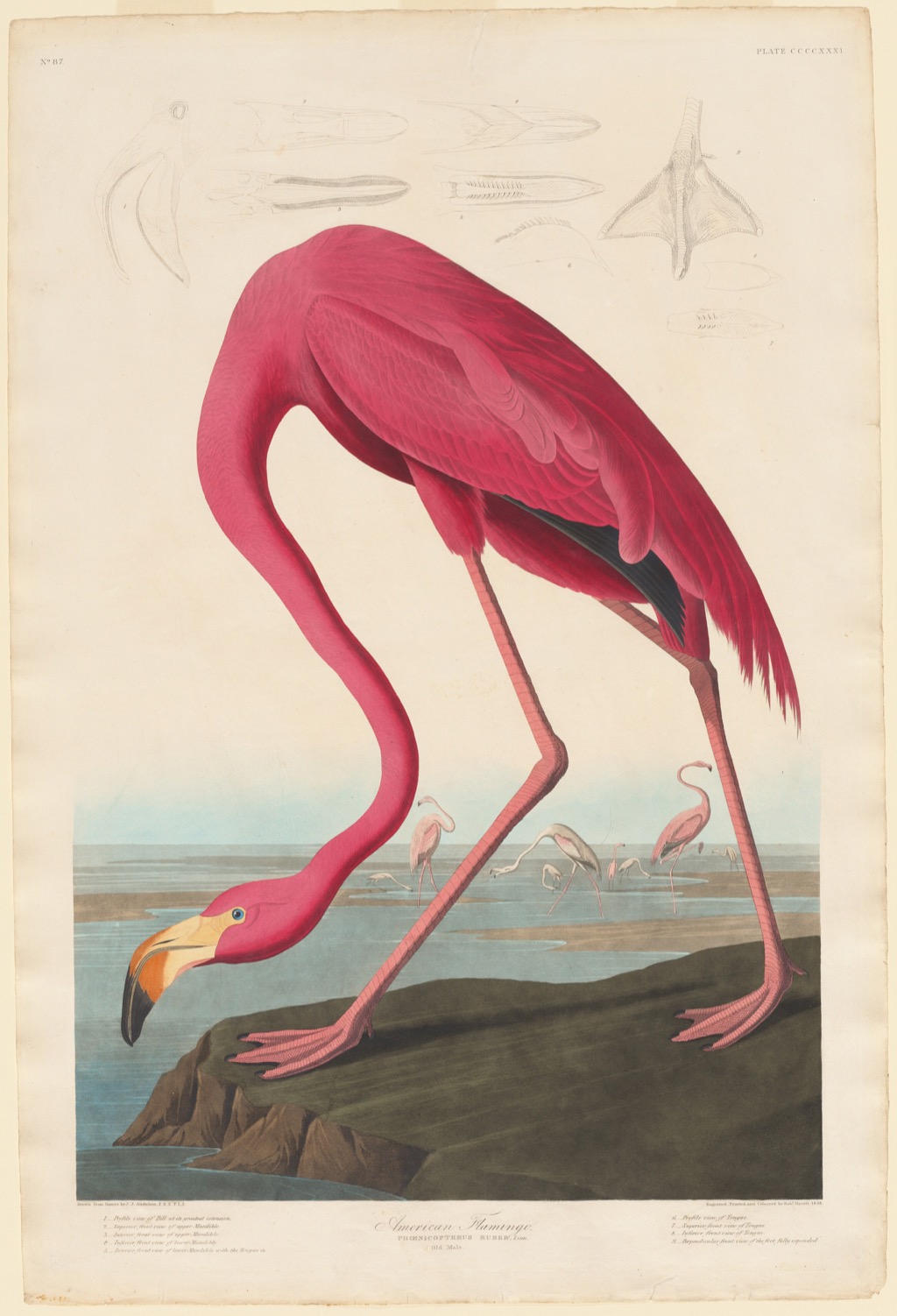
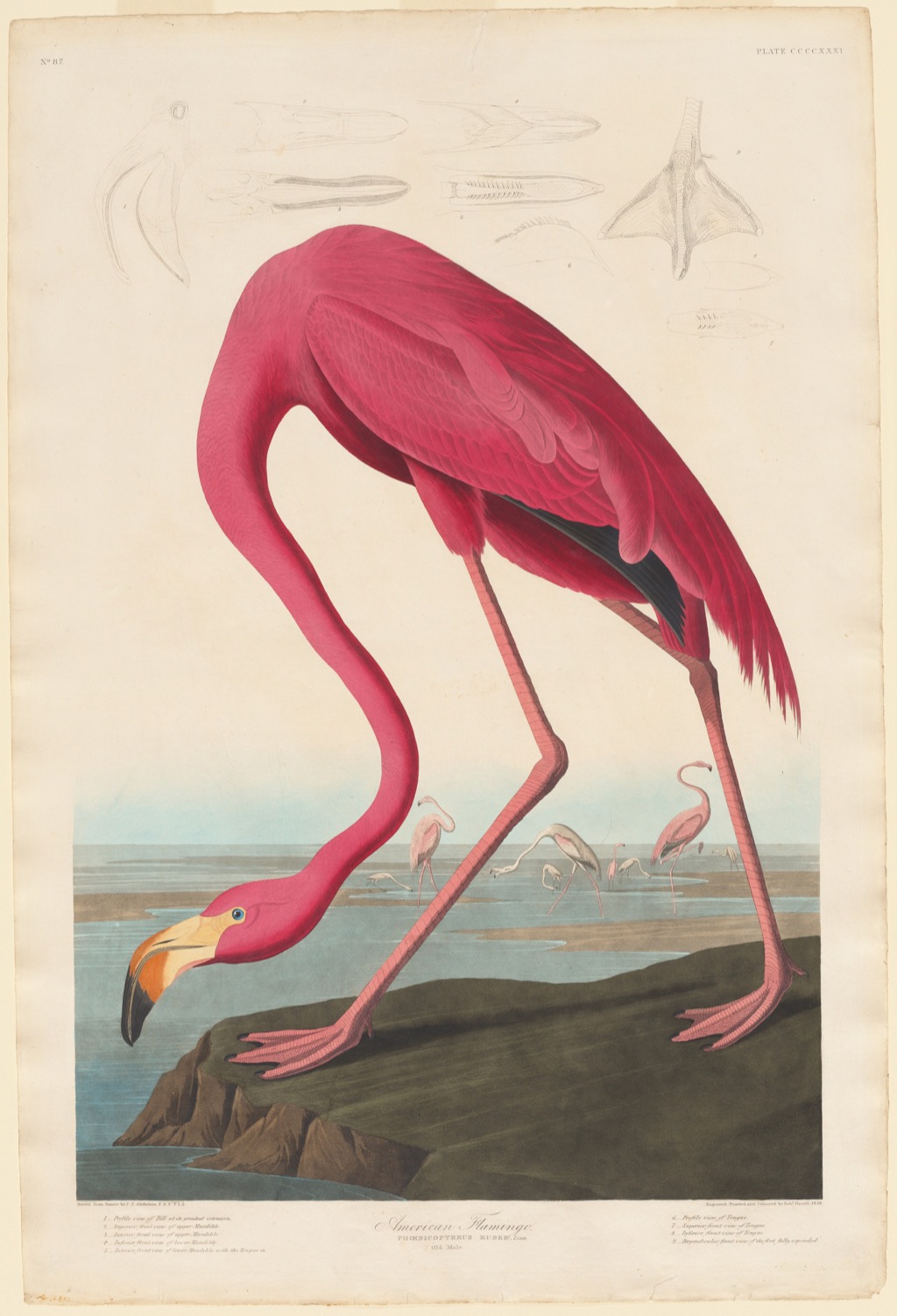
American Flamingo by John James Audubon, National Gallery of Art public-domain object record.
 by Tom Gurney
Tom Gurney BSc (Hons) is an art history expert with over 20 years experience
Published on July 26, 2026 / Updated on September 6, 2026
Email: tomgurney1@gmail.com / Phone: +44 7429 011000
John James Audubon Works: Introduction
John James Audubon's works sit between art, natural history, print culture and American myth. He is remembered above all for The Birds of America, the vast illustrated publication that attempted to show the birds of North America at life size. Yet the famous plates did not appear from nowhere. They grew from years of field observation, specimen collecting, drawing, painting, travel, subscription selling, engraving, coloring and revision.
Audubon was not only a bird painter in the narrow sense. His output includes drawings, watercolors, oil paintings, printed plates, book projects, written accounts and later mammal studies. Some works are intimate records of looking. Others are grand public statements, built for the double-elephant folio scale of The Birds of America. Many combine scientific ambition with theatrical composition: birds stretch, twist, feed, fight, court, guard nests, fly or die in arrangements that are often more active than earlier natural history illustration.
That mixture explains why Audubon's works still reach different audiences. Art historians study the images as part of nineteenth-century printmaking, Romantic-era nature imagery and American visual culture. Natural history readers use them as documents of birds, habitats and older species names. Collectors and designers respond to their scale, color and decorative force. Conservation-minded readers see them differently again, especially when the subject is the Carolina Parakeet, Passenger Pigeon or Ivory-billed Woodpecker, birds now bound to stories of extinction, rarity and ecological loss.
At a Glance
- Best known workThe Birds of America, 435 hand-colored plates issued 1827-1838 [3], [4]
- Main mediadrawings, watercolors, oil paintings, hand-colored engravings, books and later mammal studies [1], [6], [9]
- Publication formatdouble-elephant folio designed to make many birds appear life size or physically commanding [7], [8]
- Key print collaboratorRobert Havell Jr., after early engraving work by William Home Lizars [3], [8]
- Featured plate pathsAmerican Flamingo, American White Pelican, Roseate Spoonbill, Wild Turkey and Passenger Pigeon
- Read nextBiography and The Birds of America
Contents
- Introduction
- What Counts as an Audubon Work?
- Drawings and Field Studies
- Paintings and Close Observation
- The Birds of America
- Prints, Engravers and Publication
- Famous Plates and Image-Led Paths
- Later Works and Quadrupeds
- How to Look at Audubon's Work
- Audubon's Works Today
What Counts as an Audubon Work?
Audubon's best-known works are the 435 plates of The Birds of America, published between 1827 and 1838. Those plates, however, are only one form of a larger practice. Before a plate could be engraved and colored, Audubon needed studies: drawings made from life, from freshly killed specimens, from memory, from repeated observation and from prepared bird bodies arranged into poses. Some drawings became models for printed plates. Others remained as working evidence or private material.
The National Gallery of Art's Audubon holdings show how broad that production can look from the museum side. Its records include hundreds of works connected to the artist, from celebrated bird plates to an oil painting such as Osprey and Weakfish. Harvard's Audubon collection points in another direction: surviving drawings, letters, annotated books, ledgers and family papers help recover the network behind the finished works. The Biodiversity Heritage Library and Smithsonian Libraries preserve the book side of the story, making the plates and related volumes legible as publications rather than isolated images.
The word works also needs to include collaboration. Audubon drew, composed, observed, wrote and promoted. But The Birds of America became a printed object through engravers, colorists, subscribers, publishers, printers, family labor and scientific correspondents. Robert Havell Jr. was crucial to the London production of most plates. Audubon's wife Lucy, his sons Victor Gifford and John Woodhouse, and later collaborators such as John Bachman shaped the practical, financial and textual sides of his career. The works that carry Audubon's name are inseparable from that machinery.
Drawings and Field Studies
Audubon's drawings are the foundation of his art. They register the tension between direct observation and finished effect. He wanted birds to appear alert and alive, not simply arranged as flat specimens. To reach that result, he studied bodies closely: wings, claws, bills, feathers, eyes, tails, proportions and the way a pose changes when a bird turns or grips a branch. The final image often looks spontaneous, but the liveliness is built from repeated acts of control.
Earlier natural history illustration often favored profile clarity. A bird might be shown cleanly from the side, with enough detail for identification. Audubon's drawings pushed toward action. A bird bends forward, grasps prey, opens its bill, protects young or coils around a stem. This brought drama into the image, but it also brought risk. A pose might be visually memorable while asking the viewer to accept a carefully staged version of nature.
That staging was central to Audubon's method. He observed birds outdoors, but he also worked from dead specimens. He is known for using wires and supports to arrange bird bodies in chosen attitudes before drawing them. For a modern reader, this can feel unsettling. It is part of the historical reality of nineteenth-century natural history, where collecting, killing and classification were closely linked. It also helps explain why the works can seem both intensely lifelike and highly theatrical: they are not quick snapshots of living birds, but constructed images based on study, possession and arrangement.
Harvard's collection is especially important because it preserves early materials that sit closer to this working process. Surviving drawings and papers help show Audubon before the completed folio became a monument. They remind us that the famous plates began as labor: travel, sketching, correction, comparison, correspondence and financial pressure.
Paintings and Close Observation
Audubon's oil paintings are less familiar to many readers than the printed bird plates, but they widen the view of his work. Osprey and Weakfish is a strong example. Instead of presenting a bird as a specimen-like subject, the painting stages a moment of predation. The osprey grips a weakfish, wings extended, body tense, the prey curved beneath it. The image belongs to natural history, but it also belongs to the language of dramatic painting: force, movement, balance and conflict.
The painting helps explain why Audubon cannot be reduced to an illustrator who simply copied birds. He turned animal behavior into composition. He chose the angle of attack, the placement of bodies, the relation of air and water, and the instant at which the viewer meets the action. In that sense, his works often operate as scenes rather than diagrams.
This is one reason Audubon's art entered museum collections as well as libraries. The books matter as scientific and publishing achievements, but individual images also stand up as works of visual invention. Their drama can be admired while their methods and assumptions are questioned. A modern reading does not need to flatten Audubon into either hero or villain. His works are more useful when seen as historically powerful, visually ambitious and ethically complicated.
The Birds of America
The Birds of America is Audubon's defining work. Published in London across more than a decade, it attempted to show North American birds at life size in a format large enough to accommodate even the most imposing species. The double-elephant folio was huge: later institutional descriptions commonly give dimensions close to 90 by 67 centimeters. The size mattered because Audubon wanted the birds to occupy the sheet with physical presence. A turkey, flamingo, pelican or heron was not merely named and classified; it had to fill space.
The publication was issued by subscription, a demanding business model that required Audubon to win patrons, manage production, maintain momentum and keep subscribers confident in the project. It was also physically and financially extravagant. Plates were engraved, printed and hand-colored. The resulting volumes were both natural history and luxury objects.
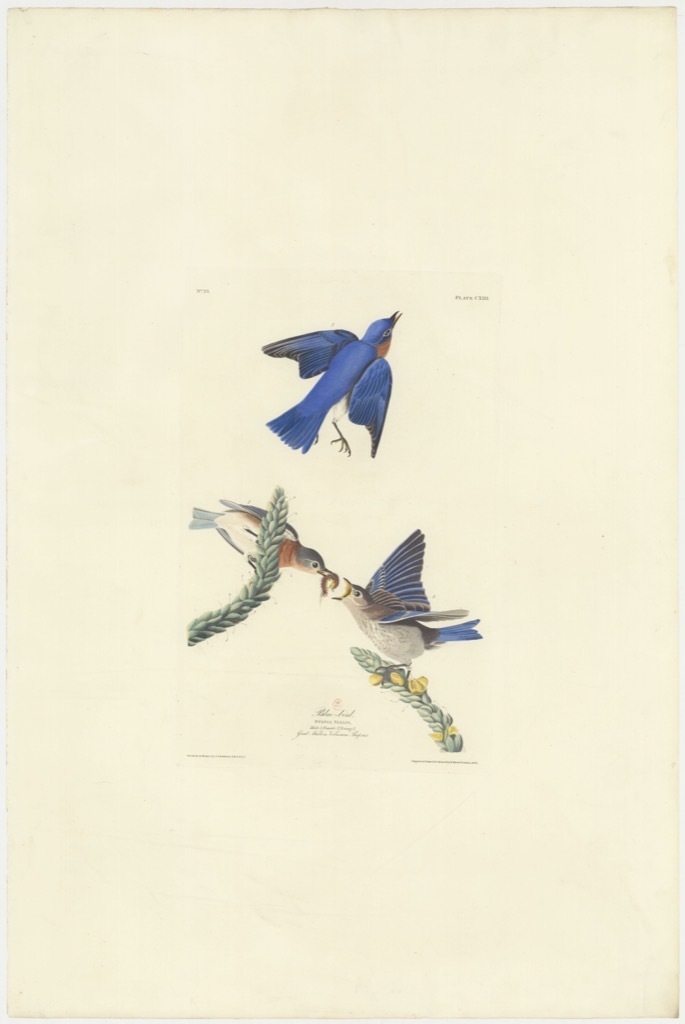
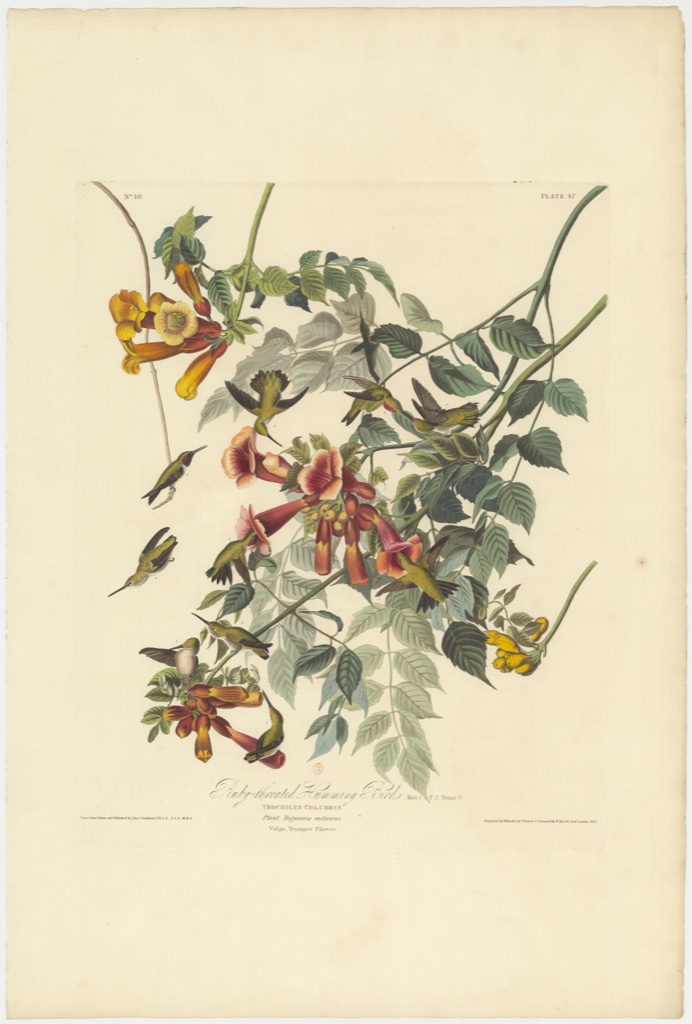
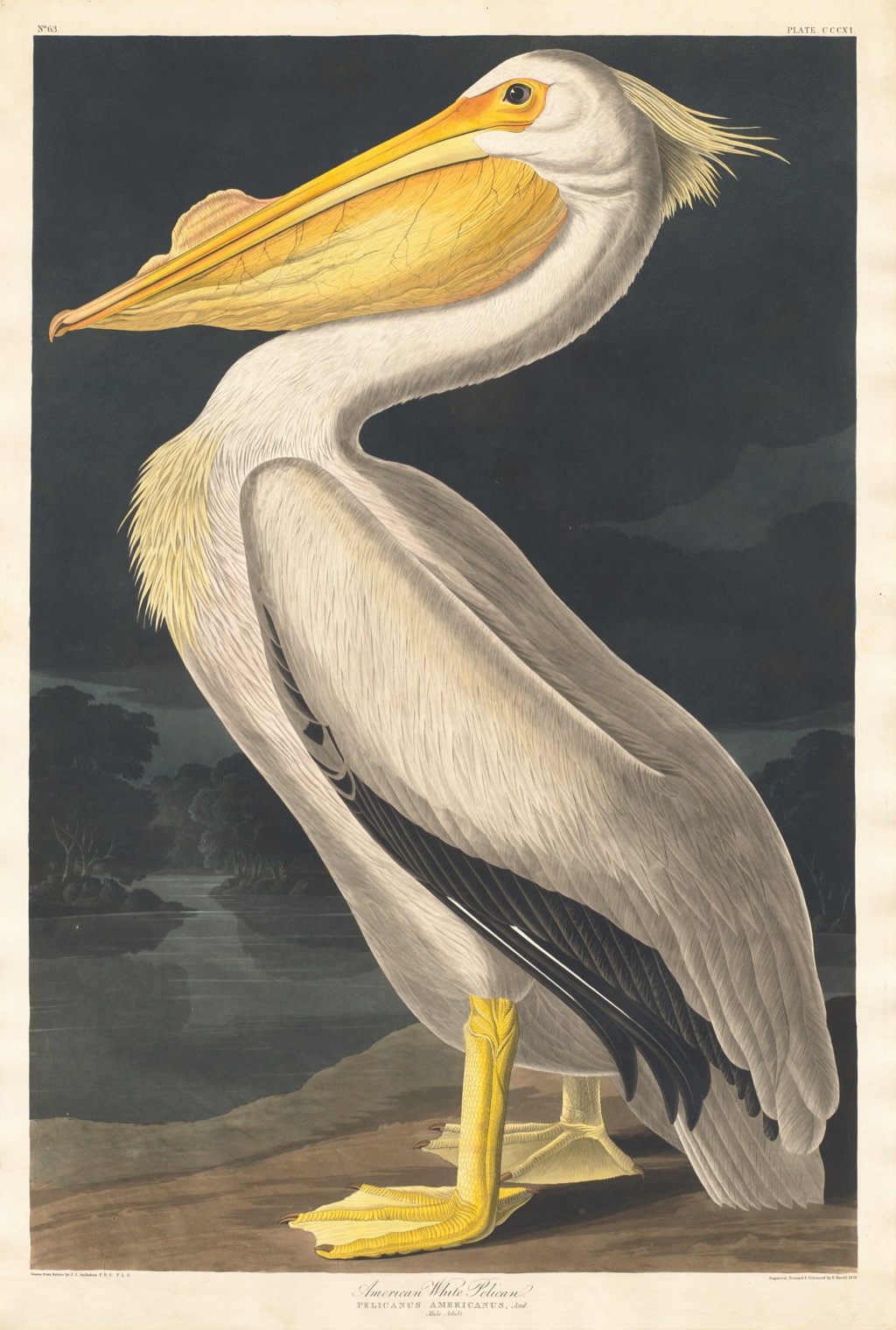
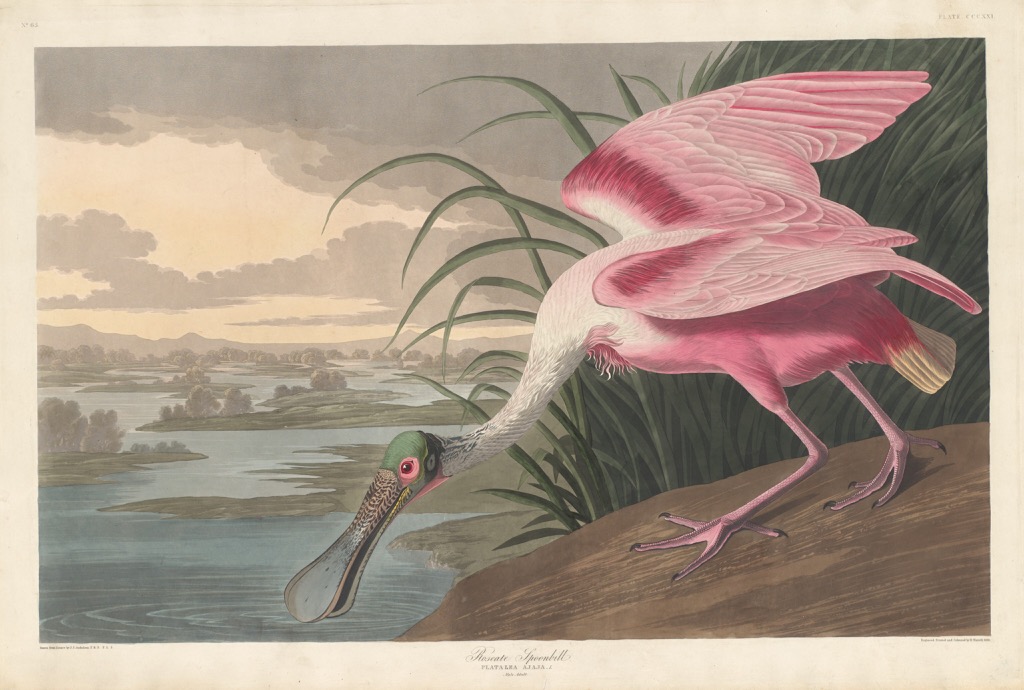
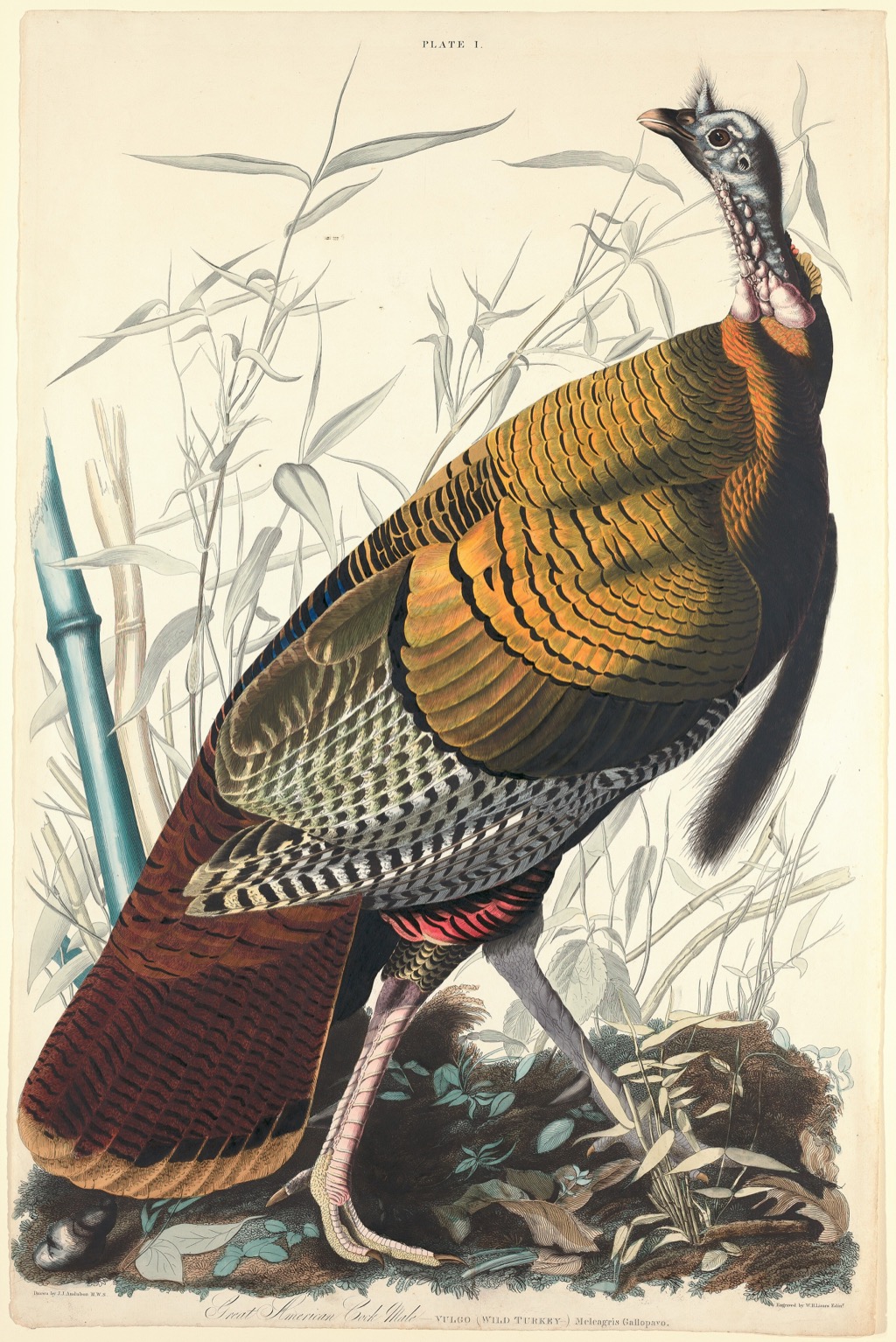
The plates vary widely in mood and structure. Some are almost emblematic. The Wild Turkey, published as Plate I under the historic title Great American Cock, announces the project with scale and confidence. The American Flamingo bends its long neck and legs into a compressed design that solves the problem of fitting a tall bird onto a sheet. The American White Pelican and Roseate Spoonbill use large pale or pink forms to make the page feel almost sculptural. Smaller birds such as the Ruby-throated Hummingbird or Eastern Bluebird work differently, drawing attention to delicacy, plant life, scale and motion.
Audubon's strongest plates often depend on a problem. How do you show a bird life size when its body is too tall, too wide or too restless for the format? How do you make plumage, anatomy and behavior clear without draining the image of energy? How do you turn a scientific subject into something a subscriber wants to own and revisit? The answers are rarely neutral. Audubon bends birds into poses, pairs them with plants, places them in dramatic relationships and uses the sheet itself as a stage.
Prints, Engravers and Publication
The printed plates of The Birds of America were not simple reproductions of Audubon's drawings. They were translations into print. The early work began with William Home Lizars in Edinburgh, but the main production shifted to London, where Robert Havell Jr. became the key engraver and printer. Havell's technical work helped give the plates their finish: line, texture, color separation, atmospheric space and the physical richness expected by subscribers.
This collaborative print process is central to the identity of the works. When a viewer looks at a plate of the Cardinal Grosbeak, Snowy Owl or Louisiana Heron, the result reflects Audubon's design and observation, but also the craft of engraving, printing and hand coloring. The plate is both image and manufactured object.
The relation between picture and text was also unusual. Because British copyright deposit rules complicated the publication of text alongside the plates, Audubon issued Ornithological Biography separately with William MacGillivray. This means The Birds of America is best understood as a two-part achievement: the monumental image publication and the textual accounts that supplied description, anecdote, range, behavior and observation. Readers now often encounter the plates online as single images, but historically they belonged to a wider system of books, subscribers and written explanation.
Print culture also shaped the afterlife of Audubon's works. The double-elephant folio was rare and expensive. Later octavo editions made the images more widely available in smaller form. Reproductions, facsimiles, posters and digital collections have since made Audubon's birds familiar far beyond the circle that could ever have owned the original volumes. The popularity of individual images today comes partly from that long history of reproduction.
The difference between editions matters. A double-elephant folio plate carries the physical ambition of the original project: large paper, hand coloring and a scale that makes the bird seem to share the viewer's space. A smaller later edition can preserve the subject and much of the composition, but it changes the encounter. The bird is no longer life size. The image becomes more portable, more affordable and more available, but less overwhelming.
Famous Plates and Image-Led Paths
Several Audubon works have become especially strong entry points because they combine visual impact with recognizable subjects. The American Flamingo is one of the most dramatic solutions to the life-size challenge. The bird's height is folded into the design, turning anatomy into rhythm. The Roseate Spoonbill has a different appeal: the plate's color, bill shape and coastal identity make it immediately memorable. The American White Pelican offers broad wings, pale mass and a strong sense of bodily scale.
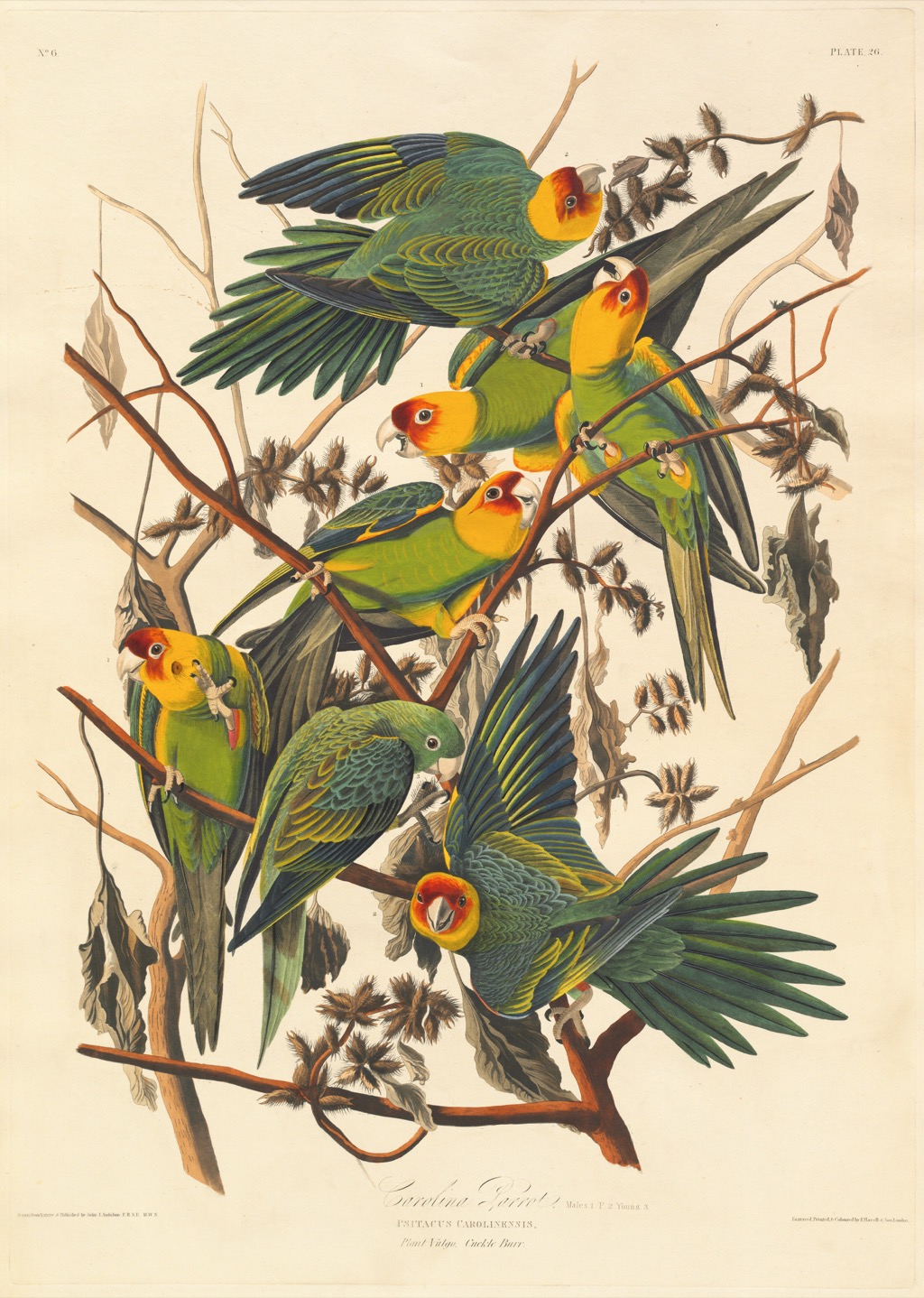
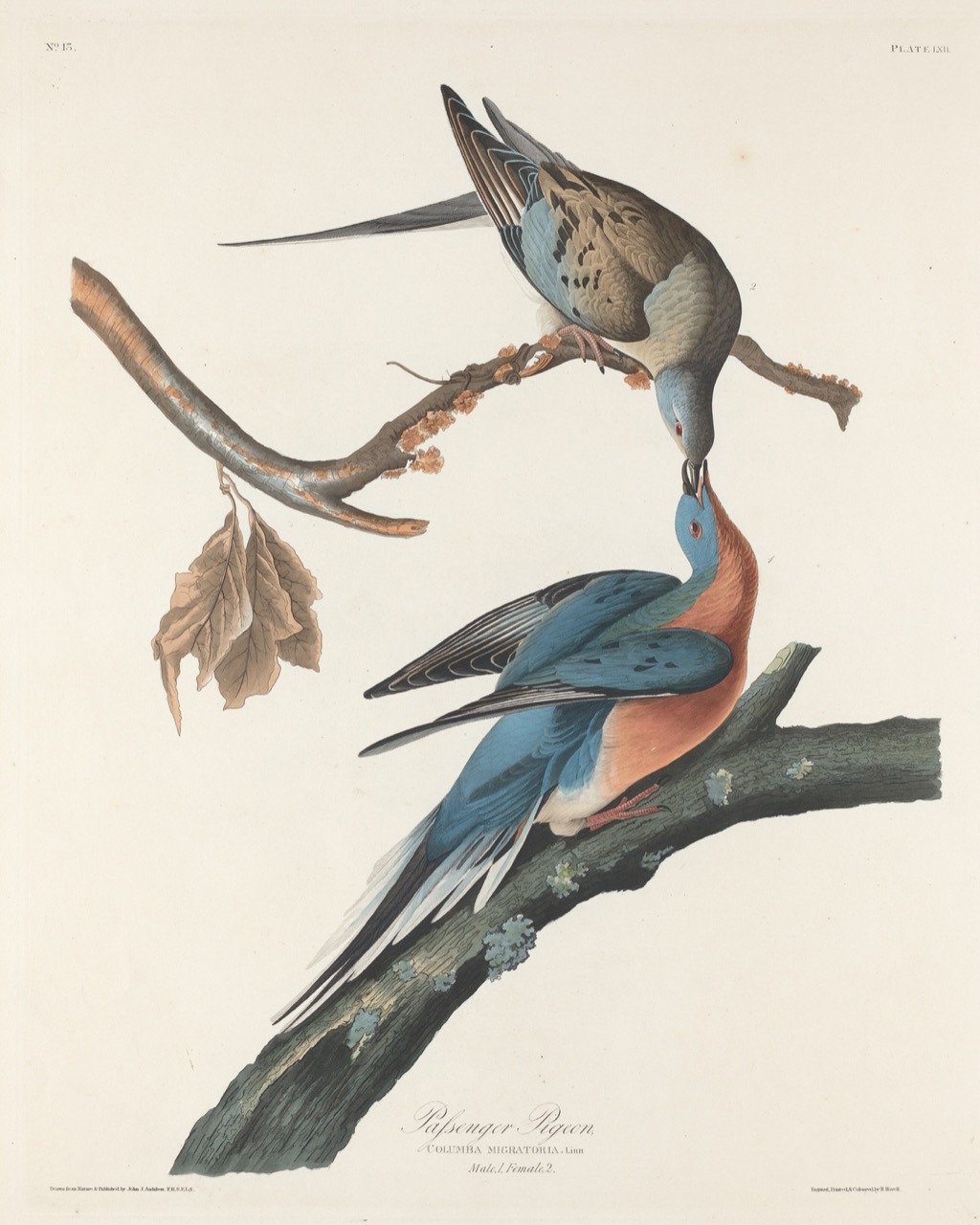
Extinct or nearly lost birds form another group. The Carolina Parakeet and Passenger Pigeon are now read through the knowledge that their species disappeared after Audubon's lifetime. The Ivory-billed Woodpecker carries a different kind of modern charge because its status has long been tied to rarity, disputed sightings and old-growth habitat. These images are not only attractive historical prints. They are also records that later viewers cannot separate from loss.
Other plates matter because they connect Audubon's work to familiar birds and habitats. The Great Blue Heron and Louisiana Heron, now generally understood in relation to the Tricolored Heron, lead into wetland imagery and long-legged bird anatomy. The Eastern Bluebird and Ruby-throated Hummingbird bring the scale down to garden and woodland subjects. The Snowy Owl gives the cluster a northern, seasonal and predatory presence. The Cardinal Grosbeak, now associated with the Northern Cardinal, connects the historic title to one of the most recognizable birds in North America.
Selected Audubon Works and Plates
This focused image group uses public-domain National Gallery of Art object records selected for the Works hub. The links lead into focused studies of individual Audubon plates and related works.
Later Works and Quadrupeds
Audubon's later career extended beyond birds. The Viviparous Quadrupeds of North America, produced with major involvement from his sons and with scientific collaboration from John Bachman, widened the project toward mammals. The work belongs to a different period of Audubon's life, when the grand bird publication had already established his name and his family network was increasingly central to production.
The mammal project also makes clear that Audubon's reputation was not built from a single act of genius. It depended on a repeatable model: field collecting, drawing, scientific correspondence, publishing ambition, subscription economics and family labor. John Woodhouse Audubon played a major artistic role in the quadrupeds project, and Victor Gifford Audubon was important to the business and publication structure. Bachman's scientific collaboration helped shape the textual and taxonomic side.
Works such as Audubon's study of the Arctic Hare show how the animal subject could shift while the underlying problem remained similar. The artist and his circle still had to turn living nature, collected specimens and written description into images that could persuade readers. The quadrupeds do not replace the birds in Audubon's legacy, but they keep the career from ending at the edge of the famous folio.
How to Look at Audubon's Work
A useful first question is what kind of object you are looking at. Is it a drawing, a painting, a hand-colored engraving, a book plate, a later edition or a digital image of one of these things? Audubon's works are often reproduced in ways that make them seem interchangeable, but medium changes meaning. A watercolor study carries the trace of working observation. An oil painting such as Osprey and Weakfish has the density and drama of a finished picture. A double-elephant folio plate belongs to a luxury publication made through engraving, printing and hand coloring.
A second question is how the body has been arranged. Audubon's birds often twist, bend or interact with other birds, plants or prey. These poses can reveal behavior, but they can also reveal design pressure. The flamingo is folded to fit the sheet. The turkey stands as a commanding opening statement. The hummingbird needs plant life and scale to make its smallness vivid. The pelican, heron and spoonbill use long bodies and broad silhouettes to make the viewer feel the size of the subject.
A third question is what later history has added. Audubon could not have seen the Passenger Pigeon's extinction in 1914, nor the full modern meaning of the Carolina Parakeet's disappearance. Yet those facts now change how the works are read. The images become evidence of presence before loss. They also bring discomfort, because Audubon's own methods were part of a natural history culture built on collecting and killing specimens. The works are beautiful, but they are not innocent.
Finally, it helps to notice the publication system. Audubon's art was not made for a quiet studio audience alone. It was built to persuade patrons, subscribers, scientists, collectors and readers. The beauty of the works is tied to ambition: to make North American birds visible at an unprecedented scale, to compete with European natural history publishing, and to turn field observation into a monumental printed project.
Looking also means keeping historic names and modern names in conversation. Audubon's Carolina Parrot is now usually discussed as the Carolina Parakeet. Cardinal Grosbeak points toward the Northern Cardinal. Louisiana Heron is commonly connected with the Tricolored Heron. These shifts are not editorial decoration; they show how natural history knowledge changes over time.
Audubon's Works Today
Audubon's works remain widely reproduced because they are visually legible at a glance. A flamingo, owl, cardinal, hummingbird or pelican can work as an image even for someone who knows nothing about nineteenth-century natural history. But the deeper interest comes from the layered nature of the works. They are records of birds and habitats, works of composition, products of printmaking and subscription publishing, and objects whose meaning has changed through extinction, conservation and modern reassessment.
That layered quality is why a Works hub matters alongside a John James Audubon Biography and a dedicated study of The Birds of America. Biography explains the life. The publication history explains the great folio. The works themselves show how Audubon's reputation was made image by image: through pose, scale, color, text, collaboration and the stubborn effort to transform observed nature into printed art.
Frequently Asked Questions
Discussion
Audubon's works ask readers to move between bird, image, printed object and historical context.
Use the prompts below to compare the artworks as pictures, publications and records of natural history.
Reader Insights
Which selected plate makes scale, pose or movement feel most important?
How does engraving, hand coloring and subscription publishing change the idea of an Audubon work?
What changes when you compare a spectacular large bird with a smaller, more intimate plate?
Join the Conversation
Share your reading of Audubon's works, plate choices and publication history below.
References
- National Gallery of Art, John James Audubon artist and object records, accessed 26 July 2026.
- National Gallery of Art, Osprey and Weakfish, accessed 26 July 2026.
- Biodiversity Heritage Library, The Birds of America, accessed 26 July 2026.
- Smithsonian Libraries and Archives, The birds of America record, accessed 26 July 2026.
- Biodiversity Heritage Library, Ornithological Biography, accessed 26 July 2026.
- Harvard Library, John James Audubon Collection, accessed 26 July 2026.
- Yale Beinecke Library, The Double Elephant Folio, accessed 26 July 2026.
- Natural History Museum, London, The Birds of America overview, accessed 26 July 2026.
- Biodiversity Heritage Library, The Viviparous Quadrupeds of North America, accessed 26 July 2026.
- Smithsonian Libraries and Archives, The Viviparous Quadrupeds of North America record, accessed 26 July 2026.
- National Gallery of Art, American Flamingo, accessed 26 July 2026.
- National Gallery of Art, American White Pelican, accessed 26 July 2026.
- National Gallery of Art, Roseate Spoonbill, accessed 26 July 2026.
- National Gallery of Art, Great American Cock, accessed 26 July 2026.
- National Gallery of Art, Passenger Pigeon, accessed 26 July 2026.