 by Tom Gurney
Tom Gurney BSc (Hons) is an art history expert with over 20 years experience
Published on July 26, 2026 / Updated on September 6, 2026
Email: tomgurney1@gmail.com / Phone: +44 7429 011000
Passenger Pigeon: Introduction
John James Audubon's Passenger Pigeon is one of the most moving plates in The Birds of America because it shows a bird that once seemed beyond counting. In the early nineteenth century, passenger pigeons moved through eastern North America in immense flocks, feeding on forest mast and nesting in colonies so large that observers struggled to describe them. By 1914, the last known individual, Martha, had died at the Cincinnati Zoo. [2], [3]
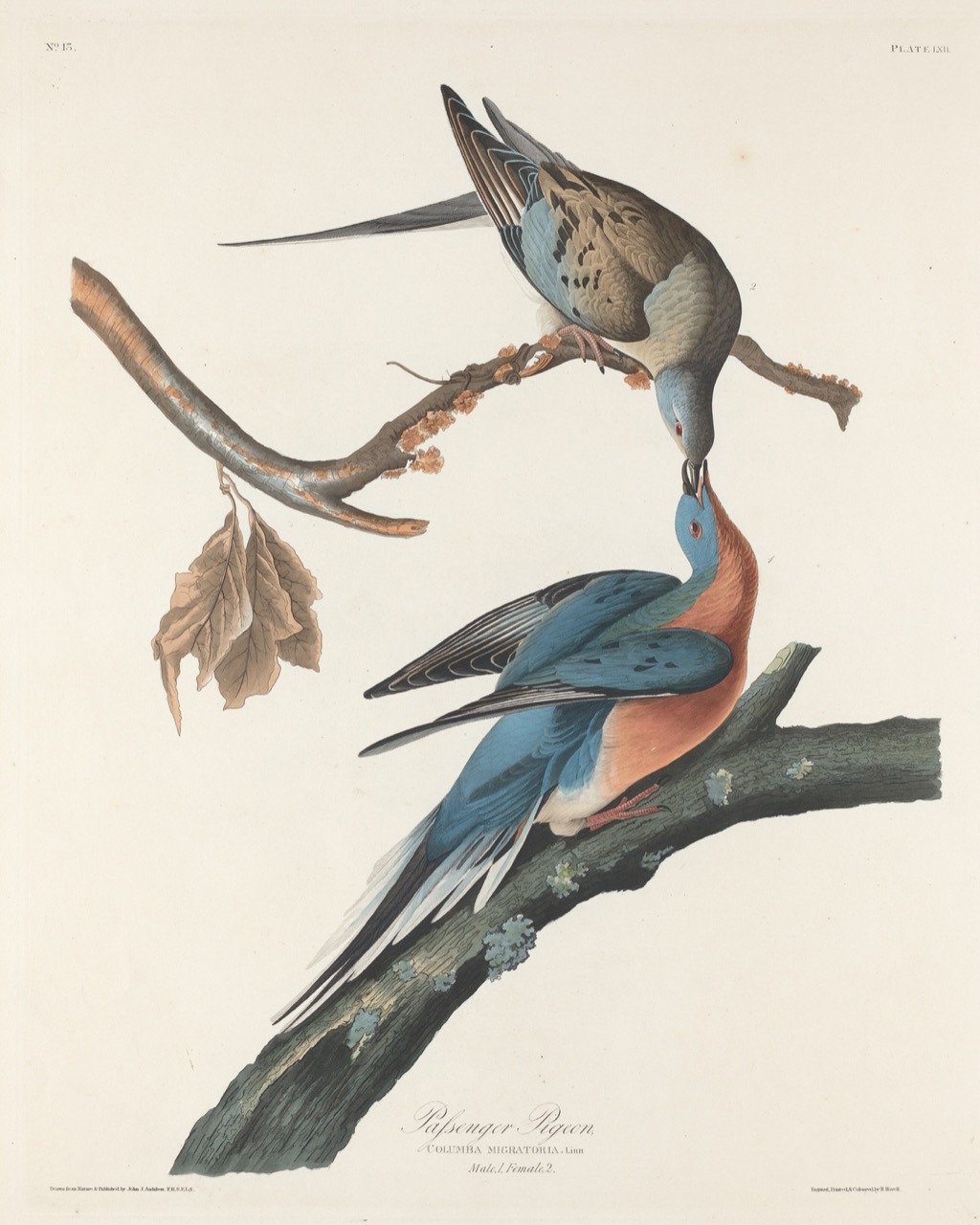
Audubon's plate belongs to the earlier world, before extinction became the species' defining modern story. It shows a male and female passenger pigeon perched on branches, meeting beak to beak in an intimate exchange. The composition is quiet rather than panoramic. Instead of showing the famous flocks, Audubon brings the species down to two bodies, two heads, two different colour patterns and a moment of contact. That decision now gives the plate a complicated emotional charge. A bird remembered for abundance is preserved here as a pair. [1]
The artwork was published in 1829 as Plate 62 of The Birds of America. The National Gallery of Art records its title as Passenger Pigeon, with Robert Havell after John James Audubon as the maker attribution. It is a hand-coloured engraving and aquatint on Whatman wove paper, part of the double-elephant folio project that made Audubon's bird images famous. In modern species language, the passenger pigeon is Ectopistes migratorius. The historic plate belongs to an older naming tradition, while the current scientific name helps connect Audubon's image to modern natural history and conservation writing. [1], [5]
At a Glance
- Public titlePassenger Pigeon
- PlateThe Birds of America, no. 62 / Plate LXII [1], [5]
- Date1829 [1]
- MakerRobert Havell after John James Audubon [1]
- Mediumhand-coloured engraving and aquatint on Whatman wove paper [1]
- Dimensionsplate: 65.7 x 52.7 cm; sheet: 101 x 68 cm [1]
- AccessionNGA 1945.8.62 [1]
- SpeciesPassenger Pigeon, Ectopistes migratorius [2], [5]
- Modern statusExtinct; last known individual died on 1 September 1914 [2], [3]
Contents
- Introduction
- Annotated Details
- Object Facts
- What the Plate Shows
- Colour, Sex and Pairing
- The Bird Behind the Image
- Abundance Made Intimate
- Place in The Birds of America
- Extinction and Conservation Memory
- How to Read the Plate Today
- Why Passenger Pigeon Matters
Annotated Details from Passenger Pigeon
These annotated details follow Audubon's Passenger Pigeon through the paired birds, touching bills, blue and rose colouring, long tail feathers, branch and leaf details that structure the plate.
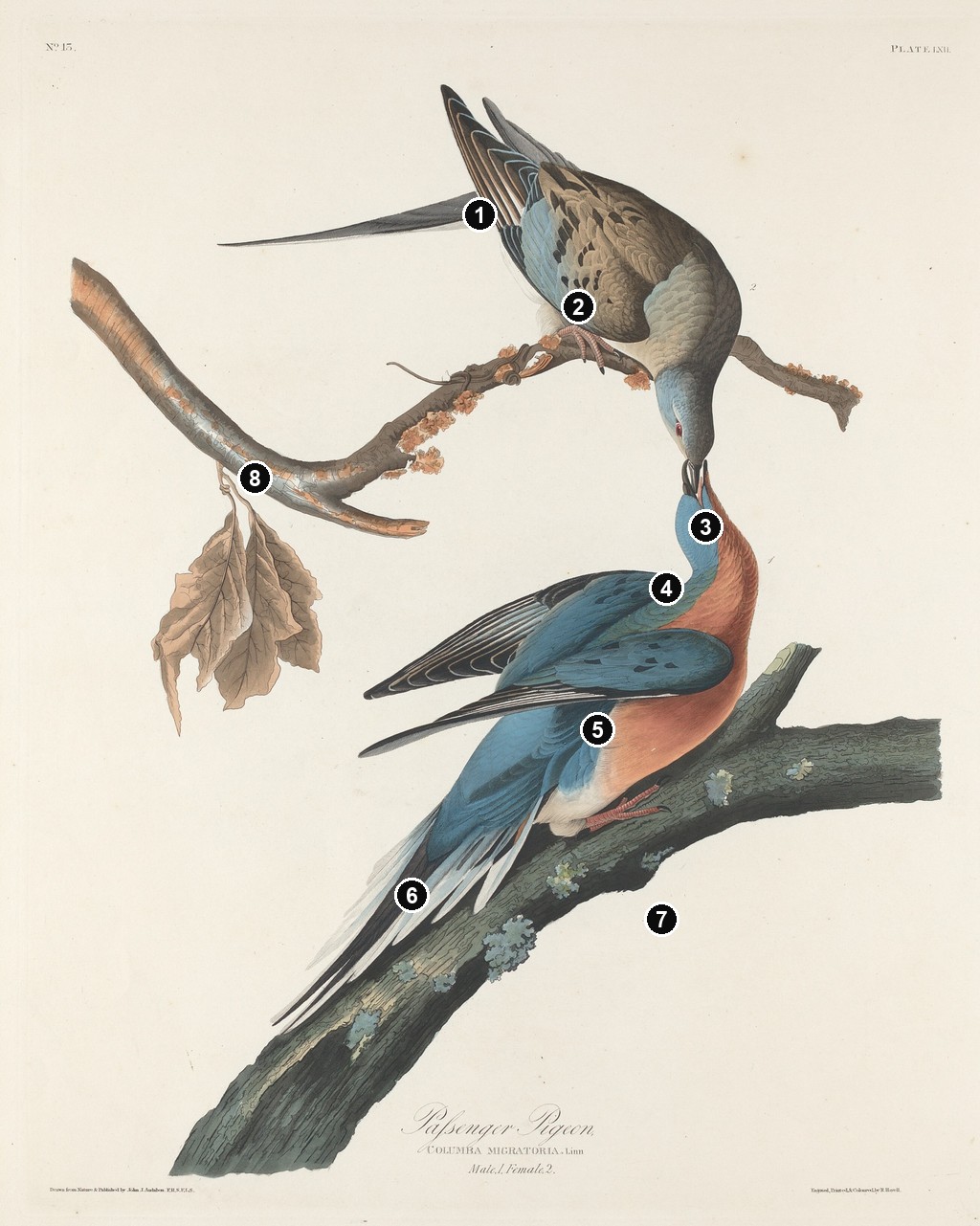
Details from PASSENGER PIGEON
Close looking keeps the reading anchored in the plate itself while recognising the particular weight this extinct species now carries for modern viewers.
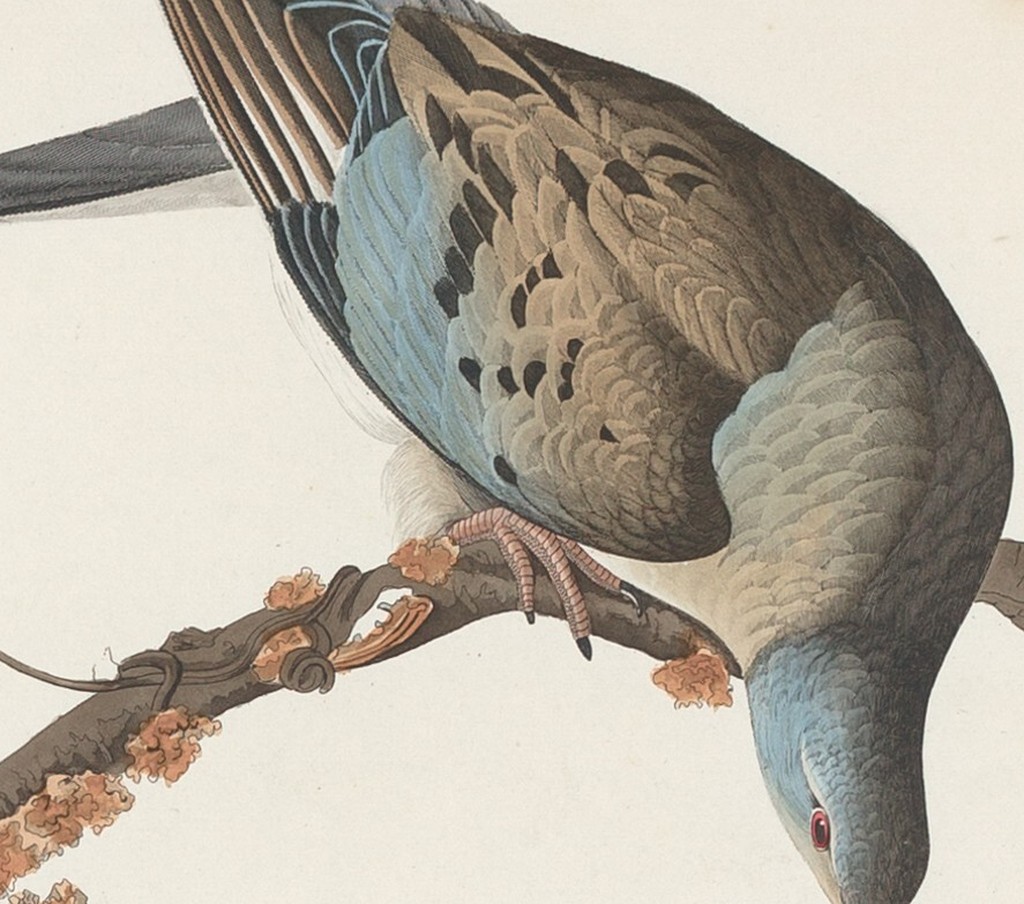
Upper bird and long tail
The upper bird's long tail points left across a largely open sheet. Its length gives the pair a quiet diagonal movement before the heads meet.
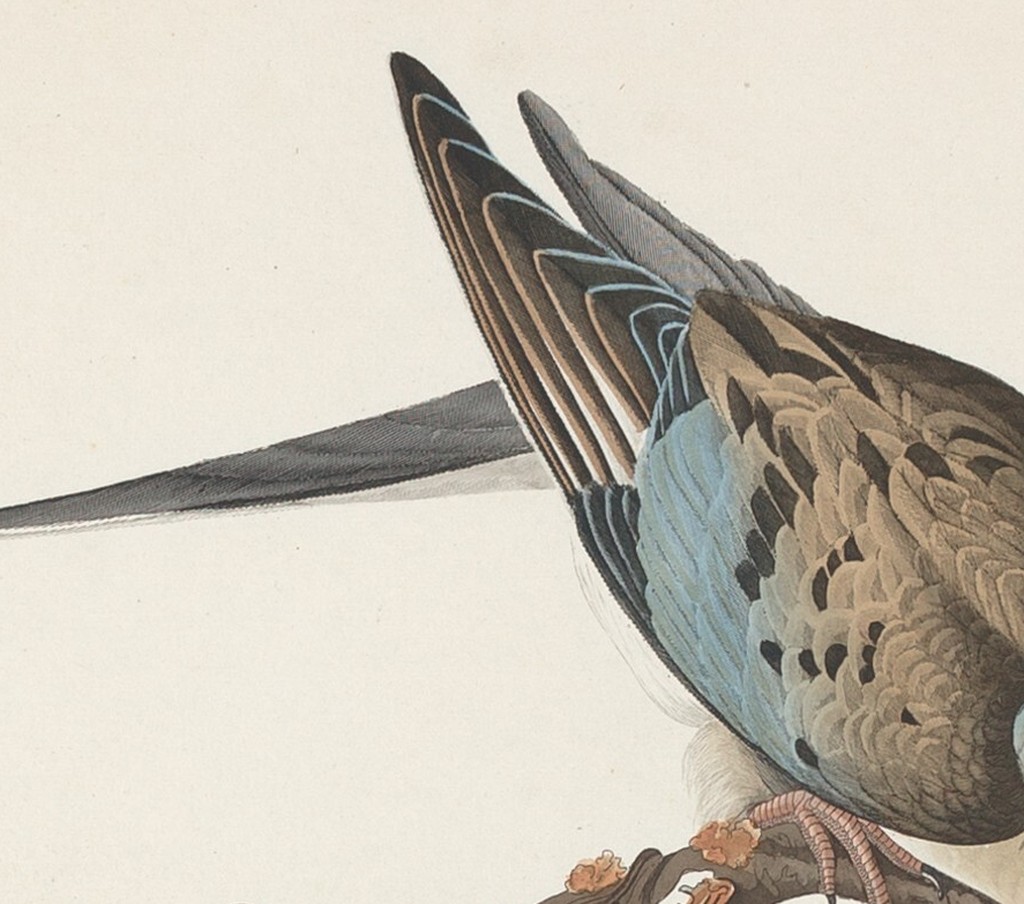
Layered upper wing
Brown and blue-grey wing feathers overlap in small repeated shapes. The restrained pattern contrasts with the stronger colour on the lower bird.
Touching bills
The two bills meet at the centre of the plate's action. Audubon makes a small contact point carry the relationship between the birds.
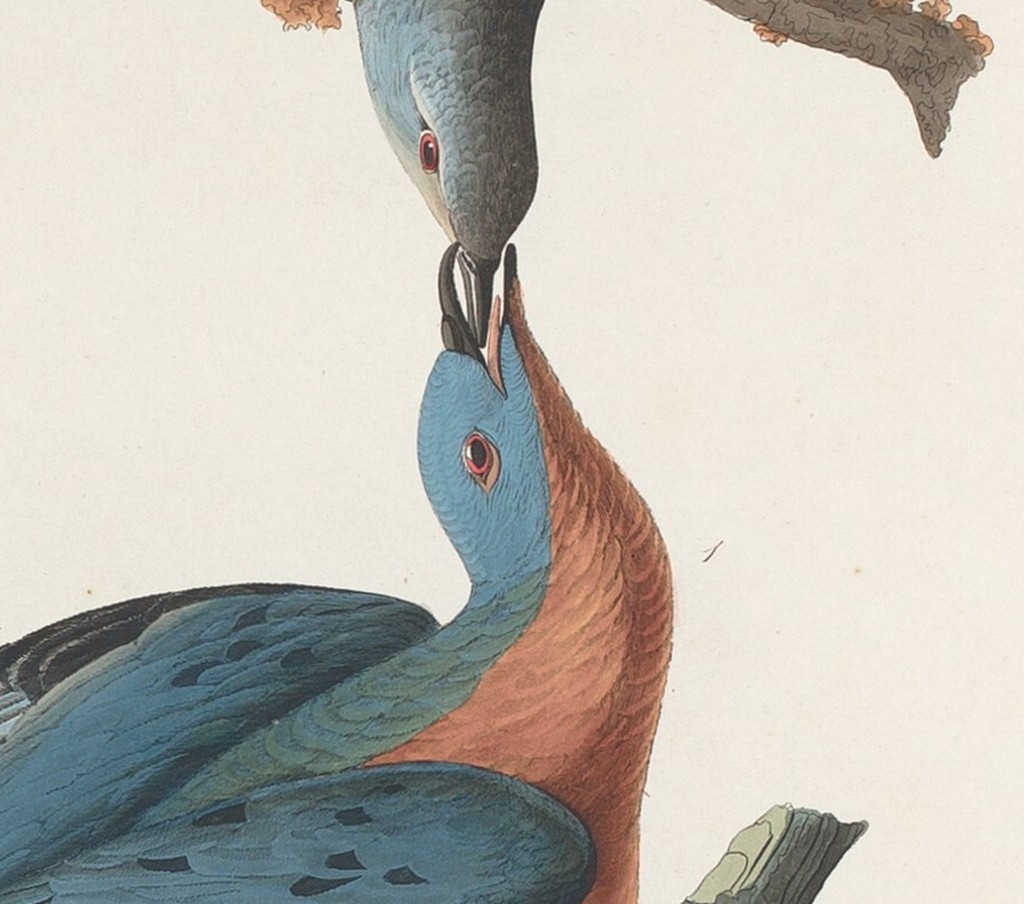
Lower red eye
The lower bird's red eye and blue head sit just below the paired bills. This detail fixes the bird's alert presence inside the gentle pose.
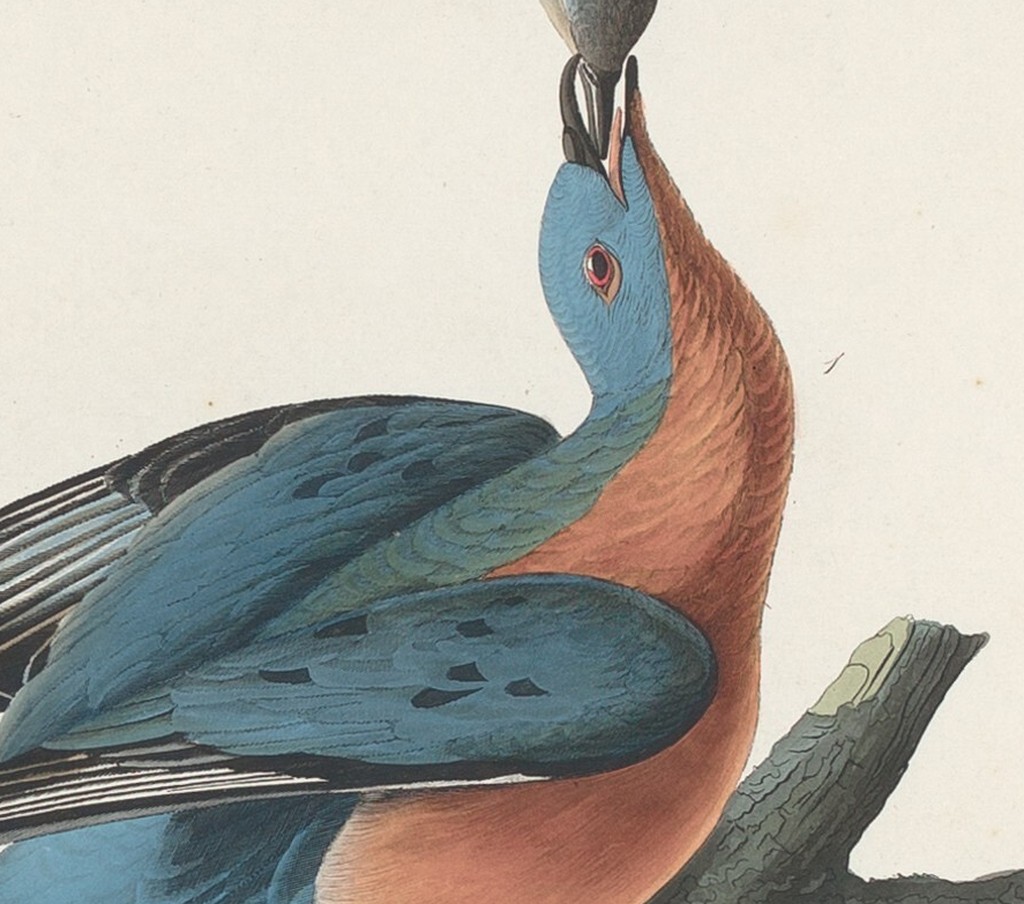
Blue wing and rose breast
Blue wing feathers and the warm rose breast create the plate's richest colour contrast. The body is soft in tone but clearly modelled.
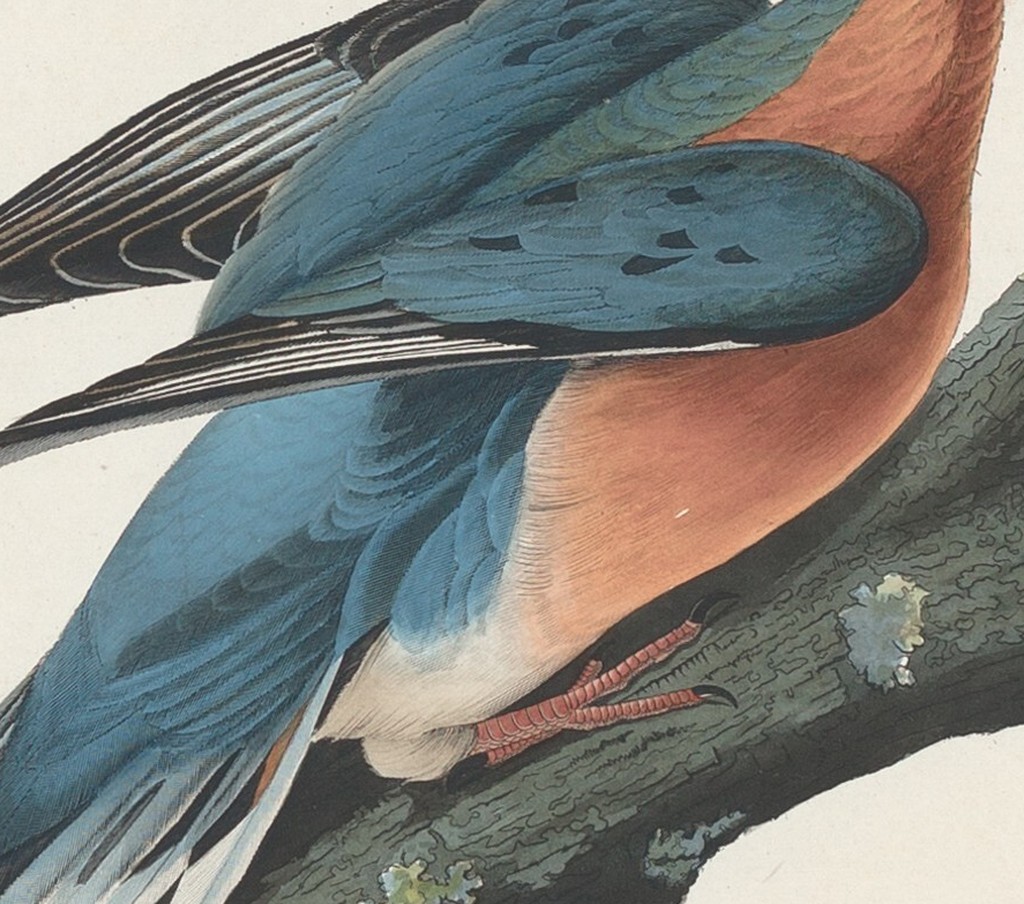
Long lower tail feathers
The long tail feathers sweep down the page and partly overlap the branch. Their pale edges make the bird's length unmistakable.
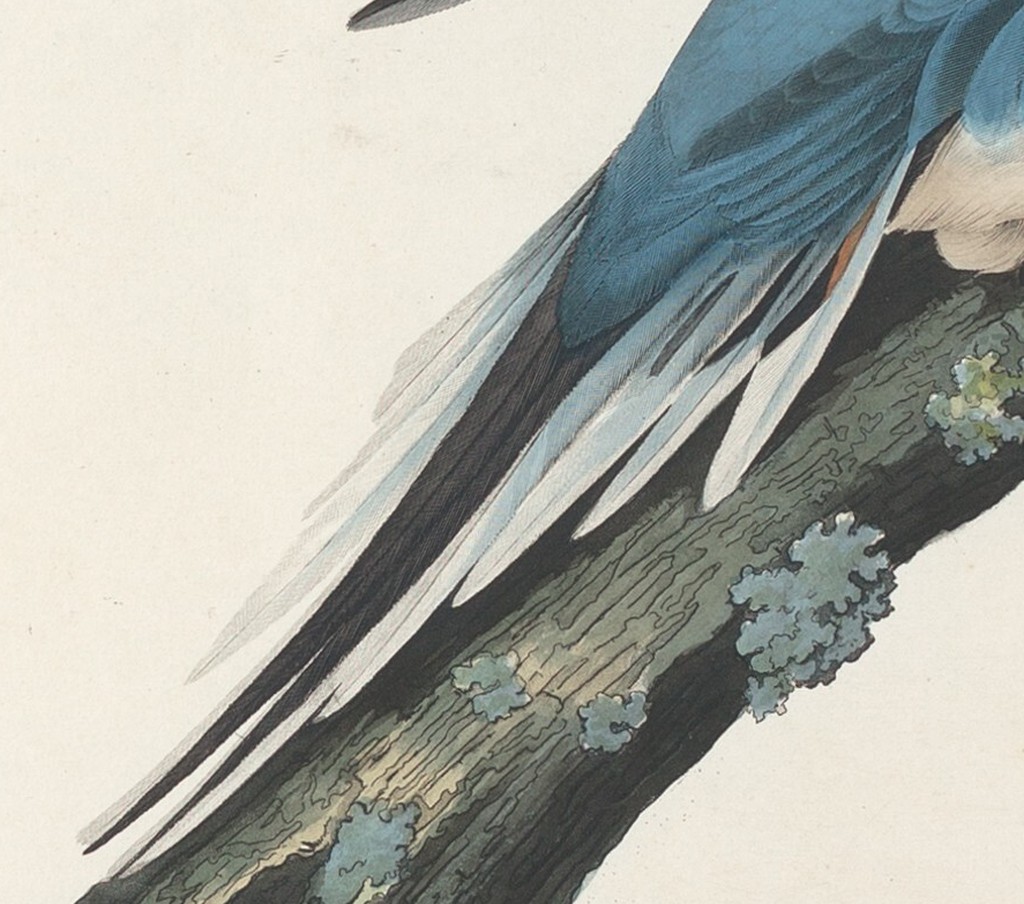
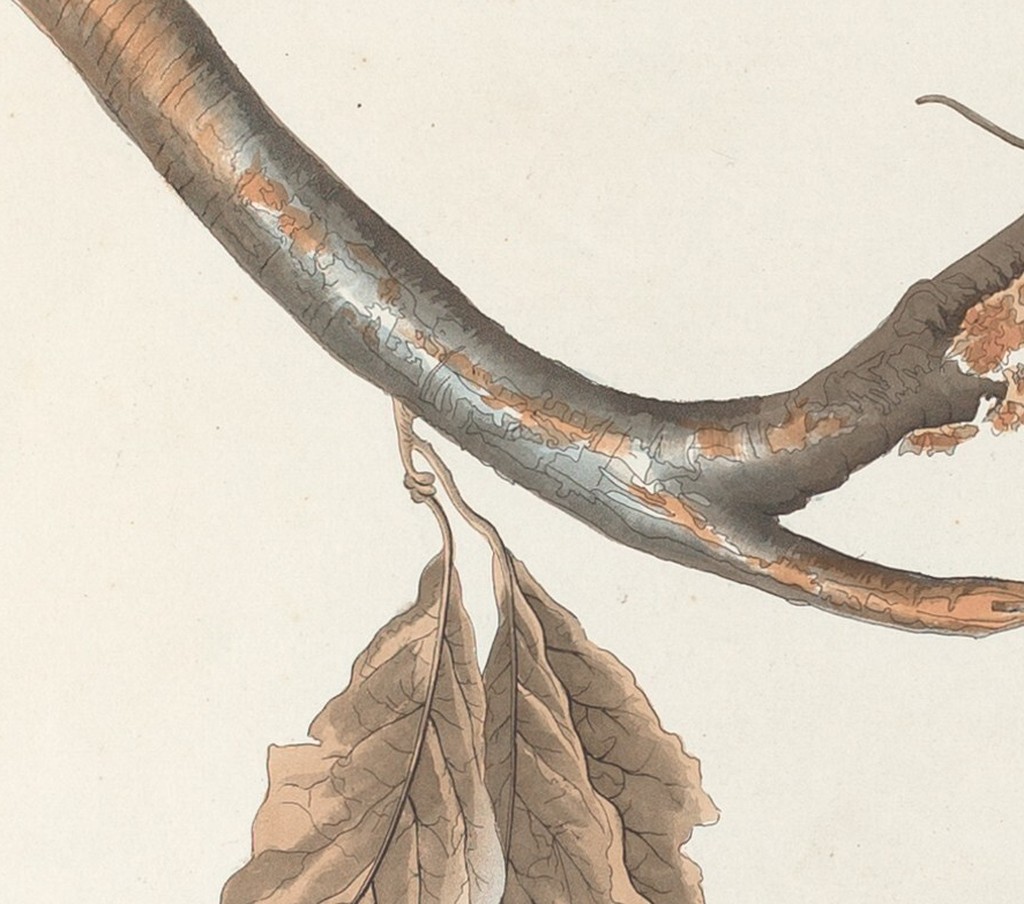
Lichen-covered branch
The dark branch is textured with patches of pale lichen. It gives the birds a solid perch and keeps the empty background from feeling bare.
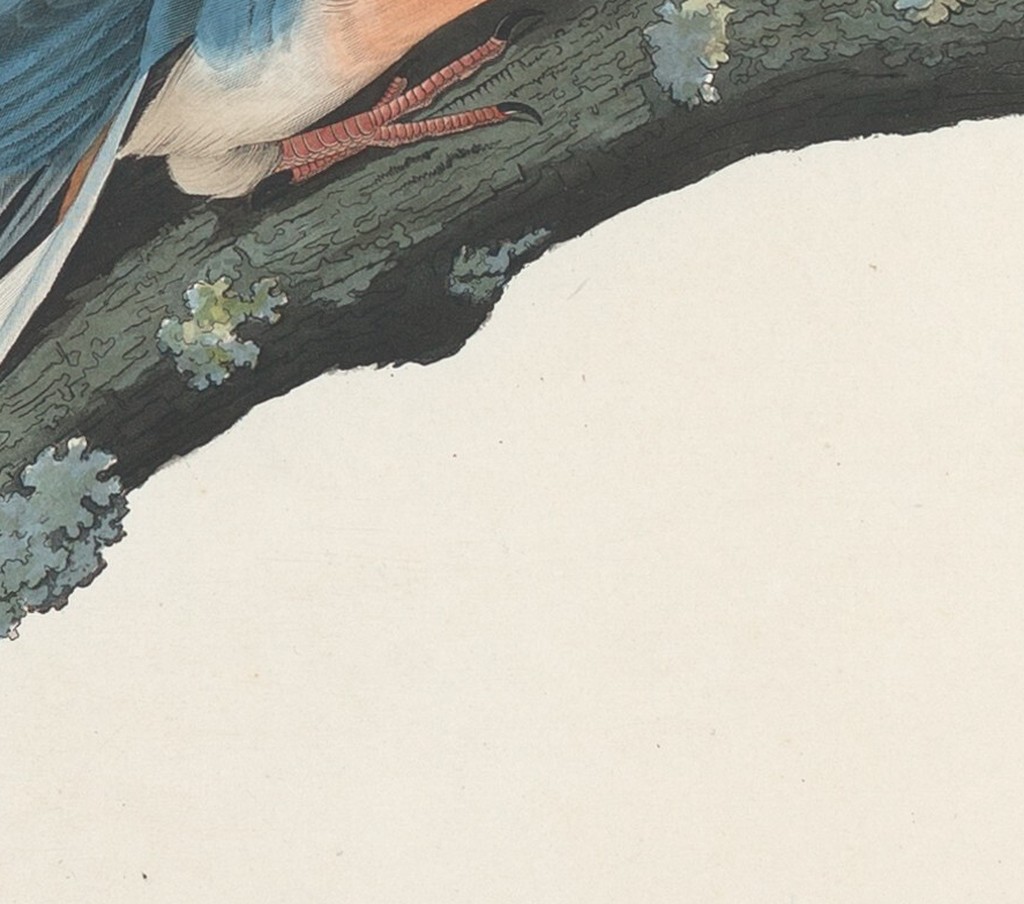
Dry leaves and small blossoms
Dry leaves and small blossoms add botanical detail to the perch. Their subdued colour leaves the birds visually dominant.
Object Facts
The National Gallery of Art's Passenger Pigeon is dated 1829 and catalogued as The Birds of America, no. 62. The plate measures 65.7 by 52.7 centimetres, with a sheet size of 101 by 68 centimetres. Its medium is hand-coloured engraving and aquatint on Whatman wove paper. The accession number is 1945.8.62. [1]
Those measurements matter because they place the image inside Audubon's unusually large publication format. The Birds of America was not a pocket guide or small scientific handbook. It was issued as a double-elephant folio, large enough to make birds feel bodily present on the sheet. Even when the subject is modest in size, the paper gives the figure space, authority and drama. [6], [7]
The National Gallery record also states that the object's media is free and in the public domain. That makes it the strongest primary institutional image path for local production, subject to the practical checks any image needs: exact file, credit line, dimensions and recorded terms. Other records, including Canadian institutional material and university collection references, are useful for comparison, but the NGA object remains the cleanest primary route. [1]
The historic plate title is the same as the modern common name, which makes this page simpler than some Audubon bird plates. The scientific name is less simple. Audubon's era used Columba migratoria, while current sources use Ectopistes migratorius. A clear account should keep those labels apart: historic plate terminology belongs to Audubon's nineteenth-century publication, while current species terminology belongs to modern taxonomy. [5]
What the Plate Shows
The image shows two passenger pigeons perched on branches against plain paper. One bird sits higher and bends its head down. The lower bird lifts its head upward. Their beaks meet, creating a small but intense focal point near the centre of the composition. [1]
The National Gallery's description identifies the lower bird as having a reddish breast, a sky-blue head and body, and blue wings with black and grey tips. The upper bird is softer in colour, with earth-toned brown and blue plumage and black markings. This contrast helps the viewer read the pair as male and female. Modern natural-history summaries also describe passenger pigeons as sexually dimorphic, with males brighter and females duller. [1], [2]
Audubon sets the birds on two angled branches. Lichen clings to the wood, and dried leaves hang above. The background remains largely open, so the relationship between the birds carries the composition. There is no dense forest, no flock, no dramatic sky. The plate instead turns the species into a paired study of posture, colour and interaction. [1]
That intimacy is one reason the work is memorable. The passenger pigeon is often discussed through numbers: billions, flocks, market shipments, collapse. Audubon's picture asks the viewer to pause before the numbers. It presents a male and female as living bodies, each with a different colour and position. The extinction story arrives later, but once known it changes the whole scene. The two birds look like a beginning, while history tells us they belong to an ending.
Colour, Sex and Pairing
Audubon uses colour to distinguish the pair. The male's warmer breast and cooler blue-grey upper body give him a stronger visual presence. The female, above him, is quieter in tone. Her brown and grey plumage makes her less brilliant but also gives the upper part of the print a softer weight. Together, the two birds form a diagonal exchange from lower left to upper right. [1], [2]
The beak-to-beak contact has long invited interpretation. It may suggest courtship, feeding, pair bonding or a theatrical version of bird behaviour. The Library of Parliament's collection spotlight notes that later ornithological commentary questioned Audubon's exact behavioural claim, especially the arrangement of the birds during billing and the direction of food transfer. That caution is useful. It reminds readers that Audubon's images can be powerful without being treated as flawless behavioural records. [5]
This does not make the plate less important. It makes it more interesting. Audubon was an artist-naturalist working from observation, memory, specimens and pictorial invention. His goal was not only to classify birds but to make them vivid. In Passenger Pigeon, the visual drama depends on a close encounter that turns scientific illustration into a scene.
The plate also shows how Audubon could compress a large ecological story into a small gesture. The passenger pigeon was a species of mass movement, but the image is built around touch. The bird that darkened skies is represented through a pair of beaks. That contrast between scale and intimacy is now central to the work's modern meaning.
The Bird Behind the Image
The passenger pigeon was native to eastern North America and is now extinct. The Natural History Museum describes it as a bird of deciduous forests, especially landscapes rich in red oak, white oak, American chestnut and American beech. These trees produced mast, the nuts and fruits that sustained the pigeons as they travelled in enormous flocks. [2]
The scientific name Ectopistes migratorius points to wandering movement. Passenger pigeons were nomadic, travelling long distances to find food. Their breeding range stretched across much of eastern North America, from the Atlantic side toward the Mississippi River and from the Great Lakes southward into Kentucky and West Virginia, with wider movements outside the breeding season. [2], [5]
Their abundance is difficult to state precisely because modern researchers rely on eyewitness accounts, historical records and estimates. The Natural History Museum notes that many estimates place the population between three and five billion birds, while some claims run higher. Cornell reporting similarly describes the passenger pigeon as once the most abundant bird in North America and possibly on Earth. The safest wording is therefore not a single exact number, but a scale: billions of birds, moving in flocks of staggering size. [2], [3]
That abundance shaped the species' biology and its vulnerability. Passenger pigeons nested in large colonies and travelled in immense groups. Such numbers could reduce danger from predators when the population was healthy. But once commercial hunting, forest loss and other pressures reduced the flocks, the same reliance on mass social life may have made recovery difficult. [2], [4]
Abundance Made Intimate
Audubon's plate is striking because it does not try to picture abundance directly. A scene of thousands or millions of passenger pigeons would have been almost impossible to organise within one natural-history plate. It might have suggested spectacle, but it would have reduced individual birds to marks. Instead, Audubon selects a pair and lets the viewer study their bodies closely.
That choice changes the way the species is remembered. Historical accounts often emphasise clouds of birds, darkened skies and branches breaking under the weight of nesting colonies. The plate does something else. It turns a mass species into a relationship. The viewer notices one breast, one lifted head, one bending neck and one exchanged beak gesture. The extinct population becomes visible through two individuals.
This is not the whole truth of the passenger pigeon, and it should not replace the ecological story. The bird's life depended on scale: scale of forest, scale of food supply, scale of flock movement and scale of nesting. Yet Audubon's picture is valuable precisely because it pulls against that scale. It reminds readers that extinction is never only the loss of a number. It is the loss of bodies, colours, behaviours, relationships and local presences. [2], [4]
The image also helps explain why Audubon's plates still matter to conservation memory. A chart can show decline. A museum specimen can preserve anatomy. A written account can describe a flock passing overhead. Audubon's print offers a different kind of evidence: an imagined encounter with living presence. That presence is artistic, constructed and historically limited, but it is powerful. The pair on the branch makes the disappeared species easier to feel.
Place in The Birds of America
Passenger Pigeon belongs to The Birds of America, Audubon's defining publication. The project appeared between 1827 and 1838 and eventually included 435 colour plates in four large volumes. The book was designed to impress as well as inform. It required field observation, drawing, engraving, printing, hand colouring, subscription management and transatlantic production. [6], [7]
The plate was engraved, printed and coloured by the Havell workshop in London after Audubon's design. That collaboration is essential to the finished image. Audubon supplied the pictorial conception, but the public work took form through aquatint, engraving and hand colouring. The softness of the pigeons' bodies, the lichen on the branches and the difference between male and female plumage all depend on that translation from drawing to print. [1]
Within Audubon's larger book, Passenger Pigeon is not one of the spectacular oversized waterbirds or flamboyant colour displays. Its power is quieter. The composition is simple, the setting spare, the action concentrated. It sits well beside the broader The Birds of America overview, which explains the format and publication history, and beside John James Audubon Works, which places the plate among drawings, prints and other media.
The image also speaks to John James Audubon Biography because it reveals the tension that runs through his life and legacy. Audubon wanted to make birds visible with unprecedented force. Today, some of his most compelling images are also bound to questions about collecting, killing, habitat loss, commercial exploitation and the limits of nineteenth-century natural history.
Extinction and Conservation Memory
The passenger pigeon's extinction is one of the central conservation stories of modern North America. The Natural History Museum records Martha, the last known living passenger pigeon, as dying at the Cincinnati Zoo on 1 September 1914. Cornell's centennial coverage gives the same date and presents the species' collapse as a warning about unregulated hunting, commercial exploitation and the danger of assuming abundance equals safety. [2], [3]
The causes should be described with care. Habitat loss mattered: the bird depended on vast eastern forests, and those forests were cut for timber, agriculture and settlement. Hunting also mattered enormously. Passenger pigeons were killed for food at industrial scale, and railroads helped carry their bodies to urban markets. The Natural History Museum treats habitat loss and overexploitation as major factors, while Cornell emphasizes market hunting and the lack of regulation. [2], [3], [4]
The most careful conclusion is that extinction resulted from human pressure, not from one isolated event. Vast flocks made the birds easy to find and kill. Their colonial nesting made adults, young and eggs vulnerable together. Their dependence on large forest systems meant that fragmented landscapes could not support the old pattern of movement, feeding and breeding. As the population fell, the social scale that had once protected them may have become impossible to maintain. [2], [4]
The story became a conservation lesson because it overturned a dangerous assumption. In the nineteenth century, many people believed that a species counted in billions could not be destroyed. Passenger Pigeon proved otherwise. A bird could move from abundance to absence within a human lifetime. [3]
How to Read the Plate Today
A modern reading of Passenger Pigeon begins with the pair. The lower bird, brighter and more forward, seems to offer or receive contact. The upper bird bends down, completing the exchange. Their beaks meet at the centre of the image, making the plate feel tender before it feels tragic. [1]
A second reading begins with absence. The empty background looks different once we know the species is gone. Audubon did not intend the blank paper as a metaphor for extinction, but the modern viewer may feel it that way. The two birds are held in a quiet space with no flock behind them.
A third reading begins with uncertainty. Later observers did not always accept Audubon's behavioural interpretation. That matters because the plate is both observation and art. It records a species, but it also presents a relationship in a way designed for visual force. The best reading does not ask the image to behave like a photograph or a modern field study. It asks what Audubon saw, what he imagined, what Havell translated and what later history changed. [5]
A fourth reading begins with conservation memory. Passenger Pigeon is not simply an old print of an extinct bird. It is an artwork caught inside a historical lesson about scale, appetite and responsibility. The pair on the branch now stands for billions of vanished birds.
Why Passenger Pigeon Matters
Passenger Pigeon matters because it joins beauty to warning. As a print, it is a finely balanced image of two birds, with colour, posture and contact arranged for close looking. As a historical object, it belongs to one of the most ambitious natural history publications ever made. As a modern subject, it is inseparable from the extinction of a species that once seemed inexhaustible.
The plate is also important because it changes the way readers understand abundance. Conservation stories often focus on rarity, but the passenger pigeon warns that commonness is not invulnerability. A species can be everywhere and still be at risk if its habitat, breeding system and survival strategy are overwhelmed quickly enough. [3], [4]
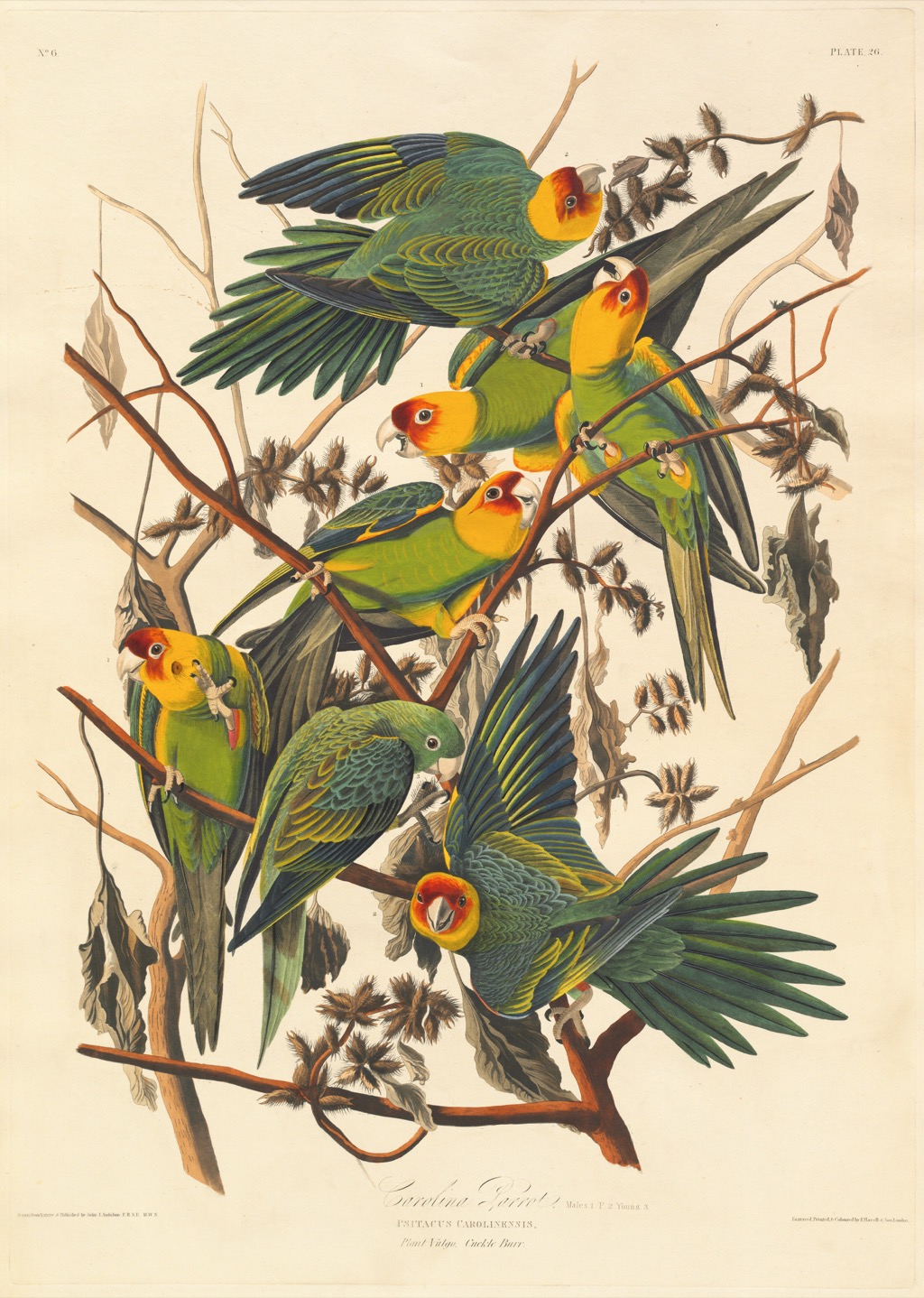
Within Audubon's cluster, Passenger Pigeon should be read alongside Carolina Parakeet and Ivory-billed Woodpecker. Each subject has a different history, but together they show how Audubon's bird images have become more than records of nineteenth-century natural history. They are now part of the way people picture loss.
For readers interested in a wider tradition of bird art, the site's bird drawings section offers another route into the subject. Passenger Pigeon belongs there as well: not only as a species image, but as an example of how drawing and printmaking can keep visible a creature no longer alive.
Frequently Asked Questions
Discussion
Passenger Pigeon asks readers to look at a vanished species through the intimacy of a paired Audubon plate.
Use the prompts below to think about abundance, extinction memory, behavioural caution and the relationship between art and natural history.
Reader Insights
How does the quiet beak-to-beak exchange change once you know the species is extinct?
What is gained when Audubon shows two birds rather than attempting to picture a huge flock?
How should we read a powerful natural-history image when later sources question part of its behaviour?
Join the Conversation
Share your reading of Audubon's Passenger Pigeon and its place in conservation memory below.
References
- National Gallery of Art, Passenger Pigeon, accessed 26 July 2026.
- Natural History Museum, London, Passenger pigeon extinction overview, accessed 26 July 2026.
- Cornell Chronicle, 100 years later: Passenger pigeon loss is red flag, accessed 26 July 2026.
- Cornell Lab of Ornithology, What Caused the Passenger Pigeon's Collapse, and What Have We Learned, accessed 26 July 2026.
- Library of Parliament, Passenger Pigeon, plate LXII, accessed 26 July 2026.
- Biodiversity Heritage Library, The Birds of America, accessed 26 July 2026.
- Yale Beinecke Library, The Double Elephant Folio, accessed 26 July 2026.